Author Archives: author

Febrile Neutropenia in Pediatric Oncology: Prevalence and Risk-Factors for Bacterial and Fungal Infection

DOI: 10.31038/IDT.2024511

Introduction

Febrile neutropenia (FN) frequently complicates cancer treatment, contributing to overall morbidity and the burden of hospitalization in children with cancer [1-6]. Myelosuppression is a side-effect of cytotoxic chemotherapy, resulting in recurring episodes of neutropenia; fever complicates about 27-34% of neutropenic episodes among children receiving chemotherapy or undergoing hematopoietic stem cell transplant (HSCT) [1-3]. Due to the risk of serious bacterial or fungal infections in children with FN, the difficulty of localizing infections in neutropenic children, and the mortality rate associated with inadequate treatment [4,5] the historical standard in pediatric hematology-oncology was hospitalization with empiric broad-spectrum antibiotics until the fever resolves and the neutropenia improves [6-8]. More recently, however, there is evidence of greater practice variation [9,10] based on practice guidelines emphasizing risk-stratification of children with chemotherapy-induced FN and the benefits of decreasing inpatient hospitalization [9,11-27]. Most FN episodes resolve without diagnosis of a serious infection; bacteremia, the most common infection complicating FN episodes, has a prevalence of 20%-29 [11,28-32]. Invasive fungal infection (IFI) is less common, occurring in less than 5% of FN episodes [32] and data on bacterial infection of sites other than the bloodstream are more limited. There is no single approach to risk-stratification in pediatric FN [26] which necessitates ongoing analysis of risk factors for serious infection, which facilitate risk-stratification and step-down management of children at lower risk [25,27,32,33].

Materials and Methods

Study Design

To evaluate the prevalence and potential predictors of bacterial and fungal infection among pediatric oncology patients with FN at our institution, we conducted a retrospective cohort study containing a nested case-control study. Using hospital billing codes and electronic medical records, we obtained a consecutive 3-year sample of children admitted with FN to the pediatric hematology-oncology teams at UCSF Benioff Children’s Hospital Oakland (Oakland, CA, US), with the end of the sample period preceding the Covid-19 pandemic. Children receiving treatment for cancer were included in the cohort if they had an absolutely neutrophil count (ANC) <500 x109/L or (if no ANC was reported) a total white blood cell count (WBC) <500 x109/L, as well as a single temperature >38.3°C or a sustained temperature >38°C [34]. Participants were excluded if they were receiving or had previously received allogeneic or autologous HSCT or had an underlying syndrome (such as Fanconi anemia) associated with chronic neutropenia. This study was approved by our hospital’s institutional review board and conducted in accordance with the Declaration of Helsinki.

Statistical Methods

Continuous variables, including participants’ ages and days to infection diagnosis, were not normally distributed and are described using median and interquartile range (IQR). Children with multiple episodes of FN during the sample period reentered the cohort for each episode. For the case-control analysis, we randomly sampled one episode per participant. Cases were defined by culture-proven bacteremia, urinary tract infection (UTI), meningitis, cellulitis, osteomyelitis, neutropenic colitis (typhlitis), Clostridium difficile enterocolitis, or invasive fungal infection (IFI). Clinical and radiographic findings were accepted for diagnosis of typhlitis, osteomyelitis, and IFI if cultures were not available [35]. Per institutional standards of care, any positive blood culture from a central venous catheter (CVC) was considered infectious, including coagulase-negative staphylococci. Controls were sampled at a two-to-one ratio with cases. To compare clinical and laboratory findings between the case and control groups, we used rank-sum tests for continuous variables and standard two-by-two tables with Fisher exact tests for categorical variables. Associations were considered significant with an uncorrected p-value <0.05. We also report each association’s relative risk ratio (RR) with a 95% confidence interval. Data analysis was performed using Stata 13 (Statacorp, College Station, TX).

Results

Study Cohort

The cohort (Table 1) consisted of 199 FN episodes among 140 participants, 43% female, with a median age at cohort entry of 6.1 years (3.1-12.3). Most participants (71.4%) were hospitalized once for FN during the study period; among the rest, the number of hospitalizations ranged from 2 to 8. The most common diagnoses were acute leukemia and lymphoma. There were 5 participants (3.6%) with trisomy 21, all of whom had acute leukemia. Nearly all of the participants had a CVC, and 31 (22.1%) had a history of at least one prior infection, including bacteremia (N=21), another bacterial infection (N=7), or IFI (N=4). All participants received empiric intravenous antibiotics with antipseudomonal activity upon the onset of fever. Most of the FN episodes (81.9%) developed in outpatients who were then admitted; 36 FN episodes (18.1%) occurred in children who were already hospitalized, especially those receiving high-intensity chemotherapy for acute myeloid leukemia (AML) or brain tumors. Among participants with acute lymphoblastic leukemia (ALL), 26 FN episodes (13.1% of the total) occurred during the lower-intensity maintenance phase of therapy.

Table 1: Demographic and clinical characteristics

Parameter

N (%)

Sex

 Female

60 (42.9)

 Male

80 (57.1)

Age at onset (years), median (IQR)

6.1 (3.1-12.3)

Trisomy 21

5 (3.6)

Diagnosis
 ALL

61 (43.6)

 Brain tumor

19 (13.6)

 Sarcoma

18 (12.9)

 Lymphoma

13 (9.3)

 AML

7 (5.0)

 Neuroblastoma

7 (5.0)

 Wilms tumor

6 (4.3)

 Hepatoblastoma

5 (3.6)

 Other diagnosis*

4 (2.9)

History of cancer relapse

21 (15.0)

Central venous catheter

127 (90.7)

IQR: Interquartile Range; ALL: Acute Lympoblastic Leukemia; AML: Acute Myelogenous Leukemia; UTI: Urinary Tract Infection.
*Desmoplastic small round cell tumor (N=1), renal carcinoma (N=2), and rhabdoid liver tumor (N=1).

Infectious complications

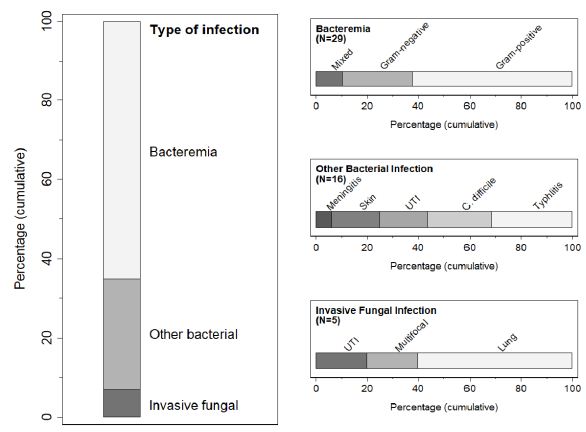
Of the 199 FN episodes studied, 43 (21.6%) led to a diagnosis of bacterial or fungal infection (Figure 1), with 6 episodes (3%) involving multiple infections. The most common was bacteremia, of which there were 29 cases (14.6%); cultures were positive for Gram-positive organisms in 18 (including 8 with coagulase-negative staphylococci), Gram-negative organisms in 8, and mixed flora in 3. Bacteremia was diagnosed a median of 1 day (1-3) after fever onset. There were 16 cases (8%) of other bacterial infections, which were diagnosed a median of 4 days (2-6) after fever onset and included typhlitis (N=5), Clostridium difficile enterocolitis (N=4), UTI (N=3), and cellulitis (N=3); 5 of these infections occurred along with bacteremia. There were 5 cases of IFI, most commonly pulmonary aspergillosis, diagnosed a median of 5 days (0-9) after fever onset. Overall, the median time from fever onset to diagnosis was 2 days (1-4). Distributive shock requiring intensive care occurred in 4 FN episodes (2%) due to bacteremia or meningitis, and one of these children died.

fig 1

Figure 1: Overview of bacterial and fungal infections in the cohort. For episodes with multiple infections, the left panel categorizes the first diagnosed. UTI, urinary tract infection; C. difficile, Clostridium difficile enterocolitis.

Risk Factors for Bacterial or Fungal Infection

The case-control sample consisted of 40 cases and 80 controls (Table 2). There was not a statistically significant difference in age or sex between the cases and controls, although the case group contained a larger proportion of children <1 year of age and a larger proportion of children who were already hospitalized at fever onset. at the onset of FN. The relative risk of infection was markedly higher in children with trisomy 21 (RR 3.11 [2.39-4.03]) and those with AML (RR 2.11 [1.13-3.95]), although these p-values were >0.05. While cases were slightly more likely to have a temperature ≥39°C, presenting temperature and laboratory values were not significantly different between cases and controls, nor were clinical findings like mucositis and gastrointestinal upset. Cases were more likely to have fever recurrence after >24 hours afebrile and also to have fevers lasting ≥7 days, although these associations were not statistically significant. There was a significantly increased risk of infection (p<0.004) for participants with a prior history of prior bacterial or fungal infection (RR 2.16 [1.34 to 3.48]).

Table 2: Univariate analysis of a nested case-control sample of pediatric patients with febrile neutropenia (FN)

Risk factor, N (%)

Cases (N=40) Controls (N=80) p

Relative risk (95% CI)

Demographic and historical features
Sex

27 (67.5)

41 (51.2) 0.118 1.59 (0.91 to 2.77)

Relapsed

6 (15.0) 12 (15.0) 1.000

1.00 (0.49 to 2.03)

Age at onset (years)*

6.6 (4.2-15.9)

7.2 (3.1-12.3) 0.432

Age <1 year

3 (7.5) 2 (2.5) 0.332

1.86 (0.87 to 4.00)

Trisomy 21

2 (5.0)

0 (0.0) 0.109 3.11 (2.39 to 4.03)

Diagnosis of AML

4 (10.0) 2 (2.5) 0.095

2.11 (1.13 to 3.95)

Prior infection

18 (45.0)

15 (18.8) 0.004

2.16 (1.34 to 3.48)

Findings at FN onset
Temperature (oC)*

39 (38.6-39.7)

38.8 (38.4-39.3) 0.052

Presenting WBC (x109/L)*

0.3 (0-0.8) 0.5 (0.2-0.9) 0.106

Presenting ANC (x109/L)*

115.5 (0-250)

86.0 (11-348) 0.538

Already admitted

10 (25.0) 10 (12.5) 0.118

1.67 (0.98 to 2.83)

Rhinitis or rhinorrhea

5 (12.5)

16 (20.0) 0.445 0.67 (0.30 to 1.51)

Severe mucositis

7 (17.5) 12 (15.0) 0.793

1.13 (0.59 to 2.16)

Abdominal pain

8 (20.0)

11 (13.8) 0.430 1.33 (0.73 to 2.42)

Vomiting

13 (32.5) 15 (18.8)

0.111

1.58 (0.95 to 2.63)

Findings at reevaluation
Fever duration (days)*

2 (1.5-5)

2 (1-4) 0.346

Fever recurrence

12 (30.0) 13 (16.3) 0.097

1.63 (0.97 to 2.72)

Fever for ≥7 days

7 (17.5)

8 (10.0) 0.255

1.48 (0.81 to 2.73)

*Reported as median and interquartile range.
P-values are from Fisher exact tests for proportions and rank-sum tests for continuous variables. CI: Confidence Interval; AML: Acute Myeloid Leukemia; WBC: White Blood Cells; ANC: Absolute Neutrophil Count.

Discussion

In this consecutive sample of 199 FN episodes in a typical pediatric oncology population at a United States tertiary-care hospital, 21.6% were complicated by a bacterial or fungal infection, most frequently Gram-positive bacteremia. UTI was more common than expected, likely reflecting our emergency department’s practice of obtaining non-catheterized urine samples from most febrile children. Although undiagnosed UTI would likely be treated by empiric antibiotics, this source of pathology in children with FN warrants further investigation. In a nested case-control analysis, the relative risk of bacterial or fungal infection was higher in children with trisomy 21 and those with AML and considerably higher in those with a prior history of infection. Infections diagnosed during the study period were generally not relapses of prior infection; instead, infection risk may reflect cumulative person-level factors, including duration of chemotherapy, cumulative antibiotic exposure, and differences in the microbiome.

As with any observational retrospective study, these findings are not definitive. Our broadly inclusive definition of infection was designed to reflect clinical decision-making, with emphasis on clinical data that would indicate a change in management or a longer course of inpatient observation. The overall similarity between groups in the case-control analysis, as well as the fact that infections occurred during relatively low-intensity chemotherapy (like maintenance ALL therapy) emphasizes the challenge of risk-stratifying children with FN. Most infections in this cohort, however, were diagnosed within the first 4 days after the onset of fever. For children without trisomy 21, AML, or a prior infection history, who do not have overt signs of infection, there may be less benefit of hospitalization longer than through neutrophil recovery, as long as careful outpatient follow-up can be assured.

Conflict of Interest

The authors have no conflicts of interest or external funding sources to disclose.

References

  1. Bagnasco F, Haupt R, Fontana V, et al. (2012) Risk of repeated febrile episodes during chemotherapy-induced granulocytopenia in children with cancer: a prospective single center study. J Chemother 24(3): 155-160. doi: 10.1179/1973947812Y.0000000002
  2. Castagnola E, Fontana V, Caviglia I, et al. (2007) A prospective study on the epidemiology of febrile episodes during chemotherapy-induced neutropenia in children with cancer or after hemopoietic stem cell transplantation. Clin Infect Dis 45(10): 1296-1304. [crossref]
  3. Castagnola E, Garrè ML, Bertoluzzo L, et al. (2011) Epidemiology of febrile neutropenia in children with central nervous system tumor: results from a single center prospective study. J Pediatr Hematol Oncol 33(7): e310-315. [crossref]
  4. Davis K, Wilson S (2020) Febrile neutropenia in paediatric oncology. Paediatr Child Health (Oxford) 30(3): 93-97. [crossref]
  5. Boccia R, Glaspy J, Crawford J, Aapro M (2022) Chemotherapy-Induced Neutropenia and Febrile Neutropenia in the US: A Beast of Burden That Needs to Be Tamed? Oncologist 27(8): 625-636. [crossref]
  6. Pizzo PA (1993) Management of fever in patients with cancer and treatment-induced neutropenia. N Engl J Med 328(18): 1323-1332. [crossref]
  7. Freifeld A, Marchigiani D, Walsh T, et al. (1999) A Double-Blind Comparison of Empirical Oral and Intravenous Antibiotic Therapy for Low-Risk Febrile Patients with Neutropenia during Cancer Chemotherapy. New England Journal of Medicine 341(5): 305-311. [crossref]
  8. Basu SK, Fernandez ID, et al. (2005) Length of Stay and Mortality Associated With Febrile Neutropenia Among Children With Cancer. JCO 23(31): 7958-7966. [crossref]
  9. Boragina M, Patel H, Reiter S, et al. (2007) Management of febrile neutropenia in pediatric oncology patients: a Canadian survey. Pediatr Blood Cancer 48(5): 521-526. [crossref]
  10. Maxwell RR, Egan-Sherry D, Gill JB, et al. (2017) Management of chemotherapy-induced febrile neutropenia in pediatric oncology patients: A North American survey of pediatric hematology/oncology and pediatric infectious disease physicians. Pediatr Blood Cancer 64(12). [crossref]
  11. Agyeman P, Kontny U, Nadal D, et al. (2014) A Prospective Multicenter SPOG 2003 FN Study of Microbiologically Defined Infections in Pediatric Cancer Patients with Fever and Neutropenia. Pediatr Infect Dis J. [crossref]
  12. Brack E, Bodmer N, Simon A, et al. (2012) First-day step-down to oral outpatient treatment versus continued standard treatment in children with cancer and low-risk fever in neutropenia. A randomized controlled trial within the multicenter SPOG 2003 FN study. Pediatr Blood Cancer 59(3): 423-430. [crossref]
  13. Dommett R, Geary J, Freeman S, et al. (2009) Successful introduction and audit of a step-down oral antibiotic strategy for low risk paediatric febrile neutropaenia in a UK, multicentre, shared care setting. Eur J Cancer 45(16): 2843-2849. doi: 10.1016/j.ejca.2009.06.003 [crossref]
  14. Gupta A, Swaroop C, Agarwala S, et al. (2009) Randomized controlled trial comparing oral amoxicillin-clavulanate and ofloxacin with intravenous ceftriaxone and amikacin as outpatient therapy in pediatric low-risk febrile neutropenia. J Pediatr Hematol Oncol 31(9): 635-641. [crossref]
  15. Kern WV (2006) Risk Assessment and Treatment of Low-Risk Patients with Febrile Neutropenia. Clin Infect Dis 42(4): 533-540. [crossref]
  16. Lucas KG, Brown AE, Armstrong D, et al. (1996) The identification of febrile, neutropenic children with neoplastic disease at low risk for bacteremia and complications of sepsis. Cancer 77(4): 791-798. [crossref]
  17. Manji A, Beyene J, Dupuis LL, et al. (2012) Outpatient and oral antibiotic management of low-risk febrile neutropenia are effective in children—a systematic review of prospective trials. Supportive Care in Cancer 20(6): 1135-1145. [crossref]
  18. Mullen CA, Petropoulos D, Roberts WM, et al. (1999) Outpatient treatment of fever and neutropenia for low risk pediatric cancer patients. Cancer 86(1): 126-134. [crossref]
  19. Phillips B, Wade R, et al. (2010) Systematic review and meta-analysis of the discriminatory performance of risk prediction rules in febrile neutropaenic episodes in children and young people. European Journal of Cancer 46(16): 2950-2964. [crossref]
  20. Rackoff WR, Gonin R, Robinson C, et al. (1996) Predicting the risk of bacteremia in childen with fever and neutropenia. J Clin Oncol 14(3): 919-924. [crossref]
  21. Rondinelli PIP, Ribeiro K de CB, de Camargo B (2006) A proposed score for predicting severe infection complications in children with chemotherapy-induced febrile neutropenia. J Pediatr Hematol Oncol 28(10): 665-670. [crossref]
  22. Santolaya ME, Alvarez AM, Avilés CL, et al. (2002) Prospective evaluation of a model of prediction of invasive bacterial infection risk among children with cancer, fever, and neutropenia. Clin Infect Dis 35(6): 678-683. [crossref]
  23. Teuffel O, Ethier MC, Alibhai SMH, et al. (2011) Outpatient management of cancer patients with febrile neutropenia: a systematic review and meta-analysis. Ann Oncol 22(11): 2358-2365. [crossref]
  24. Cennamo F, Masetti R, Largo P, et al. (2021) Update on Febrile Neutropenia in Pediatric Oncological Patients Undergoing Chemotherapy. Children (Basel) 8(12): 1086. [crossref]
  25. Lehrnbecher T, Phillips R, Alexander S, et al. (2012) Guideline for the management of fever and neutropenia in children with cancer and/or undergoing hematopoietic stem-cell transplantation. J Clin Oncol 30(35): 4427-4438. [crossref]
  26. Lehrnbecher T, Robinson P, Fisher B, et al. (2017) Guideline for the Management of Fever and Neutropenia in Children With Cancer and Hematopoietic Stem-Cell Transplantation Recipients: 2017 Update. JCO 35(18): 2082-2094. [crossref]
  27. Lehrnbecher T, Robinson PD, Ammann RA, et al. (2023) Guideline for the Management of Fever and Neutropenia in Pediatric Patients With Cancer and Hematopoietic Cell Transplantation Recipients: 2023 Update. J Clin Oncol 41(9): 1774-1785. [crossref]
  28. Alexander SW, Wade KC, Hibberd PLMD, Parsons SKMD (2002) Evaluation of Risk Prediction Criteria for Episodes of Febrile Neutropenia in Children with Cancer. Journal of Pediatric Hematology 24(1): 38-42. [crossref]
  29. Ammann RA, Hirt A, Lüthy AR, Aebi C (2003) Identification of children presenting with fever in chemotherapy-induced neutropenia at low risk for severe bacterial infection. Med Pediatr Oncol 41(5): 436-443. [crossref]
  30. Hakim H, Flynn PM, Knapp KM, et al. (2009) Etiology and clinical course of febrile neutropenia in children with cancer. J Pediatr Hematol Oncol,(9): 623-629. [crossref]
  31. Hakim H, Flynn PM, Srivastava DK, et al. (2010) Risk Prediction in Pediatric Cancer Patients With Fever and Neutropenia: The Pediatric Infectious Disease Journal 29(1): 53-59. [crossref]
  32. Boeriu E, Borda A, Vulcanescu DD, et al. (2022) Diagnosis and Management of Febrile Neutropenia in Pediatric Oncology Patients-A Systematic Review. Diagnostics (Basel) 12(8): 1800. [crossref]
  33. Teuffel O, Sung L (2012) Advances in management of low-risk febrile neutropenia. [Miscellaneous Article]. Current Opinion in Pediatrics 24(1): 40-45. [crossref]
  34. Freifeld AG, Bow EJ, Sepkowitz KA, et al. (2011) Clinical practice guideline for the use of antimicrobial agents in neutropenic patients with cancer: 2010 update by the infectious diseases society of america. Clin Infect Dis 52(4): e56-93. [crossref]
  35. Ascioglu S, Rex JH, de Pauw B, et al. (2002) Defining opportunistic invasive fungal infections in immunocompromised patients with cancer and hematopoietic stem cell transplants: an international consensus. Clin Infect Dis 34(1): 7-14. [crossref]

Morphological Variation of Permanent Mandibular First Molar (Radix Entomolaris) (In vivo Study)

DOI: 10.31038/JDMR.2024711

Abstract

Objectives: Successful endodontic treatment requires complete information about morphology of root canals of the tooth. The object of our research was to assess the prevalence of third root in permanent mandibular first molars between Iraqi people.

Methods: Two hundred fifty-seven patients (161 females and 96 males) were included in this study. Those patients required endodontic treatment for permanent mandibular first molar. Examination of teeth was done during a period of one and a half year. Digital radiograph was used to investigate the occurrence of radix entomolaris. Comparison of the percentage of third root between males and females were established. Data were statistically analyzed with chi-square test.

Results: Statistical evaluation was carried out for the presence of third root among males and females using chi-square test with SPSS version 20. In this test P > 0.05 (non-significant), P ≤ 0.05 (significant). Total incidence of radix entomolaris was five teeth (5/257) the percentage was 1.9 %. Statistical analysis revealed a non-significant difference in the incidence of third root between females (2/161) and males (3/96).

Conclusion: Endodontists should have thorough information about anatomical variations of the root and root canals of mandibular first molar during endodontic treatment. Correct examination clinically and radiographically is essential to discover the presence of any morphological variations of the root canal system.

Keywords

Digital radiograph, Distolingual root, Endodontic treatment, Radix entomolaris, Maxillary first molar

Introduction

Scientific knowledge of the morphology of the tooth roots and their canals plays an important role during endodontic treatment. This will ensure complete debridement of all infected pulp with complete instrumentation and obturation [1]. A periapical lesion may be result from failed endodontic treatment if any one of these steps are inadequately done [2]. Generally, permanent mandibular first molars have two roots: one root mesially and one root distally. Two root canals present in the mesial root (mesiobuccal and mesiolingual). One canal present in the root distally, sometime distal root may comprise a second canal. The presence of the further distolingual root in the mandibular first molar is considered the main variant of this tooth, named radix entomolaris (RE) and its occurrence is infrequent. There are numerous anatomical surveys established a racial origin for the occurrence of third distolingual root in the permanent mandibular first molar. It presents with an incidence of 5 to more than 30% in populations with Mongoloid traits, such as Chinese, Eskimos, and American-Indians [3,4], A maximum rate of 3% in African population [5,6], while its prevalence in Europeans was less. Cinically, it is of great importance to provide sufficient information about morphological variation of any tooth that can affect the success rate of the root canal therapy. Our research was aimed to determine the prevalence of third root distolingually in the permanent mandibular first molar in Iraqi people.

Materials and Methods

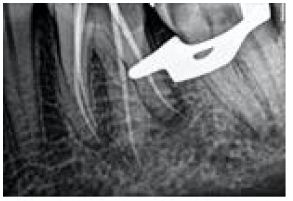
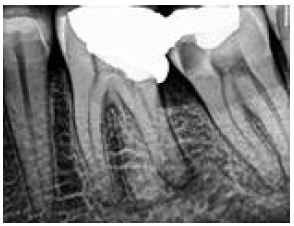
Two hundred fifty-seven patients with an average age of 20-45 years old (161 females and 96 males) were included in this study. Those patients attained private dental clinic for endodontic treatment. Two Preoperative radiographs were done for each patient with a digital X-ray sensor (Visiodent RVG Dental Sensor, France). Sign of the presence of third root is translucent lines defining the pulp space and the periodontal ligaments located in the superior part of the distal root. Firstly, anaesthetic solution was injected to patient. Rubber dam was applied for tooth isolation. Then prepared the access cavity. Pulp extirpation was accomplished. Apex locator (Woodpex III Golden Apex Locater, Zhengzhou Linker Medical Equipment Co., Ltd. China) was used to determine working length. Radiograph using digital X-ray sensor was taken to establish working length. The next step is the instrumentation of all canals by using a rotary endodontic system (protaper Gold, Dentsply, Maillefer, Switzerland), then obturation was done by using single cone with bioceramic sealer. After finishing, a radiograph was obtained in order to evaluate the efficiency of the obturation (Figures 1-3).

fig 1

Figure 1: Preoperative radiograph

fig 2

Figure 2: Cone fit checking

fig 3

Figure 3: Obturation with bioceramic sealer

Results

Statistical evaluation was carried out for the presence of third root among males and females using chi-square test with SPSS version 20. In this test P > 0.05 (Non-significant), P ≤ 0.05 (Significant) Two hundred fifty-seven patients (161 females and 96 males) were included in this study. Total incidence of radix entomolaris was five teeth (5/257) the percentage is 1.9 %. Statistical analysis revealed a non-significant difference (P > 0.05) in the incidence of third root between females (2/161) and males (3/96) as shown in Table 1.

Table 1: Percentage of radix entomolaris in the tested patients

tab 1

Discussion

The first Permanent teeth erupted is the Mandibular first molar. This tooth highly involved with tooth decay and commonly need to root canal treatment. Missed canals with the subsequent incomplete instrumentation of all infected pulp tissues are one of the most common reasons of unsuccessful endodontic treatment. Full familiarity with morphological variations of root plays an important role in increasing the chance of the successful root canal treatment. In the cases of incomplete treatment for all root canals such as the third root distolingually this will result in failure of the endodontic treatment. Radix entomolaris has been classified into the following types: Type I means straight root or canal. Type II means the beginning of the entry is curved and then continued as a straight root/root canal. Type III means the beginning of the entry is curved in the coronal third of the root canal with the presence of another curve started in the middle and continuing to the apical third [7]. Requirement of successful endodontic treatment is the preoperative radiograph with a correct examination of the tooth clinically [8]. Thorough information about the presence of additional root or root canals can be obtained by taking a radiograph with various angles [7]. The clinician can suspect the presence of additional third root when he noticed changing of the tooth form coronally, like a highly clear distolingual lobe with a convex cervical outline [9]. Many studies stated that taking two radiographs with mesial or distal shifting cone (30 degrees) very helpful for investigating occurrence of the of radix entomolaris [10]. Rectangular or trapezoidal outline access cavity preparation should be performed when the additional third root is established or suspected radiographically. The location of the orifice of radix entomolaris is disto to mesiolingually from the main distal canal. If the access to third root not clearly seen after the roof of the pulp chamber is removed, this need to complete detection of wall and floor of the pulp chamber, mainly distolingually by using sharp endodontic explorer [9]. In the current study, the total percentage of third root incidence in mandibular first molars was 1.9%, the result in accordance with other investigations that were accomplished on Middle East people [10,11]. In comparison with data of another studies collected for Asian origin our result is lower, they reported the incidence of additional root as follows: in Koreans 4.5% [12], in Chinese 32% [13], and in Taiwanese 25.6% [14]. Our result showed a non significant difference in the occurrence of radix entomolaris between males and females. Other studies showed similar results [15-18]. Previous in vivo study was accomplished by Mukhaimer and Azizi whom study the incidence of radix entomolaris in Palestinian people when they attained a dental center for endodontic treatment, the total percentage of third root incidence in mandibular first molars was 3.73%, which considered within the range of other researches done for the Middle East population, although it was significantly lesser than the range obtained for population of far east [19]. Whenever the additional root suspected to presence during endodontic treatment of permanent mandibular first molar, modification of the access cavity preparation should be performed in order to ensure complete cleaning and obturation of all root canals, Otherwise the presence of missed canal can result in failure of the treatment.

Conclusion and Recommendation

Endodontists should have thorough information about anatomical variations of the root and root canals of mandibular first molar during endodontic treatment. Correct examination clinically and radiographically is essential to discover the presence of any morphological variations of root canal system. Preoperative radiographs with certain angulation are a vital issue in this matter. Modification of access cavity is necessary to locate all root canal orifices to certify complete debridement and obturation.

Conflict of Interest

The authors declare that they have no conflicts of interest.

Source of Funding

This research did not receive any specific grant from funding agencies in the public.

Ethical Approval

This research was performed in accordance with Helsinki Declaration and approved by the Ethical Approval Committee at university of Anbar.
Date: 21/6/2021
No.83

Author Contribution

All authors have participated sufficiently in this work in order to have a public responsibility for its contents, including conception and design, or analysis and interpretation of the data, conscripting the article or revising it critically for important intellectual content; and final approval of the article. All authors agree to be accountable for all aspects of the work in ensuring that questions related to the accuracy or integrity of any part of the work are appropriately investigated and resolved.

NAH Concept and design of the study, research conduction, OHA collection and organization of data, analyzing and interpretation of data, HAS writing the initial and final draft of the manuscript, and all authors have critically reviewed and approved the final draft and are agreed for their responsibility for the contents and similarity index of the manuscript.

References

  1. Sjogren U, Agglund BH, Sundqvis Gt, Wing K (1990) Factors affecting the long-term results of endodontic treatment, J Endod 16: 498-504. [crossref]
  2. Siqueira JF (2001) Aetiology of root canal treatment failure: why well-treated teeth can fail. Int Endod J 34: 1-10. [crossref]
  3. Turner II CG (1971) Three-rooted mandibular first permanent molars and the question of American Indian origins. Amer J Phy Anth 34: 229-241. [crossref]
  4. Curzon ME, Curzon JA (1971) Three-rooted mandibular molars in the Keewatin Eskimo. J Can Den Ass 37: 71-72. [crossref]
  5. Sperber GH, Moreau J L (1998) Study of the number of roots and canals in Senegalese first permanent mandibular molars. Int Endod J 31: 117-122. [crossref]
  6. Ahmed HA, Abu-Bakr NH, Yahia NA, Ibrahim YE (2007) Root and canal morphology of permanent mandibular molars in a Sudanese population. Int Endod J 40: 766-771. [crossref]
  7. De Moor RJG, Deroose CA, Calberson FLG (2004) The radix entomolaris in mandibular first molars: an endodontic challenge. Int Endod J 37: 789-799. [crossref]
  8. Carlsen O, Alexandersen V (1999) Radix paramolaris and radix distomolaris in Danish permanent maxillary molars. Acta Odont Scan 57: 283-289. [crossref]
  9. Calberson FL, De Moor RJ, Deroose CA (2007) The radix entomolaris and paramolaris: clinical approach in endodontics. J Endod 33: 58-63
  10. Naoum HJ, Love RM, Chandler NP, Herbison P (2003) Effect of X-ray beam angulation and intraradicular contrast medium on radiographic interpretation of lower first molar root canal anatomy. Int Endod J 36: 12-19. [crossref]
  11. Al-Nazhan S (1999) Incidence of four canals in root-canal-treated mandibular first molars in a Saudi Arabian subpopulation. Int Endod J 32: 49-52. [crossref]
  12. Al-Qudah AA, Awawdeh LA (2009) Root and canal morphology of mandibular first and second molar teeth in a jordanian population. Int Endod J 42: 775-784. [crossref]
  13. Song JS, Choi HJ, Jung IY, Jung HS, Kim SO (2010) The prevalence and morphologic classification of distolingual roots in the mandibular molars in a korean population. J Endod 36: 653-657. [crossref]
  14. Gu Y, Lu Q, Wang H, Ding Y, Wang P, Ni L (2010) Root canal morphology of permanent three-rooted mandibular first molars—part I: pulp floor and root canal system. J Endod 2010; 36: 990-994. [crossref]
  15. Tu MG, Tsai CC, Jou MJ et al. (2007) Prevalence of three-rooted mandibular first molars among Taiwanese individuals. J Endod 2007;33: 1163-1166. [crossref]
  16. Schafer E, Breuer D, Janzen S (2009) The prevalence of three-¨ rooted mandibular permanent first molars in a German population. J Endod 35: 202-205. [crossref]
  17. Garg AK, Tewari RK, Kumar A, Hashmi SH, Agrawal N, et al. (2010) Prevalence of three-rooted mandibular permanent first molars among the indian population. J Endod 36: 1302-1306. [crossref]
  18. Olak HC, Ozcan E, Hamidi MM (2012) Prevalence of three-¨ rooted mandibular permanent first molars among the Turkish population. Nig J Clin Prac 15: 306-310. [crossref]
  19. Mukhaimer R, Azizi Z (2014) Incidence of radix entomolaris in mandibular first molars in Palestinian population: a clinical investigation. Int Schol Res Not. [crossref]

Is Methylphenidate Useful to Survivors of Childhood Brain Tumour? An Accessible Summary of Recent Research

DOI: 10.31038/PSYJ.2024623


Many children and young people experience long-term difficulties after having a brain tumour. This paper discusses interventions using the medication methylphenidate and describes the current research in this area being conducted at the Great North Children’s Hospital (Newcastle upon Tyne) and Newcastle University Centre for Cancer. The children, young people, and their families who use our hospital tell us that some of their most challenging difficulties only happened once the brain tumour treatment had finished. Some survivors of childhood brain tumour are left with lifelong disabilities that result from their cancer or treatment. These disabilities are often related to brain injury, and can be relatively invisible to the general public. Some disabilities only become apparent over the time following treatment. These are known as ‘long-term late effects’. The most common long-term late effect that is reported after childhood brain tumour is an acquired brain injury. We see signs of an acquired brain injury following brain tumour in behaviour such as reduced attention, a reduction in ability to remember things, a slowing down of how quickly the child can take in information, and an impact on their academic performance and overall intellectual ability (IQ). Depending on the location of the tumour, brain injury can present in a different way. It is important to remember that the term ‘brain injury’ refers to any injury affecting the brain, so information on brain injury on the internet may not apply to the specific injury a child has acquired. A child can develop brain injury after a brain tumour due to one or many different factors, including any build-up of fluid in the brain before the tumour was discovered (hydrocephalus), surgery, post-surgical complications (such as posterior fossa syndrome), certain chemotherapies, or radiotherapy. Generally, the younger a child is at the time of diagnosis, the more likely they are to experience significant late effects.

We have worked with a number of patients and their families in Newcastle at the Great North Children’s Hospital to help us understand what the role of methylphenidate might be in helping to reduce long-term late effects that affect intellectual and academic ability. Methylphenidate is a medication that is used for a few different reasons. Usually people have heard of methylphenidate by one of its brand names, ‘Ritalin’, which they know is used for children with Attention Deficit Hyperactivity Disorder (ADHD). We do not use this for ADHD in our centre, and in fact we do not assess our patients for ADHD. We use this medication to try to reduce the delayed effect on brain function that we see in many children following brain tumour. We read about some research using methylphenidate with children after brain tumour that was carried out in America in 2008 [1-4]. This research found that methylphenidate may be useful for some children and young people who experience late effects after a brain tumour or after acute lymphoblastic leukaemia. We knew that methylphenidate has been trialled also for children and young people who have attentional impairment or slowed cognitive function (slowed thinking speed) after a traumatic brain injury, such as following a serious head injury. We wanted to know what other groups experience was of methylphenidate to help us think about its potential benefit to our patients. We wrote two papers that looked at which other groups of children methylphenidate has been trialled with, and discussed whether these benefits might translate to our patients. Both papers were written with Alexander Hagan, one of our Research Assistants. Translating Methylphenidate’s Efficacy on Selective and Sustained Attentional Deficits to… Childhood Cancer Survivors: A Qualitative Review [5]. The Influence of Methylphenidate on Sustained Attention in Paediatric Acquired Brain Injury: A Meta-Analytical Review [6].

Both of these studies helped us to see that there may be benefit to using methylphenidate as part of more structured clinical use. Methylphenidate has been used in our hospital for patients with traumatic brain injury and with post-cancer brain injury before, but the effects of the medication were not measured fully. Working with our medical colleagues, we started measuring the benefit of methylphenidate with patients at the start of 2017. We have now been working with methylphenidate for nearly seven years and we have published some research about what we have learned. In 2017-2019 we asked children and young people about what they thought about using methylphenidate. We collected data on children’s views by talking with them and by asking them to complete some short questionnaires with us. We worked with an MSc postgraduate student, Lauren Bell, to help us share our patients’ experiences. You can read this in a paper titled “I feel happy again”: Methylphenidate Supports Health-Related Quality of Life in Survivors of Paediatric Brain Tumour [7]. Lauren looked at questionnaire data that we had collected from 12 of our patients. Analysing these questionnaires, Lauren found that children experienced benefit of methylphenidate in five key areas of life: social, emotional, academic, physical, and cognitive. We also asked parents and carers about their experiences of their child using methylphenidate in 2017-2019. We worked with a doctoral postgraduate student, now Dr Lauren Smith, to write a paper titled Parental Perceptions of the Efficacy of Methylphenidate on Health-Related Quality of Life in Survivors of Paediatric Brian Tumour [8]. Lauren gathered questionnaire data that we had collected in clinic from 10 parents/carers. Parents were generally positive about the use of methylphenidate and believed this to have a benefit on their child’s quality of life.

From talking with children, young people, and their parents and carers in these parent and patient studies, we learned that post-treatment fatigue was a significant problem in the long term. Patients faced fatigue during treatment, but were experiencing long-term fatigue due to the impact of the tumour and treatment on their cognitive function. We worked with a medical MRes postgraduate, now Dr Jennifer Wood, to look at the impact of fatigue on brain tumour survivors: Exploring Evidence of Fatigue in Survivors of Pediatric Brain Tumors [9]. Jenny found that there was a lot of studies that discussed fatigue in cancer survivorship, but many of these were poor quality and did not adequately distinguish between fatigue in the early days related to illness and treatment, and longer term fatigue related to brain injury. A Danish group led by Dr Michael Callesen at Hans Christian Andersen’s Children’s Hospital are now looking at the effect of methylphenidate on fatigue in children after brain tumour in something called a ‘randomised control study’. This sort of study is the gold standard for research as its findings are very robust. We are involved with this study as one of their scientific advisors, and have shared our own research protocol with Dr Callesen’s team. We look forward to seeing their results. All the existing research on the use of methylphenidate in cancer survivorship looks at the effects over a relatively short period of time. Most studies only continue for 2-3 weeks. Two studies looked at the impact of methylphenidate over a 12 month period. One of these studies was written by our team: Methylphenidate Improves Cognitive Function and Health-Related Quality of Life in Survivors of Childhood Brain Tumours [10]. We looked at anonymised data from 29 patients who were using methylphenidate. We found that methylphenidate had a significant impact on selective attention-that is, the ability to pay attention to a specific stimulus, rather than the other distractions in the room. This is important when listening to a teacher, or trying to pay attention to one’s lesson rather than the chatter in the room around one. This study also showed that benefits to quality of life that may be associated with methylphenidate were still present at 12 months.

We wanted to know whether methylphenidate has any benefit on academic attainment and to intellectual ability over the medium to long term. Dr Shauna Palmer explored the factors that cause reduced intellectual ability in long-term survivors of a brain tumour called a medulloblastoma [11]. One of the factors found to be associated with intellectual development was the speed at which an individual can take in information-an area that we know is affected in many survivors of brain tumour. We are interested in finding out whether methylphenidate-used to support the speed at which information is processed-might decrease the reduction in intellectual ability seen in some survivors. We have just completed writing a case series including six of our patients that have used methylphenidate for over three years: Key Questions on the Long-Term Utility of Methylphenidate in Paediatric Brain Tumour Survivorship: A Retrospective Clinical Case Series [12]. This study helped us to identify some unanswered questions about using methylphenidate after brain tumour. We hope to answer many of those questions in our ongoing longitudinal study. This study will run over a further three year period (2022-25) and may help us to answer some of the things that we don’t yet know about using methylphenidate with this group. Over the nearly seven years that we have been exploring methylphenidate with our patient group we have learned a lot. We are building experience in identifying which patients are more likely to have mild side-effects and which will be most likely to benefit from the treatment. We still need to discover more about methylphenidate, including gaining more evidence about how long it is useful to take methylphenidate for, and when to stop. We could not do this work without the support of our patients and their families, from whom we are gathering expert data. We look forward to finding out what more we have to learn from our patients, and to being one step closer to making survival from a tumour as positive an experience as possible.

Conflict of Interest

The author claims no conflict of interest.

Statement on Serial Publishing

The submitted paper is an accessible summary of a number of associated published studies by the same author.

Funding

No funding was received for this paper.

Acknowledgements

SJV wishes to thank the following colleagues and supervisees for their input into the studies discussed in the current paper: Jennifer Wood, Lauren Smith, and Lauren Bell (MRes and MSc, Newcastle University); Alexander Hagan, Rebecca Hill, Simon Bailey, and Jade Ryles (Newcastle Upon Tyne Hospitals NHS Foundation Trust). Thanks are due also to the patients and their families of our service, whose support of our research is greatly appreciated.

References

  1. Conklin HM, Khan RB, Reddick WE, Helton S, Brown R, et al. (2007) Acute neurocognitive response to methylphenidate among survivors of childhood cancer: A randomized, double-blind, cross-over trial. Journal of Pediatric Psychology 32: 1127-1139. [crossref]
  2. Conklin HM, Lawford J, Jasper BW, Morris EB, Howard SC, et al. (2009) Side effects of methylphenidate in childhood cancer survivors: A randomized placebo-controlled trial. Pediatrics 124: 226-233. [crossref]
  3. Conklin HM, Helton S, Ashford J, Mulhern RK, Reddick WE, et al. (2010) Predicting methylphenidate response in long-term survivors of childhood cancer: A randomized, double-blind, placebo-controlled, crossover trial. Journal of Pediatric Psychology 35: 144-155. [crossref]
  4. Conklin HM, Reddick WE, Ashford J, Ogg S, Howard SC, et al. (2010) Long-term efficacy of methylphenidate in enhancing attention regulation, social skills, and academic abilities of childhood cancer survivors. Journal of Clinical Oncology 28: 4465-4472. [crossref]
  5. Hagan AJ, Verity SJ (2022b) Translating methylphenidate’s efficacy on selective and sustained attentional deficits to those reported in childhood cancer survivors: A qualitative review. Applied Neuropsychology 12: 74-87 .[crossref]
  6. Hagan AJ, Verity SJ (2022a) The influence of methylphenidate on sustained attention in paediatric acquired brain injury: a meta-analytical review. Child Neuropsychology 1-32. [crossref]
  7. Verity SJ, Bell L, Ryles J, Hill RM (2022) “I Feel Happy Again”: Methylphenidate Supports Health-Related Quality of Life in Survivors of Pediatric Brain Tumor. Children 9: 1058. [crossref]
  8. Smith L, Verity SJ (2022) Parental Perceptions of the Efficacy of Methylphenidate on Health-Related Quality of Life in Survivors of Paediatric Brain Tumour. Psychoactives 31-44.
  9. Wood J, Verity S (2021) Exploring evidence of fatigue in survivors of paediatric brain tumours: a systematic review. BJPsych Open 7: S302-S302. [crossref]
  10. Verity SJ, Halliday G, Hill RM, Ryles J, Bailey S (2022) Methylphenidate improves cognitive function and health-related quality of life in survivors of childhood brain tumours. Neuropsychological Rehabilitation, 1-21. [crossref]
  11. Palmer SL (2008) Neurodevelopmental impact on children treated for medulloblastoma: A review and proposed conceptual model. Developmental Disabilities Research Reviews 14: 203-210. [crossref]
  12. Hagan AJ, Verity SJ (2024) Key Questions on the Long-Term Utility of Methylphenidate in Paediatric Brain Tumour Survivorship: A Retrospective Clinical Case Series. Children 11: 187.

D.A.R.E. Drug Prevention during the Pandemic: Response to COVID-19

DOI: 10.31038/PSYJ.2024622

Abstract

Background: The COVID-19 pandemic resulted in dramatic public health measures including school closures nationwide. This resulted in notable gaps in the delivery of evidence-based drug prevention as part of formal educational curriculum. The goal of the current study was to document police officers’ responses to curtailed activities surrounding delivery of D.A.R.E.’s elementary, middle and high school drug prevention programs.

Method: Respondents were 584 officers who completed an online survey between June 2020 and August 2020.

Results: Of those scheduled to teach during the spring semester, the largest share of officers (56.6%) were able to teach a portion of the lessons, a third (33.5%) were not able to teach any of the lessons, and nearly one in ten (9.9%) were able to teach all of the required lessons. Officers reported numerous strategies to circumvent the cessation of in-person instruction. Methods included teaching online, providing students with links to videos, and providing students with handouts.

Conclusion: Despite the interference in teaching posed by the COVID-19 pandemic, many officers were resourceful and found alternatives to continue delivery of the intervention.

Keywords

D.A.R.E., Pandemic, Alternative teaching methods, Drug prevention, Education

The SARS-CoV-2 coronavirus and the associated COVID-19 disease have disrupted many walks of life, contributing to a tremendous toll in human suffering. Although much attention has focused on the increased morbidity and mortality associated with health effects of the virus [1], and its overwhelming economic burden to our nation’s healthcare system [2-4], there were other more subtle effects. One of the more profound changes to our nation’s institutions was widespread school closure [5]. This was instituted to meet public health mandates for social distancing, sheltering in place, and mandated lockdowns. These decisions were made based on the airborne nature of the virus and the noted favorable effects of school closure during other H1N1 influenza outbreaks [6-8]. One consequence of school closure during the COVID-19 pandemic in the US was decreased mortality among younger school-age children [9,10]. The national lockdown and suspension of face-to-face instruction that occurred during the COVID pandemic was in response to CDC guidance and mitigation measures. School closures produced a new set of educational challenges including reliance on distance learning [11-13]. With online learning, teachers relied on synchronous meetings to hold live lectures using video and audio-conferencing platforms such as Zoom or Google Classroom [14]. Teachers also used asynchronous forms of communication with students relying on cloud-based storage (e.g., Google Drive), emails, and discussion boards so that students could readily access class materials (e.g., handouts, tests, and supplementary lesson materials) and upload homework assignments. In addition to their academic instructional role, schools are also a primary source of distributing various supplemental prevention and intervention services that affect the health and well-being of children [15]. In many cases, these programs were considerably curtailed if not completely reduced.

Beginning in March 2020 when stay-at-home orders were initiated nationwide, the implementation of drug prevention programs like D.A.R.E.’s keepin’ it REAL were cut back as police officers that teach this program had limited access to schools. This provided a rare opportunity to document and examine the impact of COVID-19 on officers’ delivery of the program. Such a focus falls in line with other efforts to examine the effects of the pandemic disruption on educational practices and the detrimental effects of a national lockdown on student academic performance [16,17] and mental health [18-20].

Concerns about the Disruption of In-class Instruction

There is a general consensus that school closure would have some adverse effect on students, particularly those who have specific definable needs. This might include students who are economically disadvantaged or reside in under resourced neighborhoods [21]. Schools often provide students with access to healthcare, federally subsidized lunches to offset food insecurity, and other forms of nonacademic support (i.e., mental health and emotional support through school counselors). Schools also provide prevention and intervention services including treating behavioral disorders, detecting at-risk students, and providing screening for learning problems. Long hiatuses from schools limit student access to important services and may contribute to the proverbial “summer slide,” a phenomenon associated with loss of academic proficiency during the summer when many students do not attend classes [22-24]. This effect is particularly noticeable with economically disadvantaged students who may lack social capital, have less access to physical resources (e.g., library books), be less engaged in school, and experience less parental support [25,26]. The absence from in-person instruction due to stay-at-home public health mandates and the increased reliance on distance education is expected to mimic setbacks in academic proficiency experienced during the summer months [27]. Recent research found learning attitudes of middle school students predicts academic performance [28]. Students who performed well prior to the pandemic continued to do well only when they had positive attitudes toward online learning. Students whose attitudes favored in-class education fared less well.

Challenges with Teaching during the Pandemic

Numerous studies have examined various challenges to teaching during the pandemic. Among the more salient concerns, teachers reported struggling with getting students to complete assignments, maintaining student engagement in coursework, familiarity with technology, inadequate resources, and finding alternative pedagogical strategies suitable for distance learning [29,30]. The latter issue is particularly relevant for teaching classes that include music, physical education, and visual arts where group participation or hands-on instruction are required [31,32]. Studies of a global nature have reported that at least initially both teachers and students were dissatisfied with online learning and teaching [33]. Bergdahl and Nouri surveyed Swedish teachers about their preparedness to deliver online distance education [34]. They examined school and teacher preparedness, strategies teachers used when shifting to distance education, learning activities teachers employed for distance education, and teachers’ positive experiences and challenges. While teachers provided reassurance of their technical ability, they also reported they lacked pedagogical strategies needed to make online learning successful. Among the issues teachers noted was that despite using technologies that allowed classes to interact, students nonetheless felt a great deal of social isolation. Ironically, teachers also reported that students working from home often concentrated better on learning tasks than they did when in the classroom.

Bhat and Shiva tested a model of teachers’ willingness to adopt technology in education during the COVID-19 pandemic’s requirement for distance learning. They found that perceived ease of use and the perceived usefulness of online technologies predicted teachers’ attitudes toward use, their intentions to use technology and their actual use. For many teachers, distance education is relatively new and, as a result, teachers may benefit from training and from being able to share with each other what they learn when new technologies are adopted [35].

A Brief History of D.A.R.E.

As a brief overview, the D.A.R.E. program was initially developed during the early 1980s. Then Los Angeles Police Commissioner Daryl Gates held strongly that police could gain a better foothold and beneficial presence in the communities they served through delivery of youth-oriented educational programs targeting drug prevention. Working in concert with the Los Angeles Unified School District, D.A.R.E. was instituted as an elementary school drug prevention program and quickly became the most widely distributed drug prevention program in America [36]. The core curriculum of D.A.R.E. was strongly aligned with contemporary drug prevention programs that favored social-cognitive theory [37]. Instructional modalities reinforced social pressure resistance training (i.e., drug refusal skills) combined with normative education that corrected misperceptions regarding the social acceptability of drug use. Additional core components presented information about the consequences of drug use (i.e., harmful effects of misuse) and included material to boost children’s self-confidence. Indeed, the original conceptual framework for D.A.R.E. borrowed heavily from several social-psychological drug prevention programs being tested at the time [38-41] and that produced favorable findings supporting both skills and norms thought to be integral to drug prevention. Historically, D.AR.E. has undergone several methodologically rigorous evaluations based on longitudinal prospective data [42-45]. Few of these studies were able to show favorable program effects on self-reported drug use, albeit some were able to show some positive effects on knowledge, attitudes, perceived peer norms, and in one case, media portrayal of drugs and assertiveness skills [46]. The lack of credible evidence for program efficacy coupled with meta-analysis findings [47,48] led to substantial changes in both program content and delivery.

In 2008, D.A.R.E. America adopted (and adapted) the middle school version of Keepin’ it REAL (kiR) for its use in community-based policing efforts [49] and followed this in 2012 by adapting the elementary school curriculum [50], the latter incorporating social-emotional learning theory [51]. The elementary school program was recently evaluated and found to have positive effects for past 30-day alcohol use, drunkenness, and vaping [52]. The 10-session kiR middle school program blends the principles of cultural grounding [53] and narrative communication theory [54] with a skills-based approach to drug prevention. The program incorporates effective messaging that reflects the experiences of the target audience, which, in its earliest stages of program development, captured the linguistic and cultural experiences of southwestern Mexican and Mexican/American youth [55]. The narrative component involves building a repository of examples provided by youths when they encounter drug offers and decisive situations that require the application of social communication, problem-solving, and decision-making skills. The building blocks of communication competence theory include knowledge, resistance skills and decision-making skills, and the promotion of conventional injunctive and descriptive normative beliefs. The intervention teaches four resistance skills: Refusing (saying “no”), Explaining (answering “no” with an explanation), Avoidance (not attending an event where alcohol or drugs might be available or being in a situation conducive to drug use), and Leaving (removing oneself from a situation where alcohol or drugs are being used), giving the program the moniker keepin’ it REAL [56].

As of 2020, more than 6,000 law enforcement agencies had officers trained to deliver D.A.R.E. programs to more than 1.2 million students who reside in more than 10,000 communities throughout the United States. In 2022 alone, D.A.R.E. launched the program in a record 212 new sites throughout 39 states and Canada. A total of 900 new law enforcement officers were trained and certified to deliver the kiR drug prevention program, with new modules addressing teen suicide prevention, vaping, internet and social media safety, and opioid drug abuse prevention. It has long been known that effective interventions include delivering evidence-based intervention programs with fidelity, embedding practices that support student engagement and motivation, and providing adequate intervention dosage [57]. It is particularly important to ensure instructors can facilitate class discussions, elicit students’ active thinking, and maintain norms about discipline and engagement.

The Current Study

The goal of the current study was to document D.A.R.E. officers’ responses to having schools closed down because of the COVID-19 pandemic. The goal was to learn how many of the officers were able to fully implement the drug prevention curriculum and what kinds of alternatives (if any) they pursued as schools transitioned to remote learning.

Method

Participants

Survey respondents were 584 D.A.R.E. officers. Respondents included 438 (75.0%) male and 146 (25.0%) female officers. Most, 505 (86.5%) were White, 36 (6.2%) were Black, 13 (2.2%) identified as being from multiple races, 10 (1.7%) were Asian, and 9 (1.5%) were Native American. The remainder 11 (1.9%) identified as “other.” In the sample, 52 (8.9%) identified as Hispanic (a non-exclusive ethnic category). Self-reported ages included 48 (8.2%) who were between 20 and 29 years old, 175 (30.0%) who were between 30 and 39, 201 (34.4%) who were between 40 and 49, and 160 (27.4%) who were 50 years old or older. Almost half (266; 45.5%) of the officers were from rural communities. Slightly more than a quarter (172; 29.5%) were from suburban communities. Smaller numbers of officers came from small urban communities (107; 18.3%) or large urban communities (39; 6.7%). Most of the respondents (403; 69.0%) reported being in law enforcement for 10 or more years. About a quarter (138; 23.6%) had been in law enforcement between five and 10 years. The remainder (43; 7.4%) had been in law enforcement fewer than five years. Involvement in delivering D.A.R.E. varied among the group with the largest group (255; 43.7%) having been involved from two to four years, about a quarter (134; 22.9%) involved for more than 10 years, 99 (17.0%) involved for one year or less, and 96 (16.4%) had been involved between five and 10 years.

A majority of the officers taught only elementary school (388; 66.4%). Fewer taught D.A.R.E. in elementary and middle school (122; 20.9%) or only in middle (55; 9.4%). Fewer still taught D.A.R.E. in high school (19; 3.3%). D.A.R.E. includes enhancement lessons that provide additional instruction about bullying, cyber security, a supplemental marijuana lesson, family talks, and opioid information about prescription drug abuse. A number of officers (84; 14.4%) also indicated they taught enhancement lessons. About half of the officers (284; 48.6%) reported that they were also School Resource Officers (SROs) assigned to a particular school on a long-term basis to help ensure order.

Procedure

Participants were recruited through an open invitation to participate in a web-based survey promoted by national and regional D.A.R.E. America staff. Surveys were administered via a Google forms survey and completed between June 26, 2020 and August 24, 2020. These dates coincide with the time frame when the World Health Organization first declared an official pandemic.

Results

Impact of the Pandemic

All but three officers (99.5% of officers scheduled to teach during the school year) reported that the schools in which they served were closed during the spring semester of 2020. Not all officers were scheduled to teach during the spring semester; 114; 19.5% were not scheduled to teach. Among those who did teach, 47 (10.0%) were able to teach all of the lessons, 269 (57.2%) were able to teach some lessons before their school was closed, and 159 (33.8%) were not able to teach any lessons. The use of a distance teaching/learning application was rarely used; reported by only 5 (1.1%) of those who taught all lessons and 36 (7.7%) of those who were able to teach some lessons, respectively. Only one officer reported using D.A.R.E. Mobile, a smartphone app that can be used for program delivery [58].

There was a statistically significant difference, χ2=21.922, df=2, p<0.001 between officers that were able to teach none, some, or all of the lessons and their willingness to send materials home, (17; 3.6% vs. 77; 16.4% vs. 16; 3.4%, for none, some, or all, respectively). Likewise, among the 470 officers assigned to teach, they differed significantly in their ability to maintain contact with students, χ2=5.617, df=2, p=0.060, [57 (12.1%), 126 (26.8%), and 22 (4.7%), for officers not able to teach, those who taught some of the D.A.R.E. lessons, and those able to completed teaching, respectively]. Officers who taught both elementary and middle school versions of D.A.R.E. were significantly more likely to send Family Talks and other lesson materials home (29.5%) compared to those who only taught elementary school (20.9%) or only middle school (7.3%), χ2=11.351, df=2, p=0.003. Dual grade officers were just slightly more likely to teach using an online meeting room such as Zoom (13.1%) than were officers who only taught elementary (9.0%) or only middle school (3.6%; χ2=4.195, df=2, p=n.s.). Grade of instruction (elementary, middle school, or both) did not affect how much of the program was delivered (some vs. all; χ2=0.423, df=2, n.s.).

Dual Roles: D.A.R.E. Instructor and SRO

D.A.R.E. officers often also serve as SROs in the schools in which they are assigned to teach. Older officers were significantly more likely to play the dual role of SRO and D.A.R.E. instructor, χ2=4.395, df=1, p=0.036 [50 years old or older (55.0%) vs. <50 years old (45.2%)]. There was also a significant difference in length of time teaching D.A.R.E. and what capacity officers played in the school (SRO), χ2=11.359, df=3, p=0.009, with officers teaching for one year or less more likely to be an SRO (62.63%) compared to those who had taught for 2 to 4 years (42.8%), 5 to 10 years (47.9%) or more than 10 years (47.0%).Dual role officers were significantly more likely to be from rural or small urban communities, χ2=28.442, df=3, p<0.0001 (57.5% vs. 52.3%, respectively) than from large urban (28.2%) or suburban communities (34.8%). D.A.R.E. officers indicating their ethnicity as Hispanic were significantly less likely than non-Hispanic officers to serve as SROs, χ2=4.064, df=1, p=0.043 (34.6% vs. 49.3%; 3.6%). There were no racial differences in the rate of participating as SROs for Black and non-Black and White and non-White officers. There was a significant difference between SRO and non-SRO officers in the amount of the program they could teach. Among those who attempted to teach during the spring semester, most (85.0%) taught only part of the program. However, whereas 42.5% of officers who were not SROs were able to teach all of the program, 57.5% those who performed the dual D.A.R.E. officer and SRO roles were able to do so, χ2=3.256, df=1, p=0.071.

Anecdotal Outcomes

Officers were asked to provide written anecdotes about program adaptations they made. In addition to online instructions and handouts noted above, 13 reported that they uploaded videos for students to watch. Several (4) reported doubling the number of lessons taught during any given week when the threat of school closure became apparent. Four of the officers emailed lessons home. Three of the officers provided teachers with lesson plans and asked them to complete lessons once they began remote instruction. A few officers noted that they perceived their regular classroom teachers to be overly burdened with the responsibilities of dealing with remote instruction and felt it inappropriate to ask more of them.

Discussion

D.A.R.E. continues to be among the most widely disseminated drug prevention programs. As a result, it provides an ideal case for studying the impact that school closures had on program delivery during the coronavirus pandemic. It should be noted that the national office and regional D.A.R.E. offices, much like the rest of American society and its educational institutions, had not anticipated school closure. As a result, it appeared that most officers were left to their own vices in order to seek creative alternatives for program delivery both individually and in collaboration with their host teachers. Officers that completed the survey indicated an almost complete shutdown of schools and cessation of in-person learning during the spring semester of 2020. At that point in time, there was tremendous variability in how officers handled the situation. A few were fortunate in that they had completed teaching prior to school closure. Slightly more than half had completed some teaching but were not able to complete the entire 10 session program. About a third of the officers reported that they were unable to teach any lessons.

A sizable minority of officers actively sought alternatives to in-person teaching. Interestingly, only one officer used the D.A.R.E. mobile app. The mobile app was new and very few officers had been trained to use it. Had the app been fully released, it may have provided a means for reaching students during school closure. On the other hand, some officers took it upon themselves to find workarounds, including sending home written materials, preparing videos, teaching via online meeting rooms such as Zoom, and working with teachers to disseminate program content. Among the cadre of officers who were able to teach, and found ways to structure workaround given school closures, those that taught both elementary and middle school were more likely to be resourceful and send lesson materials home compared to officers that taught in only one environment. They were also more likely to use an online forum compared to officers teaching at only one educational site. Officers that move back and forth from elementary to middle school may be able to capitalize on available resources and apply them regardless of age group taught. This may point to possibilities of educating officers into the use of technology for teaching, in the same manner as teachers are introduced to novel technology that enhances learning. There were also some noted differences between officers that are strictly committed to law enforcement in the communities they serve and officers that are attached to a school in the capacity of SRO. The officers serving as SRO’s are older, newer to D.A.R.E., from smaller communities, and were more likely to have greater coverage of the course content even when faced with restrictions during the pandemic. While these differences are not pronounced, they still point to the possibility that being an SRO carries with it certain responsibilities to maintain a safe environment in the school, but also to learn teaching strategies that benefit the students exposed to D.A.R.E. Here too, additional training may encourage non-SRO officers to blend in better and absorb teaching tactics that helps them to be more effective in program delivery.

It goes without question that the COVID-19 pandemic ushered in a new era in education. The lockdown ended up with massive school closures across the US, leading to dramatic if not radical changes in the way educational material is delivered. This created new opportunities as well as new challenges, for many teachers, let alone officers, were not skilled in the use of online meeting rooms like Zoom, Google Meet or Microsoft Teams. As a result, there was a learning curve to blend curricular demands with the novelty of delivering course content using digital technology. Offers teaching D.A.R.E. were no exception to this novelty and the pandemic forced them to face both new challenges as well as opportunities. The data we were able to gather from officers teaching the D.A.R.E. keepin’ it REAL drug prevention program clearly indicate there is a need to both adapt to the situation and also take advantage of alternative strategies for deploying prevention efforts.

Funding

This research was funded in part by a contract from D.A.R.E. America.

References

  1. Chow N, Fleming-Dutra K, Gierke R, Hall A, Hughes M, et al. (2020) Preliminary estimates of the prevalence of selected underlying health conditions among patients with coronavirus disease 2019-United States. Morbidity and Mortality Weekly Report 69: 382-386. [crossref]
  2. Cypress BS (2022) COVID-19: The economic impact of a pandemic on the healthcare delivery system in the United States. Nursing Forum 57: 323-327. [crossref]
  3. DeMartino JK, Swallow E, Goldschmidt D, Yang K, Viola M, et al. (2022) Direct health care costs associated with COVID-19 in the United States. Journal of Managed Care & Specialty Pharmacy 28: 936-947. [crossref]
  4. Di Fusco M, Shea KM, Lin J, Nguyen JL, Angulo FJ, et al. (2021) Health outcomes and economic burden of hospitalized COVID-19 patients in the United States. Journal of Medical Economics 24: 308-317. [crossref]
  5. Fowler JH, Hill S, Levin R, Obradovich N (2020) The effect of stay-at-home orders on COVID-19 infections in the United States.
  6. Cauchemez S, Ferguso, NM, Wachtel C, Tegnell A, Saour G, et al. (2009) Closure of schools during an influenza pandemic. The Lancet Infectious Diseases 9: 473-481. [crossref]
  7. Ferguson NM, Cummings DA, Fraser C, Cajka JC, Cooley PC, et al. (2006) Strategies for mitigating an influenza pandemic. Nature 442(7101): 448-452. [crossref]
  8. Stern AM, Cetron MS, Markel H (2009) Closing The Schools: Lessons From The 1918-19 US Influenza Pandemic: Ninety-one years later, the evidence shows that there are positive and negative ways to do it. Health Affairs 28: w1066-w1078.
  9. Auger KA, Shah SS, Richardson T, Hartley D, Hall M, et al. (2020) Association between statewide school closure and COVID-19 incidence and mortality in the US. Journal of the American Medical Association 324: 859-870. [crossref]
  10. Staguhn ED, Weston-Farber E, Castillo RC (2021) The impact of statewide school closures on COVID-19 infection rates. American Journal of Infection Control 49: 503-505. [crossref]
  11. Dhawan S (2020) Online learning: A panacea in the time of COVID-19 crisis. Journal of Educational Technology Systems 49: 5-22.
  12. Ford TG, Kwon KA, Tsotsoros JD (2021) Early childhood distance learning in the US during the COVID pandemic: Challenges and opportunities. Children and Youth Services Review 131: 106297.
  13. Francom GM, Lee SJ, Pinkney H (2021) Technologies, challenges and needs of K-12 teachers in the transition to distance learning during the COVID-19 pandemic. TechTrends 65: 589-601. [crossref]
  14. Bhatt S, Shiva A (2020) Empirical examination of the adoption of Zoom software during Covid-19 pandemic: Zoom tam. Journal of Content, Community & Communication 12: 70-88.
  15. Hoffman JA, Miller EA (2020) Addressing the consequences of school closure due to COVID-19 on children’s physical and mental well-being. World Medical & Health Policy 12: 300-310. [crossref]
  16. Harmey S, Moss G (2021) Learning disruption or learning loss: using evidence from unplanned closures to inform returning to school after COVID-19. Educational Review 75: 637-656.
  17. König C, Frey A (2022) The impact of COVID-19-related school closures on student achievement-A meta-analysis. Educational Measurement: Issues and Practice 41: 16-22.
  18. Loades ME, Chatburn E, Higson-Sweeney N, Reynolds S, Shafran R, et al. (2020) Rapid systematic review: the impact of social isolation and loneliness on the mental health of children and adolescents in the context of COVID-19. Journal of the American Academy of Child & Adolescent Psychiatry 59: 1218-1239. [crossref]
  19. Panchal U, Salazar de Pablo G, Franco M, Moreno C, Parellada M, et al. (2021) The impact of COVID-19 lockdown on child and adolescent mental health: Systematic review. European Child & Adolescent Psychiatry 1-27. [crossref]
  20. Zima BT, Edgcomb JB, Rodean J, Cochran SD, Harle CA, et al. (2022) Use of acute mental health care in US children’s hospitals before and after statewide COVID-19 school closure orders. Psychiatric Services 73: 1202-1209. [crossref]
  21. Masonbrink AR, Hurley E (2020) Advocating for children during the COVID-19 school closures. Pediatrics 146: e20201440. [crossref]
  22. Alexander KL, Entwisle DR, Olson LS (2007) Lasting consequences of the summer learning gap. American Sociological Review 72: 167-180.
  23. Downey DB, Von Hippel PT, Broh BA (2004) Are schools the great equalizer? Cognitive inequality during the summer months and the school year. American Sociological Review 69: 613-635.
  24. von Hippel PT, Workman J, Downey DB (2018) Inequality in reading and math skills forms mainly before kindergarten: A replication, and partial correction, of “Are schools the great equalizer?” Sociology of Education 91: 323-357.
  25. Banerjee PA (2016) A systematic review of factors linked to poor academic performance of disadvantaged students in science and maths in schools. Cogent Education 3: 1178441.
  26. Cooper H, Nye B, Charlton K, Lindsay J, Greathouse S (1996) The effects of summer vacation on achievement test scores: A narrative and meta-analytic review. Review of Educational Research 66: 227-268.
  27. Kuhfeld M, Soland J, Tarasawa B, Johnson A, Ruzek E, et al. (2020) Projecting the potential impact of COVID-19 school closures on academic achievement. Educational Researcher 49: 549-565.
  28. Lee J, Lim H, Allen J, Choi G (2021) Effects of learning attitudes and COVID-19 risk perception on poor academic performance among middle school Sustainability 13: 5541.
  29. König J, Jäger-Biela DJ, Glutsch N (2020) Adapting to online teaching during COVID-19 school closure: teacher education and teacher competence effects among early career teachers in Germany. European Journal of Teacher Education 43: 608-622.
  30. Phillips SA (2020) Middle school teachers making sense of education during the covid-19 pandemic. The Journal of Advancing Education Practice 1: 4.
  31. Hash PM (2021) Remote learning in school bands during the COVID-19 shutdown. Journal of Research in Music Education 68: 381-397. [crossref]
  32. Sabol FR (2022) Art education during the COVID-19 pandemic: The journey across a changing landscape. Arts Education Policy Review 123: 127-134.
  33. Zwilling M, Klein G, Lesjak D, Kohun F, Delorenzo GJ, et al. (2020) The attitude towards online education as a result of the Covid-19 outbreak: An international comparison among students and lecturers. Expanding Horizons: Business, Management and Technology for Better Society 609-610.
  34. Bergdahl N, Nouri J (2021) Covid-19 and crisis-prompted distance education in Sweden. Technology, Knowledge and Learning 26: 443-459.
  35. Canipe MM, Bayford A (2020) Lessons learned moving an elementary science methods course to emergency online delivery. Teaching, Technology and Teacher Education during the COVID-19 Pandemic: Stories from the Field. Association for the Advancement of Computing in Education (AACE), 65-69.
  36. Kumar R, O’Malley PM, Johnston LD, Laetz VB (2013) Alcohol, tobacco, and other drug use prevention programs in US schools: a descriptive summary. Prevention Science 14: 581-592. [crossref]
  37. Bandura A (1986) Social foundations of thought and action. Englewood Cliffs, NJ: Prentice-Hall.
  38. Botvin GJ, Eng A, Williams CL (1980) Preventing the onset of cigarette smoking through life skills training. Preventive Medicine 9: 135-143. [crossref]
  39. Hansen WB, Graham JW (1991) Preventing alcohol, marijuana, and cigarette use among adolescents: Peer pressure resistance training versus establishing conservative norms. Preventive Medicine 20: 414-430. [crossref]
  40. Hansen WB, Johnson CA, Flay BR, Graham JW, Sobel J (1988) Affective and social influences approaches to the prevention of multiple substance abuse among seventh grade students: Results from Project SMART. Preventive Medicine 17: 135-154. [crossref]
  41. Hansen WB, Malotte CK, Fielding JE (1988) Evaluation of a tobacco and alcohol abuse prevention curriculum for adolescents. Health Education Quarterly 15: 93-114. [crossref]
  42. Clayton RR, Cattarello AM, Johnstone BM (1996) The effectiveness of Drug Abuse Resistance Education (Project DARE): 5-year follow-up results. Preventive Medicine 25: 307-318. [crossref]
  43. Dukes RL, Stein JA, Ullman JB (1997) Long-term impact of Drug Abuse Resistance Education (DARE): Results of a 6-year follow-up. Evaluation Review 21: 483-500. [crossref]
  44. Lynam DR, Milich R, Zimmerman R, Novak SP, Logan T, et al. (2009) Project DARE: no effects at 10-year follow-up. Addictive behaviors: New readings on etiology, prevention, and treatment. 187-196)
  45. Rosenbaum DP, Hanson GS (1998) Assessing the effects of school-based drug education: A six-year multilevel analysis of project DARE. Journal of Research in Crime and Delinquency 35: 381-412.
  46. Ringwalt C, Ennett ST, Holt KD (1991) An outcome evaluation of Project DARE (drug abuse resistance education) Health Education Research 6: 327-337.
  47. Ennett ST, Tobler NS, Ringwalt CL, Flewelling RL (1994) How effective is drug abuse resistance education? A meta-analysis of Project DARE outcome evaluations. American Journal of Public Health 84: 1394-1401. [crossref]
  48. West SL, O’Neal KK (2004) Project DARE outcome effectiveness revisited. American Journal of Public Health 94: 1027-1029. [crossref]
  49. Gosin M, Marsiglia FF, Hecht ML (2003) keepin’ it REAL: A drug resistance curriculum tailored to the strengths and needs of pre-adolescents of the southwest. Journal of Drug Education 33: 119-142. [crossref]
  50. Day LE, Miller-Day M, Hecht ML, Fehmie D (2017) Coming to the new DARE: A preliminary test of the officer-taught elementary keepin’ it REAL curriculum. Addictive Behaviors 74: 67-73. [crossref]
  51. Weissberg RP, Durlak JA, Domitrovich CE, Gullotta TP (2015) Social and emotional learning: Past, present, and future. Handbook of social and emotional learning: Research and practice 3-19.
  52. Hansen WB, Beamon ER, Saldana S, Kelly S, Wyrick DL (2023) DARE/keepin’ it REAL elementary curriculum: Substance use outcomes. PLoS ONE 18: e0284457. [crossref]
  53. Hecht ML, Krieger JLR (2006) The principle of cultural grounding in school-based substance abuse prevention: The drug resistance strategies project. Journal of Language and Social Psychology 25: 301-319.
  54. Hecht ML, Graham JW, Elek E (2006) The drug resistance strategies intervention: Program effects on substance use. Health Communication 20: 267-276. [crossref]
  55. Hecht ML, Marsiglia FF, Elek E, Wagstaff DA, Kulis S, et al. (2003) Culturally grounded substance use prevention: An evaluation of the keepin’ it REAL curriculum. Prevention Science 4: 233-248. [crossref]
  56. Alberts J, Hecht ML, Miller-Rassulo M, Krizek RL (1992) The communicative process of drug resistance among high school students. Adolescence 27: 203-226. [crossref]
  57. Beach KD, Washburn EK, Gesel SA, Williams P (2021) Pivoting an elementary summer reading intervention to a virtual context in response to COVID-19: An examination of program transformation and outcomes. Journal of Education for Students Placed at Risk (JESPAR), 1-23
  58. Hecht ML, Miller-Day M, Ndiaye K (2019) Implementing face-to-face and mobilized versions of the evidence-based keepin’ it REAL substance use prevention curriculum through DARE police officers. Paper presented at the 12th Annual Conference on the Science of Dissemination and Implementation.

Three AI-synthesized Mind-sets of Patients Talking to Their Surgeon about a Prospective Operation for Different Types of Diagnosed Cancer

DOI: 10.31038/CST.2024912

Abstract

The study shows what can be done when AI is built into a platform that is easy to use, with the topic being how the surgeon should communicate with a person who is about to have an operation for cancer. The approach posits three mind-sets for each type of cancer patient. Embedded AI in the program (SCAS; Socrates as a Service) is then instructed to answer a set of seven standard questions for each of the three AI-suggested mind-sets for that specific cancer. The study shows the power of AI to simulate the interaction between surgeon and patient, with the approach showing promise as an easy-to-customize method for teaching how to become sensitive to the emotional needs of people.

Introduction

Communicating with patients is a crucial aspect of a surgeon’s role, helping build trust and alleviate any fears or concerns the patient may have. Patients want to know about the risks and benefits of the surgery, as well as alternative treatment options available. It is important for the surgeon to explain the procedure in a way that the patient can understand, using non-medical jargon and providing visual aids if necessary. Patients also want to know about the recovery process, including how long it will take and what restrictions they may have post-op. Additionally, patients appreciate surgeons who are upfront about the potential complications of the surgery, as this shows transparency and honesty. It is important for the surgeon to listen to the patient’s concerns and address them in a compassionate and empathetic manner. Patients want to feel like their surgeon cares about their well-being and is invested in their successful outcome. Providing emotional support during the pre-op and post-op period can go a long way in helping the patient feel more at ease. Surgeons should also take the time to explain the anesthesia process to patients, as this can be a source of anxiety for many. Patients want to know what to expect during the surgery and how they will be monitored throughout the procedure. It is important for the surgeon to reassure the patient that they will be well cared for and that their safety is the top priority. Empathy and active listening are key components of effective communication with patients.. Furthermore, patients appreciate it when surgeons involve them in the decision-making process and take their preferences into account. This can help empower the patient and make them feel more in control of their healthcare. Surgeons should encourage patients to ask questions and express any concerns they may have, creating an open and transparent dialogue. A well-informed patient is more likely to have a positive outcome and adhere to post-operative instructions. Thus, effective communication between surgeons and patients is essential to build trust, alleviate fears, and ensure a successful surgical outcome. By addressing the patient’s concerns, providing clear and concise information, and showing empathy and compassion, surgeons can establish a strong rapport with their patients. To summarize, a well-informed patient is a confident patient, and a confident patient is more likely to have a positive surgical experience [1-4].

The Contribution of Mind Genomics to Understanding People, and In Turn Communicating with Patients

The field of mind genomics tries to explain how and why people act and make choices. It uses psychology, neuroscience, and marketing research to find out what people’s unconscious thoughts are that make them make the choices and preferences they do. Mind Genomics can separate people into groups based on the way they think by using advanced data analysis methods [5-7]. One of the most important things that Mind Genomics has shown is that people have different mental models. Within these mindsets are specific ways of thinking that affect how people see the world, decide what to do, and form opinions. Researchers can make products, services, and interventions that better meet the needs and preferences of different groups of people by finding and understanding these modes of thought. It’s possible that this personalized approach will make customers happier, help patients do better, and help the business grow [8,9]. The implications of discovering mind-sets extend far beyond the realm of marketing and consumer behavior. Within the medical field, knowing how patients think and feel can help create more effective treatment plans that make patients happier and improve their health. By making healthcare interventions fit the way patients think, providers can get patients to follow through more often, get them more involved, and ultimately improve the quality of care overall. If this personalized approach works, it could completely change how healthcare is provided and experienced [10-12]. Mind Genomics can help doctors and nurses better understand their patients’ unique behaviors and thoughts in clinics and hospitals. Finding the thought patterns that cause patients to act out can help doctors come up with better ways to talk to them, treat them, and help them in other ways. This individualized approach can help patients and providers trust each other more, work together better, and have a better relationship. Healthcare professionals can make a more supportive and empowering care environment for patients by recognizing and respecting their unique mental states [13-15]. In order to help patients in the clinic and hospital, healthcare professionals must first understand that people have different mental states. Clinical professionals can better meet the needs and preferences of each patient by recognizing and understanding the unique ways that each person thinks and acts. This personalized approach can help doctors and nurses get to know their patients, earn their trust, and provide better care overall. Health care professionals can make care more patient-centered and interesting by using Mind Genomics principles [16-19]. Mind Genomics’ discovery of mindsets could change the way healthcare is provided and experienced in a big way. Healthcare providers can improve outcomes, make patients happier, and lead to better health results by understanding and adapting interventions to each patient’s unique cognitive patterns. This personalized approach has the potential to change the relationship between the patient and the provider, get the patient more involved, and ultimately improve the quality of care as a whole. Healthcare professionals can make the care environment more caring, supportive, and effective by recognizing and embracing the different ways people think. To sum up, Mind Genomics is a revolutionary way to study how people act and make choices [20]. Researchers can make interventions, products, and services better fit the needs and wants of different groups of people by figuring out the different ways people think. The discovery of mindsets has huge implications for medicine, because tailoring care to each patient’s unique ways of thinking can lead to better outcomes, higher patient engagement, and higher patient satisfaction. Healthcare professionals can make care more compassionate and patient-centered by using Mind Genomics principles in their work. This can lead to more collaboration, trust, and better health outcomes..

How can AI Help Mind Genomics Discover Mind-Sets

Mind Genomics and AI can work together to learn about mindsets by combining them through data analysis and pattern recognition. AI can find patterns and themes that are unique to each mind-set by gathering and analyzing data from people with those mindsets. Because of this method, the AI can give each mindset a name or label based on the most important traits found in the data. This process of giving people names helps to group and tell the difference between different ways of thinking, which makes it possible to use more targeted and personalized communication methods. AI can not only name the mindset, but also guess what kinds of people are in it by looking at things like age, gender, and socioeconomic status. AI can find trends and correlations in the data collected from people with similar mental states. These can help us understand the demographic profile of each mental state. This information can be used to make sure that communication and intervention strategies work better with people who are in a certain demographic group and have a certain mindset. When trying to guess what questions a cancer patient might have before surgery, AI can use what it knows about different mindsets to guess the most common worries and doubts that people with that mindset might have. AI can find common themes and topics that are usually talked about before surgery by looking at data from past interactions between surgeons and cancer patients. This ability to predict the future lets AI know ahead of time what questions and concerns are most likely to come up during pre-operation consultations and prepares to answer them. If everything goes well with the surgery, AI can use what it knows about how people think to send the patient personalized and caring messages. AI can figure out the best ways to share good news with people of different personalities by looking at data on successful outcomes and patient feedback. This personalized way of talking to the patient helps to build trust and a relationship with them, which makes the recovery process more positive and helpful. If, on the other hand, things don’t go as planned and problems arise, AI can use its knowledge of how people think to send the patient messages that are both kind and helpful. AI can figure out the best and most understanding ways to share difficult information with people of all mentalities by looking at data on failed outcomes and patient experiences. This personalized way of talking to the patient helps to manage their expectations and support them during a tough and uncertain time.

Putting AI to the Test

The original Mind Genomics approach was to require the user to state the problem and provide four questions which tell a story. To each question the user would be requested to provide four answers, the answers called ‘elements,’ and being stand-alone phrases which conveyed a single idea. While seeming straightforward to an experience user, the ‘task’ of providing questions, and then answers to the questions soon emerged as a roadblock. The consequence was that many prospective users ‘froze; at the prospect of asking and answering questions, with the statement that they were not sufficiently conversant with the topic. The sad outcome was that many prospective users aborted their efforts as soon as they were requested to participate. The solution to the problems emerged from the introduction of Chat GPT by Open AI, Inc. The user simply had to ask the AI about the topic, and the AI would return a paragraph or two, from which the user would create the four questions. Later on, the system to create questions was codified into SCAS (Socrates as a Service). The strategy was to create 15 questions for each input ‘squib’ or background statement about the problem. The user was able to select questions, edit them if desired, provide their own questions if desired, and then ‘drop the questions’ into the study. Once the four questions were selected after one or several iterations, the user would then move to the next section, where the ‘squib’ was the question previously selected. The process would return 15 answers to each question. The entire process allowed for iteration after iteration, each iteration taking 10-15 seconds. The ‘hard part’ evolved to editing and polishing the squib to introduce the topic, the questions that were selected so that they would generate the correct answers, and finally the answers so that they would be meaningful as well as simple. What took days and weeks now took less than an hour and required relatively little familiarity with the topic. The fortunate ‘byway’ leading to this project on communication between surgeon and patient before the cancer operation occurred when the ‘squib’ to introduce the project was expanded, so that the squib contained within it statements to the effect that there were a certain number of (not-yet-named) mind-sets, and the answers to certain questions had to be created by AI once the mind-sets were established, also by AI. Table 1 shows the ‘squib’ or orientation to AI. The same squib was used for each of the nine cancers ‘studied’ using AI to provide the answers. Each table will present the three mind-sets for the particular cancer. It is important to keep in mind that the AI does not keep the information generated. Rather, each iteration is separate. The answers provided by AI attempt to conform to the format prescribed in Tables 1-9.

Table 1: Most of the time the answers do fall into the format. Occasionally, the introductory words might change, but the answer itself is appropriate to the question.

tab 1

Table 2: AI exploration of three mind-sets for liver cancer

tab 2

Table 3: AI exploration of three mind-sets for Myeloma

tab 3

Table 4: AI exploration of three mind-sets for stomach cancer

tab 4(1)

tab 4(2)

Table 5: AI exploration of three mind-sets for breast cancer

tab 5

Table 6: AI exploration of three mind-sets for colon cancer

tab 6

Table 7: AI exploration of three mind-sets for pancreatic cancer

tab 7(1)

tab 7(2)

Table 8: AI exploration of three mind-sets for stomach cancer

tab 8

Table 9: AI exploration of three mind-sets for breast cancer

tab 9

Dealing with Different Results from AI-Implications, Problems, Hidden Benefits

When artificial intelligence generates various synthesized mindsets for a patient with lung cancer, it can be both a problem and a learning opportunity. The different mindsets could be the result of AI processing and interpreting information in different ways, leading to contradictory conclusions. This discrepancy can be confusing for healthcare providers, making it difficult to determine the best course of action for the patient. However, the presence of various mindsets can be viewed as a positive aspect of using AI in healthcare education. It enables a more thorough examination of various perspectives and approaches to patient care, potentially improving nurses’ and doctors’ knowledge and skills. By examining and considering various synthesized mindsets, healthcare providers can gain a better understanding of the complexities involved in treating lung cancer patients. When using AI to teach nurses and doctors, encountering different mindsets for a patient with lung cancer emphasizes the value of critical thinking and evidence-based practice. It emphasizes the importance of healthcare providers critically evaluating AI-generated information and considering multiple perspectives when making clinical decisions. It also emphasizes the importance of continuing education and training to stay current on the latest advancements in healthcare technology and AI algorithms. Overall, the presence of various synthesized mindsets in AI-generated recommendations for patient care serves as a reminder that healthcare is a dynamic and ever-changing industry. It requires healthcare providers to think critically, be adaptable, and constantly seek new knowledge and insights in order to (Table 10).

Table 10: AI exploration of two iterations to create three mind-sets for lung cancer

tab 10(1)

tab 10(2)

tab 10(3)

Questions Posed by AI in the Output Stated as Facts, and Elaboration by AIs

The standard output of SCAS (Socrates as a Service) comprises both questions/answers as well as additional questions that should be answered. These are questions generated for every iteration, no matter what the input. That is, SCAS ends up creating additional ‘questions for further thought and study.’ Here the questions are, put to AI as statements of ‘fact,’ and with a request to AI to elaborate on the ‘fact’ (Table 11).

Table 11: Additional ‘insights’ provided by AI as elaborations of information put to AI as ‘facts’

tab 11

Discussion and Conclusions

AI synthesis of patients’ thoughts before surgery has the potential to completely change the medical field by giving personalized insights and suggestions based on patient data. With this technology, surgeons can better understand their patients’ feelings, hopes, and fears, which leads to better communication and better surgical outcomes. AI can also help doctors understand the psychological aspects of surgery by making them smarter and more empathetic. AI synthesis can be used to find possible risks and complications before surgery. This can lead to better results and happier patients. There could be problems with relying only on AI to combine mindsets. It’s possible that the algorithms used don’t always understand how complicated human emotions and experiences are, which could lead to assessments that are too simple or wrong. Additionally, relying too much on AI in medical practice may take the place of human connection and empathy, which could make the relationship between the patient and surgeon less human. In addition, using AI in this way might make intuition and personal judgment less important when making medical decisions, which could stop medical professionals from developing these important skills. However, AI for mindset synthesis in medicine may have advanced significantly in ten years. New technologies and algorithms may help surgeons understand and interpret patient emotions more accurately and nuancedly. AI mind-set synthesis could transform patient care and decision-making in healthcare in the next decade. AI may become part of preoperative assessments and treatment planning as technology advances, providing more personalized and efficient care. However, a renewed emphasis on human intuition and compassion in patient care may counteract AI’s overuse in medicine. Medicine may also face ethical issues related to AI use in sensitive medical settings, including privacy, consent, and technology limits. To ensure AI algorithms complement medical judgment and expertise, they must be constantly evaluated and refined. At the end of the day, the use of artificial intelligence (AI) in decision-making must be balanced with the need to provide patients with individualized attention. Over-reliance on AI synthesis could impede medical professionals’ ability to develop intuition and empathy. Care quality and patient outcomes could be jeopardized if patients and healthcare providers become emotionally distant due to an over-reliance on AI.

References

  1. Ertürk EB, Ünlü H (2018) Effects of pre-operative individualized education on anxiety and pain severity in patients following open-heart surgery. International Journal of Health Sciences 12: 26. [crossref]
  2. Grocott MPW, Ball JAS (2000) Consensus meeting: management of the high-risk surgical patient. Clinical Intensive Care 11: 263-281.
  3. Phillips J, Perriman C (2016) Pre-operative and post-operative care. Clinical Skills for Nursing Practice 423-446.
  4. Zeynep T, Gozde TS, Ikbal C, Emel S (2020) Pre-operative comfort levels of patients undergoing surgical intervention. International Journal of Caring Science 13: 1339-1345.
  5. Buss DM (ed.) (2005) The Handbook of Evolutionary Psychology. John Wiley & Sons.
  6. Milutinovic V, Salom J (2016) Mind Genomics: A Guide to Data-Driven Marketing Strategy. Springer.
  7. Moskowitz HR, Gofman A Beckley J, Ashman H (2006) Founding a new science: Mind Genomics. Journal of Sensory Studies 21: 266-307.
  8. Prahalad CK, Ramaswamy V (2000) Co-opting customer competence. Harvard Business Review 78: 79-90.
  9. Swift RS (2001) Accelerating customer relationships: Using CRM and relationship technologies. Prentice Hall Professional.
  10. Bombard Y, Baker GR, Orlando E, Fancott C, Bhatia P, Casalino S, Onate K, Denis JL, Pomey MP, et al. (2018) Engaging patients to improve quality of care: a systematic review. Implementation Science 13: 1-22.
  11. Koh HK, Brach C, Harris LM, Parchman ML (2013) A proposed ‘health literate care model’ would constitute a systems approach to improving patients’ engagement in care. Health Affairs 32: 357-367. [crossref]
  12. Zapka JG, Lemon SC (2004) Interventions for patients, providers, and health care organizations. Cancer: Interdisciplinary International Journal of the American Cancer Society 101: 1165-1187.
  13. Castro EM, Van Regenmortel T, Vanhaecht K, Sermeus W, Van Hecke A (2016) Patient empowerment, patient participation and patient-centeredness in hospital care: A concept analysis based on a literature review. Patient education and counseling 99: 1923-1939. [crossref]
  14. Holmström I, Röing M (2010) The relation between patient-centeredness and patient empowerment: a discussion on concepts. Patient Education and Counseling 79: 167-172.[crossref]
  15. Spence Laschinger HK, Gilbert S, Smith LM, Leslie K (2010) Towards a comprehensive theory of nurse/patient empowerment: applying Kanter’s empowerment theory to patient care. Journal of Nursing Management 18: 4-13. [crossref]
  16. Benner PE, Hooper-Kyriakidis PL, Stannard D (2011) Clinical wisdom and interventions in acute and critical care: A thinking-in-action approach. Springer Publishing Company.
  17. Charles C, Gafni A, Whelan T (1999) Decision-making in the physician-patient encounter: revisiting the shared treatment decision-making model. Social Science & Medicine 49: 651-661. [crossref]
  18. Gafni A, Charles C, Whelan T (1998) The physician-patient encounter: The physician as a perfect agent for the patient versus the informed treatment decision-making model. Social Science & Medicine 47: 347-354. [crossref]
  19. Gerteis M, Edgman-Levitan S, Daley J, Delbanco TL (2002) Through the Patient’s Eyes: Understanding and Promoting Patient-Centered Care. John Wiley & Sons.
  20. Wallace LM (1986) Communication variables in the design of pre-surgical preparatory information. British Journal of Clinical Psychology 25: 111-118. [crossref]

Another Fluid Inclusion Type in Pegmatite Quartz: Complex Organic Compounds

DOI: 10.31038/GEMS.2024611

Abstract

Besides typical fluid and melt inclusions specific for miarolitic pegmatites, unusual fluid inclusions filled with complex solid or liquid hydrocarbons were described. Raman spectroscopy was used as the principal method for first characterizing these inclusions. We briefly discuss the meaning of the hydrocarbons in inclusions in pegmatite quartz and think that Oparin’s thoughts on the origin of life became new impulses.

Keywords

Volyn pegmatites, Raman spectroscopy, Organic compounds in fluid inclusions

Introduction

An illustrative description and a short genetic interpretation of the mostly isometric to lens-shaped miarolitic Volyn pegmatites within the Korosten Pluton in Ukraine is in Pavlishin and Dovgyi [1]. Generally, the pegmatite bodies are often gigantic: dimensions of 20 x 20 x 15 m are usual. Melt inclusion in quartz and topaz trace the magmatic stage of the Volyn chamber pegmatites [2] as a pseudo-binary solvus curve with the solvus crest at 732°C and 27.4% water down to temperatures of about 550°C. Besides melt inclusions, representing the magmatic state, the quartz from the giant miarolitic pegmatites often contains fluid inclusion with homogenization temperatures around 375 and 400°C, meaning the hydrothermal-metasomatic stage in the mineralization [1,3]. According to Pavlishin and Dovgyi [1], the postmagmatic stage is characterized by an intense dissolution of quartz at about 300-400°C. At this stage, or slightly lower temperatures, the inclusions with relatively pure organic liquids were probably trapped. The hard bitumoid kerite [C491H386O87(S)N] formed under the same conditions [4]. Kerite was found in the center of a pegmatite body and comprises heavy black aggregates of up to 3 kg of abiogenic origin (according to Ginsburg et al., [5], cited in Gorlenko et al. Last time, an intense and controversial discussion started on the 1.5-billion-year-old Volyn ‘biota’ by Franz et al. [5] and Head et al. [6].

Methods

We used for all microscopic and Raman spectrometric studies a petrographic polarization microscope with a rotating stage coupled with the RamMics R532 Raman spectrometer working in the spectral range of 0-4000 cm-1 using a 50 mW single mode 532nm laser. Details are in Thomas et al. 2022a [7] and 2022b [2]. For the Raman spectroscopic routine measurements, we used the Olympus long-distance LMPLN100x as a 100x objective. For the identification of the organic compounds, we applied the Spectral Database for Organic Compounds [8].

Sample

The studied sample, a polished quartz plate about 1.5 mm thick, is from the root of a giant quartz crystal (~1000 kg) from Volyn pegmatite body № 402. The original sample is in the Mineralogical Museum of the Taras Ševčenko National University Kyiv, and the studied plate is from D.K. Voznyak (Kyiv, Ukraine). A description of the sample cross-section is in Voznyak (2007). The inclusions in question are between the crystal zones IV and V. According to Voznyak [3], the fluid inclusions beside the new type of inclusions homogenize at 390-395°C in the vapor phase. Also, other quartz samples of the same pegmatite from different, unclear positions contain inclusions with organic liquids.

Results

The presence of graphite and diamonds in the pegmatite quartz shows mantle components participate in pegmatite formation. By the spheric form, they are intruded fast by supercritical fluids. Table 1 shows Raman spectroscopic data on diamonds and graphite. According to Zaitsev [9], the spectral position of the diamond Raman line can vary considerably. Values between 1331 and 1346 cm-1 are possible depending on crystal perfection.

Table 1: Raman data of spherical diamond and graphite inclusions in pegmatite quartz from Volyn (11 different aggregates).

Phase

Line position (cm-1) FWHM

(cm-1)

Line position (cm-1)

FWHM

(cm-1)

Diamond

1336.4 ± 6.4

83 ± 5.0

Graphite G

1580.6 ± 5.9

65.0 ± 7.0

Graphite D2

1609.7 ± 1.0

39.0 ± 10.0

FWHM-full width at half maximum

Because we studied only diamonds about 100µm deep under the sample surface, we used a laser power of 50 mW on the sample and a counting time of 200 seconds for the Raman spectra of diamond and graphite. The main concern of the present contribution is the description and composition of the inclusion type filled with hydrocarbon compounds. Most inclusions contain a small black ball-like carbon aggregate and small colorless to pale yellow strip-shaped crystals. Rare are tiny vapor bubbles. They form primarily at the Raman measurements. Their movement inside such inclusion demonstrates their liquid consistency. However, there are also inclusions with solid organic compounds with low melting temperatures, around 30°C, trapped as liquid droplets in the quartz. The following compounds found Thomas and Voznyak (2023) [10] in the inclusions: isoprene [C5H8], dimethyl cyclohexane [C8H16], 2,3-xylenol [C8H10O], and diisobutyl phthalate [C16H22O4]. Figure 1 shows the new fluid inclusions type filled with organic liquids, sometimes tiny crystals of organic composition, and mainly with a small black aggregate of complex hydrocarbons.

FIG 1

Figure 1: Typical fluid inclusion in pegmatite quartz from Volyn. The fluid is a liquid organic compound or a mixture (OL). C-hydrocarbon, V1, and V2 are the vapor bubbles at positions 1 and 2. The vapor bubble forms at the Raman measurement and disappears after the measurement. The change in the bubble position demonstrates the liquid state of the inclusion content.

The fluid inclusions, composed of organic material in the pegmatite quartz, are mostly isometric and have diameters between 20 and 100 µm. Figure 2 shows typical inclusions with organic material in quartz.

FIG 2

Figure 2: Typical organic fluid inclusions in Volyn pegmatite quartz. C with arrow shows small spherical hydrocarbon material. XXX-pale yellow colored crystals of organic material, similar to the liquid phase.

Clear indications are missing that the new kind with organic compounds-filled inclusions are impurities. However, up to now, the trapping conditions are not clear. The relatively isolated position far from the sample surfaces, microcracks, and the local distribution of these inclusions clearly show that they are not contaminations-they formed during the pegmatite crystallization. Generally, the small black ball-like aggregates inside the fluid inclusions are complex hydrocarbon material, not graphite or simple carbonaceous material, with the characteristic D1, D2, D3, and G bands in the Raman first-order region [11].

The origin of the organic material is related directly to the pegmatite crystallization, which follows from Figure 3, a melt inclusion in pegmatite quartz with a drop of organic material separated now from the volatile phase (V + L). Figures 2a and 2d show a faint meniscus in the liquid phases. In Thomas and Vosnyak (2023) [10], the meniscus is seen very well for inclusion 2a and shows three different organic liquid phases: dimethyl cyclohexane, 2,3-xylenol, and isoprene. That means at least the composition of the inclusions is not homogenous-from inclusion to inclusion, we see with Raman an inevitable variability by mixing different compounds. Mixing also happens by the laser light heating used for the Raman measurements. A surprise was the finding of DL-2-aminobutyric acid in fluid inclusions. α-Aminobutyric acid (AABA) is a non-proteinogenic amino acid with the structural formula H2N-C(CH3)2-COOH. It is rare and found in nature only in meteorites [12]. Table 2 lists the measured Raman data (532 nm laser) against the reference SDBS No. 1076 [8] using the 488 nm laser.

FIG 3

Figure 3: Melt inclusion in pegmatite quartz from Volyn. Gl-silicate glass, L-water-rich fluid phase. This phase also contains a tiny droplet of organic material (OL). OL-drop of a liquid organic compound. V-vapor phase, XXX-crystal.

Table 2: Comparison of the Raman data between natural inclusion in pegmatite quartz from Volyn and the SDBS database reference No. 1076: DL-2-amino-n-butyric acid.

DL-2-amino-n-butyric acid Volyn inclusions

DL-2-amino-n-butyric acid C4H9NO2 SDBS No. 1076
Band position in cm-1 Relative Intensity Band position in cm-1

Relative Intensity

2964

48 2979 87
2944 67 2943

96

2872

98 2881 55
1454 55 1455

39

1436

59 1426 31
1384 10 1382

20

1346

11 1337 23
1319 16 1319

32

1274

9 1274 11
1124 7 1120

10

1070

21 1069 29
1046 14 1046

28

987

4  985 15
 919 16  926

17

 863

11  871 28
 839 26  847

21

 808

27  811 29
 770 7  769

15

 648

6  643 32
 420 5  424

22

 n.d.

 226 24
 n.d.  186

49

 n.d.

 166

48

n.d.: not detected: by the strong background of the host (quartz), an unambiguous Raman measurement was impossible.

Figure 4 shows the structure formula of DL-2-amino-n-butyric acid [C4H9NO2] according to the database [8]. The linear formula is [C2H5CH(NH2)CO2H]. The melting point of DL-2-amino-n-butyric acid, a white solid, is 295°C. That means that the trapping of this substance must be higher than this temperature.

FIG 4

Figure 4: Structure formula of DL-2-amino-n-butyric acid according to the database (Author Collective, 1987)

The differences (relative intensity) in both spectra (Table 2) result mainly from the laser wavelengths used-532 vs. 488nm (database) and by mixing with small amounts of other organic components in the natural sample.

The unambiguous determination of the inclusion content alone with Raman spectroscopy is complicated by varying composition. The complex Raman band between 2800 and 3020 cm-1 is typical for all inclusions. A strong Raman band sometimes appears at 3079 cm-1 (e.g., at diisobytyl phthalate and butyl cyclohexane).

Another exceptional compound (tetrabutylgermane) is present as a liquid phase in the fluid inclusion (Figure 2e). Tetrabutylgermane is [C16H36Ge] or as a linear formula [CH3(CH2)3]4Ge. This compound is a colorless to light yellow liquid.

Table 3 lists the Raman data of the measured and given tetrabutylgermane. Differences result from the applied Raman stimulation light (532 vs. 488 nm) and possible impurities.

Table 3: Comparison of the Raman data between natural inclusion in pegmatite quartz from Volyn and the SDBS database reference No. 18433 (see Author collective, 1987): tetrabutylgermane.

Tetrabutylgermane in Volyn inclusions

Tetrabutylgermane C16H36Ge SDBS No. 18433
Band position in cm-1 Relative Intensity Band position in cm-1

Relative Intensity

2961

 48 2964 34
2930  90 2938

67

2895

 99 2895 95
2875  99 2877

72

2856

 99 2869 60
1450  49 1449

29

1437

 55 1425 13
1305  12 1311

12

1286

 12 1295 12
1060  14 1067

19

 888

 10  889 29
 845  13  853

16

628

 5  626 27
236  41  231

33

The occurrence of tetrabutylgermane, a metalorganic compound, is a surprise. However, Ge can enriched during pegmatite-forming processes in considerable amounts. The Raman bands’ slight deviation can also be caused by substituting Ge by Si contribution. The Raman Spectrum is presented in Figure 5 [8].

FIG 5

Figure 5: Part of the tetrabutylgermane Raman spectrum in a fluid inclusion in quartz of the Volyn pegmatite (Figure 2e).

Besides the compounds called here, there are a lot of others, often simpler in composition, for example, p-nitrophenol [C6H5NO3] or butyl cyclohexane [C10H20].

Discussion

The age of the Volyn pegmatites is, according to Popov [13], about 1760 ± 3 Ma. During the crystallization of the chamber pegmatites, starting at about 750°C [2], organic material is formed, enriched, and suspended in the late liquid phase. For the origin, we think of a catalytic formation from methane, CO2, or carbon coming from the mantle region, indicated by the finding of nanodiamonds and graphite in pegmatite quartz [10]. Freund [14] states that highly active carbon is present near all minerals and fluids coming from mantle depths and can form in water abiotic hydrocarbons. Carbonic material is often current during experimental work at high pressure and temperature due to contamination using carbon-bearing solutions such as acetone or CO2 [15]. So strong Raman bands between 2800 and 3000 cm-1 are, according to our Raman work, characteristic of hydrocarbons in synthetic stishovite, coesite, and buddingtonite [NH4AlSi3O8]. Carbon is often present in nature, particularly in supercritical fluids [16]. The transition from the supercritical into the critical and under-critical fluid is related to unusual processes, such as heterogeneous catalyzing [17], which can be responsible for the direct formation of the liquid organic material, including metalorganic compounds. The appearance of the ball-like carbon in almost all inclusions with organic material is unusual because, generally, carbon is graphite or a graphite-like material in fluid and melt inclusions. Unlike graphite, that black material is also unstable under the Raman laser light. Maybe this stuff forms the kerite aggregates found in the chamber center of Volyn pegmatites [1,4].

Freund [14] stated that the ancient ocean’s formation of appreciable amounts of biologically relevant essential molecules was ineffective. Alternatively, forming such molecules in a closed room like the Volyn pegmatites (as a natural laboratory) is possible. There are also significant older pegmatites with ages of 2900 Ma. Here forces the question: Is forming organic compounds also possible outside pegmatite bodies by the change of supercritical fluids coming from mantle regions into non-critical conditions in the ancient ocean? Oparin’s [18] thoughts obtain a new impulse here.

Acknowledgment

The present author thanks Dmytro K. Voznyak for providing the pegmatite samples

References

  1. Pavlishin VI, Dovgyi SA (2007) Mineralogy of the Volynian Chamber Pegmatites, Ukraine. Volodarsk- Mineralogical Almanac 12.
  2. Thomas R, Davidson P, Rericha A, Voznyak DK (2022b) Water-rich melt inclusions as “frozen” samples of the supercritical state in granites and pegmatites reveal extreme element enrichment resulting under non-equilibrium conditions. J. (Ukraine) 44: 3-15.
  3. Voznyak DK (2007) Microinclusions and reconstruction of conditions of endogenous mineral formation. Dumka, Kyiv, U.A. [in Ukrainian].
  4. Gorlenko VM, Zhmur SI, Duda VI, Suzina NE, Osipov GA, et. al. (2000) Fine structure of fossilized bacteria in Volyn kerite. Origins of Life and Evolution of the Biosphere 30: 567-577.
  5. Franz G, Lyckberg P, Khomenki V, Chournousenko V, Schulz HM, et al. (2022) Fossilization of Precambrian microfossils in the Volyn pegmatite, Ukraine. Biogeosciences 19: 1795-1811.
  6. Head MJ, Riding JB, O’Keefe JMK, Jeiter J, Gravendyck (2023) A reinterpretation of the 1.5 billion year old Voly’ biota’ of Ukraine, and discussion of the evolution of the eukaryotes. EGUsphere (Preprint repository).
  7. Thomas R, Davidson P, Rericha A, Recknagel U (2022a) Discovery of stishovite in the prismatine-bearing granulite from Waldheim, Germany: A possible role of supercritical fluids of ultrahigh-pressure origin. Geosciences 12: 1-13.
  8. Author Collective (1987) Spectral Database for Organic Compounds, SDBS, National Institute of Advanced Industrial Science and Technology (AIST), Japan.
  9. Zaitsev AM (2001) Optical Properties of Diamond. Data Handbook. Springer-Verlag Berlin, Heidelberg GmbH, 502.
  10. Thomas R, Voznyak DK (2023) Volyn Pegmatite: Unusual hydrocarbon-bearing fluid inclusions in pegmatite quartz. Aspects in Mining and Mineral Sciences 12: 1353-1360.
  11. Beyssac O, Coffee B, Chopin C, Rouzaud (2002) Raman spectra of carbonaceous material in metasediments: a new geothermometer. metamorphic Geol. 20: 859-871.
  12. Kvenvolden K, Lawless J, Pering K, Peterson E, Flores J, et al. (1970) Evidence for Extraterrestrial amino-acids and hydrocarbons in the Murchison meteorite. Nature 228: 923-926. [crossref]
  13. Popov DV (2023) Do pegmatites crystallise fast? A perspective from petrologically-constrained isotopic dating. Geosciences 13: 1-12.
  14. Freund F (1983) Atomarer Kohlenstoff in gesteinsbildenden Mineralen. Naturwissenschaftliche Rundschau. 36: 439-441.
  15. Mustart DA (1972) Phase relations in the peralkaline portion of the system Na2O-Al2O3-SiO2-H2 Dissertation, Stanford University, pg: 187 .
  16. Thomas R (2023) Growth of SiC whiskers in Beryl by a natural supercritical VLS process. Aspects in Mining & Mineral Science 11: 1292-1297.
  17. Thomas R, Rericha A (2023) The function of supercritical fluids for the solvus formation and enrichment of critical elements. (2023) Geology, Earth and Marine Sciences 5: 1-4.
  18. Oparin AI (1957) Die Enstehung des Lebens auf der Erde. VEB Deutscher Verlag der Wissenschaften Berlin 411.

The Role of Endocrine Mediators in the Neurodegeneration and Synaptic Dysfunction of Depressive Illness

DOI: 10.31038/EDMJ.2024811


Major depression is the 2nd greatest cause of disability worldwide, and the first greatest cause in individuals under 45 years of age. It is a lifetime disorder with multiple depressive episodes interspersed by remissions. Its principal manifestations include anxiety, especially directed at the self, feelings of worthlessness, inability to anticipate or experience pleasure, significant changes in appetite and sleep, hypersecretion of cortisol and norepinephrine [1], and a highly significant increase in the incidences of complex medical illness such as coronary artery disease, stroke [2], diabetes [3], and osteoporosis [4]. Specific central nervous system loci have been connected to these stigmata. There is a. loss of 40% in the volume of the subgenual prefrontal cortex [5,6], making depression a neurodegenerative disease. This site estimates the likelihood of punishment or reward, helps set the tone for the level of self-esteem, ordinarily restrains the amygdala in its generation of fear, accentuates the activity of the nucleus accumbens reward and pleasure center, and restrains the activity of the CRH-cortisol system and the sympathetic nervous system [1]. Its deficits in depression contribute to the majority of its principal clinical manifestations. As noted, these include anxiety and feelings of worthlessness, the decreased activities of the nucleus accumbens and ventral striatal system reward and pleasure centers, as well as hypercortisolism and a hypernoradrenergic state [1].

Hormonal mediators play large roles in these clinical and biochemical manifestations [7]. Corticotropin releasing hormone plays a significant role in the overall biological stigmata of depressive illness. We showed that CRH was hypersecreted in depression [8]. It is predominantly located in the hypothalamus to stimulate the pituitary-adrenal axis and in the amygdala to activate the locus-ceruleus norepinephrine system. It is by itself neurotoxic, and one of its principal effects, the inducement of hypercortisolism also promotes neurodegeneration and maladaptive central nervous system activity. It is also a potent stimulus to inflammation, and its actions include promoting the degranulation of mast cells. Either psychological or emotional stress activates both the hypothalamic and amygdala components of the CRH system [8].

Stress also activates inflammation in the brain and periphery independent of CRH. Circulating inflammatory mediators also damage neural tissue and function and play a significant role in the stigmata of depression [9,10]. In our early evolutionary history, the primary stressors were serious: either competition for territory or competitions for mates. In these instances, even the perception of danger stimulated neuroinflammation, in part, as a premonitory response to support tissue repair in the face of a flight or fight situation.

Norepinephrine excess in depression [11,12] also has deleterious effects. It not only produces anxiety, but also increases heart rate and blood pressure, production of a proinflammatory state (synergistic with CRH) increased coagulation, and insulin resistance.

Insulin in brain derives from the periphery to activate a host of insulin receptors in sites that are involved in depressive pathophysiology. Insulin resistances in the periphery [9] associated with increased plasma insulin levels decrease insulin transport into the CNS by downregulating blood brain barrier insulin receptors. Insulin in brain supports the density of synapses, maintain synaptic itegrity, and synaptic density and integrity decrease when insulin receptors are removed or dysfunctional. Depression is associated with significant synaptic dysfunction in multiple ways [13].

Estrogen in females and androgens in male are often reduced in depression. Estrogen is neuroprotective, anti-inflammatory, reduces anxiety and depression, promote cognition, and modulate synaptic plasticity in rodents. Androgen deficiency is associated with depression which is corrected by restoring androgen levels to normal.

Thyroid hormones are often low in patients with depressive illness [14]. Thyroid hormones suppress the activity of the amygdala and thyroid deficiency is likely to promote anxiety. Adult hypothyroidism is associated with an increase in glucocorticoid actions in the amygdala, which we have shown promotes anxiety, is associated with fear memory enhancement, and deficits in the extinction of fear memories. These deficits are reversed by thyroid hormone replacement.

Concluding Remarks

Endocrine abnormalities contribute to the neurogenerative aspects of depressive illness, to synaptic abnormalities, and can adversely affect sites such as the amygdala and the ventral striatum. CRH, noradrenergic, and glucocorticoid antagonists and anti-inflammatory treatment can all have therapeutic potential for treating depression. Agents that are neuroprotective can also have therapeutic potential in treating depression, and multiple neuroprotective compounds are currently in active trials in antidepressant protocols.

References

  1. PW G (2015) The organization of the stress system and its dysregulation in depressive illness. Mol Psychiat 20: 32-47. [crossref]
  2. Dong JY, Zhang YH, Tong J, Qin LQ (2012) Depression and risk of stroke: a meta-analysis of prospective studies. Stroke 43: 32-37. [crossref]
  3. MJ K, JWR T, ATF B, RJ H, FJ S, F P (2005) Depression as a risk factor for the onset of type II diabetes. Diabetologia 49: 837-845. [crossref]
  4. Michelson D, Stratakis C, Hill L, Reynolds J, Galliven E, et al. (1996) Bone mineral density in women with depression. N Engl J Med 335: 1176-1181. [crossref]
  5. Drevets WC, Price JL, Simpson JR, Todd RD, Reich T, et al. (1997) Subgenual prefrontal cortex abnormalities in mood disorders. Nature 386: 824-827. [crossref]
  6. Drevets WC, Savitz J, Trimble M (2008) The subgenual anterior cingulate cortex in mood disorders. CNS spectrums 13: 663-681. [crossref]
  7. PW G (2023) Breaking Through Depression: A Guide to the Next Generation of Promising Research and Revolutionary New Treatments. New York, NY: 12 Hachette Book Group; 2023.
  8. Gold PW LL, Roy A, Kling MA, Calabrese JR, et al. (1986) Responses to corticotropin-releasing hormone iushing’s disease. Pathophysiologic and diagnostic implications. Eng. J. Med 1329-1335. [crossref]
  9. Miller AH, Raison CL (2016) The role of inflammation in depression: from evolutionary imperative to modern treatment target. Nat Rev Immunol 16: 22-34. [crossref]
  10. Miller AH, Maletic V, Raison CL (2009) Inflammation and its discontents: the role of cytokines in the pathophysiology of major depression. Biol Psychiatry 65: 732-741. [crossref]
  11. Gold PW, Wong ML, Goldstein DS, Gold HK, Ronsaville DS, et al. (2005) Cardiac implications of increased arterial entry and reversible 24-h central and peripheral norepinephrine levels in melancholia. Proc Natl Acad Sci U S A 102: 8303-8308. [crossref]
  12. Wong ML, Kling MA, Munson PJ, Listwak S, Licinio J, et al. (2000) Pronounced and sustained central hypernoradrenergic function in major depression with melancholic features: relation to hypercortisolism and corticotropin-releasing hormone. Proc Natl Acad Sci U S A 97: 325-330. [crossref]
  13. Gold PW, Licinio J, Pavlatou MG (2013) Pathological parainflammation and endoplasmic reticulum stress in depression: potential translational targets through the CNS insulin, klotho and PPAR-γ systems. Molecular Psychiatry 18: 154-165. [crossref]
  14. Bode H, Ivens B, Bschor T, Schwarzer G, Henssler J, et al. (2022) Hyperthyroidism and clinical depression: a systematic review and meta-analysis. Transl Psychiatry 12: 362. [crossref]

Understanding Life Through Structured AI-Illustration Using PTSD

DOI: 10.31038/ASMHS.2024811

Abstract

The paper introduces a new approach for understanding aspects life, based upon the emerging science of Mind Genomics. The approach presents a internet-based technology (www.bimileap), which enables the interested person to use an AI-empowered system, Idea Coach, to ask ideas. Originally developed as a way to provide novices with a way to learn structured, critical thinking, Idea Coach has been expanded, allowing the user to describe a topic, posit the existence of mind-sets, and instruct the AI to answer a set of user-defined questions about these mind-sets. The Idea Coach system can be iterated to provide new sets of answers, each iteration requiring about 15-30 seconds. The Idea Coach request to AI can be changed ‘mid-stream’, to provide different types of information. The approach is illustrated with a deep analysis by Idea Coach of what might be in the mind of a person suffering from post-traumatic stress. The position of the paper is that AI can now be used to launch critical thinking about a topic, doing by posing ‘what if’ types of questions to promote discussion and experimentation.

Introduction

It is commonly recognized that a vast number of internet searches are done to understand situations, events, things which affect one personally [1-3]. The foregoing sentence seems so simple, so realistic, so obvious. The point is made cogently when one experiences a life-impacting situation, e.g., a disease to which one is newly diagnosed. What was an intellectual topic before may often evolve to an obsession with knowing as much about this disease or other problem [4,5], often to the point that the individual’s entire focus and conversation revolves around the different aspects of the disease, the origins, diagnoses, prognoses, and so forth [6].

One consequence of the desire to ‘know’ about things most important is the use of the Internet as a source of information. When the topic is health and medical most websites are careful to emphasize in one way or another that the reader should consult a medical professional for guidance, and that the information presented is for popular, informal consumption. Typically, the material presented to the reader is couched in an interesting, easy to understanding, and engaging fashion. The information is usually superficial, a level which makes sense because the typical reader wants a quick and superficial overview.

The origin of this paper was the request to provide a deeper level of information about a medical topic, that level not being one that a medical student might learn, but certain more structured and deeper than one might receive from a cursory search through Google.

The choice of PTSD was dictated by other reasons, namely a growing interest to deal with social issues intertwined with medical issues. One of the important ones was the providing deeper information about PTSD, a psychiatric disorder of interest to local town officials coping with the effects of exposures to violence among many of the town’s poorer citizens. Could Mind Genomics, and its AI components, Idea Coach, provide the user with new types of information.

The Historical Background

The approach presented here evolved over the 30-year span from the early 1990’s. At that time author Howard Moskowitz and colleague Derek Martin had been expanding the scope of concept testing by creating what was then called IdeaMap [7], later to evolve to Mind Genomics [8]. The ingoing vision was to democratize the acquisition of insights into two ways, one by a new way of thinking about insights, the other by the vision of DIY, first at one’s own computer, and then on the internet.

Up to the introduction of IdeaMap researchers tested new ideas by one of two ways. The first was called ‘promise’ testing, or some variation thereof. The ingoing notion was that the researcher would come up with a number of different ideas, and test these among prospective consumers. The ideas could be alternative execution of a basic idea or proposition’ (viz., rate each of these ideas for a new medicine), or the ideas could be even more basic (viz., rate the importance of each of these benefits of a new medicine, such as speed of relief, degree of relief, safety, etc.). These ideas could be rated in a study, but the basic notion is that the research could take a simple situation and have people rate facets of that situation, or take a simple offering, and have people rate ways of expressing what the offering could do. The methods were easy, the respondent in the study had no problem, but the test stimuli lacked context, depth, and the richness of everyday life. Nonetheless, the researchers working in the field followed through on these, and often were quite successful because the study with real consumers gave the developers and marketers a great deal of insight.

A second approach, also widely done, and complementing the promise test was to create an execution, a stand-alone ‘concept’ of the problem or offering. The test stimulus in this case was a concept ‘board’, usually presenting a picture, product or service name, description, and so forth. The execution of the basic idea was as important to the corporation as the basic idea itself. The ingoing assumption was that people needed to be convinced, by having something which appealed to them, presented in a way that would be more typical more ‘ecologically valid.’ The executions, the test concepts, demanded a great deal of judgment about what to put in, what to exclude, how to talk about the product or service, along with work to create the actual concept, e.g., what visuals were needed, and so forth. The studies were called concept screens when the concepts were rough, barebones descriptions, or called concept tests when the concepts were finished, and the testing was necessary to measure the expected performance in the marketplace.

The Contribution of Mind Genomics

When Mind Genomics appeared on the scene it is evolved form, beginning in the first years of this 21st century [8] the ingoing notion was that people should be able to respond easily to combinations of messages, even when the messages were not necessarily connected, but rather thrown together. Unpublished work with respondents beginning in 1980 with The Colgate Palmolive Company in Toronto, Canada evaluating new ideas for Colgate Dental Cream uncovered the surprising observation respondents reported NO DIFFICULTIES when they were exposed to combinations of messages in this sparse framework. There were, however, ‘concerns’ from the advertising agency.

This study is about PTSD, post-traumatic stress disorder [9], but the reality is that the approach presented here could be used virtually for any topic. Figure 1 shows the structure of a concept, or ‘vignette’ in the language of Mind Genomics. The figure shows a spare structure comprising a short introductory instruction, a small collection of unconnected phrases, albeit all dealing with PTSD, and then the rating scale. After an initial shock of seeing such a spare format, most respondents adjust quickly, going through the vignettes by ‘skimming’, and then making a quick decision about what rating to assign,. The reality was that in most studies with concepts the respondent skims the concept, grazing for information, rather than reading the material.

fig 1

Figure 1: Example of a vignette about PTSD (post-traumatic stress disorder)

The important advance of Mind Genomics was the focus on the material, not on th execution. It was the questions and the answers that were important. In the actual execution, the Mind Genomics platform, www.bimileap.com, would combine the answers into vignettes, according to an underlying experimental design. The questions would not appear in the vignettes, only the answers. Respondents participating found this format easy, perhaps slightly boring, but not intimidating at all. The people who were intimidated turned out to be the users wanting to use Mind Genomics. These prospective users ended up having to provide questions and answers, a task that seemed to be so easy to do when Mind Genomics was first developed, but which turned out to be intimidating as real people were exposed to the task. It had been unclear until that point how difficult people found the job of thinking about a topic, coming up with questions which tell a story, and then coming up with answers to those questions.

The Mind Genomics approach ended up disposing of the believed requirement that the vignettes presented to the respondent be complete vignettes. Rather, it was simpler to create a template that the user could complete. Rather than using statistical jargon, and talking about underlying experimental design, everything was put into the template, requiring the user simply to think of ideas. In the most recent format, the user would be instructed to give the project a name (Figure 2, Panel A), and then provide the template with four questions telling a story (Figure 2, Panel B), and then for each question, four answers (not shown).

fig 2

Figure 2: Set up screens for a Mind Genomics study. Panel A shows the first step, to name the study. Panel B shows the instructions to provide four questions.

Mind Genomics requires that the user think critically. Figure 1, Panel B instructs the user to create a set of four questions which ‘tell a story’.’ For many neophytes, individuals who wanted to experience what Mind Genomics could do for them, the task seemed overwhelming. In order to ameliorate this problem, Mind Genomics evolved to incorporate AI, through Idea Coach. Figure 2, Panel A shows the ‘squib’, which allows the user write a request to Mind Genomics, and in turn have AI use that request to create the questions, as well as create the answers (not shown). Panel B shows the four questions which were chosen (Figure 3).

The actual output of Idea Coach appears in Tables 1 and 2, respectively. Table 1 shows the request made to Idea Coach to provide it with 15 questions. From this, the user selected four questions, shown in Figure 3, Panel B. Table 2 shows the 15 answers to each question provided by Idea Coach.

Table 1: Output of 15 questions from Idea Coach, with the output emerging immediately after the request was given to Idea Coach.

tab 1

Table 2: The four sets of 15 answers, one set for each question selected (see Figure 2, Panel B)

tab 2


fig 3 new

Figure 3: Panel A shows a request to Idea Coach to provide relevant questions for the study. Panel B shows four questions which emerged from Idea Coach.

Moving Beyond the Question-and-Answer Format to the Tutoring/Coaching System

The success of Idea Coach as a way to provide questions and answers gave rise to another discovery, one which motivates this paper among others. That discovery is what emerges when the user asks more of Idea Coach than simply providing questions to address a simple squib (Table 1), or answers to a simple question (Table 2). Table 3 shows the squib for PTSD, but a far more elaborate request. The request ‘assumes’ without specification that PTSD has three different mind-sets. The squib does not specify anything about these mind-sets, but rather requests Idea Coach to answer 11 different questions.

Table 3: A more elaborate squib to both get answers about PTSD and to teach about PTSD

tab 3

In turn, Tables 4-6 show three sequential runs of Idea Coach, each taking about 30 seconds. Idea Coach uses the same squib shown in Table 3, and returning back each time with a unique set of answers, albeit answers with substantial commonality.

Table 4: The first set of answers to the squib shown in Table 3. Idea Coach attempts to provide answers to each question, viz., to each request.

tab 4(1)

tab 4(2)

Table 5: The second set of answers to the squib shown in Table 3. Idea Coach attempts to provide answers to each question, viz., to each request.

tab 5(1)

tab 5(2)

tab 5(3)

Table 6: The third set of answers to the squib shown in Table 3. Idea Coach attempts to provide answers to each question, viz., to each request.

tab 6(1)

tab 6(2)

Discussion and Conclusions

During the course of the research and writing, an effort requiring less and less time and effort, AI has been both lauded and lambasted, lauded because of the possibilities it has, lambasted because it is far from being omniscient and fair [10]. The world of academics is struggling with the impact of the widely available Chat GPT system and its clones [11], worrying about cheating [12], about the reliance of students on AI for their knowledge and even for writing the papers that they turn in for coursework [13].

The approach presented here may provide a different pattern of activities, one which incorporates early-stage learning with AI as a tutor, and then experimentation with real people, or eventually event with synthetic respondents, viz., survey takers constructed by AI. The paper began with the history of Mind Genomics, the problems with critical thinking, and the salutary effects introducing AI as an aid to creating questions, and then providing answers to those questions. The paper ‘ended’ with the benefits emerging from a more detailed introduction to the issue, that introduction created simply by expanding the nature of the squib, the introduction to the problem. Rather than a simple instruction to produce questions and answers, the paper shows how a more detailed request to AI could produce a wealth of information.

The suggestion made here is quite simple: REVERSE THE PROCESS. That is, for a designated topic topic, e.g., PTSD, begin the process by a tutorial with detailed request, such as that shown in Table 2. Once the tutorial has finished, the Idea Coach, acting as a true coach, has done its work, producing sufficient information about PTSD. It is now entirely in the hands of the user to do the Mind Genomics experiment with real people, using the information conveyed to the user by the expanded squib. Whether the user must use their own questions and answers or can once again use idea Coach to request questions and answers is a policy decision, one beyond the scope of this paper.

References

  1. Ellery PJ, Vaughn W, Ellery J, Bott J, Ritchey K, et al. (2008) Understanding internet health search patterns: An early exploration into the usefulness of Google Trends. Journal of Communication in Healthcare 1: 441-456.
  2. Mellon J (2014) Internet search data and issue salience: The properties of Google Trends as a measure of issue salience. Journal of Elections, Public Opinion & Parties 24: 45-72.
  3. Ripberger JT (2011) Capturing curiosity: Using internet search trends to measure public attentiveness.” Policy Studies Journal 39: 239-259.
  4. Svenstrup D, Jørgensen HL, Winther O (2015) Rare disease diagnosis: a review of web search, social media and large-scale data-mining approaches. Rare Diseases 3: p.e1083145.
  5. Zuccon G, Koopman B, Palotti J (2015) Diagnose this if you can: On the effectiveness of search engines in finding medical self-diagnosis information. In: Advances in Information Retrieval: 37th European Conference on IR Research, ECIR 2015, Vienna, Austria, March 29-April 2, 2015. Proceedings 37 562-567. Springer International Publishing.
  6. Endicott NA, Endicott J (1963) Objective measures of somatic preoccupation. The Journal of Nervous and Mental Disease 137: 427-437.
  7. Moskowitz HR, Martin D (1993) How computer aided design and presentation of concepts speeds up the product development process. In: ESOMAR Marketing Research Congress 405.
  8. Moskowitz HR, Gofman A, Beckley J, Ashman H (2006) Founding a new science: Mind genomics. Journal of Sensory Studies 21: 266-307.
  9. Shalev AY (2001) What is posttraumatic stress disorder? Journal of Clinical Psychiatry 62: 4-10.
  10. Suchman L (2023) Imaginaries of omniscience: Automating intelligence in the US Department of Defense. Social Studies of Science 53: 761-786.
  11. Guleria A, Krishan K, Sharma V, Kanchan T (2023) ChatGPT: ethical concerns and challenges in academics and research. The Journal of Infection in Developing Countries 17: 1292-1299. [crossref]
  12. Cotton DR, Cotton PA, Shipway JR (2023) Chatting and cheating: Ensuring academic integrity in the era of ChatGPT. Innovations in Education and Teaching International, 1-12.
  13. Chan CKY (2023) A comprehensive AI policy education framework for university teaching and learning. Int J Educ Technol High Educ 20: 38.

Open Innovation in the World Order through AI: Gaza, Israel and Beckoning Opportunities

DOI: 10.31038/PSYJ.2024621

Abstract

The paper focuses on the use of AI to summarize and hypothesize mind-sets, motives, and strategies for peace, all involving the current conflict between Israel and Hamas in Gaza. The embedded AI in the BimiLeap program (Idea Coach), originally developed to facilitate critical thinking, has been expanded to allow users to understand social situations and the motives of people more profoundly. The Mind Genomics platform thus moves from its origin as an attitude research platform into an easy-to-use, rapid, affordable component of the world of Open Innovation, accessible to all, and producing useful, testable suggestions. The paper shows easy-to-create inquiries provided to AI, and the type of output immediately available, and then more output summaries returned a few minutes later.

Introduction

The sociology, psychology, and other areas of social science are filled with studies of conflict, of conflict resolution, and so forth. Conflict appears to be inborn. The purpose of this paper is to move from a profound study of the nature of conflicts to the use of easily deployed artificial intelligence to deal with conflicts. Conflict, disagreements, take many forms, each form the focus of a scientific literature going back decades, and for political conflict, going back centuries and millennia. The continuing question is how to resolve a conflict and can there be new ways of discovering resolutions.

The approach presented in this paper, AI-Enhanced Mind Genomics, emerged from decades of research on understanding how people make decisions. The objective of Mind Genomics is to study the decisions that people make in their ordinary lives, not so much by asking them what is important but instead by showing people different ‘vignettes’, combinations of messages about people, and asking people to select how they feel when they read these vignettes. Table 1 shows an example of a vignette and the rating question.

The important thing about the vignettes is that they represent slices of life. Although the vignette is simply a phrase, like those in Table 1 below, when these phrases are put into a combination, either by a person who is thinking or by a machine following a prescribed set of combinations, they paint a picture of situation that has some semblance of reality. People who read the vignette get a feeling of the situation and make a judgment about the situation.

Before proceeding with the AI enhancements, it is important to contrast the approach presented here with the conventional approaches. Conventional wisdom works with simple ideas, general concepts. These ideas often cover a wide range of topics. The ideas themselves are rarely ‘fleshed out’ with specific, depending rather on the mind of the respondent to fill in the specifics. In this way the researcher is able to identify the general point of view of the respondent, e.g., the respondent is interested in economic opportunities, or the respondent is interested in safety and security, etc. One need only take one of the seemingly omnipresent surveys on a business transaction or a medical visit to see the focus from the top down, from the general topics such as efficiency, politeness and competency. This is no focus on specifics, on the granularity of the experience.

Table 1: The vignette and the rating question

TAB 1

The Original Mind Genomics Approach

Mind Genomics emerged about thirty years ago, when author Moskowitz and colleague Derek Martin presented the approach at the annual congress of ESOMAR (World Society of Market Research), held in Copenhagen [1]. The approach, then called IdeaMap, featured the notion of evaluation of systematically varied vignettes, and then the deconstruction of the rating into the part-worth contribution made by each element. The approach was an advancement of earlier efforts called ‘conjoint measurement’, based on foundational work by Luce and Tukey [2], and continued by Wharton School professors Paul Green, Jerry Wind, and Abba Krieger [3,4]. Their focus was the complexity of decision making by assuming that people were presented with options, and that they had to trade-off one option for another. They could not have everything. The experiments run by Green and Wind were done to identify the rules of the mind, viz., what was important to a person. Their sets of experiments were augment by modeling and segmentation

In the end, these early contributions set the stage for the emergence of IdeaMap, morphing into RDE (Rule Developing Experimentation [5], and finally the emerging science of Mind Genomics [6] The Mind Genomics science facilitated by a computer platform, www.bimileap.com. The platform guided the user, first to define the study, then to develop four questions which told a story about the topic (Figure 1, Panel A). After some years of experience it became clear that the stumbling block was the development of meaningful questions. The education system taught people how to give answers, but not how to think critically, and clearly not how to formulate a series of questions which would tell a relevant story.

The introduction of AI in the form of ChatGPT) solved the problem [7]. The Mind Genomics platform was augmented with an AI capability called Idea Coach (Figure 1 Panel B). The user simply typed in a request for questions about a topic, and Idea Coach returned with 15 suggestions, as shown in Table 2. The user then selected four questions or developed questions without the AI, or even took the questions suggested by AI, and edited the questions. The output became the four questions. The same approach is used to provide answers to the questions selected. The user could select questions and edit them, obtain 15 answers to each question, and finally select four answers. This was done four times, once for each question. This second step, obtaining answers to a selected question using Idea Coach, appears in Table 3. The entire process from start to finish typically requires about 20 minutes once the user has understood the steps.

FIG 1

Figure 1: Panel A shows the request for four questions. Panel B shows the input to Idea Coach, which permits the user to invoke AI to help create the questions.

Table 2: The 15 questions generated by AI embedded in Idea Coach

TAB 2

Table 3: The 15 answers to one of the selected questions generated by AI embedded in Idea Coach

TAB 3

Using Mind Genomics and Idea Coach to Spur Open Innovation in Public Policy

The term open innovation has been presented as a new way to drive innovation [8-10]. The notion is that one can innovate in many ways, and need not follow the typical, perhaps exaggerated pattern of innovation following the ‘inspiration’ given to the highest-ranking member in the group or in the company. The number of articles on open innovation (Number?) is testament to the fact the concept is alive and well. The application of open innovation to public policy is also testament to the acceptance of the concept in a world where competition, profit and lost, and very survival take a different shape.

The focus of this paper is to present how a new way of thinking with Idea Coach and Mind Genomics can contribute to open innovation in public policy. The effort presented here shows just one exercise in what became a short set of exercises in public policy to formulate what to do in the current war between Israel and Hamas being fought in Gaza. The presentation shows directly what can be obtained in a matter of less than a few minutes and suggests how to iterate the inputs to suggest new ideas.

The remainder of this paper is the presentation of the results of the exercise. There is little need for comment. The results and the interpretation are self-evident. What is important to remember, however, are the immediacy, simplicity, affordability, and depth of the results. And, of course, the reality that these ideas must be quickly evaluated, whether using Mind Genomics with real people to identify the acceptable of the ideas, or some other method, such as in-depth interviews, focus groups, or even surveys.

Mind Genomics as Ideas Underlying Open Innovation in Policy: The Steps, the Results

Following the process shown in Figure 1, Panel B, the user defines the situation (Table 4). The squib is far more complicated, however, because now the user is going to engage the AI built into Idea Coach to provide much more information. The instructions are to provide questions, reasons underlying the questions, answers to those questions from Israel, answers to those questions from the UN, as well as making the answers come from an honest person, and making the questions and answers interesting.

Within a minute or so, the AI in Idea Coach returns with the request. The immediate results are shown in Table 5. The user can edit the request shown in Table 4 and re-run, or simply re-run for another attempt at providing the information. Each iteration can be done in 30 seconds or shorter. Within 10 minutes the motivated user can do 20 iteration, simply by pressing the repeat button. Some of the results will be the same in several iterations, but many of the iterations will surface new material. The process allows for instant iterations by giving the user the opportunity to modify the ‘squib’ or prompt to Idea Coach in real time, and then re-submit.

After about 20 minutes, and after the user has logged out correctly, the platform sends the user the entire booklet of iterations, doing so by email. In addition to one tab devoted to the iteration that the user saw, the platform further summarizes the results, and applies additional AI to the material it generated. Table 6 shows the summarized material.

Table 4: First set of inputs which frame the question

TAB 4

Table 5: Immediate output from Idea Coach to address the input squib (prompt) shown in Table 4

TAB 5

Table 6: Summarization and AI-based expansion of initial AI output shown in Table 5

TAB 6(1)

TAB 6(2)

TAB 6(3)

Moving the Process Entirely to AI to Explore Synthetized Mind-sets

The final demonstration in this paper emerges from the work in Mind Genomics which demonstrated the existence of ‘mind-sets’, operationally defined as people who responded the same way to specific messages in a granular topic (REF). These mind-sets may more profoundly differentiate people than do the simple patterns of response in questionnaires, primarily because the latter, the questionnaires, focus on the generalities. The different segments emerging from these questionnaires are more global. It is often very difficult to know what to say to a segment in these global segments when the requirement is to deal with a specific, localized issue. In contrast, mind-sets in Mind Genomics emerge from the granular. Mind-sets in Mind Genomics become general, global, only when they seem to emerge again and again in different topics as now-familiar ways in which the people differ.

What happens when the AI is told that there are three mind-sets, but is not told what the mind-sets are, or anything about them. Rather, the AI is asked to define the mind-sets, and then answer questions about these mind-sets. Table 7 shows one of these ‘exercises’, showing the input to Idea Coach at the top (section A), then the materials returned immediately in the middle (section B), and finally the AI summarization returned with the Idea Book at the boom (section C).

Table 7: Using A to synthesize and then understand possible mind-sets

TAB 7(1)

TAB 7(2)

TAB 7(3)

TAB 7(4)

TAB 7(5)

Discussion and Conclusions

There is no dearth of ideas in the world of public policy. As Mark Twain is presumed to have quipped about the weather, ‘while everybody talked about the weather, nobody seemed to do anything about it. The same may be said about the world order, although the proliferation of government organizations as well as NGO’s suggest that there ought to be a way to do things about conflicts, rather than watch the conflict continue to fester, with the loss of lives, property, and the destruction of hope.

The approach presented here was founded on an emerging science, Mind Genomics. Mind Genomics does not seek to fill holes in the literature, nor answer calls from the literature to create a nice, tidy, coherent whole piece of knowledge. Rather, having descended both from the abstract mathematical psychology of Luce, the elegance of the nascent field of consumer psychology by Wharton Marketing Professors Green and Wind, and finally battle tested in the commercial world, Mind Genomics presents a way to deal with these problems of public policy. Moving one step beyond, however, Mind Genomics incorporates AI in its Idea Coach, first to create questions and answers for those challenged to think critically about a topic, and in this second instantiation to do a lot of the thinking and suggest strategies.

What then will the literature look like in a generation when the science of Mind Genomics blends with the informational and idea generating capabilities of AI. Will there be a science of public policy? What will happen to issues with conflicts of all types, the ‘stuff of life’ which reduces its quality. It is possible that the conflicts of the world will each be addressed in a Mind Genomics ‘Idea Book’, such as the Gaza conflict addressed here, each of the Idea Books for the specific conflict requesting the same sets of choreographed suggestions, ranging from negotiations to suggestions for motives, the understanding of basic mind-sets, and finally activities to reduce the conflict and work towards a long-lasting peace. The immediate availability (minutes and hours) of Idea Books created for each situation, each conflict, makes it possible to make that conjecture, that dream, into a reality.

References

  1. Moskowitz HR, Martin D (1993) How computer aided design and presentation of concepts speeds up the product development process. In ESOMAR Marketing Research Congress, 405.
  2. Luce RD, Tukey JW (1964) Simultaneous conjoint measurement: A new type of fundamental measurement. Journal of Mathematical Psychology 1: 1-27.
  3. Green PE, Srinivasan V (1978) Conjoint analysis in consumer research: issues and outlook. Journal of Consumer Research 5: 103-123.
  4. Green PE, Krieger AM, Wind Y (2001) Thirty years of conjoint analysis: Reflections and prospects. Interfaces 31: 56-S73.
  5. Moskowitz HR, Gofman A (2007) Selling Blue Elephants: How to Make Great Products that People Want Before They Even Know They Want Them. Pearson Education.
  6. Moskowitz HR (2012) ‘Mind genomics’: The experimental, inductive science of the ordinary, and its application to aspects of food and feeding. Physiology & behavior 107: 606-613.[crossref]
  7. Kim T, Han S (2023) An exploratory study on social issues related to ChatGPT: focusing on news big data-based topic modeling analysis. Journal of the Digital Content Society 24: 1209-1220.
  8. Bogers M, Chesbrough H, Moedas C (2018) Open innovation: Research, practices, and policies. California Management Review 60: 5-16.
  9. De Jong JP, Kalvet T, Vanhaverbeke W (2010) Exploring a theoretical framework to structure the public policy implications of open innovation. Technology Analysis & Strategic Management 22: 877-896.
  10. Lee S.M, Hwang T, Choi D (2012) Open innovation in the public sector of leading countries. Management Decision 50: 147-162.

Magnetism-Inspired Quantum-Mechanical Model of Gender Fluidity

DOI: 10.31038/PSYJ.2024614

Abstract

Quantum-mechanical models of human cognition, opinion formation and decision-making have changed the way we understand and predict human behaviour in many practical situations, including political elections, financial decisions and international affairs. Yet, at present, such models overlook certain essential social aspects of human behaviour and self-identification. In this paper, we introduce a magnetism-inspired quantum-mechanical model of gender fluidity, a concept that challenges social norms across the globe. Addressing a number of independent suggestions made by members of the general public concerning a potential analogy between quantum superposition and non-binary self-identification, we explore new territories, demonstrating that physic of magnetism can help explain gender fluidity and similar social phenomena better than the traditional quantum-mechanical models of human cognition and perception. We anticipate that the proposed model can be used to analyse experimental datasets aimed to develop sexual orientation and gender identity legal definitions as well as to create artificial intelligence systems that can sensibly identify both binary and non-binary genders.

Introduction

To survive and evolve in this world, humans have always strove to understand who and what they are. This continuous process has led to the creation of certain norms, acceptable social roles and behaviour patterns. One of such norms is the concept of gender, a set of socially constructed characteristics of women, men, girls and boys that varies from society to society and can change over time [1-7], playing an important role in popular culture and literature [8,9].The concept of gender fluidity challenges social norms [10-17]. Adopting a binary point of view, being gender fluid can be defined as having a different gender identity at different times [18]. For example, at one moment an individual may identify themselves as female and at another moment they may identify themselves as male. Yet, an individual may also identify themselves as both male and female at the same time or none. Such identity shifts can happen at different timescale: several times a day, weekly, monthly or yearly [19]. In fact, gender fluidity is more complex. However, the extent of its complexity has not been established yet despite the attempts to understand it using the methods adopted in the domain of complex systems [20].

Complex systems is an umbrella term applied to a methodological approach used in physics, engineering, life and social sciences, management and health to reveal how relationships between parts give rise to a collective behaviours of the entire system, also explaining how the system interacts with the environment [21,22]. The human brain is also a complex system [23] (this explains why neuroscience can also help understand the origins of gender fluidity [13]). Moreover, the brain is a nonlinear dynamical system since its behaviour changes over time [24]. Thus, due to complexity of gender fluidity and a dynamical nature of the brain and social processes relevant to gender fluidity, physical and mathematical principles underpinning the nonlinear dynamics [25] could be used to create a viable model of gender fluidity.

Indeed, using the fundamental principles of physics we can comprehend and challenge the common binary view of male and female through the prism of our basic understanding of nature. For example, let us consider a traditional digital computer and a quantum computer [26]. Similarly to an on/off light switch, a bit of a digital computer is always in one of two physical states corresponding to the binary values ‘0’ and ‘1’. However, a quantum computer uses a quantum bit (qubit) that can be in states |0=[1 0] and |1=[0 1]. These states are analogous to the ‘0’ and ‘1’ binary states of the classical digital computer. However, a qubit also exists in a continuum of states between |0 and |1, i.e. its states are a superposition =α|0 + β|1 with |α|2 + |β|2=1.

Computational algorithms based on measurements of the states of a qubit are exponentially faster than any possible deterministic classical algorithm [26]. Subsequently, it has been demonstrated that quantum mechanics can model human mental states better than any existing classical model [27-30]. In particular, it was suggested that a quantum-like superposition of human mental states can explain human preference, anomalies of decision-making and perception of optical illusions [31-41]. It is noteworthy that the models proposed in the cited papers are mostly phenomenological, i.e. they describe the psychological and behavioural science phenomena without necessarily conforming to the existing theories. Despite perceived limitations that are yet to be investigated in more detail, this approach has proven useful for analysis of complex experimental data, serving as a valuable tool for researchers working across several disciplines [42-44].

Importantly, quantum-mechanical models go hand in hand with the general public interest in gender fluidity. Indeed, it was suggested that, since the quantum physics that describes the universe is not binary, the gender must also be non-binary [45-47]. Often referring to the famous book [48], several authors elaborated this idea and tried to establish a stronger link between science and gender (see, e.g., [49,50]).

From the physical point of view, the ideas expressed in the works cited above may be illustrated using the concept of the Bloch sphere (Figure 1). When a quantum measurement is done [26,51], a closed qubit system interacts in a controlled way with an external system, thereby revealing the state of the qubit under measurement. Using the projective measurement operators M0=|0⟩⟨0| and M1=|1⟩⟨1| [26], the measurement probabilities for =α|0 + β|1 are P|0=|α|2 and P|1=|β|2, which means that the qubit will be in one of its basis states. Visually, the measurement procedure means that the qubit is projected on one of the coordinate axes (e.g., z-axis in Figure 1). Thus, we may assume that the state corresponds to the non-binary gender and that the quantum measurement makes a probabilistic prediction of whether the non-binary gender state is closer to the purely binary male or female gender.

FIG 1

Figure 1: Illustration of a projective measurement of a qubit using the Bloch sphere

However, while this theoretical approach serves as a formal model of the intuitive suggestions made in [45-47] and the relevant works, measuring a quantum system results in a collapse of the superposition quantum state that describes that system into one definite state, which is an essential feature of quantum mechanics [51]. Of course, on the level of the model, this peculiarity of quantum theory does not mean that the actual gender state is destroyed by the measurement. Nevertheless, despite the fact that quantum physics has achieved experimental success and wide-range applicability, the debate about the interpretation of the quantum measurement continues on a more philosophical level [52], complicating the comprehension of social quantum-mechanical models by non-experts in physics.

In this paper, we propose a more intuitive quantum-physical model of gender fluidity that helps avoid using the concept of quantum measurement. Figure 2a and 2b schematically illustrates how gender fluidity can be described using a combination of the concepts of binarity and magnetisation. While the depiction of the binary and non-binary genders in Figure 2a is used rather for illustration purposes (the readers interested in a more rigorous picture are referred to [19,53,54]), the arrows in Figure 2b, despite their schematic character, have a clear physical meaning—they correspond to the macrospins. The direction of the leftmost and rightmost arrows are assigned to the binary definitions of the gender. The directions of the in-between arrows phenomenologically describe non-binary gender identities.

FIG 2

Figure 2: (a, b) Illustration of how gender fluidity can be described using a combination of the concepts of binarity and the physical process of magnetisation. The arrows correspond to the macrospins. The direction of the leftmost and rightmost arrows denote the binary gender. The directions of the in-between arrows describe non-binary gender identities. (c) Result of a numerical simulation of magnetisation reversal for the static magnetic field H0 = 8 kOe. The left-and right-most macrospin arrows in Panel (b) correspond to the values 1 and 1, respectively.

Spin is a quantum-mechanical concept that is pivotal for magnetism [51,55]. Spin cannot be explained using the principles of classical physics. However, a theoretical relationship between spin and classical rotation can be established [56] (see Figure 3a and 3b). Yet, one can create a feasible classical physical model of magnetism using the concept of macrospin [57]. When in a substance the number of spins pointing in different directions is equal, the magnetic properties of this substance are cancelled. However, when most of the spins point in the same direction forming a macrospin, the substance becomes magnetic. This substance can be further magnetised using a static magnetic field to form a magnet.

The direction of the macrospin can be forced to change when the magnetised substance is affected by a dynamical (time-varying) magnetic field or an electric current. When the strength of the forcing is low, the macrospin just slightly deviates from its original orientation and then quickly returns to the equilibrium position (Figure 3c.i). As the strength of the forcing increases, the direction of macrospin significantly deviates from the equilibrium position and the macrospin starts to precess around the direction of the applied static magnetic field (Figure 3c.ii). We can visualise this precession as the motion of a spinning top, as illustrated in Figure 3b. Importantly, the macrospin can continue precessing for an indefinitely long time due to a balance between the forcing and damping processes in the substance. Furthermore, when a strong dynamic magnetic field or electric current is applied, the amplitude of the precession becomes high enough for the spin to permanently change its original direction for the opposite one via the process of magnetisation reversal (Figure 3c.iii).

FIG 3

Figure 3: (a) Illustration of precession of the magnetisation vector M representing a macrospin. (b) The movement associated with the precession of M can be compared with the wobbling motion of a spinning top. Simulated results: (c.i) M spirals back toward the direction of Heff due to the damping, (c.ii) stable precession of M around Heff and (c.iii) reversal of the direction of M. In the model, the applied field is H0 = 8 kOe. The coloured sphere is used for visualisation only.

Methods: Magnetisation Reversal Model

To demonstrate the reversal of the macrospin direction and represent the non-binary gender states illustrated in Figure 2, we create a rigorous physical model of magnetisation dynamics in a ferromagnetic metal (FM) nanostructure [58]. The readers not interested in these specific physical aspects of the model can skip reading this section without affecting their understanding of the mainstream discussion. It is known that an electric current is unpolarised since it involves electrons with a random polarisation of spins. However, when a current passes through a thin FM film with a fixed magnetisation direction it can become spin-polarised since spins become oriented predominantly in the same direction [59].

This physical effect is exploited in a spin transfer torque nano-oscillator (STNO) device that consists of a layer with a fixed direction of magnetisation M separated from a thinner FM layer by a non-magnetic metal layer [60]. When a spin-polarised current flows from the “fixed” magnetisation layer to the “free” magnetisation layer, the equilibrium orientation of magnetisation in the “free” layer becomes destabilised. Depending on the strength of the electric current, the destabilisation can lead to either stable precession of magnetisation of the “free” layer about the direction of the effective magnetic field or to a complete reversal of the magnetisation direction (see Figure 3c and the discussion around it).

We solve the Landau-Lifshitz-Gilbert equation to model the dynamics of magnetisation [61]:

M/∂t=γ [Heff × M] + TG + TSB, (1)

where γ is the gyromagnetic ratio. The first term of the right-hand side of Eq. (1) governs the precession of M (Figure 3a) about the direction of the effective magnetic field Heff=H0ez + H + Hex, where H0 is the external static magnetic field orientated along the z-axis, H is the dynamic field due to currents and magnetic sources such as demagnetising field and eddy current fields and Hex is the exchange field [62]. The dissipative torque is [61]

TGGMS1 [M × M/∂t],                                                                                      (2)

where Ms is the saturation magnetisation of the “free” magnetisation layer and αG is Gilbert damping parameter [61,62]. The Slonczewski-Berger torque is

TSB0IMS1 [M × [M × êp]],                                                                                    (3)

where I is the strength and êp is the direction of the spin polarisation of the current. The parameter σ0 accounts for the fundamental physical constants and the thickness of the “free” magnetisation layer [61]. Equation (1) is numerically solved using a finite-difference time-domain method and a typical set of material parameters used to model in STNO devices [62].

Results

We first demonstrate that the rigorous model of magnetisation reversal validates our earlier discussion of the microspin direction variation (Figure 2b). In Figure 2c we plot the dependence of the direction of M in the “free” layer as a function of the electric current strength for the applied magnetic field H0=8 kOe (from the physical point of view, we plot the dynamics of the Mz component of the magnetisation vector normalised to the saturation magnetisation Ms; H0=8 kOe is a typical field strength achievable with a laboratory electromagnet).

The trajectories of M for the static applied magnetic field H0=8 kOe computed at the simulated time of 1 ns are shown in Figure 3c. In Panel (c.i), since the current strength I=1.5 µA is low, the macrospin M spirals back toward the direction of the effective magnetic field Heff due to the effect of damping. In Panel (c.ii), the application of a stronger current I=2.25 µA results in a stable precession of M around Heff achieved when the spin transfer torque compensates the damping. Finally, in Panel (c.iii) the complete reversal of the direction of M is observed at I=3 µA.

Thus, we can see that the leftmost and rightmost macrospin arrows in Figure 2b correspond to the values 1 and 1 in Figure 2c, respectively. We can assign these states to the basis binary states, defined in terms of both |0 and |1 states in Figure 1 and binary gender roles illustrated in Figure 2a. Furthermore, we assign the values of magnetisation in between 1 and 1 to non-binary gender identifications, noting that, unlike the arrow-based representation in Figure 2a, the variation of the magnetisation from 1 and 1 is a gradual and continuous process.

It is noteworthy that by changing the value of H0 in a technically feasible range we can control the shape of the magnetisation reversal curve. This property can be used to account for the fact that the gender fluidity picture shown in Figure 2 is an idealisation but the real-life picture is more complex. Moreover, while it has not been established yet which curve would better fit a real-life gender fluidity scenario, we can reasonably assume that that curve would have step-like features. The proposed model can capture step-like features provided that the values of both H0 and electric current I are continuously varied in the modelling process. However, for the sake of clarity, in the following we will focus only on a gradually varying shape of the magnetisation reversal curve, demonstrating that a gradual variation has important implications.

Discussion

The gradual variation of the magnitude and direction of the magnetisation results in the formation of a sigmoid-like curve shown in Figure 2c. Although the illustration of gender fluidity in Figure 2a and the macrospin picture Figure 2b were intuitively designed following a sigmoid-like trajectory, a sigmoidal character of the result presented in Figure 2c has a solid scientific meaning. Indeed, it is well-established that the sigmoid function and its modifications play a central role virtually in all areas of fundamental and applied research [63-65], including the studies aimed to reveal how languages [66] and culture [67] change with time as well as how new ideas are born and spread in the society [68]. Yet, this function also fits many theoretical intuitions [69] and experimental datasets [69-73] obtained in the fields of psychology, economics, human behaviour and decision-making.

Another potential link between the physical model proposed in this paper and gender fluidity can be established based on a recent experiment that demonstrated that a perceptual illusion of having an opposite-sex body can be associated with gender fluidity [14]. Intriguingly, optical illusions have also been associated with quantum-mechanical effects [28,31,36,40,74] and they can be both modelled using the concept of qubit (Figure 1) and the process of magnetisation reversal introduced above (for details we refer the interested reader to [74] and references therein).

Yet, gender fluidity might be understood in the framework of the concept of quantum Darwinism, a theory that explains the emergence of the classical world from the quantum world following a process of Darwinian natural selection [75,76]. The quantum Darwinism theory clarifies the nature of quantum-classical correspondence and its postulates have been confirmed in a recent experiment [77]. These findings correlate with the works that have established a link between Darwinian natural selection, evolution and gender diversity [78-80].

On a general note, any model is an approximation that is valid mostly in one specific situation and can be applied, with certain limitations, to a number of similar situations. Yet, the sole purpose of a model can be to create a precedent for using certain theoretical approaches in a new area, motivating further research and development that, in turn, would produce a more practicable model. To a large extent the model proposed in this paper intends to create such a precedent, also urging all experts in the interdisciplinary field of gender studies to embrace novel approaches to the conduct of their research work.

Conclusions

To summarise, we proposed a magnetism-inspired quantum-mechanical model of gender fluidity that has the following characteristics that differentiate it from the existing classical and quantum models of human cognition, perception and decision-making:

  • Compared with the quantum models of human cognition that exploit the physical and mathematical properties of a qubit, the magnetism-inspired model is more intuitive and easier to use by experts who want to abstract from complex physical aspects. The accessibility of the model to non-experts is essential as evidenced by the previous examples, including a successful prediction of the result of major elections by sociologists who used a physical model as a black box [81,82];
  • A sigmoid-like output of the model fundamentally fits many processes that govern the dynamics of natural phenomena, societal changes and human cognition. Significant experimental evidence speaking in favour of sigmoidal approximation of human beliefs and actions has been recently produced in [83];
  • The model is linked to the quantum models of perception of optical illusions, which, intriguingly, connect it to a hypothesis claiming that gender fluidity may be explained by illusory body-sex changes.

Thus, the proposed model can be used to analyse experimental datasets such as those used to develop a sexual orientation and gender identity legal index [84]. It can also lay the foundation for advanced computer algorithms that would judiciously combine physics, statistics and machine learning techniques [74]. In particular, such algorithms can be used to create a deep learning system that can correctly recognise individuals of binary and non-binary gender [85] within the framework of the law system in a democratic state [86]. Finally, the general aspects of the model can be incorporated into school instruction materials aimed to teach the student about gender diversity.

Acknowledgements

The author would like to thank Professor Ganna Pogrebna for valuable discussions of the magnetisation reversal model and the role of sigmoid-like functions in psychology and behavioural science.

References

  1. Udry JR (1994) The nature of gender. Demography 31:561. [crossref]
  2. Hausman BL (1995) Changing Sex: Transsexualism, Technology, and the Idea of Gender. Durham, NC: Duke University Press 1995.
  3. Haig D (2004) The inexorable rise of gender and the decline of sex: social change in academic titles. Arch Sex Behav 33:87. [crossref]
  4. Kimmel MS (2004) The Gendered Society. Oxford, UK: Oxford University Press.
  5. Ridgeway CL, Correll SJ (2004) Unpacking the gender system: A theoretical perspective on gender beliefs and social relations. Soc. 18: 510.
  6. Lindqvist A, Sendén MG, Renström EA (2021) What is gender, anyway: a review of the options for operationalising gender. Psychol Sex 12:332
  7. Bates N, Chin M, Becker T (2022) Measuring Sex, Gender Identity, and Sexual Orientation. Washington, DC: The National Academies Press.
  8. Courtenay B (2006) Penguin Books: Australia.
  9. Raynard-Leroy S, Trinquet du Lys C (2021) Gender fluidity: from euphemism to pride. An editorial with comprehensive bibliography on gender fluidity in children’s literature and fairy tales. Open Cult Stud 5:295.
  10. Fontanella L, Maretti M, Sarra A (2014) Gender fluidity across the world: a multilevel item response theory approach. Qual Quant 48:2553.
  11. Moleiro C, Pinto N (2015) Sexual orientation and gender identity: review of concepts, controversies and their relation to psychopathology classification systems. Front Psychol. [crossref]
  12. Gülgöz S, Glazier JJ, Enright EA, Alonso DJ, et al. (2019) Similarity in transgender and cisgender children’s gender development. PNAS 116: 24480.
  13. Roselli CE (2018) Neurobiology of gender identity and sexual orientation. J Neuroendocrinol 30:e12562. [crossref]
  14. Tacikowski P, Fust J, Ehrsson HH (2020) Fluidity of gender identity induced by illusory body-sex change. Sci Rep 10:14385.
  15. Zitelny H, Dror T, Altman S, Bar-Anan Y (2022) The relation between gender identity and well-being. Pers Soc Psychol Bull 48:495. [crossref]
  16. Katz-Wise SL, Todd KP (2022) The current state of sexual fluidity research. Curr Opin Psychol 48:101497. [crossref]
  17. Albarracin M, Poirier P (2022) Enacting gender: an enactive-ecological account of gender and its fluidity. Front Psychol 13:10. [crossref]
  18. Morgenroth T, Sendén MG, Lindqvist A, Renström EA, et al. (2021) Defending the sex/gender binary: the role of gender identification and need for closure. Soc Psychol Personal Sci 12:731.
  19. Hässler T, Glazier JJ, Olson KR (2022) Consistency of gender identity and preferences across time: An exploration among cisgender and transgender children. Dev Psychol 58:2184. [crossref]
  20. Moore TR, Foster EN, Mair C, Burke JG, et al. (2021) Leveraging complex systems science to advance sexual and gender minority youth health research and equity. LGBT Health 8:379. [crossref]
  21. Freeberg TM, Dunbar RIM, Ord TJ (2012) Social complexity as a proximate and ultimate factor in communicative complexity. Philos Trans R Soc Lond B Biol Sci 367:1785. [crossref]
  22. Prokopenko M (2017) Modelling complex systems and guided self-organisation. J Proc R Soc NSW 150: 104.
  23. Telesford QK, Simpson SL, Burdette JH, Hayasaka S, et al. (2011) The brain as a complex system: using network science as a tool for understanding the brain. Brain Connect 1: 295. [crossref]
  24. Korn H, Faure P (2003) Is there chaos in the brain? II. Experimental evidence and related models. C R Biol 326:787. [crossref]
  25. Strogatz SH (2019) Nonlinear Dynamics and Chaos: With Applications to Physics, Biology, Chemistry, and Engineering. Boca Raton, FL: CRC Press.
  26. Nielsen M, Chuang I (2002) Quantum Computation and Quantum Information. Oxford, UK: Oxford University Press.
  27. Pothos EM, Busemeyer JR (2009) A quantum probability explanation for violations of ‘rational’ decision theory Proc R Soc B 276:2171. [crossref]
  28. Busemeyer JR, Bruza PD (2012) Quantum Models of Cognition and Decision. Oxford, UK: Oxford University Press.
  29. Benedek G, Caglioti G (2019) Graphics and quantum mechanics—the Necker cube as a quantum-like two-level system. Proceedings of the 18th International Conference on Geometry and Graphics. Berlin, Germany: Springer International Publishing 161-172.
  30. Pothos EM, Busemeyer JR (2022) Quantum cognition. Annu Rev Psychol 73:749.
  31. Atmanspacher H, Filk T (2010) A proposed test of temporal nonlocality in bistable perception. J Math Psychol 54: 314.
  32. Trueblood JS, Busemeyer JR (2011) A quantum probability account of order effects in inference. Cogn Sci 35:1518.
  33. Castro AD (2013) On the quantum principles of cognitive learning. Behav Brain Sci 36:281.
  34. Martin F, Carminati F, Carminati GG (2013) Quantum information theory applied to unconscious and consciousness. NeuroQuantology 11:16.
  35. Aerts D, Sozzo S, Tapia J (2014) Identifying quantum structures in the Ellsberg paradox. Int J Theor Phys 53:3666.
  36. Conte E, Licata I, Alelú-Paz R (2015) A quantum neurological model of perception-cognition and awareness in ambiguous figures and the case of the Dalmatian dog. J Behav Brain Sci 5:61407.
  37. Broekaert J, Basieva I, Blasiak P, Pothos EM (2017) Quantum-like dynamics applied to cognition: a consideration of available options. Philos Trans A Math Phys Eng Sci 375:20160387.
  38. Gronchi G, Strambini E (2017) Quantum cognition and Bell’s inequality: A model for probabilistic judgment bias. J Math Psychol 78:65.
  39. Khrennikov A, Basieva I, Pothos M, Yamato I (2018) Quantum probability in decision making from quantum information representation of neuronal states. Sci Rep 8: 16225. [crossref]
  40. Aerts D, Arguëlles JA (2022) Human perception as a phenomenon of quantization. Entropy 24: 1207.
  41. Ozawa M, Khrennikov A (2020) Application of theory of quantum instruments to psychology: combination of question order effect with response replicability effect. Entropy 22:37. [crossref]
  42. Tesař J (2015) Quantum theory of international relations: Approaches and possible gains. Hum Affairs (Bratisl) 25:486.
  43. Allan BB (2018) Social action in quantum social science. Millennium 47:87.
  44. Holtfort T, Horsch A (2023) Social science goes quantum: explaining human decision-making, cognitive biases and Darwinian selection from a quantum perspective. J Bioecon 25:99.
  45. Al-Kadhi The physics that underpin the universe aren’t binary—why would gender be?
  46. Schmidlin Quantum superposition explained with the help of gender.
  47. Gender fluid: The quantum and the binary.
  48. Herbert N (1985)Quantum Reality: Beyond the New Physics. New York, NY: Anchor Press/Doubleday.
  49. Smith F (2016) Contemplating Infinity: A Mathematical Insight Into God’s Nature. Fremantle, Australia: Vivid Publishing.
  50. Pirie SJ (2019) The Dynamics of Gender and Life: Timeless Principles of Quantum, Fractal and Natural Phenomena, and Human Social Dynamics. Mullumbimby, Australia: ProCreative Pty Ltd.
  51. Messiah A (1962) Quantum Mechanics. Amsterdam, The Netherlands: North-Holland Publishing Company.
  52. Myrvold W (2022) Philosophical Issues in Quantum Theory. The Stanford Encyclopedia of Philosophy. Stanford, CA: Stanford University.
  53. Katz-Wise SL, Reisner SL, Hughto JW, Amand CS (2016) Differences in sexual orientation diversity and sexual fluidity in attractions among gender minority adults in Massachusetts. J Sex Res 53: 74. [crossref]
  54. McGuire JK, Beek TF, Catalpa JM, Steensma TD (2019) The genderqueer identity (GQI) scale: measurement and validation of four distinct subscales with trans and LGBQ clinical and community samples in two countries. Int J Transgend 20:289. [crossref]
  55. Kittel C (1985) Introduction to Solid State Physics. New York, NY: John Wiley and Sons 1971.
  56. Ohanian HC (1985) What is spin? Am J Phys 54:500.
  57. Lakshmanan M (2011) The fascinating world of the Landau-Lifshitz-Gilbert equation: an overview. Phil Trans R Soc A 369:1280.
  58. Maksymov IS, Kostylev M (2015) Broadband stripline ferromagnetic resonance spectroscopy of ferromagnetic films, multilayers and nanostructures. Phys E: Low-Dimens Syst Nanostructures 69:253.
  59. Ralph DC, Stiles MD (2008) Spin transfer torques. J Magn Magn Mater 320:1190.
  60. Rippard WH, Pufall MR, Kaka S, Russek SE, et al. (2004) Direct-current induced dynamics in Co90Fe10/Ni80Fe20 point contacts. Phys Rev Lett 92:027201.
  61. Slavin A, Tiberkevich V (2009) Nonlinear auto-oscillator theory of microwave generation by spin-polarized current. IEEE Trans Magn 45:1875.
  62. Maksymov IS, Kostylev M (2013) Impact of conducting nonmagnetic layers on the magnetization dynamics in thin-film magnetic nanostructures. J Appl Phys 113:043927.
  63. Kyurkchiev N, Markov S (2015) Sigmoid Functions: Some Approximation and Modelling Aspects. Saarbrucken, Germany: Lambert Academic Publishing.
  64. Gesztelyi R, Zsuga J, Kemeny-Beke A, Varga B, et al. (2012) The Hill equation and the origin of quantitative pharmacology. Arch Hist Exact Sci 66:427.
  65. Maksymov IS (2023) Analogue and physical reservoir computing using water waves: Applications in power engineering and beyond. Energies 16:5366.
  66. Kroch AS (1989) Reflexes of grammar in patterns of language change. Lang Var Change 1: 199-244.
  67. Smaldino PE, Aplin LM, Farine DR (2018) Sigmoidal acquisition curves are good indicators of conformist transmission. Sci Rep 8: 14015. [crossref]
  68. Rocha LS, Rocha FSA, Souza TTP (2017) Is the public sector of your country a diffusion borrower? Empirical evidence from Brazil. PLOS ONE 12:10. [crossref]
  69. Loomes G, Pogrebna G (2017) Do preference reversals disappear when we allow for probabilistic choice? Manage Sci 63:166.
  70. Mosteller F, Nogee P (1951) An experimental measurement of utility. J Pol Econ 59:371.
  71. Loomes G, Pogrebna G (2014) Testing for independence while allowing for probabilistic choice. J Risk Uncertain 49: 189.
  72. Blavatskyy PR, Pogrebna G (2010) Models of stochastic choice and decision theories: Why both are important for analyzing decisions J Appl Econom 25:963.
  73. Butler DJ, Pogrebna G (2018) Predictably intransitive preferences. Judgm Decis Mak 13:217.
  74. Maksymov IS (2024) Quantum-inspired neural network model of optical illusions. Algorithms 17:10.
  75. Zurek WH (2003) Decoherence, einselection, and the quantum origins of the classical. Rev Mod Phys 75:715.
  76. Zurek WH (2009) Quantum Darwinism Nature Phys 5:181.
  77. Burke AM, Akis R, Day TE, Speyer G, et al. (2010) Periodic scarred states in open quantum dots as evidence of quantum Darwinism. Phys Rev Lett 104:176801.
  78. Roughgarden Evolution’s Rainbow: Diversity, Gender, and Sexuality in Nature and People. Berkeley, CA: University of California Press 2013.
  79. Wren B, Launer J, Reiss MJ, Swanepoel A, et al. (2019) Can evolutionary thinking shed light on gender diversity? BJPsych Adv 25:351.
  80. Fritzsche K, Henshaw JM, Johnson BD, Jones AG (2021) The 150th anniversary of The Descent of Man: Darwin and the impact of sex-role reversal on sexual selection research. Biol J Linn Soc 134:525.
  81. Galam S (2005) Heterogeneous beliefs, segregation, and extremism in the making of public opinions. Phys Rev E 71:046123.
  82. Redner S (2019) Reality-inspired voter models: A mini-review. C R Phys 20:275.
  83. Maksymov IS, Pogrebna G (2023) The physics of preference: Unravelling imprecision of human preferences through magnetisation dynamics. arXiv: 2307.08758.
  84. Serwatka Dataset for “sexual orientation and gender-identity (SOGI) laws that support and/or limit international development”.
  85. Dhomne A, Kumar R, Bhan V (2018) Gender recognition through face using deep learning. Procedia Comput Sci 132:2.
  86. Moulds S (2019) Making the invisible visible again: Pathways for legal recognition of sex and gender diversity in Australian law. Griffith J Law Hum Dignity 7:246.