Abstract
Immunotoxins (ITs), promising agents for targeted cancer therapy by fusing targeting moieties with potent toxins, face significant clinical translation hurdles including poor stability, systemic toxicity, inefficient tumor delivery, and a lack of scalable production platforms. This review highlights engineered microalgae as an innovative integrated “production-delivery” platform to address these limitations. Capitalizing on their high biocompatibility, genetic tractability, and costeffective cultivation, microalgae can be engineered via surface functionalization and chloroplast/nuclear genetic manipulation to directly produce and deliver ITs, thereby bypassing complex chemical conjugation and enhancing therapeutic integrity. Beyond serving as efficient carriers, these engineered systems demonstrate unique synergistic capabilities: their motility or externally guided (e.g., light/magnetic) navigation improves deep tumor penetration; photosynthetic activity alleviates tumor hypoxia and modulates the immunosuppressive microenvironment; and inherent immunomodulatory components (e.g., polysaccharides) activate innate immune cells, creating a favorable context for IT efficacy. Despite remaining challenges in expression optimization and precise in vivo targeting, the convergence of synthetic biology and smart material design positions engineered microalgae as a transformative platform poised to advance the next generation of safe, effective, and affordable IT based cancer therapeutics.
Keywords
Immunotoxin, Engineered microalgae, Drug delivery, Biocompatibility cancer therapy
Introduction
Cancer ranks as the second leading cause of death globally, with incidence rates showing a persistent upward trend year on year [1]. National cancer statistics reveal that approximately 10 million people die from cancer annually, with global cancer cases projected to rise to 28.4 million by 2040 [2]. Cancer cells pose a major threat to the life and health of patients due to their uncontrolled proliferation and easy metastasis to other organs or tissues. However, traditional therapies such as chemotherapy and radiotherapy often have limited clinical efficacy due to poor specificity, strong systemic toxicity, and tumor drug resistance [3-5]. In recent years, new anticancer therapies have been emerging. Among them, biological targeted therapy can achieve the dual goals of accurately killing cancer cells and protecting normal tissues, and its side effects are significantly lower than those of synthetic drugs, which has attracted wide attention. ITs are a typical representative of this strategy [6-9]. Composed of a targeting moiety (usually a monoclonal antibody or antibody fragment) and a cytotoxic payload (such as gelonin toxin or Pseudomonas aeruginosa exotoxin A) via chemical conjugation or recombinant fusion, they can selectively induce cell death by recognizing specific antigens on the surface of cancer cells (Figure 1) [10,11], providing a highly efficient targeted approach for cancer therapy [12]. Although preclinical studies of ITs have shown good prospects, its clinical application is still restricted by multiple factors [13]: (1) Systemic toxicity caused by nonspecific binding to normal cells; (2) It is easily degraded by protease in the blood; (3) The toxin induces neutralizing antibodies and induces immunogenicity; (4) low penetration efficiency for solid tumors; (5) It is difficult to maintain its biological activity during large-scale production. Among these, two issues are particularly prominent: the high immunogenicity induced by exogenous toxins and the lack of a suitable large-scale production platform. The former readily triggers an anti-ITs anti-body response in the body, accelerating drug clearance and increasing the risk of adverse reactions such as allergies and cytokine release syndrome; The latter limitation arises from traditional platforms failing to meet the production requirements for soluble expression and low toxin residue levels of ITs, thereby hindering industrialization progress [14,15].
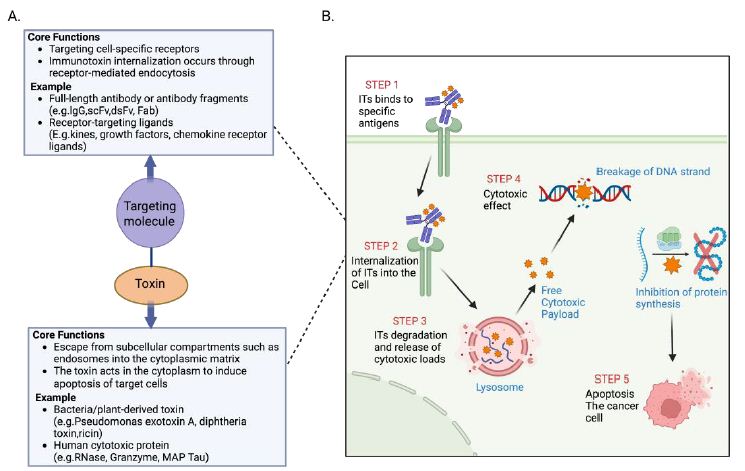
Figure 1: Schematic diagram of IT structure and tumor targeting mechanism. A. Structure of IT B. Tumor Targeting Mechanism: 1. The target molecule of IT binds specifically to the antigen (or receptor) on the surface of tumor cells. 2. ITs are internalized into tumor cells by receptor-mediated endocytosis. 3. Upon entry into the cell, the IT is transported to the lysosome where it undergoes degradation to release the free cytotoxic payload. 4. The cytotoxic payload acts in the cytoplasm: it either disrupts the DNA strand or inhibits protein synthesis. 5. Apoptosis of tumor cells was induced to complete targeted killing.
To address these challenges, there is an urgent need to develop highly efficient integrated drug “production-delivery” systems that enhance the stability, targeting, and bioavailability of ITs while overcoming bottlenecks in large-scale production. As a kind of diverse photosynthetic microorganisms, microalgae have become a research hotspot of new biological carriers due to their inherent advantages [16,17]. More importantly, as an expression platform with both eukaryotic modification ability and low-cost culture characteristics, eukaryotic microalgae can not only directly produce the core functional modules of ITs (such as targeting fragments, toxic molecules, and immune activation elements), but also provide an important reference for the optimization of ITs by developing special expression systems and delivery technologies. In recent years, relevant research results have preliminarily verified its feasibility (Table 1). In addition, microalgae can regulate the tumor microenvironment (TME) and tumor-associated microbiome (TAM) through engineering, creating favorable conditions for ITs to play a therapeutic role [18-20].
Table 1: IT functional components and other functional proteins produced by eukaryotic microalgae.
|
Recombinant protein |
Function | Expression host | Genome engineered |
Core Highlights |
References |
| IT components | |||||
| CD22-targeting ITs (αCD22PE40, αCD22CH23PE40) | Treatment of B-cell lymphoma | Chlamydomonas reinhardtii Chloroplast | Chloroplast | Expresses both monomeric and dimeric forms, which are soluble and enzymatically active; specifically binds CD22-positive B cells for efficient killing; significantly prolongs survival of tumor-bearing mice; avoids in vitro chemical conjugation, reducing off-target toxicity | (Tran et al., 2013) [21] |
| Human IgG antibody against Hepatitis B Virus surface protein (CL4mAb) | Prevention of Hepatitis B virus infection | Phaeodactylum tricornutum | Nuclear genome | Efficiently secretes fully assembled functional antibodies, with a maximum concentration of 2550 ng/mL in culture medium; high purity of secreted antibodies eliminates complex purification steps, enabling low-cost production | (Hempel and Maier, 2012) [22] |
| Attenuated E7 protein of Human Papillomavirus 16 (E7GGG) | Prevention of HPV-related lesions and cancer | C. reinhardtii Chloroplast | Chloroplast | High solubility and strong immunogenicity; induces specific antibody production and T-cell proliferation; provides effective protection against HPV-related tumors; can be produced under sterile and controlled conditions complying with Good Manufacturing Practice(GMP) standards | (Demurtas et al., 2013) [23] |
| Fusion protein of multiple antihypertensive peptides (RPLKPW, LKPNM, AINPSK) | Treatment of hypertension | C. reinhardtii Chloroplast | Chloroplast | Fusion expression of multiple angiotensin-converting enzyme inhibitory peptides; in vivo experiments confirm antihypertensive effect, with the most significant blood pressure reduction 6 hours after oral administration; suitable for direct development of functional foods without complex purification | (Carrizalez-López et al., 2018) [24] |
| Major birch pollen allergen (Bet v 1.0101) | Allergen immunotherapy (AIT) for allergic diseases | C. reinhardtii Chloroplast | Chloroplast | Similar secondary structure and immunological activity to Escherichia coli-expressed counterparts; effectively binds human IgE and mouse-specific IgG; serves as a safe and efficient production platform for oral desensitization vaccines | (Hirschl et al., 2017) [25] |
| Other Functional Proteins | |||||
| Plasmodium falciparum PfCelTOS-IL2 antigen-adjuvant fusion protein | Malaria prevention (pre-erythrocytic and transmission-blocking vaccine) | C. reinhardtii Chloroplast | Chloroplast | Mixotrophic culture (low light) promotes protein accumulation; the fusion protein is soluble, correctly folded, and immunologically active; IL-2 adjuvant enhances antigen immunogenicity | (Shamriz and Ofoghi, 2018, 2019) [26-27] |
| White Spot Syndrome Virus (WSSV) VP28 protein | Prevention and control of WSSV infection in shrimp | C. reinhardtii Chloroplast | Chloroplast | Codon optimization enables efficient expression; the algal strain tolerates the weakly acidic environment (pH 4.0) and 0.3% bile salts in shrimp digestive tracts; oral administration results in a shrimp survival rate of 87%, serving as a carrier for aquatic animal oral vaccines | (Kiataramgul et al., 2020) [28] |
| Hyperthermophilic endoglucanase (CelB)-PTXD chimeric protein | Lignocellulosic degradation, biofuel production | C. reinhardtii Chloroplast | Chloroplast | Cultivable in non-sterile, phosphite-containing medium to avoid contamination; enzyme activity reaches 7.37–8.57 U/g dry weight; PTXD endows the algal strain with phosphorus source selectivity, ensuring culture stability | (Cutolo et al., 2021) [29] |
The engineering strategy further expands the potential of microalgae as IT delivery vectors, and surface modification technology can enhance the specific binding to tumors by coupling targeting ligands [30]. Genome engineering can achieve stable expression of ITs in the chloroplast or nucleus [31,32]. Microalgae-based micro-robots have the ability of autonomous movement and responsiveness to environmental stimuli, and can actively navigate to tumor sites [33,34]. These engineered microalgal systems not only protect ITs from degradation but also reduce off-target toxicity, increase tumor accumulation, and synergistically regulate anti-tumor immune responses [35,36]. In this review, we systematically review the latest progress of engineered microalgae in IT-mediated tumor therapy, including the inherent characteristics of vectors, targeted engineering strategies, synergistic mechanisms, challenges, and prospects, in order to provide a prospective reference for technological innovation and clinical translation in this field.
The Core Potential of Eukaryotic Microalgae as an Integrated “Production-Delivery” Platform for ITs
Recent advances in biopharma have laid the foundation for the research and development of complex protein drugs. However, due to the structural characteristics of macromolecules, industrial production of these drugs is still facing challenges. Cell-free protein synthesis cannot achieve large-scale manufacturing at present, and the production of protein drugs (such as ITs) mainly relies on living cell-based expression systems. Different expression systems have their own advantages and disadvantages (Table 2) [37-41]. Eukaryotic microalgae have unique advantages, such as prokaryotic operation convenience and eukaryotic modification ability, which are extremely promising alternative platforms. Their core advantages are reflected in the synergistic adaptation of “production” and “delivery” dimensions.
Table 2: Comparison of different recombinant protein expression systems.
|
Evaluation Indicator |
Eukaryotic Microalgae (e.g. C. reinhardtii) | Bacteria (e.g. Escherichia coli) | Yeast (e.g. Saccharomyces cerevisiae) | Transgenic Plants (e.g. Tobacco) | Plant Viruses (e.g. Tobacco Mosaic Virus) | Mammalian Cells (e.g. CHO Cells) |
Transgenic Animals (e.g. Cattle and Sheep) |
| Glycosylation Ability | Eukaryotic: mammalian – like; Prokaryotic: None | None | Incorrect (high – mannose type) | Correct (mammalian – like) | Correct (mammalian – like) | Correct (mammalian – like) | Correct (mammalian – like) |
| Target Protein Folding Quality | Good | Poor | Medium | Good | Good | Excellent | Excellent |
| Genetic Manipulation Convenience | Highly Convenient | Highly Convenient | Relatively Convenient | Highly Convenient | Relatively Convenient | Moderately Convenient | Highly Convenient |
| Scale up production feasibility | Easily Achievable | Easily Achievable | Easily Achievable | Easily Achievable | Easily Achievable | Moderate Difficulty | Good Feasibility |
| Proliferation Rate | Rapid | Extremely Fast | Relatively Fast | Slow | Relatively Fast | Slow | Slow |
| Product Output Level | Medium | Extremely High | Relatively High | Relatively High | Extremely High | Relatively Low | Relatively Low |
| Cost of cultivation | Extremely Low | Extremely Low | Relatively Low | Relatively Low | Relatively Low | High | High |
| Biosafety Level | High Safety | Low Safety | Safety Unknown | High Safety | High Safety | Moderate Safety | High Safety |
| Potential Contamination Type | Low Contamination Risk | Endotoxin Contamination | Low Contamination Risk | May contain pesticides, herbicides and toxic plant metabolites | Unknown Contamination Status | May carry viruses, prions and oncogenic DNA | May carry viruses, prions and oncogenic DNA |
These photosynthetic microorganisms belong to the kingdom Protista, encompassing two major groups: prokaryotic cyanobacteria (blue-green algae) and eukaryotic microalgae. They are widely distributed across marine, terrestrial, and extreme ecosystems, and their rich species diversity enables adaptation to diverse applications [42]. Most clinically relevant species (e.g., C. reinhardtii, Dunaliella salina, Chlorella vulgaris, Haematococcus pluvialis) are FDA-approved Generally Recognized as Safe (GRAS) level, with no human pathogen host risk and outstanding biosafety [43]. Its chloroplasts can stably express foreign proteins, and the correct folding rate of over 90% can be achieved by the eukaryotic folding system, and the products are not contaminated by endotoxin. It has the ability of post-translational modification, such as disulfide bond formation, and there is no transgene silencing mechanism. It has successfully expressed SCFV, full-length human IgG1, and a variety of recombinant proteins [44,45]. The nuclear genome also supports efficient transformation. Although the amount of protein accumulation is slightly lower than that of the chloroplast, the resources of alternative markers, promoters, and reporters are abundant, and the expression efficiency can be improved through strategies such as codon optimization [46,47]. Genetic modification techniques for microalgae have become increasingly sophisticated, with transformation methods including DNA-coated nanoparticle uptake, CRISPR-Cas9-mediated transformation, electroporation, gene gun delivery, and Agrobacterium-mediated transformation [48,49]. In addition, the nuclear genome, chloroplast genome, and mitochondrial genome can all realize foreign gene integration, which goes far beyond some expression platforms that can only undergo nuclear transformation [50]. C. reinhardtii, as a model organism, possesses comprehensive molecular genetic tools and genomic databases. It exhibits rapid growth rates (doubling every 8 hours) and can be cultured under phototrophic, mixed-trophic, or heterotrophic conditions. Non-toxic and capable of low-cost protein secretion, its chloroplasts have successfully synthesized complex therapeutics such as foot-and-mouth disease virus VP1-toxin fusion proteins [51]. Diatoms (e.g., P. tricornutum) have attracted attention due to their silicified cell walls and unique ecological functions. Both the nuclear genome and plastidial genome have been stably transformed, and functional monoclonal antibodies can be efficiently secreted and expressed [52,53], providing more species options for IT production. Prokaryotic cyanobacteria have also been genetically engineered to achieve the synthesis of biofuels, bioplastics, and secondary metabolites [54]. Their genetic manipulation technologies (such as plasmid expression systems and homologous recombination) have laid the foundation for the subsequent expression of Its [55].
Biocompatibility and Low Immunogenicity Biocompatibility and Low Immunogenicity
Most clinically relevant microalgae are of the FDA-approved GRAS grade and have a long history of use in the field of food supplements. Their core advantage lies in the dual biocompatibility encompassing production host tolerance and in vivo therapeutic safety. At the production level, microalgae can tolerate the expression of complex ITs by means of the chloroplast sequestration mechanism [21]. At the level of in vivo application, its cell wall polysaccharide (predominantly β-1,3-glucan), photosynthetic proteins (sharing 30%-40% similarity with human homologous proteins), and phospholipid composition similar to that of human cell membranes can minimize immune rejection to the greatest extent [56]. They can also be enzymatically cleaved into non-toxic metabolites, combining host tolerance with in vivo therapeutic safety. Unlike traditional hosts, they do not rely on protease-deficient mutations or balanced lethal systems to circumvent toxin toxicity [57]. In the C57BL/6 mouse model, the drug delivery system constructed with microalgae showed no obvious inflammatory response within 72 hours after intravenous injection (the serum IL-6 level increased by ≤15% compared with the control group), and no inflammatory infiltration was observed in liver tissue sections [58]. By comparison, traditional expression systems have significant limitations: ITs expressed by Escherichia coli are prone to residual endotoxins, which can trigger inflammatory reactions such as fever and vascular leak syndrome [59]. The high-mannose glycan modification of Pichia pastoris tends to induce anti-carrier antibodies, with the antibody positive rate increasing with the frequency of administration [60]. Mammalian cells (e.g., CHO cells) are liable to retain animal-derived components, which increases the risk of allergies [61]. Microalgal microrobots can also be engineered to enhance safety: erythrocyte membrane, macrophage membrane, or PEG molecules can be coated on the surface to achieve immune escape, reduce macrophage phagocytosis rate, and prolong the circulation half-life [62]. Biodegradable materials such as GRAS strain and Fe₃O₄@SiO₂ are selected to ensure that the carrier is enzymatically metabolized without long-term accumulation, which makes it suitable for intravenous, oral, local injection, and other routes of delivery [63]. For example, oral administration of microalga-adriamycin complex can avoid intestinal mucosal injury and penetrate the intestinal barrier, providing new possibilities for the treatment of gastrointestinal tumors [64-66].
Surface Modification of Microalgae: A Key Support for Targeted Delivery of ITs
The surface of microalgae cells is naturally rich in active functional groups. Through a variety of flexible ways, such as covalent coupling, electrostatic interaction, membrane coating, and bioorthogonal reaction, microalgae can modify antibodies, peptides, aptamers, and other targeting elements to significantly improve the specific binding and enrichment ability of ITs to tumor tissues. In traditional modification strategies, microalgae such as C. reinhardtii and Arthrospira platensis are naturally negatively charged on their surfaces, enabling them to efficiently adsorb positively charged ITs (e.g., PE38 toxin domain, saponin) or targeting ligands through electrostatic interaction [67]. For instance, the spirulina-based drug delivery system (SP@Dox) developed by Zhou Min’s team from Zhejiang University achieved targeted tumor accumulation in a breast cancer lung metastasis model. Compared with the unmodified group, the tumor selectivity was increased by 2-3 fold, and the drug accumulation in normal lung tissues was reduced by more than 40% [68]. The chlorella-based biomimetic carrier coated with macrophage cell membrane can precisely deliver ITs by virtue of its inflammation-homing property. This not only increases the drug concentration in inflammation-associated tumor tissues by 3.2-4.5 fold but also reduces the non-specific distribution in normal organs such as the liver and kidneys [69]. In addition, microalgae can be adapted to different tumor targets to form a “one carrier and multiple targets” mode, which can be conjugated with trastuzumab, hyaluronic acid, and cetuximabfor HER2-positive breast cancer, CD44 high expression pancreatic cancer, and EGFR positive lung cancer, respectively, and the preparation cost is more than 40% lower than that of synthetic vectors such as liposomes [70-72].
Different from traditional systems that can only produce ITs, microalgae can achieve the integration of “production-modification”. For example, C. reinhardtii chloroplast can stably express ITs, and the carboxyl group on ITs surface can be directly covalently coupled with RGD peptide without additional purification steps [73], and the specific binding rate is over 85%; The modification of ITs expressed in Escherichia coli requires at least five steps of inclusion body dissolution, renaturation and multiple chromatography, which easily leads to the loss of toxin activity [74]. The targeted modification of ITs expressed in mammalian cells is easily interfered with by serum components [75]. The emerging bioorthogonal reaction (click chemistry) further amplifies the advantages of microalgae modification: Cu (I) -catalyzed azido-alkyne cycloaddition (CuAAC) can form a stable covalent bond between the targeted molecules and microalgae, and the tumor cell binding rate is 5-7 times higher than that of the unmodified group [76]; Strain-enhanced azido – alkyne cycloaddition (SPAAC) can achieve specific coupling under physiological conditions without metal catalyst [77], and retain ITs activity and carrier biocompatibility to the greatest extent. The surface modification of microalgae not only achieves efficient targeted delivery of ITs but also simplifies operation and reduces cost through an integrated process, which provides key technical support for the clinical transformation of ITs.
Structural Stability and High Loading Capacity of Microalgae: The Key to Efficient Delivery of ITs
The unique multi-level cellular structure of microalgae (rigid cell wall, phospholipid bilayer cell membrane, chloroplast and other intracellular compartments) can not only provide a physical barrier for ITs to resist acid-base environment and enzymatic degradation, but also achieve high-capacity loading by means of porous structure and intracellular storage, simultaneously solving the core defects of ITs which are easy to degrade and conformational instability. At the same time, it reduces the process complexity of in vitro loading and provides a double guarantee for efficient delivery.
(1) The multilayered structure confers strong stability and prolongs the active period of ITs
The rigid cell wall (containing cellulose, peptidoglycan, silica, and other components) acts as a “first line of defense” to physically isolate proteases, nucleases, and acidic environments in the blood [78], such as the siliceous shell of diatoms and the model toxin encapsulated by the cellulose-pectin complex cell wall of Chlorella. After incubation in the simulated fluid containing 1mg/mL trypsin for 72 hours, the activity retention rate was more than 70%, which was much higher than 15%-20% of the free toxin [79]; Spirulina-peptidoglycan cell wall could reduce the contact between protease and intracellular toxin, and the toxin activity could maintain more than 65% after 48 hours of incubation in pH 5.0 acidic environment [80]; The phospholipid bilayer can isolate pH-sensitive toxins (e.g., Pseudomonas aeruginosa exotoxin A) from the acidic environment of endosomes and lysosomes through hydrophobic interaction, resulting in a 3.3-fold longer half-life in vivo than the free form [81,82]; The thylakoid membrane of chloroplast can also provide a “secondary protection”, which can achieve a continuous and slow release of ITs in the cytoplasm even if the microalgal cell membrane is destroyed by lysosomes, avoiding toxic burst or rapid degradation [83]. In contrast, ITs expressed by Escherichia coli (e.g., PE38, DT388) require additional modification with BSA or PEG to resist degradation, with a half-life of only 2-4 hours [84]. ITs expressed by Pichia pastoris lose more than 60% of their activity within 24 hours in a simulated intestinal environments [85]. For ITs expressed by mammalian cells (e.g., CHO cells), low-temperature storage and stabilizers are necessary. Moreover, their stability decreases significantly in the presence of an acidic environment and proteases, making them unable to tolerate the complex tumor microenvironment [86,87]. In contrast, microalgae can achieve the stable existence of ITs without additional modification by virtue of their natural structure.
(2) Multiple load mechanism to achieve high-capacity delivery and adapt to different types of ITs
Microalgae support three loading modes, including physical encapsulation, chemical conjugation, and intracellular expression and storage, which can be flexibly adapted according to the hydrophilicity, hydrophobicity, and molecular size of ITs. The loading capacity of microalgae is significantly higher than that of synthetic vectors and traditional expression system-derived vectors. In terms of physical encapsulation, the porous silica shell of diatoms and the intracellular cavity of Chlorella can encapsulate small-molecule toxins or bioactive conjugates in batch, and the loading capacity of some microalgae-based carriers is better than that of traditional liposomes [88]. In the chemical coupling mode, the active groups, such as the hydroxyl group and the carboxyl group, on the cell wall surface could form covalent bonds with ITs to achieve stable loading. Microalgae such as Spirulina had high coupling efficiency and could well retain the loading molecular activity [89]. Under the mode of intracellular expression and storage, the chloroplast genome of microalgae can directly express ITs and store them [90]. The chloroplast of C. reinhardtii has been proven to be an efficient expression platform for recombinant therapeutic proteins. The products exhibit excellent solubility and comparable activity to those from traditional systems. Meanwhile, the thylakoid membranes of the chloroplast can provide protection for the expressed products, endowing them with greater advantages in activity retention compared to prokaryotic expression systems. Additionally, mild ultrasonic treatment can form nanoscale micropores in the chlorella cell wall to enhance encapsulation efficiency. Regulating the nitrogen source concentration in the culture medium can induce microalgae to accumulate lipid droplets, significantly increasing their loading capacity for hydrophobic molecules [91].
(3) Synergy of Stability and Loading Capacity, Adapting to Diversified Therapeutic Scenarios
In local long-acting tumor therapy, embedding the microalgae-bioactive molecule complex in sodium alginate bio-degradable hydrogel and implanting it locally at the tumor site can not only protect the loaded molecules from degradation by hydrolytic enzymes but also achieve sustained release through the porous structure, thereby extending the local effective treatment cycle [92]; In the scenario of systemic delivery, bioactive molecules encapsulated by spirulina can resist degradation by metabolic enzymes in the body after intravenous injection, enhance the enrichment efficiency at tumor sites, and alleviate off-target toxicity to organs such as the kidneys [93,94]. Traditional expression systems have long faced the core bottleneck of stability and load imbalance. Microalgae, through the synergistic advantages of structural protection and high capacity loading, simultaneously solve the key problems of insufficient stability and low delivery efficiency of ITs, providing a more suitable integrated solution for diverse clinical scenarios.
Complementary Applications of Microalgae and Conventional Platforms
Different expression platforms exhibit distinct adaptabilities, and there is no absolute superiority or inferiority among them: the microalgae platform is suitable for ITs that do not require complex glycosylation and demand low-cost, large-scale production (e.g., CD22-targeted ITs). Its culture cost is only 1/5 to 1/3 of that of Escherichia coli and more than 80% lower than that of CHO cells [95]; Mammalian cells are still the preferred choice for highly active ITs requiring precise glycosylation, which can achieve complex post-translational modifications and ensure ITs in vivo stability and targeted binding activity [96]. E. coli can be used for rapid expression of short peptide toxin fragments with a short turnaround time (only 24-48 hours), which is suitable for preliminary functional verification in the laboratory stage [97]. For practical applications, a strategy of “segmented production + in vitro assembly” can be used, such as microalgae expressing the target ligand and toxin backbone, followed by mild chemical coupling (e.g., SPAAC click chemistry) to achieve functional assembly, which takes both production cost and product activity into consideration.
Limitations of Existing Loading Strategies and Breakthroughs in Microalgal Recombinant Expression Systems
The production and delivery of traditional targeted drugs (including “magic bullet” drugs such as ITs) have long faced core technical bottlenecks, which seriously restrict their clinical translation efficiency. Currently reported microalgae-based microrobots (Figure 2), while integrating the natural motility of microalgae with engineered modification properties, achieve autonomous movement driven by flagella and can be precisely regulated via external stimuli such as light and magnetic fields [98,99]. These robots offer a promising solution for the active navigation and targeted delivery of ITs. However, such systems primarily achieve targeted drug delivery through chemical modification strategies like covalent binding and electrostatic adsorption, or physical loading methods such as biomembrane encapsulation [100,101], and thus still possess significant inherent limitations.
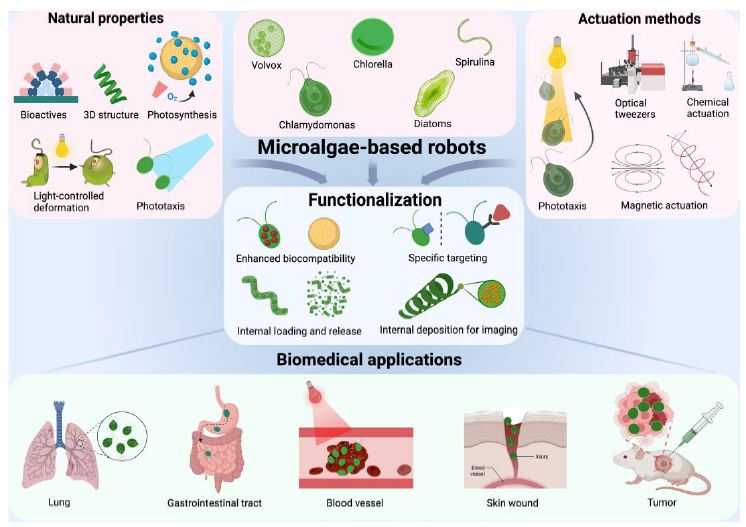
Figure 2: schematic depicts the natural properties, actuation methods, functionalization strategies, and biomedical applications of microalgae-based robots.
The first is the “single-use” limitation. The microalgae and the drug are not integrated in the design, and the micro-algae carrier has no regenerative loading capacity after the loaded part works, which is eventually removed by immune cells and cannot be reused. For example, the C. reinhardtii -red blood cell membrane-coated nanoparticle robot developed by the University of California, San Diego, can specifically deliver doxorubicin to lung metastatic tumor sites, significantly reduce tumor volume, and extend the median survival time of model mice from 27 days to 37 days [102]. However, it still fails to overcome this limitation. Second, large-scale production is limited, chemical modification requires secondary treatment, and biofilm encapsulation is limited by capacity, proliferation, and transmission, which leads to a cumbersome process and about 40% reduction in efficiency [103]. Thirdly, there is insufficient loading stability and adaptability. Chemically modified drugs are prone to detachment, leading to off-target toxicity. Biomembrane encapsulation has a narrow adaptability range for drugs with different molecular weights and hydrophilic-hydrophobic properties. For instance, ITs with a molecular weight greater than 100 kDa are difficult to load efficiently, while the loading rate of chemically modified small-molecule toxins may drop to less than 50% of the initial value after 24 hours of in vivo circulation [104]. For example, in the spirulina delivery system modified with Fe₃O₄ nanoparticles, the detachment rate of the loaded doxorubicin reaches 58% after 24 hours of in vivo circulation, resulting in toxic reactions induced by drug accumulation in some normal tissues [105].
The recombinant expression system in eukaryotic microalgae provides an innovative way to break through these limitations and is expected to solve the key challenge of the lack of efficient adaptation production platforms for ITs. The core breakthroughs focus on three aspects: first, the integrated production of carrier and drug. Microalgae are genetically engineered to directly express ITs or functional antibodies, and then stably stored or directed released by means of chloroplast isolation, signal peptide-mediated secretion, and other mechanisms, without in vitro modification or encapsulation steps, to avoid the loss of drug activity and the risk of contamination. For example, Synechocystis sp. PCC 6803 ex-pression system constructed by Zhang et al. successfully expressed phycocyanin (C-PC) and prepared polyclonal anti-bodies with a titer as high as 1: 1,025,000. Western blot analysis confirmed its high specificity, and due to the absence of in vitro chemical modification throughout the process, the antibody activity retention rate exceeded 95% [106]. Another study confirmed that when using chloroplast engineering technology to express fish virus subunit vaccines, the isolation and protection effect of the thylakoid membrane could make the antigen activity retention rate up to 94%, and the production efficiency was 38% higher than that of the traditional process [107]. Second, it possesses the capability of sustainable proliferation and stable expression. The engineered microalgae, after modification, can reproduce repeatedly under simple conditions, and their progeny can still stably carry and express ITs, achieving “one-time modification and continuous production.” This eliminates the need for repeated synthesis and significantly simplifies the production process. For example, the glass bead transformation method established by Kindle et al. successfully achieved nuclear transformation of Chlamydiae reinhardtii, which provided a reliable technical basis for the introduction of exogenous genes [108,109] further optimized the exogenous gene expression system of C. rhinophylla by inserting endogenous regulatory elements into the transgenic sequence, which significantly improved the expression stability. After successive passages, the expression of exogenous genes in the recombinant algal strain did not decrease significantly, and the growth rate was consistent with that of the wild-type algal strain [109]. Third, it enhances delivery safety and efficiency. ITs are expressed and stored by microalgae themselves, avoiding the reduction in biocompatibility caused by chemical modification. Meanwhile, by integrating the natural motility of microalgae with engineered navigation modules such as light and magnetic responsiveness, it enables full-chain controllable delivery encompassing “autonomous movement – targeted enrichment – endogenous release.” For example, the functionalized diatom delivery system constructed by De la Soie et al., which is modified with vitamin B₁₂-targeting molecules and a light-responsive module on its surface, achieves a 2-fold increase in targeted enrichment and photoactivated toxicity against colorectal cancer cells [110].
Although there is no direct study on the delivery of ITs mediated by microalgae, microalgae, as a natural delivery carrier with excellent biocompatibility, have accumulated a large number of successful cases in the delivery of “magic bullet” drugs (targeted chemotherapy drugs, immunomodulators, etc.), which provides an important reference for the application of ITs (Table 3). The nuclear and chloroplast genomes of the model microalgae have been transformed efficiently, and the CRISPR-Cas9 precision editing technology is mature. The chloroplast expression system has no transgene silencing and can complete key post-translational modifications. The commercial application of large-scale culture technology lays a solid foundation for the mass production of ITs. This integrated mode of “production-delivery” not only breaks through the limitations of existing microalgal robotics but also builds a low-cost, sustainable, and high-safety system, which is expected to become an ideal platform for the production and delivery of ITs. Subsequent optimization of microalgal surface targeting modifications (such as coupling with specific ligands, such as anti-CD22 and anti-HER2) and IT expression systems (such as chloroplast promoter optimization and signal peptide screening) can achieve synergistic optimization of efficient production and precise delivery, providing a new path for the clinical transformation of “magic bullet” drugs.
Table 3: Targeted delivery and clinical application of microalgae-based robots.
|
Microalgae Category |
Modification Techniques |
Carrier Substances |
Targeting Methods |
Clinical Application |
References |
| C. reinhardtii | Electrostatic interaction load | Doxorubicin | Light signal-regulated guidance | Bioactive substance delivery | (Akolpoglu et al., 2020b) [111] |
| Click on chemical coupling | Ciprofloxacin | Passive enrichment in lung capillaries | Acute bacterial pneumonia intervention | (Zhang et al., 2022b) [112] | |
| Click chemical modification | Vancomycin + Ciprofloxacin | Light-controlled targeted delivery | Bacterial infectious disease prevention and treatment | (Shchelik et al., 2021) [113] | |
| Cell-penetrating modification | Functional drugs | Magnetic field-driven navigation | Bioactive substance delivery, fluorescence tracing | (Santomauro et al., 2018) [114] | |
| C. pyrenoidosa | Electrostatic adsorption loading | Doxorubicin | In situ direct injection | Osteosarcoma targeted therapy | (Liang et al., 2024b) [115] |
| Electrodeposition modification | Doxorubicin | Magnetic field-regulated navigation | Targeted drug delivery efficacy enhancement | (Gong et al., 2022) [116] | |
| Calcium phosphate coating modification | / | Active dispersion targeting | Improvement of radiotherapy resistance in hypoxic tumors | (Zhong et al., 2021b) [117] | |
| Cell membrane coating process | Chloroquine + Hematoporphyrin dihydrochloride | Immune-mediated targeting | Antitumor immunotherapy efficacy enhancement | (Gao et al., 2023) [118] | |
| Hydrogel composite modification | Doxorubicin | In situ injection administration | Hypoxic breast cancer treatment | (Lee et al., 2019) [119] | |
| Spirulina | Electrostatic adsorption loading | Doxorubicin | Passive targeting to lung capillaries | Breast cancer lung metastasis treatment | (Zhong et al., 2020) [120] |
| Electrostatic interaction-based loading | Doxorubicin | In situ injection administration | Osteosarcoma clinical treatment | (An et al., 2024) [121] | |
| Electrostatic adsorption technology | Astaxanthin | Passive entrapment by intestinal villi | Radiotherapy-related injury protection | (Zhang et al., 2023) [122] | |
| Cell encapsulation technology | Curcumin | Passive retention by intestinal villi | Oral drug delivery for intestinal diseases | (Zhong et al., 2021d) [123] | |
| Cell encapsulation process | Amifostine | Passive entrapment by intestinal villi | Intestinal radiotherapy injury protection | (Zhang et al., 2022a) [124] | |
| Cell encapsulation technology | Metformin | In situ injection administration | Targeted intervention for osteoarthritis | (Liang et al., 2024d) [125] | |
| Electrodeposition modification process | Doxorubicin | Magnetic field-driven navigation | Chemo-photothermal synergistic therapy | (Wang et al., 2019) [126] | |
| Hydrogel composite modification | Resveratrol | Floating retention in gastric juice | Alcohol-related disease treatment | (Hua et al., 2024) [127] |
Mechanisms of Enhanced Efficacy in Engineering Microalgae-Mediated IT Therapy
Engineered microalgae can significantly improve the therapeutic effect of ITs through multidimensional mechanisms such as enhancing tumor penetration, regulating tumor microenvironment and tumor-associated microbiome, and cooperative immune regulation. It can effectively solve the key bottleneck of clinical application of traditional ITs and provide core technical support for their clinical transformation.
Enhancement of Tumor Penetration
Microalgae-based microrobots, leveraging the advantages of natural flagella-driven autonomous motility and small size (1-10 μm), exhibit superior penetration capability into solid tumors compared to passive delivery systems such as liposomes and nanoparticles. McCord et al. confirmed via optical tweezers technology that the flagellar propulsive force of wild-type C. reinhardtii is significantly higher than that of flagellar structure-deficient mutants, providing a dynamic basis for its penetration through dense biological matrices [128]; Related studies have shown that C. reinhardtii can effectively cross the physical barrier composed of collagen fibers and glycosaminoglycans in the tumor extracellular matrix (ECM) by means of the voluntary movement driven by two flagella, and its tissue penetration ability is significantly better than that of static nanoparticles [129]. The advantages of self-driven microrobots in solid tumor penetration have been demonstrated in many studies. For example, the Fe₃O₄-mediated self-driven nanobots constructed by Banerjee et al. can penetrate into the core of the tumor in the HCT116 colorectal cancer tumor sphere in vitro, and the drug distribution is significantly better than that of free drug delivery and passive delivery vehicles. The disintegration of tumor spheres can be induced within 72 hours, which effectively solves the problem of uneven distribution of therapeutic agents and insufficient killing of deep cells, and significantly improves the killing efficiency of tumor cells [130].
Regulation of Tumor Microenvironment and Tumor-associated Microbiome
Polysaccharides, proteins, and antioxidant substances in microalgae can reduce inflammatory response, alleviate tumor hypoxia, and enhance anti-tumor immunity. In terms of microenvironment regulation, studies have shown that spirulina can significantly reduce the levels of TNF-α and other pro-inflammatory cytokines in tissues by inhibiting the NF-κB signaling pathway, and play an anti-inflammatory role [131]; Seaweed polysaccharides can inhibit macrophage activation by blocking the nuclear translocation of NF-κB, thereby reducing the release of IL-6 and TNF-α [132]; In addition, spirulina polysaccharides can effectively inhibit the polarization of tumor-associated macrophages (TAM) towards the tumor-promoting M2 phenotype (an anti-inflammatory macrophage subtype that promotes tumor angiogenesis, invasion, and metastasis), thereby collectively improving the tumor inflammatory microenvironment [133]. More importantly, the photosynthesis of microalgae can produce oxygen continuously in the tumor site, which not only enhances the killing activity of ITs against hypoxic cancer cells but also enhances the activity of immune cells. In terms of microbiome regulation, Ge et al. [134] confirmed that oral administration of spirulina can selectively regulate the structure of intestinal flora and increase the abundance of beneficial bacteria through its rich β-glucan and other prebiotics, thereby improving the body’s immune function [134]. Relevant studies have further confirmed that the increase in the abundance of beneficial intestinal bacteria can promote the maturation of dendritic cells and indirectly enhance the anti-tumor immune response of immunotherapy, which provides a mechanism to support the synergistic effect of engineered spirulina [135].
Synergistic Immunoregulatory Effects
The engineered characteristics of microalgae not only enhance their ability as IT delivery vectors, but also achieve synergistic effects with ITs through a variety of ways to improve the effect of anti-tumor immunity. Bioactive components released by microalgae can directly affect the function of immune cells. Polysaccharides (such as β-glucan) can bind to innate immune cell receptors, activate macrophages and dendritic cells, and induce the secretion of key cytokines, including IL-12 and TNF-α, which lay the foundation for the initiation of the acquired immune response. Enhance the body’s recognition and attack of tumor cells [136]; At the same time, its specific compounds can regulate the production of cytokines, reduce the level of immunosuppressive factors in the tumor microenvironment, inhibit the activity of MDSC (tumor-associated myeloid suppressor cells), and create favorable conditions for T cells and NK cells to exert anti-tumor effects [137,138]. Engineered microalgae also have the potential to activate long-term memory immune cells, such as memory T cells, which provides the possibility of improving the long-term efficacy of treatment and enhancing the immune system’s long-term monitoring and elimination ability against cancer cells. This direction is worthy of further exploration [139-141]. Additionally, microalgae can combine with immune-activating particles, such as CpG oligonucleotides, to further stimulate the anti-tumor activity of immune cells. Through the coordination of delivery systems and immune activation mechanisms, microalgae can significantly enhance cell-specific immune responses [142]. In the combination therapy scenario, microalgae can achieve an amplification of efficacy when combined with other cancer therapies, such as checkpoint inhibitors and CAR-T cell therapy. This combi-nation can not only provide sustained release of immunomodulatory factors but also efficiently deliver ITs to form synergistic effects through multiple mechanisms [143,144]. Through continuous improvement of the coordination strategy of microalgae and ITs, the killing ability of tumor cells can be greatly improved, and exploring the differences in the roles of different microalgae species in activating different immune pathways also opens up a new direction for follow-up research in this field.
Challenges and Future Prospects
Although engineered microalgae have shown significant potential in IT production, they still face several technical bottlenecks. Firstly, the expression efficiency is low. At present, the expression level of microalgal recombinant proteins is generally low, which is difficult to meet the needs of large-scale clinical application; Secondly, the purification process is complex, the microalgae cell wall structure is dense, which increases the difficulty of protein extraction, and the traditional fragmentation method may also lead to the degradation of the target protein; In addition, the immunogenicity problem should not be ignored. The glycosylation pattern of the microalgae expression system is different from that of mammalian cells, which may cause the expressed ITs to trigger non-specific immune responses in the host. In terms of targeted delivery, the tumor enrichment efficiency of microalgal vectors still needs to be improved. During oral administration, gastric acid and digestive enzymes in the gastrointestinal tract will cause significant damage to microalgal cells, resulting in low bioavailability. When injected intravenously, unmodified microalgae are easily cleared by the reticuloendothelial system and shorten the half-life of blood circulation. Synthetic biology technology has provided a clear optimization path to solve the above bottlenecks. By introducing heterologous signal peptide genes into model microalgae such as C. reinhardtii and reconstructing the ER-Golgi secretion pathway, the secretion efficiency and extracellular recovery rate of recombinant proteins can be significantly improved [145]; At the same time, the central carbon metabolism network and amino acid synthesis pathway were optimized to increase the supply of key amino acids and provide raw material support for the efficient synthesis of special structure Its [146].
The development of intelligent delivery systems is also the core of future research. The integration of blue-light-inducible promoters can realize the precise activation and release of ITs by light [147], and the pH-sensitive modification technology can make the microalgal vectors respond to the acidic tumor microenvironment to achieve targeted release and increase the local therapeutic concentration [148]. Advancing clinical translation requires multidisciplinary collaboration, with breakthroughs focused on three key areas. First, establish GMP-compliant large-scale microalgae cultivation and purification processes. Optimize parameters in closed photobioreactors—including light intensity (120–150 μE·m⁻²·s⁻¹), temperature (25±1°C), and pH (7.0–7.5)—to ensure batch consistency of products (purity ≥95%, coefficient of variation in activity ≤10%) [149]; second, enhancing immunogenicity-related research by conducting systematic safety evaluations (including acute toxicity, chronic toxicity, and immunogenicity assessments) and developing standardized clinical assessment methods (e.g., measuring anti-microalgal carrier IgG and IgE antibody titers in patient serum) [150]; Third, optimize the administration method by using enteric coating or targeted nano-suspensions to increase oral bioavailability from 10%–15% to over 30%, thereby reducing the required dosage and the risk of adverse reactions [151,152].
At present, preliminary progress has been made in the preclinical study of microalgae-mediated ITs. For example, anti-CD22 ITs expressed by C. reinhardtii were intraperitoneally injected consecutively at a dose of 10 mg/kg for 4 weeks in a mouse model of B-cell lymphoma; the tumor inhibition rate reached 58%-72%, with no significant weight loss or liver and kidney function damage observed. In the future, combination therapy and personalized treatment will become the core development direction. Micro-algal IT combined with CAR-T cell therapy can alleviate tumor hypoxia through microalgal oxygen generation, inhibit M2 macrophage polarization, and increase the infiltration rate of CAR-T cells by 2-3 times [153]; Based on patient-derived tumor organoids, suitable combinations of microalgae-expressing ITs (such as anti-HER2 ITs + immune activation module for HER2-positive breast cancer) can be rapidly screened to achieve “tailored” precision treatment and reduce the incidence of adverse reactions [154].
Conclusion
Engineered microalgae, as an emerging platform for IT production and delivery, offer innovative solutions for cancer treatment through their exceptional biosynthetic capabilities, outstanding cost-effectiveness, and favorable biocompatibility. From fundamental research to clinical translation, this platform has achieved significant progress in IT design, efficient production, and elucidation of the mechanism of action, demonstrating remarkable potential, particularly in targeted therapies for hematological malignancies and solid tumors. In the future, with the continuous development of synthetic biology, gene editing and nanobiotics, engineered microalgal systems will be iteratively upgraded to the direction of intelligence and precision. By optimizing expression efficiency, innovating delivery systems and developing combined treatment strategies, microalgal IT expression is expected to become one of the core technologies of the next generation of cancer immunotherapy. It provides a new way to solve the key problems such as drug resistance and side effects in current cancer treatment.
Author Contributions
Yuxin Xie: Conceptualization, Visualization, Data curation, Writing – original draft. Xiaoyu Deng: Formal analysis, Writing – review & editing. Quan Wang: Supervision, Writing – review & editing. Jishi Lv: Project administration, Supervision, Funding acquisition.
Funding
This research was funded Hubei University of Science and Technology Cultivate Scientific Research Project (2025-26X11).
Conflicts of Interest
The authors declare that the research was conducted in the absence of any.
References
- Bray F, M Laversanne, H Sung, J Ferlay, RL Siegel, et al. (2024) Global cancer statistics 2022: GLOBOCAN estimates of incidence and mortality worldwide for 36 cancers in 185 countries. CA A Cancer J Clinicians 74: 229-263. [crossref]
- Wu Y, S He, M Cao, Y Teng, Q Li, et al. (2024) Comparative analysis of cancer statistics in China and the United States in 2024. Chinese Medical Journal 137: 3093-3100. [crossref]
- Diao, J., Y. Jia, E. Dai, J. Liu, R. Kang, et al. (2024a) Ferroptotic therapy in cancer: benefits, side effects, and risks. Mol Cancer 23. [crossref]
- Diao, J., Y. Jia, E. Dai, J. Liu, R. Kang, et al. (2024b) Ferroptotic therapy in cancer: benefits, side effects, and risks. Mol Cancer 23. [crossref]
- Farhangnia, P., H. Khorramdelazad, H. Nickho and A.-A. Delbandi (2024) Current and future immunotherapeutic approaches in pancreatic cancer treatment. J Hematol Oncol 17. [crossref]
- Thrush GR, LR Lark, BC Clinchy, ES Vitetta (1996) Immunotoxins: An Update. Annu Rev Immunol 14: 49-71. [crossref]
- Kreitman RJ (2000) Immunotoxins. Expert Opinion on Pharmacotherapy 1: 1117-1129.
- Kreitman RJ (2006) Immunotoxins for targeted cancer therapy. AAPS J 8: E532-E551. [crossref]
- Akbari, B., S. Farajnia, S. Ahdi Khosroshahi, F. Safari, M. Yousefi, H. Dariushnejad and L. Rahbarnia 2017a. Immunotoxins in cancer therapy: Review and update. International Reviews of Immunology 36: 207–219.
- Lee HB, SG Park, HJ Kim, JP Jeon, S Oh, et al. (2025) CD7-Targeted Cytotoxic Potency of Diphtheria Toxin- and Ricin-Based Immunotoxins in Targeted Therapy for T-Cell Acute Lymphoblastic Leukemia. Mol Pharmaceutics 22: 3255-3267. [crossref]
- Mesri A, N Asadi, H Maleki‐Kakelar, A Maleksabet, R Saadatian Kharajo, et al. (2025) Ribonuclease‐Based Immunotoxins as Anticancer Agents. Biotech and App Biochem bab 70046. [crossref]
- Rajabi, A., M. Ataee, H.M. Hosseini and J. Amani. 2025. Chitosan gold nanogel containing Rova-Typhoid immunotoxins against the DLL3 receptor has a promising effect on small-cell lung cancer. Naunyn-Schmiedeberg’s Arch Pharmacol 398: 17043-17055. [crossref]
- Akbari B, Farajnia S, Ahdi Khosroshahi, F Safari, M Yousefi, H Dariushnejad, et al. (2017b) Immuno-toxins in cancer therapy: Review and update. International Reviews of Immunology 36: 207-219.
- Movahedpour A, K Ahmadi, M Taheri-Anganeh, A Amiri, N Ahmadi, et al. (2022) Designing a Humanized Immunotoxin Based on HER2 Specific scFv and DFF40 Toxin Against Breast Cancer: An In-Silico Study. Int J Pept Res Ther 28.
- Yuan Y, X Wang, J Ge, W Jiang, Z Li, et al. (2023b) Developmental immunotoxicity of maternal exposure to yttrium nitrate on BALB /c offspring mice. Environmental Toxicology 38: 1939-1950. [crossref]
- Vasilieva, S.G., E.S. Lobakova, A.A. Lukyanov and A.E. Solovchenko (2016) Immobilized microalgae in biotechnology. Moscow Univ Biol Sci Bull 71: 170-176.
- Khavari F, M Saidijam, M Taheri, F Nouri (2021) Microalgae: therapeutic potentials and applications. Mol Biol Rep 48: 4757-4765. [crossref]
- Zhong D, W Li, S Hua, Y Qi, T Xie, et al. (2021a) Calcium phosphate engineered photosynthetic microalgae to combat hypoxic-tumor by in-situ modulating hypoxia and cascade radio-phototherapy. Theranostics 11: 3580-3594. [crossref]
- Liang F, X An, R Wang, W Wu, L Yang, et al. (2024a) Microalgae-based drug delivery system for tumor microenvironment photo-modulating and synergistic chemo-photodynamic therapy of osteosarcoma. Engineered Regeneration 5: 199-209.
- Qiu T, X Li, H Sun, S Zhang, Y An, et al. (2025) Advancements of algae-involved cancer treatment. Swwlxb 11. [crossref]
- Tran M, C Van, DJ Barrera, PL Pettersson, CD Peinado, et al. (2013) Production of unique immunotoxin cancer therapeutics in algal chloroplasts. Proc Natl Acad Sci U S A 110. [crossref]
- Hempel F, UG Maier (2012) An engineered diatom acting like a plasma cell secreting human IgG antibodies with high efficiency. Microb Cell Fact 11. [crossref]
- Demurtas OC, S Massa, P Ferrante, A Venuti, R Franconi, and G. Giuliano. 2013. A Chlamydomonas-Derived Human Papillomavirus 16 E7 Vaccine Induces Specific Tumor Protection. PLoS ONE 8. [crossref]
- Carrizalez-López C, O González-Ortega, CE Ochoa-Méndez, FU Galván-Moreno, S Rosales-Mendoza, et al. (201). Expression of multiple antihypertensive peptides as a fusion protein in the chloroplast of Chlamydomonas reinhardtii. J Appl Phycol 30: 1701-1709.
- Hirschl S, C Ralser, C Asam, A Gangitano, S Huber, C Ebner, et al. (2017) Expression and characterization of functional recombinant Bet v 1.0101 in the chloroplast of Chlamydomonas reinhardtii. International Archives of Allergy and Immunology 173: 44-50. [crossref]
- Shamriz S, H Ofoghi (2018) Engineering the chloroplast of Chlamydomonas reinhardtii to express the recombinant PfCelTOS-Il2 antigen-adjuvant fusion protein. Journal of Biotechnology 266: 111-117. [crossref]
- Shamriz S, H Ofoghi (2019) Expression of Recombinant PfCelTOS Antigen in the Chloroplast of Chlamydomonas reinhardtii and its Potential Use in Detection of Malaria. Mol Biotechnol 61: 102-110. [crossref]
- Kiataramgul A, S Maneenin, S Purton, N Areechon, I Hirono, et al. (2020) An oral delivery system for controlling white spot syndrome virus infection in shrimp using transgenic microalgae. Aquaculture 521.
- Cutolo E, M Tosoni, S Barera, L Herrera-Estrella, L Dall’Osto, et al. (2021) A chimeric hydrolase-PTXD transgene enables chloroplast-based heterologous protein expression and non-sterile cultivation of Chlamydomonas reinhardtii. Algal Research 59.
- Zhou M, Y Yin, J Zhao, M Zhou, Y Bai, et al. (2023) Applications of microalga-powered microrobots in targeted drug delivery. Biomater Sci 11: 7512-7530. [crossref]
- Lu Y, X Zhang, X Gu, H Lin, A Melis (2021) Engineering microalgae: transition from empirical design to programmable cells. Critical Reviews in Biotechnology 41: 1233-1256. [crossref]
- Jayaprada T and JJ Wewalwela (2023) The Application of DNA Transfer Techniques That Have Been Used in Algae. In: CO Adetunji, JK Oloke, N Dwivedi, SB Ummalyma, S. Dwivedi, D.I. Hefft, and J.B. Adetunji (eds.), Next‐Generation Algae. Wiley. Pg: 195-224.
- Chen T, Y Cai, B Ren, BJ Sánchez, R Dong (2024b) Intelligent micro/nanorobots based on biotemplates. Mater Horiz 11: 2772-2801. [crossref]
- Wang X, S Ma, R Liu, T Zhang, X Mao, et al. (2025b) Microalgae-driven microrobots: revolutionizing drug delivery and targeted therapy in biopharmaceuticals. Adv Biotechnol 3.
- Ahmadishoar S, S Mones Saeed M Salih Mahdi, W Mohammed Taher, M Alwan, M Jasem Jawad, et al. (2025) The potential use of bacteria and their derivatives as delivery systems for nanoparticles in the treatment of cancer. Journal of Drug Targeting 33: 1272-1305. [crossref]
- Wang Q, R Cao, Y Xie, Z Zhang, X Li, Y Zhang, et al. (2025a) Unlocking the potential of engineered microbes in immunotoxin-based cancer therapy. Front Microbiol 16. [crossref]
- Brondyk WH (2009) Selecting an appropriate method for expressing a recombinant protein. Methods in Enzymology 463: 131-147. [crossref]
- Kunert R, E Casanova (2013) Recent advances in recombinant protein production: BAC-based expression vectors, the bigger the better. Bioengineered 4: 258-261. [crossref]
- Meyer S, C Lorenz, B Baser, M Wördehoff, V Jäger, et al. (2013) Multi-Host Expression System for Recombinant Production of Challenging Proteins. PLoS ONE 8. [crossref]
- Gecchele E, M Merlin, A Brozzetti, A Falorni, M Pezzotti et al. (2015) A comparative analysis of recombinant protein expression in different biofactories: bacteria, insect cells and plant systems. Journal of Visualized Experiments: JoVE. [crossref]
- Gomes A., SM Byregowda, BM Veeregowda, V Balamurugan (2016) An overview of heterologous expression host systems for the production of recombinant proteins. Adv Anim Vet Sci 4: 346-356.
- Hachicha R, F Elleuch, H Ben Hlima, P Dubessay, H de Baynast, et al. (2022) Biomolecules from microalgae and cyanobacteria: Applications and market survey. Applied Sciences 12.
- Su M, L Bastiaens, J Verspreet, M Hayes (2023) Applications of microalgae in foods, pharma and feeds and their use as fertilizers and biostimulants: legislation and regulatory aspects for consideration. Foods 12. [crossref]
- Dyo YM, S Purton (2018) The algal chloroplast as a synthetic biology platform for production of therapeutic proteins. Microbiology 164: 113-121. [crossref]
- Siddiqui A, Z Wei, M Boehm, N Ahmad (2020) Engineering microalgae through chloroplast transformation to produce high‐value industrial products. Biotechnology and Applied Biochemistry 67: 30-40. [crossref]
- Baier T, J Wichmann, O Kruse, KJ Lauersen (2018a) Intron-containing algal transgenes mediate efficient recombinant gene expression in the green microalga Chlamydomonas reinhardtii. Nucleic Acids Research 46: 6909-6919. [crossref]
- Perozeni F, T Baier (2023) Current nuclear engineering strategies in the green microalga Chlamydomonas reinhardtii. Life 13.
- Feng S, X Xie, J Liu, A Li, Q Wang, et al. (2023) A potential paradigm in CRISPR/Cas systems delivery: at the crossroad of microalgal gene editing and algal-mediated nanoparticles. J Nanobiotechnol 21. [crossref]
- Ahmad Kamal AH, NF Mohd Hamidi, MF Zakaria, A Ahmad, MR Harun, et al. (2024) Genetically engineered microalgae for enhanced bioactive compounds. Discover Applied Sciences 6.
- Guihéneuf F, A Khan, LSP, Tran (2016) Genetic engineering: a promising tool to engender physiological, bio-chemical, and molecular stress resilience in green microalgae. Frontiers in plant science .7. [crossref]
- Sun M, K Qian, N Su, H Chang, J Liu, et al. (2003) Foot-and-mouth disease virus VP1 protein fused with cholera toxin B subunit expressed in Chlamydomonas reinhardtii chloroplast. Biotechnology Letters 25: 1087-1092. [crossref]
- Veluchamy A, A Rastogi, X Lin, B Lombard, O Murik, et al. (2015) An integrative analysis of post-transational histone modifications in the marine diatom Phaeodactylum tricornutum. Genome Biol 16. [crossref]
- Dhaouadi F, F Awwad, A Diamond, I Desgagné-Penix (2020) Diatoms’ breakthroughs in biotechnology: Phaeo-dactylum tricornutum as a model for producing high-added value molecules. American Journal of Plant Sciences 11: 1632-1670.
- Agarwal PR, Soni P, Kaur A, Madan R, Mishra J, et al. (2022) Cyanobacteria as a promising alternative for sustainable environment: Synthesis of biofuel and biodegradable plastics. Frontiers in Microbiology. [crossref]
- Zhang X, N Betterle, D Hidalgo Martinez, A Melis (2021) Recombinant Protein Stability in Cyanobacteria. ACS Synth Biol 10: 810-825. [crossref]
- Fuertes-Rabanal M, D Rebaque, A Largo-Gosens, A Encina, H Mélida (2025) Cell walls: a comparative view of the composition of cell surfaces of plants, algae, and microorganisms. Journal of Experimental Botany 76: 2614–2645. [crossref]
- Shivakumar S, N Serlini, SM Esteves, S Miros, R Halim (2024) Cell walls of lipid-rich microalgae: A comprehensive review on characterisation, ultrastructure, and enzymatic disruption. Fermentation 10.
- Liang F, C Zhao, Y Zheng, D Zhong, M Zhou (2024c) Microalgae‐Based Dual Drug Delivery System with Enhanced Articular Cavity Retention for Osteoarthritis Treatment. Adv Funct Materials 34.
- Sokolova EA, ON Shilova, DV Kiseleva, AA Schulga, IV Balalaeva, et al. (2019) HER2-specific targeted toxin DARPin-LoPE: immunogenicity and antitumor effect on intraperitoneal ovarian cancer xenograft model. International. Journal of Molecular Sciences 20.[crossref]
- Intamaso U (2003) Development of a mimotope-based synthetic peptide vaccine against HIV using plant viruses. Montana State University.
- Tihanyi B, L Nyitray (2020) Recent advances in CHO cell line development for recombinant protein production. Drug Discovery Today: Technologies 38: 25-34. [crossref]
- Wang X, Z Xia, H Wang, D Wang, T Sun, et al. (2023) Cell-membrane-coated nanoparticles for the fight against pathogenic bacteria, toxins, and inflammatory cytokines associated with sepsis. Theranostics 13. [crossref]
- Benaoura A, M Gasmi, MS Bouizzar, M Rira (2025) Cefazolin Biodegradation by a Molecularly Identified Bacterium: Hybrid RSM-ANN-GA Optimization and Enzyme Immobilization on Fe₃O₄ Nanoparticles.
- Zhong D, D Zhang, W Chen, J He, C Ren, et al. (2021c) Orally deliverable strategy based on microalgal biomass for intestinal disease treatment. Sci Adv 7. [crossref]
- Morilla MJ, K Ghosal, EL Romero (2023) More than pigments: The potential of astaxanthin and bacterioruberin-based nanomedicines. Pharmaceutics 15.
- Garaeva, L., E. Tolstyko, E. Putevich, Y. Kil, A. Spitsyna, et al. (2025) Microalgae-Derived Vesicles: Natural Nanocarriers of Exogenous and Endogenous Proteins. Plants 14. [crossref]
- Danouche M, N El Ghachtouli, H El Arroussi (2021) Phycoremediation mechanisms of heavy metals using living green microalgae: physicochemical and molecular approaches for enhancing selectivity and removal capacity. Heliyon 7. [crossref]
- Ruoxi W, Z Min (2024) Research Progress of Active Microalgae Drug Delivery Systems. Progress in Pharmaceutical Sciences 48: 403-411.
- Khan M, R Ullah, G Wang, M Chu (2025) Macrophage membrane-functionalized nanotherapeutics for tumor targeted therapy. Theranostics 15. [crossref]
- Esfandyari J, B Shojaedin-Givi, H Hashemzadeh, M Mozafari-Nia, Z Vaezi (2020) Capture and detection of rare cancer cells in blood by intrinsic fluorescence of a novel functionalized diatom. Photodiagnosis and Photodynamic Therapy 30.
- Choi MJ, SJ Kang, YK Lee, KC Choi, DH Lee, et al. (2024) Novel Lipid Nanocomplex Co-Carrying Bcl2 siRNA and Quantum Dots for EGF Receptor-Targeted Anti-Cancer Theranosis. International. Journal of Molecular Sciences 25: 6246. [crossref]
- Ma Z, K Zhang, Y Zhao (2025) Strategies for engineering biomimetic materials for tumor therapy. Matter 8.
- Chae SY, R Park, SW Hong (2022) Surface-mediated high antioxidant and anti-inflammatory effects of astaxanthin-loaded ultrathin graphene oxide film that inhibits the overproduction of intracellular reactive oxygen species. Biomater Res 26. [crossref]
- Hashemzadeh MS, M Mohammadi, HE Ghaleh, M Sharti, A Choopani, et al. (2021) Expression, solubilization, refolding and final purification of recombinant proteins as expressed in the form of “classical inclusion bodies” in E. coli. Protein and Peptide Letters 28: 122-130. [crossref]
- Hunter M, P Yuan, D Vavilala, M Fox (2019) Optimization of Protein Expression in Mammalian Cells. CP Protein Science 95. [crossref]
- Delpont WF, G Neutelings, ZA Popper (2025) Click & sea: using bioorthogonal click chemistry to visualize sea-weed cell walls. Annals of Botany 136: 437-450. [crossref]
- Wiltschi B (2016) Protein building blocks and the expansion of the genetic code. Synthetic Biology. Springer. Pg: 143-209.
- Md Nadzir S, N Yusof, N Nordin, A Kamari, MZM Yusoff (2023) A review of microalgal cell wall composition and degradation to enhance the recovery of biomolecules for biofuel production. Biofuels 14: 979-997.
- Kiran BR, S Venkata Mohan (2021) Microalgal cell biofactory—therapeutic, nutraceutical and functional food applications. Plants 10.
- Tan S, F Wen, D Liu, H Lu, L Li, et al. (2024) Physiological responses and lipid accumulation of freshwater microalgae Chlorella sorokiniana under short-term zinc stress in water solution. Algal Research 80.
- van Eerden FJ, DH de Jong, AH de Vries, TA Wassenaar, SJ Marrink (2015) Characterization of thylakoid lipid membranes from cyanobacteria and higher plants by molecular dynamics simulations. Biochimica et Biophysica Acta (BBA)-Biomembranes 1848: 1319-1330. [crossref]
- Maher, S., T. Kumeria, M.S. Aw and D. Losic 2018. Diatom Silica for Biomedical Applications: Recent Progress and Advances. Adv Healthcare Materials 7. [crossref]
- Sasirekha R, TS Sheena, MS Deepika, P Santhanam, HE Townley K, et al. (2019) Surface engineered Amphora subtropica frustules using chitosan as a drug delivery platform for anticancer therapy. Materials Science and Engineering 94: 56-64.
- Baradaran B, S Farajnia, J Majidi, Y Omidi, N Saeedi (2013) Recombinant expression and purification of Pseudomonas aeruginosa truncated exotoxin A in Escherichia coli.
- Henry M (2023) Development and Characterization of recombinant immunotoxins for cervical carcinoma.
- Pirzer T, KS Becher, M Rieker, T Meckel, HD Mootz, et al. (2018) Generation of Potent Anti-HER1/2 Immunotoxins by Protein Ligation Using Split Inteins. ACS Chem Biol 13: 2058-2066. [crossref]
- Li M, S Mei, Y Yang, Y Shen, L Chen (2022) Strategies to mitigate the on-and off-target toxicities of recombinant immunotoxins: an antibody engineering perspective. Antibody Therapeutics 5: 164-176. [crossref]
- Biessy L, KF Smith, SA Wood, A Tidy, R van Ginkel, et al. (2021) A microencapsulation method for delivering tetrodotoxin to bivalves to investigate uptake and accumulation. Marine Drugs 19. [crossref]
- ElFar OA, N Billa, HR Lim, KW Chew, WY Cheah, et al. (2022) Advances in delivery methods of Arthrospira platensis (spirulina) for enhanced therapeutic outcomes. Bioengineered 13: 14681-14718. [crossref]
- Rasala BA, M Muto, PA Lee, M Jager, RMF Cardoso, et al. (2010) Production of therapeutic proteins in algae, analysis of expression of seven human proteins in the chloroplast of Chlamydomonas reinhardtii. Plant Biotechnology Journal 8: 719-733. [crossref]
- Alzahrani MAJ and CO Perera (2019) Ultrasound-Assisted Extraction of Bioactive Compounds from Microalgae. Handbook of Algal Technologies and Phytochemicals. CRC Press. Pg: 81-88.
- Bahadori F, BS Akinan, S Akyil, MS Eroglu (2019) Synthesis and engineering of sodium alginate/inulin core-shell nano-hydrogels for controlled-release oral delivery of 5-ASA. Org Commun 12: 132-142.
- Aziz MM, NI Eid, AS Nada, NED Amin, AA Ain-Shoka (2018) Possible protective effect of the algae spirulina against nephrotoxicity induced by cyclosporine A and/or gamma radiation in rats. Environ Sci Pollut Res 25: 9060-9070. [crossref]
- Delasoie J, P Schiel, S Vojnovic, J Nikodinovic-Runic, F Zobi (2020a) Photoactivatable surface-functionalized diatom microalgae for colorectal cancer targeted delivery and enhanced cytotoxicity of anticancer complexes. Pharmaceutics 12. [crossref]
- Barolo L, RM Abbriano, AS Commault, J George, T Kahlke, et al. (2020) Perspectives for glycoengineering of recombinant biopharmaceuticals from microalgae. Cells 9. [crossref]
- Walsh, G. and R. Jefferis (2006) Post-translational modifications in the context of therapeutic proteins. Nature Biotechnology 24: 1241-1252. [crossref]
- Klint JK, S Senff, NJ Saez, R Seshadri, HY Lau, et al. (2013) Production of Recombinant Disulfide-Rich Venom Peptides for Structural and Functional Analysis via Expression in the Periplasm of E. coli. PLoS ONE 8. [crossref]
- Chiang C, C Liu, L Rethi, HT Nguyen, AE Chuang (2024) Phototactic/Photosynthetic/Magnetic‐Powered Chlamydomonas Reinhardtii‐Metal‐Organic Frameworks Micro/Nanomotors for Intelligent Thrombolytic Management and Ischemia Alleviation. Advanced healthcare materials 13. [crossref]
- Li Z, T Liu, X Sun, Q Zhou, X Yan (2024) Natural algae-inspired microrobots for emerging biomedical applications and beyond. Cell Reports Physical Science 5.
- Hussein HA, MS Nazir, N Azra, Z Qamar, A Seeni, et al. (2022) Novel drug and gene delivery system and imaging agent based on marine diatom biosilica nanoparticles. Marine Drugs 20. [crossref]
- da Silva AF, AF Moreira, SP Miguel, P Coutinho (2024) Recent advances in microalgae encapsulation techniques for biomedical applications. Advances in Colloid and Interface Science 333.
- Zhang F, Z Guo, Z Li, H Luan, Y Yu, et al. (2024) Biohybrid microrobots locally and actively deliver drug-loaded nanoparticles to inhibit the progression of lung metastasis. Sci Adv 10. [crossref]
- Akolpoglu MB, NO Dogan, U Bozuyuk, H Ceylan, S Kizilel, et al. (2020a) High‐Yield Production of Biohybrid Microalgae for On‐Demand Cargo Delivery. Advanced Science 7. [crossref]
- Wang J, F Soto, S Liu, Q Yin, E Purcell, et al. (2022) Volbots: Volvox Microalgae‐Based Robots for Multimode Precision Imaging and Therapy. Adv Funct Materials 32.
- Sarkar N, RR Ray (2025) Algal-mediated nanoparticles in treating livestock infection: an overview. Environmental Technology Reviews 14: 1001-1017.
- Yu P, P Li, X Chen, X Chao (2016) Combinatorial biosynthesis of Synechocystis PCC6803 phycocyanin holo-α-subunit (CpcA) in Escherichia coli and its activities. Appl Microbiol Biotechnol 100: 5375-5388. [crossref]
- Nakahira Y, K Mizuno, H Yamashita, M Tsuchikura, K Takeuchi, et al. (2021) Mass production of virus-like particles using chloroplast genetic engineering for highly immunogenic oral vaccine against fish disease. Frontiers in Plant Science 12. [crossref]
- Kindle KL (1990) High-frequency nuclear transformation of Chlamydomonas reinhardtii. Proc Natl Acad Sci U S A 87: 1228-1232. [crossref]
- Baier T, J Wichmann, O Kruse, KJ Lauersen (2018b) Intron-containing algal transgenes mediate efficient recombinant gene expression in the green microalga Chlamydomonas reinhardtii. Nucleic Acids Research 46: 6909-6919.
- Delasoie J, P Schiel, S Vojnovic, J Nikodinovic-Runic, F Zobi (2020b) Photoactivatable surface-functionalized diatom microalgae for colorectal cancer targeted delivery and enhanced cytotoxicity of anticancer complexes. Pharmaceutics 12. [crossref]
- Akolpoglu MB, NO Dogan, U Bozuyuk, H Ceylan, S Kizilel, et al. et al. (2020b) High‐Yield Production of Biohybrid Microalgae for On‐Demand Cargo Delivery. Advanced Science 7. [crossref]
- Zhang F, J Zhuang, Z Li, H Gong, B.E.-F. de Ávila, et al. (2022b) Nano-particle-modified microrobots for in vivo antibiotic delivery to treat acute bacterial pneumonia. Nature Materials 21: 1324-1332. [crossref]
- Shchelik IS, JV Molino, K Gademann (2021) Biohybrid microswimmers against bacterial infections. Acta Biomaterialia 136: 99-110. [crossref]
- Santomauro G, AV Singh, B Park, M Mohammadrahimi, P Erkoc, et al. (2018) Incorporation of terbium into a microalga leads to magnetotactic swimmers. Advanced Biosystems 2.
- Liang,F, X An, R Wang, W Wu, L Yang, et al. (2024b) Microalgae-based drug delivery system for tumor microenvironment photo-modulating and synergistic chemo-photodynamic therapy of osteosarcoma. Engineered Regeneration 5: 199-209.
- Gong D, N Celi, D Zhang, J Cai (2022) Magnetic Biohybrid Microrobot Multimers Based on Chlorella Cells for Enhanced Targeted Drug Delivery. ACS Appl Mater Interfaces 14: 6320-6330.
- Zhong D, W Li, S Hua, Y Qi, T Xie, et al. (2021b) Calcium phosphate engineered photosynthetic microalgae to combat hypoxic-tumor by in-situ modulating hypoxia and cascade radiophototherapy. Theranostics 11. [crossref]
- Gao C, CHT Kwong, Q Wang, H Kam, B Xie, et al. (2023) Conjugation of Macro-phage-Mimetic Microalgae and Liposome for Antitumor Sonodynamic Immunotherapy via Hypoxia Alleviation and Autophagy Inhibition. ACS Nano 17: 4034-4049. [crossref]
- Lee C, K Lim, SS Kim, LX Thien, ES Lee, et al. (2019) Chlorella-gold nanorods hydro-gels generating photosynthesis-derived oxygen and mild heat for the treatment of hypoxic breast cancer. Journal of Controlled Release 294: 77-90. [crossref]
- Zhong D, D Zhang, T Xie, M Zhou (2020). Biodegradable Microalgae‐Based Carriers for Targeted Delivery and Imaging‐Guided Therapy toward Lung Metastasis of Breast Cancer. Small 16. [crossref]
- An X, D Zhong, W Wu, R Wang, L Yang, et al. (2024) Doxorubicin-Loaded Microalgal Delivery System for Combined Chemotherapy and Enhanced Photodynamic Therapy of Osteosarcoma. ACS Appl Mater Interfaces 16: 6868-6878. [crossref]
- Zhang D, J He, J Cui, R Wang, Z Tang, et al. (2023) Oral Microalgae-Nano Integrated System against Radiation-Induced Injury. ACS Nano 17: 10560-10576.
- Zhong D, D Zhang, W Chen, J He, C Ren, et al. (2021d) Orally deliverable strategy based on microalgal biomass for intestinal disease treatment. Sci Adv 7.
- Zhang D, D Zhong, J Ouyang, J He, Y Qi, et al. (2022a) Microalgae-based oral microcarriers for gut microbiota homeostasis and intestinal protection in cancer radiotherapy. Nature Communications 1.
- Liang F, C Zhao, Y Zheng, D Zhong, M Zhou (2024d) Microalgae‐Based Dual Drug Delivery System with Enhanced Articular Cavity Retention for Osteoarthritis Treatment. Adv Funct Materials 34.
- Wang X, J Cai, L Sun, S Zhang, D Gong, et al. (2019) Facile Fabrication of Magnetic Microrobots Based on Spirulina Templates for Targeted Delivery and Synergistic Chemo-Photothermal Therapy. ACS Appl Mater Interfaces 11: 4745-4756. [crossref]
- Hua S, S Liu, L Zhou, L Wang, C Liu, et al. (2024) Natural floating biosystem for alcohol-induced diseases. Matter 7: 1879-1894. [crossref]
- McCord RP, JN Yukich, KK Bernd (2005) Analysis of force generation during flagellar assembly through optical trapping of free‐swimming Chlamydomonas reinhardtii. Cell Motil Cytoskeleton 61: 137-144. [crossref]
- Wang X, S Ma, R Liu, T Zhang, X Mao,et al. (2025c) Microalgae-driven microrobots: revolutionizing drug delivery and targeted therapy in biopharmaceuticals. Adv Biotechnol 3.
- Andhari SS, RD Wavhale, KD Dhobale, BV Tawade, GP Chate, et al. (2020) Self-propelling targeted magneto-nanobots for deep tumor penetration and pH-responsive intracellular drug delivery. Scientific Reports 10. [crossref]
- Zhu C, S Zhang, C Song, Y Zhang, Q Ling, et al. (2017) Selenium nanoparticles decorated with Ulva lactuca polysaccharide potentially attenuate colitis by inhibiting NF-κB mediated hyper inflammation. J Nanobiotechnol 15. [crossref]
- Hwang PA, SY Chien, YL Chan, MK Lu, CH Wu, et al. (2011) Inhibition of Lipopolysaccha-ride (LPS)-Induced Inflammatory Responses by Sargassum hemiphyllum Sulfated Polysaccharide Extract in RAW 264.7 Macrophage Cells. J Agric Food Chem 59: 2062-2068. [crossref]
- Uppin V, SM Dharmesh, SR (2022) Polysaccharide from Spirulina platensis Evokes Antitumor Activity in Gastric Cancer Cells via Modulation of Galectin-3 and Exhibited Cyto/DNA Protection: Structure–Function Study. J Agric Food Chem 70: 7058-7069. [crossref]
- Ge Y, YK Kang, L Dong, LH Liu, GY An (2019) The efficacy of dietary Spirulina as an adjunct to chemotherapy to improve immune function and reduce myelosuppression in patients with malignant tumors. Translational Cancer Research 8. [crossref]
- Yuan H, R Gui, Z Wang, F Fang, H Zhao (2023a) Gut microbiota: A novel and potential target for radioimmunotherapy in colorectal cancer. Frontiers in Immunology 14. [crossref]
- Mittal D, R Thakur, S Singh, A Chauhan, R Devi (2025) Microalgae-derived bioactive compounds-A natural ally in cancer immunotherapy. The Applied Biology & Chemistry Journal 6: 62002-62002.
- Talero E, S García-Mauriño, J Ávila-Román, A Rodríguez-Luna, A. Alcaide, et al. and V. Motilva 2015. Bioactive compounds isolated from microalgae in chronic inflammation and cancer. Marine Drugs 13: 6152-6209. [crossref]
- Qu R, Y Zhao, Y Zhang (2024) The mechanism of cytokine regulation of cancer occurrence and development in the tumor microenvironment and its application in cancer treatment: a narrative review. Translational Cancer Research 13. [crossref]
- Riccio G, C Lauritano (2019) Microalgae with immunomodulatory activities. Marine Drugs 18. [crossref]
- Luo L, X Li, J Zhang, C Zhu, M Jiang, et al. (2021) Enhanced immune memory through a constant photothermal-metabolism regulation for cancer prevention and treatment. Biomaterials 270. [crossref]
- Meng F, Z Lin, Y Ma, R Che, C Zhang, et al. (2024) Engineered algae microrobots as photosynthetic living materials promote T cells’ anti-tumor immunity. Cell Reports Physical Science 5.
- Jia J, X Wang, X Lin, Y Zhao (2024) Engineered Microorganisms for Advancing Tumor Therapy. Advanced Materials 36. [crossref]
- Ali S, M Arshad, M Summer, M Zulfiqar, S Noor, et al. (2025) Recent developments on check-point inhibitors, CAR T cells, and beyond for T cell-based immunotherapeutic strategies against cancer. J Oncol Pharm Pract 31: 1115–-1144. [crossref]
- Vujović T, T Paradžik, S Babić Brčić, R Piva (2025) Unlocking the therapeutic potential of algae-derived compounds in hematological malignancies. Cancers 17. [crossref]
- Le TT, QG Tran, SB Park, HR Yoon, DY Choi, et al. (2025) Efficient secretory production of recombinant proteins in microalgae using an exogenous signal peptide. Frontiers in Microbiology 16. [crossref]
- Dincoglu B, AS Gulsay, E Imamoglu (2026) Protein and Amino Acid Metabolism in Algae. Algae and Algal Metabolites: Emerging Applications, Trends and Prospects. Springer. Pg: 1-32.
- Ma X, X Liang, Y Li, Q Feng, K Cheng, et al. (2023). Modular-designed engineered bacteria for precision tumor immunotherapy via spatiotemporal manipulation by magnetic field. Nature Communications 14. [crossref]
- Yeo S, I Yoon, WK Lee (2022) Design and characterisation of pH-responsive photosensitiser-loaded nano-transfersomes for enhanced photodynamic therapy. Pharmaceutics 14: 210. [crossref]
- Novoveská L, SL Nielsen, OT Eroldoğan, BZ Haznedaroglu, B Rinkevich S, et al. (2023) Overview and challenges of large-scale cultivation of photosynthetic microalgae and cyanobacteria. Marine Drugs 21. [crossref]
- Carter PJ, V Quarmby (2024) Immunogenicity risk assessment and mitigation for engineered antibody and protein therapeutics. Nature Reviews Drug Discovery 23: 898-913. [crossref]
- Chen Q, Z Yang, H Liu, J Man, AO Oladejo, et al. (2024a) Novel drug delivery systems: an important direction for drug innovation research and development. Pharmaceutics 16. [crossref]
- Ding L, X Luo, Q Xian, S Zhu, W Wen (2024) Innovative Approaches to Fucoxanthin Delivery: Characterization and Bioavailability of Solid Lipid Nanoparticles with Eco-Friendly Ingredients and Enteric Coating. International Journal of Molecular Sciences 25. [crossref]
- Pan Y, X Xue, X Liang (2024) Nanotechnology‐Empowered Combination Cancer Immunotherapies: Mechanisms, Synergies, and Perspectives. Advanced NanoBiomed Research 4.
- Mahmoudi R, H Dianat-Moghadam, M Poorebrahim, S Siapoush, V Poortahmasebi, et al. (2021) Recombinant immunotoxins development for HER2-based targeted cancer therapies. Cancer Cell International 21. [crossref]