Author Archives: author

Joint Infection following an Ankle Sprain – A Case Report

DOI: 10.31038/IJOT.2022424

Abstract

We herein report an unusual case of an infected ankle joint haematoma following a non-operatively managed closed traumatic ankle joint injury. This case report is about a 48-year-old man, who developed an open wound of his left ankle two weeks after an inversion trauma of the ankle. The patient was admitted for further examination and was diagnosed with septic arthritis. Treatment following international standards for septic arthritis was started. After thirteen weeks, the wound was healing sufficiently without further complications.

Keywords

Ankle sprain, Joint infection, Trauma

Introduction

Ankle sprains are one of the most common musculoskeletal injuries in the Western World [1]. An ankle sprain is an injury to the ligamentous structures supporting the ankle joint typically due to an inversion trauma of the ankle [2]. Most of the injuries involve the lateral ligament complex and most commonly the anterior talofibular ligament [3]. Ankle sprains often cause acute soft tissue swelling due to haemorrhage and oedema, which result in pain and recurrent injuries due to instability years after the initial injury [4,5]. Treatment is based on the MICE principles; mobilization, ice, compression and elevation.

Acute bacterial septic arthritis is a condition that needs early diagnosis and correct treatment to save the joint from irreversible degradation. The incidence in Western Europe is 4-10 per 100,000 per year. Of these, less than 10% involve the ankle joint [6]. Bacterial septic arthritis is often a one joint disease, presenting with a red, swollen and painful joint. Risk factors are diabetes mellitus, recent joint surgery, rheumatoid arthritis, previous intra-articular corticosteroid injection and skin infections. The most frequent causative organism is Staphylococcus Aureus followed by other Gram-positive bacteria.

Treatment involves debridement of purulent material from the joint and antibiotics. The antibiotic treatment should be based on the organisms involved examined by joint aspiration [7-9]. If not treated properly septic arthritis can be lethal.

This case presents a young healthy man, suffering a sprain to his ankle leading to an infected joint. We believe this is the first reported case of an infected ankle joint haematoma following a non-operatively managed closed traumatic ankle joint injury.

Case

Patient Description

A 48-year-old formerly healthy man presented in the emergency department (ED) two days after he sustained an inversion trauma of the left ankle. Pain was localized to the lateral malleolus. The ankle was swollen and discolored without excoriations or open wounds. X-ray showed no fracture and the patient was initially treated according to the MICE principles for a sprained ankle.

Two weeks later the patient presented in the ED, now with an open wound over the left lateral malleolus. The walk was with a limp but fully weight bearing. The patient described that after the trauma a scab with serous seepage developed superficial of left lateral malleolus. A few days before the second contact to the ED the crust had dissolved, and the wound was now open with serous seepage. The patient had not observed fever or any feeling of illness.

Physical Examination Results

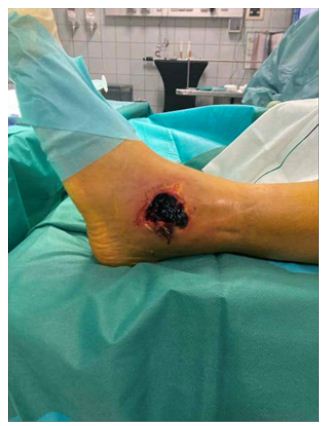
The left ankle was found swollen, red and the pain was localized to the posterior part of the lateral malleolus. An open wound measuring 4×4 cm with a depth of 1 cm was seen over lateral malleolus (Figure 1). Serous seepage with blood mixed fluid was seen from the wound. The fluid smelled badly. There were normal neurovascular conditions distally from the wound. Rectal temperature was 36.9°C. Blood sample showed C-reactive protein < 4 and leukocytes 7.76 ^9 per liter (normal range 3.5-10.0 ^9 per liter). The patient was admitted for further examination and debridement surgery.

fig 1

Figure 1: The wound in the operating room before debridement surgery (day 0)

Results of Pathological Tests and Other Investigations

The patient underwent surgery and it was proven that the anterior talofibular ligament and calcaneofibular ligament were torn. There was rupture of the joint capsule. The patient was diagnosed with septic arthritis, and treatment following international standards for septic arthritis was started. A vacuum-assisted closure (VAC) system was applied and the patient was initially treated with 1,5-gram Cefuroxime intravenously three times daily.

The ankle capsule and hematoma tissue were sent for cultivation and antimicrobial resistance which showed Staphylococcus Aureus sensitive for Dicloxacillin.

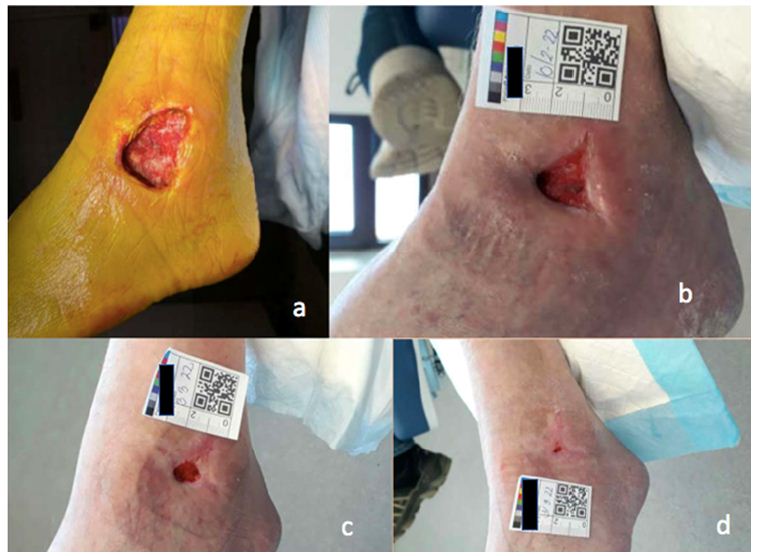
Figure 2a shows photo from the second look operation two days after the primary. A smaller amount of fibrin was removed. The wound was with fresh bleeding, no undermining cavities and without signs of infection. Hereafter, the wound dressing was changed every other day. Intravenous Cefuroxime treatment continued for two weeks. Subsequently, the patient switched to oral treatment with Dicloxacillin for four weeks. The patient was discharged after three weeks and followed up by regular out-patient checkups.

After six weeks, the wound had almost healed. As seen on Figure 2c there was a cavity above the wound only of cosmetic significance. At last follow-up thirteen weeks after debridement, the wound was healing sufficiently without further complications.

fig 2

Figure 2: Photos of the thirteen weeks long wound healing period. a) Second look operation two days after debridement surgery b) Day 40 c) Day 61 d) Day 88

Discussion

This case report addresses a rare, but severe complication to an ankle sprain. To our knowledge this is the first reported case of an infected ankle joint haematoma following a non-operatively managed closed traumatic ankle joint injury. No inherent risk factors of septic arthritis were identified for the patient. Neither did the patient suffer from any apparent exposures that could cause septic arthritis.

Staphylococcus Aureus commonly resides on the skin of healthy individuals. Since there was no primary traumatic lesion to the skin of the ankle, one explanation to the etiology could be hematogenous or lymphogenous spread of the bacteria to the traumatic hematoma.

However, no bacterial focus was identified in this patient. Another feasible explanation could be a secondary rupture of the skin due to the traumatic oedema, thereby introducing skin bacteria to the underlying structures. It addresses the importance of treating the oedema following an ankle sprain.

However, the direction of causality between the wound and the infection is still an open question.

Intraarticular swelling is common in ankle sprains, but rupture of the joint capsule is not. Rupture of the capsule may have made the joint more vulnerable and susceptible to bacteria.

Up to 25% of patients with septic arthritis will experience impaired joint function afterwards [10]. Furthermore, pain and ankle instability may be sequelae of ankle sprain. It is therefore likely that the patient in this case will suffer from sequelae.

Conclusion

Septic arthritis is an extremely rare, but severe complication to an ankle sprain. The treatment existing of debridement and intravenously antibiotic is effective but cannot eliminate the risk of impaired joint function.

Notes on Patient Consent

Informed consent was obtained from the patient

References

  1. Thompson JY, Byrne C, Williams MA, Keene DJ et al. Prognostic factors for recovery following acute lateral ankle ligament sprain: a systematic review. BMC. [crossref]
  2. Blankenbaker D, Davis KW (2016) Ankle Sprain, in Diagnostic Imaging: Musculoskeletal Trauma. Elsevier 952-955.
  3. Doherty C, Delahunt E, Caulfield B, Hertel J (2014) The incidence and prevalence of ankle sprain injury: a systematic review and meta-analysis of prospective epidemiological studies. Sports Medicine 44: 123-140. [crossref]
  4. Buttaravoli P (2007) Ankle Sprain: (Twisted Ankle) in Minor Emergencies, pp: 396-403.
  5. Konradsen L, Bech L, Ehrenbjerg M, Nickelsen T (2002) Seven years follow-up after ankle inversion trauma. Scandinavian Journal of Medicine & Science in Sports 12: 129-135. [crossref]
  6. Holtom PD, Borges L, Zalavras CG (2008) Hematogenous septic ankle arthritis. Clinical Orthopaedics and Related Research 466 (6) : 1388-1391. [crossref]
  7. Mathews CJM, Weston VCF, Jones ADM, Field MF et al. (2010) Bacterial septic arthritis in adults. The Lancet 375: 846-855. [crossref]
  8. Wang J, Wang L (2021) Novel therapeutic interventions towards improved management of septic arthritis. BMC Musculoskeletal Disorders 22: 530. [crossref]
  9. Mathews CJ, Kingsley G, Field M, Jones A, et al. (2007) Management of septic arthritis: a systematic review. Annals of the Rheumatic Diseases 66: 440-445. [crossref]
  10. Weston V, Jones A, Bradbury N, Fawthrop F, et al. (1999) Clinical features and outcome of septic arthritis in a single UK Health District 1982-1991. Annals of the Rheumatic Diseases 58: 14-9. [crossref]

Soft Tissue Management in a Lisfranc Fracture- Dislocation Case

DOI: 10.31038/IJOT.2022423

Abstract

Lisfranc fracture-dislocation injuries are commonly associated with axial loading on plantar flexed foot [1]. The trauma causing the injury can occasionally be either a low or a high energy trauma [2]. Lisfranc fracture-dislocation injuries are often treated with open reduction and internal fixation [3]. Status of the soft tissues and the skin should be assessed before any surgical intervention [4]. Here we present a case of Lisfranc fracture-dislocation initially treated with open reduction and internal fixation which consequently developed soft tissue problems and had to be operated several more times. Six months after the injury the patient had mild midfood pain, no activity limitations and no soft tissue problems.

Introduction

The tarsometatarsal join is often called the Lisfranc joint [5]. Lisfranc injury is a rare foot trauma and it’s diagnosis is often missed [1]. It accounts for 0.2% of all fractures [6]. It is more common in males than females [3]. Lisfranc injuries lead to functional problems and gait impairty. Lisfranc injuries are generally classified using the Hardcastle & Myerson classification system. Lisfranc injuries are considered intra-articular injuries which concern the tarsometatarsal joint [5]. In high-energy traumas, there is often associated fractures and the Lisfranc injury can be missed in the acute polytrauma setting [7]. Early diagnosis of a Lisfranc injury is important to achieve anatomic reduction which is the most important surgical parameter to avoid long term complications such as flatfoot deformity, loss of medial arch of foot, limited range of motion, arthrosis and chronic pain syndrome [8]. The aim of Lisfranc injury treatment is to provide rapid soft tissue healing, prevention of repositioning, and stabilization of foot structures at the same time [9].

Here, we present a case of lisfranc fracture-dislocation who had been struggling with soft tissue complications. The treatment plan process of the case was arranged in accordance with orthopedic practice.

Case Report

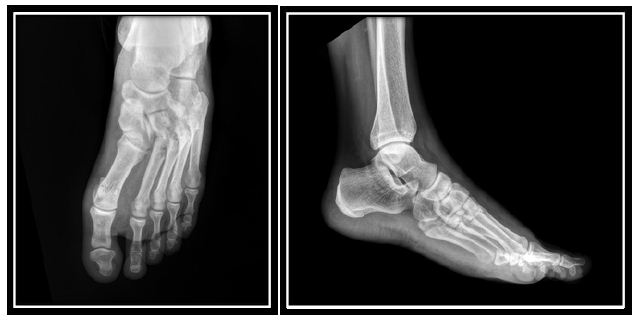
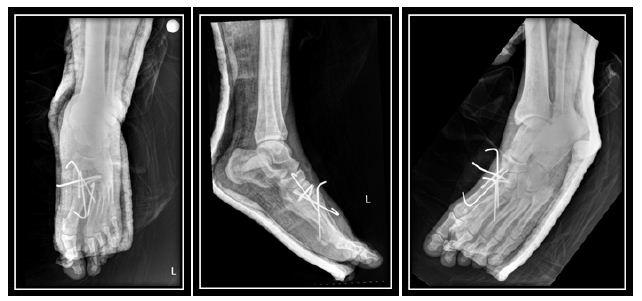
A 51-year-old male applied to our emergency service after a tractor trailer fell on his feet. About two hours after the trauma, the patient presented to the emergency room. No neurovascular deficit was detected after the first evaluation in the emergency department. His foot was sore and swollen with a ‘toe up’ sign. After the radiological examinations, 2-3-4 metatarsal basis, middle and lateral cuneiform fractures were identified. Short leg plaster splint was applied after the patient was evaluated after consultation from the emergency department to the orthopedic clinic. In the radiological examinations performed in the emergency room, it was observed that the fleck sign and the alignment of the 2nd metatars with the medial edge of the medial cuneiform were impaired. As a result, the patient was diagnosed with type B2 Lisfranc fracture-dislocation. The patient was hospitalized in the orthopedic service for operation preparation. In accordance with his orthopedic practice, after 48 hours of moderate elevation, cold application and skin circulation, it was decided that the soft tissue was suitable for surgery and the patient’s surgery was performed (Figure 1)

fig 1

Figure 1: Foot anteroposterior and lateral views

Surgical Procedure

After spinal anesthesia and pneumatic tourniquet application in the orthopedic operating room, the Lisfranc joint was approached with a dorsomedial incision of the foot after proper surgical preparation. After establishing a medial cuneiform relationship with the 2nd metatarsal, a headless cannula screw was sent to the medial cuneiform and 1st metatarsal joint. Afterwards, the medial cuneiform and the base of the second metatarsal were fixed with a headless cannulated screw while the reduction was maintained with the help of a clamp. After it was observed that lisfranc joint alignment was achieved with fluoroscopy controls, additional 3 percutaneous kischner wires provided support for the stability of the foot columns . After bleeding control and washing, the layers were closed in accordance with the anatomy. There was no opening in the skin after wound closure (Figure 2)

fig 2

Figure 2: Postoperative foot anteroposterior, lateral, oblique views

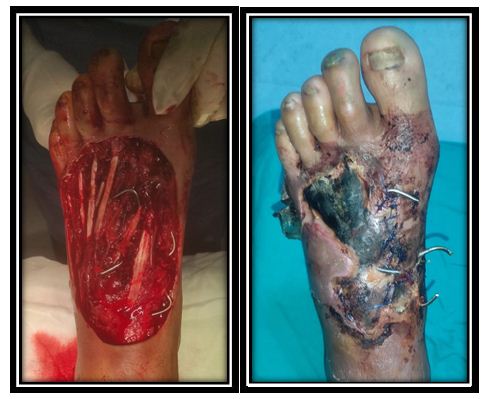
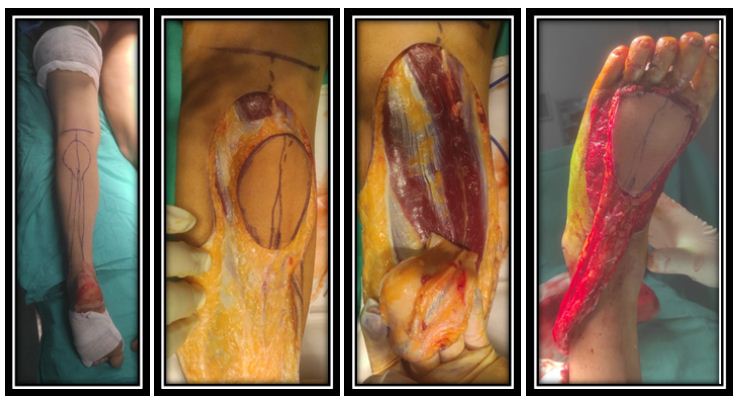
A few days after the operation, skin necrosis began to develop on the dorsal side of the patient’s foot. It was thought that the discharges in the dorsum of the foot were due to necrotic tissue rather than infection. The patient was followed up with daily antibiotic-pomade-dressing, elevation and ice compression for two weeks. Intravenous dextran was used to avoid distal circulation problems. The patient was followed up daily before discharge due to necrosis and wound follow-up in the dorsum of the foot. When the demercation line became evident in wound necrosis, surgery was planned for the patient on the 15th postoperative day. A meticulous and detailed debridement and vacuum assisted closure (VAC) application was performed together with the plastic surgeon. Wound culture samples were taken during the surgical procedure. The culture sample was examined and S. aureus was identified by the laboratory. The patient was given vancomycin treatment for two weeks in line with the recommendations of the infectious diseases clinic. During the next two weeks, the debridement and VAC application procedure was performed four more times. The K-wires were removed approximately 1 month after the initial surgical fixation. In this process, the patient was consulted to the plastic and reconstructive surgery clinic and the infectious diseases clinic, and as a result of a multidisciplinary approach, sural fasciocutaneous flap operation was decided (Figure 3).

fig 3

Figure 3: Wound necrosis and debride

The wide skin opening on the dorsum of the foot was closed with the planned sural fasciocutaneous flap with the support of the plastic surgery clinic. Flap viability was closely monitored in the first 48 hours after surgery. High sensitivity was shown in terms of daily circulation control, dressing applications and protection from infection (Figure 4). The patient was followed at the service for one more week. During this period, the distal part of the muscle flap developed skin necrosis. The decision was made again, together with the plastic and reconstructive surgery department. Thus, a skin graft was applied to the necrotic part of the dorsal side of the foot by the plastic and reconstructive surgery team. The patient was followed for one more week. He was dismissed as his neurovascular status was very good and his flap vitality was fine.

fig 4

Figure 4: Fasciocutaneous flap surgery stage

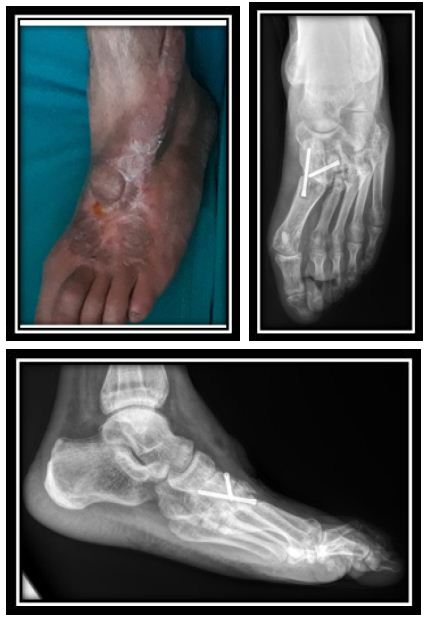
After flap surgery, the patient was followed up in the ward for one more week. Outpatient follow-up from the outpatient clinic continued for about 6 months. Daily dressing with rifampicin was recommended to the patient. Oral antibiotic therapy was discontinued after discharge. After the flap sutures were removed, rifampicin administration was also discontinued. At 6th week partial weight-bearing was started and full weight-bearing was achieved in the 12th week. At the 6th month follow-up appointment of the patient, no signs of infection or soft tissue problems were detected. The patient had 10 degrees of dorsiflexion and 40 degrees of plantar flexion in ankle range of motion. Visual analogue scale (VAS) score was 30, American Orthopedic Foot & Ankle Society (AOFAS) function score was 39, and compliance score was 8, reaching a total of 77. There was no obstacle in finger flexion and extension (Figure 5).

fig 5

Figure 5: At last control, skin fotography and anteroposteior/lateral radiographies

Discussion

Lisfranc fracture dislocation describes a range of injuries, from occult fractures/ligamental injuries to open crush injuries with extensive bone/soft tissue damage [10]. Early diagnosis of a Lisfranc injury is important to achieve anatomic reduction which is the most important surgical parameter to avoid long term complications [8]. Anatomical realignment, stabilization, and soft tissue coverage are key principles in the management of Lisfranc injuries [11]. There is no general consensus on the best fixation method. However, the current trend is to treat this injury with open anatomical reduction and internal fixation [12,13]. It is stated that in Lisfranc-fracture dislocation, soft tissue damage caused by inflammation and edema may affect the results more than the delay in surgical treatment, so early diagnosis is very important to avoid this [14]. Soft tissue management is fundamental for a Lisfranc injury treatment [15]. As the literature suggests, we made an early diagnosis of lisfranc fracture-dislocation injury in our case. Since there was no displaced joint dislocation, the surgical timing was decided according to soft tissue suitability. Open reduction and internal fixation were performed for the patient’s lisfranc injury in accordance with the guidelines.

In the treatment of Lisfranc fracture-dislocations, both the severity of soft tissue damage and non-anatomical reduction are unfavorable prognostic factors [16]. Soft tissue treatment is especially important in open Lisfranc fracture-dislocation. Compared to conventional methods, the vacuum assisted closure technique resulted in earlier wound closure, clean wound surface drainage, faster detumescence, accelerated tissue growth, and reduced clinical workload [17,18]. In the article by Wenqing Qu et al. [19] on open lisfranc injury, when the vacuum assisted closure was first replaced 5-7 days after surgery, wounds healed well in most cases. The soft tissue was quickly repaired by direct suture, skin graft, or skin flap transplantation, thanks to emergency measures such as washing with large volumes of normal saline. It has been mentioned that holding as much skin as possible, avoiding high tension sutures are essential elements for soft tissue closure in lisfranc injuries. An aggressive management by use of a ‘one-stage fix and flap protocol’ has been proven effective in the treatment for severe open fractures of the tibia (Gustilo IIIb or IIIc). This protocol consisted of immediate radical wound debridement, skeletal stabilisation and immediate soft-tissue cover [20]. In the case report of Ilknur et al. regarding another open lisfranc injury, a radical debridement of the foot followed by a Thiersch skin graft was performed one month after surgery due to superficial necrosis of the interposition skin flap. Four months after surgery, a patient with excellent wound healing and good functional outcome was seen. As it is understood from the studies, lisfranc injuries are a type of injury that is pregnant with soft tissue problems. Close follow-up of soft tissue and timing of surgery are the most essential points. It has been mentioned that even flap application can be performed in a single session in open lisfranc injuries. We believe that soft tissue healing aids such as not tight closure of the soft tissue, gradual closure and VAC application should be considered in lisfranc closed fractures. Otherwise, more serious soft tissue problems may be encountered.

There are very limited studies on soft tissue healing in lisfranc injury in the literature. Most of these studies also deal with open lisfranc injuries. In our case report, we encountered serious soft tissue problems, although we continued the treatment process of the patient, whom we diagnosed and treated with closed lisfranc fracture-dislocation, in accordance with the guidelines. Along with the Plastic and Reconstructive Surgery clinic, more difficult and costly surgical treatments were applied. Although the functional result is satisfactory, the lesson we will learn from our case is which methods can be preferred to provide soft tissue healing without complications.

Conclusion

Goal of the treatment of Lisfranc fractured location is to achieve a painless, functional plantigrade foot with a good appearance. The issue that we want to emphasize in our case is the timing of surgery in closed Lisfranc fracture-dislocations. As much as possible, minimally invasive approaches should be prioritized. Avoiding the use of tight sutures during surgery for the healing of soft tissue, and secondary healing can be considered with VAC application when necessary. It should be considered that closing the wounds with skin flaps, which can be closed with a partial skin graft if necessary, leads to possible consequences such as prolongation of the process, decrease in functional results and increase in cost.

References

  1. Desmond EA, Chou LB (2006). Current concepts review: Lisfranc injuries. Foot Ankle Int 27: 653-660. [crossref]
  2. Renninger CH, Cochran G, Tompane T, Bellamy J, Kuhn K (2017). Injury Characteristics of Low-Energy Lisfranc Injuries Compared With High-Energy Injuries. Foot Ankle Int 38: 964-969. [crossref]
  3. Moracia-Ochagavía I, Rodríguez-Merchán EC (2019). Lisfranc fracture-dislocations: current management. EFORT Open Rev. Jul 4: 430-444. [crossref]
  4. Peicha G, Labovitz J, Seibert FJ, Grechenig W, Weiglein A, et al. (2002). The anatomy of the joint as a risk factor for Lisfranc dislocation and fracture-dislocation. An anatomical and radiological case control study. J Bone Joint Surg Br 84: 981-985. [crossref]
  5. Myerson MS, Fisher RT, Burgess AR, Kenzora JE (1986) Fracture dislocations of the tarsometatarsal joints: end results correlated with pathology and treatment. Foot Ankle 6: 225-242. [crossref]
  6. Myerson MS, Cerrato R (2009). Current management of tarsometatarsal injuries in the athlete. Instr Course Lect 58: 583-594. [crossref]
  7. Feng P, Li YX, Li J, Ouyang XY, Deng W, et al. (2017). Staged Management of Missed Lisfranc Injuries: A Report of Short-term Results. Orthop Surg 9: 54-61. [crossref]
  8. Aronow MS (2006) Treatment of the missed Lisfranc injury. Foot Ankle Clin 11: 127-142. [crossref]
  9. Kamin K, Rammelt S, Kleber C, Marx C, Schaser KD (2020). Fixateur externe: temporäre Fixation und Weichteilmanagement am oberen Sprunggelenk [External fixator: temporary fixation and soft tissue management of the ankle]. Oper Orthop Traumatol 32: 421-432.
  10. Ahmed N, Kugan R (2015) Ilizarov frame delayed internal fixation of Lisfranc fracture dislocation with severe soft tissue injury: New technique. Trauma Case Rep 1: 88-94. [crossref]
  11. Panagiotis S, Craig SR, Fragiskos NX, Peter VG (2010) The role of reduction and internal fixation of Lisfranc fracture-dislocations: a systematic review of the literature. Orthop 34: 1083-1091. [crossref]
  12. Boffeli TJ, Pfannenstein RR, Thompson JC (2014). Combinedmedial column primary arthrodesis,middle column open reduction internal fixation, and lateral column pinning for treatment of Lisfranc fracture-dislocation injuries, Foot Ankle Surg 53: 657-663. [crossref]
  13. García-Renedo RJ, Carranza-Bencano A, Leal-Gómez R, Cámara-Arrigunaga F. (2016)Análisis de las complicaciones en pacientes con fractura-luxación de Lisfranc [Complication analysis in Lisfranc fracture-dislocation]. Acta Ortop Mex 30: 284-290. [crossref]
  14. Gu W, Shi Z (2017) Staged management of open Lisfranc injury: Experience from 14 patients. Medicine (Baltimore) 96: e6699. [crossref]
  15. Demirkale I, Tecimel O, Celik I, Kilicarslan K, Ocguder A et al. (2013) The effect of the Tscherne injury pattern on the outcome of operatively treated Lisfranc fracture dislocations. Foot Ankle Surg 19: 188-193. [crossref]
  16. Li W, Ji L, Tao W (2015) Effect of vacuum sealing drainage in osteofascial compartment syndrome. Int J Clin Exp Med 8: 16112-16116. [crossref]
  17. Ko YS, Jung SW. (2014).Vacuum-assisted close versus conventional treatment for postlaparotomy wound dehiscence. Ann Surg Treat Res 87: 260-264. [crossref]
  18. Qu W, Ni S, Wang Z, Zhao Y, Zhang S, (2016) Severe open Lisfranc injuries: one-stage operation through internal fixation associated with vacuum sealing drainage. J Orthop Surg Res 11: 134. [crossref]
  19. Gopal S, Majumder S, Batchelor AGB, Knight SL, De Boer P et al. (2000). Fix and flap: the radical orthopaedic and plastic treatment of severe open fractures of the tibia. J Bone Joint Surg Br 82-B: 959-966. [crossref]
  20. Sanli I, Hermus J, Poeze M (2012). Primary internal fixation and soft-tissue reconstruction in the treatment for an open Lisfranc fracture-dislocation. Musculoskelet Surg 96: 59-62. [crossref]

The Six Keys for Optimal Quality Perception and Successful Orthodontic Service

DOI: 10.31038/JDMR.2022514

Abstract

In this paper, we elaborate and describe the steps of the orthodontic journey which are oriented to increase the patient’s satisfaction. Six keys, aimed to improve the quality perception, are also summarized and discussed.

Keywords

Efficiency, Quality perception, Practice management, Orthodontic journey, Satisfaction

Introduction

As medical specialty in the healthcare service, quality perception (P) is essential to obtain satisfaction (S) when the orthodontic journey meets patient’s expectation (E). The relationship among these three variables is showed by the following equation [1]:

S = (P – E) >= 0

The three main relative scenarios are: 1) P<E, then S < 0, dissatisfaction; 2) P=E, then S=0, satisfaction; 3) S>0, then P>E, Satisfaction Beyond the Expectation (SBE).

The consequent considerations are: 1) unrealistic or unmet expectations always lead to dissatisfaction because the quality perception will always be smaller than waits; 2) S=0 must be the minimum goal, that is when orthodontic problem is solved by effective orthodontic treatment; 3) patients who, other than solving malocclusion, experience efficient and people-oriented orthodontic journey, will always reach SBE. These patients most likely will be fans of the orthodontic team, referring other patients enthusiastically.

Therefore, a well-organized and structured practice is needed to provide a successful orthodontic service [2], which should be able to solve malocclusion effectively and, at the same time, to obtain high quality perception by efficiency. Efficiency in this paper will be considered the ability to reach the visualized objectives in the most predictable and comfortable ways and shorter treatment time.

Importantly, the premise for an optimal quality perception is based on creating and maintaining a relationship of mutual trust among all the people involved in the orthodontic journey [2].

The main stages and their related steps to reach both the minimum goal (S=0) and SBE goal (S>0) are described as follows in a chronological order.

First Visit and Treatment Plan

Minimum Goal

The first visit starts from the first contact that usually occurs by phone, however after having verified the web-reputation; for this reason, build a well-perceived on-line presence.

Perform an effective call by: (1) listening carefully the reasons leading to the consultation; (2) giving all the information regarding what will happen in the first appointment.

Communicate the value of the first visit by describing all the stages included in the meeting: the reception assistance, the mutual knowledge, the clinical visit, the digital impression, the photographs, the x-ray needed, the final feedback; then, communicate the fee.

Assist patients while approaching the first visit, by reminding the date, by giving instruction on how to reach the office;

At the date, perform the visit coherently with the information given at phone.

SBE Goal

Once the first visit is scheduled, send a video in which you thank for trust, explain the aim and what will happen in the first visit, coherently with the previously given information.

Also, share the link of your website form, through which patients enter their data so that they will be ready once arrived.

When the date is approaching, send the map link how to reach the office.

Welcome the people in the waiting room and be on time to start the first visit. If possible, receive patient/family in a consultation room, different from the operation room.

As part of the anamnestic questionnaire, ask what they desire from the orthodontic treatment and listen carefully the compliance and any functional or aesthetic concerns, to understand the expectation precisely.

While parents/relatives are waiting for in the consultation room, perform the visit in the chair room, collecting also all the images needed, pictures and x-ray.

Also, take impression by intraoral scanner because the digital impression was referred significantly more comfortable than conventional impression [3].

At the end of the visit journey, by using “why, how, what” process [2] explain the malocclusion which needs to be corrected and show the visualized treatment objectives (VTO). Show some treated cases to help the patients in visualizing the goals and the need of long-term retention.

Help patient to comprehend the treatment options by a synoptic table which reports the advantage and disadvantage of each other.

Give a branded package including images, diagnosis, treatment plan, informed consent and the proposal treatment fee, specifying carefully all the services included and the possible tailor-made terms of payment. The last point should be assessed by the back-office employ who should always be present at the consultation meeting, by listening and assisting the family/relatives, and also to know, then to fulfil their extra-clinical needs.

If a deeper case study is necessary, schedule another meeting, even online, for the case discussion. In the case of on-line appointment, send all the branded package by email after the case discussion.

At the end of the case presentation, always schedule an appointment to start treatment or to receive a feedback.

When the mutual acceptance is confirmed, congratulate with them for their contribution to the public health undergoing orthodontic treatment.

Treatment Protocols and Patient’s Experience

Minimum Goal

Meet patient’s expectation by solving malocclusion effectively, with no aesthetic decline, no residual CO-CR discrepancy, keeping periodontics healthy with long-term stability [4].

Improve the post-treatment outcomes by developing the orthodontic skills in order to treat patients at the best, attending post-graduate orthodontic programmes [5] aimed to improve the expertise.

SBE Goal

Be always available by listening, assisting, supporting patients and families, exploiting at the best the saved time.

Visualize the final tri-dimensional position of the upper central incisors as the crucial variable influencing the final aesthetic outcomes, because it establishes the smile arc display and tooth exposure [6]. In this view, perform an indirect bracket positioning guide [7] which may help in planning and obtaining an early smile arc protection [8] by an efficient and effective indirect bonding technique (Figure 1).
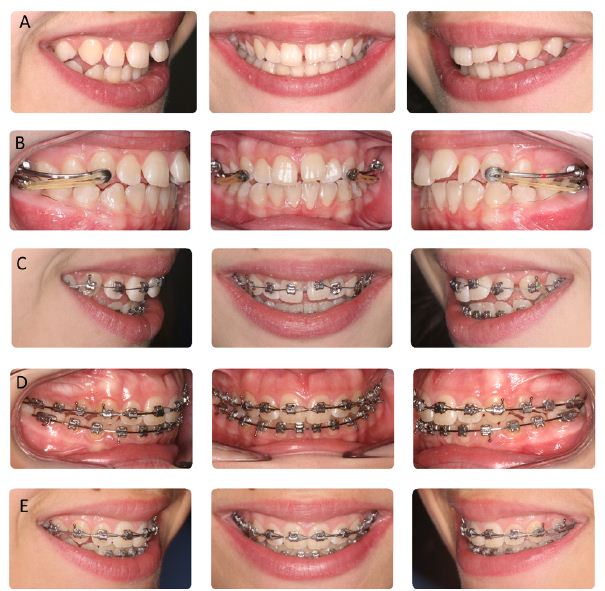
fig 1

Figure 1: Upper incisors flaring and crowding, reduced upper incisor display and left class-2 subdivision are shown in a 13-years old female patient (A). The sagittal over correction of upper left class-2 subdivision, with the consequent space recovering, was performed by using bilateral upper 3-to-6 segmental bars, lower essix, full time 8 oz 3/16 class-2 elastics on the left and full time 6 oz 3/16 class-2 elastics on the right, in the first 4 months (B). Upper and lower MBT-prescription straight-wire appliance, .014 NiTiHA arch-wires and early anterior class-2 elastics (2 Oz, 3/16; full time), were applied in one step (C). Notice 1-mm over correction of upper central bracket position, the improvement of both upper incisors display and smile arc after the levelling occurred in the next 5 months by sequential .016x.022 .019x.025 NiTiHA (D, E).

Start treatment at the right time to be efficient, taking into account of several variables: (1) teeth eruption in the late mixed dentition, especially upper canines and second molars; (2) the pubertal growth spurt; (3) the psychomotor maturity to undergo orthodontic treatment.  The synchrony of all previous variables usually allows starting treatment at the best time.

By using Indirect bonding technique, also focus on the levelling of the marginal ridges among the premolar and molars in order to reduce the need of bracket repositioning [7], causing unnecessary prolonged treatment time.

Perform one-step upper and lower indirect bonding because it allows to have significant chair-time saving and also to use early inter-arch mechanics [9,10]. In the bonding stage, also use strategic build-up (e.g. turbos) in order to have disarticulation of both arches and an early vertical control [11] (Figure 2). Both early inter-arch mechanics and vertical control may help in improving efficiency.
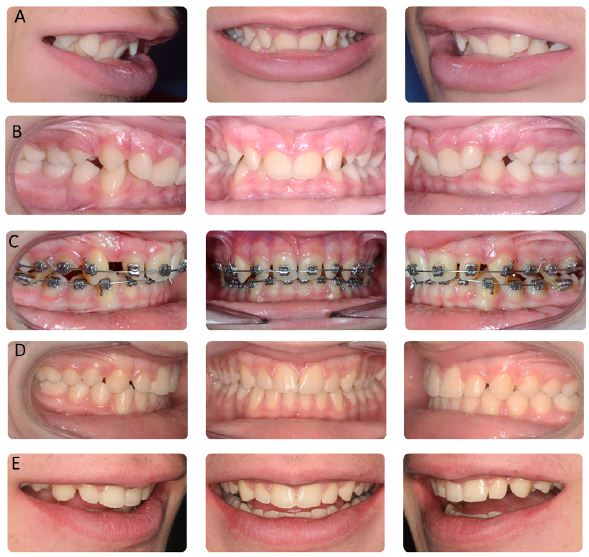
fig 2

Figure 2: Bilateral class-2 div-2, deep-bite and over erupted upper incisors are shown in a 13-years old male patient (A, B). The sagittal correction of bilateral class-2 div-2 were performed by using bilateral upper 3-to-6 segmental bars, lower essix, full time bilateral 8 oz 3/16 class-2 elastics in the first 5 months. Upper and lower MBT-prescription straight-wire appliance, .014 NiTiHA arch-wires, early posterior class-2 elastics (2 Oz; 3/16; full time) and upper incisor turbos were applied in one step (C). Notice 1-mm over correction of upper central bracket position and the posterior open bite created to allow vertical correction, which was obtained by posterior extrusion (D) and anterior intrusion (E), in the next 14 months.

Once the upper and lower bonding is performed, give a branded package with the instrument for brushing and cleaning, and also send a video where the instructions are reinforced.

In non-extraction cases with sagittal discrepancy, use a sagittal-fast strategy (SFS) in order to exploit the initial best patient’s compliance by a minimal invasive and comfortable strategy (Figure 3). The SFS also should allow to transform a sagittal malocclusion into a class I malocclusion in 3-6 months, which should be finished by further efficient aligning, levelling, space closure and settling stages. Even in extraction cases, apply simplified mechanics [4] and use mini-screws when they are indispensable to reinforce absolute anchorage and/or when the conventional mechanics are unable.
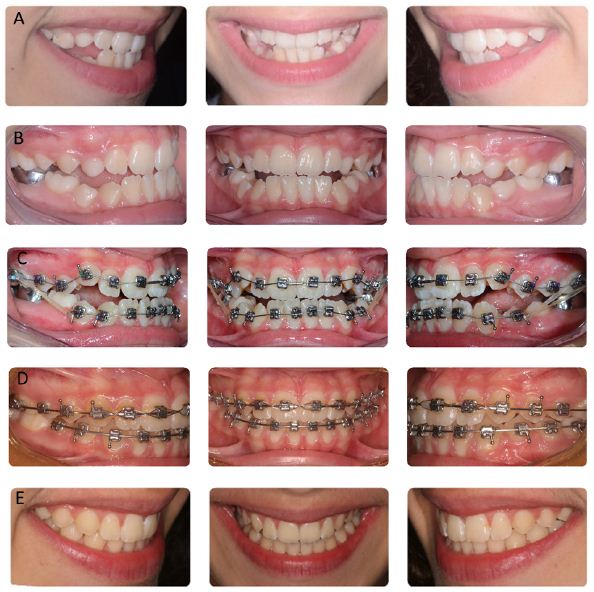
fig 3

Figure 3: Reduced upper incisor display, bilateral class 3, edge-to-edge incisor relationship, open bite tendency and upper and lower crowding are shown in an 11-years old female patient (A, B). Upper and lower MBT-prescription straight-wire appliance, .014 NiTiHA arch-wires and early class-3 elastics (2 Oz, 3/16; full time), were applied in one step after having maintained lower E space by lingual arch (C). Notice 1-mm over correction of upper central bracket position, performed in order to improve upper incisors display, smile arc and open bite tendency. In the next orthodontic stages, occurred by using sequential .016x.022, .019x.025 NiTiHA, .019x.025 SS, alignment, levelling, arch width coordination, space closure and settling completed the treatment (D, E).

When the debonding stage is approaching, schedule a meeting with the parents in order to show the advancement of the case and the pictures which were taken in progress. This is the time to let the family be aware of both the improvements and the reached objectives. It is also time to explain again the strategies for upper and lower retention.

At the debonding stage, take all the final records and hand the retention appliances at the same day together with all the written instruction to prevent relapse. At the same time, give a book with the orthodontic image history to show the reached results; then, plan the retention appointments.

Ask web recension, written feedback or a video testimony about the reached objectives and the experience lived during the entire orthodontic journey.

Discussion and Description of the Keys

Since the current evidence does not support the clinical use of aligners as a treatment modality that is equally effective to the gold standard of braces [12], in this paper the clinical and extra-clinical factors which contribute to reach SBE focused on orthodontic journey performed by using fixed appliance. However, most of the principles enounced in this paper are also applicable in orthodontic journey performed by clear aligner therapy, unless the reduced predictability of tooth movement affects the orthodontic outcomes and patient’s expectation. The following key factors include early correction of transversally discrepancy and/or reverse overjet whom cases are eventually affected [13,14].

The first key for optimal quality perception is described in the following sentence: “the first visit is everything”. Therefore, the families coming into the office for the first visit will search for all positive confirmation during the journey if the first impressions will be optimal, increasing the chances of mutual acceptance of the treatment plan; the reverse is also true. In addition, the use of “why, how, what” process [2] contribute in helping to visualize the objectives and in understanding the proposed journey and the devices chosen.

The second key which contributes in obtaining SBE is the chair-time saving. This variable impacts the quality perception by different mechanisms. The more is the time saving: (1) the more is the available time for listening patient’s feedbacks and for communicating with them; (2) the more is the perceived comfort due to the efficiency of each performance; (3) the less is the perception of treatment duration, due to the reduced time spent in the entire journey. Furthermore, time-saving affects the economic sustainability of the orthodontic practice because the chair-time expresses the fixed costs of the orthodontic treatment. Therefore, the more is the entire chair-time, the more is the fixed costs to supply the orthodontic service [2].

The third key influencing the quality perception is the assistance given to families by supplying tools and information during the entire orthodontic treatment, every time it is possible. The mechanisms which allow to improve the quality perception is related to receive unexpected useful service oriented to sincere interest in the patients well-being, increasing the P value more than their E value [1].

The fourth key is the treatment timing. This factor is fundamental to perform an efficient orthodontic treatment because it impacts on the duration of the entire journey. As mentioned above, the best timing to start treatment is when the synchrony among the eruption of upper canines and sevenths, the pubertal spurt and the psychomotor maturity is present. On the contrary, early treatment, when it is not indicated, always leads to prolonged treatment duration, reducing efficiency, increasing number of appointments with more costs.

The fifth key which helps in reaching SBE is the use of simplified and minimal invasive mechanics in relation of the complexity of the case. The use of minimal invasive devices, obviously improves the patient’s experience by two main mechanisms: (1) more comfort; (2) chair-time saving. Furthermore, the use of simplified mechanics impacts on management control, because both fixed and variable costs are reduced by chair-time saving and less number of devices applied, respectively.

The sixth key for optimal quality perception described in this paper is the use of early vertical and sagittal inter-arch mechanics with the priority to solve sagittal discrepancy fast and to fix the three-dimensional position of upper incisors at best, obtaining both the correction of malocclusion and optimal aesthetic perception contextually. The achievement of the mutual accepted visualized treatment objectives, together with an optimal upper incisor display, always lead to a satisfaction for the reached outcomes.

Therefore, the six keys for optimal quality perception and successful orthodontic service may be summarized as follows:

  1. The first visit is everything
  2. Save and spend time to inform, assist, support
  3. Explain and supply all digital and physical supporting tools
  4. Start treatment at the best timing
  5. Use the most simplified and minimal invasive mechanics
  6. Solve sagittal discrepancy fast, fix upper incisors at best

In conclusion, the more the patient’s satisfaction is researched, the more well-structured orthodontic service, expertise, trained human resources and systematized processes are needed. The six keys shared in this paper may contribute in increasing the quality perception and reaching SBE.

References

  1. Fornell C, Johnson MD, Anderson EW, Cha J E Bryant E (1996) The American Customer Satisfaction Index: nature, purpose and findings. J Mark 60: 7-18.
  2. Ciuffolo F (2021) The key factors for future orthodontic prosperity: A commentary paper. APOS Trends Orthod 11: 169-173.
  3. Yilmaz H, Aydin MN (2019) Digital versus conventional impression method in children: Comfort, preference and time. Int J Paediatr Dent 29:728-35. [crossref]
  4. Arnett GWA, McLaughlin RP (2003) Facial and dental planning for orthodontists and oral surgeon. 1st ed. Philadelphia: Mosby (Elsevier).
  5. Nur Yilmaz RB, Nalbantgil D, Ozdemir F (2016) The effect of awareness of American Board of Orthodontics Criteria on treatment outcomes in a postgraduate dental clinic. J Dent Educ 80: 1091-1097. [crossref]
  6. Sarver DM (2001) The importance of incisor positioning in the esthetic smile: the smile arc. Am J Orthod Dentofacial Orthop 120: 98-111. [crossref]
  7. Ciuffolo F, Tenisci N, Pollutri L (2012) Modified bonding technique for a standardized and effective indirect bonding procedure. Am J Orthod Dentofacial Orthop 141: 504-509. [crossref]
  8. Pitts TR. (2017) Bracket Positioning for Smile Arc Protection. J Clin Orthod 51: 142-156.
  9. Ciuffolo F. (2016) Contemporary contribution of orthodontics to the public health: A brief commentary paper. Dent Oral Craniofac Res 2: 1-2.
  10. Li Y, Mei L, Wei J, Yan X, Zhang X, Zheng W, Li Y (2019) Effectiveness, efficiency and adverse effects of using direct or indirect bonding technique in orthodontic patients: a systematic review and meta-analysis. BMC Oral Health 19: 137. [crossref]
  11. El-Bokle D, Abbas NH (2020) A novel method for the treatment of Class II malocclusion. Am J Orthod Dentofacial Orthop 158: 599-611.
  12. Papageorgiou SN, Koletsi D, Iliadi A, Peltomaki T, Eliades T (2020) Treatment outcome with orthodontic aligners and fixed appliances: a systematic review with meta-analyses. Eur J Orthod 42:331-43. [crossref]
  13. Mutinelli S, Manfredi M, Guiducci A, Denotti G, Cozzani M (2015) Anchorage onto deciduous teeth: effectiveness of early rapid maxillary expansion in increasing dental arch dimension and improving anterior crowding. Prog Orthod 16: 22. [crossref]
  14. Baccetti T, McGill JS, Franchi L, McNamara JA Jr, Tollaro I (1998) Skeletal effects of early treatment of Class III malocclusion with maxillary expansion and face-mask therapy. Am J Orthod Dentofacial Orthop 113: 333-343. [crossref]

A Novel Strategy for Communication to Drive Voluntary Compliance with Social Distancing in COVID-19 across Religious-Cultures in Mumbai India – The Case of ‘Cognitive Polyphasia’

DOI: 10.31038/JIPC.2022212

Abstract

Aims: Social distancing contains the coronavirus but compliance with social distancing is challenging. Previous studies called to enhance compliance by culturally adaptive messages. We fill the gap in the state of the art testing the power of specific messages as drivers of willingness to comply.

Methods: The sample comprised 277 residents of Mumbai India, who self-classified themselves into one of four religious-cultural groups. A conjoint-based experimental-design was applied with willingness to comply as the dependent variable and contributors to compliance as independent variables.

Results: Regression coefficients for the total panel suggested minor differences in the power of messages. Commonalities in response patterns yielded three distinct mindsets transcending cultures: people seeking to assure compliance; people focusing on the policy communicator; and people focusing on risks of coronavirus. Different messages drive willingness to comply among members of each mindset.

Conclusions: A web-based prediction tool enables to identify the mindset-belonging of individuals/groups and use mindset-tailored messaging to enhance compliance.

Keywords

COVID-19; India; Messaging; Mindset-segments; Religious-culture; Social distancing; Social representation theory; Voluntary compliance

Introduction

Under the complexity and uncertainty of the COVID-19 pandemic, social distancing was found to be effective in containing the Coronavirus [1,2]. Social distancing entails isolation of people with symptoms of COVID-19; quarantines for people with confirmed COVID-19; prohibition congregations, and maintaining physical distance. Social distancing is a central non-pharmaceutical intervention for breaking the chain of infection transmission [3-6]. But compliance with social distancing is poor among members from different cultures compared to the general population [7,8]. Health authorities aspire to optimize compliance with social distancing [9,10]. Optimal compliance with social distancing emerges from personal responsibility for the greater good [11].

In India the COVID-19 pandemic started on 30 January 2020. Within 8 months, India reported 78,761 new cases; 3,542,733 cumulative cases; and 63,498 cumulative deaths on 30 August 2020 [12,13]. Health authorities in India were early to adopt non-pharmaceutical interventions to contain the spread of the Coronavirus slowing the spread of the epidemic [14]. The government of India implemented sought to  understand the impact of social distancing interventions on the dynamics of the daily rates of COVID-19 infections, by estimating rates across 7 periods of the pandemic (Pre-lockdown, Lockdown Phases 1 to 4 and Unlock 1–2), and phased relaxations [1]. Interventions were estimated using Google mobility data, estimates at the national level and for 12 Indian states [1].

Data collection in this current study was from May 20 to July 28th, 2020, which was parallel to the third and fourth strict Lockdown from May 18th to May 31st and to the first and second unlock phases from 1 June to 31 July 2020 in which a conditional relaxation was allowed where the virus spread was contained. A study performed in April 2020 with 2164 participants from India through social networks and WhatsApp found that 61% of participants had heard details about COVID‑19 from the social media, 89% knew all ways of coronavirus transmission, 40% felt that COVID‑19 is a serious disease, and 78% agreed with the lockdown intervention, 85% believed that lockdowns help reduce the rate of infection, 89% reported following lockdown guidelines, and 87% reported maintaining social distancing [15]. Data, however, indicated that knowledge about the virus and positive attitudes towards social distancing did not enhance compliance with it [1]. In Mumbai as well, poor compliance with social distancing was evident resulting in a severe outbreak of COVID-19 [10,16,17].

Social distancing is challenging as it alters norms (e.g., personal space, transportation, gender relations within the family), particularly in heavily populated crowded living conditions as in Mumbai [3,18]. Health authorities acknowledge that communication is essential to voluntary compliance [3,8]. People may comply better with social distancing if messages are crafted to promote voluntary rather than mandatory compliance [2,19]. To protect the vulnerable population, in the absence of an effective treatment and a vaccine, social distancing will continue as the non-pharmaceutical intervention, especially in a populous crowded country as India [14,20].

Health authorities have a critical role in designing messages clearly and consistently to enhance willingness to comply (hereafter: WTC) with social distancing [7,21-23]. Culture was found to be central designing messages to shape behavior [24]. The social representation theory stresses that messages regarding social distancing need to be adapted to religious cultures so they reflect the shared reality of group members of each religious culture yielding higher WTC [24-26]. Health authorities were called upon to consider the unique characteristics, needs, and behaviors, of members of distinct religious cultures in designing messages to contain the spread of the virus. Since WTC is strongly related to compliance behavior, identifying messages that drive WTC with social distancing is essential to higher WTC across religious cultures [2,27,28]. Research on the effect of specific messaging on WTC with social distancing in the COVID-19 context is scant. This study responds to previous calls to discover messages that influence WTC particularly necessary for those whose compliance with preventive measures is lower [1,2,24,29-31]. This study seeks to start closing the gaps in state-of-the-art by applying novel strategy for communication to enhance WTC with social distancing.

This study tests the power of messages as drivers of WTC with social distancing From May 18th 2020 to July 31st, 2020 across religious cultures in Mumbai, India [32]. Perceived benefits of social distancing and its practices predict WTC with social distancing [23]. Likewise, trust in the agent communicating the social distancing policy enhances compliance [33]. Some messages may have greater power in driving WTC. Membership in a religious culture relates to shared history, myths, beliefs, language, values, which may not be a matter of personal choice but rather be shared by all members of that religious culture [25].

According to the social representation theory, one’s inner world encompasses both the collective and the personal, creating a shared reality among members of a religious-cultural group [25]. The shared religious-culture may transcend the individual so that one’s identity accords with perceptions, beliefs, and norms of the religious-cultural group, ignoring dimensions that are inconsistent with them [34]. The influence of messages on WTC with social distancing may depend, in part, on how people from different religious cultures identify with the different messages [35]. Individuals may differ from each other in many other ways but will share a common response to the messaging on social distancing.

Hypothesis 1: Groups of People Will Respond Similarly to Different Messages on Social Distancing, by Their Religious-Cultural Belonging, Revealing ‘Cultural-Mindsets’

In a pandemic, individuals may have low exposure to mass communication and to networks, they may lack information, or may have different individual experiences (e.g., being infected, quarantined, or hospitalized), all creating a different psychological impact [36]. It is therefore possible that messages regarding social distancing may center the individual, transcending cultural differences.

Hypothesis 2: Groups of People Will have Similar Response Patterns to Different Messages Regarding Social Distancing, Transcending Religious-Cultural Belonging

We explore the effectiveness of messages to drive WTC with social distancing across religious-cultural groups in Mumbai, India. The exploratory research questions are a). Do responses to messaging differ by religious-cultural group? b). What patterns of response are there to different messages?

Subjects and Methods

Ethics

This study is part of a multi-national research project on WTC with social distancing during the second wave of COVID-19 in Canada, the US, Hungary, Italy, Turkey, England, Australia, India, and Israel. This study protocol was approved by the Ryerson University Research Ethics Board (#2020-149). Participants were informed that participation is anonymous and confidential. Participants signed an informed consent regarding participation and publication.

Sample

Respondents were 277 residents of various neighborhoods of Mumbai. Respondents were recruited through social networks and were not paid for their participation. The sample size is acceptable for conjoint-based studies, particularly when aiming for stable coefficients [37]. Based on the concept of religiousness as a universal four-dimensional structure which was recently validated as encompassing the four dimensions of religiousness for cross-cultural and cross-religious research applications in India, participants self-classified themselves to one of the four groups: believing (orthodox), bonding (conservative), behaving (liberal), and not belonging (no religion) [16,38].

Procedure

We utilized an experimental design in which we allocated participants to different groups using repeated measures, where the same participants took part in each condition of each of the independent variables (within groups, or within-subjects design). In this experimental design, participants rated a series of different combinations of messages with the same rating question. This way, participants did not complete “parallel measures” but were repeatedly exposed to the same question in relation to different aspects of physical distancing. To control the results, we alternated the order by which participants performed in different conditions of an experiment. This experimental design enabled higher variation, randomization, analysis of co-variance and control than in typical observational studies [39]. Considering our complex reality, in which many stimuli may interact with one another, we utilized well known conjoint-based experimental design methodology known for testing the power of messages which has been used to test the power of messages in a great variety of topics [40,41]. With 277 participants and 16 messages in 24 vignettes presented to each participant, 4432 messages were tested with no limitation of degrees of freedom while bypassing typical biases of surveys [37]. A digital link for this online study was distributed through social networks and snowball sampling.

Instrument

The dependent variable is ‘WTC with social distancing, independent variables in conjoint analysis are four categories, each acknowledged as a driver of WTC with social distancing [23,33]. Each category contained four messages, strictly one from each category, all together sixteen different messages. Messages were created based on elements we identified in a thorough literature review on drivers of compliance with social distancing [41]. Participants were instructed to rate each vignette as a unity [37]. The rating question was: “To what extent does the following vignetter drive your WTC with social distancing?” The rating question appeared on each screen above the vignette. The rating scale ranged on a scale of 1 (Does not at all drive my WTC with social distancing) to 9 (Strongly drives my WTC with social distancing).

The order of the vignettes was dictated by a well-crafted mathematical method called an ‘experimental design’ which structures the 24 vignettes to ensure statistical independence of the predictor variables for subsequent regression at both the individual and group levels [26,29] The vignettes generated a compound message, pulling in different directions, forcing the respondents to evaluate the vignette using their intuition reducing typical biases of surveys [29]. Instrument reliability was tested by comparing data for the total sample with data for half of the sample (0.70; 0.76). Table 1 presents the study instrument.

Table 1: The Instrument with Messages according to the Four Independent Variables

Code Message
Category A: The perceived risk of the COVID-19
A1 The COVID-19 is a dangerous virus spreading wildly.
A2 Health experts suggest what to do, but government is reactive rather than proactive.
A3 The COVID-19 is not a dangerous virus, but the media dramatizes its strain.
A4 Experts suggest what to do, but the government is reactive rather than proactive
Category B: Preferences of social distancing practices
B1 To practice social distancing, everyone should work only from home on internet, e.g., Zoom/Skype
B2 To practice social distancing, everyone stays 2 meters apart.
B3 To practice social distancing, everyone is to be confined to within 100 meters from home.
B4 To practice social distancing, everyone should wear a mask everywhere.
Category C: Ways to ensure social distancing
C1 To assure social distancing, we need a military lockdown.
C2 To assure social distancing, food shopping should be limited to 3 people at a time and pharmacy shopping to 1 person at a time.
C3 To assure social distancing, only age 60+ are allowed to buy groceries during first 2 hours of store day.
C4 To assure social distancing, designated young volunteers should shop for elderly and disabled.
Category D: The agent communicating the social distancing policy
D1 Provincial/State Government should communicate the social distancing policy.
D2 Federal Government should communicate the social distance policy.
D3 Religious Clergy should communicate the social distancing policy.
D4 The media should communicate the social distancing policy.

Data Analysis

The experimental design enabled the deconstruction of responses to the messages by ordinary least-squares regression (OLS) [37]. We created 277 models for WTC using OLS, one for each respondent, each with an additive constant and 16 coefficients, one coefficient for each message. The additive constant is the intercept in a linear equation that may be interpreted as the predisposition of the group to agree to a set of messages in the absence of any specific message. High additive constants (60+) represent groups of people who are likely to agree with the messages. Low additive constants (<35) represent groups of people for whom specific messages drive agreement, not the general proclivity to agree.

We performed OLS to generate individual level equations for each respondent relating to the presence/absence of the sixteen messages [40]. The OLS model was written as follows: for 1, where for 2 is the predicted or expected value of WTC (here, the transformed, binarized ratings), x1 through for 3 are for 4 distinct independent or predictor variables. for 5 is the value of Y when all of the independent variables, (x1 through for 3), are equal to zero, and for 6 through for 7 are the estimated regression coefficients. The OLS coefficient is the conditional probability that the specific message adds to the perceived driving power of the message for WTC. A coefficient of six or higher is statistically significant, given the standard error of about 4 for the coefficient [40]. A higher coefficient means higher WTC. OLS was run for the total panel, for each religious-culture and for key subgroups (gender, age), incorporating all relevant data into one regression model for the sample. The response to the vignettes, uncovered by OLS, reveals the part-worth contribution of each message to WTC [40].
Since the self-ratings of respondents are not calibrated, following OLS the rating was transformed to a categorical variable (1-6=0; 7-9=1) enabling reduction of variability and crystallization of the strongest drivers of WTC. Next, we analyzed response patterns to each message, using k-means clustering algorithm with 1 Pearsons’s R distance measure. Fundamental groups, ‘mindsets’, emerged. ANOVA and Post Hoc tests indicated that differences among mindsets are significant and different specific messages drive l WTC for each group. The pattern of positive high coefficients across the mindsets guided the assignment of respondents to mindsets. Last, to translate the knowledge to policy implementation, we developed a prediction tool, the personal viewpoint identifier (PVI). The PVI enables health authorities to may assign a person in the population to a mindset based on the summary data, converting the six strong distinguishing messages to binary questions (agree or disagree). The six messages were chosen using a Monte-Carlo simulation. Each of the 64 possible patterns of responses to the set of six messages is best associated with one of the three mindsets. Based on answers to the six questions in the PVI, the individual or group is assigned to one of the three mindsets, and thus, the appropriate messages may be established for individuals or groups.

Results

Preliminary Analysis

Participants were 202 Liberals, 41 conservatives, 19 orthodox, and 15 with no religion belonging, ages 18 to 70. The sample comprised 130 females and 147 males. The response rate was 48% (Out of 573 people that started the online-study, 277 completed it). Table 2 presents the sample demographics.

Table 2: Sample Demographic Composition

Variable

Level

Size (n)

Affiliation


Liberal

202

Conservative

41

Orthodox

19

No religion

15

Gender Female

130

Male

147


Age

18-24

53

25-34

167

35-44

33

45-54

13

55-64

9

65+

2

Hypotheses Testing

To simplify the analysis, we present only messages with positive regression coefficients, driving WTC with social distancing. There were no significant differences in the driving power of messages for the total panel and subgroups. Significant differences emerged when respondents were clustered by the commonality in the patterns of their responses to the individual messages. Analysis of variance and post hoc tests indicate that the distinct mindsets that emerged from are significantly different, highlighting the different messages that impact WTC with social distancing for members of each mindset. The pattern of positive high coefficients across different mindsets guided the assignment of respondents to a mindset. Mindsets are “Pandemic Observers”, who pay close attention to the news; “Obedient Followers”, who expect to be told EXACTLY what to do; and “Sensitive Interpreters” who are attentive to what the government decides. The names of the mindsets were determined by the dominant messages in each. Table 3 presents the additive constant, coefficients, p values, and post hoc results of the mindset-segmentation.

Table 3: Mindset segments by ANOVA and Post Hoc Tests for Messages Driving WTC

Group

Total Segment 1 of 3 Segment 2 of 3

Segment 3 of 3

Base Size

277

92 81

104

Additive Constant

52

58 49

49

Code Category A: The perceived risk of the COVID-19 virus
A1 The COVID-19 is a dangerous virus spreading wildly.

0

-12a -6a

14b

A2 The COVID-19 is not a dangerous virus, but the media over dramatizes its strain.

-1

-12a -3b

10c

A3 Health experts suggest what to do but government is reactive rather than proactive.

-2

-17a -5b

13c

A4  The COVID-19 is not dangerous, but all news seems to be about it.

-2

-15a -1b

11c

Category B: Preference of social distancing practices
B1 To practice social distancing everyone should work only from home on internet, e.g., Zoom/Skype

-3

-11a 5b

-4a

B2 To practice social distancing, everyone stays 2 meters apart.

-3

-12a 6b

-3a

B3 To practice social distancing, everyone should be confined to within 100 meters from home.

-3

-10a 6b

-3a

B4 To practice social distancing, everyone should wear a mask everywhere.

-4

-16a 8c

-2b

Category C: Ways to ensure social distancing
C1 To assure social distancing, we need a military lockdown.

3

15c -11a

3b

C2 To assure social distancing food shopping is to be limited to 3 people at a time and …pharmacy shopping to 1 person at a time

2

12c -12a

3b

C3 To assure social distancing only age 60+ are allowed to buy groceries during first 2 hours of store day

1

8c -9a

3b

C4 To assure social distancing, designated young volunteers should shop for elderly and disabled.

2

15c -12a

2b

Category D: The agent communicating the social distancing policy
D1 Provincial/State Government should communicate the social distancing policy.

0

3b 10c

-9a

D2 Federal Government should communicate the social distance policy.

-2

2b 5b

-12a

D3 Religious Clergy should communicate the social distancing policy.

0

1b 11c

-10a

D4 The media should communicate the social distancing policy.

0

2b 9c

-10a

Analysis of variance (ANOVA) showed significance differences (p<0.05) between mind-sets for all elements. Letters indicate homogenous subsets determined by Tukey test.

Translating Knowledge to Practice

The three mindsets transcend religious-culture, age, and gender as seen in Table 4. To identify the belonging of individuals in the population to a mindset-segment a PVI is required. We generated 64 patterns, mapping each of the three mindset-segments. We identified six messages that best differentiate among the mindset-segments, based on a two-point scale. Figure 1 presents the web based PVI. The link of the PVI for Mumbai is: https://www.pvi360.com/TypingToolPage.aspx?projectid=223&userid=2018

Table 4: Cross Tabulation among Mindsets


Total

MS1 Strong Controller MS2 Religious Attentive

MS3 Pandemic Observer

Total

277

92 81

104

Male

147

54 43

50

Female

130

38 38

54

20-29

157

52 50

55

30-49

100

33 24

43

50- 50 Plus

20

7 7

6

Orthodox

19

5 7

7

Conservative

41

18 9

14

Liberal

202

65 60 77
No religion

15

4 5

6

fig 1

Figure 1: Personal Viewpoint Identifier for Assigning Individuals to Sample Mindsets

Conclusion

This study applied a novel mindset-tailored communication strategy which tested the power of specific messages as drivers of WTC with social distancing through the second wave of the COVID-19 pandemic, across religious-culture groups in Mumbai, India. Theoretically, this study extends the knowledge suggesting that in an extreme health crisis, commonality is based on one’s thinking rather than on one’s belonging to a religious-cultural group. Methodologically, this study used a conjoint-based experimental design, overcoming typical biases of surveys, and simultaneously testing numerous messages with no limit of degrees of freedom. Practically, this study presents a novel strategic approach of specific mindset-tailored messaging to enhance WTC with social distancing during future waves of COVID-19.

Hypothesis 1, stating that people from religious-cultural groups will respond similarly to messages on social distancing was not corroborated. Findings contradict the social representation theory and indicate that members of religious-cultural groups have differential sensitivities to messages [25]. Hypothesis 2, stating that messages transcend religious-cultural belonging, was corroborated. Responses to messages transcended demographics and cultural differences. Findings may be explained by the ‘cognitive polyphasia’ phenomenon [42]. Accepted social representations regularly shared by members of a cultural group, may be challenged in a health crisis creating ‘cognitive polyphasia’, the coexistence of several incongruent social representations at both the group and the individual level, despite their inconsistency with the traditional social representation of the religious-cultural group [34]. Even within one culture, there may be different sources of information about social distancing, generating a variety of ways that people process the information and only then connect it to the social context of the culture.

Members of the four religious-cultural groups may have obtained different information because of who they are as a group (i.e., lack of information, little exposure to mass communication and to networks), and because of their individual experiences in the situation, (i.e., being infected, quarantined, or hospitalized), illustrating ‘cognitive polyphasia’ [42]. Thus, ‘cognitive polyphasia’ may account for the three mindsets emerging across religious cultures rather than within religious cultures [42]. The emergence of three mindsets revealed the strong messages for each mindset. The proper messages, by mindset, may encourage WTC with social distancing in a pandemic [2,3]. ‘Strong controllers’, (33%), are driven to WTC through messages detailing ways to assure compliance with social distancing: “A military lockdown”; and “Designated young volunteers to shop for the elderly and disabled.” ‘Strong controllers’ prefer harsher measures to assure compliance with social distancing. ‘Religion Attentive’, (29%), are driven to WTC by the agent communicating the message. They prefer that religious leaders communicate the policy. ‘Pandemic Observers’, (38%), pay close attention to the news and are influenced by messages describing the dangers of infection that affect their attitudes and behaviors.

Findings may prompt health officials in Mumbai, India to use the novel strategy of mindset-tailored communication to effectively optimize WTC with social distancing across religious-culture groups, rather than use the same messages for everyone. Recognizing the existence of mindsets and identifying them within the population will allow health officials to communicate through mindset-tailored messaging using the PVI we developed. To assign individuals to a mindset, individuals may be led to a video or a ‘landing page’ on a website creating a base line of mindset-belonging for groups and individuals [2].

Study Limitations and Future Directions

The independent variables of this study are based on recent literature, omitting variables that may not yet be acknowledged as drivers of WTC with social distancing. Also, participants may have been exposed to messaging regarding social distancing before participating in the study, perhaps influencing the rating of the vignettes. Further, the study used a convenience sample, and was conducted in English, perhaps limiting the sample to English speakers in India. Future studies may test the effect of mindset-tailored messaging on WTC with social distancing and examine the effect of previous exposure to messages, the prime effect of messaging, and their effect on WTC.

References

  1. Singh BB, Lowerison M, Lewinson RT, Vallerand IA, Deardon R, et al. (2021) Public health interventions slowed but did not halt the spread of COVID-19 in India. Transbound Emerg Dis 68: 2171-2187. [crossref]
  2. Saikia B, Tamuli RP, Sharma D (2020) Community engagement in times of COVID-19: Lessons from neo-Vaishnavite practices. Indian J. Med. Res 151: 499-500. [crossref]
  3. Bhatia R (2020) Public engagement is key for containing COVID-19 pandemic. Indian J Med Res 151(2 & 3): 118-120. [crossref]
  4. Kant R, Zaman K, Shankar P, Yadav R (2020) A preliminary study on contact tracing & transmission chain in a cluster of 17 cases of severe acute respiratory syndrome coronavirus 2 infection in Basti, Uttar Pradesh, India. Indian J Med Res 152(1 & 2): 95-99. [crossref]
  5. Bassi A, Arfin S, John O, Jha V (2020) An overview of mobile applications (apps) to support the coronavirus disease 2019 response in India. Indian J Med Res 151: 468-473. [crossref]
  6. Varghese GM, John R (2020) COVID-19 in India: Moving from containment to mitigation. Indian J Med Res 151: 136-139. [crossref]
  7. Andersen M (2020) Early Evidence on Social Distancing in Response to COVID-19 in the United States. SSRN [Internet] 2020
  8. Mæland S, Bjørknes R, Lehmann S, Sandal GM, Hazell W, et al. (2022) How the Norwegian population was affected by non-pharmaceutical interventions during the first six weeks of the COVID-19 lockdown. Scand J Public Health 50: 94-101. [crossref]
  9. Lytras T, Tsiodras S (2020) Lockdowns and the COVID-19 pandemic: What is the endgame? Scand J Public Health 49: 37-40. [crossref]
  10. Agrawal M, Kanitkar M, Vidyasagar M (2021) Modelling the spread of SARS-CoV-2 pandemic – Impact of lockdowns & interventions. Indian J Med Res 153: 175-181. [crossref]
  11. Collatuzzo G, Boffetta P (2021) Memorial in honour of Andrea Farioli. J. Public Health 49: 123. [crossref]
  12. Coronavirus disease 2019 (COVID-19) (2020) Situation Reports [Internet].
  13. Coronavirus Disease (COVID-19) Dashboard [Internet]
  14. Patel P, Athotra A, Vaisakh TP, Dikid T, Jain SK (2020) Impact of nonpharmacological interventions on COVID-19 transmission dynamics in India. Indian J Public Health 64: S142-S146. [crossref]
  15. Dkhar S, Quansar R, Saleem S, Khan S (202) Knowledge, attitude, and practices related to COVID-19 pandemic among social media users in J&K, India. Indian J Public Health 64: 205-210. [crossref]
  16. Kumar S, Jain R, Saini R (2021) Confirmatory factor analysis and gender invariance of the Four Basic Dimensions of Religiousness Scale in India. Psycholog Relig Spiritual 13: 53-62.
  17. Wasdani KP, Prasad A (2020) The impossibility of social distancing among the urban poor: the case of an Indian slum in the times of COVID-19. Local Environ 25: 414-418.
  18. Mishra M, Majumdar P (2020) Social Distancing During COVID-19: Will it Change the Indian Society? J Health Manag 22: 224-235.
  19. Qazi A, Qazi J, Naseer K, Zeeshan M, Hardaker G, et al. (2022) Analyzing situational awareness through public opinion to predict adoption of social distancing amid pandemic COVID-19. J Med Virol 92: 849-855. [crossref]
  20. Lahiri A, Jha SS, Bhattacharya S, Ray S, Chakraborty A (2020) Effectiveness of preventive measures against COVID-19: A systematic review of In Silico modeling studies in indian context. Indian J Public Health 64: S156-S167. [crossref]
  21. Nihlén Fahlquist J (2021) The moral responsibility of governments and individuals in the context of the coronavirus pandemic. Scand J Public Health 49: 815-820. [crossref]
  22. Masters NB, Shih S-F, Bukoff A, Akel KB, Kobayashi LC, et al. (2020) Social distancing in response to the novel coronavirus (COVID-19) in the United States. PLoS One 15: 1-12.
  23. Fullerton MK, Rabb N, Mamidipaka S, Ungar L, Sloman SA (2021) Evidence against risk as a motivating driver of COVID-19 preventive behaviors in the United States. J Health Psychol
  24. Huynh TLD. Does culture matter social distancing under the COVID-19 pandemic? Saf Sci 2020;130:104872. [crossref]
  25. Wagner W, Hayes N (2005) Everyday Discourse and Common Sense: The Theory of Social Representations. London: Macmillan Education UK; 2005.
  26. Michie S, West R, Amlôt R, Rubin J (2020) Slowing down the covid-19 outbreak: changing behaviour by understanding it. BMJ Opin
  27. Ghader S, Zhao J, Lee M, Zhou W, Zhao G, Zhang L (2020) Observed mobility behavior data reveal social distancing inertia. PsyArXiv
  28. Simonov A, Sacher SK, Dubé J-PH, Biswas S (2020) The Persuasive Effect of Fox News: Non-Compliance with Social Distancing During the Covid-19 Pandemic.
  29. Bourassa KJ, Sbarra DA, Caspi A, Moffitt TE (2020) Social Distancing as a Health Behavior: County-Level Movement in the United States During the COVID-19 Pandemic Is Associated with Conventional Health Behaviors. Ann Behav Med 54: 548-556. [crossref]
  30. Yan Y, Malik AA, Bayham J, Fenichel EP, Couzens C, Omer SB (2021) Measuring voluntary and policy-induced social distancing behavior during the COVID-19 pandemic. Proc Natl Acad Sci USA 118: e2008814118.
  31. Beca-Martínez MT, Romay-Barja M, Falcón-Romero M, Rodríguez-Blázquez C, Benito-Llanes A, Et al. (2021) Compliance with the main preventive measures of COVID-19 in Spain: The role of knowledge, attitudes, practices, and risk perception. Transbound Emerg Dis 3: 10. [crossref]
  32. Salmon CT, Poorisat T, Kim SH (2019) Third-person effect in the context of public relations and corporate communication. Public Relat Rev 45: 101823.
  33. Briscese G, Lacetera N, Macis M, Tonin M (2020) Expectations, reference points, and compliance with COVID-19 social distancing measures.
  34. Ben-Asher S, Wolff R (2014) Privacy as a social mechanism for maintaining inconsistency between identities. Pap Soc Represent 23: 1-22.
  35. Clarke CE, Niederdeppe J, Lundell HC (2012) Narratives and images used by public communication campaigns addressing social determinants of health and health disparities. Int J Environ Res Public Health 9: 4254-4277. [crossref]
  36. Brooks SK, Webster RK, Smith LE, Woodland L, Wessely S, et al. (2020) The psychological impact of quarantine and how to reduce it: rapid review of the evidence. Lancet 395: 912-920. [crossref]
  37. Cattin P, Wittink DR (1982) Commercial Use of Conjoint Analysis: A Survey. J Mark 46: 44-53.
  38. Saroglou V (2011) Believing, bonding, behaving, and belonging: The Big Four religious dimensions and cultural variation. J Cross Cult Psychol 42: 1320-1340.
  39. Kirk RE. Experimental Design. In: Weiner IB, Schinka JA, Velicer WF, editors. Handbook of Psychology. Wiley; 2012 23-46.
  40. Gofman A, Moskowitz H (2010) Isomorphic Permuted Experimental Designs and Their Application in Conjoint Analysis. J Sens Stud 25: 127-145.
  41. Bellissimo N, Gabay G, Gere A, Kucab M, Moskowitz H (2020) Containing covid-19 by matching messages on social distancing to emergent mindsets—the case of North America. Int J Environ Res Public Health 17: 1-10.
  42. Provencher C (2011) Towards A Better Understanding of Cognitive Polyphasia. J Theory Soc Behav 41: 377-395.

Effectiveness of Therapy with Hyaluronic Acid and a Mint Olfactory Substance in the Treatment of Olfactory Dysfunctions in Patients with Post-Viral Hyposmia-Anosmia

DOI: 10.31038/JCRM.2022531

Abstract

Introduction: Sense of smell represents an important system with a great impact on our life, since it allows recognizing the chemical signals from the environment and its direct involving in routine life. The loss of smell leads to a critical issue in patients’ life. The olfactory disfunction is a result set up by many etiologies; from posttraumatic to neurodegenerative disorder. Our study focused on patients afflicted by general post viral olfactory deficiency since they represent the largest number and the etiopathogenesis is related to olfactory mucosa degeneration. Idiopathic anosmia and anosmia related to rhinosinusitis were excluded given the unknown cause and the chronic phlogistic process they related to, respectively.

Objective: Human olfactory processing is determinate by the smell perception of the nasal olfactory epithelium, localized in the upper part of nasal cavities. This precious nervous structure can be damaged by multiples agents such as virus, chemical substances. During the years, olfactory training, with its daily exposures to a range of odorants, proved to be an important means to enhance the olfactory disorder. Patients with post viral olfactory disfunction can improve their impaired smell sense through olfactory training practice to restore its physiological function. The objective of our study is to evaluate the effectiveness of an olfactory training made of two substances, the Hyaluronic Acid (HA) and mint flavor in the treatment of post viral olfactory disfunction.

Methods: 150 patients with olfactory disfunction were enrolled in our study and divided in three groups of 50 each one. The patients underwent to a treatment based of hyaluronic acid, known for its reparation tissue quality, and a precise pure olfactory stimulus represented by the mint flavor to stimulate regeneration of olfactory neurons. Every group was submitted to a precise olfactory therapy (hyaluronic acid, mint flavor solo or the dual combination) for three months, twice a day.

Results: The data display the dual treatment of hyaluronic acid combined with mint improved the impaired olfactory perception by 50% of their optimal value. Hyaluronic acid associated with the pure mint olfactory essence found out to be more effective than the use of both materials alone and have a more valuable statistic data (p < 0.001).

Conclusions: Hyaluronic acid, with high molecular weight and hydrophilic nature, can form viscous water solutions and has uninflammatory properties, while mint oil is well-known to stimulate the olfactory and trigeminal nerve. Our study aimed to evaluate the effectiveness of administrating the two substances in the treatment of post viral olfactory pathologies. We concluded the two substances can be associated in the olfactory training with mostly higher results than the two used alone.

Keywords

Anosmia, Hyposmia, Olfactory training, Hyaluronic acid, Mint

Introduction

An unimpaired sense of smell allows us to perceive the chemical signs the environment is made of, by doing this, the sense contributes to determinate significantly the quality of our lives. One of its main characteristics is focus on the attention toward the hazards and positive items ordinary life is characterized. The smell is considered chemical warning sensor for safety issues, and is directly involved in the social relationships [1].

Nowadays it is well known smell disfunction is increasing with age, with a higher prevalence in male than female. The prevalence of the sense disfunction in the population has been reported between 9,5 and 15,3% [2,3].

As it regards the smell nervous processing, the whole system is based on a single cranial nerve that mediates data from the olfactory neuroepithelium to the brain. Olfactory perception starts at the level of the olfactory epithelium in the olfactory cleft, situated in the nasal cavities. The Olfactory Epithelium (OE) of vertebrates has the property to have a highly regenerative neuroepithelium which is maintained in natural conditions by a population of stem, progenitor and Globose Basal Cells (GBCs). Olfactory Receptor Neurons (ORN) are embedded within the respiratory epithelium and the axons through the cribriform plate. The key to olfactory information processing is based on the action of Olfactory Receptors (OR). All ORN converge in the same site within the bulb, called “glomerulus”. Then the fibers directly project to the pyriform and entorhinal cortices as well as to the amygdalae (“limbic system”), in memory and emotional processing [4]. Several causes, from posttraumatic injury to neurodegenerative disorders, can lead to an impaired smell function; each one with different mechanism, still not completely ruled out. Upper Respiratory Tract Infection (URTI) is one of the leading causes of post viral olfactory impairment. The precise mechanism and harm location are still unknown; nevertheless, a direct damage of the olfactory receptor cells is very likely. The affected patients usually report a spontaneous recovery which might occur within 2 years, but the improvement reported to be modest, and likely in younger patients [5]. No prognostic items predict the clinical outcome and up to now, no effective therapy exists. Despite that, a specific olfactory training, applied twice a day over a period of 3 months at least, emerged as a promising therapy in promoting the olfactory regeneration [5]. The patients with olfactory loss due to general post-infectious disease can have an increase of smell sense with olfactory training [6,7]. The pathophysiological mechanism for successful of smell training is due to involve increased regenerative capacity of neurons as a result of repeated odorant exposure and due to plasticity of the olfactory sensor. The exact mechanism is still unknown, but many studies had demonstrated the increase of the smell identification after the specific training with intense odors such as lemon, mint, and cloves. In fact, a pure olfactory stimulus is well known to increase the perception of the aromatic substance by the receptor in smell area and mint oil is renowned to stimulate the olfactory and trigeminal nerve [8]. Starting from this premises giving a pure olfactory stimulus for the smell training (mint odor) could improve olfactory functions, and its association with another regenerator tissue substance as Hyaluronic Acid (HA) could be able to speed up the recovery of the olfactory damage. The study aimed to evaluate the effectiveness of administrating a dual therapy with hyaluronic acid and a mint olfactory in the treatment of URTI post-viral olfactory disorders.

Methods

It is well known to stimulate regeneration of olfactory neurons; it is necessary to administrate a pure olfactory stimulus as a part of the olfactory training. For this reason, we decided to submit a treatment based on hyaluronic acid which is able to increase tissues reparation to a precise pure olfactory stimulus such as mint odorant. A total of 150 patients affected by post-viral hyposmia-anosmia were enrolled, and they were provided for a treatment based on a randomized in a single blind in the various defined groups. A group of 50 patients underwent a treatment with only hyaluronic acid, a group of 50 patients with hyaluronic acid plus mint and a group of 50 patients with only mint in solution. Patients were given a solution by intranasal nebulization made of ha 0.3% in association with mint 0.1% as pure olfactory essence. They were treated twice daily for a period of 3 months.

Before starting the therapy, every patient underwent an endonasal endoscopy in order to verify the absence of organic obstruction at the level of the olfactory fissures and spheno-ethmoidal recess bilaterally. All patients then underwent the Sniffin Sticks test kit from Dresden university which involves: standard identification test (the patient is exposed for a few seconds to 16 felt-tip pens with different smells and has to choose between 4 possibilities), discrimination test (the discrimination test requires to where three olfactory elements are submitted to him with eyes closed, two equal and one different, he must indicate the one different from the two, identification of the substance is not necessary) and threshold test (used to verify the minimum concentration at which the patient can perceive an olfactory substance). The sum of the scores from the three subtests resulted in the TDI-score (Threshold, Discrimination, and Identification) with a maximum of 48 points. The test was performed before the treatment and after one month of the end of the treatment. The primary end point is given by the number of patients who have recovered the olfactory function (Table 1). The secondary end point (Table 2) is given by:

1) The number of patients with the 50% improvement compared to the basal

2) The number of patients with the 25% improvement from baseline.

The statistical analysis used for the data was Fisher’s Exact Test significant for “adjusted” P-Values less than 0.05.

Our study was approved by ethical committee IARA1202015 – 1.2.2015

Table 1: Analysis of Primary Endpoint

Statistical Model Information

Statistical Test Fisher’s Exact Test
Tails for discrete tests Two-tailed
Strata weights None
P-value adjustment Permutation
Number of resamples 1000
Seed 764511

Statistical data used for analysis

Table 2: Analysis of 1st Secondary Endpoint

Statistical Model Information

Statistical Test Fisher’s Exact Test
Tails for discrete tests Two-tailed
Strata weights None
P-value adjustment Permutation
Number of resamples 1000
Seed 764511

Statistical data used for secondary endopoint analysis

Results

All groups are homogenous for gender; age and the time of begin of the pathology (Table 3). The medium age is equal in all three groups of patients. The onset of hyposmia is various from 9 to 11 months. The TDI score before the start of the treatments is from 19 to 22 score. All the patients underwent to the therapy and concluded the cycle of therapy, medical control and Sniffin Sticks test. According to the data analysis, HA in association with the pure mint olfactory essence is more effective to improve olfactory perception by 50% of their optimal value than the use of both treatments alone (Figure 1) and it demonstrated to have a more valuable statistic data (p<0.001).

Table 3: Patients data and result of sniffing stick test

Hyluronic alone

Hyluronic + mint

Mint alone

Medium age

54

56

56

m/f

25/25

27/23

24/26

TDI score before treatment

20

19

22

TDI score after treatment

22

31

23

Time iposmia begining (month)

10

11

9

P-value

P=0.2

P<0.001

P=0.198

The medium age of the three groups is uniform.

The age of the three groups is uniform.

The beginning of iposmia is similar in the three groups.

TDI: The better result is in the group of patients treated with hyaluronic acid plus mint, this is statistically significative.

fig 1

Figure 1: TDI Score.
The value of the TDI of the three groups after therapy. The better results is the group treated with hyluronic acid with mint that results statistical significative p<0.001.

Discussion

Post viral olfactory disorders following Upper Respiratory Tract Infection (URTI) are documented in many studies and typically associated with common cold or influenza. The exact pathogenesis and location of the epithelial damage caused by URTI remains still unclear, even if a damage of the olfactory receptor cells is very likely. The onset of the olfactory disease is typically sudden but many patients delay the medical consultation since they assume the smell deficit is just transient. The olfactory loss is indeed too often underestimated, both from medical and patient points of view. The smell sense is usually considered as a “forgotten sense” and its importance is realized only when it is missing. Furthermore, the diagnosis and treatment of patients come too late in order to be useful to restore proper olfaction’s functionality. For this reason, it is useful to investigate accurately the olfactory loss in every patient referring smell impairment after an URTI episode, so that the damage can be treated as soon as possible. Spontaneous recovery can occur in about one third of patients with postviral olfactory diseases and it is more frequent in younger patients than in the elderly [9]. The individual prognosis is challenging to make and no clinical factors are predictable of a good outcome. It is known the longer the disease has been lasting, the less likely is a recovery, although a timing of 2 years represents the highest chance of recovery [10]. Nowadays, no effective therapy still exists but olfactory training appears to be promising in increasing the regeneration of olfactory function [11]. The olfactory training can be helpful in the recovery of smell loss. The training consists in exposing patients with smell loss with selected odors twice a day for over a period of 12 weeks. The utility of olfactory training in a group of patients with olfactory loss due to post-infectious, posttraumatic or idiopathic etiologies was investigated by Konstantinidis et al. In this study forty of these patients underwent the olfactory training twice-daily with 4 odorants: rose, eucalyptol, lemon, and clove, and they compared the final result, tested with Sniffin Sticks test, with the patients who did not perform olfactory training [12]. They found out the training group significantly improved at 12 weeks, whereas the non-training group did not [12,13]. Even group Geißler et all. demonstrated improved psychophysical test scores following prolonged training (32 weeks) [14]. In a randomized, controlled multicenter study, Damm et al. demonstrate that olfactory training with high odor concentrations resulted in greater improvement than very low odor concentrations [15]. So far olfactory training has gained successful results and suggests it may be a helpful supplement for recovery in patients with smell loss.

As it is known, the damage of smell function is often caused by an injury of the sensory epithelium, the harm, at first, causes alterations in the mucosa and receptors, and often causes alterations of the nerve transmission along the course of the olfactory nerve. The repair of damage in the olfactory area is the first action to be encouraged, keeping in mind that the olfactory area has the intrinsic property of continuously regenerating itself over life’s course. This feature is linked to the presence of a significant amount of stem cells, which have the potential to transform themself into olfactory neurons. Hyaluronic Acid (HA) is an extracellular matrix component consisting of glycosaminoglycans with long polysaccharide chains with molecular weights from 1 kDa up to 8 MDa. HA is produced in the cytoplasmic membrane of mammalian cells by three Hyaluronic Acid Sintetasis HAS membrane enzymes. HAS-1 is responsible for the production of medium to high molecular weight HA (200-2000 kDa), HAS-2 for high molecular weight HA (2000 kDa) and HAS-3 for low molecular weight HA (< 300 kDa) [1,4,7]. HA is continuously extruded through the plasma membrane and it provides a hydrophilic viscous that facilitates cell motility, proliferation and differentiation [5,16]. Its metabolism is regulated by HAS and the plasma concentrations through hyaluronidases enzymes [3,17,18]. The hydrophobic groups and the degree of HA are important for the formation of amphipathic structures to create aggregates in water, generating physical hydrogels [19]. Hydrophobized or crosslink allow HA to have a higher resistance to biodegradation and viscous supplementation [4,20,21]. In literature, many studies had proven the effectiveness of the HA in remodeling the damage of nasal mucosa, facilitating the tissue hydration. In fact, the HA acts as a mucosal lubricant and it is able to influence the nasal bio-mechanical forces, hydric balance, cellular functions, growth factors activity and cytokines behavior. In this way the substance improves the capacity of the cell to carrier the essence to the olfactory area and keep remaining there for longer to stimulate the stem cell to be transform in olfactory receptor [22-24]. It is reported nebulized HA acts positively in determine a significant reduction in nasal exudate and inflammatory cells. It improves the microbiological status, nasal respiratory patency, mucociliary clearance and regulation of mucosal glands secretion in many ENT disorders [25]. HA shown to improve not just the sinonasal symptoms, such as nasal obstruction, but even the olfactory ability in CRSsNP patients [26]. All things considered, HA can be considered effective in modulation of the inflammatory response, being a useful tool for the improvement of reactivation of the normal tissue functions (remodeling) [22-27].

In order to obtain a more successful regeneration of the olfactory tissue, we considered necessary the association of the HA with another substance as a pure olfactory stimulus. For this reason, the dual treatment was created involving HA, capable of accelerating the damage heal at the olfactory level, in association with a precise pure olfactory odorant such as mint odorant. They were submitted to patients as nebulized nasal spray, twice a day. The proposal of our treatment was to stimulate the supposed damaged area of the smell function with an early prompt therapy. The administration of the dual substances improved the olfactory function in the patients group submitted with statistically significant results. For this reason, we can say the synergy action of both elements demonstrated to act in a more effective way than the administration of the solo treatment.

Conclusion

Our study found out the combined action of HA and mint has proven its efficiency in improving the smell functionality in patients with olfactory disfunction after viral damage. Furthermore, nowadays no specific and valid treatment still exists as an option for recovery in these kinds of patients, highlighting the importance of the dual association figured out. Nevertheless, during the years olfactory training emerged as an effective improvement modality with great results in olfactory disease. Therefore, more studies will be necessary to validate this protocol of therapy, such an association with olfactory training.

References

  1. Stevenson RJ (2010) An initial evaluation of the functions of human olfaction. Chem Senses 35: 3-20. [crossref]
  2. Murphy C, Schubert CR, Cruickshanks KJ, Klein BE, Klein R, et al. (2002) Prevalence of olfactory impairment in older adults. JAMA 288: 2307-2312. [crossref]
  3. Nordin S, Brämerson A, Bende M (2004) Prevalence of self-reported poor odor detection sensitivity: the Skövde population-based study. Acta Otolaryngol 124: 1171-1173. [crossref]
  4. Smith DV, Scott TR (2003) Gustatory neural coding. In: Doty RL, ed. Handbook of Olfaction and Gustation. New York, NY: Marcel Dekker 2003:731-758.
  5. Duncan HJ, Seiden AM (1995) Long-term follow-up of olfactory loss secondary to head trauma and upper respiratory tract infection. Arch Otolaryngol Head Neck Surg 121: 1183-1187. [crossref]
  6. Skovbjerg S, Johansen JD, Rasmussen A, Thorsen H, Elberling J (2009) General practitioners’experiences with provision of healthcare to patients with self-reported multiple chemical sensitivity. Scand J Prim Health Care 27: 148-152. [crossref]
  7. Knaapila A, Tuorila H, Kyvik KO, Wright MJ, Keskitalo K, et al. (2008) Self-ratings of olfactory function reflect odor annoyance rather than olfactory acuity. Laryngoscope 118: 2212-2217. [crossref]
  8. Moss M, Hewitt S, Moss L, Wesnes K (2008) Modulation of cognitive performance and mood by aromas of peppermint and ylang-ylang Int J Neurosci 118: 59-77. [crossref]
  9. Hummel T (2000) Perspectives in Olfactory Loss Following Viral Infections of the Upper Respiratory Tract. Arch Otolaryngol Head Neck Surg 126: 802-803. [crossref]
  10. Reden J, Mueller A, Mueller C, Konstantinidis I, Frasnelli J, Landis BN, Hummel T (2006) Recovery of olfactory function following closed head injury or infections of the upper respiratory tract. Arch Otolaryngol Head Neck Surg 132: 265-269. [crossref]
  11. Hummel T, Rissom K, Reden J, Hähner A, Weidenbecher M, et al. (2009) Effects of olfactory training in patients with olfactory loss. Laryngoscope 119: 496-499. [crossref]
  12. Konstantinidis I, et al. (2013) Use of olfactory training in post-traumatic and postinfectious olfactory dysfunction. Laringoscope 123: 2013. [crossref]
  13. Goodspeed RB, Gent JF, Catalanotto FA (1987) Chemosensory dysfunction. Clinical evaluation results from a taste and smell clinic. Postgrad Med 81: 251-257. [crossref]
  14. Geissler K, Reimann H, Gudziol H, Bitter T, Guntinas-Lichius O (2014) Olfactory training for patients with olfactory loss after upper respiratory tract infections. Eur Arch Oto- Rhino-Laryngology 271: 1557-1562. [crossref]
  15. Damm M, Temmel A, Welge-Lüssen A, Eckel H, et al. (2004) Olfactory dysfunctions. Epidemiology and therapy in Germany, Austria and Switzerland. [Article in German] HNO 52: 112-120. [crossref]
  16. Brämerson A, Johansson L, Ek L, Nordin S, Bende M (2004) Prevalence of olfactory dysfunction: the Skövde population-based study. Laryngoscope 114: 733-737. [crossref]
  17. Nordin S, Brämerson A (2008) Complaints of olfactory disorders: epidemiology, assessment and clinical implications. Curr Opin Allergy Clin Immunol 8: 10-15. [crossref]
  18. Shu CH, Hummel T, Lee PL, Chiu CH, Lin SH, et al. (2009) The proportion of self-rated olfactory dysfunction does not change across the life span. Am J Rhinol Allergy 23: 413-416. [crossref]
  19. Bremner EA, Mainland JD, Khan RM, Sobel N (2003) The prevalence of androstenone anosmia. Chem Senses 28: 423-432. [crossref]
  20. Tepper BJ (2008) Nutritional implications of genetic taste variation: the role of PROP sensitivity and other taste phenotypes. Annu Rev Nutr 28: 367-388. [crossref]
  21. Hoffman HJ, Cruickshanks KJ, Davis B (2009) Perspectives on population-based epidemiological studies of olfactory and taste impairment. Ann N Y Acad Sci 1170: 514-530. [crossref]
  22. Castelnuovo P, Tajana G, Terranova P, Digilio E, Bignami M, et al. (2016) From modeling to remodeling of upper airways: Centrality of hyaluronan (hyaluronic acid). Int J Immunopathol Pharmacol 29: 160-167. [crossref]
  23. Macchi A, Castelnuovo P, Terranova P, Digilio E (2013) Effects of sodium hyaluronate 9 mg in children with recurrent upper respiratory tract infections: Results from a randomized controlled study. International Journal of Immunology and Pharmacology 26: 127-135. [crossref]
  24. Macchi A, Gallo S, G.Montrasio, Periolo A, Simoncini D (2017) Anlysys of mucociliar clearance. A new diagnostic methods and therapeutical proposal. The Rhinologist 4: 33. [crossref]
  25. Pignataro L, Marchisio P, Ibba T, Torretta S (2018) Topically administered hyaluronic acid in the upper airway: A narrative review. Int J Immunopathol Pharmacol 32: 2058738418766739. [crossref]
  26. Savietto E, Marioni G, Maculan P, Pettorelli A, Scarpa B, et al. (2020) Effectiveness of micronized nasal irrigations with hyaluronic acid/isotonic saline solution in non-polipoid chronic rhinosinusitis: A prospective, randomized, double-blind, controlled study. Am J Otolaryngol 41: 102502. [crossref]
  27. Isnard N, Legeais JM, Renard G, Robert L (2001) Effect of hyaluronan on MMP expression and activation. Cell Biology International 25: 735-739. [crossref]

Can Active Aging Reduce the Elderly Abuse?

DOI: 10.31038/ASMHS.2022643

The Phenomenon of Aging

Life expectancy has increased with increasing quality of life and health services. The aging population has grown so rapidly that it is estimated that by 2050 years, 30% of the world’s population will be aging, and this is a serious crisis. With the increase of the elderly community in any country, there is a possibility of increasing chronic diseases such as diabetes, hypertension, Alzheimer’s, dementia, etc. And these diseases can affect a person’s health ,social status and Interaction.

Term of Active Aging?

The process of transforming opportunities into health, participation and security in the elderly in order to improve their quality of life. It seems that some elderly people with cognitive disorders, disabilities, Alzheimer’s, cannot actively participate in society and their presence in society may even pose a risk to their lives (accident, fall, theft, etc.)

From the above definitions it is understood that achieving active and healthy aging is difficult but possible. Chronic disease imposes a lot of costs on the elderly and the government. Chronic diseases in the elderly are among the main obstacles to achieving these goals [1].

Elderly Abuse?

Elderly due to physiological and anatomical changes due to increasing age, retirement and decreased social activities Death of relatives and friends, child avoidance due to marriage, work or Migration is more vulnerable and at risk. One of the risk factors for the elderly is elder abuse [2]. Elderly abuse is one of the indirect predictors of death, which is difficult to evaluate.  Elderly abuse: A general term that includes doing or not doing

Performing a single or repeated behavior that causes harassment or harm a person and acted upon by someone he or she trusts, such as family and children.

The Relationship between Elder Abuse and Active Aging

Elderly people with disabilities and chronic illnesses who need the help of others to provide care seem to be more prone to abuse. Active seniors are more self-reliant, independent in their personal affairs, and do not put pressure on family members and caregivers. The higher the degree of dependence of the elderly on the family and caregiver, the greater the risk of abuse. It seems that one of the medium-term strategies for controlling the elderly  abuse is to strengthen active aging, and we have proposed solutions. Which includes the following.

  1. Survey of knowledge, attitude and practice of the elders about aging.
  2. Survey of knowledge, attitude and practice of the elders about chronic diseases.
  3. Develop regular screening programs for the elderly to prevent chronic diseases.
  4. Identify sources of stress in the elderly as an important risk factor for many diseases.
  5. Regular evaluation of drug adherence in the elderly.
  6. Reduce medication administration if possible to prevent polypharmacy and drug side effects.
  7. Develop an appropriate diet plan according to the economic and physical condition of the elderly by health centers.
  8. Develop an appropriate exercise program with the physical ability of the elderly.
  9. Follow nursing education at home.
  10. Create elderly-friendly cities appropriate physical situation.
  11. Teaching the elderly how to properly use drugs and their side effects.
  12. Identify risk factors in the life of the elderly and reduce it.
  13. Periodic evaluation of the elderly for cognitive impairment by health centers.
  14. Training self-care ability in middle age and old age.
  15. Training of physiological and pathological processes in middle age to better prevent chronic diseases of old age.
  16. Familiarize family members with the aging process in order to better support the elderly.
  17. Creating a safe environment to prevent secondary complications of the disease (falls, sleep disorders, etc.)
  18. Familiarity of the elderly with various types of abuse.
  19. Existence of protection laws for the elderly
  20. Consider financial and social support for the elderly and caregivers.
  21. Familiarity of the elderly and families with various types of abuse.

References

  1. Mansouri F, Pourghane P, Mansour Ghanaei R (2019-2020) Investigating the factors affecting the promotion of self-concept in the elderly: A review article. Cjhaa 4: 18-27.
  2. Safarkhanlou H, Rezaei Ghahroodi Z (2017) The evolution of the elderly population in Iran and the world. Statistics Journal 5: 8-16.

Gonabad City is also to Find Its Way Out of COVID-19 Pandemic

DOI: 10.31038/PSYJ.2022434

Abstract

Introduction: Health is of the most significant affairs we are in challenge based on the crisis such as COVID-19 or any others such so. We aimed to review and follow Gonabad city activities for preventing and finding a way out of COVID-19 pandemic.

Methods: In this study, different sources of information such as the news, articles, mass media, and some people’s views were investigated regarding the subject. The local mass media were also followed to know the activities being done in the city, as well.

Results: Based on priorities and potentialities and the culture ruling the city or the country, some have relied on mass-scale testing to segregate the infected ones from the uninfected ones or have had a carefully monitored, micro-managed region-specific quarantine strategy or even adopted a strategy of a national lockdown, home lockdown and quarantine, covering mask, conducting social distancing and washing hands 20 times for 20 seconds every day. Some have referred to disinfectants, using traditional drugs and some vegetables and local grasses, however, they have not shown or it does not seem to be sure of any positive and treatment impact, but a way out of stress and fear of COVID-19 pandemic for most of them.

Conclusion: The people should be aware and try to care about it and learn the protocols and health recommendations that is advised by the men and the organizations responsible in the country as they are waiting for a safe and immune way out of it.

Keywords

COVID-19, Crisis, Immunity, Social Health, Health Protocols

In December 2019, a new coronavirus (SARS-CoV-2) emerged, sparking an epidemic of acute respiratory syndrome (COVID-19) in humans, centered in Wuhan, China. Within three months, the virus had spread to more than 118,000 cases and caused 4,291 deaths in 114 countries (Up to now, COVID-19 coronavirus pandemic Last updated: August 01, 2020, 05:53 GMT: Coronavirus Cases: 17,770,530; Deaths: 683,229 and Recovered: 11,167,447), leading the World Health Organization to declare a global pandemic. The pandemic has led to a massive global public health campaign to slow the spread of the virus by increasing hand washing, reducing face touching, wearing masks in public and physical distancing [1].

The world is in a deep crisis and a dangerous challenge with no parallels to draw experiences and lessons from. In most countries the infection curve hasn’t really flattened at present and they are faced with a big crisis and if the lockdown, that is one of the preventive ways of the pandemic, is withdrawn without any proper alternative, the world must bear a potential health crisis, in spite of the fact that its lockdown continues in its current form, so many other problems such as joblessness, economic crisis, food crisis, stress, depression, suicide, divorce increasing, local and global clashes, being tired and so many problems resulted from its continuation and prolonged economic shutdown will appear to bother the populations through the world from the poor to average and the riches. Then what’s the way out? It is a big question. How the global economy be actively running while keeping the health crisis under reasonable control? A possible way out, till the COVID-19 vaccine arrives, is providing personal protective equipment (PPE) and follow the health protocols being provided and recommended to all the workers in sectors which need to be opened up on priority. We take our city, Gonabad, as a case in point but this can be true for any economy and city. Based on priorities and potentialities and the culture ruling the city or the country, some have relied on mass-scale testing to segregate the infected ones from the uninfected ones or have had a carefully monitored, micro-managed region-specific quarantine strategy or even adopted a strategy of a national lockdown, home lockdown and quarantine, covering mask, conducting social distancing and washing hands 20 times for 20 seconds every day. Some have referred to disinfectants, using traditional drugs and some vegetables and local grasses, however, they have not shown or it does not seem to be sure of any positive and treatment impact, but a way out of stress and fear of COVID-19 pandemic for most of them.

Since Epidemiological records in China suggest that up to 85% of human-to-human transmission has occurred in family clusters and that 2055 health-care workers have become infected, with an absence of major nosocomial outbreaks and some supporting evidence that some health-care workers acquired infection in their families. These findings suggest that close and unprotected exposure is required for transmission by direct contact or by contact with fomites in the immediate environment of those with infection. Continuing reports from outside China suggest the same means of transmission to close contacts and persons who attended the same social events [2]. Then, it should be believed that following the health protocols and recommendations from Ministry of Health and Medical Education or Corona virus control center in the country must be considered as a big and important way out of the pandemic at the first.

Facing the COVID-19 pandemic, Gonabad people must take decisive action to stop the spread of the virus at least in local area. In these critical and fearful circumstances, it is essential that everyone be informed about other health risks, hazards and dangers of COVID-19 pandemic and the next problems it can leave and if they are informed and sufficient information is given and presented to have a deep impact on the population, then they can stay safe and live healthy. As one of the health workers in Allameh Bohlool hospital said the in bed patients for corona virus is subsiding in Aug month and this is for more covering mask, following social distancing, avoiding of crowd, ceremonies, traditional funerals in crowd, close contact and following other recommendations and advices, that not Iran but whole the men of responsible call out and insist in the world.

Recommendations and advice for the public during previous outbreaks due to other coronavirus (Middle-East Respiratory Syndrome (MERS) and Severe Acute Respiratory Syndrome (SARS), human-to-human transmission occurred through droplets, contact and fomites, suggesting that the transmission mode of the COVID-19 can be similar. The basic principles to reduce the general risk of transmission of acute respiratory infections include the following: Avoiding close contact with people suffering from acute respiratory infections, Frequent hand-washing, especially after direct contact with ill people or their environment, Avoiding unprotected contact with farm or wild animals, People with symptoms of acute respiratory infection should practice cough etiquette (maintain distance, cover coughs and sneezes with disposable tissues or clothing, and wash hands) and within healthcare facilities, enhance standard infection prevention and control practices in hospitals, especially in emergency departments. WHO does not recommend any specific health measures for travelers? In case of symptoms suggestive of respiratory illness either during or after travel, travelers are encouraged to seek medical attention and share their travel history with their health care provider [3].

COVID-19, our new and may long-time guest has brought about so many different concerns for our planet living creatures and mostly, up to now, people feared and lost hope to live safe and immune, since it is too dangerous, complicated and mysterious to be prevented, controlled or be stopped [4].

Therefore, To be safe, healthy and live in peace, the people of Gonabad and all of the cities in the world also should consider the recommendations and the said advices presented based on science and standards of WHO and Iran Ministry of Health and Medical Education or their health ministries to reach the goal and prevent to overcome COVID-19 pandemic as soon as possible with low cost and time. Through cooperation, knowledge sharing, following health standard messages advised, exhibit a novel cultural effort and have a look on health workers struggling for saving lives with no stop round the clock and considering that they are also human and may be tired and washed out one day, we can defeat corona virus and let it be such as other controlled and prevented diseases and viruses that once upon a time were ruling over the planet. Hope to be such so.

References

  1. Bavel JJV, Baicker K, Boggio PS et al. (2020) Using social and behavioral science to support COVID-19 pandemic response. Nat Hum Behav 4: 460-471.[crossref]
  2. Bedford J, Enria D, Giesecke J, Heymann DL, Ihekweazu C, et al. (2020) COVID-19: towards controlling of a pandemic. The Lancet 395: 1015-1018.[crossref]
  3. Coronavirus disease 2019 (COVID-19) Situation Report – 33. Data as reported by 10AM CET 22 February 2020.
  4. Atarodi A, Atarodi A (2020) The world concerns of covid-19 pandemic in people’s daily life. EC Psychology and Psychiatry 9:10-12.[crossref]

Effects of Cognitive and Metacognitive Strategy for Developing Reading Comprehension Capacity

DOI: 10.31038/ASMHS.2022642

Abstract

Reading comprehension ability is potency of students to comprehend meaning of written texts, text details and main ideas. Furthermore, ability of reading comprehension activated learners to communicate with writers. To understand main ideas of written texts, help learners to be aware and to get particular messages from texts. Cognitive and metacognitive knowledges help readers to analyze, to summarize, to judge, and to distinguish main idea of reading texts and also more details about writer viewpoints to predicate and decision making to monitor text contents too. Monolingual students are those groups which must be aware about impacts of metacognitive strategy upon reading development and comprehension through to prepare and emanate bio feedbacks with teachers. Hence, monolingual groups have to be taught more than bilingual ones due to their low – proficiency levels and also their weak knowledge capacities about reading development strategies. Indeed, today understanding the effective strategies which help to learn language skills for all of scholars in TESOL domains is very significant, so every teacher that is aware about efficacy of those psychological strategies like cognitive and metacognitive or both; he or she is able to teach language skills particularly reading comprehension very conveniently and more productive language learning results. Without understanding reading strategy text comprehension to learn language skills is impossible.

Keywords

Cognitive strategy, Metacognitive strategy

Introduction

Reading is a cognitive activity which is essential for adequate functioning and to gain information in today’s communities. Nowadays, to outburst of researches in SL reading have been focused on readers’ strategies. Research in second language reading suggests that learners use a variety of strategies to assist them with acquisition, storage, and retrieval of information (Rigney, 1978). Comprehension or reading tactics exhibit how readers to conceive a task, how they make sense of what they read, and what they do when they do not understand. It is most emphasized in traditional ELT courses and even today is focal center of English as a foreign language instruction in some countries (Susser & Robb, 1990). Reading skill is an instrument to facilitate communicative fluency in each of other language skills. Reiss (1983) contends that “the more our students read, the more they become familiar with figurative and imaginative dimensions and also creativeness native speakers of language.” Other researchers emphasized upon importantly about reading and addressed it separately. Rivers (1981) believes that reading is most important activity in any language learning (p. 259). According to Flavell; metacognitive involves about active monitoring and subsequent adjusting and controlling of information processing. For example, it includes these elaboration strategies such as building of connected to prior knowledges, or memory strategies such as note taking. According with Pintrich (2000) that combined function of a discrepancy from self-discipline theorists through a common framework that included following factors [1-4]:

  1. Predicting, planning and activating
  2. To monitor
  3. Controlling and self-awareness
  4. Apropos reacting and reflecting

Cognitive process is a mental procedure that includes thinking strategies to solve problems, decision making, to learn new knowledge and to understand previous experiments. English language teaching as a second or foreign language (ESL/EFL) has four basic skills: reading, listening, speaking and writing which have been identified as four policies in language learning. Reading is considered especially valuable under foreign language context because it is one main source for students to achieve language content (Ediger, 2001), therefore it is important that students become advanced in reading process. Alfassi stated that students should “understand meaning of text, critically to assess message remember content, and apply new-found knowledge flexibly [5-9].

Review of Literature

Reading Strategy

Reading strategies which are important for what indicated about the way readers manage to interact with text materials and how those strategies are related to reading comprehension developments. Researchers offer a variety of theoretical definitions of reading strategies in literature, during past decades. Duffy (1993), and Richards and Renandya (2002, p. 278) stated that reading strategies means, plans for solving problems encountered in constructing meaning. According to Brantmeier (2002) reading strategies are “the comprehension processes that readers use in order to make sense of what they read.” According with Garner; reading strategies are essentially deliberate, planned activities used by active learners, over and over to remedy apparent cognitive failure. In same way, reading strategies are defined by Afferbach, Pearson, and Paris (2008) as: deliberate, goal directed attempts to control and modify reader’s efforts to decode text, understand word, and construct meanings out of text.

Reading Comprehension

Reading comprehension is perpetual developmental strategy that is to receive and to interpret encoded information of written texts. In fact, it occurs while readers are extracting and to integrate different types of text contents and then to combine them with their prior knowledges which have been stored in their memories. It is an active and also a complex procedure in which it involves to understand reading texts and to interact with them and to interact with writer’s intensions and their purposes to write text.

Reading to Understand

Reading Understanding: According with R&D Program in Reading Comprehension (RAND Reading Study Group, 2002, p. 11), often referred to as RAND Report, defined reading comprehension as “the process of simultaneously extracting and constructing meaning through interaction and involvement with written language. It consists of three elements: reader, text and purpose of reading.”

Students’ linguistics knowledge for reading comprehension:

There are several differences which affected upon reading comprehension development between L1 and L2 readers that include; linguistic level, educational proficiencies, sociocultural and also institutional differences. There are two kinds of different characters among L1 and L2 readers:

1: linguistic differences

2: processing differences

Linguistic differences: Research results revealed that L2 readers commenced their reading processes with different linguistic knowledge resources of first language readers. Ordinary, L1 students approximately know around 5000-8000 new words and expressions orally while they have six years old and when their reading abilities are being progressed. During that age, they store more enriched knowledges of morphology and syntactic structure of language. According to Koda (2007): In contrast with L1 reading, L2 reading involves two languages. Dual language involvement implies continual interaction between two languages as well as incessant adjustments in accommodating disparate demands each language imposes for this reason, L2 reading is cross-linguistic, and thus, inherently more complex than first language reading. The false cognates or near cognates had influenced upon word cognition in reader mind. Also, linguistic differences; at discourse, syntactic or orthographic levels can mislead and misconceptions for L2 readers particularly at beginning stages of learning procedures. L2 readers due to their dominancy upon two language knowledges they have a professional level about to develop standard level of metalinguistic information which to support their reading comprehension developments.

To process differences: According to that view professionals or L2 ones have a very slowly word recognition ability and also a less accurately ranges about word processing which they leaded to slowing while they began to read. In summary, while L2 readers are limited in linguistic resources and their experiences with their native language may interfere with L2 reading processing, they enjoy advantage over L1 readers in terms of experience with their native language and the world, as most L2 readers are older in age than L1 readers. Reading researchers are therefore suggested to conduct studies examining differences and similarities between L1 and L2 reading processes which will inform classroom instructions in reading comprehension. In addition, given linguistic processing, educational, developmental, and sociocultural differences between L1 reading and L2 reading, it is recommended that findings and implications from L1 reading research be examined carefully before its application to L2 reading research and instruction.

Reading Comprehension’s Relevant Models

Models provide a description and representation about different reading theories to interpret how reading comprehension process works and to which factors it has been involved. There are two important models: information processing model and multiple component models.

Methodology

Subject

Research participants has been selected among Iranian high school students in public and private departments and institutes that their gender ratios are mostly male and at least female by which their age ranges are from 15-18 years old. Total numbers of research samples are 42 mono and bilingual English language learners. That selection is randomly drafted. According to designed and distributed questionnaires among experimental groups, all of research populations divided to two groups with attention to their linguality abilities. Monolingual groups are those language learners that just know one language (their mother languages) or in fact they are L1s but bilingual populations are those language learners that speak English language fluently and accurately beyond their vernacular or native language. Language capability phenomena in research paper are ability of experimental groups in their houses and also in outside communications speech particularly L2 or bilingually are more emphasized.

Material

To complete that research article a lot of instruments is being applied.

A: Penguin English reading test which contains of several sections: message, people, places, things, fictions and facts. During test process experimental groups answered to reading questions as fill in blank options, multiple choice items, yes/no questions and short or long answer ones also cloze texts or c-tests (total time=60 m).

B: Reading between lines test, which questions are designed as documents based or DBQs.This test is for middle or high school students to improve their reading comprehension development capacities to learn new vocabulary, learning real grammatical structure, etc. Students have to answer a question according to a particular theme or topic which had a lot of primary related source documents (total time 75 m).

C: Questionnaires predetermined and administered to assess and measurement background knowledges of experimental groups about reading comprehension development abilities regarding to metacognitive and cognitive strategies with emphasized to linguality. Article has used five- items Likert scale questionnaires by which participants must selected one option from other items for their reading comprehension strategies. Semantic differential scale which has bi-polar attitudes about reading strategies or pairs of adjectives. All of questionnaires were piloted in order to their validity and reliability to use cognitive test procedure.

Procedure

Researcher considered a group of participants to complete article, understanding effects of metacognitive and cognitive strategies with regard to learner’s linguality to achieve his intended purposes. At first researcher acted to select research participants then to prepare useful instruments to perform research processes regularly. Writing questionnaire’s topic and related contend to article subject are other job of research article investigator.

To complete that article has been took times at least a month by which included two phases:

First: Reading test was administered among high school students mono and bilingual ones, total 42 EFL learners.

Second: Questionnaires have been accomplished by participants; mono and bilingual student (Table 1).

Table 1: Reading comprehension test results

Reading strategy

No M

SD

Cognitive Strategy

42

3

1.09

MetaCognitive Strategy

42

3

1

Conclusion

Reading is mental and cognitive process which combined of two abilities: The ability to decode and for comprehension. It is a cognitive ability which helps to learn new knowledges about word meanings and structures. Meta-cognitive process helps learner to monitor, self-awareness, to analyze and to control cognitive ability during reading comprehension. According with research data analysis it indicated that linguality has a significant impact upon both groups monolingual and bilinguals, especially bilingual groups. Two groups meaningfully are very different regard to applying above strategies developing their reading comprehension.

Keywords Definition

  1. Cognitive strategy: It is strategy which helps learners to organizing and summarizing to learn very conveniently.
  2. Metacognitive strategy: It is strategy by which learner think about the skill that he or she is learning and includes: reflecting, monitoring, problem-solving and think aloud.

References

  1. Afflerbach P, Pressley M (1995) Verbal Protocols of Reading: The Nature of Constructively Responsive Reading. Hillsdale, NJ: Lawrence Erlbaum Associates Inc.
  2. Kean Mark T; Eysenks W Michael. Cognitive psychology: A student handbook; 6th.
  3. Donna-Lynn Forrest-Pressley T. Gary Waller. Cognition, Metacognition and Reading.
  4. Zhang, Limei (2018) Metacognitive and Cognitive Strategy Use in Reading Comprehension, Springer.
  5. Decker Scott L, Strait, Julia Englund, Roberts Alycia M, Wright, Emma Kate (2018) Cognitive Mediators of Reading Comprehension in Early Development; Contemporary School Psychology.
  6. Taboada Barber, Ana Bueh, Michelle M, Beck Jori S, Ramirez Erin M et al. (2018) Reading & Writing Quarterly, 2018 Literacy in Social Studies: The Influence of Cognitive and Motivational Practices on the Reading Comprehension of English Learners and Non-English Learners.
  7. Hung Cathy On-Ying, Loh, Elizabeth Ka-Yee – Educational Psychology, 2021. Examining the Contribution of Cognitive Flexibility to Metalinguistic Skills and Reading Comprehension.
  8. Duke, Nell K, Ward, Alessandra E.; Pearson, P. David – Reading Teacher, 2021. The Science of Reading Comprehension Instruction.
  9. Thomas, David (2003). Improving your memory.

Opinion; Heterologus Prime-Boost as COVID-19 Vaccine Strategies: Towards a Nationwide Implementation

DOI: 10.31038/JIPC.2022211

Abstract

The specific immune priming can be either through immunization or hyper-immunization approach. Priming of mammalian animals models initiate primary immune response events leading to effector cells formation. Boost activates immune cell to be memory immune cells that are involved in the secondary immune response events. Immunization protocols based either on prime, homologous prime-boost and/or heterologous prime-boost strategies. This theme is operable both in mammalian laboratory animals and human beings. Murine, lapin and primates immune system functions are similar but not identical to that of human beings. So far concerning vaccine development and manufacture. On transition from mammalian laboratory animal to man, there may be variations in responses and/or in vaccine adverse effects. Homologous prime-boost is being the classical and traditional strategy in the national and international vaccination schedules of vaccine preventable infectious diseases for human welfare. Heterologous prime boost strategies are being less sounded in vaccine care givers and in health professional communities. Day by day current trials all over the world were conducted to uncover the validity of use of heterologous prime-boost in mass vaccination of COVID-19. Workers reached one of three conclusions as; i) it reactivate immunogenicity, reactogenicity and/or efficacy ii-Are of comparable efficacy and iii) Preference advise to apply it for mass vaccination of COVID-19. International authority recommendation in this concern is still not in hand. Though, there were few published human volunteer trails for heterologous COVID-19 vaccine strategies.

Keywords

Animal, Boost, COVID-19, Homologous, Heterologous, Prime, Vaccine

Introduction

From the down of COVID-19 till date, the pandemic is circulating, vaccine developed and emergency licensing obtained for few vaccines and vaccine adverse effects were being currently reported in vaccine all over the world. COVID-19 pan mass vaccinations pose to a number of interesting and fascinating topics among which the theme of heterologous prime-boost validity in combating the burden of the sars-cov-2 infections especially those concerning the newly rising variants [1-3]. The objective of the present opinion was to shed a light on the current experimental Coid-19 vaccine designs and vaccine strategies for the application of heterologous prime-boost theme across the globe.

Prime-Boost Theme

In any immunization protocol or schedule, the first applied vaccine shot is known as prime shot, while the following vaccine shots term as booster or boosting shots. The time period between the prime and boost shots depends onto; nature of the vaccine, nature of the receiving immune system, vaccine dose, rout of the proper administration and cautions of the manufacturer. Booster shot induce; memory B cell, memory T cell and both of the memory cells to produce mediator as that for B the antibodies and that of T the cytokines [4,5].

Mammals and Vaccine Development

Small mammalian laboratory animals are eligible for the vaccine laboratory development phase of a newly invented or known vaccines to determine; safety, identity, immunogenicity and efficacy. Efficacy in this case measured from live vaccine challenge model through calculation of morbidity and mortality rate among vaccinated and non-vaccinated test animals. Large primate animals can serve for the preclinical development of a vaccine but mostly used for clinical development of human fetal pathogen as a doublear similar to man [6,7].

Vaccine Prime-Boost in Mammals

Vaccine prime-boost theme is operable both in mammals and man. When a boost shot is of an identical vaccine nature to the prime shot. The schedule is known as homologous prime boost. While when the boosting vaccine shot is for the same pathogen but using different vaccine design and/or different strategies the protocol is termed heterologous prime-boost [5-8].

Mammals-Human Immune Simlulatin

Mammalian immune system is rather similar but not identical to the human immune system. There were found percentages of genetic relatedness between the human genome and genomics and the genome and genomics for mice, rabbit and chimpanzee [9,10]. Rabbit and chimpanzee are genetically more related to human being than mice in the major aspects of the human immune system. Shnawa [10] report about nine immune models of the lapin immune system that simulate for the human immune system among which the vaccine development models [5,6,10]. Though, on transmission from mammalian immune system models to human immune system, there found differences in the nature of in the immune response, efficacy and in the post vaccination vaccine adverse effects. What so ever the nature of these mammalian immune system differences than that of man they stand as an eligible indispensable developmental tool for human vaccine development due to high genetic and immune simulation percentages.

Prime-Boost Theme and Human Vaccine Preventable Diseases

Almost all of the human licensed vaccination schedules in the national and international vaccine list for vaccine preventable communicable infectious disease are of homologous-prime boost type and it is common notion among vaccine care giver and health professionals. Heterologous prime-boost theme is not sounded among vaccine care givers and health professionals. On limited scale it has been tried in HIV, Deng, Ebola [and now it is being experimentally in practice for COVID-19 vaccination in more than one country all over the world (Table 1) [11-15].

Table 1: Vaccines recommended for children aged 0-6 years as homologous prime boost

Bacterial Vaccines

Viral vaccines

Diphtheria toxoid, tetanus toxoid, acellular pertussis Hepatitis A
Haemophilus influenza type b[Hib] Hepatitis B
Meningococcal Influenza
Pneumococcal Measles, Mumps, rubella, polio inactivate, Rotavirus, Varicella

Source: Adapted from [11]

Heterologous Prime-Boost Time Line

DNA prime-protein boost and/or protein boost DNA boost, vector-protein, protein-vector as well as the mRNA-vector, vector-mRNA vaccine strategies were noticed all-over the timeline of heterologous prime boost vaccine designs both in mammals [16-26] and man [27-34] as depicted in Tables 2 and 3.

Table 2: The timeline of heterologous Prime Boost in small mammals and primate

Date

Vaccine Strategy Vaccine immunity

Reference

1991 Priming with live recombinant virus, boost with subunit recombinant protein More effective than either vaccines. It is considered as key principle of heterologous prime boost 16
1991 Prime with recombinant vaccine virus boosted by multiple time with mixture of HIV protein or synthetic peptide Increase in HIV specific antibodies 17
1992 First trail for Heterologous prime boost in nonhuman primates Increase In HIV specific antibody, promising and promote HIV vaccine development 18
1999 DNA-viral vector based in nonhuman primates Good protection. Good inducer to T cell mediated immunity 19
2005-2006 DNA prime-recombinant protein boost with primary HIV Env antigen in nonhuman primates Increase in HIV specific antibodies 20,21,22
2006 DNA prime-protein boost in nonhuman primates Proved effective vaccine strategy, provide active sterilizing immune protection 23
2008

2021

DNA prime-protein boost

Heterologous prime-boost COVID-19 vaccine strategy in nonhuman primate

High frequency responders, HIV specific Antibodies, functional T cell immune responses

Increase in antibody titres

Balanced Th1/TH2 cells

More CD8+ T cells response

24-26

Table 3: The timeline of heterologous prime boost vaccination strategy in human being

Date

Vaccine strategy Vaccine immunity

References

1988 Recombinant vaccine virus HIV coding gene an boosted by recombinant envelope protein First human done by the author himself by inoculating this vaccine strategy gave reasonable individual immunity 27
2005 Vector prime-Protein boost HIV vaccine strategy Induce high antibody and high CD* T cells 28
2008 DNA prime-Protein boost HIV vaccine strategy More significant immunity 21
2016-2019 Ebola heterologous prime-boost vaccine strategy 1a,1b clinical trial in healthy human beings 29,30,31,32
2021 Astrazinicka prime-Pfizer boost COVID-19 heterologous prime boost in human volunteers Significant rise in antibody titre and T cell reactivity 33
2022 Hetero and homologous COVID-19 vaccine strategies for modrena J&J,Pfizer using 458 participant Increase of 6to 73 fold in hetero and 4 to 20 folds rise in neutralizing antibodies and durable T cell mediated immunity 34

Heterologous Prime Boost Strategies and COVID-19 Vaccination

Lessons derived from mass vaccination of COVID-19, showed that the nature of the emergency licensed vaccines and vaccine strategies are of homologous prime-boost nature. Currently, there were reports in more than area across the globe showed that they were tempting heterologous prime boost strategies at an experimental levels. They reached to one of the following conclusions; i) heterologous yield more reactogenicity, more immunogenicity and efficacy than the homologous, ii) homologous and heterologous were of comparable vaccine efficacy and iii) Cautious recommendation for mass vaccination. Strategies tempted for heterologous prime boosts were; i) starting prime boost mono-epitopic followed by multi-epitopic ii) multi-epitopic followed by mono-epitopic vaccines using variable time periods, Table 4, between the prime and the booster shots. Till date no evident international health authority recommend frankly heterologous prime-boost theme in mass vaccination of human against COVID-19 [12,13,34,35].

Table 4: Heterologous, homologous prime –boost versus single vaccine dose in human beings

Priming Nature

Vaccine design and strategy Response nature

References

Prime Astrazinicka Efficacy up to 76% in day 22 to the day 90 post to single vaccine shot 34
Homologous Prime-boost Pfizer-Pfizer, Astrazinicks-Astrazinka Appreciable neutralizing ab rising and CD8+ T cells 35
Heterologous prime-boost Mix Watch of the above makes Higher Ab titre 73 fold High CD8+ T cells 35

Immune Features of Hetrologous Prime Boost both in Mammal and Man

The immune feature of vaccinated small mammals and non-human primate [36,37] as well as that for human beings [35,38,39] are depicted in Table 5. The similarity appeared to be evident in both of the cases.

Table 5: The immune features of heterologous prime boost vaccine strategies in mammal and man

Recipient Immune System

Immune features

References

Mammals; Mice And nonhuman primates i) Make use of existing vaccine candidates

ii) Produce high long term antibody titres especially the neutralizing antibody

iii) Robust germinal center responses

iv) Long term T cell responses

Balanced TH1/TH2 responses

v) High memory CD8+ cells

vi) Immunogenic and effective

vii) Improve TH1 biased T cell responses

viii) Safe, fast and economic

36

37

Human i) Safe, effective. high systemic reactogenicity

ii) Lend profile flexibility for future vaccines

38
Human iii) Increase in the levels of neutralizing antibodies

iv) Provide better protection

v) Combine the best characteristic of each vaccine to enhance the immune system

vi) Advisable to be used in shortage, emergency, low and middle income countries

vii) Heterologous give 6-73 fold rise in neutralizing ab as compared to 4-20 folds in homologous

35,39

Conclusions

Prime and homologous prime-boost vaccine strategies were classically and traditionally known among vaccine care giver and health profession involved in the vaccine community. Heterologous prime-boost, seems to be not known among vaccine workers before 1988. From 1988 onwards to 2022 the scientific community became gradually familiar with the heterologous prime-boost both in; mammals and man. Few current phase I/II human trail using mix and match vaccine strategies for COVID-19, with cautious recommendation for use in low and middle income countries. Though till now international vaccine authority recommendation for mass vaccine implementation concerning heterologous prime boost COVID-19 vaccine strategies is not in hand. Hopes in the coming couple of months or a year, the international vaccine authority be in a position able to license any of experimental and/or the field trail proved heterologous prime boost COVID-19 vaccine strategies.

References

  1. Shnawa IMS (2020) The covid-19 vaccine race, vaccine immunity and vaccine herd immunity. Clin Med Invest 5: 1-4.
  2. Shnawa IMS (2021) Immunity to Sars-cov-2 Infections. Book Publishing International. Science Domain International. India-UK.
  3. Shnawa IMS, ALFatlawi RH, Neamah AH, Abed AS (2021) Determination role of some biomarkers tests for severe Sars-cov-2 infection. Mat. Today; Proceedings, doi.10.1076. matpr. 2021-08.223.
  4. AL-Shaery MAN, Shnawa IMS (1998) The immune-adjuvant effect of sunflower oil. Vet Med J Giza 37: 291-298.
  5. Shnawa IMS (2021) Lapin immune features of experimental Escherichia coli-Pseudomonas aeruginosa combined bacterin. J Hunan Uni Natural Science 48: 388-399.
  6. Shnawa IMS (2019) Vaccine Technology At Glance. Boffin Access UK 36-48.
  7. Shnawa IMS (2016) Vaccinology At Glance. Lap Lambert Academic Publication, Germany 11-29.
  8. Shnawa IMS (2021) Animal contributions to immunology. J Hunan Uni Nat Sci 48: 330-335.
  9. Shnawa IMS (2013) Lapin Mucosal Immunology Lap Lambert Academic Publication, Germany 5-17.
  10. Shnawa IMS (2021) Lapin-Human Immune Simulation Models. Book Publishing International. Science Domain International India-UK.29-52.
  11. Levinson W, Chin-Hong P, Joyce EA, Nussbaum J, Schwartz B (2018) Review of Medical Microbiology and Immunology15th ed, McGraw-Hill/Lange, New York 273.
  12. Lu S (2009) Heterologous Prime-Boost vasccination. Curr Opin Immunol 21: 245-251.
  13. Siddiqui A, Adnan A, Abbas M, Taseen S, Ochani S, Essar MY (2022) Revival of heterologous prime-boost :An outlook from the history of outbreaks. Hlth Sci Rep 5: 531. [crossref]
  14. George JA, Eo SK (2011) Distinct humoral and cellular induced by alternative prime boost vaccination using plasmid DNA and live viral vector vaccination expression of E protein of Denge virus type2. Immune Network 11: 268-280. [crossref]
  15. Brown SA, Surman SL, Sealy R (2010) Heterologous Prime-boost HIV vaccination regimen in pre-clinical trials. Viruses 2: 435-467. [crossref]
  16. Hu SL, Kalniecki J, Sirdhar P, Travis BM (1991) Neutralizing antibodies against HIV-1BRU and SF2 isolates generated in mice immunized with recombinant virus expressing HIV-1BRU envelope glycoproteins and boosted with homologous gp 160 AIDS Res, Hum. Reteroviruses 7: 615-620. [crossref]
  17. Girard M, Kieny MP, Barre-Sinouss F, Nara P, Kolbe H, et al. (1991) Immunization of chimpanzee confer protection against challenge with human immune deficiency virus. Proc Nat Acad Sci USA 88: 542-546. [crossref]
  18. Hu SL, Abrams K, Barber GN, Moran P, Zarling JM, et al. (1992) Protection of macaques against SIV infection by subunit vaccine of SIV envelope glycoprotein 160. Science 255: 456-459. [crossref]
  19. Hank T, Samuel RV, Blanchard TJ, Neumann VC, Allen TM, et al. (1999) Effective induction of simian immune deficiency virus specific cytotoxic T lymphocytes in macaques by using multiepitopic gene and DNA prime-modified vaccine virus Ankara boost vaccine regimen. J Virol 73: 7524-7532. [crossref]
  20. Beddows S, Schulke N, Kirschner M, Barnes K, Franti M, et al. (2005) Evaluating immunogenicity of disulfide stabilized, cleaved tri-meric form of envelope glycoprotein complex of human immunodeficiency virus 1. J virol 79: 8812-8827. [crossref]
  21. Wang S, Arthus J, Lawrence JM, Ryk DV, Innocent M, et al. (2005) Enhanced immunogenicity of gp120 protein when combined with recombinant DNA priming to generate antibodies that neutralize the JR-FL priming isolate of HIV-I. Virol 19: 7933-79337. [crossref]
  22. Wang S, Pal R, Mascola JR, Chou THW, Innocent M, et al. (2006) Polyvalent HIVI envelope vaccine formulations delivered by the DNA priming HIV-I isolate subtypes A, B, C, D & E. Virol 350: 34-47. [crossref]
  23. Pal R, Kalyanaraman VS, Nair BC, Whitney S, Keen T, et al. (2006) Immunization of rhesus macaques with polyvalent DNA prime-protein boost HIV-I vaccine elicit protective antibody response against siamian human immune deficiency virus of R5 phenotype Virology 348: 341-353. [crossref]
  24. Wang S, Kennedy JS, West K, et al. (2008) Cross-subtype antibody and cellular immune responses induced by polyvalent DNA prime-protein boost HIV-I vaccine in healthy volunteers. Vaccine 26: 1098-1110.
  25. Bansal A, Jackson B, West K, Wang S, Lu S, et al. (2008) Multi-functional T cell characteristics induced by polyvalent DNA prime-protein boost human immune deficiency virus type I vaccine regimen given to healthy adults are dependent on the rout and dose administered. Virol 82: 6458-6469. [crossref]
  26. Liu J, Xu K, Xing M, et al. (2021) Heterologous prime boost immunization with chimpanzee adenoid vector elicit potent protective immunity against sars-cov-2 infection. Cell Discovery 7: 123.
  27. Zagury D, Bernard J, Cheyneir R, Desportes I, Leonard R, et al (1988) A group specific anamestic immune reaction against HIV-I induced by a candidate vaccine against AIDS. Nature 332: 728-731. [crossref]
  28. Nitonyaphan S, Pitisuttithum P, Karmasuta C, Eamsila C, Souza MD, et al. (2004) Safety and immunogenicity of an HIV subtype B and E prime-boost combination in HIV negative Thia adults. J Infect Dis 190: 702-706. [crossref]
  29. Wang QM, Sun SH, Hu ZL, Yin M, Xiao CJ, et al. (2004) Improved immunogenicity of tuberculosis DNA vaccine by DNA priming and protein boosting. Vaccine 22: 3622-3527. [crossref]
  30. University of Oxford (2016) A phase I a clinical trial to assess the safety and immunogenicity of MVA-EBOZ alone and a heterologous prime-boost with ChAd3-EBOZ in healthy UK volunteers. Clinical trial.gov.2016.Report Number NCT0Z451891.
  31. University of Oxford (2019) A Phase I b safety and immunogenicity. Clinical trial of heterologous prime boost immunization with MBOZ an MVA-EBIZ in healthy Senegalese adults aged 18-50 years. Report NumberNCT02485912.
  32. Venkatraman N, Ndiaye BP, Bowyer G, Wade D, Sridhar S, et al. (2019) safety, and immunogenicity of a heterologous prime boost EBOLA virus vaccine regimen in healthy adults in UK and Senegal. J Infect Dis 219: 1187-1197. [crossref]
  33. Gro BR, Zanoni M, Seid IA et al. (2021) heterologous chldoxin cov-19 andBNT162bz prime boost vaccination elicit potent neutralizing antibodies and T cell reactions. mdRxiv 21257971.
  34. Voyasey M, Clemens SAC, Madhi SA, et al. (2021) Sigle dose administration and the influence of the timing of the booster dose on the immunogenicity and efficacy of Chdoxin covid19 (AZD1222) vaccine a pooled analysis. Lancet 397: 881.
  35. Atmar RL, Lyke KE, Deming ME, et al. (2022) Homologous and heterologous covid-19 booster vaccination. New Eng J Med 386: 11.
  36. Lu S, Wang S, Grimes-Serrani JM (2008) Current progress of DNA vaccine studies in human. Expert Rev Vaccine 7: 175-191. [crossref]
  37. He Q, Mao Q, An C, Zhang J, Gao F, et al. (2021) Heterologous prime boost; breaking the protective immune response bottole neck of covid-19 vaccine candidate. Emerg Microbe Infect 10: 629-637. [crossref].
  38. Sapktota B, Saud B, Shretha R, Fahad DA, Sah R, et al.(2022). Heterologous prime boost strategies covid-219 vaccine. Trav.Med [crossref]
  39. Zhang R, Liu D, Leung KY, Fan Y, Lu L, et al. (2022) Immunogenicity of a heterologous prime-boost covi-19 vaccination with mRNA and inactivated vaccines compared with homologous vaccination strategy against sars-cv-2 variants. Vaccine 10: 72. [crossref]

Dereism and Commemoration: A Conceptual Review

DOI: 10.31038/PSYJ.2022433

Abstract

From a clinical viewpoint, dereism can be an evil warning sign, which may hint at disruption of thought organization, damaged reality testing, impaired insight, compromised judgement and serious mental condition. So, in the realm of descriptive psychopathology and phenomenological diagnosis, dereistic thinking or animism, demands, first of all, exclusion of organic problems, like space occupying lesions of brain, and, then, ruling out psychosis, like schizophrenia. On the other hand, dereism can be found in neuroses or personality syndromes, a finding that may indicate its multidimensional connotation. In the present article, while dereism has been appraised from psychoanalytic and cognitive viewpoints, it has been tried to delineate some of its valuable aspects, as well, which may be ignored clinically during routine psychiatric evaluation, counseling or psychotherapeutic approaches.

Keywords

Dereism; Dereistic thinking; Autistic thinking; Magical thinking; Fantasy thinking; Animistic thinking; Animism; Animatism; Animalism; Preoperational thought; Obsessive-compulsive disorder; Obsessive-compulsive personality disorder

Introduction

The process of thinking, which cannot be separated from other mental functions, has been divided into the following three types: 1) undirected fantasy thinking = dereistic thinking = autistic thinking; 2) imaginative thinking; and 3) rational or conceptual thinking. In practice, of course, these three types of thinking are not discrete but constantly intermixed [1]. Animism is the doctrine of souls and spiritual beings. It may be said that the principle governing magic, the technique of the animistic mode of thinking, is the principle of the omnipotence of thoughts. In the course of treatment, most obsessive patients are able to tell how the deceptive appearance arose in most of these cases, and by what contrivances they themselves have helped to strengthen their own superstitious beliefs. All obsessional neurotics are superstitious in this way, usually against their better judgment, which seems to have abandoned such beliefs. Thus, the omnipotence of thoughts, the overvaluation of mental processes as compared with reality, is seen to have unrestricted play in the emotional life of neurotic patients and in everything that derives from it, which resembles the barbarians who believe they can alter the external world by mere thinking [2]. In the present article, dereism and the associated items, as important psychopathologic issues, which are many times, and in line with descriptive phenomenology, ascribed to serious psychiatric disorders, have been looked over, based on the available resources and some innovative inferences, which may indicate advantageous clinical suggestions.

Background

A) Operational Definition of Dereism and Associated Issues

Dereism is defined as a mental activity that follows a totally subjective and idiosyncratic system of logic and fails to take the facts of reality or experience into consideration. So, dereistic thinking, which is known as one of the characteristics of schizophrenia, includes mental activity not concordant with logic or experience. Similarly, autistic thinking, in which the thoughts are largely narcissistic and egocentric, with emphasis on subjectivity rather than objectivity, and without regard for reality, is used interchangeably with autism and dereism and is seen in schizophrenia and autistic disorder [3]. Likewise, magical thinking is known as a form of dereistic thought and is defined as an irrational (but not delusional) belief that certain outcomes are connected to certain thoughts, words, or actions, e.g. if I hold my nose, someone will die [4]. Moreover, it is similar to that of the preoperational phase in children, in which thoughts, words, or actions assume power (e.g., to cause or to prevent events) , and a tendency to endow physical events and objects with lifelike psychological attributes, such as feelings and intentions, which is termed animistic thinking [5].

B) Cognitive Epistemology

Epistemologically, during the stage of preoperational thought (2 to 7 years of age), thinking and reasoning are intuitive and children learn without the use of reasoning. So, events are not linked by logic. Preoperational thought is midway between socialized adult thought and the completely autistic Freudian unconscious. Children in the preoperational stage cannot deal with moral dilemmas, although they have a sense of what is good and bad, and have a sense of immanent justice, the belief that punishment for bad deeds is inevitable. Also, children in this developmental stage are egocentric: they see themselves as the center of the universe; accordingly, they are unable to modify their behavior for someone else [6]. During this stage, children also use a type of magical thinking, called phenomenalistic causality, in which events that occur together are thought to cause one another (e.g., thunder causes lightning, and bad thoughts cause accidents). In addition, children use animistic thinking, and they can use a symbol or sign to stand for something else, a process that is termed semiotic function.

C) Psychiatric and Clinical Issues

Psychiatrically, persons with Hoarding Disorder (HD), which is a syndrome in the spectrum of Obsessive-Compulsive and Related Disorders, have persistent and profound difficulty discarding or parting with their possessions. As a rule, people with the disorder acquire things of little or no value and cannot throw them away. What drives the behavior appears to be the fear of losing items that the patient believes will be needed later and a distorted belief about or an emotional attachment to possessions. Moreover, though most hoarders accumulate possessions passively rather than intentionally, they perceive their behavior to be reasonable and part of their identity. Patients with HD also overemphasize the importance of recalling information and possessions, and may believe that forgetting the information will lead to severe consequences and prefer to keep their possessions within sight so as not to forget them [7]. The same pattern is observable, as well, in some demented patients, though with less reasoning or understandable impetus in comparison with HD. On the other hand, in Obsessive-Compulsive Personality Disorder (OCPD), which is characterized by orderliness, perfectionism, and mental and interpersonal control at the expense of flexibility, openness, and efficiency, and is frequently coexist with Obsessive–Compulsive Disorder (OCD), Inability to discard worn off or worthless objects with no sentimental value is, also, observable. Sigmund Freud suggested that those with an anal character are stubborn, parsimonious, and highly conscientious because of struggles over toilet training during the anal period. In addition to acknowledged Psychodynamic Factors and secondary gains that are involved in OCD, like keeping the attention of care takers, controlling interpersonal relationships and management of environmental stressors, and recognized defense mechanisms (the unconscious mental processes that the ego uses to resolve conflicts among wish, reality, important persons, and conscience), like Isolation ( separation of an idea or memory from its attached emotion), Splitting (dividing persons toward whom the patient is ambivalent, into good and bad) and FANTASY ( seeking solace and satisfaction by creating imaginary lives), Freud formulated OCD as a regression from the oedipal phase to the anal psychosexual phase of development.

As stated by him, when patients with OCD feel threatened by anxiety about retaliation for unconscious impulses or by the loss of a significant object’s love, they retreat from the oedipal position and regress to an intensely ambivalent emotional stage associated with the anal phase (1 to 3 years of age, somewhat comparable to the stage of preoperational thought). The ambivalence is connected to the unraveling of the smooth fusion between sexual and aggressive drives characteristic of the oedipal phase. The coexistence of hatred and love towards the same person leaves patients paralyzed with doubt and indecision. Accordingly, ambivalence is an important feature of normal children during the anal-sadistic developmental phase; children feel both love and murderous hate toward the same object, sometimes simultaneously. Patients with OCD often consciously experience both love and hate towards an object. This conflict of opposing emotions is evident in a patient’s doing and undoing patterns of behavior and in paralyzing doubt in the face of choices. The above-mentioned magical thinking can be found in OCD, too. In magical thinking, regression uncovers early modes of thought rather than impulses; that is, ego functions as well as id functions are affected by regression. Since inherent in magical thinking is the omnipotence of thought, people believe that merely by thinking about an event in the external world they can cause the event to occur without intermediate physical actions. Thus, the said feeling causes them to fear having an aggressive thought [8].

D) Thinking and Psychopathological Cataloging

In fantasy thinking, as is obvious, the psyche, if deprived of any adequate object, prefers to deceive itself or invent some nonsensical object rather than give up all drive or aim. So, fantasy allows the person to escape from, or deny, reality; or alternatively, convert reality into something more tolerable and less requiring corrective action. Accordingly, shy or reserved people, without any mental ailment, may use dereistic thinking to compensate for the disappointments of life. Fantasy may develop from the stage of being deliberate and sporadic into an established mode: the person comes to believe the contents of his fantasy, which becomes subjectively real and accepted as fact. Pathological lying (pseudologia fantastica), hysterical conversion and dissociation (somatic and psychological hysterical symptoms), and the delusion-like ideas occurring in affective psychosis are among the said falsifications. Anyhow, this fantastic rearranging or transformation of reality is shown by neurotic patients habitually, and all people occasionally. In imaginative thinking, there is a joined use of fantasy and memory to generate plans for everyday life, and though it does not go beyond the rational or the possible, it is not necessarily confined to solving immediate problems. On the other hand, rational or conceptual thinking is the use of logic, without intermixing with fantasy, to solve problems [9].

E) Freud’s Annotations Re Obsessive-Compulsive Neurosis, In Brief

An important mental need in obsessive patients is the need for uncertainty in their life, or for doubt. The creation of uncertainty is one of the methods employed by neurosis for drawing the patient away from reality and isolating him from the world – which is among the objects of every psychoneurotic disorder, and so may prepare the person’s perspective for dereism. Again, it is only too obvious what efforts are made by the patients themselves in order to be able to avoid certainty and remain in doubt. The predilection felt by obsessional neurotics for uncertainty and doubt leads them to turn their thoughts by preference to those subjects upon which all mankind are uncertain and upon which our knowledge and judgments must necessarily remain open to doubt. The chief subjects of this kind are paternity, length of life, life after death, and memory – in the last of which we are all in the habit of believing, without having the slightest guarantee of its trustworthiness. On the other hand, the relationship between love and hatred is among the most frequent, the most marked, and probably, therefore, the most important characteristics of obsessional neurosis. In every neurosis we come upon the same suppressed instincts behind the symptoms. After all, hatred, kept suppressed in the unconscious by love, plays a great part in the pathogenesis of hysteria and paranoia. So, the neurotic phenomena in OCD arise, on the one hand, from conscious feelings of affection which become exaggerated as a reaction, and on the other hand, from sadism persisting in the unconscious in the form of hatred (reaction formation). If intense love is opposed by an almost equally powerful hatred, and is at the same time inseparably bound up with it, the immediate consequence is certain to be a partial paralysis of the will and an incapacity for coming to a decision upon any of those actions for which love ought to provide the motive power. Also, it is an inherent characteristic in the psychology of an obsessional neurotic to make the fullest possible use of the mechanism of displacement. So the paralysis of his powers of decision gradually extends itself over the entire field of the patient’s behavior. The doubt corresponds to the patient’s internal perception of his own indecision, which, in consequence of the inhibition of his love by his hatred, takes possession of him in the face of every intended action. The doubt is in reality a doubt of his own love, and is especially apt to become displaced on to what is most insignificant and small. Accordingly, a man who doubts his own love may, or rather must, doubt every lesser thing and may endeavor to ‘isolate’ all such protective acts from other things. The compulsion, on the other hand, is an attempt at compensation for the doubt and if the patient, by the help of displacement, succeeds at last in bringing one of his inhibited intentions to a decision, then the intention must be carried out.

Furthermore, by a sort of regression, preparatory acts become substituted for the final decision, thinking replaces acting, and, instead of the substitutive act, some thought preliminary to it asserts itself with all the force of compulsion. True obsessional acts such as these, however, are only made possible because they constitute a kind of reconciliation, in the shape of a compromise, between the two antagonistic impulses. The obsessive thought which has forced its way into consciousness with such excessive violence has next to be secured against the efforts made by conscious thought to resolve it. As we already know, this protection is afforded by the distortion which obsessive thought has undergone before becoming conscious [10].

F) Freud’s Comments Re Animism, Magic and the Omnipotence of Thoughts, In Short

The terms ‘animatism’, animalism’ and ‘manism’ denote the theory of the living character of inanimate objects. What led to the introduction of these terms was a realization of the highly remarkable view of nature and the universe adopted by the primitive races, which peopled the world with innumerable spiritual beings both munificent and malicious. As said by them, these spirits and demons were the causes of natural phenomena, and accordingly, not only animals and plants but all the inanimate objects in the world are animated by them. Similarly, they believe that human individuals are inhabited by similar spirits, and the souls, which live in human beings, can leave their residences and transfer into other human beings; so, they are the vehicle of mental activities and are to a certain extent independent of their bodies. How did primitive men arrive at the unusual dualistic views on which the animistic system is based? It is supposed that they did so by noting the phenomena of sleep (including dreams) and of death, which so much look like that, and by attempting to elucidate those phenomena which are of such close concern to everyone. The main starting-point of this hypothesizing must have been the problem of death. While what primitive man regarded as the natural thing was the indefinite prolongation of life (immortality), the idea of death was only accepted late, and with doubtfulness. So, by forming the idea of the soul and its extension to objects in the external world, he kept the earlier dogmas. As stated by Hume, there is a general inclination among mankind to imagine all creatures like themselves, and to transfer to every object those abilities with which they are intimately familiar, and of which they are very well aware. Animism is a system of thought that allows us to grasp the whole universe as a single unity from a single point of view, and myths, as well, are based on animistic premises. On the other hand, it is not to be supposed that men were motivated to create their first system of the world by pure theoretical curiosity, because the practical need for controlling their surroundings must have played its part. So, hand in hand with the animistic scheme, there came a body of guidelines for how to achieve mastery over men, monsters, animals and things – or rather, over their spirits. These instructions go by the names of ‘sorcery’ and ‘magic’ as the ‘strategy of animism’. Sorcery, the art of manipulating spirits by treating them in the same way as one would treat men in similar conditions and by the same techniques that have proved operative with living men. Magic, on the other hand, disregards spirits and has to serve different purposes – it must protect the individual from his enemies and from dangers, it must give him power to injure his enemies, and it must subject natural phenomena to the will of man, like a series of rituals for producing rain and fertility. Furthermore, in magic, the element of distance is ignored; in other words, telepathy is taken for granted. Also, there is a similarity between the act performed and the result expected (‘imitative’ or ‘homoeopathic’ magic). For example, if I wish it to rain, I only have to do something that looks like rain or is reminiscent of rain. At a later stage of civilization, instead of this rain-magic, processions will be made to a temple and prayers for rain will be addressed to the deity living in it. Also, if one knows the name of a man or of a spirit, one has obtained a certain amount of power over the owner of the name. The higher motivations for cannibalism among primitive races have a comparable basis. By incorporating parts of a person’s body through the act of eating, one at the same time gains the abilities possessed by him, which leads in certain situations to restrictions and precautions with respect to diet. While association of ideas permits misidentifying an ideal connection in place of a real one, men mistook the order of their ideas in place of the order of nature, and therefore imagined that the control which they have, or seem to have, over their thoughts, allowed them to exercise an analogous control over things. It is easy to perceive the motives which lead men to practice magic: they are human wishes, like children that, to begin with, satisfy their wishes in a hallucinatory manner by creating a satisfying situation (kids’ play). As a result, as said by Schopenhauer, the problem of death stands at the outset of every philosophy; and we have already seen that the origin of the belief in souls and in demons, which is the essence of animism, goes back to the impression which is made upon men by death. While on the animistic stage, men assign omnipotence to themselves, the scientific view of the universe no longer gives any possibility for human omnipotence; men have accepted their littleness and submitted reluctantly to death and to the other necessities of nature. None the less, some of the primitive belief in omnipotence still continues in men’s conviction in the power of the human mind, which struggles with the laws of reality.

Discussion

The primitive idea of a soul, which accepts that both persons and things are of a dual nature and that their known qualities and variations are scattered between their two component slices, is identical with the dualism that is declared by our current distinction between soul and body. There is an intellectual function in us which demands unison, linking and unambiguousness from any material, whether of perception or thought, that comes within its comprehension; and if, as a result of special conditions, it is unable to establish a true connection, it does not hesitate to fabricate a false one. Systems constructed in this way are known to us not onlyfrom dreams, but also from phobias, obsessive thinking and delusions, as well.

Magical thinking, which, according to recognized manuals, is apparently more observable in OCD and OCPD in comparison with other neuroses or characters, respectively, and, accordingly, has been pronounced in addition to other psychodynamic factors, may have some characteristics which differentiate it from an unconscious defense mechanism, an explicit delusion with manifest content, or an overvalued idea with boundless process. First of all, it may not have any latent meaning that demands intensive interpretation, because it is not an unconscious desire. In addition, it may be a symbolic idea that brings to mind a series of wishes. Thirdly, it may have a provisional quality, not an enduring feature. Last of all, there is some kind of relationship or overlapping between magical thinking and animistic thinking in the said psychiatric complications or traits, which, though has been described en masse by Freud, has not been cited clearly in most known textbooks, except for reporting animistic thinking as a characteristic feature of preoperational thinking during early and middle childhood. Anyway, while magical thinking is around power, surroundings and actions, animistic thinking is around life and existence. On the other hand, though magical thinking may derive from conscious anxiety, unconscious fear, constructive or destructive yearnings, and influential desires, animistic thinking may be driven from inner wishes, internalized objects, and personified losses. Emblematically, like phobia, which involves an exaggerated fear that is apparently regarding an obvious thing, but in reality it is regarding the harm which may result from the said item, animistic thinking, as well, is similar to a firm belief in living of a lifeless entity, while in fact it may be just some symbolic repercussions of a number of ruminations or nostalgias that are attached to some objects. So, the stuff may be assumed as overestimated objects, which are associated with some reminiscence of adored persons, important events, esteemed settings, treasured surroundings, etc. Such an implication with respect to healthy or neurotic individuals, which is in addition to the common psychodynamic, anthropological, or sociological formulations, can be correct as well with respect to psychotic patients, because dereistic thinking is not limited to any specific category of age, personality or morbidity. It is part of normal development of mentality during childhood, which may elongate limitlessly into later phases of development in the shape of trait, ethos or symptom, and can be classified, accordingly, based on the personal, social and occupational functionality of the creature. While spiritualism is basically constructed through dereism or intermixed with it, no illness is mechanically attributable to dereistic or autistic thinking. For example, it has been stated that what drives the behavior of a patient with hoarding disorder appears to be the fear of losing items that the patient believes will be needed later and a distorted belief about or an emotional attachment to possessions, or overemphasizing the importance of recalling information and possessions, and patients may believe that forgetting the information will lead to severe consequences and prefer to keep their possessions within sight so as not to forget them. But, maybe the inability of a person with Obsessive-Compulsive Personality Disorder , hoarding disorder or even some cases of Alzheimer’s disorder, who is unable to discard worn-off or worthless objects with no, apparently, sentimental value, may drive essentially from emotional reminiscences, as well, which may not express visibly due to unconscious defense mechanisms like isolation. Therefore, while many times, the resistance of an obsessive person against abandoning of antique objects, old homes, aged cars and similar vintage objects are being ascribed to vicariousness, stinginess or financial conspiracy, no unfriendly or criminal reason can be found except a number of unnoticed memories regarding absent persons, vanished happiness, or missing chances; a system of valuing that is specific to such kind of apparently emotionless persons. So, discarding such memorial stuff may act as a stressor for every individual who values his or her objects of interest mystically, not fiscally. So, it is not surprising that the end result of such a process, if it comes across with constant negligence of families, can be desperateness, vulnerability, anxiety or depression. On the other hand, while subjective characterization of objects may not be robotically equal to acceptance of living of lifeless objects, personification of stuff is not limited to children, obsessive persons, schizotypal individuals or psychotic patients. Having faith in the creation of human beings from soil and the rising from the dead on resurrection day makes magical or animistic thinking allowable for countless believers and turns it into a cultural principle. So, what obsessives or schizotypal persons display more than others or psychotics believe more absolutely is nothing more than a deeply-rooted old-fashioned idea, which, though is unscientific, has no clinical significance per se without other defined criteria for diagnosis of primary or secondary psychiatric complications. In addition to internal wishes or fears in primitive people that may have facilitated the primary creation of dereistic thinking, along with its secondary gains, psychiatric symptoms, like hallucination, pseudo-hallucination or illusion, as well, along with imagination, over-valued ideation, delusions and emotional dynamics, may have assisted elaboration of dereism through olden times. It is interesting that all the aforementioned processes are still operative. Therefore, it is the task of every psychotherapist or counselor to ask patients with apparently animistic thinking regarding the significance that they may attribute to apparently insignificant objects, if it is part of the problem, and probe the related ins and outs or associations. Hence, similar to misidentification, misinterpretation and misbehavior, which may result from internal aspirations, worries and dogmas, dereism, as well, may have discoverable and accustomed roots, whether conscious or unconscious, which demand patience and enquiry by therapists, before clinical diagnosis and psychopathological labeling. Furthermore, as is obvious, some sort of parallelism is evident between preoperational stage of cognitive progress, anal stage of psychosexual development and dereism, which is facilitated by regression in adult cases of OCD, or individuals who are characterized as OCPD. So, overrepresentation of magical or animistic thinking in the said group of patients or individuals is not an accidental finding. Therefore, at this juncture, disregard for classical psychoanalytic interpretations about unconscious motivations for resorting to dereism in neuroses like OCD, or conscious exaggeration of the importance of recalling information in HD, or semiconscious trait in OCPD, another idea has been stated, which involves a conscious motivation, namely commemorative dynamics, for animistic thinking. On the other hand, while, as said by Freud, primitive men and neurotics attach a high valuation or over-valuation to psychical acts, this attitude may probably be brought into relation with narcissism and regarded as an indispensable component of it. The psychological outcomes must be the same in both cases, whether the libidinal hyper-cathexis of thinking is an original one or has been produced by regression: intellectual narcissism and the omnipotence of thoughts. Then again, in only a single field of our civilization has the omnipotence of thoughts been reserved, and that is in the field of art. Only in art does it still come about that a man who is inspired by desires performs something like the execution of those wishes and that what he does in the play produces emotive effects – due to an arty impression – just as though it were something real. So, folks speak with justice of the ‘magic of art’ and compare artists to magicians. Consequently, although spirits and demons are only projections of men own emotional instincts, such an inclination will be intensified when projection promises to bring with it the advantage of mental relief. In addition, as said by Freud, the omnipotence of thoughts, which is ascribed by obsessives to thoughts, feelings and wishes, and has been recognized as an essential element in the mental life of primitive people, may be accounted as a frank acknowledgement of a remnant of the old megalomania of infancy.

Conclusion

Though dereism, is scientifically an archaic mode of thinking, and in psychiatry, may be accounted as an important symptom, disregard to its developmental or pathologic basis of genesis, it may harbor additional implications, which have not been outlined serviceably before, except than revealing its soothing effect re inherent subjective weaknesses and endless mental conflicts of human being by expert psychoanalysts, psychologists, mythologists and anthropologists. commemorative role of what seems to be animism, though in the presence of intact reality testing, in obsessive persons, neurotic patients or any other individual, can be considered as an advantageous implication, which demands thorough exploration of beliefs and remembrances by psychotherapist, counselor or psychiatrist, before ascribing dereism to serious mental problems, which demands aggressive interventions. It is somewhat similar to post-grief mummification of recollections of a lost darling by a surviving kin or companion, whether depressed or not, though at this juncture it may involve further subjects or moods.

References

  1. Hamilton M (1974) Fish’s Clinical Psychopathology. Yohn Wright & Sons LTD. Bristol.
  2. Freud S, Totem and Taboo, Strachey J et al.(1955) The standard edition of the complete psychological works of Sigmund Freud. London: The Hogart Press 13: 1 – 255.
  3. Boland RJ, Verduin ML, Ruiz P.Glossary of Terms Relating to Signs and Symptoms. Kaplan & Sadock’s Synopsis of Psychiatry. Lippincott Wolters Kluwer.
  4. Burton N.(2010) Psychiatry. John Wiley & Sons Ltd, West Sussex, UK.
  5. Kaplan HI, Sadock BJ, Grebb JA.(1994) Contributions of the Psychosocial Sciences to Human Behavior. Kaplan And Sadock’s Synopsis of Psychiatry. Philadelphia: Williams & Wilkins;
  6. Boland RJ, Verduin ML, Ruiz P (2022) Contributions from the Behavioral and Social Sciences. Kaplan & Sadock’s Synopsis of Psychiatry.. Philadelphia: Lippincott Wolters Kluwer.
  7. Cloninger CR, Svrakic DM (2017) Personality Disorders. In: Sadock BJ, Sadock VA, Ruiz P, eds. Kaplan & Sadock’s Comprehensive Textbook of Psychiatry. Wolters Kluwer.
  8. Sadock BJ, Sadock VA, Ruiz P. (2015) Obsessive – Compulsive and Related Disorders. Kaplan & Sadock’s Synopsis of Psychiatry. Lippincott Wolters Kluwer.420 – 421.
  9. Sims A. (1988) Symptoms in the mind: an introduction to descriptive psychopathology. Bailiere Tindall, London, 105 – 107.[crossref]
  10. Freud S, Strachey J, et al. (1909) Notes upon a case of obsessional neurosis. The standard edition of the complete psychological works of Sigmund Freud. London: The Hogart Press.153 – 318.