Author Archives: author

The Moderating Role of Core Self Evaluation in the Relationship Between Family Functioning and Drug Abuse Patients

DOI: 10.31038/PSYJ.2025774

Abstract

This study examined how core self-evaluation influences the relationship between family functioning and patients with drug abuse. A sample of 88 patients were used with age range of 18-65 with mean age of 33.83 and standard deviation of 9.728. 40 patients were selected from Federal Neuropsychiatric Hospital New Haven and 48 participants were selected from Nigeria Correctional service in Enugu. Simple random sampling technique (balloting) was used in selecting hospitals and purposive sampling technique (Inclusion and Exclusion criteria) was adopted in the selection of participants. Inclusion Criteria (the participants were inpatient and they are drug abuse patients and exclusion (those who have never used substance) Three instruments were used to obtain information and these include; (1) core self-evaluation scale, (2) The brief relationship scale, (3) drug abuse screening test. Correlational research design and moderated hierarchical regression analysis was adopted as a statistical tool. Family functioning did not relate with drug abuse (β=-.261, t=10.445, P=.072). Core self-evaluation negatively correlated with drug abuse (β=-.697, t=-9.117, P>.01). finally core self-evaluation did not moderate family functioning and drug abuse (β=.226, t=1.579, P=.118). One implication of this study is that clinical psychologist (psychotherapist) should always pay attention to the drug abuse patients core self-evaluation, teach them the importance of handling task and challenges well. (self-efficacy), how to stabilize their emotions and also learn to value themselves (self-esteem) [1-3].

Keywords

Core self-evaluation, Family functioning, Drug abuse

Introduction

Background to the Study

Drug abuse is a growing public health concern, with far-reaching implications for both individual and their families. The transition to adulthood is a serious period marked by significant psychological and social changes, during which the risk for developing drug abuse can increase. Family functioning, which includes the quality of relationships, communication, and overall emotional support within the family unit, has been exposed to significantly impact the likelihood of drug abuse among patients.

World Drug Report in 2021 revealed that approximately 275 million individuals worldwide had used drugs within the past year, with 36 million people going through drug abuse. In Nigeria, the same report estimated that there were 14.3 million drug users, among whom close to 3 million abuse drugs [4]. In Nigeria, a nationwide study by the WHO in 2016 and UBE, 2016 reported that 7.5% of individuals had ever used cannabis, and 12.0% had ever used drugs, of particular concern in Nigeria is the significant association between drug use and crime rates. Recent research indicates that young people, influenced by psychoactive substances, are increasingly involved in various crimes, including terrorism, banditry, and kidnapping [5-7]. In Southern part of Nigeria, a range between 50.2% and 78.4% indicating a very high rate of current alcohol use was observed by [8]. More so, In Enugu State, there was a noticeable disparity in substance use patterns, in alcohol consumption, 92.5% of patient’s males consume more than females 7.5%. In Tobacco consumption, 96.1% patient’s males smoke more than female 1.0%. While in marijuana usage, 100% of patient’s males consume more than their female counterparts 0.0% ([9], 2010 cited in [8]). Furthermore, substance use has been linked to additional social challenges such as high school dropouts and weak parental backgrounds [10].

The misuse of these substances can cause the development of drug abuse, which is a significant social and public health concern globally. This issue affects individuals across all demographic groups, but adolescents and youths, who are undergoing physiological and psychological development, are particularly vulnerable. This age group is often characterized by self-exploration, heightened curiosity, and a propensity for risk-taking [11].

Drug abuse refers to the dependence on and misuse of drugs by individuals who voluntarily use them for their effect on the central nervous system. This term has been adopted to replace past popular terms such as ‘illicit drug use, substance abuse and drug addiction/dependence. Two related categories, substance abuse and addiction/dependence constitute drug abuse. Both terms refer to maladaptive patterns of substance use that result in impairment or distress [12].

Historically, substance use was often intertwined with religious, cultural, and medicinal practices. Ancient texts from civilizations such as the Sumerians, Egyptians, and Greeks document the use of substances like alcohol, opium, and cannabis for various purposes, including rituals, recreation, and pain relief [13]. However, not until the year nineteenth and twenty centuries that medical professionals and researchers began to systematically study the effects of substance use on individuals’ physical and mental health. The identification of drug abuse as a clinical disorder gained traction in the 20th century, driven by advancements in psychiatry, psychology, and addiction medicine. Early pioneers in the field, recognized the addictive potential of substances like cocaine and alcohol and explored the psychological underpinnings of addiction [14]. Additionally, the introduction of diagnostic frameworks provided standardized criteria for identifying and diagnosing substance-related disorders [15].

Drug abuse is characterized by different kinds of symptoms and behaviour that indicate impairment in various areas of functioning. These symptoms may include:

Loss of Control: Individuals with drug abuse often have the challenge of been control by substance use despite negative consequences, such as legal issues, relationship problems, or health issues. They may repeatedly attempt to cut down or quit using substances but find themselves unable to do so.

Craving: Intense cravings or urges to use substances are common in individuals with drug abuse. These cravings can be activated by emotional states environmental cues, or stress and may contribute to continued substance use despite efforts to abstain.

Tolerance: Over time, individuals with drug abuse may develop resistance to the effects of substances, requiring increasing amounts to achieve the desired effects. This tolerance can lead to escalated substance use with an increased likelihood of overdose or other adverse consequences.

Withdrawal: When individuals with drug abuse attempt to reduce or stop using substances, they may experience withdrawal symptoms such as nausea, sweating, anxiety, or tremors. These warning sign can be psychologically and physically distressing, making it difficult to maintain abstinence.

Impaired Functioning: Drug abuse often impairs individuals’ functioning in various areas of life, including work, school, relationships, and social activities. They may neglect responsibilities, experience difficulties in interpersonal relationships, or engage in risky behaviours to obtain or use substances.

Continued use despite negative consequences: Notwithstanding adverse consequences related to substance use, individuals with drug abuse may continue to use substances compulsively. This pattern of continued use despite adverse outcomes is a hallmark feature of the disorder [15].

As a significant public health concern with developmental dimensions, researchers have identified several socio-demographic factors linked with drug abuse. These contributory factors are related to individuals, family, community and the clinic of the patients. The identified factors include gender, age, personal beliefs, low self-esteem, experiences of abuse, depression, poor coping skills and early exposure to or involvement in risk-taking behaviour [8].

Factors related to the family have also been identified such as parental practice and attitude towards drug use, for example, watching parents/guardians engaging in use may act as an endorsement of its usefulness [8]. Then again, family functioning encompasses various dimensions (cohesion, expressiveness and conflict) of interaction, communication, roles, and dealings in the family unit. Family functioning can be understood through a systemic lens, viewing the family as unified system where the behaviour of one member influences, and is influenced by the behaviour of others [16]. According to this perspective, family functioning is characterized by patterns of communication, power dynamics, and role assignments that maintain equilibrium or contribute to dysfunction within the system. From a transactional standpoint, family functioning is conceptualized as the ongoing exchange of behaviours, emotions, and resources among family members [17]. This perspective emphasizes the reciprocal nature of interactions within the family system, highlighting how individuals’ actions and reactions shape relational dynamics and contribute to the overall functioning of the family. Family functioning can also be viewed from an adaptive framework, which focuses on the people’s capacity to respond and adapt to internal and external stressors [18]. A family’s adaptive capacity is reflected in its resilience, problem-solving skills, and ability to maintain cohesion and support in spite of the challenges such as illness, transitions, or conflicts. The developmental perspective considers family functioning in terms of its evolution and change over time, taking into account normative developmental tasks and transitions across the family life cycle [19]. This perspective highlights how important age-appropriate role adjustments, renegotiation of boundaries, and shifts in relational dynamics as family members navigate various developmental stages from infancy to old age. Finally, family functioning can be understood within an ecological framework that considers the broader context in which the family operates, including cultural, socioeconomic, and environmental factors [20].

This perspective recognizes the influence of external systems and contexts on family dynamics, emphasizing the interconnectedness between the family and its social, economic, and cultural milieu. The impact of family functioning on drug abuse is a multifaceted and extensively studied topic in psychology and addiction research. Family dynamics, interactions, and relationships plays key role in determining an individual’s susceptibility to, initiation of, and recovery from drug abuse. Firstly, family environment and structure significantly influence the development of drug abuse. Research indicates that dysfunctional family structures characterized by no communication, absence of parental involvement, marital discord [21]. The absence of a nurturing and supportive family environment may predispose individuals to seek solace or escape through substance use, as they lack healthy coping mechanisms for dealing with stressors or emotional challenges. Secondly, parental substance abuse serves as a significant risk factor for intergenerational transmission of drug abuse. Children of parents with drug abuses are more likely to develop similar patterns of behaviour due to genetic predispositions, modeling of parental behaviour, and exposure to an environment where substance use is normalized [22]. More so, Individuals from dysfunctional family environments may engage in heightened self-evaluation processes as they navigate conflicting messages or experiences within their family systems. This internal reflection can lead to increased awareness of the impact of family dynamics on their substance use behaviour and motivation for seeking help or making changes.

Moreover, these children often experience neglect, abuse, or chaotic home environments, further exacerbating their vulnerability to drug abuse. Furthermore, family dynamics such as communication patterns, conflict resolution strategies, and parental monitoring exert profound effects on drug abuse outcomes. Families characterized by poor communication or conflict avoidance may hinder open dialogue about substance use, thereby impeding early intervention or support-seeking behaviours [23]. Conversely, families with strong communication channels and effective problem-solving skills are better equipped to address issues relating substance use providing instrumental support to affected members. Additionally, the quality of parent-child relationships significantly impacts drug abuse trajectories. Warm, supportive, and authoritative parenting styles have been linked to lower rates of substance abuse initiation and progression [24]. In contrast, hostile, neglectful, or overly permissive parenting styles may foster resentment, rebellion, or a lack of attachment, increasing the likelihood of drug abuse development [25].

Core self-evaluation in the setting of substance use refers to the process by which individuals assess their own behaviours, thoughts, feelings, and consequences related to substance use with the aim of gaining insight, making informed decisions, and initiating behaviour change [26]. This self-assessment often involves reflection on one’s patterns of substance use, the impact on various areas of life (e.g., relationships, work, health), motivations for using substances, and readiness to change. CSE is a crucial component of several evidence-based approaches to substance abuse treatment, including motivational interviewing and cognitive-behavioural therapy. In motivational interviewing, self-evaluation is facilitated through open-ended questioning, reflective listening, and exploration of ambivalence about change [27]. By eliciting and amplifying discrepancies between a person’s values, goals, and current behaviours, clinicians aim to evoke intrinsic motivation for change and enhance self-awareness. Within cognitive-behavioural therapy (CBT), self-evaluation involves identifying and challenging maladaptive thoughts, beliefs, and coping strategies accompanying substance use [28]. Through techniques such as self-monitoring, functional analysis, and cognitive restructuring, individuals learn to evaluate the triggers, cues, and consequences of their substance use more objectively and develop alternative coping skills to manage cravings and high-risk situations.

Core Self-evaluation also plays vital role in the maintenance of recovery from substance use. Individuals in recovery engage in ongoing self-assessment to monitor their progress, identify potential relapse triggers, and address any lapses in coping strategies [29]. This reflective process fosters self-awareness, self-regulation, and individual feeling of responsibility for maintaining sobriety. Moreover, self-evaluation is not limited to individual introspection but can also be facilitated through peer support groups, such as alcoholics anonymous or narcotics anonymous, where individuals share their experiences, strengths, and challenges in a supportive environment [30]. By hearing others’ stories and receiving feedback from peers, individuals can gain new perspectives, validate their experiences, and learn from shared struggles and successes.

The moderating influence of core self-evaluation on the connection between family functioning and drug abuse elucidates the intricate interplay between family dynamics, individual cognitive processes, and the development or maintenance of awkward substance use behaviours. Family functioning, encompassing aspects such as communication patterns, parental monitoring, and emotional support, significantly influences an individual’s risk for drug abuse [21]. Dysfunctional family environments characterized by conflict, neglect, or poor communication may contribute to maladaptive coping strategies and increased vulnerability to drug abuse [23].

Moreover, core self-evaluation plays a fundamental role in the effectiveness of interventions targeting substance use within the family context. Family-based interventions often incorporate components aimed at enhancing self-awareness, motivation, and decision-making skills [31]. By facilitating self-evaluation, these interventions empower individuals to critically assess the role of family functioning in their substance use and to explore alternative coping strategies or support networks. Additionally, core self-evaluation may be a defensive factor against the negative effects of dysfunctional family environments on substance use outcomes. Those with developed levels of self-awareness and self-regulation may be better equipped to resist family influences or to seek external sources of support and validation [29]. Thus, core self-evaluation acts as a mechanism through which individuals can mitigate the impact of adverse family dynamics on their substance use behaviours and outcomes. Therefore, it is against this backdrop that this study will explore how core self-evaluation influences the relationship between family functioning and patients with drug abuses.

Statement of the Problem

Drug abuse has significant public health concern affecting patients, families and society at large which the researcher discovered during her clinical internship experience at 82 division hospital rehabilitation centers, Enugu. Where the researcher noticed that about seven (7) male patients out of every 10 male patients are diagnose with drug abuse. So, it became a concern to the researcher. And a lot of questions went through my mind as to what could be the psychological factor to such problem and so the researcher decided to do a study on this very topic drug abuse and other factors in order to answer the questions in her mind. However, I looked out for past researcher like [32] they did research on perceived parenting styles and personality factors as predictors of drug abuse with the populations of adolescent student in Enugu. [33] also did a work on how family dynamics relate to coping mechanisms among individuals diagnosed with drug abuse. Research has shown that family functioning plays an important role in either protecting against or contributing to the development of drug abuse. But notwithstanding is not everyone from a dysfunctional family that will develop drug abuse, that means there are other factors like the presence of a moderator that influences the relationship.

One of such moderators is core self-evaluation (CSE), which is a person’s knowledge of their own worth, competence and ability to handle challenges. So, individuals with positive core self-evaluations may perceive adverse family environments differently and be more resilient to stressors that can lead to drug abuse but individuals with negative CSE may be prone to dysfunctional family and this can intensification the likelihoods of drug abuse.

This study aims to investigate how core self-evaluation influences the relationship between family functioning and patients who abuses drug. By focusing on this moderation process, the research seeks to provide deeper insights into the interplay between family influences and individual psychological factors, ultimately contributing to the development of more targeted and effective intervention strategies for addressing drug abuse in patients.

Thus, the following pertinent questions concerning drug abuse among patients need to be justified in this regard.

  1. Will family functioning (expressiveness, cohesion and conflict) relate with drug abuse?
  2. Will core self-evaluation correlate with drug abuse?
  3. Will core self-evaluation moderate the connection between family functioning and drug abuse?

Purpose of Study

This study is aimed at examining the role of core self-evaluation as a moderator in the relationship between family functioning and patients with drug abuse.

Hence;

  • To examine whether family functioning (expressiveness, cohesion and conflict) will significantly relate with drug abuse.
  • To examine whether core self-evaluation will significantly correlate with drug abuse.
  • To examine whether core self-evaluation will significantly moderate the connection between family functioning and drug abuse.

Operational Definition of Key Study Variables

Core Self Evaluation denotes a person’s fundamental appraisal of their own self-worth, competence, and capacity to manage their environment and behaviour as measured by Core Self Evaluation Scale developed by [1].

Family Functioning is a distinct perception of an individual, about their family and how things are managed, as measured by Brief Family Relationship Scale, developed by [2].

Drug abuse is a health disorder characterized by lack of control over the use of legal or illegal substances, despite harmful consequences as measured by drug abuse Screening Test, developed by [3].

Method

Participants

Eighty-eight (88) participants were drawn from the population of patients comprising males only. The researcher used Simple random sampling technique to select hospitals while purposive sampling technique (Inclusion and Exclusion criteria) were adopted in selecting patients. Inclusion Criteria (the participants must be an inpatient that has insight and must have use one or more substance and exclusion (those who have never used substance will be excluded and the outpatient). Their age range is 18-65 with mean age of 33.83 and standard deviation of 9.728. The questionnaire was also used to get information on demographic variables such as marital status, educational qualification, age, occupation, family upbringing.

Instruments

Three instruments were used which include:

Core Self Evaluation Scale (CSES; [1])

The Brief Relationship Scale (TBRS; [2])

Drug Abuse Screening Test (DAST-10; [3])

Core Self Evaluation Scale (CSES)

It is a 12-item, Likert-typed scale, with responses ranging from Strongly Disagree to Strongly Agree, developed by [1]. Used in assessing a person’s fundamental appraisals of their own worth, competence, and capabilities. Locus of control was less highly correlated with the CSES, with an average corrected correlation of SO. Overall, though, the CSES showed significant convergence with the four core traits. [1] reported a Cronbach Alpha of .85. [34] validated the instrument among undergraduate students with substance abuse problems, while [35] adopted CSES among bank employees. The researcher conducted a pilot study from 82 Division hospital using 20 participants and Cronbach alpha .67.

The Brief Family Relationship Scale (TBFRS; [2]).

The Relationship dimension of the Family Environment Scale, comprising Cohesion, Expressiveness, and Conflict subscales, developed by [2], assesses an individual’s perception of the quality of their family relationship functioning.

Convergent and distinct (discriminant validity) of the Scale was evaluated through correlational analysis, yielding significant results .70. The researcher conducted a pilot study from 82 Division hospital using 21 participants and it yielded Cronbach alpha of .74

Drug abuse Screening Test (DAST-10;[3])

The Drug abuse Screening Test (DAST) is a 10-item designed test to offer a concise tool for clinical and non-clinical screening to identify drug abuse or dependence disorders by Skinner (1982). The DAST-10 was found to be a psychometrically sound drug abuse screening measure with high convergent validity (r=.76) when correlation with the Drug Use Disorders Identification Test (DUDIT) was measured and to have a Cronbach’s alpha of .92. In addition, a single component accounted for 59.35% of total variance, and the DAST-10 had sensitivity and specificity scores of .98 and .91, respectively, when using the optimal cut-off score of 4. Additionally, the DAST-10 presented good discriminate validity as it strongly differentiates patients with drug use disorder from those with alcohol dependence. the instrument was validated by [32] with Kuder Richardson internal consistency of .89 obtain by the researcher mentioned with 60 adolescents.

Procedure

The researcher listed down all the Public Mental Health centers in Enugu which includes Federal Neuropsychiatric Hospital New Haven, 82 Division Military Hospital (Neuroscience and Intelligence Center), Nigeria Correctional Service and Parklane teaching Hospital Neuro-psychiatric clinic. Through the help of a research assistant, the researcher picked two names from Public Mental Health Centers and this was done using simple random sampling technique (balloting) and purposive sampling technique (inclusion and exclusion) was employed to choose patients from the two hospitals. Inclusion criteria of patients that participant must have used one or two substances, have insight so he can answer questions and lastly the participant must be an inpatient. Exclusion criteria- those patients who do not use substance will be excluded and the outpatient will also be excluded.

The researcher got a letter of introduction from the HOD of Psychology Department and then submitted it to the people in charge of the two public mental health hospitals selected. A letter of introduction was summited to the Nigeria Correctional Service, Enugu headquarter by the researcher and they responded to the researcher with an approval letter which also served as a gate pass to where I can have access to the prisoner through the help of clinical psychologist and the warden who help in bringing the inmates to the psychological unit so that they can fill in the questionnaires and while they are filling it the warden stands by for the safety of the researcher and psychologist and to also take them back to the prison when they are done. Meanwhile fifty (50) copies of questionnaires were sampled at Nigeria Correctional Service center, Enugu and forty-eight (48) was collected and used (those correctly ticked) for the research. These lasted for a duration of one week and each day as I arrive, I pass through the gate with my gate pass leaving my bag with the security outside the building because am only allowed to go with my book and pen since the questionnaire has been summited to the clinical psychologist. As I entered the gate a female warden will search me before taken me to the psychological unit for me to sit and wait for the inmates who are willing to come out. The researcher also summited the letter of introduction to Federal Neuropsychiatric Hospital New Haven and the researcher was ask to summit a copy of the research proposal that it has to be review before approval and the researcher did that which was requested from the hospital authorities. Then after a span of time the researcher was called to come and collect the approval letter. The researcher headed to the HOD of the psychological unit and she assigned to the researcher clinical psychologist who could help the researcher to reach the Drug abuse patients. It lasted for two weeks because am only allowed to come three times in a week which are the days the researcher can see the patients and the psychologist. Fifty (50) copies of questionnaires were also sample at Federal Neuropsychiatric Hospital New Haven and forty (40) was selected and used (those filled correctly). The total number of 100 copies of questionnaires were printed and shared into two equal parts between the two hospitals and so, 88 out of 100 copies of questionnaires were used. The questionnaire was also used to get information on demographic variables such as marital status, educational qualification, age, occupation, family upbringing.

Design and Statistics

The study adopted correlational research design and moderated hierarchical regression analysis as a statistical tool.

Result

Table 1 describes the correlation matrix. The table discovered that drug abuse and core self-evaluation r (88)=- .702, p<.001. This indicates that patient with low core self-evaluation have the propensity to drug abuse when faced with challenges. Marital status had a positive correlation r (88)=.204, p<.001. this means that those who are not married get involve more with drug abuse. Educational level had a negative relationship with drug abuse r (88)=- .231, p<.001. Meaning that those who are educated have more drug abuse.

Table 1: Descriptive and Correlation Matrix of study constructs

MEAN SD 1 2 3 4 5 6

7

Drug abuse (1)

6.03

2.71 1            

Core Self Evaluation (2)

37.89 17.30 -.702*

1

         
Family Functioning (3)

64.05

13.55 -.120 .072 1        

Age (4)

33.83 9.728 -.051 .105 .134

1

     
Marital Status (5)

1.73

.62 .204** -.322* .082 -.417* 1    

Educational Qualifications (6)

1.40 .49 .231** -.189** -.042 -.137 -.055

1

 
Family Upbringing (7)

2.14

.76 -.097 .031 .177 .048 -.042 .130 1

Cohesion (8)

23.58


9.14 -.103 .050 .893* .070 .140 .004

.127

Expressiveness (9)

16.59

3.29 -.071 -.004 .598* .264** -.005 -.083 .023

Conflict (10)

24.56 6.05 -.076 .061 .501* .043 -.036 -.071

.121

Occupation (11)

2.046

.79 -.330* .250** -.044 .094 -.210** -.077

.182**

Correlation significant at * P<.001, ** P<.05
Note: N= 88, Gender was coded as (male). Educational Qualification 1 (A level and above) and 2 (O level and below). Family upbringing 1(single parenting) 2(monogamy)3(polygamy). Occupation 1(employed) 2 (self-employed) and 3 (unemployed). Marital status 1 (single) 2(married) and 3 (separated).

In Table 1 above Occupation negatively correlated with drug abuse r (88)=-.330, p<.001. This indict that the ones with job (employed) are more in drug abuse patients.

Note: int_1: Family functioning x core self -evaluation.

In step one of Table 2 above, family functioning did not correlate with drug abuse (β=-.261, t=10.445, P=.072). This implies that patients’ family functioning does not bring about drug abuse. Thus, the first hypothesis which stated “that family functioning will significantly correlate with drug abuse was rejected. The table above further revealed that the moderator variable, core self-evaluation, correlates with drug abuse (β=-.697, t=-9.117, P>.01). This means that the patients’ who have low core self-evaluation are more likely to experience drug abuse. Hence, the second hypothesis which stated that core self-evaluation will significantly correlate with drug abuse is hereby accepted.

Table 2: A table summarizing moderated hierarchical regression analysis on the moderating role of core self-evaluation in relationship between family functioning and drug abuse patient.

Coefficientsa

 
Model Unstandardized Coefficients Standardized Coefficients t

Sig.

B

Std. Error Beta

1

(Constant)

11.452 1.096   10.445

.000

Family Functioning

-.052

.029 -.261 -1.823 .072

Core Self Evaluation

-.109 .012 -.697 -9.117

.000

FamilyF_CoreSelfE

.001

.000 .226 1.579 .118

2

(Constant)

11.721 1.477   7.936

.000

Family Functioning

.011

.091 .055 .121 .904

Core Self Evaluation

-.110 .012 -.702 -9.040

.000

FamilyF_CoreSelfE

.001

.000 .227 1.558 .123

Cohesion

-.064 .095 -.216 -.671

.504

Expressiv

-.093

.111 -.114 -.845 .401

Conflict

-.050 .084 -.112 -.594

.554

3 (Constant)

10.789

3.769   2.863 .005

Family Functioning

.014 .094 .072 .154

.878

Core Self Evaluation

-.082

.088 -.525 -.928 .356

FamilyF_CoreSelfE

.001 .000 .225 1.525

.131

Cohesion

-.051

.118 -.173 -.434 .666

Expressiv

.012 .192 .014 .061

.952

Conflict

-.107

.117 -.239 -.915 .363

CoreSE_Cohesion

.000 .002 -.106 -.311

.757

CoreSE_Express

-.003

.005 -.354 -.654 .515

CoreSE_Conflict

.001 .002 .269 .637

.526

4 (Constant)

11.027

4.284   2.574 .012

Family Functioning

.004 .094 .020 .042

.967

Core Self Evaluation

-.086

.089 -.553 -.969 .336

FamilyF_CoreSelfE

.001 .000 .241 1.616

.110

Cohesion

-.028

.122 -.094 -.227 .821

Expressiv

-.058 .197 -.070 -.293

.770

Conflict

-.088

.116 -.198 -.760 .449

CoreSE_Cohesion

-.001 .002 -.177 -.484

.630

CoreSE_Express

-.001

.005 -.166 -.306 .760

CoreSE_Conflict

.001 .002 .221 .520

.605

Age

.024

.025 .085 .926 .358

Marital Status

-.001 .418 .000 -.002

.998

Educational Qualifications

.626

.471 .114 1.327 .189

Family Upbringing

-.238 .304 -.067 -.784

.436

Occupation

-.495

.289 -.144 -1.713

.091

a. Dependent Variable: Drug abuse

a. Dependent Variable: Drug abuse
Note: int_1: Family functioning x core self -evaluation.

However, the table revealed that core self-evaluation did not moderate family functioning in drug abuse (β=.226, t=1.579, P=.118). This means that having high core self-evaluation did not alleviate drug abuse experience in response to family functioning. Thus, the third hypothesis which stated that “core self-evaluation will significantly moderate family functioning in drug abuse” is hereby rejected. The relationship between variables entered in step one yielded (R=.715) and accounted approximately 51.2% (>R2 =.494) of the variance in drug abuse scores which contributed significantly to the regression model, F (3,84) =29.357, p=.001. (see appendix C for model summary and ANOVA tables).

Further, the three dimension of family functioning were entered in step two, thus none of the dimensions significantly predicted drug abuse (Cohesion, β=-.203, t=-.671, P>.05; expressiveness, β=-.135, t=-.986, P>.05; Conflict, β=-.105, t=-.559, P>.05). The relationship between variables entered in step two yielded (R=.719) and accounted approximately 51.7% (>R2 =.481) of the variance in drug abuse scores which contributed significantly to the regression model, F (6,81) =14.431, p=.001. (see Appendix C for model summary and ANOVA tables).

Forward to step three, the five demographic variables controlled in this study were entered, however, all of them yielded non-significant outcomes with drug abuse (Educational qualification, β=.105, t=1.298, P.>05; occupation, β=-.150, t=-1.836, P.>.05; marital status, β=.012, t =.124, P.>05; Age, β=.083, t=.929, P.>.05). respectively. The relationship between variables entered in step three yielded (R=.749) and accounted for approximately 56.1% (>R2 =.497) of the variance in drug abuse scores, which contributed significantly to the regression model, F (11,76) =8.814, p=.001. (See Appendix C for model summary and ANOVA tables).

Summary of Results

  1. Family functioning (cohesion, expressiveness and conflict) did not significantly predict drug abuse among patients.
  2. Core self-evaluation, negatively correlated with drug abuse among patients.
  3. Core self-evaluation did not moderate the relationship between family functioning and drug abuse among patients.

Discussion

The study examined the moderating role of core self-evaluation in connection between family functioning and drug abuse patients.

This study provides an understanding of the factors influencing drug abuse among patients, focusing on the important of core self-evaluation and family functioning. The researcher discovered that family functioning (cohesion, expressiveness and conflict) did not relate to drug abuse, the hypothesis that said that family functioning will relate with drug abuse was not accepted. This might be because they are full grown adult who are independent of their own decision. This did not agree with the existing literature by [36] which state that children with a family history of drug abuse experienced poorer family functioning compared to those without such history. maybe because the researcher used children while the researcher here used adult.

core self-evaluation correlated with drug abuse in this study. The hypothesis that said core self-evaluation will correlate with drug abuse was accepted. This suggests that patients who have negative core self-evaluation are prone to drug abuse when face with challenges [37]. The study found positive correlations between self-control, self-esteem, resilience, and confidence in managing emotions (self-efficacy). And this is in line with the research finding done by the researcher. Meaning that those with external locus of control tends to attribute their use of drug abuse to others like friends, parent or relations and that will make them feel they are not in control of their actions and such patient is prone to go back to drug abuse.

Interestingly, core self-evaluation did not moderated the connection between family functioning and drug abuse because there was no relationship between family functioning and drug abuse according to the researcher’s findings it was discovered that a patient perception of their family relationship has nothing to do with drug abuse rather it is the patient core self-evaluation(which refers to a patients beliefs about themselves and their abilities) because family relationship is not inherited but environmental characteristic which can be learned and unlearned. Family members can learn cohesion (how to relate) and expressiveness (how to talk to one another) and also learn how to manager conflict in the family. So, the same way patients also learn how to use substance, they can also unlearn. But core self-evaluation is a trait and is inherent and one can learn from the environment how to modify the behaviour for example if the patients who is using external locus of control (that is referring to others as the reason they engage in drug abuse) can learn to use internal locus of control (that is taken responsibility for their action and knowing that the consequences affect them more) and how to handle task and challenges effectively.

Demographic variables such as educational qualification (high level) and occupation (employed) were link to drug abuse maybe because buying this substance requires money.

Implications of the Findings

From a theoretical viewpoint, this study supports and expands social learning theory which posits that individuals learn behaviors, through observation, imitation, and reinforcement within their social environment [38]. This theory highlights the importance of cognitive factors, such as attention, retention, reproduction, and motivation, in shaping human behaviour. Which drug abuse is a negative behaviour that need to be reshaped through paying attention to the effect of drug abuse to human brain. Social learning theory demonstrates how patients’ who have low core self-evaluation can learn by watching others (models) and personal factors (beliefs and attitudes) to modify their core self-evaluation (self-esteem, self-efficacy, locus of control and emotional stability).

Empirical implications, this study will help the mental health professional body to know the importance of a psychology in the management of mental health and addictions in general.

The findings also highlight the need for psychotherapist to always pay attention to the drug abuse patients core self-evaluation, teach them the importance of handling task and challenges well. (self-efficacy), how to stabilize their emotions and also learn to value themselves.

And also, teachers/lecturers and therapist should teach their students and patients when their friends try to introduce substance (external) to them, they should learn how to use internal locus of control to be able to say no.

Those who fail to learn how to use internal locus of control has the tendency of relapse to substance again.

Limitations of the Study

One major limitation of this study

Is that I was unable to identify those who was in the rehab because of relapse.

Secondly, those without insight where not included in the questionnaire which affected the numbers of patients reached.

And other limitations were getting the responses of those who couldn’t read and write.

Suggestions for Further Research

Further studies could sample people with drug abuse in many general hospitals and so as to increase the populations.

Future researcher should add female to the demographics and further research should also investigate other potential moderators and mediators, such as family functioning, workplace and assertiveness

Summary and Conclusion

The research topic is the moderating role of core-self -evaluation in the connection between family and drug abuse. The participants were patients from the two hospitals. correlational research design and moderated hierarchical regression analysis as a statistical tool. This result of the research is that family functioning didn’t correlate with drug abuse meaning that irrespective of the family functioning (cohesion, expressiveness and conflict) it has nothing related to the manifestation of drug abuse. However, core self-evaluation negatively correlates with patients who has low core self-evaluation (external locus of control, low self-esteem, low self-efficacy and emotional instability). Thus far, core self-evaluation fails to moderate family functioning in drug abuse among patients.

Finally, patients who are equipped with high core self-evaluation (internal locus of control, high self-esteem, high self-efficacy and emotional stability) will tend to have absence of substance. use disorder. This is important for all the mental health professionals to always advocate for high core self-evaluation.

Conflict of Interest

The authors declare that there is no conflict of interest.

Ethical Clearance

All the participants signed the consent form to declare their free consent to participate in the study.

References

  1. Judge TA, Erez A, Bono JE, Thoresen CJ (2003) The Core Self-Evaluations Scale: Development of A Measure. Personnel Psychology 56: 303-331.
  2. Fok CCC, Allen J (2011) The Brief Relationship Scale: A Brief Measure of the Relationship. Dimension in Family Functioning Retrieved from https://www.researchgate.net/publication.
  3. Skinner, HA (1982) The Drug Abuse Screening Test. Addictive Behaviour 7(4): 363-371. [crossref]
  4. United Nations Office on Drug and Crimes (2021) World Drug Report.
  5. Ogba FN, Igu NC (2019) Violence in Nigerian secondary schools: Implications for educational management and sustainable development. In School Violence in International Contexts (pp. 5770) Springer, Cham.
  6. Abasiubong FU, John UA, Idung A, et al. (2014) Pattern of psychoactive substance use in the northern region of Nigeria 13: 107-115.
  7. Hecker LL (2015) Ethical, legal, and professional issues in marriage and family therapy. In J. L. WetchlerL. L. Hecker (Eds.) An introduction to marriage and family therapy (pp. 505545) Routledge/Taylor & Francis Group.
  8. Ojulei IN, Te-Erebe (2022) Prevalence And Predictors of Substance Use Disorder Among Urban and Rural Secondary School Students of Khana, Rivers State, Nigeria. European Journal of Public Health Studies 5(2).
  9. Ekwueme OE, Chukwuneke FN (2010) Prevalence and behaviour effects of psychoactive substance use among university students in south-eastern Nigeria. Ebonyi Medical Journal; 9(1).
  10. Mehanović E, Virk HK, Akanidomo I, Pwajok J, Prichard G, et al. (2020) Correlates of cannabis and other illicit drugs use among secondary school adolescents in Nigeria. Drug and Alcohol Dependence 206: 107457. [crossref]
  11. United Nations Office on Drug and Crime (2018) Drugs and Associated Issues among Young People and Older People. Available from: https://www.unodc.org/wdr
  12. Hasin DS, O’Brien CP, Auriacombe M, Borges G, Bucholz K, Budney A (2013) DSM-5 criteria for substance use disorders: recommendations and rationale. Am J Psychiatry 170(8): 834-51. [crossref]
  13. Booth M (1998) Opium: A history. Simon and Schuster.
  14. Dodes LM (2002) The heart of addiction: A new approach to understanding and managing alcoholism and other addictive behaviors. Harper Collins.
  15. American Psychiatric Association. (2013) Diagnostic and statistical manual of mental disorders (5th ed.) American Psychiatric Publishing.
  16. Cox MJ, Paley B (2003) Understanding families as systems. Current Directions in Psychological Science 12(5): 193-196.
  17. Minuchin S (1974) Families and family therapy. Harvard University Press.
  18. McCubbin HI, McCubbin MA (1993) Family stress theory and assessment: The Double ABCX model of adjustment and adaptation. In C. Danielson B. Hamel-Bissell, P. Winstead-Fry (Eds.), Families, health & illness (pp. 143164) Mosby Year Book.
  19. Carter EA, McGoldrick M (1988) The changing family life cycle: A framework for family therapy. Allyn & Bacon.
  20. Bronfenbrenner U (1979) The ecology of human development: Experiments by nature and design. Harvard University Press.
  21. Velleman R, Templeton L (2007) Understanding and modifying the impact of parents’ substance misuse on children. Advances in Psychiatric Treatment 13(2): 79-89.
  22. Crum RM, Lillie-Blanton M, Anthony JC (2006) Neighborhood environment and opportunity to use cocaine and other drugs in late childhood and early adolescence. Drug and Alcohol Dependence 43(3): 155-161. [crossref]
  23. Kumpfer KL, Alvarado R (2003) Family-strengthening approaches for the prevention of youth problem behaviors. American Psychologist 58(67): 457-465. [crossref]
  24. Baumrind D (1991) The influence of parenting style on adolescent competence and substance use. The Journal of Early Adolescence 11(1): 56-95.
  25. Fosco GM, Stormshak EA, Dishion TJ, Winter CE (2012) Family relationships and parental monitoring during middle school as predictors of early adolescent problem behavior. Journal of Clinical Child & Adolescent Psychology 41(2): 202-213. [crossref]
  26. Miller WR, Rollnick S (2012) Motivational interviewing: Helping people change (3rd ed.) Guilford Press.
  27. Rollnick S, Miller WR, Butler CC (2008) Motivational interviewing in health care: Helping patients change behavior. Guilford Press.
  28. Beck AT, Wright FD, Newman CF, Liese BS (1993) Cognitive therapy of substance abuse. Guilford Press.
  29. Witkiewitz K, Marlatt GA (2004) Relapse prevention for alcohol and drug problems: That was Zen, this is Tao. American Psychologist 59(4): 224-235. [crossref]
  30. Kelly JF, Greene MC, Bergman BG (2018) Beyond abstinence: Changes in indices of quality of life with time in recovery in a nationally representative sample of U.S. adults. Alcoholism: Clinical and Experimental Research 42(4): 770-780. [crossref]
  31. Liddle HA, Dakof GA, Parker K, Diamond GS, Barrett K, et al. (2001) Multidimensional family therapy for adolescent drug abuse: Results of a randomized clinical trial. American Journal of Drug and Alcohol Abuse 27(4): 651-688. [crossref]
  32. Osigbeme DI, Agu SA, Nwatu AC (2022) Perceived parenting styles and personality factors as predictors of substance Abuse in a sample of adolescent students in Enugu. Third International Conference/workshop faculty of social sciences and humanities Esut Agbani, Enugu State Nigeria.
  33. Asi Karakaş S, Ersöğütçü F (2023) Examination of the relationship between family functionality and styles of coping with stress in individuals with substance use disorder. Journal of Substance Use 28(1): 79-86.
  34. Abikoye GE, Adekoya JA (2010) Predicting substance abuse in a sample of undergraduate students: The role of core self-evaluation and delay of gratification. Psychological Studies 55: 299-307.
  35. Okechukwu R, Joe-Akunne C, Elodike C (2021) Work Resilience, Core Self-Evaluations and Organizational Creativity as Predictors of Thriving at Work Among Bank Employees in Owerri Municipal. Practicum in Psychologia 11 (1): 44-58.
  36. Ryan, Stacy R, Friedman CK, Liang Y, Lake SL, et al. (2016) Family Functioning as a Mediator of Relations Between Family History of Substance Use Disorder and Impulsivity. Addictive Disorders & Their Treatment 15(1): 17-24. [crossref]
  37. Yang C, Zhou Y, Xia M (2020) How resilience promotes mental health of patients with DSM-5 substance use disorder? The mediation roles of positive affect, self-esteem, and perceived social support. Frontiers in Psychiatry 11{588968) [crossref]
  38. Bandura A (1977) Self-efficacy: Toward a unifying theory of behavioral change. Psychological Review 84(2): 191-215.

Thermometric and Raman Spectrometric Results on a Graphic Pegmatite from the Island of Elba

DOI: 10.31038/GEMS.2025782

Abstract

Starting with the determination of the Raman spectra of synthetic boric acid and deuterated boric acid and using the two boric acid lines that show a linear correlation between 10B and 11B, we estimate the boron isotope composition of the silicate melt and the coexisting fluid phase on two examples: a hydrothermal diamond anvil cell (HADAC) experiment and the Elba pegmatite. Using the graphic pegmatite from the Elba Island/Italy, we show that the fluid and melt are strongly enriched in boron and cesium, as well as a relatively high deuterium concentration of melt inclusions trapped in the immediate vicinity of the critical point of the solvus. These results support the idea that supercritical fluids have a significant effect on the pegmatite formation in the upper crust.

Keywords

Raman spectroscopy, Boric acid, Deuterated boric acid, Pegmatites, Elba Island/Italy

Introduction

The study of melt inclusions in minerals, mainly quartz, from pegmatites has provided significant insights into the formation conditions of pegmatites. This information includes data on temperature, pressure, and the composition of the mineral-forming melts. Essential data are the primary water content in the melt. In recent years, increasing amounts of information have prompted a rethink of the origin of water [1]. The author and his coauthors have collected numerous proofs for these new ideas [2,3]. The first ideas on the meaning of solvus curves for pegmatite formation date back to the first presentation of water determination in melt inclusions in a pegmatite from the Ehrenfriedersdorf tin-tungsten deposit in the Central Erzgebirge/Germany [4-6]. In Thomas et al. (2003) [2], the role of boron in the formation of solvus curves is described. New results for boron in the Elba granite pegmatite (Elba Island/Italy) are in Thomas 2025a and 2025b [7,8]. In this contribution, we will show, using new observations on boron and heavy water, that supercritical fluids make a significant contribution to pegmatite formation in the upper crust. So far, we have found many indications that supercritical fluids from the deep mantle are carriers of minerals untypical of the upper crust and their pegmatites. Among such minerals are coesite, boron, diamond, moissanite, orthorhombic cassiterite, stishovite, and many others. Here, we show that the composition of boric acid (B-isotopes and hydrogen substitution by deuterium) provides a further crucial hint for the origin of water during pegmatite formation.

Methods and Samples

Methods

Generally, we used boron acid-bearing fluids and melt inclusions in pegmatite quartz from Elba Island. It means fluid- and melt- inclusion with sassolite [H3BO3] daughter crystals. However, boron is primarily in silicate melt inclusions dissolved in the oxide form. Over time, boron from that melt migrates into the water-rich bubbles that form during cooling, forming later well-crystalized solid boric acid and, sometimes, metaboric acid. Solid boric acid (sassolite) crystals are easy to identify under crossed Nicols under the transmission light by their peculiar interference color. To select suitable samples, we used a transmission polarization microscope (JenaLab Pol). All Raman spectroscopic studies are performed with a petrographic polarization microscope (BX 43) equipped with an XY- or rotating stage, coupled to the EnSpectr Raman spectrometer R532 (Enhanced Spectrometry, Inc., Mountain View, CA, USA) in transmission. The Raman spectra were recorded in the spectral range of 0–4000 cm-1 using the 30 mW of a single-mode 532 nm laser, an entrance aperture of 20 µm, a holographic grating of 1800 g/mm, and a spectral resolution of 4 cm-1.

Hydrothermal Diamond Anvil Cell Experiments

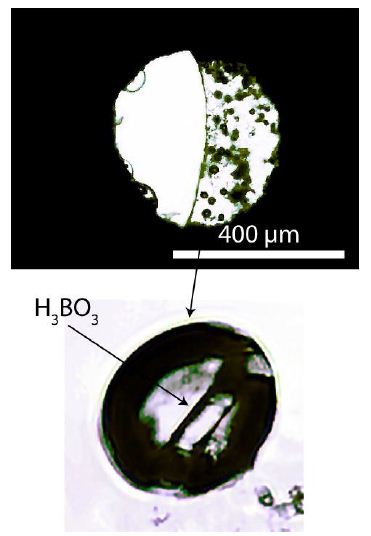
For the first test of isotope fractionation, we used an HDAC experiment conducted in 2002 [9]. Synthetic pegmatite glass with 5.0 % nB2O and destilled water, which we used for the experiment, was heated to 840°C at 0.4 GPa. At this temperature, a homogeneous water-rich glass formed, and on cooling, this homogeneous phase separated into two phases: a homogeneous glass with some dissolved boron and a water-rich phase with small amounts of boric acid, with a ratio of about 1: 1. Also, a small number of fluid bubbles appear on cooling. Over about 22 years in these bubbles, boric acid crystallized. These crystals should provide an initial indication of boron isotope fractionation. Figure 1 shows the sample chamber after the experiment.

Figure 1: The upper picture shows the sample chamber formed by the diamond anvils and the Re-gasket in between, with a hole of 400 µm. The melt, with some bubbles and a concave meniscus, is on the right side of the chamber. Smaller glass bubbles hem the left side of the chamber. The lower picture shows a boric acid crystal in a fluid bubble in the pegmatite glass.

Homogenization Experiments

To homogenize the melt inclusions, we used two techniques: (i) the cold-seal pressure vessel homogenization experiments and (ii) the hydrothermal rapid-quench homogenization experiments. Further details are available in the electronic supplemental material to Thomas et al. (2009 and 2016) [10,11] as well as in the most cited papers by Thomas and Thomas et al.

Boron Determination in Silicate Class

Boron was analyzed with the Cameca SX-50 microprobe, equipped with the PC2 pseudo-crystal for light elements, with a counting time of 300s, 10 kV, and 40 nA, using an anti-contamination cold trap cooled by liquid nitrogen [9]. The boron determination of silicate glass or boric acid in the melt and in fluid inclusions deep under the sample surface was performed by Raman spectroscopy [12,13].

Experimental Section

Boric acid (H3 nBO3 ), H3 10BO3 , H3 11BO3 and the Deuterated H3 nBO3

The samples and the preparation of the deuterated boric acid are described in Thomas (2025a and 2025b) [7,8]. Table 1 shows the results of Raman measurements on deuterated boric acid (minor corrected).

Table 1: Important Raman band of solid H3BO3, H2DBO3, HD2BO3, and D3BO3.

H3BO3

H2DBO3 HD2BO3 D3BO3
75.4 ± 1.5 103.3 ± 1.3 116.6 ± 0.6

128.8 ± 2.2

119.1 ± 3.8

207.8 ± 1.6

499.3 ± 1.0

484.5 ± 2.6 471.9 ± 1.7 466.2 ± 1.0
879.0 ± 1.9 854.0 ± 0.6 835.5 ± 1.7

817.6 ± 4.7

1092.0 ± 7.2

1158.9 ± 2.2 1201.9 ± 6.2 1305.8 ± 5.4

1386.6 ± 3.2

1383.5 ± 6.3

2384.7 ± 4.5 2406.8 ± 2.5 2416.7 ± 2.7

2432.0 ± 2.3

3173.6 ± 4.2

3211.0 ± 2.8 3235.9 ± 7.7 3254.9 ± 4.3
3249.6 ± 4.2

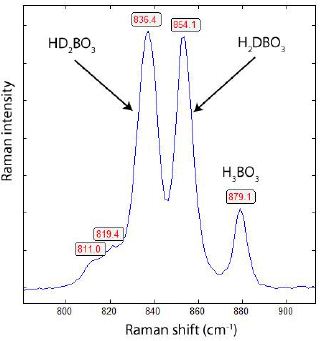
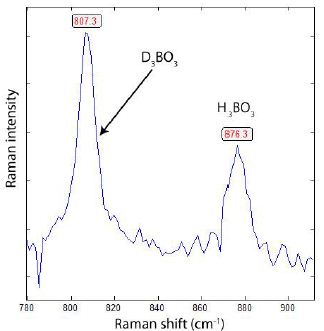
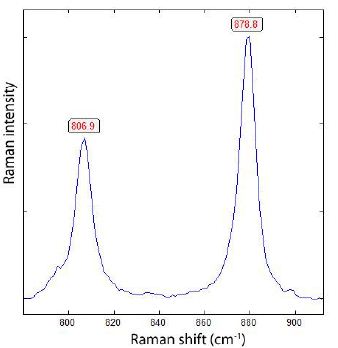
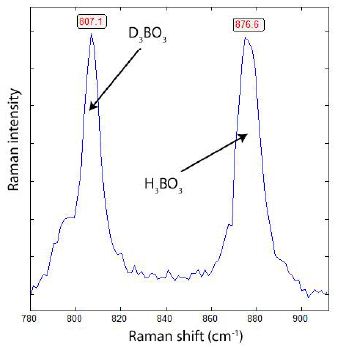
Figures 2 and 3 represent typical Raman spectra of deuterated boric acid. The main phases of simple deuteriation are H2DBO3 and HD2BO3. However, the pure phases of H3BO3 and D3BO3 are present too.

Figure 2: Raman spectrum of HD2BO3 -H2DBO3 -H3BO3

Figure 3: Raman spectrum of a solid mixture of D3BO3-H3BO3.

Table 2 shows the two Raman bands that can be used for the concentration determination of boron isotopes. The 1066 cm-1 band is influenced by deuterium; the 1384 cm-1 band is not.

Table 2: Raman lines of B-isotopes of solid boric acid with the most substantial differences, determined with the 532 nm laser (20 measurements each).

B-isotopes

Raman bands (cm-1)
11B 1165.8 ± 0.3

1380.8 ± 0.9

nB

1166.6 ± 2.7 1383.5 ± 6.3
10B 1171.6 ± 0.4

1411.9 ± 0.6

n – refers to boron of natural abundance with 19.78% 10B and 80.22 % 11B. The significant standard deviation for nB results from the isotope fractionation during preparation.

For the first test, we used the silicate glass with fluid bubbles, shown in Figure 1, formed during the cooling of the HDAC experiment. After a long time, boric acid crystallized out in such bubbles.

Graphic Pegmatite Sample from Elba Island/Italy

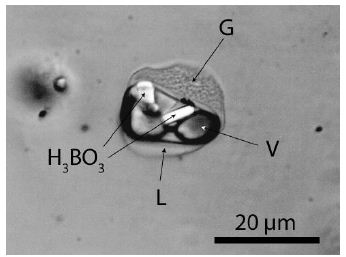
The sample is from the Mining Academy of Freiberg. It’s a small graphic granite sample from Prato alla Valle, located 400 m south of the cemetery of the village San Piero in Campo on the Island of Elba. A detailed description of paragenesis and the melt and fluid inclusions is in Thomas et al. (2008). For the study presented here, we used quartz chips approximately 300 µm thick, polished on both sides. All quartz chips contain melt and fluid inclusions with relatively large boric acid (sassolite) [H3BO3] daughter crystals, making the sample suitable for in situ isotope studies. Figure 4 shows such a melt inclusion, 17 years after the homogenization experiment.

Figure 4: Type-B melt inclusion in graphic quartz from the Elba pegmatite: re- homogenized at 600°C and two kbar, heterogenized after quenching. H3BO3 – boric acid (sassolite), G – silicate glass, L – solution, V – vapor bubble.

Results

Boron Isotopes in the Synthetic Silicate Glass Obtained by a Hydrothermal Diamond Anvil Cell Experiment

The results clearly show that the tendency goes in the right direction. In the aqueous phase, the heavy isotope is enriched, but in the silicate melt, the light B isotope predominates. The standard deviation is substantial for the 1165 cm-1 line. That result is already valid for the Elba pegmatite. (Thomas, 2025b) [8], as we see in the following section (Table 3).

Table 3: Presents the results of Raman isotope analysis of inclusions in the glass phase of the HDAC experiment, based on data from Table 2 (20 measurements each).

Raman band H311BO3 (theoretical)

11B (%) Raman band H311BO3 (measured) 11B (%) (measured)
1165.8 ± 0.3 80.22 1167.5 ± 0.2

70.7 ± 3.4

1380.8 ± 0.9

80.22 1387.8 ± 0.2

77.5 ± 0.6

Boron Isotopes in Boric Acid in the Elba Graphic Pegmatite

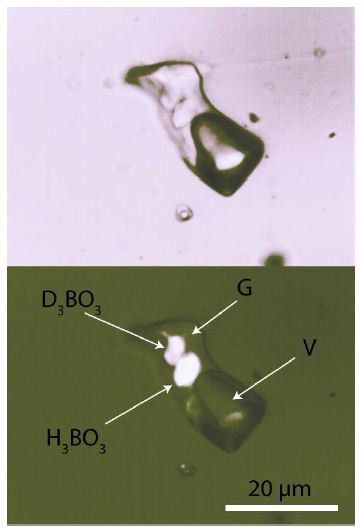
In case of melt inclusions, the 1166 cm-1 Raman band could not be used because, as a rule, the values are significantly smaller than the line at 1165.8 ± 0.3 for pure H3 11BO3.  The reason may be the influence of deuterium or of other elements in the melts. Deuterium in boric acid significantly shifts the Raman lines, primarily affecting the low-intensity lines used for boron isotope determination (Figure 5) (Table 4).

Figure 5: Recrystalized melt inclusion (homogenized at 720°C, 2 kbar, 20 hours) in quartz from the Elba pegmatite with H3BO3 and D3BO3 daughter crystals. For the upper photo, we used unpolarized light; for the lower image, polarized light. H3BO3 – boric acid, D3BO3 – deuterated boric acid, G – silicate glass, V – vapor. In Thomas (2025b) [8], the glass (G) was misinterpreted as liquid (L).

Table 4:

Raman band H311BO3 (theoretical)                  

11B (%) Raman band H311BO3 (measured)  11B (%) (measured)

n

Boric acid in fluid inclusions
1165.8 ± 0.3

80.22

1166.6 ± 0.7 86.2 ± 12.0 20

1380.8 ± 0.9

80.22 1383.3 ± 2.3 91.9 ± 7.4

27

Boric acid in re-homogenized melt inclusions
1380.8 ± 0.9

80.22

1387.6 ± 0.3 78.1 ± 1.0

20

Pseudo-binary Solvus Curve of the System: Pegmatitic Silicate System – Boric Acid-rich Fluid

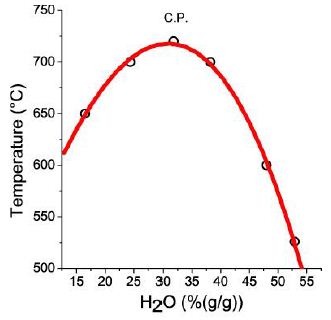
Figure 6 shows the pseudo-binary solvus curve for the Elba graphic pegmatite obtained from re-homogenization of melt inclusions in pegmatite quartz at 600, 650, 700, and 720°C and two kbar, and always 20 hours using the cold-seal pressure vessel homogenization or the hydrothermal rapid-quench homogenization experiments. The point under 550°C was obtained from homogenization measurements using the Linkam microscope heating stage (in 2003).

Figure 6: Solvus curve constructed from re-homogenized melt inclusions in quartz from the graphic pegmatite of Elba Island. Each measuring point is the mean of the homogenization measurements on 10 different melt inclusions. CP – critical point (30.0 % H2O, 712°C).

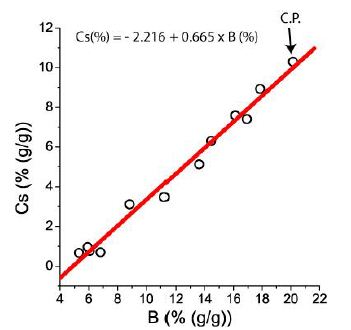
The highest boron concentration in the silicate glass was found in melt inclusions around the critical point: 15.6 % B2 O3 [14]. However, the fluid inclusions are notably higher in boron, as shown in Figure 7.  The distribution of B and Cs on the pseudo-binary solvus curve can be calculated using the reduced coordinates (Figure 3b in Thomas et al. 2019) [15,16]. Extreme high concentration of different elements are connected to the critical point, which degenerate to vertical line.

Figure 7: Cs-B correlation of boric acid and ramanite-(Cs)-bearing fluid inclusions in pegmatite quart from the graphic pegmatite of the Elba Island/Italy (see also Thomas et al., 2008) [14].

From Raman measurements, we now know that near the solvus crest (CP), in addition to extremely high boron and cesium concentrations, deuterium has its highest concentration. The determination is not straightforward because deuterium is associated with multiple deuterium-bearing species: H2DBO3, HD2BO3, and D3BO3. Figures 8 and 9 show the Raman spectrum of a typical melt inclusion in quartz with the two different boric acid phases.

Figure 8: D3BO3 and H3BO3 phases in a near-critical melt inclusion homogenized at 700°C and 2 kbar.

In a small distance (left and right) and the same depth from the sample surface to the critical point, the melt inclusions show only the H3BO3 band at about 880 cm-1. The slight shift from 880 to 878.9 cm-1 is due to contamination with deuterium. Figure 9 allows a rough estimate of deuterium concentration. If we take the analytically determined boron content of the silicate melt at the critical point (720°C and 30 % H2O) of 3.9 % B2O3 [14] we obtain a boric acid concentration of 6.9 %, Because the intensity of both species H3BO3 and D3BO3 is about similar, we have 3.45 % D3BO3, corresponding to 0.32 % (g/g) deuterium in the fluid. That is a high amount.

Figure 9: Raman spectrum of boric acid taken from the melt inclusion shown in Figure 5. Both boric acid daughter crystals (D3BO3 and H3BO3 have the same B-isotope composition: 11B is 91.9% and 8.1% 10B.

Discussion

The described fluid and melt inclusions in the graphic pegmatite from Elba Island/Italy are extremely rich in boron (B) and cesium (Cs), as well as deuterium in the supercritical fluid. The isotopic composition of these phases differs significantly between that of the fluid and the melt. The silicate melt is more enriched in the light 10B isotope, whereas the fluid inclusions, representing the fluid, are enriched in the heavy 11B isotope. However, at the critical point, the situation is reversed. That means at least that the supercritical fluid coming from the mantle is enriched in the heavy 11B isotope. That is a further hint at the extraordinary properties and origin of the supercritical fluids. The high deuterium concentration of the supercritical fluid makes it clearer. Furthermore, these observations indicate that isotope fractionation depends strongly on the origin of that phase, which is the deep mantle.

Acknowledgment

The author thanks A. Anderson, William (Bill) A. Bassett, I-Ming Chou, and Robert Mayanovich for the introduction to the hydrothermal diamond anvil cell technique during a stay at the Argonne National Laboratory near Chicago in June/July 2001.

References

  1. Thomas R, Brümmer G, Scheiblauer K (2025) Paradigm change of pegmatite formation – where does the water come from? Geol Earth Mar Sci 7: 1-7.
  2. Thomas R, Davidson P, Rericha A, Recknagel U (2023) Ultrahigh-pressure mineral inclusions in a crustal granite: Evidence for a novel transcrustal transport mechanism. Geosciences 13: 1-13.
  3. Thomas R (2023) Ultrahigh-pressure and temperature mineral inclusions in more crustal mineralizations: The role of supercritical fluids. Geo Earth Mar Sci 5: 1-2.
  4. Thomas R (2000) Determination of water contents of granitic melt inclusions by confocal laser Raman microprobe American Mineralogist 85: 868-872.
  5. Thomas R, Webster JD, Heinrich W (2000) Melt inclusions in pegmatite quartz: complete miscibility between silicate melts and hydrous fluids at low Contrib Mineral Petrol 139: 394-401.
  6. Thomas R, Kamenetsky VS, Davidson P (2006) Laser Raman spectroscopic measurements of water in unexposed glass inclusions. American Mineralogist 91: 467-470.
  7. Thomas R (2025a) Behavior of deuterium on boric acid: Raman spectrometric measurements: Preliminary Results 7: 1-4.
  8. Thomas R (2025b) Raman spectroscopy of boric acid daughter crystals with different B-isotopes: H 11BO and H 10BO , and different B-isotopes hydrogen and deuterium concentrations. Geo Earth Mar Sci 7: 1-3.
  9. Veksler LV, Thomas R, Schmidt C (2002) Experimental evidence of three coexisting immiscible fluids in synthetic granitic pegmatite. American Mineralogist 87: 775-779.
  10. Thomas R, Davidson P, Rhede D, Leh M (2009) The miarolitic pegmatites from the Königshain: a contribution to understanding the genesis of pegmatites. Contrib Mineral Petrol 157: 505-523.
  11. Thomas R, Davidson P (2016) Origin of miarolitic pegmatites in the Königshain granite/Lusatia. Lithos 250: 225-241.
  12. Thomas R (2002) Determination of the H3BO3 concentration in fluid and melt inclusions in granite pegmatites by laser Raman microprobe American Mineralogist 87: 56-68.
  13. Thomas R, Förster H-J, Heinrich W (2003) The behaviour of boron in a peraluminous granite-pegmatite system and associated hydrothermal solutions: a melt and fluid- inclusion study. Contrib Mineral Petrol 144: 457-472.
  14. Thomas R, Davidson P, Hahn A (2008) Ramanite-(Cs) and ramanite-(Rb): New cesium and rubidium pentaborate tetrahydrate minerals identified with Raman American Mineralogist 93: 1034-1042.
  15. Thomas R, Davidson P, Appel K (2019) The enhanced element enrichment in the supercritical states of granite-pegmatite systems. Acta Geochim 38: 335-349.
  16. Thomas R, Rericha A (2023) The function of supercritical fluids for the solvus formation and enrichment of critical Geol Earth Mar Sci 5: 1-4.

Aromatase Inhibitor and Potential Effect on Adult Height in Growth Hormone Treated Adolescents with Prader-Willi Syndrome: A Commentary

DOI: 10.31038/EDMJ.20261021


Classical genetic conditions with short stature as a major finding in adulthood include Noonan, Turner and Prader-Willi syndromes [1,2]. Noonan and Prader-Willi syndromes affect both males and females while Turner syndrome affects females only. These disorders have been recognized for several decades with published literature describing their features, genetic defects and natural histories but with lack of optimal treatment strategies [1,2]. They are accompanied by a list of comorbidities involving the cardiovascular system, stature, endocrinopathies, puberty and infertility. Endocrine dysfunctions affect the patient’s well-being from birth through adulthood with limited information available for providers to transition from pediatric to adult healthcare and treatment options for subnormal growth to achieve adult stature.

Prader-Willi syndrome (PWS) occurs in about 1 in 20,000 livebirths and is caused most often by a paternal 15q11-q13 deletion followed by maternal disomy 15 where both chromosome 15s are from the mother [3]. A cardinal feature of PWS is infantile hypotonia which is accompanied by a poor suck, feeding problems and decreased energy levels with low body weight during the initial failure to thrive clinical stage [4,5]. The length is typically normal in the first few months of life but falls below normal within the first year related to failure to thrive when nutrition is the main growth promoting factor and low growth with other hormone deficiencies. Short stature is particularly apparent during puberty with the median height falling below the 5th percentile when compared to unaffected individuals [6]. The average adult height of males with PWS without growth hormone treatment is 157cm and 145cm in females [6-8]. Early and continued medical care with surveillance is needed to achieve optimal adult height in this rare genetic disorder [2,4,5,7-11].

Individuals with PWS also present with several distinctive facial features including a narrow forehead, elongated skull, almond-shaped eyes, small nose and chin, decreased saliva, a dry mouth, caries and other dental issues [4]. Facial features are altered in PWS when receiving growth hormone which was approved for treatment in 2000 [5] with an elongated prominent high chin [12]. The use of larger growth hormone dose than recommended and poor supervision could lead to acromegaloid features. Feeding difficulties noted in infancy give way to excessive eating and hyperphagia in early childhood during the second stage of clinical course development which leads to morbid obesity, if not externally controlled. They present cognitive impairments including developmental delay in language and motor skills and are prone to aberrant behavior, temper tantrums, stubbornness, compulsions, self- injury and decreased pain threshold [4,5,7,8].

Our commentary focuses on the need for related medical care by the pediatric healthcare team prior to transitioning to adult services and assessing approaches to improve stature that positively impact adult height in genetic syndromes where short stature is a cardinal feature, such as Prader-Willi syndrome. In addition, hormone deficiencies are common in this rare genetic disorder requiring treatment early affecting body composition, strength, metabolism, growth and stature. Growth hormone is often prescribed in infancy in PWS once the diagnosis is genetically confirmed as growth hormone deficiency is reported in the majority of patients with PWS. Short stature is seen in 90% of cases and feeding problems with a poor suck are cardinal features [2,4,7,8].

Our commentary was stimulated by the natural history of PWS specifically the endocrinopathies, pubertal issues, short stature and hormone replacement needs with new reports of aromatase inhibitors and growth hormone treatment that may improve predicted adult height in non-syndromic pubertal boys with idiopathic short stature [13-16] with application to PWS. We also point out that related medical care required by the pediatric healthcare team is needed prior to transitioning to adult services for improvement of stature impacting adult height in genetic syndromes where short stature is a cardinal feature. As noted, hormone deficiencies are common in PWS affecting not only body composition and obesity but also strength, metabolism, growth and stature. Growth hormone is often prescribed in infancy in PWS once the diagnosis is genetically confirmed and patients are cleared for treatment [2,5,10].

Sex Hormones, Puberty, Short Stature and Treatment

Hypothalamic dysfunction, hormone imbalances and decreased physical activity and metabolic rate along with increased caloric intake can cause life threatening obesity recognized as a cardinal finding in PWS. Those with PWS are also prone to hypothyroidism, and other hormone deficiencies, puberty delay, and body composition disturbances with associated problems such as type II diabetes, cardiovascular disease and infarctions with venous thromboembolism leading to increased mortality. The reported average age at death is 30 years [17] but with early diagnosis and appropriate medical care, life expectancy improve. The presence of obesity in those with PWS are associated with increased rates of metabolic syndrome, hypothalamic insufficiency and hypogonadism leading to low estrogen and testosterone levels. These should be monitored and treated accordingly. Primary and central hypogonadism with pubertal delay is observed in nearly all individuals with PWS and commonly associated with infertility. Hypogenitalism is typically present with cryptorchidism in PWS males [4,5,8,10].

Estrogen is an essential regulator of bone maturation, growth plate fusion, and cessation of longitudinal growth in both males and females. Decreased estrogen effects due to insensitivity or deficiency [18-21] are associated with slow epiphysis closure and exceptional long period of growth. Based on these observations, it can be postulated that longitudinal growth can be modulated by blocking estrogen biosynthesis with aromatase inhibitors (AI), which inhibit aromatization of C19 androgens [(T)] to C18 estrogens including for PWS, as well.

The off-label use of third-generation AI, such as letrozole and anastrozole, has been explored to increase adult height (AH) in boys with non-syndromic short stature. Studies in those pubertal boys have shown inconsistent results on the impact of AI on increased adult height but some investigations have shown beneficial effects [14,22-25]. However, Mauras et al. [15,16] did demonstrate a rise in predicted near adult height and AH in adolescent boys treated with a combination of growth hormone (GH) and AI for GH deficiency or idiopathic short stature (ISS) compared to those treated with GH only. Similarly, more recent studies by Yackobovitch–Gavan et al. [26] demonstrated that aromatase inhibitor treatment alone or with GH increases final height in short-statured pubertal boys with early onset puberty and ISS indicating a potential use in syndromic short stature disorders; hence, the selection of PWS for study. As noted, hypogonadism and hypogenitalism are characteristics of PWS along with premature adrenarche and excessive adipose tissue which is much higher than in the general population. We have also demonstrated acceleration of linear height velocity and long-term benefit with near adult height (AH) from growth hormone treatment (GHT) [10]. The adiposity seen in PWS with premature adrenarche may also accelerate growth velocity and a decrease in adult height.

The goal of a potential long-term study is warranted to compare the effect on AH after GH treatment alone and in combination with AI in males with PWS. A longitudinal study is needed in a cohort of PWS male children or adolescents readily available with genetically confirmed PWS to further characterize the impact of GHT alone and stoppage after achieving complete skeletal maturation and followup. GH and anastrozole group (GH-AI) analysis would be recorded and studied at chronological ages of 11 to 13 years, before attaining AH and for a period of time such as 5 years. The AH will be determined as the height attained when bone age is 16 years or when growth velocity for the preceding year had reached a plateau. Initial and final height- standard deviation score (HT-SDS) will be reported and analyzed in both groups with bone maturation assessed based on roentgenograms of the left hand and wrist. Furthermore, clinical manifestations of premature adrenarche or elevated plasma DHEA-S levels will be assessed and confirmed. Final adult height will be recorded in those receiving growth hormone alone (GHA) or in those with growth hormone and aromatase inhibitor (GH-AI) treatment to determine if an increased adult height would be found and recorded in those PWS males receiving both growth hormone and aromatase inhibitors to maximize their adult height prior to skeletal maturation. Side effects would be monitored and recorded such as pain, mood changes, nausea, vomiting, abdominal pain, or back pain.

Hence, our commentary and proposed study in a classical genetic disorder where short stature is a cardinal feature could be undertaken and treatment accessed using GH and AI treatment approaches in individuals with PWS at a young age. This would be prior to achieving adult height at a point where growth and stature could be positively influenced by treatment using pediatric health care approaches. This combined treatment approach and timing if successful to maximize adult stature may have a direct application for other genetic short stature disorders.

Keywords

Genetic conditions, Prader-Willi syndrome, Clinical and genetic findings, Short stature, Treatment

References

  1. Jones KL, Jones MC, del Campo M (2013) Smith’s recognizable patterns of human malformation (7th ed.) Elsevier-Saunders. [crossref]
  2. Butler MG, Miller BS, Romano A, Ross J, Abuzzahab MJ, Backeljauw P, Bamba V, Bhangoo A, Mauras N, Geffner M (2022) Genetic conditions of short stature: A review of three classic Frontiers in Endocrinology (Lausanne) [crossref]
  3. Butler MG, Hartin SN, Hossain WA, Manzardo AM, Kimonis V, Dykens E, Gold JA, Kim SJ, Weisensel N, Tamura R, Miller JL, Driscoll DJ (2019) Molecular genetic classification in Prader-Willi syndrome: A multisite cohort study. Journal of Medical Genetics 56(3): 149-153. [crossref]
  4. Butler MG (1990) Prader-Willi syndrome: Current understanding of cause and American Journal of Medical Genetics 35(3): 319-332. [crossref]
  5. Butler MG, Lee PDK, Whitman BK (2022) Management of Prader-Willi syndrome (4th ) Springer Nature Switzerland AG. [crossref]
  6. Butler MG, Lee J, Manzardo AM, Gold JA, Miller JL, Kimonis V, Driscoll DJ (2015) Growth charts for non-growth hormone-treated Prader-Willi Pediatrics 135(1): e126-e135. [crossref]
  7. Butler MG (2016) Single gene and syndromic causes of obesity: Illustrative Progress in Molecular Biology and Translational Science 140: 1-45. [crossref]
  8. Butler MG (2023) Prader-Willi syndrome and chromosome 2 BP1-BP2 region: A review. International Journal of Molecular Sciences 24(5): 4271. [crossref]
  9. Butler MG, Miller JL, Forster JL (2019) Prader-Willi syndrome: Clinical genetics, diagnosis and treatment approaches—An update. Current Pediatric Reviews 15(4): 207-244. [crossref]
  10. Angulo MA, Butler MG, Cataletto ME (2015) Prader-Willi syndrome: A review of clinical, genetic and endocrine findings. Journal of Endocrinological Investigation 38(12): 1249-1263. [crossref]
  11. Godler DE, Singh D, Butler MG (2025) Genetics of Prader-Willi and Angelman syndromes: 2024 Current Opinion in Psychiatry 38(2): 95-100. [crossref]
  12. Butler MG, Hovis CL, Angulo MA (1998) Photoanthropometric study of craniofacial traits in individuals with Prader-Willi syndrome on short-term growth hormone Clinical Genetics 53(4): 268-275. [crossref]
  13. Hero M, Norjavaara E, Dunkel L (2005) Inhibition of estrogen biosynthesis with a potent aromatase inhibitor increases predicted adult height in boys with idiopathic short stature: A randomized controlled trial. Journal of Clinical Endocrinology & Metabolism 90(12): 6396-6402. [crossref]
  14. Hero M, Wickman S, Dunkel L (2006) Treatment with the aromatase inhibitor letrozole during adolescence increases near-final height in boys with constitutional delay of Clinical Endocrinology 64(5): 510-513. [crossref]
  15. Mauras N, Gonzalez de Pijem L, Hsiang HY, et (2008) Anastrozole increases predicted adult height of short adolescent males treated with growth hormone: A randomized, placebo-controlled, multicenter trial. Journal of Clinical Endocrinology & Metabolism 93(3): 823-831. [crossref]
  16. Mauras N, Ross JL, Gagliardi P, et al. (2016) Randomized trial of aromatase inhibitors, growth hormone, or combination in pubertal boys with idiopathic short stature. Journal of Clinical Endocrinology & Metabolism 101(12): 4984-4993. [crossref]
  17. Butler MG, Manzardo AM, Heinemann J, Loker C, Loker J (2017) Causes of death in Prader-Willi syndrome: Prader-Willi Syndrome Association (USA) 40-year mortality Genetics in Medicine 19(6): 635-642. [crossref]
  18. Smith EP, Boyd J, Frank GR, Takahashi H, Cohen RM, Specker B, Williams TC, Lubahn DB, Korach KS (1994) Estrogen resistance caused by a mutation in the estrogen receptor gene in a man. New England Journal of Medicine 331: 1056-1061. [crossref]
  19. Morishima A, Grumbach MM, Simpson ER, Fisher C, Qin K (1995) Aromatase deficiency in male and female siblings caused by a novel mutation and the physiological role of estrogens. Journal of Clinical Endocrinology & Metabolism 80: 3689-3698. [crossref]
  20. Carani C, Qin K, Simoni M, Faustini-Fustini M, Serpente S, Boyd J, Korach KS, Simpson ER (1997) Effect of testosterone and estradiol in a man with aromatase New England Journal of Medicine 337: 91-95. [crossref]
  21. Herrmann BL, Saller B, Janssen OE, Gocke P, Bockisch A, Sperling H, Mann K, Broecker M (2002) Impact of estrogen replacement therapy in a male with congenital aromatase deficiency caused by a novel mutation in the CYP19 Journal of Clinical Endocrinology & Metabolism 87: 5476-5484. [crossref]
  22. Ferris JA, Geffner ME (2017) Are aromatase inhibitors in boys with predicted short stature and/or rapidly advancing bone age effective and safe? Journal of Pediatric Endocrinology & Metabolism 30(3): 311-317. [crossref]
  23. Varimo T, Toiviainen-Salo S, Raivio T, Kerttula L, Dunkel L, Hero M (2019) Letrozole monotherapy in pre- and early-pubertal boys does not increase adult Frontiers in Endocrinology (Lausanne): 10: 201. [crossref]
  24. Wickman S, Sipilä I, Ankarberg-Lindgren C, Norjavaara E, Dunkel L (2001) Specific aromatase inhibitor and potential increase in adult height in boys with delayed puberty: A randomized controlled trial. The Lancet 357(9270): 1743-1748. [crossref]
  25. Dunkel L, Wickman S (2002) Novel treatment of delayed male puberty with aromatase Hormone Research 57(Suppl 2): 44-52. [crossref]
  26. Yackobovitch-Gavan M, et al. (2025) Aromatase inhibitors treatment alone or with growth hormone increases final height in short-statured pubertal boys—Real-world data. Journal of Clinical Endocrinology & Metabolism 110(12): e4129-e4136. [crossref]

Raman Spectroscopy of Boric Acid Daughter Crystals with Different B-isotopes: H311BO3 and H310BO3, and Different Hydrogen and Deuterium Concentrations

DOI: 10.31038/GEMS.2025781

Abstract

First, we present Raman spectroscopic results for commercial boric acid [H3 nBO3] and for the boric acid end members containing 10B and 11B. Furthermore, we show in this short contribution, using boric acid as a daughter mineral in melt and fluid inclusions in pegmatite quard from Elba Island/Italy, that the isotopic composition of boric acid is determinable in situ with an acceptable error of 6%. As a result, we obtain an 11B concentration of 91.9 ± 7.4 %. To our surprise, we also found detectable amounts of D3BO3 in the inclusions, in addition to H3BO3. The very high D concentration clearly shows that a significant portion of the pegmatite-forming fluids originated in the deep mantle.

Keywords

Raman spectroscopy, Pegmatites, Boric acid, Bor isotopes, D3BO3, Supercritical fluids

Introduction

Boron is the fifth element (atomic number) in the periodic table of elements in the third main group. Boron is a rare element, and its concentration in the lithosphere is, according to Rösler and Lange (1975) [1], 12 ppm. In granitic rock, according to the same authors, the concentration is 15 ppm. In Sn-granites from Ehrenfriedersdorf, Central Erzgebirge/Germany, the B-concentration can increase to 132 ppm [2]. In melt and fluid inclusions related to the granites and pegmatites from the Ehrenfriedersdorf deposit, boron concentrations as boric acid increase significantly to 6.88 ± 0.40 % [3] Recent studies [4] showed an extreme rise in B2O3 to 16% (corresponding to nearly 50000 ppm B) with the introduction of supercritical fluids from the mantle. At such high concentrations, it should be possible to determine boron isotopes with Raman spectroscopy. The concentration of boric acid in fluid and melt inclusions in the studied pegmatite from Elba Island can reach up to 20% (vol/vol), corresponding to about 30%(g/g).

Methods and Samples

Methods

Generally, we used boron acid-bearing fluids and melt inclusions in pegmatite quartz from Elba Island. That means fluid- and melt- inclusion with sassolite [H3BO3] daughter crystals. Solid boric acid (sassolite) crystals are easy to identify under crossed Nicols under the transmission light by their peculiar interference color. To select suitable samples, we used a transmission polarization microscope (JenaLab Pol). All Raman spectroscopic studies were performed with a petrographic polarization microscope (BX 43) equipped with an XY- or rotating stage, coupled to the EnSpectr Raman spectrometer R532 (Enhanced Spectrometry, Inc., Mountain View, CA, USA) in transmission. The Raman spectra were recorded in the spectral range of 0–4000 cm-1 using the 30 mW of a single-mode 532 nm laser, an entrance aperture of 20 µm, a holographic grating of 1800 g/mm, and a spectral resolution of 4 cm-1.

Samples

The sample is from the Mining Academy of Freiberg. It’s a small graphic granite sample from Prato alla Valle, located 400 m south of the cemetery of the village San Piero in Campo on the Island of Elba. A detailed description of the paragenesis and the melt and fluid inclusions is in Thomas et al. (2008) [5]. For the study presented here, we used quartz chips approximately 300 µm thick, polished on both sides. All quartz chips contain melt and fluid inclusions with relatively large boric acid (sassolite) [H3BO3] daughter crystals, making the sample suitable for in situ isotope studies. Figure 1 shows such a fluid inclusion.

Figure 1: Fluid inclusion in pegmatite quartz from Elba Island. F -fluid, V – vapor, H3BO3 – boric acid (sassoline), PB – pentaborate: ramanite-(Cs).
Some inclusions also contain meta-boric acid crystals. Generally, the used samples are exceptionally rich in inclusions with soluble B-bearing phases

Basic Experimental Section

At first, we took Raman measurements of commercial boric acid (H3 nBO3 ) and of both pure B-isotopes of solid boric acid. The results are in Table 1.

Table 1: Raman of crystallized H3 nBO3 , H3 10BO3 , and H3 11BO3 (n = 20 measurements each).

Boric acid with different B-isotopes

Raman band (cm-1) H3nBO3  Raman band (cm-1)
10B-isotope
Raman band (cm-1)
11B-isotope

Irel

76.0 ± 1.6

74.2 ± 0.5 75.4 ± 0.2 w
119.1 ± 3.8 118.3 ± 1.0 118.2 ± 0.3

w

207.8 ± 1.6

211.0 ± 0.4 208.3 ± 0.2 m
497.2 ± 3.8 499.7 ± 0.4 498.3 ± 0.2

s

879.8± 0.3

880.1 ± 0.4 880.0 ± 0.2 vs
1092.0 ± 7.2

w

1166.6 ± 2.7

1171.6 ± 0.4 1166.4 ± 0.4 w
1383.5 ± 6.3 1411.9 ± 0.6 1381.8 ± 1.1

w

2294.1 ± 2.7

vw
3173.6 ± 4.2 3172.2 ± 1.3 3170.4 ± 0.2

w

3246.4 ± 4.1

3252.0 ± 0.6 3252.0 ± 0.1

w

nB refers to boron of natural abundance with 19.78 % 10B and 80.22% 11B.
Irel – relative intensity: vs – very strong, s – strong, m – medium, w – weak, vw -very weak.

Table 2 presents both Raman lines of boric acid, which show the most significant differences between the two B-isotopes.

Table 2: Raman lines of B-isotopes of solid boric acid with the most substantial differences(for the 532 nm laser: 20 measurements each).

Hilger quartz spectrograph: 253.7 nm

EnSpectr Raman: 532 nm
B-isotopes Raman band
(cm-1)
Raman band
(cm-1)
Raman band
(cm-1)

Raman band
(cm-1)

11B

1166 1373 1165.8 ± 0.3 1380.8 ± 0.9
nB 1168 1375 1166.6 ± 2.7

1383.5 ± 6.3

10B

1173 1422 1171.6 ± 0.4

1411.9 ± 0.6

n – refers to boron of natural abundance with 19.78% 10B and 80.22% 11B.

Results

The basis of the present study is the determination of the Raman spectra of commercial and isotope-pure boric acid. The obtained results were applied to the melt and fluid inclusion in quartz from a graphic pegmatite of the Island of Elba/Italy. The study shows that the ~1380 cm-1 Raman band yields the best results. From 27 studied inclusions, we obtained a mean value of 1383.3 ± 2.3 cm-1. Using the data from Table 2, we obtained a linear curve with a correlation coefficient (R2 = 0.99839) and an 11B concentration of 91.9 ± 7.4 %. For the other Raman line (1165.2 ± 1.65 cm-1), we obtained a similar mean, but with a larger standard deviation. This result may be that the deuterium content influences the position of the Raman line (Figure 2).

Figure 2: Correlation of the B-isotopes in daughter crystals of boric acid in quartz from an Elba Island pegmatite. 11B-isotope content = 4532.64139 – 3.21026 * RS. RS – Raman shift. The black points are the measured ones, and the open points are from Table 2. The data for commercial boric acid were not used for the correlation because of uncontrolled partial fractionation on the microscope specimen slide.

That means the 11B concentration is incredibly high (91.9 ± 7.4 %) in the boric acid samples from the studied Elba Island pegmatite. Besides the high 11B concentration, there are also, in part, very high deuterium concentrations in the boric acid daughter crystals, as shown in Figure 3. The key results are given in Thomas (2025) [6]. Almost every boric acid crystal shows the Raman band for D3BO3. An extreme example is shown in Figure 4, along with the corresponding Raman spectrum from Figure 3. That should be the first natural example of nearby pure D3BO3. Note that each Raman spectrum of pure H3BO3 daughter crystals shows a very weak Raman band at about 807 cm-1, caused by the quartz host.

Figure 3: Raman spectrum of H and D-rich boric acid crystals shown in Figure 4. A perfect separation of both phases (H3BO3 and D3BO3) is at the moment not possible with the used Raman spectrometer, because the solution also contains both components. In the case of D3BO3, the separation from the SiO2 host is not unambiguously possible. However, the intensity of the SiO2 band at 807 cm-1 is usually very low (about 5% of the whole band).

Figure 4 shows the two daughter crystals (D3BO3 and H3BO3), which differ slightly in color and represent different phases.

Figure 4: Fluid inclusion in quartz from the Elba pegmatite with H3BO3 and D3BO3 daughter mineral phases. L – liquid phase, V – vapor phase.
Both boric acid daughter crystals in Figure 4 (H3BO3 and D3BO3) have the same B-isotope composition: 11B is 91.9% and 8.1% 10B.

Discussion

We report here, for the first time, unusual boric acid daughter crystals with extremely high 11B and high deuterium content at the % level. Both findings underline the author’s view that, for some pegmatites, a significant part of the volatiles and rare elements comes via supercritical fluids from the, in part, deep mantle of the Earth (Thomas and Rericha, 2024). Furthermore, we demonstrate that B-isotopes can be determined using Raman spectroscopy. That provides an opportunity to directly and non-destructively explore B-isotope fractionation in mineral-forming fluids, because the boric acid daughter minerals in primary inclusions represent the isotope composition of this solution (see Roedder, 1984).

Acknowledgment

We thank in memory Prof. Ludwig Baumann (1929-2008), of the Mining Academy Freiberg, for the provision of the sample from the Island of Elba.

References

  1. Rösler HJ, Lange H (1975) Geochemische Leipzig. Pg: 675.
  2. Hösel G (1994) Das Zinnerz-Lagerstättengebiet Ehrenfriedersdorf/Erzgebirge. Pg: 195.
  3. Thomas R, Förster H-J, Heinrich W (2003) The behaviour of boron in a peraluminous granite-pegmatite system and associated hydrothermal solutions: a melt and fluid- inclusion study. Contrib Mineral Petrol. 144: 457-472.
  4. Thomas R, Rericha A (2024) Extreme element enrichment, according to the Lorenzian distribution at the transition of supercritical to critical and under-critical melt or Geol Earth Mar Sci. 6: 1-6.
  5. Thomas R, Davidson P, Hahn A (2008) Ramanite-(Cs) and ramanite-(Rb): New cesium and rubidium pentaborate tetrahydrate minerals identified with Raman American Mineralogist. 93: 1034-1042.
  6. Thomas R (2025) Behavior of deuterium on boric acid: Raman spectrometric measurements: Preliminary Geol Earth Mar Sci. 7(7): 1-4.
  7. Roedder E (1984) Fluid Reviews in mineralogy. 12.
  8. Gmelin L (1954) Gmelins Handbuch der anorganischen Chemie: Bor (Ergänzungsband). Verlag Chemie, Weinheim. Pg: 253.
  9. Krishnan K (1963) The Raman spectrum of boric acid. Proceedings of the Indian Academy of Sciences, Section 57: 103-108.

Economic Shockwaves and Extremist Pathways: A Dual-Perspective Analysis of the 2025 Trade War’s Psychological Impact

DOI: 10.31038/PSYJ.2025773

Abstract

Trade wars, though driven by economic objectives, had repercussions extending beyond the economy into social and political spheres. Using a qualitative research design, this study examines the connection between the 2025 trade war and the potential rise of violent extremism by interviewing two key groups: former terrorist offenders, who provide insider perspectives, and terrorism analysts, who offer outsider viewpoints on extremist groups. The findings reveal that contemporary extremists can be categorized by ideology, scope, generational cohort, and behavioral patterns. The study further highlights how global economic instability, which leads to local crises, can exacerbate extremism and criminal behavior, particularly within vulnerable communities. This study identifies three classifications of extremists based on their responses to economic crises: “deradicalized”, “exploiters”, and “vulnerable”.

Keywords

2025 Trade war, Economic crises, Extremism, Radicalism, Terrorism

Introduction

In 2025, the United States, under Donald Trump’s presidency, escalated trade tensions by imposing high tariffs on goods imported from major economies such as the European Union (EU), China, and several ASEAN countries [1]. While these protectionist policies aimed to bolster domestic industries, they inadvertently disrupted the global economy. Simultaneously, a surge in extremist activities worldwide sparked concerns that such economic measures might be fueling the spread of radical ideologies. The Trump administration adopted an aggressive trade policy approach in 2025, implementing tariffs as high as 50% on European products while significantly increasing import taxes on goods from China and ASEAN countries. These measures were originally aimed to address trade imbalances and protect domestic industries. However, the abrupt policy shifts created substantial market instability, strained international relations, and triggered retaliatory measures from affected nations. For instance, the EU considered imposing counter-tariffs targeting U.S. technology firms, while ASEAN nations sought to mitigate the economic impact by strengthening trade partnerships with China and members of the Gulf Cooperation Council [2]. The imposition of tariffs significantly disrupted global supply chains, leading to higher production costs and subsequent price increases for consumers. While U.S. consumer confidence showed modest improvement following the trade truce with China, broader economic uncertainty persisted. Internationally, economies such as Germany faced potential GDP contractions, while several African nations revised their growth forecasts downward due to tariff-related instability. These economic pressures exacerbated social tensions, creating conditions that extremist groups exploited to capitalize on public discontent [3,4].

Historical precedents demonstrate that economic hardships can fuel extremist ideologies. The economic fallout from the 2025 trade war appears to be replicating this pattern. In the United States, the Department of Homeland Security’s Homeland Threat Assessment 2025 emphasized the ongoing threat posed by domestic violent extremists, many of whom were motivated by anti-government sentiment and conspiracy theories [5]. Globally, regions experiencing economic downturns saw a resurgence of radical groups capitalizing on widespread public discontent, a pattern that, while complex, is supported by various studies. This is evident in the rise of Pentecostal affiliation and political representation in Brazil [6], the growth of radical nationalism in Finland amid economic uncertainty [7], and the “Age of Discontent” framework, which argues that economic crises trigger cultural discontent and fuel the rise of populism and the radical right across several countries [8]. The trade war’s transnational impacts have been particularly evident. In Southeast Asia, ASEAN nations grappling with economic challenges stemming from U.S. tariffs have pursued alternative alliances and trade agreements. These geopolitical realignments not only altered regional power dynamics but also created opportunities for extremist groups to exploit perceptions of Western economic aggression. Similarly, in the Middle East, economic destabilization caused by U.S. tariffs and declining foreign investment contributed to the revival of groups like the Islamic State, which strategically leveraged the resulting chaos to recruit members and expand their influence [9].

While empirical evidence on the direct impact of trade wars on extremism remains limited, economic crises are known to significantly influence political extremism and terrorism. Historical patterns demonstrate that economic downturns frequently correlate with increased support for far-right and anti-establishment movements. This phenomenon was evident in Europe during both the 1930s Great Depression and the recent global financial crisis. Supporting this observation, a longitudinal study across 23 EU countries (1995-2012) revealed that declining GDP and rising unemployment rates consistently corresponded with growing electoral support for extremist parties, particularly far-left groups [10]. However, the relationship between economic hardship and extremism demonstrates significant complexity. In the U.S. context, Republican donors residing in foreclosure-affected areas showed reduced support for Tea Party candidates during the housing crisis [11]. On the other hand, research on Russian terrorism reveals that economic crises may produce contradictory effects on extremist activities: while economic distress can fuel public anger and potentially increase terrorist motivations, it may simultaneously constrain operational capabilities by limiting available resources [12]. These findings collectively suggest that the nexus between economic crises and political extremism is context-dependent, with outcomes varying according to specific circumstances. This study seeks to examine the intricate relationship between the 2025 trade war and the potential resurgence of violent extremism, as there is currently no research on this connection, incorporating viewpoints from both extremist networks and external sources. This will constitute the novelty of this study. Through in-depth interviews with two key stakeholder groups—former terrorist offenders (providing insider perspectives) and counterterrorism experts (offering external analyses), this study examines whether the 2025 US trade war’s economic disruptions may catalyze extremist violence. By elucidating the potential correlation between trade-induced economic shocks and extremist escalation, this study hopes to contribute in the development of mitigation strategies during periods of global economic and geopolitical instability.

Trade Wars

Definition of a Trade War

Trade wars are economic conflicts where countries impose retaliatory tariffs or trade restrictions to protect domestic industries or address trade imbalances [13,14]. These conflicts can arise from various factors, including uneven trade benefits, technological rivalries, and protectionist policies. The US-China trade war demonstrates such conflicts, with the US seeing China’s growth as a threat to its trade supremacy [15]. Trade wars can significantly impact global trade, economic growth, and international relations. The dynamic process of trade wars involves gradual tariff rises by one country, eventually prompting retaliation from the affected nations [16]. Depending on market characteristics, retaliation may lead to liberalisation or escalate into a full-scale trade war. Economist Douglas A. Irwin’s definition of trade war is a situation in which countries attempt to damage each other’s economy, usually through the tariff’s imposition or quota restrictions. It often lead to economic inefficiencies and increased tensions between nations [17]. Trade wars emerge as a direct consequence of protectionist economic policies designed to shield domestic industries through import restrictions. These measures, which include tariffs, import quotas, and regulatory barriers, fundamentally alter global economic dynamics by creating uncertainty that affects business investment patterns, disrupts global value chains, and distorts market expectations.

According to Xu (2024), protectionist interventions not only impede international trade flows but also elevate production costs and generate inflationary pressures across economies. The Sino US trade war, initiated amid economic tensions and mutual allegations of unfair trade practices, has significantly impacted strategic industries and constrained international investment flows [18]. The resulting global economic uncertainty has transmitted through financial markets, affecting both advanced and emerging economies [19]. Although current protectionist measures have demonstrated limited economic disruption to date, potential escalation poses substantial risks to global growth prospects and the Euro area [20]. This protectionism induced uncertainty adversely affects economic sentiment and potentially undermines long term market confidence. Empirical evidence from microeconomic firm data and macroeconomic analyses confirms that heightened trade policy uncertainty consistently suppresses corporate investment activity [21].

Historical Overview of Trade Wars

1. The Anglo-Dutch Trade Wars (17th Century). One of the earliest examples of a trade war occurred between England and the Dutch Republic in the 17th century. These conflicts involved both military and economic rivalry, including naval battles and commercial competition. In 1651, England passed the Navigation Acts, which restricted the use of foreign ships for trade between England and its colonies. This legislation aimed to weaken Dutch maritime dominance and ultimately led to a series of naval conflicts known as the Anglo-Dutch Wars. The outcome of these trade wars helped England establish itself as a dominant maritime and commercial power for centuries to come [22].

2. The Smoot-Hawley Tariff Act (1930). One of the most infamous trade wars in modern history was triggered by the Smoot-Hawley Tariff Act during the Great Depression. Passed by the U.S. Congress in 1930, the act imposed steep tariffs on over 20,000 imported goods. In retaliation, many countries raised their own tariffs, leading to a sharp decline in global trade. As a result, world trade plummeted by an estimated 65% between 1929 and 1934, exacerbating the global economic downturn [23].

3. The Chicken War (1960s). In the early 1960s, a trade dispute known as the “Chicken War” erupted between the U.S. and the European Economic Community (EEC) over tariffs on American poultry exports. After the EEC imposed protective tariffs, the U.S. retaliated by levying duties on European imports, most notably a 25% tariff on light trucks, including the popular Volkswagen Type 2 van. This measure had lasting consequences, in which the light truck tariff, which remains in effect as of the 2020s, has profoundly influenced the structure of the U.S. automobile industry for decades [24].

4. U.S.-China Trade War (2018–2020). The most prominent and widely documented trade war in recent history began in 2018 under the Trump administration, as tensions escalated between the United States and China. The U.S. accused China of engaging in unfair trade practices, including intellectual property theft and forcing technology transfers from foreign firms. In retaliation, the U.S. imposed tariffs on hundreds of billions of dollars’ worth of Chinese imports, prompting China to respond with counter-tariffs on American goods. This trade conflict had far-reaching consequences: it disrupted global supply chains, increased costs for manufacturers and consumers, and amplified economic uncertainty worldwide [25]. Additionally, it sparked a reassessment of global trade dependencies and contributed to a resurgence of economic nationalism across multiple countries.

Consequences of Trade Wars

Trade wars typically result in several key consequences: 1) higher consumer prices due to increased costs of imported goods, 2) supply chain disruptions, reducing efficiency and eroding competitiveness, 3) retaliatory measures from trading partners, escalating international tensions, and 4) adverse effects on global economic growth, particularly in interconnected sectors such as technology, agriculture, and automotive industries. According to the International Monetary Fund [26], the trade tensions and tariffs imposed between 2018 and 2019 slowed global economic growth, ultimately reducing world GDP by approximately 0.8% by 2020.

1. Disruption of Global Supply Chains. One of the primary mechanisms through which trade wars trigger economic crises is by disrupting global supply chains. In today’s interconnected economy, production processes often span multiple countries before final assembly. Tariffs raise the cost of intermediate goods, increasing production costs and reducing operational efficiency. During the U.S.-China trade war (2018–2020), for instance, U.S. manufacturers faced higher input costs due to tariffs on Chinese components, while Chinese exporters experienced reduced demand for their goods. Sectors with complex supply chains, such as automotive and electronics, were particularly vulnerable. A Federal Reserve study found that U.S. tariffs led to significant cost increases for domestic manufacturers and a measurable decline in industrial output [27]. Long-term consequences included widespread corporate uncertainty. Many firms delayed investments, restructured operations, or relocated production, often at substantial expense, to mitigate political and trade risks. This reconfiguration of supply chains further strained global economic stability.

2. Consumer Price Inflation and Reduced Purchasing Power. Tariffs function as a tax on imported goods, typically leading to higher consumer prices. Research by Amiti et al. [28] revealed that during the 2018-2019 U.S.-China trade conflict, American consumers and firms absorbed most of the additional costs from tariffs. These price increases reduced household purchasing power, which is crucial for maintaining GDP growth. When consumers have less to spend, overall economic demand weakens, business revenues decline, layoffs often follow, and economic growth slows. Prolonged trade conflicts may even trigger stagflation, which is a dangerous combination of rising prices and economic stagnation that, while rare, can cause severe damage. Multiple studies have examined the economic consequences of the U.S.-China trade war and potential broader global trade conflicts. Simulation results indicate that in a scenario of widespread global trade tensions, world GDP could decline by up to 1.96% with global trade volumes falling by 17% over the medium term [29]. The immediate impact of the U.S.-China dispute alone reduced GDP by 0.1% in the United States and 0.2% in China. The long-term effects appear more substantial, with potential losses reaching 1.6% for the U.S. and 2.5% for China, primarily due to reduced capital investment and diminished technological collaboration between the two nations [30]. Both countries experienced decreased energy demand and slower economic growth, which could further disrupt global energy markets [31]. While some nations may benefit from trade diversion effects, the overall impact on the global economy tends to be negative [32]. The conflict altered relative prices, disrupting established production networks and shifting comparative advantages in key sectors including transportation, electronics, and machinery.

3. Investor Uncertainty and Capital Flight. Trade wars generate significant policy uncertainty that undermines investor confidence. When trade policies become unpredictable, businesses typically delay decisions regarding expansion, innovation, and workforce growth. This cautious “wait-and-see” approach reduces aggregate investment and slows productivity growth [33]. The financial repercussions extend further as international investors may divest from nations engaged in trade conflicts, particularly those exhibiting economic vulnerability or political instability. Such capital outflows can trigger currency depreciation, increase borrowing costs, and potentially spark financial crises—especially in developing economies dependent on foreign investment.

4. Vulnerability of Emerging Markets. Emerging markets face heightened vulnerability during trade wars. These economies typically depend on exports for growth and require imports for critical industrial inputs. When major economic powers like the U.S. and China engage in trade conflicts, the ripple effects are global. Nations across Africa, Southeast Asia, and Latin America frequently experience reduced demand for their exports, volatile capital flows, and currency depreciation. These combined factors significantly elevate the risk of economic crises [34].

5. Poverty. Trade wars may impact poverty levels in developing countries through complex and indirect mechanisms. While trade expansion generally promotes economic growth, its benefits are often unevenly distributed across societal groups [35]. Trade conflicts influence poverty through multiple channels: (1) price volatility for essential goods, (2) labor market disruptions, (3) reduced government fiscal capacity, (4) heightened economic uncertainty, and (5) constrained GDP growth [36]. The ultimate poverty effects depend on three key factors: the severity of market disruptions, institutional capacity for risk mitigation, and labor demand elasticity. Particular attention must be paid to vulnerable populations, including women, rural communities, informal sector workers, and other marginalized groups [37].

Extremism

Extremism represents a multifaceted threat to both societal cohesion and fundamental rights [38]. Defined by the use of coercive violence to impose ideological or belief systems [39], its manifestations challenge common assumptions—particularly regarding religious extremism’s prevalence, which stems from complex interplays between individual psychology and communal dynamics [40]. From a psychological perspective, extremism is viewed as a form of deviant behavior that arises when there is an imbalance in motivation, where one need becomes so dominant that it overrides other needs and behavioral norms [41]. To address violent extremism requires identifying the specific needs or motivations that contribute to it and recognizing the role of external agents influencing or managing the difficulty level in carrying out extremist activities [42].

Research suggests that extremism is motivated by several psychological factors. According to significance quest theory, there are three main causes: a strong need to feel important or meaningful, a belief system that justifies the use of violence, and support from others with the same views [43]. Relative deprivation – the feeling of being treated unfairly or having less than others – is identified as an important factor that helps to explain various forms of violent extremism. This includes actions to change or protect existing social or political systems [44]. Extremism can manifest in both destructive forms (such as terrorism) and constructive forms (such as scientific breakthroughs). It can influence different parts of culture as well as individual decision-making. Understanding the psychological factors that lead to extremism is important to develop effective interventions to reduce dangerous extremist behaviors and redirect them to more constructive directions. These psychological insights offer a clear framework for studying and responding to different forms of extremism in different cultural and social settings.

Methods

Design

This study employed a qualitative research design to examine the relationship between the 2025 trade war and violent extremism. The qualitative technique was employed to gather extensive information regarding the relationship between factors. Due to various challenges in terrorism research, including confidentiality concerns and skepticism from both authorities and terrorist perpetrator [45,46], a qualitative methodology is more suitable for investigating the connection between the 2025 trade war and violent extremism.

Participants

This study involved ten deradicalized Indonesian terrorist offenders, a foreign (American) terrorist suspect, and eleven analysts/experts on terrorism (Table 1). Their ages ranged from 30 to 75 years. The terrorist offenders faced charges that included the Bali bombing, robbery, obstruction of justice, financing terrorism, involvement in worldwide terrorist networks, espionage, recruitment, and military training for terrorism. They were affiliated with militant organizations such as Jamaah Islamiyah/JI/Al Qaeda, ISIS, and Hezbollah. The eleven experts comprised forensic psychologists/terrorist profilers, senior officers from the Special Task Force Anti-Terrorism/Detachment 88 of the National Police (Densus 88), and several American, Indonesian, Malaysian, and Singaporean government think tanks (security consultants and advisors working for anti-terrorism agencies and various ministries), all of whom possess esteemed credentials.

Table 1: Participants of this study.

Perspective

Initial Sex (M/F) Age Field of expertise/ Case

Nationality/Affiliation

Outsider (experts/)


ST

M

45

Intelligence Indonesia

N

M

62

Economics Indonesia

PI

M

63

International relations, military, and defence Indonesia

GI

M

55

Politics and religion studies Indonesia

R

M

44

Legal and human rights Indonesia

IS

M

58

Law and gender studies Indonesia

MS

M

41

Middle East Studies USA

KP

F

51

Psychology Indonesia

BS

M

75

Military and intelligence Singapore

DT

F

54

Journalism, gender, and human rights Indonesia

AA

M

47

Religious studies Malaysia
 
Insider (former terrorist offenders/ suspects in extremist network)

AN

M

48

Terrorist recruitment and training JI

AT

M

45

Obstruction of justice ISIS

AI

M

48

Bombing JI

AD

F

23

Foreign fighting in Syria ISIS

TA

F

32

Terrorism financing ISIS

TS

M

49

Military training/camp JI

GL

M

32

Terrorism financing ISIS

WT

M

53

Terrorism financing JI

MI

M

45

Robbery JI

JI

M

61

Hiding information JI

SM

M

41

Espionage (foreign fighting in Iraq) Hezbollah

The study participants were selected through purposive sampling. To mitigate bias in purposive sampling, we initially defined the experts in this study as those possessing over ten years of experience in economics, social sciences, and/or counterterrorism; whereas the former offenders/suspects as those who were already deradicalized and whose names were recommended/referenced by counter-terrorism agencies/organizations (e.g., BNPT, Densus 88, the Ministry of Religious Affairs, and others). Secondly, we utilized inter-rater assessment in coding, categorizing, and interpreting the data acquired from participant interviews.

Procedure and Materials

A review of participant names, initial outreach, and communication with potential participants was conducted, followed by organized interviews with individuals who consented to participate in this study. Before the interviews, participants who agreed to take part in the study provided verbal consent to be involved. Interviews were conducted in May and June 2025 by the principal researcher of this study in Indonesia and the United States. Each participant engaged in a single interview session lasting approximately 30 to 40 minutes. Interviews were conducted in Bahasa Indonesia or English, with the researcher recording responses manually as participants opted against digital recording. Prior to concluding each interview, the researcher verified the written notes with the participant for accuracy to prevent misunderstanding and bias.

Analysis

The participants’ answers were compiled in a table for qualitative analysis. This enabled researchers to identify key similar concepts. The researchers subsequently deliberated on the participants’ replies and coding to ensure inter-rater agreement. They subsequently analysed the data using an inductive approach to identify a general pattern.

Results and Discussion

Extremists’ Perspectives on the 2025 Trade War

The findings of this study suggest that up-to-date extremists can be classified based on their scope, gender, ideology, hierarchical position within terrorist organisations, role, occupation, motivations for joining terrorist groups, generational cohort, and behavioural changes (Table 2). Extremists can be categorised as female or male, leaders or non-leaders, entrepreneurs or labourers, economically or non-economically oriented, religion- or non-religion-based, non-deradicalized or deradicalized, and active or passive. Regarding scope, there exist both local/home-grown and global extremists. Generational classifications include non-Gen Z individuals, specifically Baby Boomers (born 1946–1964), Generation X (born 1965–1980), and Millennials (born 1981–1996), as well as Gen Z or younger (born 1997 or later). The participants emphasise the Gen Z and younger cohort to anticipate the post-Artificial Intelligence (AI) age, as Gen Z is seen as a ‘cyber/digital generation’, fundamentally differing from preceding generations in many aspects of life. Although previous studies have recommended many classifications of terrorists or extremists, the participants of this study advocate for more simplified categories for pragmatic investigative objectives following the disbandment of Jamaah Islamiyah (JI) and the ‘zero-attack’ phenomenon.

Table 2: Classifications of contemporary extremists.

Category

Type

Scope Home-ground/local vs global
Gender Female vs Male
Hierarchy in terrorist network High-ranked (e.g., leaders, commanders) vs lower-ranked (e.g., technicians, couriers)
Work Entrepreneurs vs non-businessmen/labourers
Ideology Religion vs non-religion based (e.g., separatism, socialism, communism)
Motives to join network Economic vs justice vs security vs social vs political vs adventure
Generation Gen Z vs others
Level of radicalism Low vs medium vs high
Change in behaviour Non-deradicalized vs deradicalized vs unstable
Role Active (i.e., recruiter, producer) vs passive

The findings demonstrate that local extremist networks possess a limited understanding of the 2025 trade war in comparison to their global counterparts. Furthermore, extremist leaders and businessmen possess a greater understanding of the 2025 trade war and its ramifications on the daily lives of individuals, in contrast to non-leaders and labourers. Interestingly, participants of this study explain that female extremists (umahat) lack comprehension of global trends and the conflict between nations (USA/allies and China/allies), in contrast to their male kins (husband, father, son). Moreover, Gen Z extremists comprehend global news, including the 2025 trade war and its ramifications, as they consistently engage with news and podcasts on various online.

“Terrorists might be either homegrown or global. The global ones know that big countries might use them as proxies, so they might know about trade conflicts and other global problems. They are well-informed and watch the news because they will utilize any chance they have to propagate their narratives. But the ones who are homegrown don’t know anything about trade wars or geopolitics.” (A political analyst and advisor).

“We, Gen Z, watch news and listen to podcasts on YouTube, Twitter, and other sites. We know what’s going on in the world, including the 2025 Trade War and how it will affect our economy. We even keep up with many trends and know that there are numerous layoffs and campus dropouts in Indonesia because of the economic crisis.” (A former suspect/extremist).

“Our forensic clinical examination shows that these extremists and terrorists have serious problems in two parts of their brains: the ventromedial prefrontal cortex (vmPFC) and the dorsolateral prefrontal cortex (DLPFC). This means they don’t understand global issues like the 2025 trade war between the US and China. The DLPFC is a very important part of the brain that helps with memory, decision-making, emotion management, executive functioning, and behavior that is focused on goals. The DLPFC has something to do with violent behavior and terrorism. The vmPFC is a critically important part of the brain for social and emotional functioning, like empathy, controlling emotions, and moral competence. It regulates anxiety and fear. The vmPFC mixes cognitive and affective information, which includes human values.” (A forensic clinical psychologist)

“Don’t underestimate us, we follow the news. We know what’s going on in the world. We know about the trade war and other conflicts between the US and China, which affect Indonesia’s economy in the end.” (A bombing perpetrator).

“I doubt that extremists know about this thing (trade war). Their paradigm is different unless the great powers (USA and China) attack Muslim states.” (A senior military and intelligence advisor for several governments).

“They know about the 2025 trade war because their groups have a Foreign Affairs division, meaning they always monitor developments that occur abroad, including the trade war between China and America. So, they study things like this, not only local politics but also global politics. I remember when I interviewed one of the leaders of JI, he said that his division monitors global political developments and with whom they must cooperate.” (A senior journalist and analyst for governments).

The Expected Relationship Between the 2025 Trade War and the Rise of Extremism

The findings in this study show that participants split in opinions about the impact of trade war to the rise of extremism. Most participants argue that global economic challenges resulting in crises may increase the rise of extremism and criminal behaviour, especially to at-risk communities or individuals. Many of them refer to pull and push factors in criminal studies, indicating that economic or financial crises can precipitate various societal issues. They elucidated that economic difficulties may serve as catalysts or supporting factors, among other variables such as socioeconomic disparity, injustice, political instability, and so forth, in the emergence of extremism. Nevertheless, a small contingent of four individuals argues that economic issues are irrelevant to extremism, asserting that ideology is the only driver of such behaviour. These participants were former leaders or high-ranking members of JI (Table 3).

Table 3: Participants’ opinions on economic crises’ impact to the rise of extremism.

Insider (former terrorist offenders/suspects in extremist network)

Outsider (experts/analysts)

Initial and rank

Statements Agreement that trade war can lead to extremism Initial Statements

Agreement that trade war can lead to extremism

AN (JI, high-ranked) “No, nothing to do with that. Because our actions are based on ideology.”

X

N

“It is agreed in many theories that economic inequality can lead to criminality.”

AT (ISIS, high-ranked) “Yes, it can, therefore it is used in violent extremist narratives.”

PI

“Economic hardships can stimulate the rise of extremism, because vulnerable people in such situation will go to two things: gambling or extremism.”

AI (JI, high-ranked) “For us, economic issues don’t affect us. But for vulnerable people, economic difficulties may increase extreme thoughts.”

GI

“Economic troubles can be a catalyst in the increase of extremism.”

AD (ISIS, lower-ranked) “Economic problems can lead to violent extremism, yet through a very long process.”

R

“Yes, because economic discrepancy is one of the push factors in extremism and terrorism.”

TA (ISIS, lower-ranked) “Yes, economic grievance can be a trigger to make someone extreme in mind.”

IS

“No, economic troubles don’t contribute to extremism, because the extremists witness that everyone also suffers, not only their network/ fellows. We all are suffering.”

X

TS (JI, high-ranked) “For sure, yes, it can. Just like what happened in Poso.”

MS

“Yes, it can lead to extremism. Just look at Yemen.”

GL (ISIS, high-ranked) “It can, because economic troubles can increase criminal activities.”

KP

“Economic factors can increase extremism, but not directly.”

WT (JI, high-ranked) “It can but economy is not the only factor.”

BS

“Economic hardships due to the trade war can enhance existing or create new grievances, hence increase extremism.”

MI (JI, high-ranked) “There is a possibility that trade war between USA and China and other countries will cause global economic crises, and lead to the rise of extremism everywhere.”

DT

“Extremists will do the acts of terror when they have monetary resources, regardless the circumstances.”

X

JI (JI, high-ranked) “No, economic issues have nothing to do with us. We act based on ideology.”

X

AA

“Global economic crises because of the 2025 trade war between the great powers can be used by terrorists and extremists to recruit more people into extremist groups.”

SM (Hezbollah, sympathiser) “Economic difficulties for sure can increase the level of extremism in people.”

ST

“Yes, it can, that’s why economic crises is effectively used by them for their propaganda to recruit more people.”

The present findings reveal a divergence in participant perspectives regarding the potential impact of the 2025 trade war on extremism. A majority of participants posit that global economic instability may exacerbate extremism and criminal behavior, particularly among vulnerable populations. Drawing upon criminological frameworks, respondents highlighted how economic crises may function as both push and pull factors, interacting with other psychosocial variables—including socioeconomic disparities, systemic injustice, and political instability—to facilitate radicalization. Notably, a minority subset (n=4) of former Jemaah Islamiyah (JI) leaders and high-ranking members maintained that economic factors bear no significant relationship to extremism, asserting ideological commitment as the sole determinant of such behavior (see Table 3). This dissenting perspective underscores the ongoing theoretical debate regarding the relative weights of material deprivation versus ideological conviction in radicalization processes.

“People in underdeveloped regions who are still struggling, poor, and starving are more likely to commit terrorist attacks and become radicalized. For example, Poso. That’s the fact. It’s not easy to get people to do violent things while their tummies are full.” (A high-ranked JI member).

“Everywhere, it has become a premise that the greater the socioeconomic inequality, the higher the crime rate.” (A senior economic advisor of the Indonesian government.

“We are really offended when our acts are linked to money issues. Not all poor individuals in developing nations become terrorists. Our acts were based on our beliefs and ideology.” (A bombing perpetrator, former JI member).

“Trade wars and economic crises cannot turn individuals into extremists, but tensions between India and Pakistan can, due to India’s attacks against Muslims in Pakistan. There is a growing argument right now among Afghanistan ex-combatants over how to get to Pakistan from Indonesia to help our brothers and sisters there.” (A former leader of JI).

“Economic crises can turn people to be extreme in mind. Financial issues are not the main driver, but can increase extremism – indirectly maybe, along with other issues such as injustice, discrepancy, and other grievances.” (A senior JI member).

“Economic crises can lead to the rise of extremism as these can enhance existing or create new grievances.” (A senior military and intelligence advisor for several governments).

“The worse the economy in a country, the higher the extremism in its people. When people have nothing to lose – poor and starving, it’s easier to provoke them and escalate extremism in them. Just look at Yemen.” (An American analyst).

This study reveals a typology of psychological responses to economic crises among individuals with extremist affiliations. The findings demonstrate three distinct patterns of reaction and adaptation. First, there are individuals who have undergone significant belief system modification, having disengaged from violence. These individuals exhibit marked affective distress when confronted with economic crises, including inflation, rising prices, increased poverty, and heightened taxation. Their distress extends beyond personal circumstances to encompass broader societal impacts, and they maintain a determined commitment to peace advocacy regardless of external conditions.

In contrast, the study identifies a second category of extremist actors who occupy leadership or senior positions within their organizations and display high levels of radicalization. These “exploiters”-typed extremists individuals strategically exploit economic difficulties, turmoil, and chaos to advance their ideological objectives. They actively disseminate propaganda and recruit new members by framing economic crises as divine punishment for societies that fail to adhere to their prescribed religious practices. This exploitative behavior reflects sophisticated cognitive framing techniques and deliberate manipulation of in-group/out-group dynamics.

A third, more passive group emerges from the findings – individuals who are ‘muted’ members on the periphery of extremist networks while experiencing significant economic hardship. These members demonstrate increased susceptibility to radicalization during periods of economic distress, though they typically refrain from active participation in organizational activities. Their vulnerability appears rooted in the intersection of material deprivation and pre-existing network affiliations.

The study’s typological framework contributes to our understanding of how economic crises function as psychological stressors that interact differentially with individuals’ positions within extremist hierarchies and their stages of radicalization. The findings suggest that economic instability does not produce uniform effects across extremist populations, but rather activates distinct psychological and behavioral patterns depending on individuals’ organizational roles, belief systems, and personal circumstances. Thus, the study has identified three classifications of extremists according to their reactions to economic crises: 1) disengaged from violence/’deradicalized’ individuals who persistently promote peace, 2) ‘exploiters’ who use economic challenges as a means to disseminate extremist narratives and recruit more followers, and 3) ‘vulnerable’ silent individuals who may adopt more radical ideologies in response to economic hardships.

“These economic issues are exploited by recruiters to spread their ideology. They argue that the crises happen because the government is secular or not applying certain religious practices across many aspects.” (A high-ranked JI member).

“Historically proven, economic crises can cause discontentment and anger against authorities which can lead to resistance, fighting, and expressions of dissatisfaction against governments. The extremists use the issue of economic crises to blame the small group of minorities, the top 10%, the capitalists who own all the land and resources, and to promote hate-filled narratives or propaganda to get more people to join them.” (A scholar of Islamic studies, high-ranked counselor to governments).

“High prices, low purchasing power of the people, and various manifestations of economic crises cause two things in vulnerable communities: 1) online gambling due to frustration, or 2) extremism as a means to transcend existence in this world and go to the afterlife.” (An eminent professor in International Relations, Military, and Defense).

“Economic crises can cause someone to become extreme, but this is a very long process. Economic motives are not the only ones; they interact with other factors that can eventually cause people to become extreme. I am one example.” (A young former ISIS member).

Urgent Policy Measures Needed to Mitigate Risks During the 2025 Trade War

The findings of this study reveal several threats that governments must confront following the 2025 trade war, based on perspectives from both internal and external extremist groups. Former terrorist offenders/suspects and experts in various fields highlight current threats/risks, including significant economic and social disparities, political instability, poverty, and the escalation of tensions between India and Pakistan into a religious conflict (Table 4).

Table 4: Current threats according to participants.

Insider

(extremist networks)

Outsider

(experts)

Initial and rank

View on current risks Initial

View on current risks

AN (JI, high-ranked) The escalation of tensions between India and Pakistan into a religious conflict

N

Governments’ uncertainty in responding to the USA-China trade conflict
AT (ISIS, high-ranked) A new growing wave of violent extremism

PI

Poverty
AI (JI, high-ranked) Injustice, corruption, oppression and economic disparities

GI

Governments’ lack of empathy to their own people
AD (ISIS, lower-ranked) Economic, politic, and social instability

R

Social Inequality (grievance/hatred)
TA (ISIS, lower-ranked) People’s frustration and distrust in administrations of governments globally

IS

Radical narratives, such as those about India vs Pakistan war which are often linked to religion
TS (JI, high-ranked) Hunger and safety issues

MS

Economic inequality within and across nations
GL (ISIS, high-ranked) Poverty and welfare issues

KP

Crimes and terrorism
WT (JI, high-ranked) Disinformation, hoax, and dangerous radical narratives

BS

The consequences from the Israeli genocide against Palestinians
MI (JI, high-ranked) Inequality and perceived injustice in society

DT

The birth of new cells of extremist groups post-2025
JI (JI, high-ranked) Economic instability, poverty and sharp decline of people’s purchasing power

AA

Economic inequality, disinformation, and extremist narratives are thriving during economic crises and are used to manipulate public sentiment
SM (Hezbollah, sympathiser) Socio-economic discrepancies and injustice

ST

Recruitment of extremist groups

“The current threat, in my opinion as an economist, is the governments’ confusion and uncertainty in responding to BRICS versus the USA. This confusion stems from a lack of capacity.” (A senior economic advisor to the Indonesian government).

“The current threat to handle is that the fallout from the Israeli genocide against Palestinians has radicalized several Salafi groups. Although the violence has not yet happened, a new leader or coalition could trigger future jihadi attacks.” (A senior military and intelligence advisor for several governments).

“I think the current risks now are people’s frustration and distrust in their governments’ administrations. In many countries, governments have failed to win people’s hearts. They fail us. People around the world feel ignored and disrespected by their governments. Governments see their people as stupid, but actually they are not.” (A young former female ISIS member).

“Terrorism financing is now a real threat. Extremist narratives and propaganda on social media are often sponsored by terrorist groups. These groups frequently pay to spread extremist stories and propaganda online. Indonesians are generally kind and generous people, which is why these organizations collect money by tricking or manipulating ordinary citizens. They also utilize digital or cryptocurrency to transfer funds to locations like Syria.” (A forensic clinical psychologist).

This study found recommended government responses and strategies to address current threats, as proposed by former terrorist offenders and experts. These include good governance, poverty eradication, effective counternarratives and deradicalization programs, and improvements in education and healthcare systems (Table 5).

Table 5: Participants’ opinions on prompt improvement by governments globally.

Insider (former terrorist offenders/suspects in extremist network)

Outsider (experts/analysts)

Initial and rank

Strategies to Overcome Current Threats (Governments’ Areas for Improvement) Initial

Strategies to Overcome Current Threats (Governments’ Areas for Improvement)

AN (JI, high-ranked) Deradicalization and counter-narratives programs to vulnerable people

N

Educating people and focusing on strategic resources and commodities
AT (ISIS, high-ranked) Continue deradicalization and counternarrative programs, maintaining the level of defence and security, and eradicating corruption in governments’ administration

PI

Erasing poverty by: 1) eliminating corruption, 2) promoting socioeconomic equality, 3) enhancing welfare through the creation of employment opportunities, among other measures
AI (JI, high-ranked) Implementing good governance, reducing inequality, as well as performing effective deradicalization and counter-narratives against extremism

GI

Constructing positive narratives through various ways, such as legislation, politics and community empowerment, that cultivate empathy; and improve the education curriculum
AD (ISIS, lower-ranked) Strengthening all key sectors, including ending corruption, improving the quality, affordability, and accessibility of education, and enhancing healthcare

R

Countering radical narratives
TA (ISIS, lower-ranked) Demonstrating respect and empathy to people and addressing public frustrations, especially in education and healthcare

IS

Suppressing radical narratives and educating vulnerable communities
TS (JI, high-ranked) Enhancing societal safety as well as increasing employment opportunities to ensure that people can fulfil their basic needs

MS

Reducing economic disparities inside and across nations
GL (ISIS, high-ranked) Improving general welfare, especially for individuals vulnerable to radicalisation, offering employment to disengage individuals from violence, as well as maintaining deradicalization efforts

KP

Establishing a banking and non-banking framework that inhibits the financing of terrorists, alongside media counternarratives to mitigate extremism
WT (JI, high-ranked) Adopting a persuasive and inclusive approach and avoiding aggression and repression to people

BS

Ceasing the Israeli genocide against Palestinians
MI (JI, high-ranked) Implementing good governance which is full of integrity and transparency

DT

Monitoring to religious parties, new cells of extremist groups, and social media propaganda, and making effective programs to address extremism
JI (JI, high-ranked) Improving law enforcement, legal system, and economic opportunities

AA

Addressing economic inequality, countering extremist narratives, and monitoring emerging extremist group that may arise during times of economic turmoil
SM (Hezbollah, sympathiser Addressing socio-economic inequality

ST

Fixing governments’ communication which promote empathy and reduce tension

“Governments everywhere should adopt a persuasive and inclusive approach, like those successfully used with Jemaah Islamiyah in Indonesia, which led to its disbandment, and should reduce counterproductive actions such as aggression and repression toward people.” (A senior former member of JI).

“The state should enhance all sectors, including eradicating corruption, advancing education to make it more affordable and accessible to the populace, and enhancing healthcare. Avoid creating frustration among people because frustration can lead to turbulence, chaos, criminality, extremism, and terrorism.” (A young former female member of ISIS).

“The dissolution of JI does not mean the end, because there is potential for new cells to emerge from those who disagree with JI’s dissolution. There are also internal dynamics within JI post-dissolution that could lead to dissatisfaction and the emergence of new cells. Additionally, JI could change its name and strategy, and infiltrate government or non-government agencies to influence policy. Regarding ISIS, it’s crucial to monitor overseas instructions, as they are still consolidating and actively recruiting at this time.” (A senior journalist and analyst for governments).

Conclusion

While trade wars may appear politically advantageous in the short term, they typically incur significant economic costs. These include disruptions to global supply chains, increased consumer prices, erosion of investor confidence, and destabilization of developing markets. The 2025 U.S. trade war, though economically motivated, produced effects extending beyond financial systems into social and political domains. The resulting economic deterioration not only exacerbated international tensions but also created conditions conducive to the proliferation of extremist ideologies. Employing a qualitative research design, this study examines the complex relationship between the 2025 U.S. trade war and potential escalations in violent extremism, incorporating both internal (terrorist group) and external (analytical) perspectives. Through in-depth interviews with former terrorist offenders (insider perspectives) and counterterrorism experts (outsider perspectives), the research investigates whether the 2025 trade war may intensify violent extremism by creating favorable sociopolitical conditions for radicalization.”

The findings have revealed that current extremists are categorised based on their role, scope, ideology, hierarchical position within terrorist organisations, occupation, drives for joining terrorist groups, generational cohort, gender, and behavioural changes. A key revelation concerns the demonstrable secondary effects of the 2025 U.S. trade war on extremism dynamics. The economic disruptions disproportionately impacted vulnerable populations, creating identifiable psychosocial conditions that facilitated radicalization among at-risk communities and individuals. This economic shock appeared to operate as both a structural enabler and psychological accelerant for extremist mobilization. Particularly salient was the emergence of three distinct behavioral phenotypes in response to economic crises. The first group comprised disengaged/“deradicalized” individuals who actively promoted peaceful alternatives despite economic hardships, representing persistent anti-violence voices. In contrast, a second category of strategic actors – termed “exploiters” – systematically leveraged economic distress to amplify extremist narratives and recruitment efforts. Perhaps most concerning was the identification of a third, “vulnerable” silent cohort characterized by heightened vulnerability to radicalization when facing economic deprivation, suggesting a latent risk pool requiring targeted intervention.

The study’s findings yield important implications for evidence-based policymaking informed by psychological principles of radicalization. Drawing on first-hand accounts from former extremists and counterterrorism specialists, the research underscores how multidimensional interventions addressing both socioeconomic conditions and individual psychological vulnerabilities may effectively counter extremist recruitment. At the core of these recommendations lies the need for poverty alleviation programs that target the sense of relative deprivation known to fuel grievances, combined with counter-narrative campaigns that apply principles of cognitive dissonance to disrupt extremist messaging. The findings further highlight the psychological importance of governance reforms that address fundamental human needs for system justification and fairness, alongside improvements to education and healthcare systems that can foster secure attachments and hopeful future orientations. These policy priorities emerge as particularly crucial in light of the socioeconomic disruptions caused by the 2025 U.S. trade war, which appear to have created fertile ground for extremist narratives targeting vulnerable populations.

From a research perspective, the study reveals critical gaps in our quantitative understanding of how macroeconomic shocks interact with known psychological risk factors for radicalization. Future investigations employing longitudinal designs and multilevel modeling could help disentangle the complex relationships between trade-induced economic indicators, individual-level radicalization processes, and community-level transmission of extremist ideologies. Such research would benefit from incorporating both behavioral measures of extremist engagement and emerging neurocognitive markers of vulnerability to radicalization, potentially yielding more precise predictive models for preventive intervention. This integrated approach, combining psychological theory with economic policy analysis, offers a promising framework for developing more effective counter-extremism strategies that address both the structural conditions and individual pathways that facilitate radicalization.

References

  1. Reuters (2025) Trump’s trade whims strengthen EU’s hawkish camp.
  2. AP News (2025) ASEAN opens summit with Persian Gulf nations and China as US threatens tariffs.
  3. Axios (2025) Consumer sentiment jumps after U.S.-China trade truce.
  4. The Guardian (2025) IMF lifts UK growth forecast for 2025; markets welcome US delay to EU 50% tariffs – as it happened.
  5. Department of Homeland Security (2024) Homeland threat assessment 2025. U.S. Department of Homeland Security.
  6. Costa FJM, Junior AM,Rocha R (2019) Stop suffering! Economic downturns and pentecostal upsurge.
  7. Silvennoinen O (2016) But – Where do these people come from? (pp. 173–178)
  8. Rhodes-Purdy M, Navarre R,Utych S (2023) The age of discontent. Cambridge University Press.
  9. Control Risks (2025) Rising political violence.
  10. Doležalová J (2015) Economic crisis and growth in vote share for extreme left and extreme right parties. Review of Economic Perspectives 15: 269-290.
  11. Li Z (2023) When do campaign donors reject extremists? Evidence from the US foreclosure crisis. The Journal of Politics 85: 1548-1561.
  12. Omelicheva M,Webb C (2021) Economic crises and terrorism: Analyzing competing economic pressures on terrorism in Russia. Journal of Global Security Studies 6: 3.
  13. Adegboye FB, Odularu G,Matthew OA (2020) The US-China trade war: What is Africa’s gain? In G. Odularu, M. Hassan, & M. Babatunde (Eds.), Fostering Trade in Africa .153-170. Springer, Cham
  14. Batyrkanov BT,Kharlanov AS (2024) The impact of trade wars on the global economy: Analysis of the consequences of trade conflicts on the global market and economic growth of different countries in Post-Covid recovery. Economics and Entrepreneurship 9: 229-232.
  15. Mishra RK, Karthik M (2020) Understanding the US-China trade war: Causes, consequences and economic impact. Global Trade and Customs Journal 15: 580-591.
  16. Gould DM, Woodbridge GL (1993) Retaliation, liberalization, and trade wars: the political economy of nonstrategic trade policy.
  17. Irwin DA (2017) Clashing over commerce: A history of US trade policy. University of Chicago Press
  18. Xu J (2024) The impact of trade wars and protectionism on the global economy: A Sino-US perspective. Highlights in Business, Economics and Management 46: 203-208
  19. Yilmaz D (2020) From protectionism to trade wars: Their effects observed through financial markets. Yönetim ve Ekonomi Araştırmaları Dergisi 18: 1-19.
  20. Gunnella V,Quaglietti L (2019) The economic implications of rising protectionism: a euro area and global perspective. ECB Economic Bulletin. 3.
  21. Caldara D, Iacoviello M, Molligo P, Prestipino A, Raffo A (2019) The economic effects of trade policy uncertainty. International Finance Discussion Papers. 1-49.
  22. Israel J (1995) The Dutch Republic: Its rise, greatness, and fall, 1477–1806. Oxford University PressOxford
  23. Eichengreen B,Irwin DA (2010) The slide to protectionism in the great depression: Who succumbed and why? The Journal of Economic History 70: 871-897.
  24. Bown CP (2011) The WTO and antidumping in developing countries.
  25. Bown CP,Kolb M (2019) Trump’s trade war timeline: An up-to-date guide. Peterson Institute for International Economics.
  26. International Monetary Fund (2019) World economic outlook, October 2019: Global manufacturing downturn, rising trade barriers.
  27. Flaaen A,Pierce J (2019) Disentangling the effects of the 2018-2019 tariffs on a globally connected U.S. manufacturing sector. Finance and Economics Discussion Series.
  28. Amiti M, Redding S,Weinstein D (2019) The impact of the 2018 trade War on U.S. prices and welfare.
  29. Bekkers E,Teh R (2019) Potential economic effects of a global trade conflict.
  30. Tsutsumi M (2019) The economic consequences of the 2018 US-China trade conflict: A CGE simulation analysis.
  31. Xia Y, Kong Y, Ji Q,Zhang D (2019) Impacts of China-US trade conflicts on the energy sector. China Economic Review 58: 101360.
  32. Bekkers E,Schroeter S (2020) An economic analysis of the US-China trade conflict.
  33. Handley K,Limão N (2017) Policy uncertainty, trade, and welfare: Theory and evidence for China and the United States. American Economic Review 107: 2731–2783.
  34. World Bank (2020) Global economic prospects: Slow growth, policy challenges.
  35. Mamoon D (2015) How may international trade affect poverty in a developing country setup? The inequality channel. International Journal of Economics and Empirical Research (IJEER) 3: 230-244
  36. Winters LA (2020) Trade, trade policy and poverty: What are the links?
  37. Johns MB, Brenton P, Cali M, Hoppe M,Piermartini R (2015) The role of trade in ending poverty (No. 97607)
  38. Zinchenko YP (2014) Extremism from the perspective of a system approach. Psychology in Russia: State of the Art 7: 23–33
  39. Baqai, H (2011) Extremism and fundamentalism: Linkages to terrorism Pakistan’s perspective. International Journal of Humanities and Social Science 1: 242-248.
  40. Liebman CS (1983) Extremism as a religious norm. Journal for the Scientific Study of Religion 22: 75.
  41. Kruglanski AW,Moskalenko S (2024) Psychology of the Extreme. Routledge.
  42. Kruglanski AW, Jasko K, Chernikova M, Dugas M,Webber D (2017) To the fringe and back: Violent extremism and the psychology of deviance. American Psychologist 72: 217-230.
  43. Kruglanski A, Jasko K, Webber D, Chernikova M, Molinario E (2018) The making of violent extremists. Review of General Psychology 22: 107-120.
  44. Kunst JR, Obaidi M (2020) Understanding violent extremism in the 21st century: the (re)emerging role of relative deprivation. Current Opinion in Psychology 35: 55-59.[crossref]
  45. Bhui KS, Hicks MH, Lashley M,Jones E (2012) A public health approach to understanding and preventing violent radicalization. BMC Medicine 10: 16.[crossref]
  46. Shepherd J (2007) The rise and rise of terrorism studies.

Integrated Vocational Education for Maternal Care-Insights from an Empirical Study in Underserved China

DOI: 10.31038/PSYJ.2025771

Abstract

This commentary critically evaluates the empirical study An Empirical Study of Integration Models and Mechanisms for Maternity Care in Innovative Vocational Education Systems, which addresses maternal health disparities in underserved China through an integrated vocational training model. Using a mixed-methods design combining PLS-SEM and NVivo analysis, the study reveals both the promise and limitations of integrating simulation-based learning, structured supervision, and early clinical immersion. Key findings include significant improvements in patient satisfaction but no measurable impact on student engagement or maternal complications, highlighting systemic barriers to translating training into clinical outcomes. This commentary discusses the study’s methodological innovations, practical implications for vocational education reform and health policy, and identifies future research directions to enhance the model’s effectiveness.

Introduction: Background and Core Issues

Maternal health disparities persist in underserved regions of China, complication rates remain significantly higher than the national average [1]. A critical underlying factor is the fragmentation of vocational education for maternal care, characterized by three key pain points: (1) a disconnect between theoretical instruction and clinical practice, with delayed exposure to real-world scenarios; (2) fragmented simulation training, often limited to video observations rather than hands-on practice; and (3) inadequate structured supervision, leading to passive student engagement [2]. These gaps contribute to poor emergency response skills among graduates and inconsistent care delivery, exacerbating maternal health risks. Against this backdrop, the empirical study (hereafter referred to as the Study) aims to evaluate an integrated training model combining simulation-based learning, structured clinical supervision, and early clinical immersion. This commentary analyzes the Study’s contributions, limitations, and implications for addressing maternal care challenges in underserved settings.

Innovative Methodology: Mixed-Methods Design

The Study’s strength lies in its rigorous mixed-methods approach, which overcomes the limitations of single-method research:

Quantitative Analysis

Partial Least Squares Structural Equation Modeling (PLS-SEM) was used to analyze data from 300 participants (students, nurses, patients, instructors) across experimental (integrated training) and control (traditional training) groups. This allowed the assessment of causal relationships between constructs (e.g., Staff Training → Patient Satisfaction) and multi-group comparisons to identify intervention effects.

Qualitative Analysis

Thematic analysis using NVivo 14 was applied to 14 semi-structured interviews, exploring implementation barriers and stakeholder experiences. This provided contextual depth to explain quantitative findings.

Triangulation

Convergent validation of quantitative results (e.g., patient satisfaction improvements) with qualitative insights (e.g., staff communication quality) enhanced the credibility of conclusions.

This mixed-methods design is innovative in the Chinese vocational education context, as it links training inputs to both patient-centered outcomes and institutional implementation mechanisms (Luo, 2025).

Key Findings: Promise and Limitations

The Study’s findings reveal a nuanced picture of the integrated model’s effectiveness:

Quantitative Insights

The integrated training significantly predicted higher patient satisfaction (β = 0.863, R² = 0.743), aligning with Kolb’s Experiential Learning Theory. However, no significant relationships were found between student interaction and patient satisfaction, or between patient satisfaction and maternal complications. Critically, the Staff Training construct exhibited weak psychometric validity (Composite Reliability [CR] = 0.337; Average Variance Extracted [AVE] = 0.126), indicating fragmented implementation of training components.

Qualitative Insights

Interviews highlighted key barriers: inconsistent use of simulation tools (e.g., control group students only watched videos), unclear student roles in clinical settings (“We just stood back and watched; we never practiced ourselves”), and systemic constraints like emergency delays and staffing shortages. These insights explain why patient satisfaction improvements did not translate into reduced maternal complications—perceived care quality does not address structural gaps in healthcare delivery.

Together, these findings suggest that while integrated training enhances patient perceptions, it fails to improve clinical outcomes due to poor implementation fidelity and institutional readiness.

Practical and Policy Implications

The Study offers actionable insights for vocational education reform and health policy:

Vocational Education Reform

Standardize simulation training: Mandate high-fidelity simulation实操 with structured checklists to ensure consistent implementation.

Clarify student roles: Develop guidelines for student engagement in clinical care (e.g., assisting with routine tasks under supervision) to reduce role ambiguity.

Strengthen supervision: Allocate dedicated supervisory hours and implement real-time feedback mechanisms to enhance student learning.

Health Policy

Resource allocation: Prioritize funding for simulation equipment and staff training in underserved regions to address resource scarcity.

Cross-sector collaboration: Foster partnerships between education and health sectors to align training curricula with clinical needs (e.g., joint development of maternal care training standards).

Accreditation and audit: Include implementation fidelity metrics (e.g., simulation usage rates, supervision quality) in vocational college accreditation to ensure model adherence.

These measures can bridge the gap between training inputs and clinical outcomes, enhancing maternal care quality in underserved areas.

Limitations and Future Directions

The Study has several limitations that future research should address:

Construct Measurement

The Staff Training construct requires refinement (e.g., splitting into sub-dimensions like simulation quality and supervision intensity) to improve validity.

Outcome Measurement

Maternal complication data were self-reported; future studies should use electronic medical records (EMR) to obtain objective clinical outcomes (e.g., postpartum hemorrhage rates).

Generalizability

The single-institution sample limits external validity; multi-site randomized controlled trials (RCTs) are needed to test the model’s scalability.

Longitudinal Design

A longitudinal approach can track the long-term impact of integrated training on student competence and maternal health outcomes over time.

Addressing these limitations will strengthen the evidence base for integrated vocational education models in maternal care.

Conclusion

The Study provides valuable insights into the potential of integrated vocational education to improve maternal care in underserved China. While the model enhances patient satisfaction, its clinical impact is constrained by implementation gaps and systemic barriers. To realize its full potential, reforms must focus on standardizing training, clarifying student roles, and addressing structural healthcare deficits. Future research should build on these findings to develop more robust, context-adapted models that translate training into tangible improvements in maternal health outcomes. This commentary underscores the importance of rigorous mixed-methods research in evaluating vocational education interventions and the need for systemic collaboration between education and health sectors to advance maternal health equity.

References

  1. LI Y, Zhang Y, Yuan B, Wang H (2023) Analysis and thoughts on the settings of sub-campus of public hospitals directly under the National Health Commission of China. Chinese Journal of Hospital Administration, 399-403.
  2. Luo W (2025) An empirical study of integration models and mechanisms for maternity care in innovative vocational education systems.

The Virus and Sociology: A History of an Organic Relationship

DOI: 10.31038/AWHC.2025842

Abstract

The present paper is an attempt to study the hypothesis according to which the outbreak of viruses has triggered in-depth responses and research in the field of sociology. Such unprecedented interest aims at enabling the discipline to elaborate both its epistemological and methodological perspectives and therefore assert its DNA within the sphere of the so-called “hard sciences”, and more particularly that of biology. The outbreak of the Corona virus pandemics has undoubtedly disrupted people’s attitudes towards life, illness and death. In this context, sociology has to reconsider its views and stances towards the virus in order to provide an insightful understanding of such new crisis-related attitudes.

Keywords

Sociology, Virus, Organicism, Positivism, Pandemic crisis

Introduction

As a starting point, let us raise question of how sociology enables us to understand the meaning of a virus. In other words, how does sociology as an autonomous discipline contribute to thinking through and understanding virus?

Studying and dealing with Viruses is widely and traditionally believed to belong to the field of epidemiology. Any sociological attempt to embark in such a task will be a challenging and risky adventure. However, the health crisis, which is widely known as the macabre COVID-19 that has affected countries worldwide, has proved to raise great interest and appeal among scholars in sociology. A wide range of questions has been advanced and brought under study by sociologists in order to deal with issues related to prevention measures that can help combat or limit this fast spreading virus:

  • How to urge people to respect both social and physical distancing.
  • The various steps to take in order to reduce people’s interactions to their minimum and strict level.
  • Lockdown measures as a way to restrict communities’ mobility.
  • Obliging people to weak masks in public areas.

Within this health crisis context, due attention is also given to how people conceive of health, sickness and the idea of death. In fact, such interesting questions have to be handled from a sociological perspective. We have to admit that sociology is supposed to advance its findings about social mechanics during normal everyday life as well as during crises or urgent situations. Switching between such opposing contexts is so gratifying for the sociologist since it enables them to observe facts within a temporality they will be able to master. Urgent situations usually compel these scholars to make compromises and work under stressing circumstances since when one “knows he is to be hanged in a fortnight, it concentrates his mind wonderfully.” [1]

Urban Areas: A Hotspot for Viruses

Relationships, bonds and ties are thought of as organic as long as they present a certain degree of intricate complexity. The epistemological complexity stems not only from the city population density and its deeply rooted individualism but also from the complexity of its labor division. That is why these areas are the first to fell under the spell of globalization phenomena for the best and for the worst. When it comes to harmful and fast spreading viruses, cities are the first to be affected since they do not enjoy enough and adequate facilities and efficient rules and regulations. Nobody lays the blame on cities lacking adequate equipments to face such unpredictable outbreaks. Nobody attributes the cause of such effects to an uncontrolled globalization. Environment scientists point out, among other factors, the dominance of air transportation because of their speed. Thus, they overshadow or even eclipse the other modes of locomotion since they consider them time- consuming. Yet, one can’t deny the major role they contribute in slowing down the spread of air imported viruses such as COVID 19.

In the context of globalization, the spread of COVID 19 is accelerated because of the frequent recourse to air transportation as one of the favorite means of bringing people close to each other. Cities are also home for clustered economic activities as well as industrial districts that foster proxemics leading to an active and continuous spreading of the virus. The Italian case best illustrate such an uncontrolled propagation of the virus when the pandemic first broke out. Highly industrial and commercial areas, slaughterhouses, textile and garment factories and mass food services are the areas that are most exposed to the heaviest rates of contamination.

The unlimited greed of capitalism for a global city and for a huge available reserve army has pushed the city to assume roles it is well prepared to. It has to host an unqualified labor force usually living in ghettos and slums lacking proper sanitation and where viruses proliferate fast. Globalized capitalism has made of profit its main creed. Therefore, global cities’ ecosystems have undergone its destructive effects even if they stand as ramparts against viruses against which our immune system is not well equipped.

Rediscovering the benefits of the boundaries within a sovereign State Nation, protecting cities within the same national territory and restricting the flow of people and goods are among the major measures that most states took in order to control the spread of the virus. The implementation of such measures is a way to recognize the assets of sovereignty that both the global consensus and the different walks of liberals have denied so far. In other words, and to express it in sociological terminology related to the process of globalization, this context of health crisis has shown that the methodological nationalism has gained more ground over methodological cosmopolitism. Yet, if we base our assessment on the increasing number of contaminated people and the resulting panic, it will be evident to presume that governments are unable to control and contain the disease and therefore protect their citizens.

The Ambivalence of the State Response to the Global Health Crisis

When confronting uncertain and urgent situations, decision makers, standing for the dominant legitimate violence holder, usually rely on a security based approach to handle and deal with such crises: (community lockdown, compulsory masks and obligatory negative COVID 19 tests for travelers). Thus, if governments proceeded with their borders control, what was the cost to pay and what were the procedures to implement above all if the main lever is held by family owned business powers? Without focusing on cosmopolitism, this question is really worth exploring unless there is lack of data. The economic crisis following the health crisis is the worst that humanity went through. It is more likely that it has led to radical change and even to a departure from previous modes and paradigms.

Mass media have largely covered the pandemic and its subsequent effects. Yet, globalized capitalism is certainly endowed with enough resources leading to model of society. This new social configuration will be so challenging to the sociologist’s gaze. The hypothesis that a wave globalism is taking shape in a world largely controlled by the world of Finance/ Financial oligarchy disdaining peoples and having conflicting attitudes towards the Nation State. Permeated with a political and ideological note, the globalist doctrine strives to impose a new terminology and make it widely understood and accepted within academic spheres. That is to say, global governance aspires to place the notion of sovereignty at the heart of a hardline neoliberal framework expressed through symbols that ends up in a kind of a global city. Hence, the apostles of globalism clearly denigrate the principle of People’s Sovereignty, which is based on sovereignty by and for peoples.

The Health Crisis as a Total Social Fact

In overpopulated urban areas, domestic space has also been the focus of scholars, especially during the high pic periods of community lockdown. Large families living together in overcrowded shanties have certainly gone through hard times because of that deterioration in social relationships. The repercussions of such a hard and difficult situation can be summed up as follows:

An increase in the rate of urban domestic violence, children in distress, an increasing and chaotic feeling of apprehension about the future. In terms of skills and knowledge transmission, illiterate families have suffered the stress and the exhausting effects of distance learning.

Nevertheless, being locked down in a luxurious villa having different facilities such as a swimming pool and located in a gentrified neighborhood looks like spending an enjoyable holiday. This health crisis has clearly revealed the stark inequalities prevailing among the different walks of life in urban areas. Other level of segregation lies in the economic domain. As far as the private sector is concerned, employees were forced to non-paid holidays or even sacked. Both sexes were compelled to telecommuting. So professional life commitment tend to influence and overshadow intimate family life. For underground economy, substantial segments and groups, relying on resourcefulness have been considerably impoverished. The stakeholders involved were obsessed with this pandemic lest they should catch the virus and then contaminate their family members.

One of the other issues is related to paradigmatic considerations. That is, trying to establish an articulated link between the city, the health crisis and the process of globalization. The aim is to provide an insightful understanding of how fragile our common universe is. It is also a way to explain that our global society model is doomed to exhaustion because it is mainly based on the sacrosanct excessive human rights model. Instead, it should stand on a more pragmatic ground rather than relying on more ideological positions respecting Nature and maintaining an environmental balance. Commodification of wild animals living in jungles better illustrates human idiocy and their flagrant transgression of the natural order. It is admitted that bats are infected with viruses that belong to the family of RIBOVIRUSES known as “corona”. Their shape is similar to that of a crown. According to official reports and records, this virus appeared in China on December 8th, 2019. It is argued that this pandemic is so familiar among the family of bats, which plays a major role in its transmission. This scientific fact was proved by Shi ZHENGLI, a reputed Chinese scholar in virology at the Institute of virology in Wuhan (the starting point of the virus). He declared, “There are different bats and wild animal species. The unknown viruses that we have discovered stand only for the visible part of the iceberg. To protect human beings from the upcoming epidemic of infectious diseases, we should progress in research and have a deep insight into the nature of these unknown viruses that wild animals spread in nature. Therefore, we will be able to warn people in advance and incite them to take prevention measures. If we don’t study them thoroughly, we will be running the risk of suffering from further epidemics” [2]. The way people conceive of such creatures (a kind of hybrid ones with multiple virtues) living closely to them is a harbinger of a social and health cataclysm. Therefore, sociology will have to conduct more research with more findings on human animal nature and animal humanity. The perspective according to which such a task should be achieved should take into consideration the logic of the market as well as the healthcare chaos that can lead to a kind of incestuous relations between humans and animals. To sum up, commodification of animals, environmental balance disturbance and consumerism have considerably paved the way for the virus to cross the borders.

The Virus, Possible Lessons for Sociology

Our social world universe is so intricate and complex, especially when it suffers from a pandemic. Any attempt to approach it solely from the perspective based on human encroaching on animal territory will be oversimplifying and even incomplete. Instead, the CORONA virus should be dealt with according to a sociological perspective that can reflect and reveal human weaknesses and vulnerabilities. Our planet is continuously threatened by the irresponsible egoistic short-term actions of its inhabitants. Because of its omnipotence, The Corona virus, a kind of influenza that has not revealed all its secrets yet, can reach our unconsciousness and dominate our daily talks and interactions. It can also make us more worried about an uncertain future. In short, this unexpected intruder has broken out in the daily life of communities all over the world. It has acquired a global dimension through compulsory lockdowns and quarantines and the surprisingly high number of deaths it has caused.

Few observers and researchers were able to fully understand the initial scenario of the pandemic outbreak as we can infer from the parts included in a diagnosing prospective report. At the core of it lies the complexity that characterizes the practice of our “living together”. A situation that is so difficult to grasp as is the case for most of the conclusions delivered by the regularly established report of “the World in thirty years ‘time”. Such reports are one of the American central Intelligence Agency favorite activities. Empirically speaking, the virus is undoubtedly devastating since it causes both physical and psychological sufferings. It also provides regular signals about the unhealthy state of our societies via alerts that reflect the sense of life and History. The context of the pandemic as a morbid event has intensely contributed to our body and soul lockdown.

Quarantine, Lockdown or containment: macabre terms that have popped up out of the dictionary and that show how both our body and spirit have been got hold of. Discipline, manipulation and restricting people mobility by exposing them to containment areas are examples of what Michel Foucault called quarantine corollaries. Yet, the lesson to learn as previous experiences usually have shown is that the threat of a surprisingly unexpected virus is a reminder of an ontological and existential fragility. Broadly speaking, what does the virus mean?

In the next part, we will attempt to provide a sociological interpretation of the virus, considered as an intruder, without having to revisit laboratories and medical bodies or agencies. Taking into account the scope of the present paper, our analysis will be more cursory. As its founding father, Emile DURKHEIM strongly believed that sociology is similar to human body. That is to say, it is considered as a holistic whole based on a kind of solidarity among its members. Functionalism and “organicism” are theories that view social entities as organic and akin to living bodies. The core idea is that the social order and its interconnected functioning modes derive from the biological model. Before his death, DURKHEIM published his famous book on The Rules of the Sociological Method where he largely drew on C. Bernard’s findings included in his manual “Introduction to the Study of Experimental Medicine” [3]. In doing so, the French sociologist wanted to show that experiments are the basis on which this new emerging social science stands. According to this perspective, every pathology is a threat to the stability of a society. To make the difference between the normal and the pathological, DURKHEIM stated, “For societies and individuals, health is good and desirable. Illness is harmful and should be avoided. Inherent to social facts themselves, the choice of objective criteria will enable us to scientifically distinguish between health and disease throughout the different scales of social phenomena. Science can improve practical and field studies without departing from its own method” [4].

Conclusion

The virus is the intruder that nobody wishes to have at home. Yet, we end up by getting used to it. It bursts into an organism willing to set its members apart. Apart from the anatomy of a sick body, the social impacts of the virus are so frightening: a series of continuous social dramas deteriorated social bonds, the crumbling of family foundations, the collapse of the civilization based on that relative human serenity etc. That was DURKHEIM’s obsession even if he recognized the regular occurrence of all the ills that affect society. Suicide, a crime that he considers as a normal social fact, will not increase without resulting in a general impotence. The virus, as a sign that every society is subject to irregular functioning, causes anomie. This breakdown in social values and order reveals how difficult it is for institutions to assume their roles in improving the destiny of Humanity. A curious sociological premonition: during the uncertain lockdown periods, solidarity has gained more ground after having been stifled by a hegemonic world economy that promotes egoistic individualism. The virus is that intruder that nobody accepts, but once at home and looming around, everyone ends up getting used to it!

A large number of essays have stressed the fact the colonial experience would not have been possible if the colonized States had been resistant enough. Standing against the colonial virus becomes inert when a society suffers from social ills and divisions. Once compared to [5] forged the concept of “colonisability” to justify and reinforce this assertion. Due to its invisible nature, the virus mutates and attacks in a surprising and unpredictable way. It can take new forms. So, sociologists are expected to bring it under study in order to be able to provide an insightful knowledge and understanding of its propagation. The General Mc ARTHUR once said “It’s too late. These are the two words used to sum up lost battles.” [6]

What about if sociologists become crises experts?

References

  1. Samuel JOHNSON quoted by one of his best biographers, James BOSWELL (1952) in « The life of Samuel JOHNSON, Vol. III)
  2. https://www.frs-fnrs.be/docs/Lettre/lettre119.pdf p.30
  3. Bernard C (1865) Introduction à l’étude de la médecine expérimentale, Paris, Baillière.
  4. DURKEIM made a distinction between what is normal and what is pathological in The Rules of Sociological Method, chap. 3
  5. Benabi M (1954) Vocation de l’Islam, Paris, Seuil.
  6. Cited in https://www.forbes.com/sites/deloitte/2024/01/08/every-tool-in-the-toolbox-ai-regulations-that-arent-being-talked-about/?sh=1999cb6a76a3: “The history of failure in war can almost always be summed up in two words: ‘Too late.’ Too late in comprehending the deadly purpose of a potential enemy. Too late in realizing the mortal danger. Too late in preparedness. Too late in uniting all possible forces for resistance.”

Developing a Sexuality Education Survey for Women Living with HIV

DOI: 10.31038/AWHC.2025841

Abstract

Background: Advances in antiretroviral therapy have transformed HIV into a chronic condition, shifting care priorities beyond viral suppression toward quality of life and well-being. Sexual health is a central component of health; however, sexuality education for women living with HIV (WLH) has historically emphasized risk reduction and fertility control, often neglecting pleasure, sexual agency, and reproductive autonomy. The absence of tools to assess sexuality education experiences among WLH limits the ability to identify gaps, evaluate interventions, and deliver equitable, patient-centered HIV care.

Objective: To describe the development of a sexuality education assessment tailored for women living with HIV, informed by women’s lived experiences and grounded in sexual health and reproductive justice frameworks.

Methods: Between March and May 2024, two qualitative focus groups were conducted with WLH recruited from the Miami site of the Multicenter AIDS Cohort Study/Women’s Interagency HIV Study Combined Cohort Study (MWCCS). Participants reviewed and provided feedback on two existing instruments: the HIV-Positive Primary Prevention (HIV-PPP) Survey and the Student Sex Survey. Guided discussions focused on item relevance, language appropriateness, and identification of missing content domains. Audio recordings were transcribed verbatim and reviewed for accuracy. A multidisciplinary research team used a consensus-based analytic approach to determine item retention, modification, removal, and addition.

Results: Participants identified substantial limitations in existing sexuality education measures, including stigmatizing language, heteronormative assumptions, and an overemphasis on risk. Assessment refinement resulted in expanded domains addressing sexual pleasure, desire, intimacy, HIV-related counseling experiences, disclosure, U=U education, aging and menopause, and relational and structural influences on sexual agency. Women emphasized the importance of evaluating not only whether sexuality education occurred, but how it was framed; specifically whether it supported autonomy, dignity, and informed choice.

Conclusions: This study addresses a critical measurement gap by developing a sexuality education assessment tailored to the experiences of women living with HIV. Grounded in reproductive justice principles, the assessment moves beyond behavior-focused metrics to capture empowerment, agency, and well-being. This tool has the potential to inform research, clinical practice, and interventions aimed at integrating comprehensive, rights-based sexual health education into HIV care for women.

Introduction

Advances in antiretroviral therapy have transformed HIV into a chronic, manageable condition, allowing women living with HIV to experience near-normal life expectancy [1,2]. As a result, HIV care has expanded beyond viral suppression to encompass quality of life, mental health, and overall well-being, consistent with World Health Organization definitions of sexual health as a fundamental aspect of human health and human rights [3]. Despite this shift, sexuality remains insufficiently addressed within HIV research and clinical care, particularly for women.

Women living with HIV (WLH) experience sexuality at the intersection of biomedical, psychosocial, relational, and structural forces, including HIV-related stigma, gender norms, trauma histories, aging, and reproductive health transitions [4,5]. Historically, sexuality education for women with HIV has focused primarily on transmission prevention and fertility regulation, often excluding discussions of pleasure, desire, sexual functioning, intimacy, and sexual agency [6,7]. From a reproductive justice perspective, defined by the right to bodily autonomy, the right to have or not have children, and the right to parent and live with dignity in safe and sustainable communities, this narrow approach constrains women’s ability to make fully informed and self-determined decisions about their sexual and reproductive lives [8,9].

Empirical evidence demonstrates that many WLH report unmet needs related to sexual functioning, body image, menopausal changes, and communication with partners and healthcare providers [10,11]. Fear of HIV transmission and internalized stigma persist even in the context of robust evidence supporting Undetectable = Untransmittable (U=U), which has been shown to eliminate sexual transmission risk when viral suppression is maintained [12,13]. These challenges are disproportionately experienced by women who face intersecting structural inequities, including women of color, women aging with HIV, and women experiencing socioeconomic marginalization [14,15].

Despite increasing recognition of sexual well-being as integral to health, the extent to which WLH receive comprehensive, affirming, and rights-based sexuality education remains poorly characterized. This gap reflects, in part, the absence of assessment tools designed specifically for women living with HIV. Existing sexual health and HIV-related measures often prioritize risk behaviors and clinical outcomes, with limited attention to sexual pleasure, agency, power dynamics, reproductive decision-making, and trauma-informed care [16,17].

The lack of tools to assess sexuality education among WLH represents a critical limitation for advancing patient-centered, equity-oriented HIV care. Without such measures, it is difficult to identify educational gaps, evaluate interventions, train providers, or inform policy and program development. Importantly, assessment is a prerequisite for accountability and aligns with reproductive justice principles by centering bodily autonomy, informed choice, and dignity rather than fear-based or restrictive messaging [3,8].

The purpose of this study is to describe the development of a sexuality education assessment tailored for WLH. Grounded in women’s lived experiences and informed by contemporary sexual health and reproductive justice frameworks, this research aims to provide a foundational measurement tool to support holistic HIV care, guide intervention development, and advance the equitable integration of sexual well-being into HIV services.

Methods

Study Design and Participants

This qualitative study employed focus group methodology to inform the development of a sexuality education assessment tailored for women living with HIV (WLH). The study was approved by the University of Miami Institutional Review Board. Between March and May 2024, two focus groups were conducted with WLH to review existing sexuality education assessments and provide feedback to ensure relevance, appropriateness, and cultural responsiveness for the target population.

Participants were recruited from the Miami site of the Multicenter AIDS Cohort Study/Women’s Interagency HIV Study Combined Cohort Study (MWCCS), the largest and longest-running observational study of people living with HIV in the United States. Recruitment flyers were posted in areas where routine MWCCS study visits occurred. Interested individuals were referred to the study coordinator for screening and enrollment. Eligibility criteria included being an adult woman living with HIV and currently enrolled in MWCCS.

Instrument Identification and Review

A comprehensive review of the literature was conducted to identify existing sexuality education and sexual health assessments relevant to capturing women’s educational experiences across the life course. Although no single validated instrument adequately captured sexuality education experiences among WLH, two complementary tools were identified by the Principal Investigator (PI) as foundational for adaptation:

  1. The HIV-Positive Primary Prevention (HIV-PPP) Survey, which assesses HIV-related knowledge, sexual behaviors, and prevention practices before diagnosis, at the time of infection, and following diagnosis.
  2. The Student Sex Survey, which assesses exposure to school-based sexuality education, including curriculum type, duration, and perceived adequacy.

Together, these tools provided a starting framework to capture both formal sexuality education and HIV-specific sexual health experiences.

Focus Group Procedures

Two in-person focus groups were conducted in a private conference room within the same facility where MWCCS study visits occurred, enhancing participant familiarity and comfort. All participants provided written informed consent prior to participation. Each focus group was audio recorded and facilitated by the PI, with a research associate present to take handwritten notes and observe group dynamics but not participate in discussion.

Each focus group lasted approximately 90 minutes. Participants were guided through a systematic, item-by-item review of both instruments. Consistent with the study’s measurement development objectives, discussion focused narrowly on three domains:

  1. Relevance: Whether each item was appropriate and meaningful for WLH.
  2. Language: Whether wording was clear, respectful, inclusive, and non-stigmatizing.
  3. Content gaps: Identification of missing domains or questions necessary to capture women’s sexuality education experiences.

At the conclusion of each focus group, participants received $25 compensation for their time. Audio files were uploaded to the University of Miami’s secure, cloud-based server.

Analyses

Audio recordings were transcribed verbatim by two medical students completing a supervised research practicum. Following transcription, each medical student and a Master’s-level clinical research coordinator independently reviewed the transcripts against the audio recordings to ensure accuracy and completeness.

Using a consensus-based analytic approach appropriate for instrument development, the research team reviewed transcripts and summary notes to evaluate each survey item. Discussions focused on whether items should be retained, revised, or removed, and on identifying new items warranted based on participant feedback. The PI facilitated iterative team meetings to resolve discrepancies and finalize decisions regarding item inclusion and wording.

Rather than formal thematic coding, analyses emphasized pragmatic content validity, clarity, and alignment with reproductive justice and sexual health frameworks. This approach is consistent with early-phase measure development aimed at refining relevance and acceptability prior to psychometric testing.

Outcomes

Assessment Refinement and Content Expansion

Nine women participated across both focus groups (five in focus group #1, 4 in focus group #2). Focus group feedback resulted in substantial refinement of both source instruments. Participants consistently emphasized that sexuality education experiences extended far beyond school-based instruction and were shaped by healthcare encounters, HIV diagnosis, aging, relationships, and sociocultural context.

Key outcomes of the assessment development process included:

  • Removal or revision of stigmatizing or heteronormative language, particularly terminology perceived as outdated, judgmental, or male-centered.
  • Expansion of items addressing sexual pleasure, desire, and satisfaction, domains participants noted were rarely addressed in prior education yet central to quality of life.
  • Inclusion of HIV-specific educational experiences, such as counseling received at diagnosis, discussions of U=U, disclosure guidance, and provider communication about intimacy.
  • Addition of life-course perspectives, including menopause, aging, and changes in sexual identity or partnerships over time.
  • Integration of relational and structural factors, including power dynamics, partner communication, and experiences of stigma within healthcare settings.

Participants strongly endorsed the importance of assessing not only whether education occurred, but how it was delivered, including tone, framing, and whether it supported autonomy versus fear.

Alignment with Reproductive Justice Principles

Across both focus groups, participants articulated themes closely aligned with reproductive justice, including bodily autonomy, informed choice, and dignity. Women emphasized the need for education that affirmed their right to desire, intimacy, and self-determination, regardless of HIV status. These perspectives directly informed the inclusion of items assessing whether sexuality education was empowering, neutral, or restrictive.

Discussion

This study describes the development of a sexuality education assessment specifically tailored for women living with HIV, addressing a critical gap in HIV research and care. Although sexual well-being is widely recognized as integral to health, women’s sexuality, particularly in the context of HIV, remains under-measured and under-prioritized. Findings from this qualitative assessment development process underscore the inadequacy of existing tools to capture the complexity of WLH’s educational experiences.

Consistent with prior literature, participants reported that sexuality education was frequently framed through risk, fear, and restriction, rather than pleasure, agency, and well-being [10,16]. Importantly, women identified HIV diagnosis as a pivotal moment of sexuality education, yet noted substantial variability in the quality and content of counseling received. These findings highlight the need for tools that assess sexuality education across clinical, relational, and life-course contexts, not solely in adolescence or school settings.

By grounding assessment development in women’s lived experiences and reproductive justice principles, this study advances a rights-based approach to sexual health measurement. The resulting assessment moves beyond behavior-focused metrics to capture autonomy, dignity, and empowerment, dimensions essential for equitable, patient-centered HIV care.

Limitations

Several limitations warrant consideration. First, participants were recruited from a single MWCCS site, which may limit generalizability to WLH not engaged in longitudinal research cohorts or HIV care. Second, the sample size was intentionally small, consistent with qualitative focus group methodology, but not intended to capture the full diversity of WLH experiences. Third, this study focused on content development rather than psychometric validation; reliability and validity testing are needed in future research.

Next Steps and Future Directions

The revised assessment is currently being piloted among 30 WLH. Future work will involve pilot testing the refined sexuality education assessment in a larger and more diverse sample of WLH to evaluate feasibility, reliability, and construct validity. Subsequent analyses will explore associations between sexuality education experiences and outcomes such as sexual satisfaction, stigma, mental health, relationship quality, and engagement in care.

Ultimately, this assessment has the potential to inform intervention development, provider training, and policy by making women’s sexuality education experiences visible and measurable. Incorporating such tools into HIV research and clinical practice represents a critical step toward holistic, reproductive justice–aligned HIV care that affirms not only longevity, but pleasure, dignity, and self-determination.

Sexual Wellness, Education, Experiences, and Treatment in Positive Women (SWEET P)

Please fill out the below questions to the best of your ability. All answers are anonymous, so please be as honest as possible.

Demographics:

Age: _____________

  1. Are you Hispanic or Latino
    A. Yes
    B. No
  2. Which one or more of the following would you say is your race? (Check all that apply)
    A. White
    B. Black or African American
    C. Asian
    D. Native Hawaiian or Other Pacific Islander
    E. American Indian or Alaskan Native
    F. Other
  3. Which of the following best represents how you think of yourself
    A. Straight
    B. Gay or Lesbian
    C. Bisexual
    D. Other
  4. What is your annual household income from all sources?
    A. Less than $10,000
    B. $10,000 – $25,000
    C. $25,000 – $35,000
    D. $35,000 – $50,000
    E. $50,000 – $75,000
    F. $75,000 – $100,000
    G. More than $100,000
    H. Don’t Know/Unsure
  5. What is your living situation today?
    A. I have a steady place to live
    B. I have a place to live today, but I am worried about losing it in the future
    C. I do not have a steady place to live (I am temporarily staying with others, in a hotel, in a shelter, living outside on the street, on a beach, in a car, abandoned building, bus or train station, or in a park)
  6. What is your highest level of school completed?
    A. No schooling completed
    B. Some school-no diploma
    C. High School Diploma or GED
    D. Some college-no degree
    E. Trade/Technical School or Associates Degree
    F. Bachelor’s Degree
    G. Advanced Degree (Masters, Doctorate, or Professional Degree)

About Your Sex Education:

Note: This survey uses the term “sex education” to mean instruction about anything relating to preventing pregnancy and sexually transmitted infections, HIV/AIDS, abstinence from sexual activity, healthy decision-making around sexuality, and other sexual health topics.

  1. Did you receive you sex education before or after diagnosis
    A. Before
    B. After
    C. Both
    D. Don’t Know/Unsure
  2. Where were you first taught sex education (sex ed)?
    A. School
    B. Home
    C. Community outreach/program
    D. Healthcare setting (hospital, clinic, doctors office, etc.)
    E. Other (personal experience, movie/media……):
    F. I have never learned about sex education
  3. Were you ever taught sex education in school
    A. Yes
    B. No
    C. Don’t Know/ Unsure
  4. If you didn’t have sex education in school, why? (Only answer if 9 is ‘No’ or ‘Don’t Know/Unsure’)
    A. Parents didn’t want me to learn sex ed in school.
    B. Parents forgot to sign the consent form.
    C. Instructions were not offered.
    D. Other ___________
  5. If you have been taught sex education in school, when did you have it?
    A. Elementary school
    B. Middle school
    C. High school
    D. College
    E. Don’t Know/Unsure
  6. In what type of school system did you receive your sex education:
    A. Public school
    B. Private school
    C. Religious school
    D. Charter school
    E. Other: _________________________________________________________________
  7. Was the class mandatory?
    A. Yes
    B. No
    C. Don’t Know/Unsure
  8. How long did your instructor spend on sex ed in school?
    A. Less than a day
    B. 1 Day
    C. 3-4 Days
    D. 1 week
    E. More? Specify: ________
  9. Which topics did the sex education instruction cover? (Choose all that apply)
    A. No Sex/Abstinence
    B. Condoms
    C. Contraception (birth control)
    D. How to make healthy decisions
    E. Body image
    F. Gender roles
    G. Gay and Lesbian relationships (LGBTQ+)
    H. Sexual abuse/Healthy Relationships
    I. Local resources for sexual health (where to get STI testing)
    J. Consent
    K. Reproductive health (menstrual cycle)
    L. Sexual pleasure
    M. Reproduction (how pregnancy happens)
    N. STI prevention
    O. How to approach conversations about safe sex with a partner
    P. Other: __________________________________________________________________
  10. Which of the following best describes what you were taught about preventing STD’s and unintended pregnancy?
    A. Abstinence (don’t have sex) was the only thing discussed.
    B. Condoms and birth control mentioned, but most time was spent on abstinence.
    C. Abstinence and condoms/birth control were both discussed fully.
    D. Abstinence mentioned, but most time was spent on condoms/birth control.
    E. Abstinence was not discussed.
  11. Which statement most accurately reflects what you were taught about condoms?
    A. “When used properly, condoms are effective in preventing unintended pregnancy, sexual transmitted infections (STDs), and HIV.”
    B. “Condoms are not effective in preventing unintended pregnancy, STDs, or HIV.”
    C. I was not taught about condoms.
  12. In sex ed class, I generally felt: (Choose all that apply).
    A. Comfortable
    B. Uncomfortable
    C. Accepted for who I am
    D. Judged for who I am
  13. To what extent were you satisfied with your sex ed class?
    A. Very satisfied
    B. Satisfied
    C. Neutral
    D. Dissatisfied
    E. Very dissatisfied

The Sex Education You Want:

  1. Do you think your school should have spent more or less time on sex ed?
    A. More
    B. Less
    C. Fine how it is
  2. At the time, did you feel comfortable asking your parent(s) or guardian(s) about these topics (e.g. safe sex, healthy relationships, etc.)?
    A. Yes
    B. No
    C. Sometimes
    D. Don’t Know/Unsure

Factors in Becoming HIV Positive:

  1. Check the MAJOR behavior(s) you believe led to you becoming HIV positive:
    A. Vaginal sex without a condom
    B. Vaginal sex with a condom
    C. Receptive anal-penis sex without a condom
    D. Anal-penis sex with a condom
    E. Oral (mouth-penis) sex
    F. Oral (mouth-vagina) sex
    G. Sharing needles
    H. Blood transfusion
    I. I do not know
    J. Other: ___________________________________________________________
  2. Please describe your relationship (at the time of transmission) to the person(s) who may have passed HIV to you:
    A. Spouse, husband/wife, life partner, significant other
    B. Non-spouse but longstanding friend and/or longstanding sex/needle partner
    C. Casual acquaintance, casual sex partner, and/or one-night stand
    D. Sex worker
    E. Blood transfusion
    F. Needle
    G. Mother-to-baby (born with it)
    H. Nonconsensual sex
    I. I have no idea who may have passed HIV to me
    J. Other: ______________________________________________________________
  3. Where do you think you became infected with HIV?
    A. In Miami-Dade County
    B. Outside of Miami-Dade County, but in Florida
    C. Outside of Florida, but in the US
    D. Outside of the US
    E. Don’t Know/Unsure
  4. When you became HIV positive, what was your living situation?
    A. I had a steady place to live
    B. I had a place to live, but was worried about losing it
    C. I did not have a steady place to live (I was temporarily staying with others, in a hotel, in a shelter, living outside on the street, on a beach, in a car, abandoned building, bus or train station, or in a park)
    D. Don’t Know/Unsure
  5. Which of the following statements, if any, were true for you when you became HIV positive?
    A. I didn’t know the person was HIV positive
    B. I was feeling depressed, lonely, just not caring
    C. I was feeling like I really needed to have sex
    D. I was drunk or high at the time
    E. I didn’t know about safer sex and/or safer needles
    F. I was feeling in love
    G. S/he was so good-looking, health-looking, clean-looking
    H. I did not like condoms, so I didn’t use them
    I. Neither of us had condoms with us
    J. I didn’t feel assertive enough to insist on safer sex
    K. I was trying to get or keep my partner
    L. I was sexually abused as a child/adolescent
    M. The person told me s/he was HIV negative
    N. I was feeling like I really needed to get high (inject drugs)
    O. I thought my partner was only having (unsafe) sex with me
    P. The condom broke
    Q. My partner(s) refused to practice safer sex
    R. I did not have access to clean needles
    S. I hated/was conflicted about my sexual attractions and desires
    T. I was feeling damned by God
    U. I needed money or other things
    V. I wanted to become infected
    W. My partner(s) refused to practice safer needles
    X. Other_________________________________________________

Concerns of Persons with HIV Postdiagnosis:

  1. Since you were diagnosed with HIV, which of the following statements were true for you even once:
    A. I have engaged in safer sex (sex with condoms) with at least one other person
    B. I avoided sex, chose not to have sex, or shut down sexually
    C. I have had sexual contact with other(s) without disclosing my HIV status
    D. I have engaged in unprotected anal/vaginal sex (without condoms) with another person(s) who I knew was HIV positive
    E. I have engaged in unprotected anal/vaginal sex (without condoms) with another person(s) who was HIV negative or whose HIV status I did not know
    F. I have engaged in unprotected oral sex (mouth-penis/vagina without condoms) with another person(s) who was HIV negative or whose HIV status I did not know
    G. I have shared needles with another person(s) who I knew was HIV positive
    H. I have shared needles with another person(s) who was HIV negative or whose HIV status I did not know
    I. I have engaged in other risk activities that could pass on HIV
    J. I have given serious thought to having a baby
    K. On at least one occasion, I have thought seriously about ending my life
    L. On at least one occasion, I have tried to kill myself
  2. Since you were diagnosed, which of the following issues, if any, have been problems or challenges for you:
    A. Practicing/maintaining safer sex
    B. Practicing/maintaining safer needle use
    C. Alcohol and/or other drug use
    D. Feeling confident that I will not infect others
    E. Knowing how to tell potential sex partner(s) that I am HIV positive
    F. Being intimate with other people
    G. Experiencing sexual pleasure
  3. Since being diagnosed, which, if any, of the following topics have you received education on (check all that apply):
    A. Disclosing my HIV status to others
    B. How to talk to a sex partner(s) about PrEP
    C. How to experience sexual pleasure
    D. How to practice safe sex
    E. How to prevent HIV transmission (regarding sexual contact, sharing needles, mother to child, blood transfusion)

Future Sexual Education:

  1. What topics, if any, do you think should be implemented in sex education classes in schools?
    A. Abstinence
    B. Condoms
    C. Contraception (birth control)
    D. How to make healthy decisions
    E. Body image
    F. Gender roles
    G. Gay and Lesbian relationships (LGBTQ+)
    H. Sexual abuse/Healthy relationships
    I. Local resources for sexual health (where to get STI testing)
    J. Consent
    K. Reproductive health (menstrual cycle)
    L. Sexual pleasure
    M. Reproduction (how pregnancy happens)
    N. STI prevention
    O. How to approach conversations about safe sex with a partner
    P. Sexual Pleasure
    Q. Other: __________________________________________________________________
  2. Do you think adults could benefit from taking a sex education class?
    A. Yes
    B. No
    C. Don’t Know/Unsure
  3. Do you think adults living HIV could benefit from taking a sex education class?
    A. Yes
    B. No
    C. Don’t Know/Unsure

Sexual Pleasure

  1. Have you ever learned about sexual pleasure?
    A. Yes
    B. No
    C. Don’t Know/Unsure
  2. If so, where did you learn about sexual pleasure
    A. School
    B. Personal experience
    C. Media (movies, tv shows, social media, etc.)
    D. Friends
    E. Family
    F. Other __________________________________________________________________
  3. Did you ever learn about the female sexual response cycle
    A. Yes
    B. No
    C. Don’t Know/Unsure
  4. Have you ever learned about female sexual dysfunction (a persistent or recurrent problem with sexual response, desire, arousal, orgasm, or pain during intercourse that causes distress or interpersonal difficulty)
    A. Yes
    B. No
    C. Don’t Know/Unsure

References

  1. UNAIDS. Global HIV & AIDS statistics—fact sheet. UNAIDS.
  2. Centers for Disease Control and Prevention. HIV Surveillance Report. CDC.
  3. World Health Organization (2006) Defining sexual health: report of a technical consultation on sexual health. WHO.
  4. Logie CH, James L, Tharao W, Loutfy MR (2011) HIV, gender, race, sexual orientation, and sex work: a qualitative study of intersectional stigma experienced by women living with HIV in Ontario, Canada. PLoS Med 8(11): e1001124. [crossref]
  5. Turan B, Budhwani H, Fazeli PL, et al. (2017) How does stigma affect people living with HIV? The mediating roles of internalized and anticipated HIV stigma in the effects of perceived community stigma on health and psychosocial outcomes. AIDS Behav 21(1): 283-291. [crossref]
  6. Higgins JA, Hirsch JS (2007) The pleasure deficit: revisiting the “sexuality connection” in reproductive health. Perspect Sex Reprod Health 39(4): 240-247. [crossref]
  7. Sobo EJ (1995) Choosing unsafe sex: AIDS-risk denial among disadvantaged women. University of Pennsylvania Press.
  8. Ross LJ, Solinger R (2017) Reproductive Justice: An Introduction. University of California Press.
  9. SisterSong Women of Color Reproductive Justice Collective. Reproductive justice brief. SisterSong.
  10. Bhatta DN, Liabsuetrakul T, McNeil EB (2017) Social and behavioral interventions for improving quality of life of women living with HIV. Health Quality life outcomes 15: 80. [crossref]
  11. Nappi RE, Cucinella L, Martella S, Rossi M, Tiranini L, et al. (2018) Sexual dysfunctions in women living with HIV. Climacteric 21(4): 371-377.
  12. Rodger AJ, Cambiano V, Bruun T (2016) Sexual activity without condoms and risk of HIV transmission in serodifferent couples when the HIV-positive partner is using suppressive antiretroviral therapy (PARTNER study) JAMA 316(2): 171-181. [crossref]
  13. Cohen MS, Chen YQ, McCauley M, et al. (2011) Prevention of HIV-1 infection with early antiretroviral therapy. N Engl J Med 365(6): 493-505. [crossref]
  14. Crenshaw K (1991) Mapping the margins: intersectionality, identity politics, and violence against women of color. Stanford Law Rev 43(6): 1241-1299.
  15. Bowleg L (2012) The problem with the phrase women and minorities: intersectionality—an important theoretical framework for public health. Am J Public Health 102(7): 1267-1273. [crossref]
  16. Tolman DL (2002) Dilemmas of desire: teenage girls talk about sexuality. Harvard University Press.
  17. Ford JV, Barnes R, Rompalo A, Hook EW (2013) Sexual health training and education in the U.S. Public Health Rep 128(Suppl 1): 96-101. [crossref]

Obesity, Socioeconomic Transitions, and the Evolving Social Gradient of Non-Communicable Diseases in Low- and Middle-Income Countries

DOI: 10.31038/AWHC.2025835


Non-communicable diseases (NCDs) are now the leading cause of premature mortality in low- and middle-income countries (LMICs), accounting for more than 80% of early NCD deaths worldwide. As LMICs undergo rapid demographic, nutritional, and epidemiological transitions, obesity has emerged as a central driver of cardiometabolic risk—particularly among women. Although NCDs have long been characterised as “diseases of affiuence” in developing country settings, accumulating evidence suggests that this social gradient is weakening. New longitudinal evidence from India provides timely insights into how rising obesity may be reshaping the distribution of NCD risk across socioeconomic groups [1].

Using two waves of the nationally representative panel data from the India Human Development Survey (IHDS) 2004-05 & 2011- 12, which followed more than 24,000 women of reproductive age over seven years, Barik(2025) assessed the risk of developing non- communicable disease (NCDs) like hypertension, diabetes, or heart disease among the overweight/obese women. The study demonstrates that overweight and obesity significantly increase the likelihood of subsequent NCD onset, independent of age, education, caste, and household economic status. Crucially, the analysis shows that the rich–poor gap in NCD risk narrows sharply once women become overweight or obese, indicating that excess body weight acts as a powerful leveller of disease risk across socio-economic strata.

This finding resonates with emerging evidence from other LMICs. In Bangladesh, analyses of Demographic and Health Survey data have documented rapid increases in overweight and obesity among urban women across both wealthy and poorer households. While NCD prevalence remains higher among richer women, obesity- related metabolic risk factors—such as hypertension and raised blood glucose—are increasingly observed among women from lower wealth quintiles, particularly in urban settings [2]. Studies from Bangladesh suggest that once high BMI is established, socioeconomic advantage offers limited protection against cardiometabolic risk, mirroring the convergence observed in India.

Similar patterns are evident across sub-Saharan Africa, where obesity prevalence—especially among women—has risen sharply over the past two decades. In countries such as Ghana, South Africa, and Kenya, obesity is no longer confined to affiuent urban elites. Nationally representative surveys show that overweight and obese women from poorer households face risks of hypertension and diabetes comparable to those of wealthier women once BMI is accounted for. In several African settings, the association between socioeconomic status and hypertension weakens substantially after adjusting for adiposity, indicating that obesity increasingly mediates NCD risk across income groups [3].

Together, these findings point to a broader global shift: obesity is progressively eroding traditional socioeconomic gradients in NCDs across LMICs. While absolute disease burden often remains higher among wealthier populations—owing to better diagnosis and longer survival—the marginal effect of obesity on NCD risk appears strikingly similar across economic strata. This has profound implications for public health policy, which in many LMICs continues to implicitly prioritise affiuent or urban populations in NCD prevention strategies.

The Indian evidence is particularly valuable because of its longitudinal design, which overcomes a major limitation of much LMIC research that relies on cross-sectional data. By tracking changes in BMI over time, the study shows that women who remain chronically overweight have the highest risk of developing NCDs, while those who return to normal BMI experience a significantly lower risk. This dynamic perspective reinforces the importance of mid-life and reproductive-age interventions, a finding that aligns with cohort evidence from South Asia and Africa showing that weight gain during early adulthood strongly predicts later cardiometabolic disease.

The policy relevance of these results extends beyond India. Across LMICs, reproductive years represent a critical but underutilised window for obesity and NCD prevention among women. Pregnancy- related weight gain, declining physical activity, and changing diets contribute to sustained overweight, yet health systems often disengage once maternal and child health goals are met. Integrating weight management, nutrition counselling, and routine screening for hypertension and diabetes into maternal and primary care services could yield long-term benefits in India, Bangladesh, and sub-Saharan Africa alike.

At the same time, the study underscores persistent challenges in NCD surveillance. Reliance on self-reported diagnoses likely underestimates disease prevalence among poorer women with limited access to screening—a concern echoed in African and South Asian contexts. If underdiagnoses disproportionately affects disadvantaged groups, the observed convergence in NCD risk across wealth strata may in fact understate the true extent of inequality erosion driven by obesity.

In conclusion, longitudinal evidence from India adds to a growing body of global research demonstrating that obesity is transforming the social patterning of NCDs in LMICs. The convergence of disease risk across economic groups once overweight is established challenges outdated notions of NCDs as diseases of prosperity. Effective prevention will require population-wide strategies that prioritise healthy weight maintenance across the life course, rather than narrowly targeting the affiuent. As countries across South Asia and sub-Saharan Africa confront parallel transitions, addressing obesity among women must become central to equitable global NCD policy.

References

  1. Barik D (2025) Risk of Developing NCDs in Later Life among the Overweight and Obese Women in India: Insights from a Nationally Representative Longitudinal Margin: The Journal of Applied Economic Research 19(2): 1-18. https://doi. org/10.1177/00252921251394148
  2. Das S, Debnath M, Sarkar S, Rumana AS (2022) Association of overweight and obesity with hypertension, diabetes and comorbidity among adults in Bangladesh: evidence from nationwide Demographic and Health Survey 2017-2018 data. BMJ Open 12(7): e052822. [crossref]
  3. Yaya S, Ekholuenetale M, Bishwajit G (2018) Differentials in prevalence and correlates of metabolic risk factors of non-communicable diseases among women in sub-Saharan Africa: evidence from 33 BMC Public Health 18(1): 1168. [crossref]

Israel, Hamas and Strategy-Focused Experiments Using AI and Mind Genomics

DOI: 10.31038/MGSPE.2025524

Abstract

Using a combination of Mind Genomics thinking to structure an experiment and AI simulation of respondents, the study considered the impact of 15 different introductions of the Hamas-Israel conflict on the response to elements or messages about Hamas and Israel. Each of the studies was run with 500 synthetic respondents, created from personas, these personas in turn created from different combinations of up-front self-profiling classification questions. The results show the strategy of using ordinary least-squares (OLS) dummy variable regression model to simultaneously estimate the contribution of a basic message (element), introduction, and self-described AI-based persona.

Keywords

AI personas, Framing effects, Hamas-Israel conflict, Mind genomics, Synthetic respondents

Introduction—The Emerging Science of Mind Genomics

Mind Genomics is an experimentation-oriented, data-driven approach to understanding the way that people make decisions about the world of the ordinary. Mind Genomics treats the contents of people’s everyday thinking as a “genome” to be sequenced and analyzed, using short and concrete idea elements combined into vignettes. The experiment requires respondents to rate these vignettes on a scale. The analysis reveals which specific messages drive ratings, then uncovers potentially new-to-the-world mind-sets, defined as simple but often radically different ways people respond to these ordinary stimuli [1-3].

Rather than instructing respondents to evaluate single ideas through a questionnaire, Mind Genomics tries to emulate nature by presenting ideas in combination, with these ideas being different aspects of a topic. The respondent’s task is to react to the combination or vignette, rather than evaluate each idea in the vignette one idea at a time. The inspiration for using combinations comes from the realization that in our daily lives, we react to combinations virtually all our waking hours. The underlying rationale is that people typically spend most of their day confronting combinations of features in nature and react to them in what appears to be an automatic way. People usually have no problem navigating through many mixtures of stimuli and decisions and then moving on. Indeed, when we stop to think about our daily lives, we realize that the isolation and evaluation of single ideas or messages is the unusual, the aberrant, and the rare, if ever, experienced [4,5].

Mind Genomics evolved from the intersection of psychophysics, consumer research, and experimental design. The term Mind Genomics was borrowed from the sequencing metaphor from biological genomics, while deliberately avoiding biological reductionism.

Early instantiations of Mind Genomics used a simple experimental design in which each respondent evaluated every one of the different messages several times in various combinations of elements, these combinations called vignettes. Each respondent rated the vignettes created according to a complete experimental design, allowing the ratings from the individual respondent to be analyzed by ordinary least squares regression (OLS). OLS regression revealed the contribution of every one of the elements to the rating assigned to the vignette [6].

Mind Genomics advanced the effectiveness of OLS regression by creating many different but isomorphic experimental designs. The basic design structure was systematically modified so that each new “daughter design” comprised the same elements but in various combinations. The mathematical structure of the design was constant, so each respondent’s data could be analyzed either alone or in a subgroup of “similar respondents.” At the same time, however, the actual combinations differed from respondent to respondent. In this way, the research could cover a great deal—almost all of the possible combinations.

A key benefit of the permuted experimental design is that the researcher can cover a wide range of stimuli, which changes the research dynamic. In comparison, non-Mind Genomics researchers often spend a great deal of time discovering the most promising elements, wordsmith them, and then spend time creating the vignettes. A great deal of effort goes into polishing the final vignettes to make them “just right.” The result is a loss of time, and an increased expenditure to get to the “right answer(s).” Today’s effort spends valuable time and scarce resources to “short list” relevant ideas of a topic using judgment and afterwards spending one’s research budget for testing on a limited set of the most promising combinations. This effort could take months. In contrast, Mind Genomics tests many different combinations so quickly that the researcher gets a good idea of the strong elements, even with no prior knowledge of the topic and at the beginning of the research. The happy outcome is a process with Mind Genomics measured in hours [7].

The now “classic” structure of a Mind Genomics experiment is to create four questions that tell a story, and for each question, create four mutually substitutable answers. The respondent’s task is to read a vignette and a collection of answers, then assign a rating to the combination. Each respondent rates a unique set of 24 vignettes in the so-called 4×4 design (four questions, four answers or elements for each question). An underlying permutation structure changes the specific combinations that a respondent will. Still, in the end, each respondent evaluates every element five times, in vignettes which comprise four, three, or two elements. Each respondent appears five times across 24 vignettes and is absent 19 times. Finally, a vignette consists of either four, three, or two elements, but each question or silo can contribute at most one element to the vignette. This structure ensures that all 16 elements are statistically independent of each other. Statistical independence will play an essential role in the subsequent analysis because it allows the regression model to collect absolute coefficients. These coefficients—measures of the degree to which the element “drives” the rating—provide a numerical measure of how the respondent thinks about a topic. The Mind Genomics set-up allows for absolute values of coefficients, which means that the coefficients can be compared across time and different conditions [8].

Analyzing the data generated by a Mind Genomics experiment follows a now-standard procedure. The ratings are assigned on a labelled category or Likert scale, from a low of 1 to a high of usually 5, but occasionally 7 or 9. A labelled 5-point scale has become the most popular scale because it is easy to understand, and because each scale point can be labelled.

If we were to summarize the process from the point of communicating to management, we might use the following summary generated by Microsoft’s AI program, Co-Pilot. AI summarizes the process as follows:

Mind Genomics begins by decomposing a complex real-world situation into a small set of meaningful, researcher-defined aspects called silos. Each silo represents a distinct question about the situation such as goals, constraints, stakeholders, or emotions. For every silo the researcher writes four concise, concrete elements that capture plausible variations of that aspect. These elements are translated into short, vivid phrases that can be recombined to form many realistic micro-scenarios. The design then constructs a balanced set of vignettes, so each element appears multiple times across respondents in controlled permutations. Presenting these vignettes to respondents forces rapid, intuitive reactions rather than deliberative rationalization. The pattern of element combinations that elicit strong responses reveals how people mentally synthesize the situation from its parts. Mind Genomics therefore generates a map of which elements drive perception, urgency, intent, or preference in the synthesized scenario. This mapping preserves causal clarity because the experimental design treats elements as independent factors. The method makes explicit the common mind-sets people bring to the same situation, showing clusters of consistent responses. From these clusters, researchers can infer people’s implicit rules to combine facts into meaning. The result is a reproducible, empirically grounded synthesis of the situation as real people mentally construct it.

Applying the Approach to National Strategy—The Case of Israel and Hamas

The 15 different introductions to the Hamas-Israel situation, all crafted in a soft and non-judgmental way, sets the scene for the adding “meaning” or at least some “tonality” to the different descriptions of the elements, which are evaluated by respondents after being combined into vignettes according to an underlying experimental design. The soft description emphasizes situational facts, competing narratives, and the range of plausible civilian experiences without clearly endorsing any party [9-11].

To ensure broad coverage, the soft description highlights key dimensions such as security concerns, humanitarian impacts, territorial claims, and international reactions. The 15 different introductions function as experimental manipulation: small changes in wording can reveal whether framing shifts downstream evaluations.

The 15 Sets of Slightly Modified Instructions, Setting up Different Expectations

The study was run 15 times. The same elements were used for each of the 15 iterations. What changed was the introductions themselves, those that would be “read by the AI” as basic introduction to the issue. The objective was to determine whether changes in the orientation used at the start of the study would have any dramatic effects on the data. The only thing which changed from iteration to iteration was the specific introduction. Table 1 shows the introductions themselves. Table 2 shows a schematic of how the study’s orientation was systematically varied.

Table 1: The 15 different orientations. The orientation began with the basic introduction at the top of the table.

Table 3 presents the set of four questions or silos for the study, and the four answers or elements. When working with human respondents, the practice is to craft relative short answers, no more than 15 words or so. Beyond that, the respondent reports that it takes too much effort to read the vignettes. In contrast, when working with AI and synthetic respondents, preliminary efforts suggested that the data would be more precise when the answers are extensive, leaving little to interpret. Thus, the AI-generated answers or elements in Table 1 are longer than what would be the case were the respondents to be actual people. Such length provides a “tighter” specification of the information.

Table 2: Schematic of the differences in respondent orientation across the 15 “experiments.”

Creating Synthetic Respondents (Personas) by Combining Answers to Self-profiling Classification

Today’s research has taken a new turn with AI, and more specifically with synthetic respondents created by AI. These synthetic respondents are personas, generated from classification questions, the various answers to which lie at the basis of the persona. Today’s AI presumably can respond to test stimuli as if it were the persona. The study presented here used AI (ChatGPT 3.5) to create different personas, and then to have each created persona evaluate a complete set of 24 vignettes as if it were that person. The subsequent analysis is thus done on machines acting as a people, rather than as people themselves [12-14].

Table 3: The four questions and the four answers to each question generated by Idea Coach (ChatGPT 3.5 embedded in the Mind Genomics platform, BimiLeap.com).

Table 4 shows nine different self-profiling classification questions and answers selected by the researcher. In addition, the Mind Genomics platform automatically generates questions for age and for gender. Thus, after the analysis, the synthetic respondent—the persona—has 11 distinct statements about the respondent. It is these 11 statements of the persona used by AI to evaluate and then rate each test vignette.

Table 4: AI selected one of two genders, one of seven age groups, and one answer from each question below. The combination along with the appropriate introduction (out of 15) specified a “persona” which evaluated a vignette and assigned a rating.

Vignette Testing with Synthetic Personas

Each of the 15 experiments or studies comprised all elements and varying combinations of the groups formed from the answer in Table 3. Using an underlying experimental design, the Mind Genomics platform generated a set of 24 element combinations for each respondent. The experimental design was set up to ensure that each of the 16 elements would appear five times in 24 vignettes, that each vignette would have a minimum of two elements and a maximum of four elements, and that no vignette would ever have two elements from the same silo (viz., no vignette would ever have two different answers to the same question). Finally, each respondent would test a unique set of combinations or vignettes. The mathematical structure for each set of vignettes would be the same, but the specific combinations of elements would be different. This strategy is known as a permuted experimental design [15]. The permuted experimental design ensures that the data from each respondent can be analyzed separately using standard statistical methods, such as dummy-variable ordinary least squares (OLS) and clustering [16].

The synthetic respondent used a labelled 5-point scale to rate each vignette. Table 5 shows the scale. The scale has two sides. The first side addresses the expected response of the Gazans (do not want peace; do want peace). The second side addresses the publicly expressed desire for peace, whether from visionaries or from the public.

Table 5: The instructions for the rating scale and the 5-point rating scale.

Transforming the Ratings to Binary Dependent Variable (BDVs) to Prepare for Regression.

As it is constituted, the rating scale is an example of a nominal scale. The numbers themselves are just placeholders. To prepare for the analysis, the rating scale must be transformed. There are five key transformations shown in Table 6.

Table 6: The five key transformations to generate binary dependent variables (BDV), appropriate for analysis by ordinary least-squares (OLS) regression.

Table 7 shows the outcome from analyzing the full set of 180,000 “observations, created by AI. The numbers in the body are the coefficients for each of the four BDV’s developed by combining ratings, and then the five single BDV’s. The coefficients for the elements are “absolute” because the elements were combined by the underlying permuted experimental design. The design comprised “zero’s,” where an element would not appear, ensuring that the level of each of the 7500 synthetic respondents were statistically significant. In technical terms, the coefficients were estimated with a meaningful “zero condition.” Statistical modeling suggests that coefficients around 21 or higher are statistically significant. For these results, only two elements of the 16 approach significance (two diplomacy channels, hotline). Importantly, most of the elements do well, all with coefficients of 17 or higher. This type of result differs from what is often observed with real people, namely a longer “downwards” tail with more elements scoring in single digits and low teens. Our first conclusion is that where AI can synthesize respondents, the version used here—Chat GPT3.5—is too positive compared to what we observe with people.

Table 7: General model for 7500 simulated respondents. Strong performance is defined as a coefficient of 21 or higher for the coefficients for the 16 elements, and coefficients of 11 or higher for relative coefficients where the lowest scoring element ends up being the baseline.

The second section of Table 7 shows the contribution of each of the 15 introductions to the coefficients. Keep in mind the AI was given the introduction. In the case of the introductions, each of the 15 studies had a different introduction. When OLS regression is used, we cannot estimate the absolute coefficient, since every study had an introduction. We must choose one of the introductions to be the baseline, with that baseline introduction removed from the regression. The researchers chose introduction 15. The data from the 15 introductions suggest that only introductions 3 and 14 drive a response from AI that the Gazans want peace.

When looking at the coefficients for the self-profiling questions, the strongest (most positive coefficients) and the weakest performers (most negative) make a great deal of sense. Different coefficients would have emerged had we chosen different elements to be the reference but the differences among pairs of products would have been the same. As a result, the conclusions would end up being the same, but the size of the coefficients would have differed. Self-profiling statements which accept Israel end up generating higher coefficients for R54 and for R5 than self-profiling statements which reject Israel.

An important consideration in this analysis concerns the nature of the coefficients for the self-profiling classification. In this study, the self-profiling options were not statistically independent. Thus, one of the classification options must be the reference. It does not matter which of the options serves as the reference. The reference ends up being omitted from the large linear regression, with the unhappy consequence that the coefficients for the self-profiling question are relative values. Differences of 11 or higher approach statistical significance.

How the Orientation to AI Affects the Distribution of Ratings

Table 8 shows a summary of the 15 “experiments” run with synthetic respondents. The rows correspond to the 15 different introductions. Table 8 shows two sets of data columns. The first set (R1-R5) shows the distribution of the five ratings (R1-R5), as well as the four binary combinations of ratings (R54, R21, R52, R41).

Table 8: Distribution of rating points by each introduction.

One important observation from Table 8 is the preponderance of positive responses, especially ratings of 5 but also ratings of 4. With human respondents, the percent of “5” on a similar 5-point labelled scale is much lower. Table 8 shows that R5, the most positive response, is selected more frequently than one might assume, given a negative introduction.

Our first observation from this detailed analysis of the effect of introduction is that AI is not as discerning as a human respondent. Simply stated, AI generates ratings that are more positive than the responses that would be obtained from actual people.

Additional insights regarding the contribution of the introductions emerge when we consider the coefficients of the 16 elements. Recall that the elements were created to follow an experimental design. This design allows the estimation of absolute coefficients for each respondent. The equation is a simple linear model: BDV = R54 = k1A1 +k2A2 … k16D4. This regression model can be done for each respondent, or for any defined subgroup of respondents. The analysis was run 15 times, once for each of the 15 introductions. Each regression analysis thus involved 16 independent variables, one for each element, and 12,000 rows of data, 24 rows for each of 500 respondents.

Table 9 shows the coefficients for each of the 16 elements for each of the 15 introductions. The study generates a total of 240 comparable coefficients. The coefficient gives a sense of how much of the BDV can be traced to the contribution of the element. Parallel analysis of modeling with an additive coefficient suggests statistical significance when the coefficient is 10. The element value of 10 estimated without an additive constant corresponds to a coefficient of 20-21 when the equation is 1estimated without an additive constant, viz. regression through the origin. The strong, statistically significant elements are shown in shaded cells.

Table 9: Performance of the 16 elements for each of the 15 introductions to the problem. The dependent variable is R54 (Gazans want peace).

Discussion and Conclusions

This approach provides practical and ethical benefits for the examination of contentious conflicts within a structured framework. This approach enables researchers to analyze the ways in which framing and message components interact to generate varying levels of support, opposition, or ambivalence, all while minimizing dependence on the often-chaotic nature of field debates. The approach allows organized comparisons among segments defined by specific personas, including a general panel, pro-Israel groups, pro-Palestinian groups, and those with mixed attitudes.

Using Mind Genomics coupled with AI simulation through synthetic respondents permits swift iterations. The happy outcome is that teams can explore many soft descriptions, adjust vignette components, and re-execute simulations. This process enables them to assess the robustness of their findings prior to engaging in expensive research involving human subjects.

This approach mitigates potential harm by situating potentially distressing content within a controlled synthetic testing environment, all the while ensuring that the personas remain anchored in empirical response patterns. This approach enhances interpretability by generating parameter estimates for each individual element and their interactions. Such estimates can be utilized by policy communicators and researchers to predict potential public responses effectively. Additionally, it aids in identifying which framings inadvertently enhance polarization, as opposed to those that promote thoughtful reconsideration and discussion.

This approach does not substitute for meticulous field validation using human samples; rather, it serves as a robust tool for triage and the generation of hypotheses. This approach serves as a responsible and evidence-based strategy aimed at exploring the ways in which contextual descriptions and individual orientations collaboratively influence responses to conflict narratives. In other words, the approach provides a new way to explain topics at “scale.”

References

  1. Moskowitz HR, Gofman A, Beckley J, Ashman H (2006) Founding a new science: Mind genomics. Journal of Sensory Studies 21(3): 266-307. [crossref]
  2. Papajorgji P, Moskowitz H (2024) Mind Genomics: Origins, Evolution, Inner-Workings. In:  The Mind of Everyday:  Combining Individual and Artificial Intelligence. Dec 29 (pp. 91-143) Cham:  Springer Nature Switzerland.
  3. Porretta S, Gere A, Radványi D, Moskowitz H (2019) Mind Genomics (Conjoint Analysis): The new concept research in the analysis of consumer behaviour and choice. Trends in Food Science & Technology 84: 29-33. [crossref]
  4. Ludtke A, editor (1995) The history of everyday life: Reconstructing historical experiences and ways of life. Princeton University Press; May 21. [crossref]
  5. Naukkarinen O, Vasquez R (2017) Creating and Experiencing the Everyday Through Daily Life. Experiencing the Everyday. May: 166-85.
  6. Moskowitz HR (2012) ‘Mind genomics’: The experimental, inductive science of the ordinary, and its application to aspects of food and feeding Physiology & Behavior 107(4): 606-13. [crossref]
  7. Papajorgji P, Moskowitz H (2024) Mind Genomics: Origins, Evolution, Inner-Workings. In:  The Mind of Everyday:  Combining Individual and Artificial Intelligence. Dec 29 (pp. 91-143) Cham:  Springer Nature Switzerland.
  8. Kover A, Papajorgji P, Moskowitz H, editors (2022) Applying mind genomics to social sciences. IGI Global. May 13. [crossref]
  9. Atran S, Rodriguez-Gómez L, Yilmaz K, Gómez Á (2025) How Gaza Sees the 2023-2025 War and the Future of the Israel-Palestine Conflict. New England Journal of Public Policy 37(1): 11. [crossref]
  10. Segell G. Israel vs (2025) Hamas expands to eight fronts. InExploring the Implications of Local and Regional Conflicts. (pp. 1-26) IGI Global Scientific Publishing.
  11. Vitman Schorr A, Sasson Shoshan T, Govrin Y, Tokatly L, Kahlon D, Ghanem L, Dremer S, Plantonov V, Davidovich S, Lev-Wiesel R (2025) Is the Future Ours to See? Israelis’ Future Perception Following Hamas Massacre. Journal of Loss and Trauma. Apr 2: 1-27. [crossref]
  12. Bisbee J, Clinton JD, Dorff C, Kenkel B, Larson JM (2024) Synthetic replacements for human survey data? the perils of large language models. Political Analysis. Oct;32(4): 401-16. [crossref]
  13. Davidson T, Karell D (2025) Integrating Generative Artificial Intelligence into Social Science Research: Measurement, Prompting, and Simulation. Sociological Methods & Research. May 7: 00491241251339184.  [crossref]
  14. Shrestha P, Krpan D, Koaik F, Schnider R, Sayess D, Binbaz MS (2024) Beyond WEIRD: Can synthetic survey participants substitute for humans in global policy research? Behavioral Science & Policy. Oct;10(2): 26-45.
  15. Gofman A, Moskowitz H (2010) Isomorphic permuted experimental designs and their application in conjoint analysis. Journal of Sensory Studies. Feb;25(1): 127-45. [crossref]
  16. Gofman A, Moskowitz HR, Bevolo M, Mets T (2010) Decoding consumer perceptions of premium products with rule‐developing experimentation. Journal of Consumer Marketing 27(5): 425-36. [crossref]