Author Archives: author

Technology in Healthcare – Using Digital Resources to Improve Education in Oncology Research

DOI: 10.31038/IJNM.2024541

Introduction

Onboarding and induction processes are crucial for integrating new members into any professional team, particularly in specialised and complex fields like oncology health research. This abstract highlight the creation of a digital induction guide designed to facilitate a smoother transition for new members joining an oncology research team within the National Health Service (NHS). The emphasis on technology-driven solutions reflects the broader trend in healthcare towards digitisation and the use of innovative tools to enhance educational and training processes.

Background

Working in oncology health research presents unique challenges and opportunities. The field is characterised by its dynamic nature, with ongoing advancements in cancer treatment and research methodologies. New team members that join an oncology research team often face a steep learning curve, not only in understanding the scientific and clinical aspects of oncology but also in navigating the organisational structure and workflows of their new environment. Recognising these challenges, the need for a structured and effective induction system became apparent. Feedback from previous team members indicated that a cohesive onboarding/induction process could significantly enhance their integration into the team and their overall job satisfaction. This feedback served as a catalyst for the development of the induction guide described in this abstract.

Methods

The creation of the induction guide involved several key steps, each aimed at maximising the effectiveness of the resource:

1. Platform Selection

A digital platform was chosen to host the guide, allowing for interactive elements such as videos and hyperlinks to external resources. This decision was driven by the need to engage users more effectively than traditional paper-based guides, which can often be dull and difficult to navigate.

2. Content Development

The content of the guide was carefully curated from credible sources to ensure accuracy and relevance. Given the complexity of oncology research, the information was structured to be easily digestible, with complex concepts broken down into simpler segments using animations and other visual aids.

3. Design and User Experience

A significant emphasis was placed on the design of the guide to make it visually appealing and user-friendly. Vibrant colours and an intuitive layout were employed to capture and maintain the reader’s interest. The guide’s format was optimised for mobile devices, enabling users to access it on the go.

4. Feedback Mechanisms

To ensure the guide remains relevant and effective, a feedback loop was established. Readers are encouraged to provide anonymous feedback via a brief survey, which is used to continuously refine and update the content.

5. Sustainability and Accessibility

The guide was designed in an electronic format to minimise environmental impact by reducing the need for printed materials. Additionally, the digital format allows for easy updates as new information becomes available. A QR code was also implemented to facilitate easy access to the guide.

Results

The implementation of the induction guide has yielded positive results across several dimensions:

1. Seamless Integration

The guide has significantly improved the integration of new members into the oncology research team. By introducing the guide during the first week of induction, it lays a solid foundation for ongoing learning and professional development.

2. Enhanced Accessibility

The guide’s digital format ensures that it is easily accessible to all team members, regardless of their location. Users can quickly revisit the guide on their handheld devices whenever needed, making it a convenient and reliable resource. A quiz game was also added to aid users to assess their knowledge whilst adding a competitive component to make it enjoyable.

3. Positive User Feedback

Feedback from users has been overwhelmingly positive. The interactive and colourful nature of the guide has been particularly appreciated, with many users noting that it makes the learning process more enjoyable and less intimidating.

4. Multipurpose Tool

In addition to its primary function as an induction guide, the resource has also been repurposed as an educational tool for ongoing research activities. This dual functionality enhances its value to the team and underscores the versatility of digital resources in healthcare education.

5. Continuous Improvement

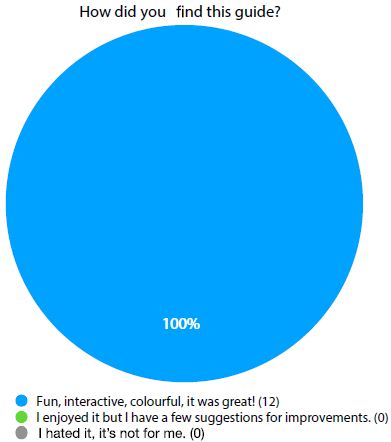
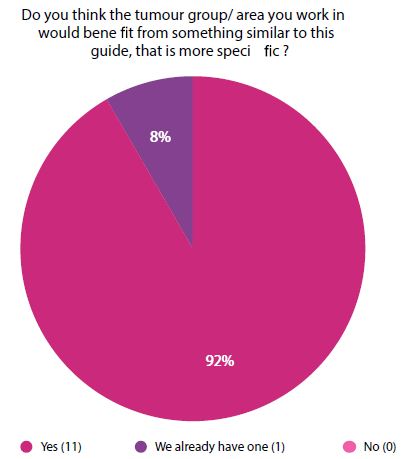
The feedback mechanism embedded in the guide has proven to be an effective tool for continuous improvement. By regularly collecting and analysing user feedback, the team can make informed decisions about updates and enhancements to the guide. How did you find this guide (Figures 1 and 2).

fig 1

Figure 1: How did you find this guide?

fig 2

Figure 2: Do you think the tumour group/area you work in would benefit from something similar to this guide, that is more specific?

Discussion

The success of the induction guide reflects broader trends in healthcare and education, where digital tools are increasingly being used to enhance learning and training processes. The use of technology in this context offers several advantages over traditional methods:

1. Interactivity and Engagement

Digital platforms allow for the incorporation of interactive elements that can significantly increase user engagement. Videos, animations, and hyperlinks to external resources provide a richer learning experience compared to static text.

2. Flexibility and Accessibility

The ability to access educational resources on mobile devices is a key advantage in today’s fast-paced work environments. This flexibility allows team members to learn at their own pace and revisit material as needed, which can be particularly beneficial in a field as complex as oncology research.

3. Sustainability

The move towards digital resources aligns with broader sustainability goals by reducing the reliance on printed materials. This not only minimises waste but also allows for the easy updating of content, ensuring that the information remains current and relevant.

4. Feedback and Adaptation

The integration of feedback mechanisms into digital resources enables continuous improvement. By regularly updating the guide based on user feedback, the resource remains relevant and effective over time, ensuring that it meets the evolving needs of the team.

5. Cost-Effectiveness

While there may be initial costs associated with the development of digital resources, these are often offset by the long-term savings achieved through reduced printing costs and the ability to easily update content without the need for reprinting (Table 1).

Table 1: Feedback survey results

Date

Do you have any suggestions for improvements?

29/08/2023  
29/08/2023 It was very explanatory and captured everything one needs to know about beginning research
29/08/2023 Great slideshow and very detailed, definitely provides a holistic overview of working in research, thank you for taking the time to make this resource!
29/08/2023 Just a correction on a name but other than that, it was great.
29/08/2023  
29/08/2023  
29/08/2023  
01/11/2023 nil
24/01/2024 no
02/02/2024 Perfect
12/03/2024  
15/07/2024 I thoroughly enjoyed the presentation! It provided valuable insights into the team and gave an overview of clinical trials. I also appreciated and was interested at the end where current trials conducted at RFH were outlined. The slides were very easy to follow and also were designed nicely. o suggestion for improvements!

Conclusion

The development and implementation of a digital induction guide for new members of an oncology research team based in a NHS trust has proven to be a highly effective strategy for improving the onboarding/induction process. The guide’s interactive, accessible, and user-friendly design has been well-received by users, who have praised its ability to make the learning process more engaging and less daunting. Moreover, the guide’s utility extends beyond its initial purpose, serving as an ongoing educational resource for the entire team. This multipurpose functionality underscores the value of investing in digital resources for healthcare education. As the field of oncology research continues to evolve, the need for effective training resources will only grow. The success of this induction guide demonstrates the potential of digital tools to meet this need, providing a model that can be adapted and applied in other areas of healthcare and beyond.

Future Directions

Looking ahead, there are several potential areas for further development and improvement of the induction guide:

1. Expansion of Content

As oncology research continues to advance, there will be a need to regularly update and expand the content of the guide. This could include new sections on emerging research areas, advanced treatment modalities, and updates on clinical trial protocols.

2. Integration with Other Training Resources

The guide could be integrated with other training resources, such as online courses, webinars, and virtual simulations, to provide a 29/08/2023 01/11/2023 nil 24/01/2024 no 02/02/2024 Perfect 12/03/2024 15/07/2024 I thoroughly enjoyed the presentation! It provided valuable insights into the team and gave an overview of clinical trials. I also appreciated and was interested at the end where current trials conducted at RFH were outlined. The slides were very easy to follow and also were designed nicely. o suggestion for improvements! Do you have any suggestions for improvements? Date more comprehensive educational experience. This could help to reinforce key concepts and provide opportunities for hands-on learning in a virtual environment.

3. Customisation for Different Roles

While the current guide is designed for a general audience, there may be value in creating customised versions for different roles within the oncology research team. For example, separate guides could be developed for clinical researchers, laboratory technicians, and administrative staff, each tailored to the specific needs and responsibilities of these roles.

4. Data Analytics

By leveraging data analytics, the team could gain deeper insights into how the guide is being used and identify areas for improvement. For example, data on which sections are most frequently accessed, or where users tend to spend the most time, could inform decisions about content updates and enhancements.

Broader Implications

The success of this digital induction guide has broader implications for the use of technology in healthcare education and training. As the healthcare landscape continues to evolve, there will be an increasing need for innovative solutions that can keep pace with the rapid advancements in medical knowledge and practice. Digital resources, such as the induction guide described in this abstract, offer a promising way to meet this need. By providing flexible, accessible, and engaging learning experiences, these tools can help to ensure that healthcare professionals are well-equipped to navigate the complexities of their roles and contribute to the ongoing advancement of their fields. Moreover, the principles underlying the development of this guide—such as the importance of interactivity, user feedback, and sustainability—can be applied to other areas of healthcare education. Whether in medical schools, clinical training programs, or continuing professional development courses, the use of digital tools has the potential to transform the way healthcare professionals learn and develop their skills.

Conclusion

In conclusion, the digital induction guide developed for the oncology research team represents a significant step forward in the use of technology to enhance healthcare education. By leveraging the power of digital platforms, the guide provides a user-friendly, engaging, and effective resource for new team members, helping to facilitate their integration into the team and supporting their ongoing professional development. As healthcare continues to embrace digital transformation, resources like this induction guide will play an increasingly important role in ensuring that professionals are well-prepared to meet the challenges of their roles. The success of this project serves as a testament to the value of digital tools in healthcare education and offers a model that can be adapted and applied in a wide range of settings.

The Parliamentary Assembly of the Union for the Mediterranean: Evaluation of Its Work and Challenges

DOI: 10.31038/PSYJ.2024643

Abstract

This research aims to evaluate the works and challenges of the Parliamentary Assembly of the Union for the Mediterranean (PA-UfM). The Union for the Mediterranean and The Parliamentary Assembly of the Union for the Mediterranean are the two most important regional cooperation tools in the Euro-Mediterranean area. The origin of the Euro-Mediterranean commit to the cooperate is “The Barcelona Process”, an initiative launched in 1995 to promote cooperation and dialogue between the European Union (EU) and countries in the Mediterranean region.

To achieve the evaluation of its work, we study the political recommendations that have been made in the plenary sessions of the PA-UfM in the period 2014-2024; we have studied the agenda of the Spanish rotating presidency of the PA-UfM; and evaluated the results of the Conferences of Presidents of the PA-UfM member parliaments (Summit of Speakers).

The methodology of this study is quantitative, and it combines techniques of analysis of content, the technique of the participant observation and study case,

Keywords

Euro-Mediterranean partnership, Barcelona process, Regional cooperation, Stability, democracy, Union for the Mediterranean, Parliamentary Assembly of the Union for the Mediterranean

Introduction

The Parliamentary Assembly of the Union for the Mediterranean is the parliamentary debate forum for the representatives of the parliaments of the 42 states that make up the Union for the Mediterranean. Since the creation of the Union for the Mediterranean (2008), this alliance between the member states of the European Union and 16 States on the southern and eastern shores of the Mediterranean have wanted to have a parliamentary dimension that would give continuity to the regional integration project that defined in the Barcelona Process established in 1995. The initial form of inter-parliamentary cooperation was the Euro-Mediterranean Parliamentary Forum, which was first convened in 1998. Delegates from the European Parliament and the national parliaments of the EU Members and Southern Mediterranean partners attended this forum. The European Parliament initiated the Forum’s conversion into a genuine Euro-Mediterranean Parliamentary Assembly (EMPA) through a resolution. In 2002, the fifth Euro-Mediterranean Conference of Foreign Ministers in Valencia approved this resolution. Following, the EMPA’s inaugural sitting was held in Greece in March 2004. At the sixth plenary session, held in Amman in March 2010, EMPA’s name was changed to Parliamentary Assembly of the UfM (PA-UfM). This name emphasizes the PA-UfM’s unique role as the parliamentary body of the UfM, with a focus on democratic control and its consultative role.

Methodology

The methodology of this research is quantitative. It combines techniques of analysis of content, the technique of the participant observation because one of the two authors was a member of the PA-UfM, and study case, focusing specifically in the Parliamentary Assembly of the Union for the Mediterranean.

Hypothesis

The hypothesis of this study are the followings:

H1. Final recommendations (2014-2024) of the plenary session of PAUFM are sensitive to the geopolitics of the moment rather than long-term strategic lines.

H2. As for the agenda of the Spanish presidency, it tends to give continuity to the Moroccan agenda for the points of contact between the two countries regarding the issue of regular and irregular immigration.

H3. The Summit of speakers should be a structured forum to define the work of the parliamentary assembly during a certain period of time.

Theoretical and Contextual Framework

The Euro-Mediterranean Region and its Partnership

The Mediterranean has traditionally been a regional meeting point for state and interstate actors who, despite sharing problems, strengths, and weaknesses, do not share rhythms of political, economic and social development. It is precisely the desire to share and collaborate between these various actors at the regional level that the Barcelona Process (1995) launched the Euro-Mediterranean partnership project. The European Council noted in Lisbon in June 1992 that, like the Middle East, the southern and eastern shores of the Mediterranean were crucial to the EU’s security and social stability [1].

The Euro-Mediterranean Partnership, also known as the Barcelona Process, is a cooperative framework that aims to promote stability and prosperity in the Mediterranean region. It was launched in 1995 in Barcelona, Spain, by the European Union (EU) and 12 Mediterranean countries: Algeria, Cyprus, Egypt, Israel, Jordan, Lebanon, Malta, Morocco, Palestinian Authorities, Syria, Tunisia, Turkey [2].

The partnership [3] was based on three main pillars:

  1. Political and Security Dialogue: This pillar focuses on promoting peace, stability, and security in the region through political dialogue and cooperation on issues such as conflict prevention, counterterrorism, and non-proliferation of weapons of mass destruction.
  2. Economic and Financial Partnership: this pillar aims to enhance economic integration and development in the region by promoting trade liberalization, investment, and economic reforms. It includes initiatives such as the Euro-Mediterranean Free Trade Area (EUROMED FTA) and financial assistance programs.
  3. Social, Cultural, and Human Partnership: this pillar aims to foster mutual understanding, dialogue, and cooperation among peoples and cultures of the Euro-Mediterranean region. It includes initiatives to promote cultural exchange, education, civil society participation, and human rights.

Over the years, the Euro-Mediterranean Partnership has faced challenges, including political tensions, economic disparities, and security threats [4]. However, it remains an important framework for promoting cooperation and addressing common challenges in the Euro-Mediterranean region, and especially after the institutionalization process that entails the foundation of the Union for the Mediterranean (UfM) and the Parliamentary Assembly of the Union for the Mediterranean (PA-UfM).

Some authors have discussed whether the institutionalization strategies of a regional partnership such as the Euro-Mediterranean are effective if they are not accompanied by agreed policy declarations and the focus of the respective problems of the northern and southern countries with solutions that come directly from the affected countries [5-7]

The Union for the Mediterranean (UfM)

The Union for the Mediterranean (UfM) is an intergovernmental organisation that brings together 43 countries to strengthen regional cooperation and dialogue through specific projects and initiatives that address inclusive and sustainable development (Esseghir & Haouaoui Khouni, 2014), stability and integration in the Euro-Mediterranean area. The Union for the Mediterranean (UfM) was launched at the Paris Summit for the Mediterranean in 2008. As a direct continuation of the Barcelona Process (1995), the launch of the UfM in 2008 was the reflection of its member states who shared political commitment to enhance the Euro-Mediterranean Partnership.

It was in the context of the Euro-Mediterranean Partnership meeting of foreign ministers, held in Valencia on 22–23 April 2002, that it was decided ‘to recommend the creation of a Euro-Med Parliamentary Assembly’, which will only include members of the European Parliament (MEPs) and parliamentarians from the southern shores

The organization has always undertaken a diverse range of projects and initiatives to promote inclusive regional sustainable development and integration [8]. The main focus is on women’s rights, job creation, fostering cross-country connectivity efforts and addressing environmental and climate emergencies. It also prioritizes grant schemes and programmes to encourage entrepreneurship and job opportunities for young people, recognizing their crucial role in shaping the region’s future [9].

The headquarters of the UfM is in BCN and its 43 member states are the followings: Albania, Algeria, Austria, Belgium, Bosnia and Herzegovina, Bulgaria, Croatia, Cyprus, Czech Republic, Denmark, Egypt, Estonia, Finland, France, Germany, Greece, Hungary, Ireland, Israel, Italy, Jordan, Latvia, Lebanon, Lithuania, Libya, Luxemburg, Malta, Mauritania, Monaco, Montenegro, Morocco, The Netherlands, North Macedonia, Palestine, Poland, Portugal, Romania, Slovakia, Slovenia, Spain, Sweden, Syria, Tunisia and Turkey.

Regarding the structure of the UfM we should mention [10]:

Senior Officials

The Member States meet on a regular basis at the level of Senior Officials from the Ministries of Foreign Affairs. The Senior Officials Meetings (SOM) provide the framework to discuss the current regional context, coordinate the work of the UfM Secretariat and endorse new development projects to which the UfM label is given.

The Co-Presidency

The UfM works on the basis of the principle of co-ownership. So do, and since 2012, there is a Northern and Southern co-presidency.

Secretariat

It was established in 2010 in Barcelona. It is the first permanent structure dedicated to the implementation of this partnership. It ensures operational follow-up of the regional priorities and supports the implementation of region-wide cooperation projects and initiatives.

Parliamentary Assembly of the UfM (PA-UfM)

It is considered the parliamentary body of the UfM, although it has its all functioning process ad total autonomy.

The methodology of work used by the UfM is based on three main tools: policy (building common thematic agendas), platforms (fostering regional dialogue) and projects (translating the policy dimension into tangible impact).

The Parliamentary Assembly of the UFM (PA-UfM)

As mentioned above, since the creation of the UfM it was clear that the unique way of creating an effective and real regional integration process, was with a parliamentary assembly. The initial form of inter-parliamentary cooperation was the Euro-Mediterranean Parliamentary Forum, which was first convened in 1998. Delegates from the European Parliament and the national parliaments of the EU Members and Southern Mediterranean partners attended this forum.

The European Parliament initiated the Forum’s conversion into a genuine Euro-Mediterranean Parliamentary Assembly (EMPA) through a resolution. In 2002, the fifth Euro-Mediterranean Conference of Foreign Ministers in Valencia approved this resolution. Following, the EMPA’s inaugural sitting was held in Greece in March 2004. At the sixth plenary session, held in Amman in March 2010, EMPA’s name was changed to Parliamentary Assembly of the UfM (PA-UfM). This name emphasizes the PA-UfM’s unique role as the parliamentary body of the UfM, with a focus on democratic control and its consultative role.

The following countries have parliamentarians in the PA-UfM: Albania, Algeria, Austria, Belgium, Bosnia and Herzegovina, Bulgaria, Croatia, Cyprus, Czech Republic, Denmark, Egypt, Estonia, Finland, France, Germany, Greece, Hungary, Ireland, Israel, Italy, Jordan, Latvia, Lebanon, Lithuania, Luxemburg, Malta, Mauritania, Monaco, Montenegro, Morocco, The Netherlands, Palestine, Poland, Portugal, Romania, Slovakia, Slovenia, Spain, Sweden, Syria, Tunisia, Turkey

Considering its functions the PA-UfM provides parliamentary impetus, input and support for the consolidation and development of the Euro-Mediterranean Partnership; It expresses its views on all issues relating to the Partnership, including the implementation of the association agreements; and finally adopts resolutions or recommendations, which are not legally binding, addressed to the UfM and its members.

Regarding the structure we should mention:

Assembly

Plenary Session

The meeting of all the parliamentarians which represent their respective countries.

Standing Committees

The PA-UfM has five standing committees which indicate the focus areas of the Parliamentary Assembly. These committees are responsible for monitoring their respective thematic areas of the Euro-Mediterranean partnership and meet at least once a year. Each committee consists of 56 members, of which 28 are from the Mediterranean partner countries, 19 are from EU national Parliaments, and nine are members of the European Parliament. Each parliamentary committee elects a chairperson and three vice-chairpersons that serve a two-year term.

Working Groups

There are currently two working groups. On the one hand, “The Working Group on Financing of the Assembly and Revision of the Rules of Procedure” which discusses and revises the PA-UfM Rules of procedures and financial regulation. On the other one, “The Working Group on the post-Covid economy in the Mediterranean” which works systematically analysing the post covid situation in the Mediterranean region.

Permanent Secretariat

It assists the Assembly and its bodies in the preparation, proper management, and follow-up of their work. It is coordinated and managed by the Secretary-General. Its headquarters is in Rome.

Bureau

It is responsible for coordinating the work of the Assembly. It is the body responsible to represent the Assembly for matters regarding relations with the other institutions. The Bureau of the PA-UfM consists of four members appointed for a four-year mandate: two appointed by the Southern Mediterranean partner countries, one appointed by the EU national parliaments and one appointed by the European Parliament. The European Parliament is a permanent member of the Bureau.

Presidency

The Assembly shall be chaired by one of the members of the Bureau, in rotation and on an annual basis, thus ensuring parity and alternate South/North presidencies. The three other members of the Bureau shall be Vice-Presidents.

The Summit of Speakers

The Speakers of Parliament of each member country of the PA-UfM gather annually for the Summit of Speakers.

As a north- south forum, the Assembly brings together 44 parliaments — the 43 parliaments of the countries in the Union for the Mediterranean, and the European Parliament. The Assembly consists of 278 members:

138 Members come from the northern shore of the Mediterranean, made up of 49 members from the European Parliament and 81 members from the EU’s 27 national parliaments (three members per country) and 8 members from the four European Mediterranean partner countries (Albania, Bosnia and Herzegovina, Monaco and Montenegro, with two members each).

140 members represent the southern shore: 130 members from the ten founding Mediterranean partners (13 members per parliament) and 10 members from the Mauritanian parliament.

Study Case

As mentioned before, the Parliamentary Assembly of the UfM was a crucial tool to work effectively for a real regional cooperation. In this investigation we wanted to focus specifically in three main aspects to qualify PA-UfM as an effective tool: the final political recommendations from plenary sessions; the agenda of the Spanish presidency of the PA-UfM; the Summit of Speakers.

Final Recommendations from Plenary Sessions

In this section we want to study the final recommendations from the plenary sessions in the period 2014-2024. Each plenary session makes generally three types of recommendations: political, economic, and cultural. Those that are approved are incorporated into the “final recommendations” document that concludes each plenary session. Moreover, every plenary session is focused in one thematic issue.

Note the Assembly decides by consensus. The quorum is the majority of the delegations plus one within each of the two components of the Assembly, that is, the European and Mediterranean components. Alternatively, when it is not possible for the Assembly to adopt its decisions by consensus, it will adopt its decisions by a qualified majority of at least 2/3 of the votes of the members present from each of the two shores of the Mediterranean, in the presence of at least half plus one of the members of both components of the Assembly. Although the resolutions of the Assembly are not legally binding they are politically valuable.

It should be noted that the plenary meetings that were held in the period studied (2014-2024) were eight. More specifically, the annual meeting scheduled for 2020 in Antalya (Turkey) had to be cancelled due to the pandemic and was held on December 3 and 4, 2021 in Brussels under the presidency of the European Parliament. Little news was recorded about this meeting even under the impact of the health crisis. In 2022 and 2023, plenary sessions of the PA-UfM were not held due to the impact of the global health crisis caused by the Covid-19 virus.

In the next figure you can find a summary of the most important political recommendations from plenary sessions of the PA-UfM:

Plenary session

Place Thematic issue

Political recommendations

10th Amman 2014 corruption in Europe and the southern Mediterranean countries post-2011 Tackling corruption and facilitating asset recovery.
11th Lisbon2015 Human Rights, migrations, and terrorism – Promoting human rights- Securing the safety of migrants in the Mediterranean

-Fighting against terrorism

– creation of a special internet platform for ‘Euro-Mediterranean inter-parliamentary cooperation’

12th Tangier2016 building a better intercultural Mediterranean anchorage for shared development in terms of peace and security and for sustainable development that takes into consideration climate change and protection of the environment in the Mediterranean. -stability and security.-Condemns terrorism and violent extremism.

-Refugees and conflicts: Syria, Iraq and Libya

-Support the establishment of the Government of National Unity in Libya as the sole legitimate government.

-Concerned about the deteriorating human rights situation in Egypt and calls on Egyptian authorities to respect their obligations.

13th Rome 2017 Employment in the EM area, in a context of sustainable development Concern about a lack of a global and effective strategic line. It invites us to analyse successes and failures nine years after the constitution of the Parliamentary Assembly of the Union for the Mediterranean.-Stability and security of the Mediterranean.

-Firmly condemns all terrorist acts that represent a common threat to both shores of the Mediterranean.

– improve the governance of the UfM by holding annually in Barcelona a ‘Regional UfM Forum’

-Collective response to Migration.

-encourage the revival of regional integration in the Southern Mediterranean, in particular the Arab Maghreb Union.

-Improve the social integration and employability of young people.

-Water supplies: Gaza desalinisation plant project, project to decontaminate Lake Bizerte in Tunisia and the European Investment Bank’s recent support, worth 70 million euros, for the EuroMediterranean University

14th Cairo2018 countering terrorism in EM region -combating terrorism and preventing violent extremism.-Condemning all sorts of violence and terrorism acts.

-Urges the UfM member states to strengthen judicial and police cooperation and the exchange of data and information in the field of combating terrorism.

– permanent network for exchange of information and best practices between anti-terrorist partner centres in the Mediterranean countries.

-combating the trafficking of weapons.

– UfM member states to improve the monitoring of suspicious financial movements

– the urgent need to improve young people’s social integration and employability

15th Strasbourg 2019 The challenges of migrants and refugees in the Mediterranean -shared management of the migration phenomenon and therefore greater cooperation and solidarity among the countries involved.-addressing the root causes of migration, hence the need to provide young people with adequate training. -the fight against traffickers and the importance of rescues at sea.

-the impact of migrants and refugees on host societies.

-awareness of the impact of migration on the countries of the southern shore, which from transit countries have become countries of arrival.

-Palestinian refugees who have been living outside their country for seventy years.

16th Antalya2020. Postponed until December 2021 due to the Covid-19 Pandemic. Multiculturalism and xenophobia. COVID-19 pandemic, regional conflicts, migration, jobs opportunities and education.
16th bis On-lineFebruary 2021 The fight against climate change in the Mediterranean Region Global joint approach at an Euro-Mediterranean level to common challenge.Adoption of the New Agenda for the Mediterranean.

Renewed partnership with the Southern Mediterranean countries

17th Rabat2024 The Rabat Spirit -condemned violence in Gaza and West Bank, insisting on a need of a ceasefire.-Reactivate Israeli-Palestinian peace process.

-Threat of terrorist groups taking advantage of instability in some areas of the Mediterranean region.

-Climate change, health security, migration issues and human trafficking

Source: own elaboration based on data available in www.paumf.org

From the analysis of the contents of the resolutions and political recommendations of the PA-UfM plenary sessions analyzed, we can highligh:

  • There is not a multi-year work plan that defines a coherence or common thread in the work of the plenary sessions analyzed.
  • The topics discussed and the resolutions approved were raised each year in the light of current political, economic and social issues. Prevailing: fight against corruption, fight against terrorism, legal migration policies, human rights, climate change, impact of the Covid-19 virus pandemic, education, job opportunities, human trafficking, and rescues of migrants at sea, judicial and police cooperation between Member States. It is detected that the topics discussed in a plenary session do not have follow-up or evaluation in the following plenary session.
  • Current political issues and regional crises prevail in the resolutions depending on the years. Thus, in the years analyzed there were statements about the hope for political changes in the region (in reference to the so-called Arab Spring), concern about the deterioration of human rights in Egypt, a call for support for the Government of the National Union of Libya, concern for refugees from Syria, Iraq and Libya, reactivation of the Israel-Palestine conflict following the Hamas terrorist attacks on the Israeli population on October 7, 2023 and the subsequent Israeli military offensive on the Gaza Strip.
  • In the various plenary sessions of the PA-UfM, concern has been expressed about the lack of a global and effective strategic line in the work of the Parliamentary Assembly. Thus, in the 2017 plenary session, the criticism was expressed explicitly and in the following terms:
    “Concern about a lack of a global and effective strategic line. It invites us to analyze successes and failures nine years after the constitution of the Parliamentary Assembly of the Union for the Mediterranean.”
  • For a better governance of the UfM, in 2017 the plenary session proposed and supported the holding of an annual meeting of Foreign Ministers of the Member States in Barcelona under the format of “Regional UfM Forum”. Without replacing the meetings of Heads of State and Government, this new form of governance was intended to streamline dialogue between the parts and the decision-makers. In recent years, the highest and most operational level of meeting of the Governments of the Member States occurs through the annual ministerial meetings held annually in the month of November in Barcelona. To date, eight UfM Regional Forums have been held.
  • The “south-south” regional integration of the Mediterranean has been another of the lines on which the plenary sessions have repeatedly positioned themselves. Today, the “south-south” integration of the countries on the southern shore of the Mediterranean is in a phase of paralysis.
  • In some cases, the PA-UfM has stopped supporting specific development projects of some member states such as water supplies, Gaza desalination plant project, the project to decontaminate Lake Bizerte in Tunisia and the European Investment Bank’s recent support, for the Euro-Mediterranean University). Given the distrust of diligent and compliant use of public funds allocated to the projects, the Parliamentary Assembly has appointed reporters to study and monitor the projects. These types of speakers in some UfM projects are the maximum expression of the “parliamentaryization” of the decisions made by an eminently intergovernmental policy.

The Agenda of the Spanish Presidency of the PA-UfM

Initially, the presidency of the Congreso de los Diputados, which is also the presidency of the Cortes Generales (joint meeting of the Congress of Deputies and the Senate), should chair the Parliamentary Assembly of the Union for the Mediterranean in the period 2022-2023. This was publicly announced in July 2020 under the presidency of Meritxell Batet. According to the rotation criteria between countries in the north and south of the Mediterranean, the president of the Congreso de los Diputados is part of the bureau of the PA-UfM in the period 2020-2024. Due to the health crisis of the Covid-19 pandemic and a long cycle of repeating general elections between 2019 and 2023, the Spanish presidency of the PA-UfM was postponed until early 2024. This meant that the previous presidency of the president of the Moroccan Parliament, Rachid Talbi El Alami, extended his mandate beyond the planned deadlines.

Francina Armengol, the president of Congreso de los Diputados since August 17, 2023, assumed the presidency of the PA-UfM on February 16, 2024 in Rabat at the closing of the 17th Plenary Session of the PA-UfM. President Armengol assumed her position for a period of one year. In President Armengol’s speech before the plenary session of the UfM meeting in Rabat, she highlighted the priorities of her presidency: “the need to establish peace, reduce economic disparities between the North and the South, fight against climate change and better manage the migration issue”. On the same day, February 16, 2024, the president of Congreso de los Diputados published a message on social network X in the following terms:

“It is an honor to assume the presidency of the Parliamentary Assembly of the Union for the Mediterranean, a great opportunity to continue strengthening ties of international cooperation in the region. We work as a network for a peaceful Mediterranean that protects human rights and guarantees equal opportunities for all people, wherever they are born and wherever they live. Thank you for the welcome and for passing the baton, Rachid Talbi Alami”.

At the time of writing this research, three months after the assumption of the presidency, there is no reference to the Spanish rotating presidency of the PA-UfM either on the PA-UfM website or on the Spanish Parliament website. At this point, the poor political momentum that has so far been given to the rotating Spanish presidency of the PA-UfM must be highlighted. It should be noted that on June 6-9, 2024, elections to the European Parliament will be held in the different member states of the European Union. This will mean a paralysis of the European Parliament’s involvement in the PA-UfM for a period of several months. Until the new European Parliament is formed and its 720 members take office, and the parliamentary delegations are formed, the PA-UfM will remain inactive. All of this could lead to the celebration of the next plenary session of the PA-UfM until autumn. This should not be an excuse for the priorities of the Spanish presidency and for not updating the public information of the respective websites of the PA-UfM and Congreso de los Diputados.

The Summit of Speakers

The Speakers of Parliament of each member country of the PA-UfM meet annually for the Summit of Speakers. Although the availability of the information is very poor, here we expose some information of the lasts Summit of Speakers:

Speakers summit

Date and place Thematic issue

Comments and main conclusions

1st Amman, 2014 Corruption in Europe and the southern Mediterranean countries post-2011 Document not available.
2nd Lisbon2015 Human Rights, migrations and terrorism Document not available.
3th Tangier2016 Building a better intercultural Mediterranean anchorage for shared development in terms of peace and security and for sustainable development. Document not available.
4th Rome,2017 Employment in the EM area, in a context of sustainable development Document not available.
5th Cairo (Egypt), 2018 Countering terrorism in EM region Document not available.
6th Strasbourg,2019, Challenges of migrants and refugees in the Mediterranean Antonio Tajani, President of the European Parliament, and Dimitris Avramopoulos, EU Commissioner for MigratioN attended the Summit. They underlined the importance to address current migration challenges with a joint Euro-Mediterranean approach.-The resulting resolution of the Summit did not include any reference to the Global Compact for Migration, adopted at the end of 2018. This followed the line of dissonances within EU member states, which was particularly visible during EU-LAS Ministerial meeting on Foreign Affairs on February 4, 2019 in which Hungary’s veto did not allow for a common European position on migration.
7Th Brussels, videoconference, 2021 Fight against climate change in the Mediterranean region -It was adopted a declaration taking stock of some of the most pressing consequences of global warming and a changing environment on both shores of the Mediterranean.-Singularly, a member of the Delegation of the Croatian Parliament to the Parliamentary Assembly of the Union for the Mediterranean and envoy of the Speaker of Parliament Marko Pavić participated at the Summit.
8th Rabat, 2024 The Rabat Spirit The declaration includes:-A call for giving to the economic dimension to priority.

-A call for a greater commitment of the PA-UfM member states with enforcing policy coordination between them.

-A condemn of violence in Gaza and West Bank, insisting on a need of a ceasefire.

-Reactivate Israeli-Palestinian peace process.

-Threat of terrorist groups taking advantage of instability in some areas of the Mediterranean region.

-Climate change, health security, migration issues and human trafficking

Source: own elaboration based on data available in www.paumf.org

From the analysis of the data presented in the table above, we see that the lack of searchable data is evident, a fact that has not allowed us to do a more exhaustive analysis of the content of the “Summit of Speakers”. In any case, and considering the little information we have, the “Summit of Speakers” positions itself on the same topics that were discussed in the plenary session but making statements with a more institutional tone.

In any case, the formula of the annual “Summit of Speakers” meeting of the member parliaments of an international parliamentary assembly, is a common practice that improves the coordination mechanisms and the political momentum of the parliamentary dimension of the international organization. In this sense, it is worth pointing out other already consolidated experiences such as the meeting of presidents of parliaments of the member states of the Council of Europe. These meetings have been held since 1975 and the meeting takes place every two years, alternating a meeting in Strasbourg, headquarters of the Council of Europe, and a meeting in the capital of the State that at that time held the presidency of the Council of Ministers of the international pan-european organization. The Conference of speakers of the EU Parliaments (EUSC) is another stable coordination platform between the presidents of the national parliaments of the EU member states. Detailed information on the documentation and conclusions of each conference of presidents of the EU member states is found in the European Parliament’s database. It should be noted that all members of the EUSC are also members of the conference of presidents of the Parliamentary Assembly of the Union for the Mediterranean. The conference of presidents of the member states of the European Economic Communities (precedent of the EU) met for the first time in Italy, specifically in Rome, on January 11, 1963. The next meeting took place ten years later in France, at the Paris meeting of 1973. Meetings took place in 1975 until 1978. The 1980 meeting was not held and since 1981 and without interruption there has been an annual meeting of presidents of parliaments of the Member States.

These meetings have a permanent secretariat based on the respective international organizations, the Council of Europe and the European Parliament, and a thread of continuity and coherence can be seen in their work.

Conclusions and Hypothesis Validation

Conclusions

Since the creation of the Parliamentary Assembly of the Union for the Mediterranean in March 2004 in Athens, it has become a new forum for parliamentary dialogue involving the parliamentary delegations of all EU Member States and the member states of the UfM of its southern shore. It is the only international parliamentary forum where parliamentary delegations from Israel and Palestine have historically met. Their work has contributed to deepening a common Euro-Mediterranean policy.

Despite this, the approaches and expectations of the parliamentary delegations have been divergent at various times. While for the parliaments of the Member States of the European Union it is basically a forum for debate on the EU’s neighbourhood policy with its southern border, for the countries of North Africa and the Middle East it has been considered as the forum for debate on a regional integration policy. It is worth remembering that before the existence of the UfM, the Barcelona Process of 1995 promoted a regional integration policy in areas such as the economy, education or free trade that only involved states with territories bathed by the Mediterranean Sea. This divergence of expectations and the desire to integrate countries from central and northern Europe into the PA-UfM has braked the rhythm of the regional integration that marked the Barcelona Process. The level of collaboration and parliamentary discussion with the countries of the EU’s eastern partnership has never reached the level of institutionality of the UfM.

From the analysis of the PA-UfM plenary sessions held in the period 2014-2024, we can conclude that:

  • There is a no consistent and evaluable multiannual work program that has allowed relevant progress in the work of Euro-Mediterranean parliamentary diplomacy.
  • The political pronouncements of each plenary session are often related to crisis situations in one of the Member States or geopolitical situations that mark the political agenda of the moment.
  • The main aspects addressed in the years analysed are: fight against corruption, fight against terrorism, legal migration policies, human rights, climate change, impact of the Covid-19 virus pandemic, education, job opportunities, human trafficking, rescues of migrants at sea and judicial and police cooperation between Member States.
  • The UfM parliamentary assembly itself has been aware of its crisis of consistency and structuring of its work when in one of its resolutions from the Rome session of 2017 it expressed its “concern about the lack of a strategic and global line of work” in their jobs.
  • The Parliamentary Assembly promoted in a resolution of its 2017 plenary session the celebration of the annual meeting of the “Regional UfM Forum”. This represents the annual meeting in November of each year in Barcelona of the ministers of Foreign Affairs of the different member states. It is a space for political promotion of the Euro-Mediterranean agenda in the absence of meetings of Heads of State and Government initially provided for in the institutional design of the UfM.
  • The permanent Secretary General of the UfM and its deputy secretaries regularly participate in the plenary sessions of the PA-UfM to report on the sectorial policies they promote to comply with intergovernmental agreements.
  • The PA-UfM took a step forward in its consolidation as a forum for monitoring and controlling the policies of the Secretariat and intergovernmental conferences, when in 2017 created the figure of rapporteurs to monitor sectorial policies developed with public funds from the EU and to avoid potential bad practices. This is one of the most outstanding exercises of parliamentary control and accounting of the UfM that the PA-UfM has achieved.

The access to information, accounting, and transparency regarding the work of the PA-UfM has much room for improvement. Several public documents are not available on the PA-UfM website and the website itself is not updated regarding the rotating presidency of the PA-UfM. The Permanent Secretariat of the PA-UfM is based in Rome and according to the information provided by the official website, the position of Secretary General has been vacant since June 2021. Precisely, the news of a vacancy notice of the PA-UfM remains on the official website so, with no news saying that the position has been filled. The lack of dynamization of the work by the secretariat can explain the lack of information and impetus in the works of the organisation.

As mentioned, the Spanish rotating presidency of the PA-UfM was assumed by the president of the Congreso de los Diputados, Francina Armengol, on February 16, 2024. Beyond the political declaration made by the new president on the day of her election, there is no information about the priorities of the presidency neither on the PA-UfM website (which still announces the February 2024 meeting) nor on the website of the Congreso de los Diputados and its sections dedicated to the presidency or international affairs. With the elections to the European Parliament taking place from June 6 to 9, 2024, it is foreseeable that the new delegation of Members of the European Parliament to the PA-UfM will not be appointed until autumn 2024, which means that a few months of inactivity for the PA-UfM are expected. Initially, it was planned that the presidency of Congreso de los Diputados would assume the rotating presidency of the PA-UfM in the period 2022-2023, but due to the institutional paralysis caused by the effects of the Covid-19 pandemic and the situation of early elections in Spain in 2023, the Spanish presidency was not assumed until February 2024. Meanwhile, the presidency of the Moroccan parliament did extend beyond its natural term.

The conference of presidents of parliaments of the Member States of the Parliamentary Assembly of the Union for the Mediterranean (Summit of Speakers) has been held since 2014 and met uninterruptedly from 2014 to 2019. The year 2020 was not held due to the Covid-19 pandemic. The year 2021 was carried out electronically and did not meet again until February 2024. The conference of presidents of the parliaments of the member states of the PA-UfM is an instrument of coordination and political impetus for the parliamentary dimension of the work of the Union for the Mediterranean. It is worth highlighting the analysis of the conferences studied and the contents of their statements:

  • The mere fact of the meeting of the presidents of the PA-UfM member states already represents a positive framework for promoting the parliamentary dimension of the UfM. However, a long-term work plan that coordinates the work of the different rotating presidencies cannot be identified.
  • The vacancy in the position of general secretary of the PA-UfM since 2021 has undoubtedly had an impact on the coordination capacity and political momentum of the Summit of Speakers meetings.
  • Access to information on the resolutions of Summit of Speakers meetings is not available on the PA-UfM website or on the website of the European Parliament in their editions from 2014 to 2018. Only content from the years 2019, 2021 and 2024 are available.
  • Other meetings of presidents of Parliaments of Member States of international organizations demonstrate more systematized practices and a multi-year work program. Thus, the conference of presidents of parliaments of Member States of the Council of Europe, which has been held biannually since 1979, and the conference of presidents of the Member States of the EU, which has been held annually since 1981, are two examples of consolidated and well-structured meetings. Considering that the presidents of the parliaments of the EU Member States are also members of the PA-UfM Summit of Speakers, the good practices of the meeting of EU presidents could serve as a basis for increasing the organization, visibility, planning and monitoring of the Summits of Speakers.

Validation of Hypothesis

Considering the information and analysis offered in this research and regarding the hypothesis previously mentioned, we consider que can validate H1 and partially validate H2 and H3.

  • Final political recommendations (2014-2024) of the plenary session of PA-UfM are sensitive to the geopolitics of the moment rather than long-term strategic lines. We consider that we can validate this hypothesis after analysing the contents of the political recommendations of the Plenary sessions. Issues such as political statements about terrorist attacks and regional conflicts are typical. It is difficult to find any ambitious and long-term plan approved by the Assembly in the years studied.
  • As for the agenda of the Spanish presidency, it tends to give continuity to the Moroccan agenda for the points of contact between the two countries regarding the issue of regular and irregular immigration. We consider that the lack of information about Spanish presidency of PA-UfM don’t allow us to validate the hypothesis, however, looking at the bilateral political positions of Spain and Morocco in the field of immigration, a shared agenda can be detected between them.

H3. The Summit of speakers should be a structured forum to define the work of the parliamentary assembly during a certain period of time. We consider that this hypothesis can be partly validated due to the lack of information available about the “Summit of Speakers”, but also due to the lack of internal structuring of these meetings at the highest level between the speakers of the respective state parliaments members.

References

  1. Gillespie R (2011) The Union for the Mediterranean: An Intergovernmentalist Challenge for the European Union? JCMS: Journal of Common Market Studies 49: 1205-1225.
  2. Stavridis S (2002) The Parliamentary Forum of the Euro-Mediterranean Partnership: An Assessment. Mediterranean Politics 7: 30-53.
  3. Edwards G, Philippart E (1997) The Euro-Mediterranean Partnership: Fragmentation and Reconstruction. European Foreign Affairs Review 2: 465-489.
  4. Youngs R (Ed.) (2017) Twenty Years of Euro-Mediterranean Relations. Routledge
  5. Esseghir A, Haouaoui Khouni L (2014) Economic growth, energy consumption and sustainable development: The case of the Union for the Mediterranean countries. Energy 71: 218-225.
  6. Schäfer I (2007) The Cultural Dimension of the Euro‐Mediterranean Partnership: A Critical Review of the First Decade of Intercultural Cooperation. History and Anthropology 18: 333-352.
  7. Stavridis S (2008) The Euro-Mediterranean Partnership (EMP): Perspectives from the Mediterranean EU Countries Mediterranean Politics 13: 1.
  8. Colefice A (2016) Parliamentary Diplomacy and the Arab Spring: Evidence from the Parliamentary Assembly of the Mediterranean and the European Parliament. Mediterranean Quarterly 27: 100-118.
  9. Bicchi F (2012) The Union for the Mediterranean, or the Changing Context of Euro-Mediterranean Relations. The Union for the Mediterranean Routledge.
  10. Balfour R (2009) The Transformation of the Union for the Mediterranean. Mediterranean Politics 14: 99-105.
Prevalence of Temporomandibular Joint Ankylosis in a Sample of Yemeni Population

DOI: 10.31038/JDMR.2024721

Abstract

Background and Aim: Temporomandibular joint ankylosis (TMJA) is a fusion of the head of the mandibular condyle to the glenoid fossa of temporal bone at the skull base. This fusion is either fibrous, osseous, or fibro-osseous. The objective of this study is to determine the prevalence of TMJ ankylosis.

Material and Methods: This retrospective cross-sectional study was carried out in all patients who admitted in maxillofacial departments in the period January 2018 to September 2022 in Al-Thawra, Al-Gumhouri, 21 September, Al-Kuwait, Modern European Hospital, and University of Science and Technology Hospital, all these hospitals in Sana’a city. This study was based on data taken from patients’s files that include: age, gender, date of operation, etiology, side of ankylosis, type of radiograph, type of ankylosis, and type of treatment.

Results: Among the 55 patients, 63.6% were male and 36.4% were female. The mean (SD) age of patients was 15.27 <0x7E> 10.02 years (age range 4 to 55 years). Trauma was the most common cause of TMJ ankylosis (85.5%). Unilateral ankylosis was more common than bilateral; in unilateral right and left sides of TMJ, ankylosis was in equal frequency (14,50%).. A CT scan was the most radiographic x-ray used for the diagnosis of TMJ ankylosis (74.5%). Osseous ankylosis (34.5%) was the most frequent type, followed by fibroosseous (32.7%) and fibrous (21.8%). Gap arthroplasty was the most common type of treatment (29.1%).

Conclusions: In this study we revealed that the ankylosis was more prominent in males because males were more susceptible to trauma, which was the most common cause of TMJ ankylosis. A CT scan was the most radiographic x-ray used for the diagnosis. Cases of unilateral ankylosis were more than bilateral. Osseous ankylosis was the most frequent type. Gap arthroplasty was the most common type of treatment.

Keywords

Temporomandibular joint ankylosis (TMJA), Prevalence, Sana’a, Yemen

Introduction

The fusing of the mandibular bone’s condyle to the temporal bone’s glenoid fossa at the base of the skull is known as temporomandibular joint (TMJ) ankylosis [1]. It can develop at any age, but it is more frequent in children under the age of ten [2,3]. TMJ is regarded as the cornerstone of craniofacial integrity, so ankylosis in children causes mandibular disturbances because malocclusion from growth period results in distressing conditions like poor oral hygiene, impaired speech, difficulty chewing, facial disfigurement, compromised airway, and psychological stress [4]. Clinical manifestations of TMJA depend on the age at which ankylosis onset, the period of TMJA persistence, and whether the ankylosis is unilateral or bilateral. When it affects children before their growth has stopped, it causes severe problems in mastication, digestion, speech, and oral hygiene [5,6]. Clinical manifestations in unilateral ankylosis: facial asymmetry, the mandible and chin deviated to the affected side, the face on the affected side is roundness and fullness, and the lower border of the mandible on the affected side has a concavity that ends in a well-defined antegonial notch. Whereas in bilateral ankylosis, the mandible is symmetrical but small in size (retrognathic/micrognathic), there is an inability to open the mouth progresses by a gradual decrease in interincisal opening, “bird face” deformity with receding chin and the patient has a convex profile, the neck-chin angle may be reduced or almost completely absent, the antegonial notch is well defined bilaterally, and class II malocclusion can be noticed [7].

Additionally, in severe cases of TMJA, it can move the tongue posteriorly and reduce the size of the oropharyngeal airway, which can eventually cause upper airway obstruction and obstructive sleep apnea syndrome (OSAS). As a result, growing children often present a triad of symptoms, as follows: TMJ ankylosis, micrognathia, and OSAS [8]. TMJ ankylosis can be intraarticular or true and extraarticular or false. Most commonly, intraarticular ankylosis appears after trauma or infection, whereas in extraarticular type it occurs by a large variety of other disorders, including myogenic, neurogenic, and inflammatory processes, as well as bone and soft tissue tumors [9]. TMJ ankylosis has several etiological causes, including trauma, local and systemic inflammatory conditions, neoplasm, and TMJ infection. Trauma and infection are the most frequent causes [10].

Under general anesthesia, surgery is the preferred method of treating TMJ ankylosis, and there are many techniques for intubation of ankylosis patients, such as blind awake intubation, retrograde intubation, fiberoptic intubation, and tracheostomy intubation [11]. The management objectives in TMJA are the removal of the ankylotic mass, restoring the shape and function of the joint, allowing mouth opening, relief of upper airway obstruction, and prevention of recurrence [1]. Regarding the ideal treatment for TMJA, there are different procedures between surgeons, and there is no specific treatment. Recurrence still represents the main challenge in the management of TMJ ankylosis, as has been explored and developed by many authors [12]. A variety of operative procedures are used to treat TMJA, but none have been universally accepted. The operative procedures include gap arthroplasty, interpositional arthroplasty, and resection of the ankylotic mass, followed by reconstruction of the ramus-condyle unit with autogenous or alloplastic grafts [13]. This fusion is either fibrous, osseous, or fibro-osseous. The objective of this study is to determine the prevalence of TMJ ankylosis.

Methodology

Study Design

A retrospective cross-sectional study was conducted in Sana’a city in Yemen.

Study area

The study was conducted in Al-Thawra, Al-Gumhouri, 21 September, Al-Kuwait, University of Science and Technology, Modern European Hospital, in Sana’a city. These hospitals are the main referral hospitals in Yemen; they are three public, one military, and two private. Most maxillofacial surgeons are worked in these hospitals, and most TMJ ankylosis cases are referred to these hospitals.

Study Population

This study was carried out in all patients who admitted in maxillofacial departments in the period January 2018 to September 2022 and who were diagnosed with TMJ ankylosis and underwent surgical treatment. Patients associated with other facial fractures, patients who had TMJ disorder other than ankylosis, and patients that had files with incomplete data were excluded.

Data Collection

In this study, information was obtained from the patient’s archives or/and soft copies who were admitted for TMJ ankylosis in the oral and maxillofacial surgery departments of the targeted hospitals and reviewed and collected for the last five years. In Al Kuwait hospital, and after completing the entry procedures to the statistics departments, we found that there is no special section for the maxillofacial surgery. It was necessary to search in all departments of surgery, and about 1200 files for the maxillofacial surgery were obtained. The result was to get 15 cases of TMJ ankylosis. The same was in all government hospitals that were investigated, because there is no data stored in the electronic system. Also, we found 30 cases of TMJ ankylosis in Al Thawra Hospital, 4 cases in September 21 hospitals, and 6 cases in Modern European Hospital. In some patients’s files, the relatives don’t know about the cause of TMJ ankylosis, so they are added as unknown in the result and discussion. In the University of Science and Technology Hospital, there was no data about TMJ ankylosis because of an error in the system, and in Al-Gumhouri Hospital, there are no cases of TMJ ankylosis.

Data Processing and Analysis

Data was coded, entered into the computer, processed, edited, and analyzed using Excel 2010 and the Statistical Package for Social Science (SPSS) version 25, which was used to conduct the appropriate tests for the study, as the following tests were used: frequencies and percentages, chi-square test to measure the relationship between the variables of the study.

Ethical Committee

Ethical approval was obtained from the Medical Ethics Committee of the Faculty of Dentistry, Sana’a University.

Results

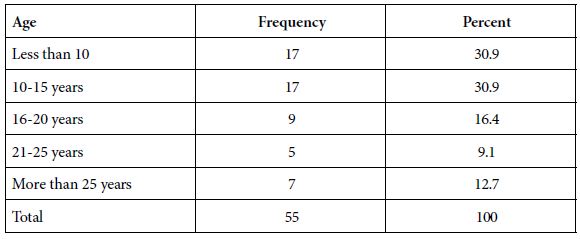
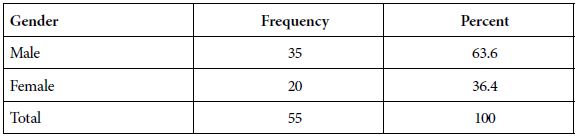
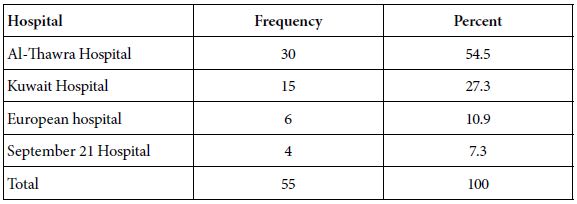
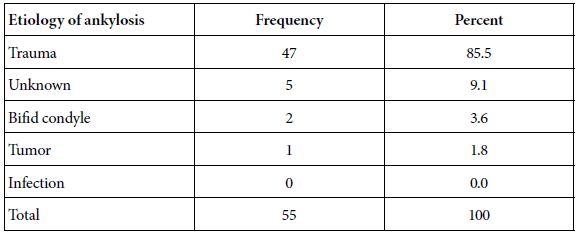
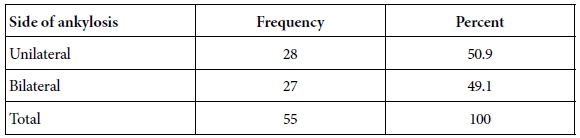
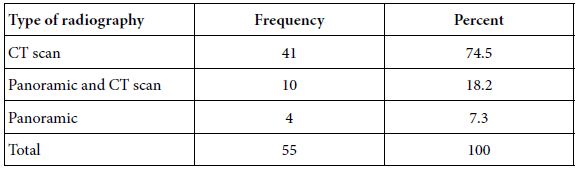
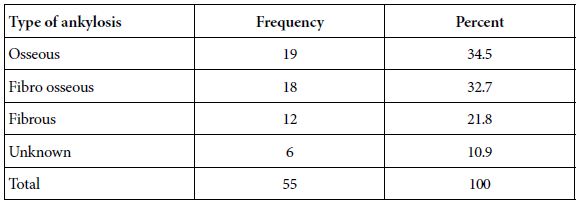
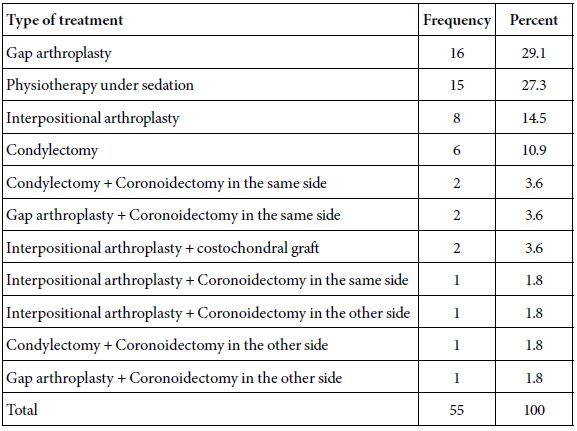
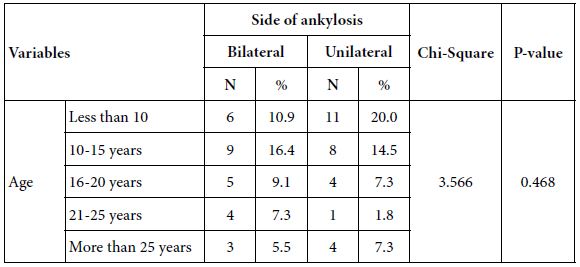
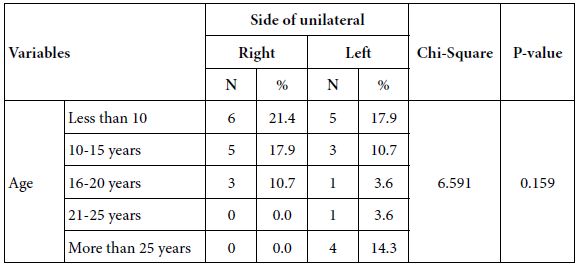
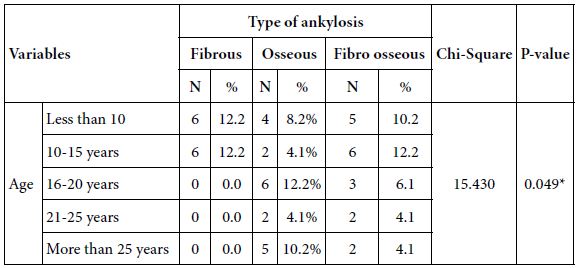
The study reveals that the majority of respondents were male, accounting for 30.9% of the total. The age distribution was dominated by those aged 10-15, followed by those aged 16-20, 12.7% over 25, and the least common age group (ages 21-25). Hospitals were the most frequent, with Al-Thawra Hospital having the highest number of respondents (54.5%). The most common etiology of ankylosis was trauma (85.5%), followed by bipolar and unilateral (49.1%). The most common type of radiography was CT scan (74.5%), followed by panoramic and CT scan (18.2%), and panoramic (7.3%). The most common type of ankylosis was osseous (34.5%), followed by fibrous (32.7%), and the least common type was unknown (10.9%). The study also revealed that the majority of respondents had a type of ankylosis, with the majority of respondents having a fibrous type (Tables 1-15).

Table 1: Frequency Distribution–Age of Respondents

tab 1

Table 2: Frequency Distribution–Gender of Respondents

tab 2

Table 3: Frequency Distribution– Hospital

tab 3

Table 4: Frequency Distribution– Etiology of ankylosis

tab 4

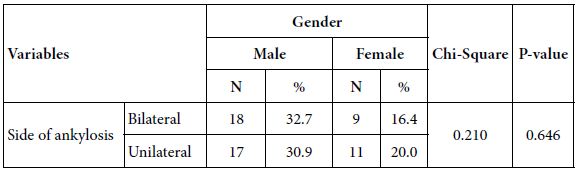
Table 5: Frequency Distribution– Side of ankylosis

tab 5

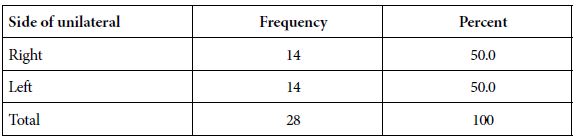
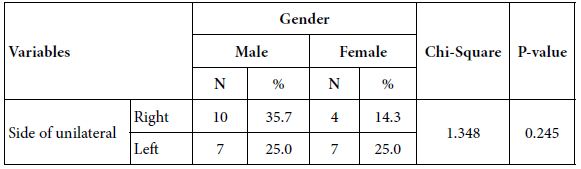
Table 6: Frequency Distribution– Side of unilateral

tab 6

Table 7: Frequency Distribution – Type of radiography

tab 7

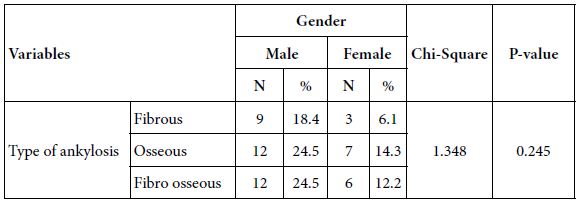
Table 8: Frequency Distribution– Type of ankylosis

tab 8

Table 9: Frequency Distribution– Type of treatment

tab 9

Table 10: Relationship between side of ankylosis and gender

tab 10

Table 11: Relationship between side of unilateral and gender

tab 11

Table 12: Relationship between type of ankylosis and gender

tab 12

Table 13: Relationship between side of ankylosis and age

tab 13

Table 14: Relationship between side of unilateral and age

tab 14

Table 15: Relationship between type of ankylosis and age

tab 15

Discussion

In this study, the age of the patients ranged from 4-55 years with a mean age of 15.27 <0x7E> 10.02, and the frequency of TMJ ankylosis was highest in the second decade (47.3%), followed by the first decade (30.9%). The finding of the most frequently occurring age group was the same with the studies conducted in Pakistan [6], Egypt [14], and Ethiopia [15]. In contrast, a study in Sudan revealed that most of the cases were in the first decade of the age [1]. The majority of patients in this study were male, 35 (63.6%), and this is similar to studies in Nigeria [2], Ethiopia [16], and Brazil [10], where male cases were predominant. This result can be explained by the fact the fact that the males are more likely to be injured than the females because of their high-risk activities and are more susceptible to trauma.

This study shows that the greatest number of cases were in Al Thawra 30 (54.5%) because it’s considered the largest hospital in receiving cases in Sana’a city, followed by Al-Kuwait Hospital 15 (27.3%).

The current study revealed that trauma was the most common cause of TMJ ankylosis, representing (85%) of all cases, and these resemble previous studies in Pakistan [6], India [17,18], and South Africa [19], in which trauma was the most common cause of TMJ ankylosis. In the current study, there were no ankylosis cases due to infection. This was in contrast to many studies that revealed the infection is one of the most common causes of ankylosis among children and adult patients [20,21].

In this study, the frequency of unilateral (right or left) ankylosis (50.9%) was slightly higher than bilateral, and this resembles result findings in studies from China [22], Pakistan [6], Brazil [10], and India [23], while the current study found the right side TMJ ankylosis was equal to the left side TMJ ankylosis 14 (50%).

The current study showed that CT scan was the most radiographic x-ray used for diagnosis of TMJ ankylosis (74.5%), and this was similar to the results of other studies [24,25]. Followed by a panoramic and CT scan (18.2%), and a panoramic x-ray was the least used x-ray for the diagnosis TMJ ankylosis (7.3%).

About a type of ankylosis frequency in this study, three different types of ankylosis were identified: osseous 19 (34.5%) and represent the greatest number of cases due to most patients presented late probably because of ignorance, poverty, and lack of easy access to treatment, followed by fibroosseous ankylosis (32.7%) and fibrous ankylosis (21.8%). These results were similar to previous studies done in Delta Nile, Egypt [26]. In the current study, there is an association between the type of ankylosis and age, in which all cases of fibrous ankylosis were found in children under the age 15 (p = 0.049).

In the current study, the gap arthroplasty was the most commonly done procedure (29.1%), and this agrees with many of the previous studies in India [27], Ethiopia [28], and South Africa [19]. Gap arthroplasty is the most commonly done procedure due to its simplicity, low surgical cost, and short operating time, but it has disadvantages of short ramus height, pseudoarticulation, anterior open bite in bilateral cases, premature occlusion on the affected side and open bite on the contralateral side in unilateral cases, decreased postoperative range of motion, and increased risk of reankylosis [28], followed by physiotherapy under sedation (15.3%), and this type of treatment is found in cases of fibrous ankylosis in Al Tharwa hospital. Interpositional arthroplasty cases were 8 (14.5%); this procedure is preferred by a lot of surgeons due to reducing the risk of recurrence of ankylosis, restoring the vertical height of the ramus, and preventing open bites when using interpositional arthroplasty in treatment cases of bilateral TMJ ankylosis [29]. In the cases of coronoidectomy for the same side of ankylosis, there were 2 cases in the condylectomy procedure and also 2 cases in the gap arthroplasty procedure, which represents 3.6% in each type of treatment, and this agrees with [10]. The type of treatment group with coronoidectomy on the other side that is used in condylectomy, gap arthroplasty, and interpositional arthroplasty procedures. The number of cases was 1 in each procedure and represented (1.8%) in each procedure, respectively; this resembles a previous study in Brazil [10]. Also, there was only 1 case of interpositional arthroplasty with coronoidectomy on the same side (1.8%). The last type of treatment group was interpositional arthroplasty with costochondral graft or total joint replacement with costochondral graft, which was 2 cases and represents (3.6%); this is similar to that reported by Mabongo and Karriem (2014) [19]. The costochondral graft is the optimal method for reconsteruction of TMJ, especially in children due to a chance for growth of a mandible.

Conclusion

The study explores the demographics, etiology, radiographic diagnosis, types of ankylosis, and surgical treatments of TMJ ankylosis in Yemen. It reveals a high incidence of trauma, with the second decade being the most common age group. The most common type is osseous ankylosis, followed by fibroosseous and fibrous ankylosis. The study also highlights the need for further research to develop more effective treatments. Thefindings underscore the need for improved diagnosis and treatment of this challenging condition.

Recommendation

The text emphasizes the importance of raising awareness about TMJ ankylosis among healthcare professionals and the public, implementing preventive measures, encouraging early diagnosis and treatment, and implementing standardized protocols. It also calls for increased availability of specialized healthcare facilities, further research for more effective treatments, and improved patient data archiving methods.

Limitations

The current study’s limitations include the scarcity of data in patient files, the unwillingness of certain hospitals to collaborate with us in order to meet the study’s objectives, and the challenges associated with gathering data from old hospital archives.

Data Availability

The accompanying author can provide the empirical data that were utilized to support the study’s conclusions upon request.

Acknowledgments

The authors would like to thank Yemen and the Faculty of Dentistry at Sana’a University for their kind cooperation.

Dispute of Interest

There are no conflicts of interest in regard to this project.

Author’s Contributions

Dr. Basheer Saeed Mohammed Khalid: Formal analysis, conceptualization, data organization, and clinical and laboratory examinations to obtain a master’s degree in Oral and Maxillofacial Surgery. Professor Sam Abd Alkarem Da’er: Methodology, formal analysis, visualization. Other authors supervised the clinical part of the work. All authors reviewed the article and approved the final version.

References

  1. ELTOHAMI Y, ABUAFFAN A, ALSAGH R, MOHAMED H, ALI A (2017) Temporomandibular joint ankylosis pattern, causes, and management among a sample of Sudanese children. Den Craniofac Res 2: 1.
  2. BELLO SA, OLOKUN BA, OLAITAN AA, AJIKE SO (2012) Aetiology and presentation of ankylosis of the temporomandibular joint: report of 23 cases from Abuja, Nigeria. British Journal of Oral and Maxillofacial Surgery 50: 80-84. [crossref]
  3. KUMAR N, SARDANA R, KAUR R, JAIN A (2016) Intraoperative mandibular nerve block with peripheral nerve stimulator for temporomandibular joint ankylosis. Journal of Clinical Anesthesia 35: 207-209. [crossref]
  4. ANYANECHI C, OSUNDE O, BASSEY G (2015) Use of oral mucoperiosteal and pterygo-masseteric muscle flaps as interposition material in surgery of temporomandibular joint ankylosis: A comparative study. Annals of Medical and Health Sciences Research 5: 30-35. [crossref]
  5. TANRIKULU R, EROL B, GöRGUN, B., SöKER M (2005) The contribution to success of various methods of treatment of temporomandibular joint ankylosis (a statistical study containing 24 cases) Turk J pediatr 47: 261-265. [crossref]
  6. HOSSAIN MA, SHAH SAA, BISWAS R S R (2014) Frequency of temporomandibular joint ankylosis in various age groups with reference to etiology. Chattagram Maa-O-Shishu Hospital Medical College Journal 13: 17-20.
  7. DE LEEUW R, KLASSER G D (2018) Orofacial pain: guidelines for assessment, diagnosis, and management, Quintessence Publishing Company, Incorporated Hanover Park, IL, USA.
  8. ANDRADE N, KALRA R, SHETYE S (2012) New protocol to prevent TMJ reankylosis and potentially life threatening complications in triad patients. International journal of oral and maxillofacial surgery 41: 1495-1500. [crossref]
  9. SU-GWAN K (20010. Treatment of temporomandibular joint ankylosis with temporalis muscle and fascia flap. International Journal of Oral and Maxillofacial Surgery 30: 189-193. [crossref]
  10. VASCONCELOS BCDE, PORTO GG, BESSA-NOGUEIRA RV (2008) Temporo mandibular joint ankylosis. Revista Brasileira de Otorrinolaringologia 74: 34-38. [crossref]
  11. ENTERLEIN G, BYHAHN C (2013) Practice guidelines for management of the difficult airway: update by the American Society of Anesthesiologists task force. Der Anaesthesist 62: 832-835.
  12. MANGANELLO-SOUZA L, MARIANI P (2003) Temporomandibular joint ankylosis: report of 14 cases. International Journal of Oral and Maxillofacial Surgery 32: 24-29. [crossref]
  13. MEHROTRA D, PRADHAN R, MOHAMMAD S, JAISWARA C (2008) Random control trial of dermis-fat graft and interposition of temporalis fascia in the management of temporomandibular ankylosis in children. British Journal of Oral and Maxillofacial Surgery 46: 521-526. [crossref]
  14. ELGAZZAR R, ABDELHADY A, SAAD K, ELSHAAL M, HUSSAIN M.et al (2010a) Treatment modalities of TMJ ankylosis: experience in Delta Nile, Egypt. International Journal of Oral and Maxillofacial Surgery 39: 333-342. [crossref]
  15. GAROMA G, DEJENE D, UMA G (2022) Temporomandibular joint ankylosis; aetiology, pattern and treatment. J Dent Health Oral Disord Ther 13: 33-37.
  16. TEFERA T (2019) Incidence, clinical presentation and surgical management of Temporomandibular Joint ankylosis: A 5 year retrospective study. Scientific Archives of Dental Sciences 2: 2-14.
  17. MISHRA N, SHARMA NK, DHIMAN N K, JAISWARA C, TIWARI P. et al (2021) Temporomandibular joint ankylosis: A tertiary center-based epidemiological study. National Journal of Maxillofacial Surgery 12: 392. [crossref]
  18. GUPTA VK, MEHROTRA D, MALHOTRA S, KUMAR S, AGARWAL G G et al (2012) An epidemiological study of temporomandibular joint ankylosis. National Journal of Maxillofacial Surgery 3: 25. [crossref]
  19. MABONGO M, KARRIEM G (2014) Temporomandibular joint ankylosis: evaluation of surgical outcomes. J Dent Med Sci 13: 60-66.
  20. KABAN LB, BOUCHARD C, TROULIS MJ (2009a) A protocol for management of temporomandibular joint ankylosis in children. Journal of Oral and Maxillofacial Surgery 67: 1966-1978. [crossref]
  21. MOVAHED R, MERCURI L G (2015b) Management of temporomandibular joint ankylosis. Oral and Maxillofacial Surgery Clinics 27: 27-35. [crossref]
  22. CHEN S, HE Y, AN JG, ZHANG Y (2019a) Recurrence-related factors of temporomandibular joint ankylosis: a 10-year experience. Journal of Oral and Maxillofacial Surgery 77: 2512-2521. [crossref]
  23. KALPANA T, LAM RM (2021) Clinical study of temporomandibular joint ankylosis & its management. International Journal of Surgery 5: 246-250.
  24. KAVIN T, JOHN R, VENKATARAMAN S S (2012) The role of three-dimensional computed tomography in the evaluation of temporomandibular joint ankylosis. Journal of Pharmacy & Bioallied Sciences 4: S217. [crossref]
  25. SHETTY P, THOMAS A, SOWMYA B (2014) Diagnosis of temporomandibular joint (TMJ) ankylosis in children. Journal of Indian Society of Pedodontics and Preventive Dentistry 32: 266-270. [crossref]
  26. ELGAZZAR RF, ABDELHADY AI, SAAD KA, ELSHAAL MA., HUSSAIN M M., et al (2010b) Treatment modalities of TMJ ankylosis: experience in Delta Nile, Egypt. Int J Oral Maxillofac Surg 39: 333-42. [crossref]
  27. JAIN G, KUMAR S, RANA AS, BANSAL V, SHARMA P. et al (2008) Temporomandibular joint ankylosis: a review of 44 cases. Oral and Maxillofacial Surgery 12: 61-66. [crossref]
  28. DANDA A.K, RAMKUMAR S, CHINNASWAMI R (2009) Comparison of gap arthroplasty with and without a temporalis muscle flap for the treatment of ankylosis. Journal of Oral and Maxillofacial Surgery 67: 1425-1431. [crossref]
  29. BANSAL S, VERMA DK, RAI M, SORAKE A, KAUR C (2019) Gap arthroplasty or interpositional arthroplasty for the management of TMJ ankylosis? A prospective randomized comparative multicenter clinical trial. Journal of Maxillofacial and Oral Surgery 18: 567-571. [crossref]

Spontaneous Skin Lesion in a Canine Patient Without Defined Breed

DOI: 10.31038/IJVB.2024821

Abstract

The cutaneous clinical manifestation characterized by deep dermatitis with granulomatous reaction, appearance of an edematous, circular and alopecic nodule was found abruptly in a 6-year-old female canine patient. Diagnosed with Lupus Erythematosus due to the presence of major symptoms, the causes of kerion were excluded by the species Microsporum canis, M. gypseum and Trichophyton mentagrophytes, which were found to be absent in the cytology, fungal and bacterial cultures of the present case. Using Causticum 30 cH, three globules, twice a day, the patient’s inflammatory process ceased on the third day, turning the lesion into a wound that healed on the fifteenth day. Complete rehairing of the affected area was observed on the thirtieth day. Immunological parameters that affected skin morphometry in the initial phase, showed positive results after the use of homeopathy, reflecting the magnitude of the therapy adopted in dermatopathies.

Keywords

Alopecia, Autoimmune, Scabs, Dermatitis, Homeopathy

Introduction

Characterized by erosive lesions on the face, systemic lupus erythematosus (SLE) is an ancient disease, first mentioned in the Middle Ages 400 years BC by Hippocrates. In 1846, the Viennese physician Von Hebra described a “butterfly wing” pattern of dermatitis, but it was named by Pierre Cazenave in 1851 when he described spontaneously arising skin lesions that resembled wolf bites.

Lupus erythematosus is a benign autoimmune condition, with a low occurrence in veterinary routine. Affected patients produce antibodies against normal skin components. The clinical presentation is varied, producing lesions mainly on the snout. There is no 100% specific test for detecting Lupus . They consider the test called FAN (antinuclear factor or antibody), with high titers, in symptomatic animals [1], but definitively the diagnosis is made through histopathological examination and the treatment is based on immunosuppression and non-exposure to solar radiation [2-11].

A spectrum of unique and often characteristic clinical signs allows the early implementation of an effective treatment [9]. In contrast, canine variants regroup therapeutic possibilities. At this time, we would also regroup under Vesicular cutaneous lupus erythematosus, Exfoliative cutaneous lupus erythematosus, Localized (facial) or generalized discoid lupus erythematosus and Mucocutaneous lupus erythematosus, the currently recognized subtypes.

If all homeopathy and its principles were not enough to demonstrate Hanemmann’s genius, a mixture of quicklime and porcelain, after the drying process, prepared in homeopathic medicine, in a fabulous therapeutic resource for the sub regent case of inflammation and burning sensation in the snout [7], has its characteristics of infinitesimal dilution, with absence of residues, being widely used [2].

Case Report

A female, spayed, mixed breed dog weighing 32 kg and 6 years old was treated for a superficial skin infection on the dorsal region of the muzzle that had been developing for less than 24 hours (she woke up like this). There was no possibility of trauma or contact with chemicals. A fragment of the lesion on the muzzle was collected for laboratory analysis and cytology revealed purulent inflammation. There was no bacterial or fungal growth in samples sent for culture. Causticum 30 cH, three globules, twice a day for fifteen days was used as treatment.

When diagnosing LES, biopsy or PCR should be considered. However, the treatment was effective, with reliable improvement 24 hours after the use of the homeopathic medicine (Figures 1C, 1D and 2C) and therefore the other tests were not performed. It can be seen that Causticum reduced the inflammation, making the lesion crusty and dry. The beginning of hair regrowth was seen on the sixth day (Figures 1E and 3). The region had collagen deposition due to its pink appearance, and it was possible to observe characteristics of remodeling of the lesion to the scarring process (Figure 1I), then evolving to a pigmented area (Figure 1K) until its complete hair regrowth.

fig 1

Figure 1: Frontal view of the muzzle, dermatological lesion with alopecic, erythematous and nodular characteristics. (A) Day 1 – onset of symptoms; (B) Day 2 – start of treatment with Causticum (C) Day 3 (D) Day 4 (E) Day 6 (F) Day 10 (G) Day 12 (H) Day 14 (I) Day 16 – medication discontinued (J) Day 18 (K) Day 20 (L) Day 30.

fig 2

Figure 2: Lesion lateral view (A) Day 2 (B) Day 3 (C) Day 4 (D) Day 6.

fig 3

Figure 3: Source: Barbosa, 2024.
Dermatological appearance of the frontal region of the muzzle 5 days after the use of Causticum 30 cH, showing the beginning of hair regrowth in the affected area.

Discussion

Separating skin diseases specific to Lupus erythematosus from those that are nonspecific is a challenge [10], mainly due to their characteristics on physical examination and stages of complementary examinations.

Clinical signs involving alopecia are variable and mainly related to scaling and crusting, which can be focal, multifocal or generalized.

The kerion-type presentation (Figure 1), also called nodular dermatophytosis, is the clinical manifestation compatible with an infectious skin disease frequently detected in small animal clinics and has the fungus Microsporum canis as its main causative agent.

After excluding this hypothesis by fungal and bacterial culture, Lupus erythematosus was considered the clinical diagnosis.

Ferreira et al. (2021) describe the treatment of a senile canine patient with dermatophytic kerion caused by Microsporum canis using Itraconazole (10mg/kg/day) for 45 days. Due to the potential side effects related to the use of itraconazole, the adopted homeopathic therapy favors the patient’s organic function due to the absence of harm to health through pharmacodynamics.

In the case reported by [5], the canine patient with erythematous, scaly and ulcerated lesions in the nasal region, lips and gums, perianal region and caudal abdominal region had SLE confirmed by histopathological examination. The treatment was prednisolone 2mg/ kg, BID, for 10 days, later reduced to 1mg/kg, BID, for 10 days and then 1mg/kg, on alternate days and sun restriction. The animal responded positively to the treatment with improvement in clinical signs.

A senior mixed-breed dog patient with ulcers and crusts on the bridge of the nose, which had gradually evolved over a two- month period, received a therapeutic protocol consisting of topical medication based on hydrocortisone (1%), vitamin E (0.5%), and SPF 45 every 12 hours for 20 days; systemic therapy was administered with prednisolone at an initial dose of 1 mg/kg, followed by weaning, until its suspension, which lasted 80 days, in addition to liver protection for 30 days and precautions regarding sun exposure. Complete remission occurred after four months [4]. In another case, an ulcer and crust between the junction of the nasal plane and the skin of a mixed- breed dog was treated with 0.1% tacrolimus ointment, sunscreen on the muzzle, and tacrolimus ophthalmic ointment in the left eye, three times a day. There was partial improvement in the third week and complete remission of the lesions occurred after twelve weeks [11].

In the present case report, partial improvement occurred after 24 hours of starting treatment, with complete remission in the second week, a rapid result when compared to other reports. Currently, most of the medications used in treatment are: high doses of corticosteroids, anti-inflammatories and immunosuppressants, which have many uncomfortable side effects. Even with all this, some patients do not show the expected response [1].

Homeopathic therapy for dermatopathies in dogs is based on the principles of homeopathy, which involve diluted and dynamized substances to stimulate the body’s natural healing capacity. Causticum was the one that showed the best health support for harlequin-type ichthyosis [8]. Its applicability was also proven in a lactating Jersey cow, with several papillomas on the teats. The tumors reduced in size with the use of Causticum 18 cH twice a day before milking [2].

The possibility of treating Lupus Erythematosus with medicines from the Homeopathic Pharmacopoeia, based on the mental and physical symptoms of the disease, found through the meticulous approach of the homeopath, shows that guilt, stress and repressed emotions influence the alteration of the Immune System that gives rise to the disease [12].

Conclusion

While conventional treatment focuses on pharmacological approaches, homeopathy offers a promising alternative based on individuality and the stimulation of the body’s natural defenses. Continuous research and the link between therapies are essential to improving dermatological conditions in dogs. It is concluded that the use of the drug Causticum can be started immediately after the appearance of the lesion, the treatment is effective and fast when compared to the conventional use of immunosuppressants.

References

  1. Arias MB, Guimarães FC Conceição RT, Flaiban KKMC (2022) Estudo retrospectivo em 18 cães com lúpus eritematoso sistêmico (2008-2018) Pubvet, v. 16, n.
  2. Ferreira T, Wagner W, Ficagna VC (2017) Rev Acad Ciênc Anim 15 (2): S355-356.
  3. Ferreira et al. Quérion dermatofítico em cadela: Relato de caso (2020) Pubvet, 15 (01)
  4. Leal SRLS, Silva JG, Tertulino MD, Barreto GMF, Noronha JA, Rodrigues LMN, Medeiros NC (2021) Aspectos clínicos e histopatológicos do Lúpus Eritematoso Discoide canino: relato de caso. Medicina Veterinária (UFRPE), Recife, v.15, n.3, 209-215.
  5. Lima RC, Lavor CTB, Santos KMM, Vago P B, Viana DA (2022) Lúpus eritematoso discoide em cão. Ciência Animal 30, n. 2, p. 51-57.
  6. Macedo CM, Silva WC, Camargo Junior RNC (2021) Dermatofitose em cães e gatos: aspectos clínicos, diagnóstico e tratamento. Vet e Zootec v28: 001-013.
  7. Mcclellan C (2015) The Homeopathy Remedy: Causticum. Int J Complement Alt Med 1 (5): 00027.
  8. Oliveira SGM, Martins VAG, Rabello GM, Beier M, Astoni Júnior ÍMB (2014) Abordagem homeopática de uma criança portadora de ictiose tipo Revista de homeopatia 77 (3/4): 28.
  9. Olivry T, Rossi MA, Banovic F, Linder KE (2015) Mucocutaneous lupus erythematosus in dogs (21 cases) Veterinary Dermatology, 26 (4), 256-e55. [crossref]
  10. Olivry T, Linder KE, Banovic F (2018) Cutaneous lupus erythematosus in dogs: a comprehensive BMC Veterinary Research, 14 (1) [crossref]
  11. Pereira P, Oyafuso MK, da Cunha O, Nunes ACB, Paulino JA (2014) Medvep Dermato- Revista de Educação Continuada em Dermatologia e Alergologia Veterinária; 3 (11); 390-393.
  12. Pereira LL (2016) Associação da terapêutica homeopática no tratamento do Lúpus Eritematoso Sistêmico. Monografia apresentada ao curso de Especialização em Homeopatia do Instituto Hahnemanniano do Brasil Departamento de Ensino, Rio de Janeiro.

High-tridymite, Cristobalite, and Londsdaleite in a Minette Lamprophyre from E-Thuringia/Germany

DOI: 10.31038/GEMS.2024653

Abstract

The minette from Cunsdorf near Elsterberg in E-Thuringia has an astonishingly high number of tridymite and remnants of other quard polymorphs. More exceptional is the high content of lonsdaleite whiskers and, in part, his degradation products in the form of diamonds and graphite in quard and K-feldspar of this rock. The presence of lonsdaleite demands ultra-high-pressure conditions for the formation of the minette lamprophyre magma. The high number of lonsdaleite whiskers in a magmatic rock is unexpected.

Keywords

Lonsdalite, Genesis of lamprophyres, Raman spectroscopy

Introduction

During the study of a minette sample from E-Turinga [1], we found in quartz schlieren, besides quartz, lonsdaleite, also hints of high- tridymite and cristobalite. Cristobalite is rare, however. Such schlieres we interpret as remnants of supercritical fluids or melts, inserted into the minette rock by multi-interaction of both phases (supercritical fluid and lamprophyre magma) coming from the earth’s mantle. The equilibrium temperature of both SiO2 phases is, according to Frondel [2], 1470°C at low pressure. The inversion of cristobalite to tridymite is sluggish, and cristobalite can persist as a metastable form at room temperature. However, the coexistence of cristobalite and tridymite is an essential mark in quartz, together with diamond and lonsdaleite, for the origin and the emplacement of the minette lamprophyre.

Sample and Methods

The minette sample 2210 is from a 50 cm thick vein in a small quarry at Highway B 92, about 1 km northwards from Cunsdorf near Elsterberg, E-Thuringia. A more detailed description and references to it are provided by Thomas and Recknagel [1]. A more detailed description of the rock is in Beuge and Kramer [3] as well as in Kramer [4]. We use Raman spectroscopy here to characterize the cristobalite and high-tridymite in quartz schlieres in the minette. For measurements, the Raman spectrometer EnSpectr R532 combined with the Olympus BX43 microscope, both for transmitted and reflected light and equipped with a rotating stage and polarizers (for parallel and perpendicular positions), is used. Generally, we used an Olympus long-distance 100x objective lens for the studies. As references, we applied a water-clear diamond crystal from Brazil (1331.63 ± 0.60 cm-1 and a semiconductor-grade silicon single-crystal (520.70 ± 0.15 cm-1). For this study, we generally used laser energies of 12 mW on the sample. To identify the minerals of the minette sample, we used the RRUFF database [5].

Result and Discussion

The Raman study of a mixture of SiO2 polymorphs, developed on the long way from the mantle to the upper crust, is a challenge [6]. The monocline modification of tridymite dominates the Raman spectrum (Figure 1). The bands at 66.3, 83.0 (not shown), 142.6, 194.7, 334.5, and 430.0 cm-1 correspond, according to Kanzaki [6], well to the monocline tridymite of the Steinbach iron meteorite (IVA-an). The Steinbach meteorite (which fell near Meissen/Germany in 1540- 1550) forms, according to Grady et al. [7], almost equal amounts of Fe-Ni metal and, tridymite and other silicates. In our minette sample, remnants of the MX-1 modification [6] are present too. This modification is formed by quenching high-temperature tridymite modifications. Typical bands are 456.9 (band quite right in Figure 1), and 789.3 cm-1.

fig 1

Figure 1: Raman spectrum of quartz, tridymite, and cristobalite in the low-frequency region (η=50-450 cm-1). The shoulder at 420 cm-1 is a hidden band of cristobalite.

Besides quartz, cristobalite, and high-tridymite modifications, there are in Figure 1 also indications of coesite present: 116.6, 175.3, 269.8, and 430 cm-1 [8]. However, the unambiguous proof is difficult because of the presence of fine-distributed microcrystals of orthoclase in the bulk quartz and also many lonsdaleite whiskers (Figure 2). Some whiskers are up to 100 µm long. The number of lonsdaleite whiskers > 20 µm is about 5.5 · 106/cm3. These whiskers appear not only in quartz and feldspar but also in other darker minerals, which demonstrate that the whole rock has seen a high-pressure history. Micro-diamonds in the larger black lath-shaped graphite crystals will also support that [1].

fig 2

Figure 2: Raman spectrum of lonsdaleite whisker in quartz of the E-Thuringia minette.

The lonsdaleite whisker in quartz proves that the SiOpolymorphs are at least clearly related to the coesite field. According to Frondel [2], the 1470°C corresponds to a pressure of about 5.25 GPa and a depth of about 165 km (however, that is a minimum), as we will see later (Figure 3).

fig 3

Figure 3: Black lath-shaped anatase crystal in orthoclase of the minette from E-Thuringia. In this needle, there are micro-diamonds and/or lonsdaleite whiskers.

Most lonsdaleite whiskers are in quartz polymorphs and transparent K-feldspars. After 20 measurements, lonsdaleite shows a strong Raman band at 1322.6 ± 2.7 cm-1 (mode η = E1g ) and a FWHM = 68.6 ± 12.3 cm-1 (see also Thomas and Recknagel 2024) [1]. FWHM means Full Width at Half Maximum. The weaker bands at 1266.9 ± 31.5 and 1528 cm-1 (modes η = E2g and A1g, respectively, are also present) – see Yang et al. [9].

Interpretation

The presence of tridymite and other remnants of SiO2 polymorphs show that during the ascent of the minette lamprophyre at high temperatures, these polymorphs with the lonsdaleite whiskers were subject to steady changes. According to Gigl and Dachille [10] and Hemley et al. [11], the stability of, for example, stishovite is strongly limited at high temperatures and low pressures. The survival of lonsdaleite and diamond under such conditions is a surprise. That means at least that lonsdaleite is more stable than the quartz polymorphs. The formation of lonsdaleite in the earth’s mantle is up to now unclear. Greshnyakov et al. [12] wrote that the formation of lonsdaleite from hexagonal graphite takes place at 56 GPa, corresponding to a depth of about 1400 km and a temperature of about 1730°C. The involvement of supercritical fluids or melts during the lamprophyre ascent can reduce the origin depth of lonsdaleite and can also accelerate the lamprophyre ascent.

Acknowledgment

The studied minette sample 2210 from Cunsdorf near Elsterberg/ E-Thuringa is from Kramer. Wolfgang Kramer wrote: The Minette from Cunsdorf bei Elsterberg is a very fascinating rock.

References

  1. Thomas R, Recknagel U (2024) Lonsdaleite, Diamond, and Graphite in a Lamprophyre: Minette from East-Thuringia/Germany. GEMS.
  2. Frondel C (1962) The System of Mineralogy, III Silica Wiley and Sons. Pg: 334.
  3. Beuge P, Kramer W (1977) Lamprphyre Ostthüringens und ihre anomalen Quecksilbergehalte im Ergebnis endogener uns exogener Anreicherungsprozesse. Schriftenreihe Geol Wiss 8: 79-99.
  4. Kramer W (1988) Magmengenetische Aspecte der Lithosphärenentwicklung. Akademie-Verlag Berlin. Pg: 136.
  5. Lafuente B, Downs RT, Yang H, Stone N (2015) The power of database: RRUFF In: Armbruster T, Danisi RM (eds.). Highlights in mineralogical crystallography. Berlin Pg: 1-30.
  6. Kanzaki M (2019) Raman spectra of tridymite modifications: MC, MX-1, and PO-Journal of Mineralogical and Petrological Sciences. 114: 214-218.
  7. Grady M, Pratesi G, Cecchi VM (2014) Atlas of Cambridge. Pg 1181.
  8. Boyer H, Schmidt DC, Chopin C, Lasnier B (1985) Raman microprobe (RMP) determinations of natural and synthetic coesite. Phys Chem Minerals 12: 45-48.
  9. Yang L, Lau CK, Zeng Z, Zhang D, Tang H, et (2021) Lonsdaleite: The diamond with optimized bond lengths and enhanced hardness. Condensed Matter, Material: 1-19 Science.
  10. Gigl PD, Dachille F (1968) Effect of pressure and temperature on the reversal transitions of stishovite. Meteoritics 4: 123-136.
  11. Hemley RJ, Prewitt CT, Kingma KJ (1994) High-pressure behavior of silica. Reviews in Mineralogy. 29: 41-81.
  12. Greshnyakov VA, Belenkov EA (2017) Investigation on the formation of lonsdaleite from graphite J Exp Theor Phys 124: 265-274.

Lifestyle Education for Hypertension Management: Insights from a College Student Cohort

DOI: 10.31038/IJNM.2024534

Abstract

Hypertension, a pervasive global health issue, poses significant risks to cardiovascular health and financial burdens on individuals and healthcare systems. We observed the impact of a lifestyle intervention, the Complete Health Improvement Program (CHIP), on blood pressure reduction among Hypertension, a pervasive global health issue, poses significant risks to cardiovascular health and financial burdens on individuals and healthcare individuals with seemingly normal levels. The pillars of a healthy lifestyle—physical activity, whole food plant-based nutrition, avoidance of harmful substances, stress management, passion, sleep, and connectedness—are examined as potential contributors to hypertension management. This study involved ten freshmen and two staff members. While statistically significant reductions in systolic and diastolic blood pressures were observed after 12 weeks of the CHIP program, no significant changes were evident at six weeks. Importantly, no substantial alterations were found in weight, BMI, total cholesterol, triglycerides, or fasting glucose levels. The results suggest that lifestyle education, exemplified by CHIP, can effectively assist individuals in lowering blood pressure. However, further research is crucial to elucidate the mechanisms through which lifestyle modifications influence blood pressure regulation. Understanding these underlying factors will contribute to tailoring interventions and addressing the rising prevalence of hypertension, enhancing overall health and well-being.

Keywords

Complete health improvement program, Hypertension, Lifestyle education

Introduction

Hypertension, commonly known as high blood pressure, is a chronic medical condition that affects millions of people worldwide. It occurs when the force of blood against the walls of the arteries is consistently too high, putting strain on the cardiovascular system. Hypertension is a major risk factor for heart disease, stroke, and other serious health complications. Moreover, it poses significant financial burdens on individuals, families, and healthcare systems. However, adopting a lifestyle that encompasses the pillars of a healthy lifestyle—physical activity, whole food plant-based nutrition, avoidance of harmful substances, stress management, passion, sleep, and connectedness—has shown promising results in managing hypertension effectively and reducing healthcare costs.

The health impacts of hypertension are far-reaching and can be severe. Prolonged high blood pressure can lead to damage of the arteries, heart, kidneys, and other vital organs. It increases the risk of heart attacks, strokes, heart failure, kidney disease, and vision problems. Furthermore, hypertension often goes undetected and uncontrolled, causing a silent deterioration of health. This silent killer can significantly reduce the quality of life and even be life-threatening if left untreated [1-4]. In addition to the health consequences, hypertension also imposes substantial financial burdens on individuals and healthcare systems [5]. The costs associated with managing hypertension include doctor visits, medications, diagnostic tests, hospitalizations, and the treatment of complications that arise from uncontrolled blood pressure. These expenses can quickly accumulate and strain personal finances, while also burdening healthcare systems with high expenditure and resource allocation.

However, there is a ray of hope in managing hypertension through the adoption of a healthy lifestyle that focuses on the pillars: physical activity, whole food plant-based nutrition, avoidance of harmful substances, stress management, passion, sleep, and connectedness. These pillars are interconnected and work synergistically to promote overall well-being and effectively manage hypertension [6-12]. Regular physical activity, such as aerobic exercises, has been proven to lower blood pressure and improve cardiovascular health. Engaging in activities like walking, swimming, or cycling for at least 30 minutes a day can have a significant impact on reducing hypertension and improving overall fitness. A whole food plant-based diet, rich in fruits, vegetables, whole grains, and legumes, has been associated with lower blood pressure levels. This dietary approach emphasizes the consumption of nutrient-dense foods while minimizing processed foods, saturated fats, and sodium, which contribute to hypertension. Some substances have been shown to elevate blood pressure. Alcohol consumption is shown to produce an acute biphasic effect on blood pressure [13]. Daily consumption of alcoholic beverages is associated with a higher instance of hypertension [13-18]. Cigarette smoking is also linked to hypertension [19-22]. Even passive smoking is associated with elevated blood pressure [23-27]. Additionally, alcohol consumption heightens the effects of smoking on hypertension [28-32]. Stress management techniques, such as meditation, deep breathing exercises, and yoga, help reduce the negative effects of stress on blood pressure. Chronic stress can contribute to the development and exacerbation of hypertension, so adopting stress management practices is crucial for managing blood pressure effectively [33,34]. Finding and pursuing one’s passion in life can provide a sense of purpose and fulfillment, which positively influences overall health. Engaging in activities that bring joy and satisfaction can reduce stress levels and indirectly impact hypertension management. It is particularly beneficial in managing occupational stress. Adequate sleep is essential for maintaining optimal health and managing hypertension. Poor sleep quality or insufficient sleep has been linked to higher blood pressure levels. Establishing a consistent sleep routine and creating a sleep-conducive environment are vital for individuals with hypertension. Finally, fostering social connections and maintaining a strong support network can contribute to better hypertension management. Positive social interactions and emotional support have been shown to reduce stress levels and promote overall well-being. By embracing the basic pillars of a healthy lifestyle, individuals can effectively manage hypertension and potentially reduce the need for costly medical interventions. Moreover, adopting these lifestyle practices can have a preventive effect, reducing the risk of developing hypertension in the first place. The long-term health benefits and potential cost savings associated with a healthy lifestyle make it a compelling strategy for individuals, families, and healthcare systems to combat the impacts of hypertension.

The Complete Health Improvement Program (CHIP) developed by Hans Diehl is a comprehensive lifestyle intervention designed to promote optimal health and well-being [35-47]. This program encompasses a holistic approach that focuses on making sustainable changes in diet, physical activity, stress management, and social support. With its evidence-based principles and practical strategies, CHIP has emerged as a highly effective program for improving health outcomes and reducing the burden of chronic diseases. The CHIP program has been proven to have significant positive effects on various health parameters. Participants often experience improvements in weight management, blood pressure control, cholesterol levels, blood sugar regulation, and overall cardiovascular health. By adopting healthier eating habits, engaging in regular physical activity, and effectively managing stress, individuals can achieve a range of health benefits and reduce the risk of chronic diseases such as diabetes, heart disease, and stroke.

Materials and Methods

Complete Health Improvement Program (CHIP). The program consisted of 18 sessions that were delivered by certified facilitators. The participants met twice a week for six weeks and then once a week for six weeks. Each session included a video presentation, facilitated discussions, and food samples. The food was prepared by a local café, following whole food, plant-based recipes provided by the facilitators. Subjects. Ten freshmen and two staff from the University of Minnesota Rochester (UMR) participated. Ten were females. One was Hispanic, three Caucasian, and eight African American. Biometrics and Questionnaires. Biometrics including height, weight, BMI, systolic and diastolic pressures, fasting glucose, triglycerides, and total cholesterol were measured at weeks 1, 6, and 12. The Perceived Stress Scale (PSS) questionnaire was filled out at weeks 1 and 12.Statistical Analysis. For biometrics, a one-way ANOVA with repeated measures was conducted to compare the three time periods for each of the physical measurements. This was performed with a protected F-test (p-value < 0.05) being the threshold for further statistical analysis. Tukey’s HSD method was used for post hoc multiple comparisons whenever the treatment effect was significant. For PSS, a paired t-test was conducted to compare the pre and post scores.

Results

Statistical analyses of biometrics were shown in Table 1. Both systolic and diastolic blood pressures were significantly reduced after 12 weeks but not six weeks. There was no statistical difference between before and after the program.

Discussion

The statistical analyses of biometrics are presented in Table 1, providing a comprehensive overview of the data. The focus of the study was on the systolic and diastolic blood pressures, and the results revealed interesting findings. After a duration of 12 weeks, both systolic and diastolic blood pressures demonstrated a significant reduction. However, it is worth noting that this notable improvement was not observed at the six-week mark. Furthermore, the statistical analysis conducted to compare the measurements before and after the program indicated that there was no significant difference between these two time points. This suggests that the program did not have a discernible impact on the biometric measurements being examined. The absence of statistical significance between the pre- and post- program measurements implies that any changes observed in the biometric data were likely due to other factors or natural fluctuations. It is important to interpret these findings with caution, considering the limitations of the study and the potential influence of confounding variables that were not accounted for in the analysis. These results shed light on the potential benefits of stress management programs in a college setting, particularly in terms of promoting healthier coping mechanisms. Although the study did not yield the expected changes in biometric markers, the students’ self-reported ability to handle stress suggests that the program had a positive impact on their overall well- being and stress management skills.

Table 1: Statistical Analysis of Biometrics

Measurement

Time N Mean ± std error

p-value

Weight

1

12 153 ± 10.7 0.597
  2 9 153 ± 10.8


3

6 154 ± 10.8  

BMI

1 12 25.1 ± 1.5

0.468


2

9 25.2 ± 1.5  
  3 6

25.5 ± 1.5

 
Systolic Blood Pressure

1

12 119 ± 2.4A <0.0001*
  2 9 119 ± 2.6 A


3

6 97 ± 2.8 B  

Diastolic Blood Pressure

1 12 71.3 ± 2.3 A

0.014*


2

9 73.8 ± 2.6 A  
  3 6

62.2 ± 3.1 B

 
Glucose Level

1

12 90.4 ± 10.6 0.157
  2 8

94.8 ± 10.7


Data expressed as least squares mean ± standard error. Different superscript letters indicate significance for time within each physical measurement. *Statistical significance.

Conclusion

The findings from this study indicate that lifestyle education, as demonstrated through the Comprehensive Health Improvement Program (CHIP), can effectively assist individuals with hypertension in lowering their blood pressure. The results suggest that equipping individuals with knowledge and strategies related to lifestyle modifications can lead to positive changes in their blood pressure levels. However, it is important to acknowledge that further research is necessary to delve deeper into the mechanisms through which lifestyle education contributes to blood pressure reduction. The study did not reveal significant differences in other biometric variables, such as weight, total cholesterol, triglycerides, or fasting glucose, nor did it show substantial changes in stress levels following the education program. Therefore, additional investigations are required to elucidate the precise pathways by which lifestyle education influences blood pressure. By conducting more comprehensive studies, researchers can explore potential mediators and confounding factors that may be associated with the observed blood pressure reduction. These investigations could involve examining variables such as dietary patterns, physical activity levels, sleep quality, and other lifestyle factors that might be influenced by the education program. Understanding these underlying factors would enhance our knowledge of how lifestyle interventions impact blood pressure regulation and provide insights into the most effective strategies for hypertension management. In conclusion, while the current study highlights the potential efficacy of lifestyle education in lowering blood pressure among individuals with seemingly normal levels, further research is warranted to unravel the intricate mechanisms involved. Such studies will aid in refining the design and implementation of lifestyle education programs, allowing for more tailored and targeted interventions for individuals with hypertension. Ultimately, this research will contribute to the development of evidence-based practices that can effectively address the rising prevalence of hypertension and improve the overall health and well-being of individuals.

Acknowledgement

The authors wish to extend their gratitude to Silas Bergen, PhD, and his team at Winona State University for conducting the statistical analyses. Funding was supported by the Lotus Health Foundation and the George Family Foundation.

References

  1. Correia ETO, Mechanick JI, Jorge AJL, Leticia MDB, Maria LGR, et (2023) The hypertension-based chronic disease model in a primary care setting. Int J Cardiol Cardiovasc Risk Prev. 18. [crossref]
  2. Katsimardou A, Imprialos K, Stavropoulos K, Sachinidis A, Doumas M, et (2020) Treatment strategies for hypertension in patients with type 1 diabetes. Expert Opin Pharmacother.21: 1241-1252.
  3. Mente A, Dehghan M, Rangarajan S, Martin O’D, Weihong H, et al. (2023) Diet, cardiovascular disease, and mortality in 80 Eur Heart J. Jul 21; 44: 2560- 2579. [crossref]
  4. Islam SMS, Daryabeygi-Khotbehsara R, Ghaffari MP, Riaz U, Lan G, et al. (2023) Burden of Hypertensive Heart Disease and High Systolic Blood Pressure in Australia from 1990 to 2019: Results From the Global Burden of Diseases Heart Lung Circ. [crossref]
  5. Gheorghe A, Griffiths U, Murphy A, Legido-Quigley H, Lamptey P, et al. (2018) The economic burden of cardiovascular disease and hypertension in low- and middle- income countries: a systematic BMC Public Health. 18 . [crossref]
  6. Debela DB, Dhaba B, Shumi G, Abdulnasir A, Gemechu G, et (2021) Effect of an Educational Intervention on Lifestyle Modification of Patients With Hypertension at Bishoftu General Hospital, Ethiopia. Prev Chronic Dis. [crossref]
  7. Hanssen H (2023) Lifestyle recommendations as treatment for arterial hypertension: a time to Eur J Prev Cardiol. 30: 95-97. [crossref]
  8. Hoshide S, Mogi M, Kario K (2023) The importance of lifestyle modification for hypertension in Asia. Hypertens Res. 46: 815-816. [crossref]
  9. Karatzi K, Manios Y (2021) The Role of Lifestyle, Eating Habits and Social Environment in the Prevention and Treatment of Type 2 Diabetes and Nutrients.13. [crossref]
  10. Kodela P, Okeke M, Guntuku S, Lingamsetty SSP, Slonovschi E (2023) Management of Hypertension With Non-pharmacological Interventions: A Narrative Review. Cureus. 15. [crossref]
  11. Krishnamoorthy Y, Nagarajan R, Murali S (2023) Effectiveness of multiple combined lifestyle interventions in reducing blood pressure among patients with prehypertension and hypertension: a network meta-analysis. J Public Health (Oxf). 45: e319-e331. [crossref]
  12. Valenzuela PL, Carrera-Bastos P, Galvez BG, Gema RH, José MO et al. (2021) Lifestyle interventions for the prevention and treatment of hypertension. Nat Rev Cardiol. 18: 251-275. [crossref]
  13. Fuchs FD, Fuchs SC (2021) The Effect of Alcohol on Blood Pressure and Curr Hypertens Rep. 23. [crossref]
  14. Asowata OJ, Okekunle AP, Adedokun B, Akpa OM (2023) Alcohol use patterns and hypertension among adults in the United States: findings from the 2015-2016 NHANES data. Public Health. 225: 327-335. [crossref]
  15. Fuchs FD, Chambless LE, Whelton PK, Nieto FJ, Heiss G (2001) Alcohol consumption and the incidence of hypertension: The Atherosclerosis Risk in Communities Hypertension. 37: 1242-1250. [crossref]
  16. Harris E (2023) Even Without Hypertension, Daily Alcohol May Increase Blood JAMA. 330.
  17. Steffens AA, Moreira LB, Fuchs SC, Wiehe M, Gus M, et al. (2006) Incidence of hypertension by alcohol consumption: is it modified by race? J 24: 1489- 1492. [crossref]
  18. Vacca A, Bulfone L, Cicco S, Gabriele B, Andrea DP, et ( 2023) Alcohol Intake and Arterial Hypertension: Retelling of a Multifaceted Story. Nutrients.15. [crossref]
  19. Reinikainen J, Harkanen T, Tolonen H (2023) Projections for obesity, smoking and hypertension based on multiple imputation. Scand J Public Health. 51: 829-834. [crossref]
  20. Song S, Lee HA, Kim Y, Jeon BK, Moon CM, et al. (2023) Dynamic changing smoking habits and cardiovascular events in patients newly diagnosed with hypertension, diabetes, or dyslipidemia: a national cohort study. Front Cardiovasc Med. 10. [crossref]
  21. Wagai GA, Jeelani U, Beg MA, Romshoo GJ (2023) Relationship between hypertension and smoking: A preliminary study in South Kashmiri population of J&K. J Family Med Prim 12(5): 958-961. [crossref]
  22. Zhang DY, Huang JF, Kang YY, Yu Dou, Yan Lun S et (2020) The prevalence of masked hypertension in relation to cigarette smoking in a Chinese male population. J Hypertens. 38: 1056-1063. [crossref]
  23. Wu L, Yang S, He Y, Miao Liu, Yiyan Wang, et al. (2017) Association between passive smoking and hypertension in Chinese non-smoking elderly Hypertens Res. 40: 399-404. [crossref]
  24. Tamura T, Kadomatsu Y, Tsukamoto M, Rieko O, Tae S, et (2018) Association of exposure level to passive smoking with hypertension among lifetime nonsmokers in Japan: a cross-sectional study. Medicine (Baltimore). 97. [crossref]
  25. Makris TK, Thomopoulos C, Papadopoulos DP, Athanassios B, Ourania P, et al. (2009) Association of passive smoking with masked hypertension in clinically normotensive nonsmokers. Am J Hypertens. 22: 853-859. [crossref]
  26. Pierdomenico SD (2009) Passive smoking and masked Am J Hypertens. 22.
  27. Akpa OM, Okekunle AP, Asowata JO, Adedokun B (2021) Passive smoking exposure and the risk of hypertension among non-smoking adults: the 2015-2016 NHANES Clin Hypertens. 1. [crossref]
  28. Palatini P, Mos L, Saladini F, Olga V, Claudio F, et al. (2023) Both Moderate and Heavy Alcohol Use Amplify the Adverse Cardiovascular Effects of Smoking in Young Patients with Hypertension. J Clin Med.12. [crossref]
  29. Nagao T, Nogawa K, Sakata K, Hideki M, Kotaro M, et (2021) Effects of Alcohol Consumption and Smoking on the Onset of Hypertension in a Long-Term Longitudinal Study in a Male Workers’ Cohort. Int J Environ Res Public Health. 18. [crossref]
  30. Singh PK, Dubey R, Singh L, Nishikant S, Chandan K, et al. (2022) Mixed Effect of Alcohol, Smoking, and Smokeless Tobacco Use on Hypertension among Adult Population in India: A Nationally Representative Cross-Sectional Study. Int J Environ Res Public Health. 19. [crossref]
  31. Gupta R, Sharma S, Gupta VP, Gupta KD (1995) Smoking and alcohol intake in a rural Indian population and correlation with hypertension and coronary heart disease J Assoc Physicians India. 43: 253-258. [crossref]
  32. Wong DR, Willett WC, Rimm EB (2007) Smoking, hypertension, alcohol consumption, and risk of abdominal aortic aneurysm in men. Am J Epidemiol. 165: 838-845. [crossref]
  33. Pickering TG (2001) Effects of stress and behavioral interventions in hypertension–the effects of smoking and nicotine replacement therapy on blood pressure. J Clin Hypertens (Greenwich). 3: 319-21.
  34. Gu Z, Qu Y, Wu H (2022) The Interaction between Occupational Stress and Smoking, Alcohol Drinking and BMI on Hypertension in Chinese Petrochemical Workers. Int J Environ Res Public Health. 19. [crossref]
  35. Davis JL (2021) Evaluating the Influence of the Complete Health Improvement Program (CHIP) on Blood Glucose, Blood Pressure, and J Lifestyle Med.11: 33-37. [crossref]
  36. Kent L, Morton D, Hurlow T, Rankin P, Hanna A, Diehl H (2013) Long-term effectiveness of the community-based Complete Health Improvement Program (CHIP) lifestyle intervention: a cohort study. BMJ Open. 3.
  37. Kent L, Morton D, Rankin P, et (2013) The effect of a low-fat, plant-based lifestyle intervention (CHIP) on serum HDL levels and the implications for metabolic syndrome status – a cohort study. Nutr Metab (Lond). 10. [crossref]
  38. Kent LM, Grant RS, Watts G, Morton DP, Rankin PM, et (2018) HDL subfraction changes with a low-fat, plant-based Complete Health Improvement Program (CHIP). Asia Pac J Clin Nutr.27: 1002-1009. [crossref]
  39. Kent LM, Morton DP, Rankin PM, Gobble JE, Diehl HA (2015) Gender differences in effectiveness of the Complete Health Improvement Program (CHIP). J Nutr Educ Behav. 47: 44-52.
  40. Kent LM, Morton DP, Rankin PM, Mitchell BG, Chang E, et (2014) Gender differences in effectiveness of the Complete Health Improvement Program (CHIP) lifestyle intervention: an Australasian study. Health Promot J Austr.25: 222-229. [crossref]
  41. Kent LM, Morton DP, Ward EJ, Rankin PM, Ferret RB, et (2016) The Influence of Religious Affiliation on Participant Responsiveness to the Complete Health Improvement Program (CHIP) Lifestyle Intervention. J Relig Health. Oct;55(5): 1561-73. [crossref]
  42. Kotekal D, Worley M, Patel H, Jensen L, Dogbey GY, Drozek D (2019) Effect of Participation with Accompanying Household Member in the Complete Health Improvement Program in Appalachia. Adv Prev Med. [crossref]
  43. Leibold C, Shubrook JH, Nakazawa M, Drozek D (2016) Effectiveness of the Complete Health Improvement Program in Reducing Risk Factors for Cardiovascular Disease in an Appalachian J Am Osteopath Assoc. 116: 84-91. [crossref]
  44. Morton D, Rankin P, Kent L, Dysinger W (2016) The Complete Health Improvement Program (CHIP): History, Evaluation, and Am J Lifestyle Med. 10: 64-73. [crossref]
  45. Morton D, Rankin P, Kent L, Rex S, Wayne D, et al. (2014) The Complete Health Improvement Program (CHIP) and reduction of chronic disease risk factors in Canada. Can J Diet Pract Res. 75: 72-77. [crossref]
  46. Morton DP, Rankin P, Morey P, Lillian K, Trevor H, et al. et al. (2013) The effectiveness of the Complete Health Improvement Program (CHIP) in Australasia for reducing selected chronic disease risk factors: a feasibility N Z Med J.126: 43-54. [crossref]
  47. Remy C, Shubrook JH, Nakazawa M, Drozek D (2017) Employer-Funded Complete Health Improvement Program: Preliminary Results of Biomarker Changes. J Am Osteopath Assoc.117: 293-300. [crossref]

Unexpected Infections in Wound Management – Case Studies

DOI: 10.31038/IJNM.2024533

Introduction

Chronic wounds pose a significant challenge in the United States, affecting approximately 2.5% of the general population. These persistent wounds not only have a detrimental impact on the quality of life for patients but also exert a considerable financial burden on the healthcare system. Given the intricate nature of the wound healing process, healthcare professionals often approach the management of wounds based on their underlying causes. In cases where a wound fails to heal, clinicians commonly resort to the utilization of wound dressings and various technologies [1,2]. However, a crucial aspect that is frequently overlooked is the reassessment of the wound’s etiology, particularly when the wounds appear superficially normal. Incorporating a comprehensive understanding of the underlying cause of a chronic wound is paramount in formulating an effective treatment plan.

One essential tool in the assessment of chronic wounds is wound culture. By conducting a wound culture, clinicians can identify the presence of specific pathogens and gain insights into the appropriate course of treatment. Conventional wound culture techniques involving plating, though commonly employed, may not always capture the causative pathogens accurately. This limitation can potentially mislead treatment decisions and inadvertently prolong the healing process. To illustrate this point, two non-typical cases are presented as examples, shedding light on the importance of accurate wound culture techniques and the subsequent implications on healing outcomes.

Case #1

A 27-year-old male presented with multiple plantar warts on toes and feet. Two months later, a lesion appeared on the left thumb. The lesion was presumed to be a wart transmitted from the feet. Debridement with topical antiviral cream, containing 5% Cimetidine, 5% 5-Fluoracil and 10% Salicylic acid, did not resolve the lesion. More lesions developed on the fingers. Patient was referred to a dermatologist who performed Candida injections without success. HIV test was negative. Patient was referred back to continue the treatment of debridement and topical antiviral cream. However, the etiology of the wounds is now being questioned. The lesions appeared on fingers on the left hand only and on four fingers except the middle one (Figure 1).

fig 1

Figure 1: Suspected verrucae on the fingers

The lesions did not appear to follow the contact transmission logics. A wound culture by PCR (HealthTrackRx, Denton, TX) was performed. High volume of Peptostreptococcus anaerobius and Cutibacterium acnes were detected. Patient admitted to a habit of nail biting. All lesions on the fingers were resolved after seven days of Azithromycin and two weeks of topical antibiotic ointment (Figure 2).

fig 2

Figure 2: Fingers after the proper antibiotic treatment

Case #2

A 47-year-old female presented with an ingrown toenail and an incidental complaint of athlete’s foot. Patient indicated that the lesions were located in the left fourth interspace and had been resistant to over-the-counter antifungal for a few weeks. The webspace was erythematous with open skin and vesicles (Figure 3).

fig 3

Figure 3: Suspected tinea pedis

Suspicion was immediately raised since she was a double-transplant recipient due to a rare desmin-related myopathy. A wound culture by PCR (HealthTrackRx, Denton, TX) was performed. High volume of Enterococcus faecalis, E. faecium, Klebsiella pneumoniae, K. Oxytoca, P. anaerobius, C. acnes, Staphylococcus spp, and Trichophyton mentagraphophytes were detected. Patient admitted to having issues with her gastric pouch. Patient immediately contacted her transplant team. Open wounds were resolved with seven days of Levofloxacin (Figures 4 and 5). Patient continued to apply topical antifungal for tinea pedis.

Six weeks later, patient returned with abscess and cellulitis in the same location. Wound culture by PCR was performed. The results showed a high amount of C. acnes and moderate amount of Trichophyton but no enterobacteria.

fig 4

Figure 4: Gastrostomy tube

fig 5

Figure 5: Resolved cellulitis

Conclusion

Verrucae and tinea pedis are prevalent skin conditions encountered frequently in podiatry and primary care practices [3-7]. As clinicians diagnose these conditions, they typically adhere to established treatment protocols. However, when wound healing fails to progress as expected, healthcare professionals often find themselves compelled to modify the course of action by altering wound dressings or incorporating additional therapeutic modalities. In such instances, it becomes imperative to consider the significance of conducting a proper wound culture to gain a comprehensive understanding of the microbial load. This timely and detailed assessment not only confirms the initial diagnosis but also plays a pivotal role in formulating an accurate and tailored treatment plan to promote optimal wound healing. By performing a wound culture, clinicians can identify the specific microorganisms present in the affected area. This information offers valuable insights into the nature of the infection, including its type, severity, and potential resistance patterns. Armed with this knowledge, healthcare professionals can make informed decisions regarding appropriate antimicrobial therapies, taking into account the specific pathogens involved. The implementation of targeted and effective treatments based on the wound culture results enhances the chances of successful wound healing.

In summary, when faced with persistent or non-progressing wounds, clinicians should recognize the significance of a wound culture. This diagnostic approach ensures a thorough assessment of the microbial load, enabling accurate diagnosis confirmation and the formulation of an individualized treatment plan. By leveraging the insights gained from a detailed wound culture, healthcare professionals can optimize their interventions and enhance the prospects of successful wound healing for their patients.

Acknowledgement

None

Funding

None

Conflict of Interest

None

References

  1. Childs DR, Murthy AS (2017) Overview of Wound Healing and Management. Surg Clin North Am 97: 189-207. [crossref]
  2. Korting HC, Schollmann C, White RJ (2011) Management of minor acute cutaneous wounds: importance of wound healing in a moist environment. J Eur Acad Dermatol Venereol 25: 130-137.
  3. Aldana-Caballero A, Marcos-Tejedor F, Mayordomo R (2021) Diagnostic techniques in HPV infections and the need to implement them in plantar lesions: A systematic review. Expert Rev Mol Diagn 21: 1341-1348. [crossref]
  4. Clebak KT, Malone MA (2018) Skin Infections. Prim Care 45: 433-454.
  5. Etcheverria E (2020) Recognizing and treating five common dermatologic conditions seen in primary care. JAAPA 33: 33-37. [crossref]
  6. Kaushik N, Pujalte GG, Reese ST (2015) Superficial Fungal Infections. Prim Care 42: 501-516. [crossref]
  7. Lai JY, Doyle RJ, Bluhm JM, Johnson JC (2006) Multiplexed PCR genotyping of HPVs from plantaris verrucae. J Clin Virol 35: 435-441. [crossref]

Optimal Deep Belief Network with Opposition Based Pity Beetle Algorithm for Lung Cancer Classification: A DBNOPBA Approach – Short Review

DOI: 10.31038/CST.2024933

Overview

Deep Belief Networks (DBN):

  • DBNs are a class of deep learning models that consist of multiple layers of stochastic, latent variables. They are particularly effective for unsupervised learning and have been widely used in feature extraction and classification tasks.

Opposition-Based Pity Beetle Algorithm (OBPBA)

  • The Pity Beetle Algorithm is a nature-inspired optimization algorithm based on the foraging behavior of pity beetles.
  • The Opposition-Based Learning (OBL) strategy enhances the algorithm by considering opposite solutions simultaneously, which helps in exploring the search space more effectively and avoiding local optima.

Approach

DBNOPBA Framework

  • The study integrates a DBN with the OBPBA to optimize the network’s weights and structure, aiming to improve the classification accuracy for lung cancer.
  • The opposition-based mechanism helps in maintaining diversity in the solution space, which enhances the optimization process.

Lung Cancer Classification

  • The model is trained and tested on lung cancer datasets to evaluate its performance in classifying cancerous and non-cancerous cases.
  • The authors claim that the DBNOPBA approach achieves superior accuracy and robustness compared to traditional methods and other deep learning models.

Strengths

  1. Improved Accuracy: The combination of DBN and OBPBA leads to improved classification performance due to the optimized network parameters.
  2. Exploration and Exploitation Balance: The opposition-based strategy allows for a better balance between exploration and exploitation, enhancing the algorithm’s ability to find optimal solutions.
  3. Scalability: The approach can be potentially applied to other medical classification problems, making it a versatile tool in healthcare diagnostics.

Limitations

  • Complexity: The integration of DBN with a metaheuristic algorithm increases the computational complexity, which might be a challenge for real-time applications.
  • Generalization: While the model shows promising results on the tested datasets, its generalization capability to diverse and unseen datasets needs further validation

Conclusion

The DBNOPBA approach offers an innovative solution for lung cancer classification by leveraging the strengths of deep learning and metaheuristic optimization. Its ability to achieve high accuracy makes it a promising tool in medical diagnostics. However, further research and testing are needed to fully understand its potential and limitations in real-world applications.

Beyond the Lesions: Unraveling the Multifactorial Nature of Endometriosis and Chronic Overlapping Pain

DOI: 10.31038/AWHC.2024741

Commentary

Endometriosis has a long and complex history in the field of medicine, with its etiology and treatment being sources of debate for many years. This estrogen-dependent neuro inflammatory disease is marked by the presence of endometrial-like tissue outside the uterus, affecting approximately 10% of women of reproductive age. The disease’s symptoms are varied, with pain being a defining characteristic, including dysmenorrhea, painful intercourse, chronic pelvic pain, and bowel and bladder pain. These symptoms can be profoundly debilitating, adversely impacting quality of life and psychological health [1].

Compounding these challenges is the staggering reality that diagnosis can take 10 years or more, prolonging the suffering of those affected and underscoring the urgent need for greater awareness and more efficient diagnostic methods for the disease. Adding to its existing burden, endometriosis remains incurable, with treatments based on the suspected etiology of the pelvic pain and primarily focused on symptom relief. While such treatments can benefit those whose pain is driven by peripheral mechanisms, therapies that primarily target the periphery are often only effective for individuals experiencing anatomically localized pain. In fact, nearly 50% of medical and surgical treatments are unsuccessful, leaving patients with ongoing pain even after the suppression or surgical removal of endometriosis lesions. Moreover, there is little correlation between the extent of the disease and the severity of pain experienced, suggesting that factors beyond the lesions themselves may play a significant role in the pain associated with endometriosis. Over the past two decades, a growing body of evidence has supported this notion, indicating that endometriosis is not merely a disease defined by the presence of endometrial lesions but one that is also mediated by central nervous system factors, including altered sensory processing as well as structural and functional changes in the brain [2-7].

In recent years, endometriosis has increasingly been recognized as a heterogeneous condition that often coexists with other organic pain disorders. Collectively referred to as chronic overlapping pain conditions (COPCs), these disorders frequently occur together and include endometriosis, vulvodynia, irritable bowel syndrome, temporomandibular disorder, chronic fatigue syndrome, interstitial cystitis/painful bladder syndrome, fibromyalgia, tension-type and migraine headaches, and chronic low back pain. COPCs predominantly affect females and exhibit a high degree of co-prevalence. Although the underlying causes of these conditions remain poorly understood, they are generally believed to share common pathophysiological mechanisms, with alterations in central nervous system processing likely contributing to the pain experienced. Substantial evidence suggests that a higher prevalence of these conditions is associated with more frequent and prolonged pelvic pain episodes, increased pain severity, impairments in daily activities, reduced treatment efficacy, and declines in psychological functioning and quality of life [8-10].

It is estimated that over 95% of patients with endometriosis report having at least one overlapping pain condition. Unfortunately, these comorbidities are often resistant to singular treatments and may even exacerbate pelvic pain severity and reduce therapeutic effectiveness. Despite this understanding, endometriosis has traditionally been classified and treated as a peripheral disease, focusing on the removal or suppression of endometrial lesions—an approach that has yielded suboptimal outcomes [11].

Why do these treatments often fall short? Given the heterogeneity of endometriosis and its common overlap with other pain conditions, one possibility is that our treatment efforts are not appropriately targeted, failing to address centrally mediated factors that impact endometriosis pain, including the multimorbidity of the disease. Recognizing this gap, our team recently conducted a study examining the prevalence of COPCs in a sample of 525 women with chronic pelvic-abdominal pain (CPP), 25% of whom also reported endometriosis. Not surprisingly, compared to women with just CPP, those with endometriosis reported more adverse pain outcomes including greater pelvic pain severity and interference, as well as a higher degree of burden associated with their pelvic pain. They also reported a higher prevalence of COPCs, including fibromyalgia, chronic fatigue syndrome, and temporomandibular disorder. Even more striking, approximately 25% of women with endometriosis reported three or more COPCs, compared to only 12% of women with just CPP. Interestingly, a higher prevalence of COPCs was linked to more adverse pain outcomes, regardless of an endometriosis diagnosis. These findings align with previous data showing that as the number of pain diagnoses increases, symptoms become significantly more severe. More importantly, our results underscore the substantial burden that multimorbidity places on patient functioning [12,13].

Given the impact of co-occurring pain, screening and treatment of COPCs in endometriosis could be crucial steps toward improving clinical care. However, achieving effective treatments for these comorbidities is often complex, as providers frequently encounter challenges stemming from limited resources and inadequate education about endometriosis and chronic pelvic pain, making it difficult to systematically assess and manage multiple pain conditions. Additionally, patients with endometriosis often endure long, fragmented care across multiple medical specialties, with many providers lacking extensive training in pain management and focusing on treatment from their own medical lens. Unfortunately, this approach often overlooks the multidimensional nature of the disease, potentially neglecting the central mechanisms driving endometriosis pain [14].

Patients with comorbidities often face an array of challenges that can significantly hinder treatment. To make meaningful strides in disease management, it is crucial that we prioritize endometriosis care and expand the focus of treatment beyond the lesions. The presence of COPCs should be a key consideration in patient management, as those with multiple pain comorbidities likely require a broader and more comprehensive spectrum of therapeutic targets to effectively manage their symptoms. Alongside pharmacological management, this could include supportive counseling or psychotherapy to address maladaptive beliefs and emotional distress that often accompany pain, integrative and complementary therapies (e.g., yoga, mindfulness), self-management strategies (e.g., physical activity, stress management), and physical therapy to treat myofascial pain and dysfunction.

Given the decades of research demonstrating that endometriosis is not merely a disease of lesions, it is time we consider other contributing biological, psychological, and social factors that affect patient functioning and well-being. We desperately need a paradigm shift in both the management of endometriosis and the way patients are informed about the disease and their treatment options. This transformation could enhance patient care and provide a more holistic approach to pain management. Not only could this offer a vital opportunity to alleviate the profound burden of endometriosis, but it may also dramatically improve the overall quality of life for those affected.

Funding

Research reported in this publication was supported by the National Institutes of Health (1R21HD104957).

References

  1. Shafrir AL, Farland LV, Shah DK, Harris HR, et al. (2018) Risk for and consequences of endometriosis: A critical epidemiologic review. Best Practice & Research Clinical Obstetrics & Gynaecology 51: 1-15. [crossref]
  2. Vercellini P, Crosignani PG, Abbiati A, Somigliana E, et al. (2009) The effect of surgery for symptomatic endometriosis: The other side of the story. Hum Reprod Update 15(2). [crossref]
  3. Guo SW (2009) Recurrence of endometriosis and its control. Hum Reprod Update 15(4). [crossref]
  4. Vercellini P, Fedele L, Aimi G, Pietropaolo G, et al. (2006) Association between endometriosis stage, lesion type, patient characteristics and severity of pelvic pain symptoms: A multivariate analysis of over 1000 patients. Human Reproduction 22(1). [crossref]
  5. As-Sanie S, Kim J, Schmidt-Wilcke T, Sundgren PC, et al. (2016) Functional connectivity is associated with altered brain chemistry in women with endometriosis-associated chronic pelvic pain. J Pain 17(1). [crossref]
  6. As-Sanie S, Harris RE, Harte SE, Tu FF, et al. (2013) Increased pressure pain sensitivity in women with chronic pelvic pain. Obstetrics and Gynecology 122(5). [crossref]
  7. Bajaj P, Bajaj P, Madsen H, Arendt-Nielsen L (2003) Endometriosis is associated with central sensitization: A psychophysical controlled study. J Pain 4(7). [crossref]
  8. Maixner W, Fillingim RB, Williams DA, Smith SB, Slade GD (2016) Overlapping chronic pain conditions: Implications for diagnosis and classification. J Pain 17(supp9). [crossref]
  9. Till SR, Nakamura R, Schrepf A, As-Sanie S (2022) Approach to diagnosis and management of chronic pelvic pain in women: Incorporating chronic overlapping pain conditions in assessment and management. Obstet Gynecol Clin North Am 49(2). [crossref]
  10. Leuenberger J, Kohl Schwartz AS, Geraedts K, Haeberlin F, et al. (2022) Living with endometriosis: Comorbid pain disorders, characteristics of pain and relevance for daily life. Eur J Pain 26(5). [crossref]
  11. Hernández Cardona MI, Ajewole C, Lewis H, Carrillo JF, et al. (2023) Time to move beyond surgical classification systems for endometriosis. Int J Gynaecol Obstet 163(1). [crossref]
  12. Bartley EJ, Alappattu MJ, Manko K, Lewis H, et al. (2024) Presence of endometriosis and chronic overlapping pain conditions negatively impacts the pain experience in women with chronic pelvic-abdominal pain: A cross-sectional survey. Womens Health V(20). [crossref]
  13. Ohrbach R, Sharma S, Fillingim RB, Greenspan JD, et al. (2020) Clinical characteristics of pain among five chronic overlapping pain conditions. J Oral Facial Pain Headache 34(s29-s42). [crossref]
  14. Greene R, Stratton P, Cleary SD, Ballweg ML, Sinaii N (2009) Diagnostic experience among 4,334 women reporting surgically diagnosed endometriosis. Fertility and Sterility 91(1). [crossref]

How US Insurance Companies Limit and Deny Payments for Mental Health Services

DOI: 10.31038/JNNC.2024712

Abstract

In the United States, insurance companies make it very difficult, and sometimes impossible, to provide mental health services. The author describes the insurance tactics and strategies he encountered while running an outpatient psychotherapy program for survivors of severe childhood trauma. After four years, the author had to close the program despite having 30-40 patients enrolled per day in the months prior to closure. This was due to low reimbursement rates and a set of denial strategies described herein.

Keywords

Insurance companies, Mental health, Denial of service

Despite an epidemic of deaths due to opiate overdoses, gun violence, drunk drivers, and suicide in the United States, insurance companies and the federal government make it difficult, and sometimes impossible to provide mental health services. This is due to low reimbursement rates for services and an array of denial strategies. The author owned and ran an outpatient psychotherapy program for survivors of severe childhood trauma for four years but it had to close effective August 16, 2024. During those four years, the author, who was the Medical Director, received no salary and the Chief Operating Officer (COO) worked extremely long hours resulting in severe burnout and strain on her physical and mental health. Despite her unflagging dedication to the program and the patients, she tendered her resignation in June, 2024. Citing overwhelming burnout, the Clinical Directors for the two Trauma Recovery Institute (TRI) program sites also tendered their resignations in the same month. It was not financially possible to hire sufficient support staff to reduce the stress level for the Clinical Directors.

TRI provided a Partial Hospitalization Program (PHP) and an Intensive Outpatient Program (IOP) both in person and by telehealth. The PHP provided 4 hours of group therapy per day Monday to Friday plus one hour of individual therapy per week. The IOP provided the same content but for 9-12 hours per week, and no individual therapy. TRI groups were highly structured and patients were provided with 91 pages of spiral-bound lesson plans that matched the different groups. Treatment included educational, cognitive-behavioral, systems and experiential approaches with a lot of focus on self-regulation skills and work with dissociated self-states. Patient acuity levels were high and meaningful treatment could not have been provided by skeleton staff. The average length of stay in the Program was 48.4 days (SD=38.0). Almost all patients admitted to TRI met criteria for Complex PTSD and/or a dissociative disorder as well as major depressive disorder, generalized anxiety disorder and multiple other comorbidities. Treatment was based on a well-defined treatment model that has been the basis of a series of prospective treatment outcome studies and is evidence-based at Level 2 of the US Public Health Service criteria, which require multiple prospective cohort studies but not randomization or a control group. All these studies were conducted with no external or grant funding [1-11].

Denial by Medicare

Even though Medicare pays more poorly than commercial insurance, the author wanted to provide services to individuals on Medicare because he had done so through hospital-based Trauma Programs for 31 years. Those programs were closed in 2020-22 by the hospitals with which he was an independent contractor despite their maintaining a stable census. The three hospitals – one in Texas, one in Michigan and one in California – decided that they could fill the beds without paying the management fee for the author so they closed the Trauma Programs. Most patients met criteria for PTSD and dissociative identity disorder or other specified dissociative disorder. In July, 2020 TRI applied to be enrolled as a Medicare provider. The application was processed and accepted and in August, 2021 TRI was told by mail that that the application had been forwarded to the state of Texas for final approval. During that year the COO had made dozens of phone calls and sent dozens of emails to Medicare with no responses. The phone number provided to reach out to the state with questions was no longer in service according to the message played when it was called. Then in July, 2022 TRI received a letter saying that Medicare had received a letter from TRI asking for is application to be withdrawn – no such letter was ever sent. Numerous phone calls did not yield any information as to how or where to reapply. Then in November, 2022 TRI received a letter from Medicare saying that its enrollment with Medicare was being cancelled because it had not treated any patients.

Insurance Denial and Cost-Escalation Strategies

Insurance company strategies for denial of payments and escalating administrative costs for providers include:

  1. If they issue a physical check that doesn’t arrive, they won’t issue a replacement check for 60 days. They require the provider to say which patient the check was for, but they don’t say in any of their payments which patient a check is for; in addition, they tell the provider that they can’t tell them which patient a check is for.
  2. They state that decisions about the need for treatment are made by the doctor, not by the insurance company, but then they deny payment on the grounds that there is no medical necessity.
  3. When a provider gets in network with an insurance company, the provider is not told that there are some policies for which the provider is not in network. The insurance company does not require prior authorization for that provider but when the provider submits a claim, the insurance company says that the provider is not in network with that particular sub-policy. The insurance company does not inform the provider in advance that the provider’s in network status with that company does not apply to all policies.
  4. The insurance company denies payment for treatment provided because no prior authorization was obtained, even though it says in insurance company paperwork that no prior authorization is required.
  5. Insurance policies often have deductibles of $5,000.00-$10,000.00 which start anew every January 1 – as a result patients have to stop treatment until their deductible is met because they can’t afford it. They pay for insulin, cardiac medications or other expenses till their deductibles are met.
  6. The insurance company gives only a few days notice that they aren’t going to pay for anymore treatment, even though the patient clearly meets criteria for ongoing treatment.
  7. When the provider calls the insurance company about a claim, the wait time for someone to answer can be an hour.
  8. When a human being does answer, the information provided is often different from that provided on previous calls and on subsequent calls.
  9. Escalating a denied claim to a supervisor is often difficult or impossible.
  10. Not processing claims at all or not for long periods.
  11. Not sending information about which payment is for which patient, which requires inordinate time on the provider’s end to sort out and reconcile everything and maintain an accurate accounts receivable.
  12. Freezing reimbursement rates without a cost of living adjustment while provider costs inflate substantially.
  13. Denying treatment altogether even for patients who are actively suicidal.
  14. Employing reviewers who are actively hostile and belittling on the telephone – of both provider and patient.
  15. Paying huge sums for new chemotherapy drugs that extend life by only a few months, and ICU stays at the end of life while nickel and diming mental health.
  16. Routinely taking 6 weeks to pay for services after a billing is submitted.
  17. Saying that the insurance company won’t pay for anymore treatment because the patient isn’t improving, is “at baseline” or has a chronic condition, while paying for renal dialysis, insulin, COPD treatment and numerous other maintenance treatments for chronic medical conditions, most of them more expensive than psychotherapy.
  18. Using the diagnosis of borderline personality disorder to deny treatment.
  19. Requiring inordinate amounts of utilization review by telephone, often resulting in denial of payment for treatment already provided.
  20. Requesting medical records in order to pay for a claim when the records were provided at the beginning of treatment.
  21. Approving a status for TRI such that pre-authorizations were no longer required but then denying payment because no pre-authorization was obtained. Insurance company personnel answering the phone had never heard of the no pre-authorization required program and didn’t know who we could talk to about it. This was a Texas program but is now being offered nationally by that insurance company.
  22. The insurance company reviewer asks only set questions from a script about symptoms, diagnoses and medications and refuses to listen to or consider recent psychosocial stresses.
  23. Multiple TRI clients ended up requiring inpatient treatment after the insurance company denied additional IOP treatment. This was not in the financial best interests of the insurance companies, which seem to have no procedure for monitoring such outcomes.
  24. For multiple TRI clients, additional treatment was denied starting the day of the denial, resulting in TRI providing additional free care for adequate discharge planning, which is required by the insurance companies.
  25. Paying only 90% of the contracted rate for PHP or IOP. However, if TRI billed above the contracted rate, the insurance company would pay 100% of the contracted rate. We found this out after a long period of providing treatment.

All the above tactics result in huge amounts of provider personnel time being expended, plus endless stress and hassle. All of these barriers to staying in business were compounded in early 2024 due to a global security breach that impacted insurance payment systems, resulting in a 75% drop in revenue for 6 weeks. The likelihood of future such calamities was another strain and source of exasperation and stress.

Discussion

In the case of TRI, the treatment involved complex sub-specialty intensive psychotherapy. This required a lot of training and supervision by TRI supervisory staff. With the low insurance reimbursement rates, TRI could not afford to pay therapists an hourly amount that could compete with private practice, therefore TRI had to employ and train interns or pay more seasoned staff more than it could afford. Four years of not knowing whether we would be able to make the next payroll took their toll. If I had sold TRI to an investor, they would have destroyed it in short order by cutting costs, meaning cutting staff and putting so many people in each group that the quality of treatment was gone. There just isn’t any political will to provide intensive, high-level psychotherapy to childhood trauma survivors in the United States – governments, insurance companies, politicians and medical schools talk the talk but none of them walk the walk. All the above problems were compounded by the fact that many TRI patients met criteria for dissociative identity disorder (DID) or other specified dissociative disorder: bias and prejudice against DID are endemic in the mental health field including at medical schools and in academic departments of psychology.

References

  1. Ross CA, Norova S, Ross AW (2024) Concurrent validity of the Dissociative Disorders Interview Schedule for diagnosing major depressive disorder in a highly dissociative outpatient sample. Journal of Neurology and Neurocritical Care 7(1).
  2. Ross CA, Halpern N (2009) Trauma model therapy: A treatment approach for trauma, dissociation and complex comorbidity. Richardson, TX: Manitou Communications.
  3. Ellason JW, Ross CA (1996) Millon Clinical Multiaxial Inventory – II follow-up of patients with dissociative identity disorder. Psychological Reports 78(V). [crossref]
  4. Ellason JW, Ross CA (1997) Two-year follow-up of inpatients with dissociative identity disorder. American Journal of Psychiatry 154(6). [crossref]
  5. Ross CA, Ellason JW (2001) Acute stabilization in a Trauma Program. Journal of Trauma and Dissociation 2(2)
  6. Ellason JW, Ross CA (2004) SCL-90-R norms for dissociative identity disorder. Journal of Trauma and Dissociation 5(3),
  7. Ross CA, Haley C (2004) Acute stabilization and three month follow-up in a Trauma Program. Journal of Trauma and Dissociation 5(1)
  8. Ross CA, Burns S (2007) Acute stabilization in a Trauma Program: A pilot study. Journal of Psychological Trauma 6(1).
  9. Ross CA, Goode C, Schroeder E (2018) Treatment outcomes across ten months of combined inpatient and outpatient treatment in a traumatized and dissociative inpatient group. Frontiers in the Psychotherapy of Trauma and Dissociation 2(1).
  10. Ross CA, Engle M, Baker B (2018) Reductions in symptomatology at a residential treatment center for substance use disorders. Journal of Aggression, Maltreatment & Trauma 28(10).
  11. Ross CA, Engle M, Edmonson J, Garcia A (2020) Reductions in symptomatology from admission to discharge at a residential treatment center for substance abuse disorders: A replication study. Psychological Disorders and Research.