Monthly Archives: March 2026

Self-Derivation through Memory Integration: A Unique Predictor of Semantic Knowledge in Children

DOI: 10.31038/PSYJ.2026812

Abstract

Developing a storehouse of semantic or world knowledge is an important developmental achievement. In addition to direct learning such as through books and lectures, semantic knowledge accumulates through so-called productive processes, which permit going beyond the given to generate new knowledge. In the present research, we tested whether the specific productive process of self-derivation through memory integration makes unique contributions to semantic knowledge, even when other known or hypothesized correlates of knowledge (i.e., verbal and visual abilities) are considered. One-hundred-forty- eight 8-12-year-old children participated in two waves of testing, one year apart. At Wave 1, latent constructs of self-derivation and fact recall and verbal and visual abilities each predicted unique and overlapping variance in the latent construct, knowledge; total variance in knowledge accounted for R2 = .56. At Wave 2, verbal and visual abilities predicted unique variance in knowledge, and self-derivation and fact recall contributed to additional shared variance; total variance in knowledge accounted for R2 = .70. Longitudinally, both self-derivation and fact recall and verbal and visual abilities from Wave 1 predicted unique and overlapping variance in the latent construct, knowledge at Wave 2; total variance in knowledge accounted for R2 = .63. The work establishes self-derivation through memory integration as a mechanism of semantic knowledge development.

Keywords

development, longitudinal, productive processes, self-derivation, semantic knowledge

Developing a storehouse of knowledge about the world—so-called semantic knowledge—is a critical developmental achievement. As such, it is important to establish the correlates of the development of semantic knowledge. One contributor to semantic content is memory for information that is directly taught or learned, such as provided through lectures, books, videos, and museum exhibits. Other contributors include productive processes such as analogy, transitive and associative inference, and induction, to name a few. Productive processes go beyond what is given through direct experience, and therefore have the potential to accelerate accumulation of knowledge [1-6]. From among the larger suite of productive processes, self- derivation through memory integration has emerged as a valid model of knowledge accumulation[7,8]. Self-derivation through memory integration involves combination of separate yet related episodes of new learning and use of the novel combination as a basis for inference of new knowledge. For example, a learner may be taught that the heart is the only muscle that never tires, and that the only muscle that never tires is powered by electricity. Combination of these facts supports derivation of the new knowledge that the heart is powered by electricity. This new information can be incorporated into semantic knowledge, even though it was not directly experienced [9].

Consistent with the suggestion that self-derivation through memory integration is a valid model of knowledge accumulation, the process is both a concurrent and longitudinal predictor of academic achievement among elementary-school children, even when other known correlates of academic achievement (e.g., working memory) are considered [10,11]. It also is a concurrent and longitudinal predictor of knowledge in a number of domains as tested by the Woodcock- Johnson measures of achievement[12,13]. However, beyond the classroom, self-derivation through integration has not been tested against other known correlates of domain knowledge, such as existing knowledge as measured by vocabulary, and working memory. As a result, it has not been established as a unique predictor of knowledge accumulation. Accordingly, in the present research, we tested self- derivation through memory integration along with measures of other cognitive abilities, as concurrent and longitudinal predictors of semantic knowledge. The major goal was to determine whether self- derivation makes unique contributions to prediction and thus can be considered a mechanism of semantic knowledge development.

Self-derivation through Memory Integration

Self-derivation through memory integration involves combination of separate yet related facts that have been directly taught, to support derivation of new knowledge. With some important exceptions, the task is structured like those that test associative inference [3]. In associative inference tasks, participants may learn arbitrarily-related pairs of images or symbols that have an overlapping element. For example, they learn the image pairs zucchini-bucket (i.e., notation: A [for zucchini], B [for bucket]) and bucket-truck (B, C [for truck]). They typically are informed that they can form an indirect relation between the two image pairs, based on the overlapping element (bucket). They then are tested for the indirect relation between zucchini-truck (AC; [14]). As suggested by the opening example (above), the test of self- derivation through memory integration is structured similarly to tests of associative inference, with the important exceptions that (a) the stimuli are true facts expected to be unfamiliar to participants, (b) participants are not made aware that the facts they are learning are related to one another, and (c) nor are they made aware that they can form an indirect relation based on an overlapping element. In these respects, the self-derivation through integration task mimics learning outside the laboratory.

Self-derivation through memory integration occurs across ages, venues, and domains. In children as young as 4 years, new information is taught in the context of brief narratives, in the laboratory [15,16]; in kindergarten and elementary school classrooms [17]; or in children’s homes, in the course of shared book reading [18] or visits to virtual museum exhibits[19]. Among children 8 years and older and adults, new information is taught in individual sentences (such as the opening example, above). Information is drawn from a range of domains, including arts and humanities, math, science, and elementary [7] and college [20] curricula. Developmental differences in self-derivation through integration are readily apparent in early childhood. By roughly 8 years of age, developmental differences are eclipsed by individual differences that persist at least into young adulthood [21].

Self-derivation through Memory Integration and Academic Achievement

As expected from a model of learning, performance on tasks of self-derivation through memory integration relates to measures of academic achievement. For example, among children in Grades 1-3 (roughly ages 7-10 years), self-derivation through integration was found to predict both math and reading achievement, as measured by end-of-year assessments. It explained up to 23% of the variance in math and 12% in reading [17]. Similar findings were reported in [10], among children in 2nd and 3rd grades. Self-derivation through memory integration also predicts math and reading achievement over one year, among children in 2nd and 3rd grade at Time 1 and 3rd and 4th grade at Time 2 ([11], Study 2). Self-derivation through memory integration performance at Time 1 predicted 18% and 21% of the variance in the Time 2 end-of-year math and end-of-year reading achievement, respectively.

Of course, self-derivation through memory integration is not the only predictor of academic achievement. For example, a consistent correlate of academic achievement is working memory [22, 23]. Children’s working memory skills predict math and reading achievement 6 years later, above measures of IQ [24]. Working memory in preschoolers predicts math and reading achievement in the first three years of primary school, and visual short term memory predicts math achievement in particular[25]. Further, visuospatial working memory predicts student’s math achievement from first grade to second grade [26].

Importantly, self-derivation through memory integration is predictive of academic performance even when other known correlates of achievement are considered. Specifically,[10] tested the concurrent predictive utility of self-derivation through integration when considered along with verbal comprehension, nonverbal intelligence, and working memory and other executive functions. End-of-year math performance was jointly predicted by self-derivation through integration, verbal comprehension, nonverbal intelligence, and working memory. The total variance in math achievement accounted for was 51% and 41% among children in 2nd and 3rd grades, respectively. Self-derivation through integration alone accounted for 31% and 25% of the total for children in 2nd and 3rd grades, respectively. In the models predicting end-of-year reading performance, for children in 2nd grade, self-derivation through integration was the only significant predictor, accounting for 32% of the variance in reading achievement. For children in the 3rd grade, self-derivation through integration was a significant predictor, along with verbal comprehension and nonverbal intelligence. The full mode accounted for 48% of the variance in reading achievement; self-derivation through integration alone accounted for 22% of the total variance. Longitudinally, as noted above, Esposito & Bauer [11], Study 2) found that self-derivation through memory integration performance at Time 1 predicted 18% of the variance in the Time 2 end-of-year math achievement. The addition of measures of vocabulary and parent education in the model did not result in significant improvement. Thus self-derivation through integration was the sole longitudinal predictor of math achievement. For the Time 2 end-of-year assessment of reading achievement, self- derivation through memory integration at Time 1 predicted 21% of the variance. The addition to the model of vocabulary and parent education increased the variance accounted for to 31%.

Self-derivation through Memory Integration and Semantic Knowledge

Just as self-derivation through integration is not the only predictor of academic achievement, so too is it the case that academic achievement is not the only measure of semantic knowledge. Indeed, end-of-year achievement tests are administered en-mass in sometimes noisy and crowded classrooms and thus may not reflect a given student’s actual achievement. As well, they do not provide information about the broader contents of semantic knowledge, beyond the skills of math and reading.

As expected from a model of learning more broadly, performance on tasks of self-derivation through memory integration relates to individually administered tests of knowledge in a larger number and variety of domains, thus providing converging evidence of relations between self-derivation through integration and semantic knowledge. Specifically, Bauer and colleagues [12] tested the predictive utility of self-derivation through integration to six domains assessed by the Woodcock-Johnson IV tests of achievement [27]. The sample was 8- to 12-year-old children tested individually, on a Zoom platform. The specific domains of achievement tested were humanities, math, sciences, and social studies, as well as general knowledge of what and where, and passage comprehension [12]. The battery thus provided a relatively comprehensive assessment of the status of semantic knowledge.

In tests of concurrent relations, self-derivation through integration predicted 15%-36% of the variance in 8- to 12-year-old children’s performance across the domains [12]. The exception was the domain of sciences, for which self-derivation through integration was not a significant predictor. [13] extended the sample to examine longitudinal relations between self-derivation through integration and the knowledge domains in the same sample of children, across one year’s time. They combined the six individual domains into one latent factor, knowledge. Self-derivation through integration at Time 1 was a significant predictor of Time 2 knowledge. Self-derivation through memory integration at Time 1 was a stronger predictor of Time 2 knowledge (β = .43) than either age (β = .33) or memory for directly taught facts (β = .30). To date, the predictive utility of the productive process of self-derivation through integration has not been tested in the context of a larger suite of cognitive abilities known to be or logical predictors of learning and semantic knowledge. This test is the subject of the present research.

The Present Research

The major goal of the present research was to determine whether self-derivation makes unique contributions to prediction of domain knowledge and thus can be considered a mechanism of semantic knowledge development in childhood. We addressed the question concurrently and longitudinally over one year, in a sample of 148 8- to 12-year-old children. The sample was the same as tested by Bauer and colleagues [12,13]. In the prior studies, self-derivation was found to predict semantic knowledge both concurrently [12] and longitudinally [13]. In those studies, self-derivation through integration—and its attendant measures of memory for the directly taught facts on which self-derivation depends—were the only measures in the predictive models. The extension provided by the present research was to include in predictive models measures of a number of cognitive abilities that have been found to relate to self-derivation itself, both concurrently and longitudinally [8].

The specific cognitive abilities measured in the present research were (a) verbal comprehension (vocabulary, synonyms, antonyms, analogies), which often is considered a measure of semantic knowledge and even as a proxy for intelligence [28]; (b) working memory, a known correlate of academic achievement in childhood [22]; (c) visual-auditory learning, which is a measure of encoding and retention of new information, such as on which self-derivation through integration depends; and (d) visualization, a potential predictor of knowledge of math and sciences in particular. The measure of verbal comprehension was from the WJ-III; the measures of working memory, visual-auditory learning, and visualization were from the WJ-IV. In [12], verbal comprehension, visual-auditory learning, and visualization were significantly positively correlated with self-derivation through integration; working memory was not. However, they were neither concurrently nor longitudinally predictive of self-derivation when measures of directly taught facts—such as on which self-derivation through integration depends—were included in the model.

Consideration of self-derivation through integration and measures of other cognitive abilities as predictors of semantic knowledge across a number and variety of domains permits test of the major question motivating the research, namely, whether self-derivation is a unique predictor, concurrently and/or longitudinally. Based on findings from elementary classroom-based studies [10, 11], we expected self-derivation through integration to make unique contributions to variance in semantic knowledge. To our knowledge, beyond the tests to evaluate the psychometric properties of the Woodcock-Johnson measures, there have not been assessments of relations between the measures of cognitive abilities and those of semantic knowledge. The present research thus presents a unique test of this question, as well as of the question of unique prediction of the measures. The work stands as an evaluation of the potential of self-derivation through integration as a mechanism of semantic knowledge development.

Method

Participants

Participants were 148 children ages 8 to 12 years (M=10.45, SD=1.37, range=8.13-12.91 years) at enrollment. Nominally, there were 30 8-year-olds, 27 9-year-olds, 42 10-year-olds, 20 11-year-olds, and 29 12-year-olds. Most participants were recruited from a database of families who had expressed interest in taking part in research in child development. The rest were recruited through a marketing firm or by referral by participants already recruited (i.e., snowballing). The sample was 76 female (51%) and 70 male (47%); 2 caregivers did not report their child’s assigned sex at birth. The racial and ethnic composition of the sample was 7% Asian, 15% Black/African American, 1% Middle Eastern or Arab, 65% White or Caucasian, 9% multi-racial, and 3% did not report on their children’s race; 7% of the sample self-identified as Hispanic or Latinx. Ninety-two percent of caregivers had received at least some college education, and 56% of caregivers had received at least some graduate level education; 7% did not report caregiver education. All demographic information is based on caregiver report provided at Year 1 (analyses of demographic information are provided [12], and are not repeated in the present report). An additional 25 children were recruited but their data were not included because of failure to complete all four sessions across the two years of data collection (18), technical failure (3), prior participation in a related study (1), parental report of a developmental disability (2), and child-initiated request to end the session before all tasks were administered (1).

The study involved two sessions in each of two consecutive years. Within each year, the two sessions took place an average of 7 days apart (Year 1 range=6-13 days; Year 2 range=5-14 days). Children participated in Year 2 Session 1 an average of 364 days after completing Year 1 Session 1 (range=341–435 days). This study was begun during the 2020 COVID-19 related shutdown, and all data were collected online via Zoom. Written informed consent for children’s participation was provided by the children’s caregivers; children provided verbal assent. Participants were compensated with $40.00 in an e-gift card at the end of the second session at Year 1, and with $50.00 in an e-gift card at the end of the final session at Year 2. The procedures were reviewed and approved by the university Institutional Review Board.

Stimuli and Materials

At both waves of data collection, the full protocol included tests of self-derivation through memory integration, recall of directly-taught and of self-derived facts, measures of candidate component cognitive abilities, and measures of domain knowledge. Concurrent and longitudinal relations between self-derivation through integration and measures of domain knowledge were reported [12,13], respectively. The unique contribution of the present report is to augment measures from the self-derivation through integration task with measures of candidate component cognitive abilities as concurrent and longitudinal predictors of measures of domain knowledge. The current analyses thus permit examination of the unique and combined predictive utility of the entire suite of potential predictors of domain knowledge. The exception is the measure of recall of self-derived facts. As reported in [12], it was not predictive of domain knowledge and for this reason, it is not included in the present report.

Outcome Measures: Tests of Achievement/Semantic Knowledge

The outcome variable of interest was domain knowledge/ semantic knowledge. Six tests from the Woodcock-Johnson® IV (WJ® IV) Tests of Achievement and Tests of Cognitive Abilities [27] were used to measure semantic knowledge. The tests assess content knowledge in a number of different domains: (a) Test 2, Applied problems (analyze and solve math problems); (b) Test 4, Passage comprehension (use syntactic and semantic cues to provide a missing word in a text passage); (c) Tests 8a and 8b, General knowledge-what and General knowledge-where (respond to questions of the form “What would you do with a                              ?” and “Where would you find a       ?”); (d) Test 18, Sciences (knowledge of anatomy, biology, geology, medicine, chemistry, and physics); (e) Test 19, Social Studies (knowledge of economics, psychology, government, history, and geography); and (f) Test 20, Humanities (knowledge of music, art, and literature). For children in the age range of 5 to 19 years, the tests have median reliability of .76 to .92. To accommodate online data collection, the tests were rendered as Qualtrics® surveys.

Predictor Variables

For both concurrent relations at each wave of testing, and for longitudinal prediction of semantic knowledge, there were two categories of predictors: measures from the self-derivation through memory integration task and measures from the Woodcock-Johnson III and IV tests of cognitive abilities.

Self-derivation through memory integration

The stimuli were 40 pairs of related facts (hereafter, stem facts) that could be used to self-derive new facts (hereafter, self-derivation facts). All facts were true and based on pilot testing with adults, were deemed unlikely to be familiar to children in the target age range. That is, adult testing demonstrated that the facts were unfamiliar to adults and that both members of the fact pairs were necessary to support high levels of production of the self-derivation facts. Specifically, for all 40 stimulus sets, adult performance was at least two-times as high when both members of the fact pair were presented (2-stem condition) relative to when only one member of the fact pair was presented (1- stem condition). Given these findings with adults, we may logically assume that the facts also would be unfamiliar to children, and that their production of the self-derivation facts would depend on exposure to both members of the fact pairs. Consistent with this assumption, at Wave 1, across the age range and for each nominal age group (8, 9, 10, 11, 12 years), performance in the 2-stem condition was reliably higher than performance in the 1-stem condition [12]. The same effect obtained at Wave 2 [13]. Because only 2-stem performance is indicative of self-derivation through integration, in the present manuscript, all analyses are of performance in the 2-stem condition only; 1-stem condition performance is not included in the present report ([12] for analysis of relative performance in the 1- and 2-stem conditions, and evidence that self-derivation depends on integration of separate yet related facts).

An example stimulus set is provided in Figure 1. The stimuli were obtained from the Bauer Lab Integration and Self-derivation Stimulus (BLISS) bank [29] , from which the stimuli are available upon request: (BLISS bank stimulus numbers S002, S051, S055-057, S066-67, S069, S084, S086, S093, S096-97, S108-111, S113, S126-147). The stimuli also included 24 “filler” facts (BLISS bank stimulus numbers F098-102, F104, F106-107, F109-110, F119-132). Filler facts were structurally similar to the stem facts yet could not be integrated with one another to derive new facts. For purposes of the present report, the purpose of the filler facts was to permit an independent test of fact recall (see below).
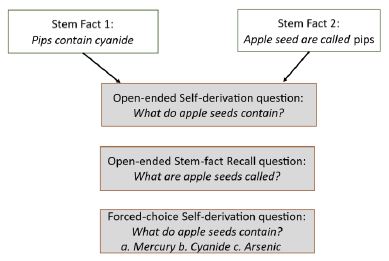
Figure 1: Example stimulus set, including a pair of related stem facts (Stem Facts 1 and 2), example open-ended test questions for self-derivation and stem-fact recall, and example forced-choice test question, with sample options.

Measures of cognitive abilities

Adapted versions of four tests from the Woodcock-Johnson Tests of Cognitive Abilities were used as candidate predictors of measures of domain knowledge: from the Woodcock Johnson III [30], (a) Test 1: Verbal Comprehension, which assesses comprehension of individual words and relations among words across the four subtests of Picture Vocabulary [1a], Synonyms [1b], Antonyms [1c] and Analogy [1d]; and from the Woodcock-Johnson IV [31]; (b) Test 7: Visualization, which is a two-part test of spatial relations, requiring visual-spatial recognition (Spatial Relations [Test 7a]) and mental manipulation of two- and three-dimensional visual representations (Block Rotation [Test 7b]); (c) Test 10: Numbers Reversed, which requires the participant to listen to and then recall a sequence of digits in reverse of the order of presentation. It is considered a measure of working memory; and (d) Test 13, Visual-Auditory Learning, which requires the participant to learn and recall pictographic representations of words. It assesses long-term storage and retrieval as well as associative memory. Verbal Comprehension is considered a measure of semantic memory and thus a “crystalized” ability, whereas Visualization, Numbers Reversed, and Visual-Auditory Learning are considered measures of “fluid” abilities. Due to the online format of data collection, the tests were rendered as Qualtrics® surveys.

Procedure

At each wave of testing, children took part in two sessions conducted and recorded via Zoom. Testing was conducted by one of six female experimenters. Within a wave, children were tested by the same experimenter for both sessions. Children were tested by different experimenters at Waves 1 and 2. The experimenters followed a detailed written protocol. Consistency was assessed by regular viewing of the session recordings by all experimenters. The protocols were the same at Wave 1 and Wave 2. Both within and between sessions, the order of the tasks and tests was the same for all participants. The order of administration was determined based on pilot testing with the goals of minimizing participant burden and maximizing participant engagement. Because the order was fixed, any general or specific carry-over effects are the same for all participants. A schematic of the testing protocol is provided in Figure 2, with Session 1 in the left panel and Session 2 in the right panel.
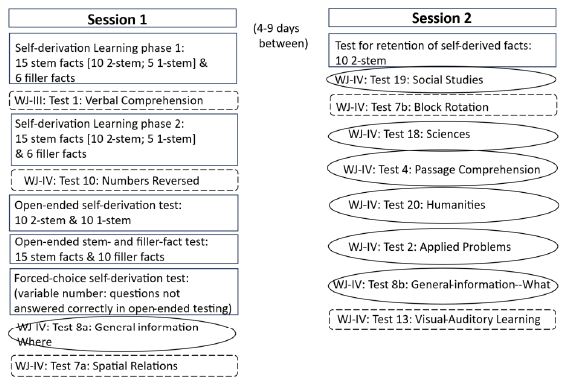
Figure 2: Schematic representation of the testing protocol. Tests in squared boxes are from the self-derivation through memory integration task; tests in rounded rectangles with broken/dashed outlines are measures of cognitive abilities; tests surrounded by ovoids are outcome measures.

Session 1

At each wave, in Session 1, participants engaged in the self- derivation through integration task, three tests of cognitive abilities, and one test of semantic knowledge.

Self-derivation through memory integratiaon

Learning phases. At each wave, in each of two learning phases, children were exposed to 21 novel facts, for a total of 42 facts. Of the 42 facts, 20 were in a 2-stem condition, 10 were in a 1-stem condition, and the remaining 12 were filler facts. Pairs of facts in the 2-stem condition could be integrated such that participants could self-derive new knowledge that had not been directly presented (i.e., self-derivation facts). The 10 facts presented in the 1-stem condition served as a control: each fact was one half of an integrable pair and thus there was no opportunity for integration and self-derivation. As noted above, because only 2-stem performance is indicative of self- derivation through integration, in the present manuscript, all analyses are of performance in the 2-stem condition only; 1-stem condition performance is not included in the report [12,13]. Each integrable fact pair was used approximately equally often in the 2-stem and 1-stem conditions across participants. The 12 filler facts provided the opportunity to examine recall of directly-taught facts, independent of the self-derivation task.

The 42 novel facts were presented across two learning phases. In Learning phase 1, children were presented with 21 facts: the first member of 10 pairs of facts in the 2-stem condition, 5 facts in the 1-stem condition, and 6 filler facts. Children were instructed to pay attention to the facts because they might be asked some questions about them later. Facts were presented individually on the experimenter’s screen, which was shared with the participant via Zoom. The experimenter first read the fact to the child and then the child read it back to the experimenter. After all 21 facts had been displayed and read aloud, children completed the Woodcock Johnson III [30] test of Verbal Comprehension (Test 1; see below for procedure). After the test for verbal comprehension, children engaged in Learning phase 2, during which they were presented with the remaining 21 facts: 10 facts in the 2-stem condition, 5 facts in the 1-stem condition, and 6 filler facts. Participants then completed Woodcock Johnson IV [27,30] Numbers Reversed test (Test 10), as a measure of auditory working memory (see below for procedure).

In total, there were 40 pairs of related stem facts, divided into two sets of 20 pairs of related facts. At each wave, half of the participants were tested on one set of related facts and half on the other. The stem-fact sets were used approximately equally often in each wave of testing, and participants were tested on different sets of facts at each wave. Within a stem-fact set, each stem-fact pair was used in the 2-stem and 1-stem conditions approximately equally often. In the 2-stem condition, each member of the stem-fact pair was presented in Learning phase 1 and Learning phase 2 approximately equally often. Each stem-fact set was presented in one of four different random orders, each used approximately equally often across participants. Participants were pseudo-randomly assigned to one of the four orders, constrained by the need to use each order approximately equally often.

Self-derivation through integration

Test phases. Following the Woodcock Johnson IV Numbers Reversed test (Test 10), children were presented with 20 open-ended questions testing for self-derivation through memory integration: 10 questions on facts from each of the 2-stem and 1-stem conditions. They then were presented with 15 open-ended stem-fact and 10 filler- fact recall questions. After tests for open-ended recall of stem and filler facts, children were tested on any self-derivation questions answered incorrectly in open-ended testing, this time in 3-alternative forced- choice format (see Figure 1 for example open-ended and forced- choice questions). Forced-choice testing of stem and filler facts was not conducted, in consideration of participant burden.

At each wave, the order of presentation of open-ended self- derivation through integration questions was randomized in Qualtrics. As well, the order of forced-choice testing of self-derivation questions not answered correctly in open-ended testing also was randomized in Qualtrics. Open-ended testing for recall of the stem and filler facts was conducted in one of eight pseudo-random orders each of which was used approximately equally often across participants. The constraint was that stem facts from the same fact set were not tested sequentially. Across participants, stem and filler facts were tested approximately equally often. After testing of self-derivation through integration and fact recall, children completed a test of domain knowledge (WJ-IV: Test 8a) and then were administered the third Woodcock-Johnson test: Test 7a: Visualization-Spatial Relations (see below for procedure).

Woodcock-Johnson tests of cognitive abilities

Between Learning phases 1 and 2, children were tested on the WJ- III test Verbal Comprehension (Test 1a-d). Between Learning phase 2 and the tests for self-derivation and fact recall, children were tested on the WJ-IV test of Numbers Reversed test (Test 10). As the final test of the session, children were tested on the WJ-IV test of Visualization- Spatial Relations (Test 7a). The tests were administered following the WJ protocols, with test items displayed on the Zoom screen. Children’s responses were recorded by the experimenter.

Woodcock-Johnson test of semantic knowledge

The pen-ultimate task of Session 1 was a test of academically- related content knowledge WJ-IV: General Information-where (Test 8a). The test was administered following the WJ protocols, with test items displayed on the Zoom screen. Children’s responses were recorded by the experimenter.

Session 2

Session 2 took place approximately 1 week after Session 1. Children were tested for retention of the self-derived facts from Session 1, six tests of academically-related content knowledge, and two tests of cognitive abilities (see Figure 2).

Retention of self-derivation facts

At each wave, children were tested for retention of the self- derivation facts from the 2-stem condition of Session 1. However, because retention of self-derived facts was not a significant predictor of semantic knowledge [12], we did not include measures of retention in analyses.

Woodcock-Johnson tests of semantic knowledge/achievement

Six tests of achievement were administered in the standard order as indicated: Test 19: Social Studies; Test 18: Sciences; Test 4: Passage comprehension; Test 20: Humanities; Test 2: Applied Problems; and Test 8b: General Information-what. All tests were administered following the WJ-IV protocol, with questions displayed on the Zoom screen.

Woodcock-Johnson tests of cognitive abilities

At Session 2, children completed two tests of cognitive abilities (see Figure 2). Between Tests 19 and 18, children completed WJ-IV test of Visualization—Block Rotation (Test 7b). As the final test of the session, children completed the WJ-IV test of Visual-Auditory Learning (Test 13). The tests were administered following the WJ protocols, with test items displayed on the Zoom screen. Children’s responses were recorded by the experimenter.

Scoring and Data Reduction

Scoring was conducted the same way for Waves 1 and 2. For open-ended self-derivation through integration and open-ended recall of stem and filler facts, 1 point was awarded for each correct response, for a total possible of 10 self-derivation facts in the 2-stem condition, 10 self-derivation facts in the 1-stem condition, 15 stem facts (5 stem-fact pairs from the 2-stem condition [10 facts] and 5 facts from the 1-stem condition), and 10 filler facts. Levels of self- derivation performance and of open-ended recall of the stem and filler facts at Session 1 were considered as potential predictors of semantic knowledge (along with measures from the Woodcock-Johnson tests; see below). Self-derivation also was tested in forced-choice. However, because open-ended performance provides stronger evidence of self- derivation, relative to performance that also includes selection of correct responses from among distracters, in subsequent analyses, we focus on open-ended self-derivation performance only ([12], for further justification for focus on open-ended performance only).

The tests of cognitive abilities were scored as per the test protocol and standardized using WJ-III and WJ-IV proprietary software.

Results

The results are presented in four sections, starting with descriptive statistics and zero-order correlations among the variables in Section 1. Section 2 outlines the results of factor analyses to determine the number of latent factors among (a) the outcome measures of domain knowledge; and (b) the predictors of domain knowledge, namely, the (i) tests of cognitive abilities (verbal comprehension, visual-auditory learning, visualization, numbers reversed) and (ii) experimental measures of self-derivation through integration performance, and memory for stem and filler facts. In Section 3 we present the results of tests for concurrent relations among the outcome measures and the predictors at each of Waves 1 and 2. Finally, in Section 4, we present the results of longitudinal prediction of the outcome measures by the predictors from Wave 1 to Wave 2, one year later.

Section 1: Descriptive Statistics and Zero-order Correlations

Descriptive statistics for the measures of interest are provided in Table 1, Panels a and b for Wave 1 and Wave 2, respectively. For the outcome measure of domain knowledge, following [13], we report W Scores for each of the six Woodcock-Johnson Tests probing domain knowledge. W Scores represent the child’s performance on the task, based on the average performance of neuro-typical children of their age (in months). For every raw score, there is a W Score that is generated by Woodcock-Johnson Score Reports. W scores are centered on a value of 500, with a typical range on any given task of between 430 and 550. As discussed in [13], W scores represent an equal interval scale across tasks, making them particularly relevant for reporting participants’ actual growth in a measured trait [32]. For all other measures, we report proportion correct out of total trials. Initial skewness and kurtosis measures indicated that the data for all variables were normally distributed, with the exception of the Wave 2 measure of applied problems. One participant performed more than 5 standard deviations below the mean on this assessment. With the data from that participant removed, skewness and kurtosis values indicated normal distribution, as indicated in Table 1. Whether the data from this participant were or were not removed, overall results from subsequent analyses did not change.

Table 1: Descriptive statistics for outcome variables (domain knowledge) and predictor variables (cognitive abilities, self-derivation) at Wave 1 (Panel a) and Wave 2 (Panel b)

Category and Measure

Descriptive Statistics
Category Measure N Model Label Mean SD Skewness

Kurtosis

Panel a: Wave 1          
Domain knowledge Domain knowledge total

148

Total01 3020.42 80.74 -.16

.40

  General information

148

Gen01 503.51 14.19 -.274

-.214

  Passage comprehension

148

PC01 499.95 14.51 .022

-.154

  Sciences

148

Sci01 501.52 14.24 -.263

-.593

  Applied problems

148

App01 509.63 19.83 -.697

.958

  Social studies

148

Soc01 505.98 17.26 -.084

-.624

  Humanities

148

Hum01 499.83 15.75 .194

-.329

Cognitive abilities Verbal comprehension

143

VC01 107.90 10.755 .032

-.613

  Visual-Auditory learning

147

VisAud01 105.551 13.426 .007

.395

  Visualization

148

Vis01 104.541 13.543 -.029

.438

  Numbers Reversed

138

Num01 107.754 15.325 -.524

2.151

Self-derivation Open-ended self-derivation

148

SDI01 .329 .206 .354

-.423

  Stem fact recall

148

Stem01 .488 .186 .015

-.376

  Filler fact recall

148

Fill01 .567 .202 -.328

.137

Panel b: Wave 2          
Domain knowledge Domain knowledge total

148

Total02 3060.14 78.09 -.21

-.28

  General information

148

Gen02 509.19 13.13 -.075

-.158

  Passage comprehension

148

PC02 506.43 14.54 .067

.034

  Sciences

148

Sci02 507.80 13.25 -.481

-.355

  Applied problems

147

App02 517.57 16.69 -.54

.93

  Social studies

148

Soc02 513.35 16.54 -.378

-.676

  Humanities

148

Hum02 506.39 16.35 .200

-.453

Cognitive abilities Verbal comprehension

143

VC02 107.783 11.368 .066

.005

  Visual-Auditory learning

144

VisAud02 113.465 12.847 .64

.902

  Visualization

148

Vis02 105.653 14.583 .016

.056

  Numbers Reversed

143

Num02 108.329 16.369 -.109

-.31

Self-derivation Open-ended self-derivation

148

SDI02 .388 .209 .086

-.807

  Stem fact recall

148

Stem02 .533 .188 -.225

-.449

  Filler fact recall

148

Fill02 .592 .197 -.313

.011

Note. W Scores are used for all measures of domain knowledge (domain knowledge total, general information, passage comprehension, sciences, applied problems, social studies, humanities); proportion scores are used for measures of self-derivation, including stem-fact and filler-fact recall.

Zero-order correlations among the outcome variables (domain knowledge) and predictor variables (cognitive abilities, self- derivation), within and across waves, are provided in Table 2. Pearson’s product-moment correlations between the categories of predictor variables (cognitive abilities and self-derivation), within and across waves, are provided in Table 3. Pearson’s product-moment correlations within predictor variables (cognitive abilities, self-derivation), within and across waves, are provided in Table 4.

Table 2: Pearson’s product-moment correlations among outcome variables (domain knowledge) and predictor variables (cognitive abilities, self-derivation), within and across waves

Predictor Variables

Age Measures of Outcome Variables: Domain Knowledge
  Age 1 Total1 Gen1 PC1 Sci1 App1 SS1 Hu1 Total2 Gen2 PC2 Sci2 App2 SS2

Hu2

VC1

-.38 .39 .38 .37 .39 .20** .28 .40 .49 .46 .44 .41 .30 .37 .51
VA1 .01ns .42 .32 .36 .35 .32 .32 .47 .49 .42 .40 .40 .39 .35

.52

Vis1

-.09ns .24** .16* .26** .26 .22** .09ns .24** .31 .27 .24** .23** .30 .16ns .31
NR1 .09ns .20* .17* .22** .01ns .25** .13ns .20* .22** .19* .19* -.01ns .24** .18*

.22*

SDI1

.15ns .59 .54 .52 .45 .37 .52 .60 .61 .52 .50 .59 .46 .51 .61
Stm1 .20* .60 .55 .50 .49 .42 .54 .58 .62 .56 .48 .55 .47 .55

.61

Fill1

.16ns .53 .42 .50 .45 .35 .45 .56 .57 .47 .51 .56 .41 .44 .58
VC2 -.20* .55 .54 .57 .51 .30 .40 .54 .64 .61 .59 .56 .43 .47

.65

VA2

.05ns .42 .31 .38 .36 .37 .29 .43 .47 .41 .38 .44 .41 .30 .45
Vis2 0ns .30 .26** .29 .30 .27** .11ns .31 .36 .32 .28 .32 .32 .16ns

.40

NR2

.04ns .16ns .14ns .20* .02ns .22* .10ns .13ns .20* .15ns .18* .00ns .21* .19* .16ns
SDI2 .11ns .61 .46 .53 .56 .45 .55 .52 .63 .57 .49 .55 .48 .56

.62

Stm2

.06ns .55 .44 .48 .52 .38 .49 .48 .62 .57 .51 .60 .43 .50.61  
Fill2 -.01ns .52 .43 .44 .48 .31 .45 .54 .59 .54 .47 .57 .39 .48

.62

Note: Measures ending in “1” were collected at Wave 1; measures ending in “2” were collected at Wave 2. Age = participant age, Total = total domain knowledge, Gen = general information, PC = passage comprehension, Sci = sciences, App = applied problems, SS = social studies, and Hu = humanities. VC = verbal comprehension, VA = visual-auditory learning, Vis = visualization, NR = numbers reversed, SDI = self-derivation, Stm = stem-fact recall, and Fill = filler-fact recall. Unless otherwise indicated, all correlations are significant at p < .001. For other correlations, **= p < .01, * = p < .05, ns = not statistically significant.

Table 3: Pearson’s product-moment correlations between the categories of predictor variables (cognitive abilities, self-derivation), within and across waves

Measures of Self-derivation

Age Measures of Cognitive Abilities
  Age1 VC1 Vis-Aud1 Visual1 NR1 VC2 Vis-Aud2 Visual2

NR2

SDI1

.15ns .36** .30** .16* .13ns .51** .35** .27** .06ns
Stem1 .20* .35** .39** .18* .19* .42** .37** .34**

.22*

Fill1

.16ns .43** .33** .25** .12ns .49** .39** .30** .15ns
SDI2 .11ns .41** .34** .18* .14ns .48** .33** .26**

.14ns

Stem2

.06ns .45** .44** .23** .09ns .52** .42** .30** .12ns
Fill2 -.01ns .52** .42** .25** .13ns .56** .43** .31**

.11ns

Note: Measures ending in “1” were collected at Wave 1; measures ending in “2” were collected at Wave 2. Age = participant age, VC = verbal comprehension, Vis-Aud = visual-auditory learning, Visual = visualization, NR = numbers reversed, SDI = self-derivation, stem = stem-fact recall, and Fill = filler-fact recall. ** = p < .001, * = p < .05, ns = not statistically significant.

Table 4: Pearson’s product-moment correlations within predictor variables (cognitive abilities, self-derivation), within and across waves

Measures of Predictor Variables at Wave 2

Measures of Predictor Variables at Wave 1
  VC1 Vis-Aud1 Visual1 NR1 SDI1 Stem1

Filler1

VC2

.801** .48** .42** .15ns  


(See Table 3 for values in this quadrant)

Vis-Aud2 .35** .582** .32**

.14ns

Visual2

.30** .44** .71** .24**
NR2 .12ns .19* .21*

.66**

SDI2


(See Table 3 for values in this quadrant)

.537** .65** .50**
Stem2 .58** .632**

.60**

Filler2

.56**

.65**

.556**

Note: Measures ending in “1” were collected at Wave 1; measures ending in “2” were collected at Wave 2. Age = participant age, VC = verbal comprehension, Vis-Aud = visual-auditory learning, Visual = visualization, NR = numbers reversed, SDI = self-derivation, Stem = stem-fact recall, and Fill = filler-fact recall. ** = p < .001, * = p < .05, ns = not statistically significant.

Section 2: Factor Analyses

We conducted factor analyses to determine the number of latent factors among (a) the outcome measures of domain knowledge; and (b) the predictors of domain knowledge, namely, the (i) tests of cognitive abilities (verbal comprehension, visual-auditory learning, visualization, numbers reversed) and (ii) experimental measures of self-derivation through integration performance, and memory for stem and filler facts.

Outcome measures: Domain knowledge

Exploratory factor analysis (EFA) reported in [13] indicated that the six domains of knowledge formed one latent factor, thereafter referred to as knowledge. The specific procedures used to arrive at this solution are detailed in [13].

Predictors

For the Wave 1 variables, we used EFA to determine the number of latent factors formed by the tests of cognitive abilities (verbal comprehension, visual-auditory learning, visualization, numbers reversed) and the measures from the self-derivation through integration paradigm (open-ended self-derivation, stem-fact recall, filler-fact recall). The analysis was conducted using JASP software with the following settings: number of factors based on parallel analysis of factors, using the minimum residual estimation method, oblique rotation (promax), and with a factor loading cut off of .4. For Wave 2, given the absence of a theoretical expectation of a different factor structure, we conducted a confirmatory factor analysis (CFA) on the new data, using the factor structure discovered at Wave 1.

For the Wave 1 assessments, a Kaiser-Meyer-Olkin test indicated that the measures were suitable for factor analysis, with an overall MSA =.776. Bartlett’s test was significant, X2(21) = 322.33, p < .001, indicating that the data are a good fit to the factor analysis. As depicted in Table 5, two factors emerged: Factor 1 was comprised of the measures of stem-fact recall, open-ended self-derivation through integration, and filler-fact recall (hereafter self-derivation and fact recall). Factor 2 was comprised of the measures of the cognitive abilities of visual-auditory learning, verbal comprehension, and visualization (hereafter verbal and spatial abilities). The test of working memory (WJ-IV, Numbers Reversed) did not load on either factor. For the confirmatory factor analysis of the Wave 2 data, a Kaiser-Meyer- Olkin test indicated that the measures were suitable for factor analysis, with an overall MSA = .827. Bartlett’s test was significant, X2(15) = 338.269, p < .001, indicating good model fit. RMSEA = .069, indicating acceptable model fit. The parameter estimates are provided in Table 6.

Table 5: Results of exploratory factor analysis (EFA) for the predictor variables (self-derivation through integration, cognitive abilities) at Wave 1

Predictor Variables

Factor Structure
  Factor 1

(self-derivation and fact recall)

Factor 2

(verbal and spatial abilities)

Uniqueness

Stem-fact recall

0.906


0.215

Self-derivation

0.877


0.307

Filler-fact recall

0.642


0.468

       
Visual-Auditory Learning

0.703

0.484

VerbalComprehension

0.618

0.531

Visualization

0.614

0.687

       
Numbers Reversed


0.919

Note. Applied rotation method is promax.

Table 6: Parameter estimates for confirmatory factor analysis (CFA) for the predictor variables (self-derivation and fact recall, verbal and spatial abilities) at Wave 2: Factor loadings (Panel a) and residual variances (Panel b)

Factor and Indicator

Parameter Estimates
       

95% Confidence Interval

Factor

Indicator Estimate Std. Error z-value p Lower

Upper

Panel a: Factor loadings          
Self-derivation & fact recall Self-derivation

0.171

0.015 11.677 < .001 0.142

0.2

Filler-fact recall

0.143

0.015 9.695 < .001 0.114

0.172

  Stem-fact recall

0.169

0.013 13.211 < .001 0.144

0.194

Verbal & spatial abilities Verbal comprehension

8.543

0.955 8.942 < .001 6.671

10.416

  Visualization

7.008

1.297 5.404 < .001 4.466

9.55

  Visual-Auditory Learning

7.632

1.117 6.832 < .001 5.443

9.822

Panel b: Residual variances          
Self-derivation & fact recall Self-derivation

0.14

.002 6.233 < .001 0.010

0.018

Filler-fact recall

0.018

.003 7.134 < .001 0.013

0.023

  Stem-fact recall

0.007

.002 3.835 < .001 0.003

0.010

Verbal & spatial abilities Verbal comprehension

53.965

11.357 4.752 < .001 31.705

76.224

  Visualization

162.122

20.923 7.749 < .001 121.114

203.131

  Visual-Auditory Learning

105.082

15.182 6.921 < .001 75.325

134.838

Section 3: Concurrent Relations among Outcome Measures and Predictors

To examine concurrent relations among the outcome measures of knowledge and the predictors of self-derivation and fact recall and verbal and spatial abilities, we conducted Structural Equation Modeling (SEM) at each of Waves 1 and 2. At each wave, we used the two latent structures discovered using factor analyses (self- derivation and fact recall, verbal and spatial abilities) as predictors of the latent outcome variable of knowledge. We did not include the WJ-IV measure of Numbers Reversed (working memory) because, as discussed in Bauer et al. (2025), SEM modeling that included working memory was less than an ideal fit; the model without working memory was a better fitting model. Accordingly, in subsequent analyses, we used the model with only the latent constructs. At both waves, Chi-square goodness of fit tests indicated good model fit: X2(12) = 12.164, p = .433, X2(12) = 17.687, p = .126, for Waves 1 and 2, respectively. Model statistics are provided in Table 7, Panels a and b for Wave 1, and Panels c and d for Wave 2. Semi-partial R-squared values indicating the proportion of variance explained by each factor are provided in Table 8, Panel a.

Table 7: Parameter estimates for Structural Equation Modeling (SEM) of the outcome measure of knowledge with the predictor variables (verbal and spatial abilities, self-derivation and fact recall) at Wave 1: Factor loadings (Panel a) and regression coefficients (Panel b), and Wave 2: Factor loadings (Panel c) and regression coefficients (Panel d)

Factor and Indicator

Parameter Estimates

Panel a: Wave 1 Factor loadings        
       

95% Confidence Interval

Latent Indicator

Estimate

Std. Error z-value p Lower

Upper

Verbal & spatial abilities1 Verbal comprehension1

1.000

.000     1.000

1.000

  Visualization1

0.873

0.182 4.808 < .001 0.517

1.229

  Visual-Auditory Learning1

1.277

0.213 6.005 < .001 0.860

1.694

Self-derivation & fact recall1 Self-derivation1

1.000

.000     1.000

1.000

Filler-fact recall1

0.864

0.091 9.538 < .001 0.687

1.042

  Stem-fact recall1

0.959

0.082 11.650 < .001 0.798

1.121

Panel b: Wave 1 Regression coefficients      
     

95% Confidence ICnterval

Predictor Outcome

Estimate

Std. Error z-value p Lower

Upper

Verbal & spatial abilities1 Knowledge1

2.235

1.063 2.103 < .036 0.152

4.319

Self-derivation & fact recall1 Knowledge1

273.283

45.282 6.035 < .001 184.533

362.034

Panel c: Wave 2 Factor loadings          
           

95% Confidence Interval

Latent Indicator

Estimate

Std. Error z-value p Lower

Upper

Verbal & spatial abilities2 Verbal comprehension2

1.000

.000     1.000

1.000

  Visualization2

0.773

0.150 5.160 < .001 0.479

1.066

  Visual Auditory Learning2

0.852

0.133 6.400 < .001 0.591

1.112

Self-derivation & fact recall2 Open-ended self-derivation2

1.000

.000     1.000

1.000

Filler-fact recall2

0.827

0.085 9.778 < .001 0.661

0.993

  Stem-fact recall2

0.948

0.078 12.188 < .001 0.796

1.101

Panel d: Wave 2 Regression coefficients        
           

95% Confidence Interval

Predictor Outcome

Estimate

Std. Error z-value p Lower

Upper

Verbal & spatial abilities2 Knowledge2

5.284

1.609 3.284 < .001 2.130

8.437

Self-derivation & fact recall2 Knowledge2

121.647

69.387 1.753 0.080 -14.349

257.643

Note: Measures ending in “1” were collected at Wave 1; measures ending in “2” were collected at Wave 2.

At Wave 1, both self-derivation and fact recall and verbal and spatial abilities contributed significant unique variance in predicting knowledge: 33.3% and 4.5%, respectively (Table 8). Shared variance was 18.4%, bringing combined variance explained to R2 = .56. At Wave 2, verbal and spatial abilities once again contributed significant unique variance in knowledge (35.4%). However, the latent factor of self- derivation and fact recall merely approached significance, with 7.4% variance accounted for. The amount of shared variance was 27.3%, bringing combined variance explained to R2 = .70. Discussion of the most likely explanations for this pattern is reserved for the Discussion.

Table 8: Beta weights and semi-partial R2 values for concurrent predictors of knowledge at each of Waves 1 and 2 (Panel a) and longitudinal predictors of knowledge from Wave 1 to Wave 2 (Panel b)

Wave

Beta Weights   Variance Explained

Type of Variance

Wave

ß(VVA)

ß(SDI) r(VVA,SDI) R2 (total) Unique VVA% Unique SDI%

Shared%

Panel a: Concurrent prediction          
Wave 1

.212

.577 .754 .562 4.5% 33.3%

18.4%

Wave 2

.595

.272 .843 .701 35.4% 7.4%

27.3

Panel b: Longitudinal prediction        
Wave 1 to Wave 2

.379

.507 .635 .625 9.3% 15.8%

37.4%

Note: VVA = verbal and visual abilities, SDI = self-derivation and fact recall.

Section 4: Longitudinal Relations among Outcome Measures and Predictors

To examine longitudinal relations among the outcome measures of knowledge at Wave 2 and the predictors of self-derivation and fact recall and verbal and spatial abilities at Wave 1, we conducted SEM. We used the two latent structures of verbal and spatial abilities and self-derivation and fact recall from Wave 1 as predictors of the latent outcome variable of knowledge at Wave 2. A Chi-square goodness of fit test indicated good model fit: X2(12) = 12.088, p = .439. Model statistics are provided in Table 9. As reflected in Table 8, Panel b, both self-derivation and fact recall and verbal and spatial abilities at Wave 1 were significant predictors of knowledge one-year later, at Wave 2, explaining 15.8% and 9.3%, respectively. Shared variance was 37.4%, bringing the combined variance explained to R2 = .63.

Table 9: Parameter estimates for Structural Equation Modeling (SEM) of the outcome measure of knowledge at Wave 2 with the predictor variables (verbal and spatial abilities, self-derivation and fact recall) from Wave 1: Factor loadings (Panel a) and regression coefficients (Panel b)

Factor and Indicator

Parameter Estimates

Panel a: Wave 1 to Wave 2 factor loadings      
       

95% Confidence Interval

Latent Indicator

Estimate

Std. Error z-value p Lower

Upper

Verbal & spatial abilities1 Verbal comprehension1

1.000

.000     1.000

1.000

  Visualization1

0.865

0.174 4.967 < .001 0.524

1.206

  Visual Auditory Learning1

1.251

0.193 6.486 < .001 0.873

1.629

Self-derivation & fact recall1 Self-derivation1

1.000

.000     1.000

1.000

Filler-fact recall1

0.863

0.090 9.608 < .001 0.687

1.039

  Stem-fact recall1

0.949

0.081 11.675 < .001 0.790

1.109

Panel b: Wave 1 to Wave 2 Regression coefficients        
           

95% Confidence Interval

Predictor Outcome

Estimate

Std. Error z-value p Lower

Upper

Verbal & spatial abilities1 Knowledge2

3.829

1.014 3.774 < .001 1.841

5.817

Self-derivation & fact recall1 Knowledge2

231.203

40.682 5.683 < .001 151.467

310.939

Note: Measures ending in “1” were collected at Wave 1; measures ending in “2” were collected at Wave 2.

Discussion

The major purpose of the present research was to determine whether self-derivation through memory integration makes unique contributions to prediction of domain knowledge and thus can be considered a mechanism of semantic knowledge development in childhood. The question was tested in a sample of 148 children, ages 8 to 12 years at the time of enrollment. The outcome measure of semantic knowledge was based on six domains that were treated as one latent factor, knowledge: applied problems (math), humanities, sciences, social studies, general knowledge of what and where, and passage comprehension. The predictors were (a) tests of self- derivation through memory integration and memory for directly taught facts (stem facts and filler facts); and (b) measures of four cognitive abilities, namely, verbal comprehension, visual-auditory learning, visualization, and working memory. The predictors formed two latent factors: self-derivation and fact recall and verbal and spatial abilities. Working memory was not included in either factor. Children participated in two waves of testing, separated by one year.

In prior research on the same sample, self-derivation through memory integration was found to predict semantic knowledge for five of the six individual domains assessed; the exception was the domain of sciences (Bauer et al., 2024). In a subsequent test of longitudinal relations, the six individual domains were treated as one latent factor, knowledge. Self-derivation through integration predicted knowledge both concurrently, at each of Waves 1 and 2, and longitudinally over one year [13]. In a separate evaluation, measures of memory for directly taught facts (stem and filler facts) were found to be both concurrently related and longitudinally predictive of self-derivation, whereas the measures of cognitive abilities were not [8]. Based on this pattern of findings, in the present research, we expected to observe (a) separate latent factors for self-derivation and fact recall and visual and spatial abilities; and (b) that both latent factors would be predictive of knowledge, concurrently and over one year.

Consistent with expectations, at Wave 1, the latent constructs of self-derivation and fact recall and verbal and spatial abilities both were uniquely predictive of semantic knowledge. The amount of unique and shared variance in semantic knowledge explained by the factors was 56%. At Wave 2, only verbal and spatial abilities was uniquely predictive. Self-derivation and fact recall predicted a nonsignificant 7.4% of the variance in semantic knowledge. Considering the amount of unique and shared variance, the total variance explained by the factors was 70%. Notably, semantic knowledge at Wave 2 was predicted by Wave 1 self-derivation and fact recall and Wave 1 verbal and spatial abilities. Both latent factors made unique contributions to prediction of semantic knowledge at Wave 2. The amount of unique and shared variance in semantic knowledge explained by the factors was 63%.

Overall, the findings of the present research were as expected, with the exception of the concurrent test at Wave 2, in which only verbal and spatial abilities emerged as a statistically significant predictor of semantic knowledge; self-derivation and fact recall only approached significance. We attribute this pattern to the strong correlations among the various Woodcock-Johnson tests at Wave 2 (see Table 2), and to the nominal increase in shared variance of the factors at Wave 2 (27.3%), relative to Wave 1 (18.4%; see Table 8). The result was relatively less variance to be explained by the experimental measures of self- derivation. The pattern of relatively stronger correlations among the Woodcock-Johnson tests at Wave 2, relative to Wave 1 was especially apparent for the measure of verbal comprehension: at Wave 1, the correlations with the individual semantic domains ranged from rs = .20-.40, whereas at Wave 2, they ranged from rs = .43-.65. This finding is understandable in light of the fact that the Woodcock-Johnson tests were essentially identical at the two waves: the same questions were asked in the same format. The only differences were in one or possibly two additional questions posed to establish ceiling performance. Given this feature of the instrument, there was substantial shared task variance at Wave 2, likely inflating the proportion of variance in semantic knowledge accounted for by verbal and spatial abilities. In contrast, whereas the format of the tests for self-derivation and fact recall were the same at both waves, the specific items were unique at each wave.

An unexpected—yet explicable—finding in the present research was of the substantial amount of variance in longitudinal prediction shared by the latent factors of self-derivation and fact recall and verbal and spatial abilities. Whereas each factor contributed unique variance, the amount of shared variance in knowledge explained approached 40%. We interpret this pattern as a reflection of the tight relation between existing knowledge and the ability to add to it. In the present research, existing knowledge was reflected in the latent construct of verbal and spatial abilities, which included a measure often used as a proxy for existing knowledge, namely verbal comprehension. The ability to add new knowledge was reflected in the latent construct of self-derivation and fact recall, which included both memory for directly taught facts and the productive process of generating new knowledge from them. Critically, each individual construct at Wave 1 was a unique predictor of semantic knowledge at Wave 2, over and above the variance they shared. Self-derivation and fact recall accounted for a nominally greater proportion of variance relative to verbal and spatial abilities (15.8% and 9.3%, respectively)

The present research makes a substantial contribution to the literature in establishing self-derivation through memory integration as a unique predictor of semantic knowledge, at least among children ages 8 to 12 years. It is not without limitations, however. One limitation is that, based on the present research, it is not known whether the same pattern of findings would be apparent among children younger than age 8 years or among participants older than 12 years. The structure of cognitive abilities changes across the late elementary school years, with increasing differentiation of cognitive abilities from one another [33]. As such, different patterns may be expected at younger and older ages. It will be left to future research to address this possibility.

A second potential limitation is that the children were tested online, as opposed to in person. The online format may have resulted in lower performance than might be expected from in-person testing. Importantly, given that all tasks and all participants were tested in the same way, any general or specific effects of online testing would be equally distributed over the entire battery and sample.

A third potential limitation of the present research is that only one productive process was tested as a predictor of semantic knowledge. As noted earlier, self-derivation through memory integration is but one among many productive processes, including (but not limited to) analogy, induction, and associative and transitive inference [1,4, 34]. It is possible that one or more of these processes also may account for unique variance in semantic knowledge. This question has yet to be tested empirically in children. Among adults, self-derivation through integration has been found to be uniquely related to academic achievement relative to other paradigms that test productive processes [35]. Importantly, finding that other productive processes also predict semantic knowledge would not undermine the importance of self- derivation through memory integration as a mechanism of semantic knowledge development. Rather, it would establish a larger suite of productive processes on which knowledge expansion depends.

In conclusion, in the present research, we tested self-derivation through memory integration along with measures of other cognitive abilities, as concurrent and longitudinal predictors of semantic knowledge. Both factors were found to be concurrent predictors at Wave 1. Critically, both factors as measured at Wave 1 predicted semantic knowledge at Wave 2. The work thus establishes self- derivation through memory integration as a unique longitudinal predictor of semantic knowledge in childhood. As such, it can be considered a mechanism of semantic knowledge development.

Acknowledgement

Support for this research was provided by NICHD R01 HD094716 to Patricia J. Bauer. The authors also thank Britney Del Solar, Jessica Dugan, Melanie Hanft, and Alissa Miller, for their help with data collection and reduction, and other members of the Memory at Emory laboratory group for their help at various stages of this research, and the children and families who so generously gave of their time to take part in this research.

References

  1. Richland, L. E., Morrison, R. G., & Holyoak, K. J. (2006). Children’s development of analogical reasoning: Insights from scene analogy problems. Journal of Experimental Child Psychology;94(3): 249–273.
  2. Bryant, E., & Trabasso, T. (1971). Transitive inferences and memory in young children. Nature, 232(5311):456–458. [crossref]
  3. Schlichting, M. L., & Preston, A. R. (2015). Memory integration: Neural mechanisms and implications for behavior. Current Opinion in Behavioral Sciences, 1:1-8. [crossref]
  4. Schulz, E., Goodman, N. D., Tenenbaum, J. B., & Jenkins, A. C. (2008). Going beyond the evidence: Abstract laws and preschoolers’ responses to anomalous data. Cognition, 109(2):211-223. [crossref]
  5. Goswami, (2011). Inductive and deductive reasoning. In U. Goswami (Ed.), Childhood cognitive development (pp. 399–419). Oxford, UK: Wiley–Blackwell.
  6. Siegler, S. (1989). Mechanisms of cognitive development. Annual Review of Psychology, 40:353–379. [crossref]
  7. Bauer, P.J. (2021). We know more than we ever learned: Processes involved in accumulation of world knowledge. Child Development Perspectives, 15(4), 220-227. [crossref]
  8. Bauer, J., Lee, K. A., Dugan, J. A., & Cronin-Golomb, L. M. (2025). Longitudinal predictors of self-derivation through memory integration—A mechanism of knowledge accumulation. Journal of Experimental Child Psychology. Advanced online publication. doi.org/10.1016/j.jecp.2024.106120
  9. Bauer, J., & Jackson, F.L. (2015). Semantic elaboration: ERPs reveal rapid transition from novel to known. Journal of Experimental Psychology: Learning, Memory, and Cognition, 41(1):271-282.[crossref]
  10. Esposito, G., & Bauer, P. J. (2022). Determinants of elementary-school academic achievement: Component cognitive abilities and memory integration. Child Development, 93(6):1777-1792.[crossref]
  11. Esposito, G., & Bauer, P. J. (2024). Self-derivation through memory integration: A longitudinal examination of performance and relations with academic achievement in elementary classrooms. Cognitive Development, 69:101416.[crossref]
  12. Bauer, J., Dugan, J. A., Cronin-Golomb, L. M., Lee, K. A., Del Solar, B., et al.(2024). Development of self-derivation through memory integration and relations with world knowledge. Memory, 32(8), 981-995.[crossref]
  13. Cronin-Golomb, M., & Bauer, P. J. (in press). Longitudinal relations between self-derivation and semantic knowledge growth. Journal of Experimental Child Psychology.[crossref]
  14. Shing, Y. L., Finke, C., Hoffmann, M., Pajkert, A., Heekeren, H. R., & Ploner, C. J. (2019). Integrating across memory episodes: Developmental trends. PLOS ONE, 14(4), [crossref]
  15. Bauer J., & Larkina, M. (2017). Realizing relevance: The influence of domain- specific information on generation of new knowledge through integration in 4- to 8-year-old children. Child Development, 88:247-262. [crossref]
  16. Bauer, J., & San Souci, P. (2010). Going beyond the facts: Young children extend knowledge by integrating episodes. Journal of Experimental Child Psychology, 107(4):452-465.[crossref]
  17. Esposito, A. G., & Bauer, P. J. (2017). Going beyond the lesson: Self-generating new factual knowledge in the classroom. Journal of Experimental Child Psychology, 153:110-125.
  18. Miller-Goldwater, E., Williams, B. M., Hanft, M. H., & Bauer, P. J. (2024). Contributions of shared book reading to children’s learning of new semantic facts through memory integration. Early Childhood Research Quarterly; 68:99-111. [crossref]
  19. Cronin-Golomb, M., Pejic, J., Miller-Goldwater, H. E., & Bauer, P. J. (2024). Factors affecting children’s explicit learning and productive memory processes in the context of virtual museums. Cognitive Development; 71: 101454.[crossref]
  20. Wilson, J. T., & Bauer, P. J. (2024). Generative and active engagement in learning neuroscience: A comparison of self-derivation and rephrase. Cognition, 245:105709. [crossref]
  21. Varga, L., & Bauer, P. J. (2017). Young adults self-derive and retain new factual knowledge through memory integration. Memory & Cognition, 45:1014-1027.
  22. Gathercole, E., Pickering, S. J., Knight, C., & Stegmann, Z. (2003). Working memory skills and educational attainment: Evidence from national curriculum assessments at 7 and 14 years of age. Applied Cognitive Psychology, 18:1-16.
  23. Serpell, N., & Esposito, A. G. (2016). Development of executive functions: Implications for educational policy and practice. Policy Insights from the Behavioral and Brain Sciences, 3:203–210.
  24. Alloway, P., & Alloway, R. G. (2010). Investigating the predictive roles of working memory and IQ in academic attainment. Journal of Experimental Child Psychology, 106(1):20-29.[crossref]
  25. Bull, , Espy, K. A., & Wiebe, S. A. (2008). Short-term memory, working memory, and executive functioning in preschoolers: Longitudinal predictors of mathematical achievement at age 7 years. Developmental Neuropsychology, 33(3):205–228.[crossref]
  26. Fanari, R., Meloni, C., and Massidda, D. (2019). Visual and spatial working memory abilities predict early math skills: a longitudinal study. Frontiers in Psychology; 10:2460. [crossref]
  27. Schrank, A., McGrew, K.S., & Mather, N. (2014). Woodcock-Johnson IV Tests of Cognitive Abilities. Rolling Meadows, IL: Riverside.
  28. Terman, M., Kohs, S. C., Chamberlain, M. B., Anderson, M., & Henry, B. (1918). The vocabulary test as a measure of intelligence. Journal of Educational Psychology, 9(8):452–466.
  29. Bauer, P. J. (06 May 2020). Bauer Lab Integration and Self-derivation Stimulus (BLISS) bank. PsyArXiv. Doi: 10.31234/osf.io/rv9n7
  30. Woodcock, W., McGrew, K. S., & Mather, N. (2001). Woodcock-Johnson III Tests of Cognitive Abilities. Itasca, IL: Riverside.
  31. Schrank, F. A., & Wendling, B. J. (2018). The Woodcock–Johnson IV: Tests of cognitive abilities, tests of oral language, tests of Contemporary intellectual assessment: Theories, tests, and issues, 4th ed (pp. 383–451). The Guilford Press.
  32. Jaffe, (2009). Development, Interpretation, and Application of the W Score and the Relative Proficiency Index (11; Woodcock-Johnson III Assessment Service). Riverside Publishing.
  33. Mungas, , Widaman, K., Zelazo, P. D., Tulsky, D., Heaton, R. K., et al. (2013). NIH Toolbox Cognition Battery (CB): Factor structure for 3- to 15-year-olds. Monographs of the Society for Research in Child Development, 78:103–118. [crossref]
  34. Smith, C., & Squire, L. R. (2005). Declarative memory, awareness, and transitive The Journal of Neuroscience, 25(44):10138-10146. [crossref]
  35. Varga, N. L., Gaugler, T., & Talarico, J. (2019). Are mnemonic failures and benefits two sides of the same coin?: Investigating the real-world consequences of individual differences in memory integration. Memory & Cognition, 47(3):496-510.[crossref]

Gender, Care, and Mobility: A Practice Approach

DOI: 10.31038/AWHC.2026912

Introduction

Mobility practices have been understood as practices that consume distance [1]. This research note investigates the gender dimensions of mobility practices and their components, as well as their links with sustainability issues. Particular focus is given to car commuting. The context studied is Belgium, a federal country comprising three regions – Flanders, Wallonia, and Brussels – each of which has competence in housing, mobility, and other socio-economic matters. Regarding mobility, rules, signs and even city names can vary between regions, meaning commuters effectively commute between different mobility systems.

In Belgium, most people are mobile (making at least one trip on the reference day): in 2024–25, the average number of trips per day is 3.53 for men aged 18 and over and 3.30 for women of the same ages, with 85% and 82% of men and women respectively making at least one trip on the reference day (Service Public Fédéral Mobilité et Transports, 2025a: 6–7). Most round trips are made mainly by car, with little difference by gender (61% for men and 59% for women). However, women walk slightly more often (23% versus 20% for men) and use local public transport (bus, tramway, or metro) more frequently (6% versus 4%). Meanwhile, men cycle more often (12% versus 10%) and use the train slightly more frequently (3% versus 2%) (Ibidem: 11). Almost four-fifths (78%) of the total daily distance is travelled by car for both men and women (Ibidem: 12). This figure has remained stable for 25 years, despite the increase in cycling (Ibidem: 28). However, men spend more time on daily travel (69 minutes) than women (60 minutes) (Ibidem: 13).

Conceptual Framework: The Social Theory of Practice

As car is the main mode of transport, let us focus on the practice of commuting by car, with reference to the sociological theory of practice. Its main author ([2]: 89) defines a practice as both a performance and a coordinated entity. For him, practice as performance ‘denotes the doing, the actual activity or energization, at the heart of action […] and reminds us that existence is a happening taking the form of a ceaseless performing and carrying out’ ([2], 90). As coordinated entities, practices are ‘open spatial-temporal nexuses of doings and sayings that are linked by arrays of understandings, rules and end-task-action combinations (also emotions and even moods) that are acceptable for or enjoined of participants’ ([3], 15). A practice as a coordinated entity is thus a pattern for action. Understandings refer to the know-how and competences needed to carry out the practice, as well as the mental and bodily routines involved. Rules are explicit, such as ‘principles, precepts, instructions, and the like [which] means that people take account of and adhere to these formulations when participating in the practice’ ([2], 100). Previously, rather than ‘end-task-action combinations’, Schatzki writes about ‘teleo-affective structures’, which he defines as ‘embracing ends, projects, tasks, purposes, beliefs, emotions and moods’ ([2], 89). [4,5], and the same later together with Watson ([6], 82) define materials as a component of a practice. As material arrangements and infrastructures are of special interest for mobility studies based on practice theory, they are included in this research.

When applying the practice theory framework, the practice under study – in this case, commuting by car – is considered the unit of analysis rather than the commuters themselves and their individual characteristics that could explain their behaviour. To understand the difference between a practice and behaviour (as studied in economics, psychology, and geography), it is helpful to make a comparison: behaviour (such as a car journey) is like the visible part of an iceberg, whereas the components of a practice – the understandings, rules, teleo-affective structure, and material arrangements – are the submerged part of the iceberg. Therefore, to understand and possibly change a practice, these components must be studied. The components of the car commuting practice are described in section 4 below. The data and methods used are presented in the following section.

Data and Methods

Along with published statistics, data come from two dozen in-depth interviews conducted with car commuters during the spring of 2022 and 2023. In spring 2022, fuel prices were high. The interviewees represented a variety of ages, genders, locations and car types, whether private or company-owned.

In-depth interviews resemble a conversation between familiar acquaintances, but the interviewer should not know the interviewee beforehand [7]. Open-ended questions allow the interviewee to express themselves, and many follow-up questions help to create empathy. Most interviews were conducted face-to-face, with only a few conducted online by my appropriately trained students. The interviews lasted between 35 and 75 minutes. To ensure comparability between the interviews, a common, detailed interview guide was developed.

All interviews were recorded and then fully transcribed. Based on a content analysis, they were analysed using a common framework based on the concepts of practice theories, particularly to describe and compare the four components that underpin commuting to Brussels by car, whether private or company. Parts of the analysis are derived from [8].

Results

Rules

The company car system replaces part of an employee’s salary by providing them with a car as a form of payment in kind, which they can use for work-related reasons or otherwise [9]. The system has existed in Belgium since the 1970s, and since the 1990s, the company car has often simply been a ‘wage car’. In practice, the company car system is a legal tax avoidance scheme from which both the employer and the employee benefit [9,10]. This form of remuneration is unfair, particularly from a distributional perspective, as neither the employee nor the employer pays tax on this portion of their wages, resulting in the state losing out on tax revenue. In 2007, 272,000 company cars were granted to 7.4% of employees, and this figure increased by around 5% each year, reaching 627,600 cars granted to 14.9% of employees by 2025. However, both figures remained stable between 2024 and 2025 ([11]: 3).

Company cars were more often provided to men in 2010 [9] and 2021 [12]. Among employees with the right to alternative financial benefits in 2023, 16.67% of women have a company car for private use, compared to 27.99% of men ([13]: 34). However, these figures should be adjusted for other factors. For example, it is well established that company cars mainly benefit higher earners (Ibidem, 36), raising issues of social justice [14]. Additionally, women tend to earn less than men. Controlling for income decile, sector of activity, age group, number of workers, and status (white- versus blue-collar), men are 1.85 times more likely than women to have a company car for private use ([13]: 77).

Since 2019, the mobility budget has set new rules to correct the fiscal advantages of company cars. It proposes alternatives to employees in the form of in-kind benefits, such as a budget for public transport, electric scooters or bicycles, smaller and less expensive company cars, and, under certain conditions, a housing cost contribution. The mobility budget can also be used as a wage supplement for the remaining part, if any [15]. Although the adoption of the mobility budget has been slow, it is increasing. Most beneficiaries choose other benefits over a company car. In 2022, there were 4,865 beneficiaries of a mobility budget who did not receive a company car. This figure increased to 9,592 in 2023 and 17,157 in 2024 ([11]: 4). In 2023, 60% of all beneficiaries of a mobility budget were men, enjoying an average financial advantage of €7,263, while 40% were women, enjoying a lower advantage of €6,660 [13]: 46). Thus, among employees granted a company car or a mobility budget, women are more likely to choose a more environmentally friendly option.

Material Arrangements

As [8] describe in detail, there are some significant material differences between commuting by private car and commuting by company car: the characteristics of the car used – company cars are generally larger and more powerful than private cars ([16]: 8), places for refuelling and repairs (specific garages for company cars). Although the same network of highways and roads is used, commuting with a company car involves longer journeys. Company cars are often granted a ‘free’ petrol or diesel card. To the best of my knowledge, there are no gender-specific statistics for any of these aspects.

Company cars offer better protection in the event of a road accident [17]. Women are less likely to be involved in road accidents than men at all ages below 65. As ([16]: 15) shows, men driving company cars are much more often involved in road accidents than men driving private cars, especially between the ages of 25 and 59. The figures are more similar and lower for women, except after the age of 55, when there is a higher incidence of road accidents involving women driving private cars. Regarding accidents involving bodily injury, 3.8 deaths occur among occupants of company cars compared to 8.8 in private cars. However, company cars cause more serious damage to third parties: 6.8 deaths as opposed to 5.0 deaths caused by private cars ([16]: 16). There are no gender-specific statistics regarding injuries.

Understandings

No difference in driving or navigation skills was found among our interviewees of different genders. Among those who commute by private car, men may have more knowledge and practice of economical driving, although our sample is too small to be conclusive in this respect. Those commuting by private car are more familiar with public transport alternatives than those travelling by company car, but there is no gender difference in this regard.

Some pragmatic versatility – taking the train once in a while for example – is shown by several women of all ages among our interviewees and by a few young men, whether they use their private car or a company car. Women thus seem to have more environmentally friendly practices than men, but this should be confirmed, or not, with a larger sample size.

Teleo-affective Structure

Autonomy, social success, efficiency, and safety are the four values structuring the practice of commuting by car. All are enhanced if commuting by company car.

Women place greater importance on flexibility and time-saving when using a car. In particular, the mothers in the sample consider the car to be essential for fulfilling their responsibilities, such as taking the children to school or their activities. [18] also highlight the dependence of mothers on cars for childcare-related tasks. Therefore, gender roles also structure mobility practices.

In addition, women attach greater importance than men to the fact that the car provides a sense of security, particularly at night and/or in areas deemed insecure, such as near large train stations.

Concluding Discussion: Gender and Environmentally Friendly Practices

As this research shows, women are less likely to have powerful vehicles or SUVs than men because they are less likely to benefit from a company car. Furthermore, when given the option of a mobility budget, women are more likely to choose this than men. Additionally, women appear to demonstrate greater pragmatic versatility, such as occasionally taking the train, than men, although this result requires confirmation with a larger sample size. Thus, women appear to engage in more environmentally friendly practices than men. However, in order to fulfil their gender role as mothers, women rely on cars, which are seen as a necessity. According to [19], representations of gender roles relating to obligations towards children and family are stronger for mothers than for fathers.

MacGregor analyses the increased gender differentiation in institutional and individual responses to climate change both as ‘a masculinization of environmentalism’ and what she calls ‘ecomaternalism’ ([20]: 128, 136). For her, “[i]n so far as consumption is a private sphere activity, and women tend to be principally responsible for household consumption, it is likely that exhortations to ‘live green’ are directed at (and will be received primarily by) women. Men may hear them, but expect women to do the work” ([20]: 134). Her examples are conserving energy, taking public transportation, recycling waste and avoiding flights.

[21] in the UK and [22] in Belgium found that women engaged in more ‘green’ practices than men. Men use more energy than women, particularly in terms of mobility and meat consumption [23]. When it comes to changing practices, [24] notes that ‘the lifestyle changes were gender-biased, with the women as driving forces but also bearing most of the extra workload’.

More sustainable mobility practices, by train or by cycling for example, were also found to be ‘compensatory practices’: some mothers reported that they could only compensate the lack of environmentally friendlier actions of their family members by changing their own practices, here for their daily trips. [25].

Overall, a practice-based approach to car commuting, combined with a gender analysis, has yielded significant findings. While women may exhibit certain mobility practices that are slightly more sustainable than men, even in the case of car commuting, for care-taking trips, cars remain a crucial necessity. The apparent conflict between caring for children and caring for the environment is thus a salient concern.

In the future, more statistics on mobility should be published by gender. Further research on a larger sample would be necessary to investigate knowledge of and practice in economical driving, pragmatic versatility, and the material arrangements and policies governing compatibility between caring for others (namely children) and caring for the environment [26,27].

References

  1. Heisserer B, Rau H (2017) Capturing the consumption of distance? A practice-theoretical investigation of everyday travel. Journal of Consumer Culture 17(3): 579-599. DOI: 1177/1469540515602304.
  2. Schatzki T (1996) Social Practices: A Wittgensteinian Approach to Human Activity and the Social. Cambridge: Cambridge University Press.
  3. Schatzki T (2015) Practices, governance and sustainability. Strengers Y, Maller C (eds.) Social Practices, Intervention and Sustainability: Beyond Behaviour Change 15-30. Abingdon: Routledge.
  4. Reckwitz A (2002) Toward a theory of social practices: A development in culturalist theorizing. European Journal of Social Theory 5(2): 243-263.
  5. Shove E, Pantzar M (2005) Consumers, producers and practices: Understanding the invention and reinvention of Nordic walking. Journal of Consumer Culture 5(1): 43-64.
  6. Shove, E, Pantzar M, Watson M (2012) The Dynamics of Social Practice: Everyday Life and How It Changes. Thousand Oaks, CA: SAGE.
  7. Kaufmann, J.-C (2016) L’entretien compréhensif. Paris: A. Colin.
  8. Bartiaux F, Habay A (2024) Commuting by car to Brussels: Insights from theories of practice. Norsk Geografisk Tidsskrift-Norwegian Journal of Geography 78(5): 1-17.
  9. May, X, Ermans T, Hooftman N (2019) Company Cars: Identifying the Problems and Challenges of a Tax System, Brussels Studies.
  10. Courbe P (2022) Le tabou des voitures de société. Politique 121: 35-39.
  11. Service Public Fédéral Mobilité et Transports (2025b) Voitures de société et budget mobilité en Belgique en 2025. https://mobilit.belgium.be/fr/publications?f%5B0%5D=b_publications_domains%3A203&f%5B1%5D=date_day%3A2025-09-18&f%5B2%5D=date_month%3A2025-09&f%5B3%5D=day_year%3A2025&f%5B4%5D=type%3A27
  12. Office National de Sécurité Sociale (2022) Évaluation des différents systèmes de rémunérations alternatives existants. Volet 3: Données salariales 2021. https://shorturl.at/9vCtr(accessed 8 August 2024)
  13. Office National de Sécurité Sociale (2025) Évaluation des différents systèmes de rémunérations alternatives existants. Volet 6: Données salariales 2023. https://shorturl.at/O7A9D(accessed 9 February 2026)
  14. da Schio N, Van Eenoo E, Caset F, Vanparys L, Bartiaux F, et al (2023) Why and how we should mainstream social justice in the car-restrictive policy agenda. BSI Position Papers, no 6, 13/11/2023.
  15. Securex (2024) Budget mobilité. https://www.securex.be/fr/politique-rh/mobilite/budget-mobilite (accessed 9 March 2024)
  16. Lambert M (2023) La voiture de société et la sécurité routière. Brussels: Institut VIAS. https://shorturl.at/kF4Kz(accessed 9 February 2026)
  17. Nuyttens N, Ben Messaoud Y (2023) Impact des caractéristiques des véhicules sur la gravité des lésions des occupants de voiture et de la partie adverse. Rapport n° 2023-R-17-FR. Brussels: Institut Vias.
  18. Demoli Y, Gilow M (2019) Mobilité parentale en Belgique: question de genre, question de classe, Espaces et Sociétés 176-177: 137-154.
  19. Southerton, Dale (2006) Analysing the Temporal Organization of Daily Life: Social Constraints, Practices and Their Allocation, Sociology 40(3): 435-454,
  20. MacGregor S (2010) A stranger silence still: The need for feminist social research on climate change. The Sociological Review 57(2): 124-140.
  21. Gilg, A, Barr S, Ford N (2005) Green consumption or sustainable lifestyles? Identifying the sustainable consumer, Futures 37(6): 481-504.
  22. Bartiaux F, Reátegui Salmón L. A (2012) Are there domino effects between consumers’ ordinary and ‘green’ practices? An analysis of quantitative data from a sensitisation campaign on personal carbon footprint, International Review of Sociology 22(3): 463-482.
  23. Räty R, Carlsson-Kanyama A (2010) Energy consumption by gender in some European countries, Energy Policy 38(1): 646-649.
  24. Svensson E (2012) Achieving sustainable lifestyles? Socio-cultural dispositions, collective action and material culture as problems and possibilities, Local Environment 17(3): 369-386.
  25. Bartiaux F, Reátegui Salmón LA (2014) Family Dynamics and Social Practice Theories: An Investigation of Daily Practices Related to Food, Mobility, Energy Consumption and Tourism, Nature and Culture 9(2): 204-224.
  26. Gilow M (2015) Travelling in Brussels and feeling unsafe: Women’s perceptions and strategies. Brussels Studies.
  27. Service Public Fédéral Mobilité et Transports (2025a) Enquête fédérale sur la Mobilité en Belgique. https://mobilit.belgium.be/fr/publications?f%5B0%5D=b_publications_domains%3A203&f%5B1%5D=date_month%3A2025-11&f%5B2%5D=day_year%3A2025&f%5B3%5D=type%3A27

Planning for Women’s Health and Wellbeing in the City: the Birmingham for People Women’s Group

DOI: 10.31038/AWHC.2026911

Abstract

The impact of the built environment on health outcomes has been long recognised [1,2], however the gender dimensions of this remain underexplored. This article uncovers the hidden history of a group of women who came together in Birmingham (England) in the 1990s to campaign for a city that would suit the needs of women. This summary of the women’s work highlights the need, then and now, for women’s views to be taken into account in the planning process. This experience shows that including women’s voices in the planning system is not only vital to ensure women’s equal access to public space, city resources and opportunities, but also has potential health benefits. We highlight two aspects of their work relevant to health: the importance of safety in urban planning, and the importance of women’s collective involvement in decision-making for positively reinforcing their self- confidence, well-being and mental health.

Keywords

Community-led planning, Women’s histories, Urban planning, Feminist planning, Health, Wellbeing; Participation

The impact of the built environment on health outcomes has long been recognised. As long ago as 1898, with the founding of the Garden City movement, Ebenezer Howard was advocating for an antidote to the ‘dark satanic mills’. Fast forward to this century and the Marmot review reinforced the role of the built environment in promoting or restricting healthy lifestyles [2]. However, the gender dimensions of the impact of planning and the environment on health and wellbeing remained underexplored (Brennan undated;[3]). This is despite research which highlights the differential experience of the built environment between men and women [4-6] and despite decades of action by women to improve urban spaces [7,8]. This piece reveals the hidden history of one such group and the relationship between two aspects of their work and public health impacts.

In the 1990s a group of women came together in Birmingham (England) to campaign for a city that would suit the needs of women. Central to their work was an emphasis on safety, in the context of the city that had been redeveloped in the 1970s on the model of the male commuting businessman, rather than to meet the everyday needs of the women who lived and worked there. This was manifested most prominently in the dangerous and disorienting subways that pedestrians had to access up and down steps in order to reach the city centre, going under the urban motorway Ring Road that encircled it. Recent reports have highlighted the impact of unsafe spaces on women’s physical and mental health [9,10], but women have been aware of this for decades. From 2022-2024 we conducted historical and archival participatory research unearthing the work in the 1990s of Birmingham for People (BfP) Women’s Group, as part of the Spaces of Hope project that explored the hidden histories of community-led planning across the four nations of the UK [11,12]. The built environment is an upstream determinant of health and this summary of the women’s work highlights the need, then and now, for women’s views to be taken into account in the planning process. It also highlights the importance, further downstream, of women being given a voice in the context of collective activism for their health and wellbeing.

BfP Women’s Group emerged from a broader community campaign called Birmingham for People who were campaigning for a more people-friendly redevelopment in Birmingham City centre. Whilst this brought together a committed group of planners, architects, market traders and community organisers, the women in the group realised at the very first meeting in 1989 that their voices and needs were not being heard. In response they set up a sister group which for the next five years worked relentlessly to push for women’s needs to be recognised and met by the city planners. Women across the UK had already begun to fight for women’s voices and needs to be included in a planning system that was typically gender blind, with a negative impact on women’s access to and experience of public space [4-6,13]. This led to the emergence of a Women in Planning movement in the mid 1980s, was manifested in the establishment of bodies such as the Women’s Design Service (WDS) in London in 1987, and the inclusion of Women’s Committees and Women’s Units in the more progressive Local Authority planning departments, including in Birmingham.

Right from the beginning women’s health and wellbeing were central to BfP Women’s Group’s work, which was evident in their key focus on safety campaigns, as well as pushing for the spaces that women needed. So, on the one hand they focused on making the city’s public spaces and transport safer for women, such as calling for the subways, multi-storey car parks and bus stops to be better lit; and on the other hand they attended to the embodied needs of women, pushing for more breast feeding areas and more public toilets (see Figures 1 and 2).

Figure 1: Cover of BfP Women’s Group’s report on women’s public toilets in Birmingham. Courtesy of BfP Women’s Group.

Figure 2: Birmingham for People News promotes the women’s group’s work. Courtesy of Birmingham for People Group.

One BfP Women’s Group member, Tonia Clark, explains how the focus on safety incorporated both the physical and emotional, and was connected to women’s typical role as carers,

“We did a lot of work on community safety – both feelings of safety and the changes needed to the built environment to make them actually safer. This was central to health in terms of a lower risk of attack or rape. We looked at physical space in terms of safety and I think feelings of wellbeing were part of this. When women have a voice in planning and in urban design they will design spaces that improve wellbeing – partly I think because of their need to create positive spaces for their children and dependent elders.”

From the start it was apparent that as well as making demands for a more women -friendly built environment, the processes of involvement and advocacy brought other benefits, both with potential health impacts. Karen Garry was the first paid worker for the group, and the central remit of her job was to build relationships with the City Council and influence council policies,

“it was a fabulous first job out of university for me… here was a chance to be right in the middle of my city. You know, I was really, really very passionate about it.”

At the time the City Council was pedestrianising the main streets in Birmingham, and BfP Women’s Group looked at women’s physical access around Birmingham city centre, particularly thinking about women with children and push chairs, which also worked to improve access for people using wheelchairs.

Karen worked with the council’s Community Safety Unit and the planning and architecture department, supported by the council’s newly-established Women’s Unit. Through this she made contact with Jeanette Arregger, who was seconded from the council as a community architect, and together they worked on the Bloomsbury estate in Nechells, a housing estate undergoing regeneration. Karen describes it as,

“a typical 1960s estate. Lots of dead end alleys, lots of overhanging bushes. Lots of lighting that’s not working. Lots of steps, lots of underpasses”

The estate already had a resident-led management board, but again dominated by men, so Karen and Jeanette pulled together a group of women residents on the estate, which became the Safe Estates for Women (SEW) group,

“We walked around the estate, and the women mapped it, and they said these are areas that we go to, these are areas that we don’t go to. This is where we’ll let our children play. And they did it from their point of view. They also identified their desire paths” (Karen).

To ensure the women’s views translated into action, Karen and Jeanette built strong relationships between SEW and the City planning department, as well as with local service providers such as the police, the council’s Community Safety Unit, Highways, Lighting and Maintenance teams and with Councillors, who they showed round the estate, “going around with clipboards, finding all the nasty areas on the estate that were just unsafe basically” (Jeanette). The relationships were built over several years and the women had a hotline to the relevant bodies to report issues, “they used to report lights going out and uneven paving slabs and all that tasking kind of thing. And they did get changes on the estate as a result of their work” (Karen) (see Figures 3 and 4).

Figure 3: Women residents auditing the Bloomsbury estate. Photo courtesy of Jeanette Arregger.

Figure 4: The Bloomsbury estate women residents and BfP Women’s Group photographed unsafe areas of the estate. Photo courtesy of Jeanette Arregger.

The methods used on the estate were developed into a Safety Audit tool that was then used by women across the city to gather evidence about their environment and lobby for change. The work of SEW on the estate also led to the setting up a more strategic city-wide body called the Women’s Safety Initiative (WSI). Karen convened its Women and Safety in the Built Environment Task Group, which brought women representing various bodies across the city together, including the City Planning Department, the voluntary sector, the Police Community Safety Unit, BfP Women’s Group, SEW and the West Midlands Passenger Transport Executive. This cross-sectoral group was able to effectively push for women’s perspectives to be taken on board in policy decision-making. Thus they had influence on city-wide issues such as anti-social behaviour, police safety initiatives and planning issues such as improved design and pedestrianisation, ultimately contributing to the break up of the Inner City Ring Road with surface-level crossings. BfP Women’s Group also benefited from a grant from the Home Office Safer Cities project, set up in 1988 by the Conservative government and launched in Birmingham with a £250,000 budget for three years to fund crime prevention schemes, a multi-agency approach and to work with existing locally-run schemes (see Figure 5).

Figure 5: Birmingham for People News, publicising the women’s work for the Forum on Women’s Safety and SEW, supported by the Home Office Safer Cities project. Courtesy of Birmingham for People Group.

The building of relationships, between BfP Women’s Group and the residents, between residents and the relevant authorities, and between the city partners, took time, which was in part about building trust and confidence. Karen says of the women residents in Nechells, “It took time for that to build up really, for the women to have confidence”. BfP Women’s Group even fundraised for one of the residents, Jo Townsend, to present their estate work as a case study at a conference in San Francisco. Jo describes how important this was for her self-confidence,

“I’ve never flown before…For me personally, it was quite amazing. It was another building of confidence moment because of getting up and speaking in front of people… it was a really big step for me… quite nerve wracking. But it definitely helped build my confidence”

The BfP Women’s Group members also spoke of how important their work was for positively reinforcing their self-confidence and well-being, and indeed how important community activism is for women’s health in general. Polly Feather, a volunteer, says

“My over-riding belief is that most forms of community and grass-roots engagement and activism, where people who perceive themselves as being ‘without a voice’ do actually acquire a voice and make themselves heard, are health-giving to those involved. By ‘health’ in this context I mean mostly mental health. Any improvement in self- esteem and self-confidence is by definition a strengthening process, even leaving aside the possible beneficial outcomes that the activism has been aiming for. These ideas apply particularly to women’s activism. Hence I believe that for myself, getting involved in campaigning for change in the attitudes and practice of the world of Planning and the Built Environment was a much healthier behaviour than not engaging and feeling frustrated, ignored & dismissed. I think others in the BfP Women’s Group would subscribe to this view too.”

Through her experiences as a community architect on the Bloomsbury estate, Jeanette Arregger joined BfP Women’s Group as a volunteer, and she reflects on the importance of being part of a women-only group for her health. Throughout her career she had undiagnosed ADHD and says she struggled to make her voice heard, especially in groups and committees, and in the context of a male- dominated patriarchal society,

“I was terrified of saying the ‘wrong thing’ and found those situations extremely stressful. Birmingham for People Women’s group offered a supportive group where my ideas were listened to and taken seriously. Knowing that the group supported my ideas gave me the confidence to set up the Women’s Safety Group in Nechells with their help, and to promote the Women’s Safety Group at the Bloomsbury Estate Management Board and the Heartlands Development Corporation. With both organisations, I had to attend all male or male dominated meetings and raise issues that were not necessarily prioritised. So having a supportive group behind me encouraged me to promote other women too. My mental health must have benefitted from their support as my role as Community Architect was quite an isolated one. As the BFP Women’s Group grew in stature we were able to attract interest from the planning department and West Midlands transport and were included in consultation. We interviewed Les Sparks, head of Planning at Birmingham City Council, for a video and were able to influence the renewal of the City Centre that all added to the strength and status of the group and individuals in it. The support of the group extended to long term friendships and Karen Garry was a really great and supportive friend to me. I think that having a “cause” to fight for brought us closer as a group.”

This highlights the affective dimension of being part of a supportive group, particularly important to consider in the context where a person’s identity (in this case as a woman) is not the model upon which decisions are made. It also has crucial impacts where your positionality (such as being a woman, living in poverty or suffering a health condition) can erode your mental health and confidence to speak out. This was evident as Jeanette describes how the Bloomsbury women residents who joined SEW also benefitted from the support of a local group where they felt safe to express their feelings and personal situations, as well as their opinions about the public good,

“where they could discuss their fears and problems with negotiating the immediate environment and their frustrations with getting their voices heard by the local authority. One woman who was disabled could not use a bath and the local authority didn’t want to remove the bath as a future tenant may need it. We were able to negotiate with them to get her a shower. Some of the women who joined the group struggled with poverty and ill health and the isolation of living on a large housing estate, but gained confidence and optimism from being listened to and seeing small improvements being made to their environment. One woman volunteered to take the minutes of the meetings and as a result grew in confidence enough to apply for and get a job at the Development Corporation.”

Several of the women went on to take what they had learned with BfP Women’s Group into other workplaces, some specifically in health, such as Karen,

“it was a fantastic opportunity, it opened my eyes to all sorts of possibilities around people having a voice and being able to influence things and that’s never gone away for me. After Birmingham for People, I worked on a regeneration project in inner city Birmingham, City Challenge, on the health side of one of those massive area regenerations that happened in the early ‘90s. And currently I am working in an NHS environment on still the same topics, really”

The work that Birmingham for People Women’s Group did clearly centres safety in urban planning as a crucial upstream determinant of women’s health, and the importance of understanding health inequities in relation to gender, as well as to disability and class. Further downstream, the importance of women having a voice, being involved in activism and decision-making, and being part of a women’s group in order to further such participation, is also crucial for positively reinforcing self-confidence, mental health and wellbeing. Creating the conditions to enable participation as a way to address health inequities is increasingly being recognised by both researchers and public health agencies [2,14]. And, as the women’s work here indicates, integral to creating those conditions is understanding the ways in which gendered and other marginalised identities can be better enabled to participate. We need to learn the lessons from these types of projects and carry them forward, as well as continuing to engage in more research focusing on the relationship between women’s health and the built environment, and women’s health and their participation in community activism and public-health decision-making.

Acknowledgements

The Spaces of Hope research was funded by an AHRC grant number AH/T00729X/1

Thanks to all the women who participated in the Spaces of Hope research, including Jeanette Arregger, Tonia Clark, Polly Feather, Mary Fielding and Jo Townsend. And special thanks to Karen Garry who made a crucial and exceptional contribution to the BfP Women’s Group. Karen sadly died last year.

No conflict of interest.

References

  1. Howard E (1898) Tomorrow; A Peaceful Path to Real Reform.
  2. Marmot M, Allen,J, Boyce T,Goldblatt P, Morrison J (2020) Health Equity in England; The Marmot Review 10 years BMJ, 368: m693. [crossref]
  3. Kettel B (2020) Women, health and the environment. Women, Medicine, Ethics and the Law, pp: 23-35.
  4. Greed CH (1994) Women and Planning: creating Gendered Routledge: London, New York.
  5. Little J (2002) Women, planning and local central relations in the In Gender, planning and human rights (pp: 25-38) Routledge.
  6. Horwood K (2022) Women and planning: developing the Town Planning Review 93(6): 571-573.
  7. Wall C (2017) Sisterhood and squatting in the 1970s: feminism, housing and urban change in History Workshop Journal 83(1): 79-97. Oxford University Press.
  8. McGiveron K (2023) ‘Notes on a Community Struggle’ Big Flame, the Kirkby rent strike and the ‘mass struggle of housewives’, Women’s History Review 32(4): 517-539,
  9. Arup, University of Liverpool &UNDP (2022) Cities Alive; Designing citiest hat works for women https://www.undp.org/publications/cities-alive-designing-cities- work-women
  10. Barker A Holmes G Alam R et al et al.(2022) What Makes a Park Feel Unsafe, West Yorkshire Combined authority, available at https://eprints.whiterose.ac.uk/id/ eprint/194214/1/Parks Report FINAL 7.12.2022.pdf accessed on 3 Feb 2026
  11. Humphry D, Brownill S (2025) Women in the centre: dialogue on past and present community-led planning in Birmingham (UK) City 29(5–6): 1118–1132.
  12. Inch AS, Brownill Humphry, Broomfield D (2025) “Uncovering Hidden Histories of Community-Led Planning.” Chapter 12 In New Planning Histories, edited by L. Andres Y. Beebeejaun, and Y. Rydin, 199–214. Palgrave MacMillan.
  13. Greed CH (2003) Women and planning: creating gendered Routledge.
  14. Baxter S, Barnes A, Lee C, Mead R, Clowes M (2023) Increasing public participation and influence in local decision-making to address social determinants of health: a systematic review examining initiatives and theories. Local Government Studies 49(5): 861-887.

Vascular Disease as a Consequence of Impaired Endothelial Redox Adaptation

DOI: 10.31038/JCRM.2026911

Abstract

Endothelial dysfunction plays a central role in cardiovascular and cerebrovascular disease, but its portrayal as a simple imbalance associated with oxidative stress and nitric oxide (NO) deficiency has somewhat hindered therapeutic progress over the years. Accumulating evidence supports a conceptual shift towards endothelial redox plasticity, the capacity of vascular endothelium to dynamically regulate NO synthase activity and reactive oxygen species (ROS) production during various physio-pathological processes, including growth, repair, and ageing. Experimental, genetic, and clinical data exhibit that ROS are required for physiological adaptation, and that pathology emerges from a regulatory imbalance rather than oxidative stress alone. Mechanistic studies have further exhibited that redox-sensitive signalling networks tightly coordinate endothelial survival, mitochondrial function, and inflammatory activation, reinforcing the concept that oxidative signalling is integral to vascular homeostasis rather than merely deleterious. Distinct vessel-specific redox profiles, microenvironmental factors, progenitor cell dysfunction, and cellular senescence further determine vascular resilience. Hence, restoration of redox adaptability offers a sound foundation for precision vascular therapies.

Introduction

Endothelial dysfunction, characterised by impaired endothelium-dependent vascular relaxation, remains a central concept in the pathogenesis, progression, and exacerbation of cardiovascular and cerebrovascular disease [1,2]. However, its underlying mechanistic framework has changed remarkably little over the past few decades. Oxidative stress, stemming from an imbalance between pro-oxidant and antioxidant bioavailability and the consequent reduction in nitric oxide (NO) levels, has long been regarded as a principal driver of endothelial dysfunction [1]. Inevitably, this oversimplified view of endothelial dysfunction has contributed to the translational failures observed with antioxidant therapies over the years [3]. We propose that a more accurate interpretation, supported by experimental, genetic, and clinical evidence, is that vascular disease reflects a profound disruption of endothelial redox plasticity, defined as the capacity of endothelial cells to dynamically coordinate NO synthase (NOS) activity and reactive oxygen species (ROS) signalling in response to diverse physio-pathological processes such as growth, injury, and ageing.

Redox Regulation and Endothelial Growth

Early mechanistic studies revealed a close interplay between endothelial cell growth and redox regulation. In coronary endothelial cells, NOS and NAD(P)H oxidase appear to regulate proliferation and survival in a coordinated manner, rather than acting in opposition [4]. Subsequent studies demonstrated that the state of endothelial cell growth directly regulates the expression of a functionally critical NAD(P)H oxidase subunit, p22-phox, a membrane-bound subunit also required for enzymatic stability [5]. These findings refute the notion that ROS generation is inherently pathological and highlight the role of ROS as critical signalling mediators during endothelial adaptation and angiogenesis. These in turn suggest that the problem lies in the loss of regulatory balance, rather than in the bioavailability of ROS.

Experimental studies have further shown that endothelial redox signalling interacts with mitochondrial dynamics and apoptotic pathways, linking ROS generation to cell cycle progression and cell survival decisions [6,7]. Additional evidence demonstrates that ROS genetaed by NADPH oxidase modulate cardiomyocyte and endothelial growth responses in a context-dependent fashion, reinforcing the notion that tightly controlled oxidative signalling is critical for adaptive vascular remodelling [8].

However, in pathological conditions such as diabetes and hypertension, ROS signalling becomes poorly controlled, leading to endothelial NOS (eNOS) uncoupling. This process is accompanied by excessive production of superoxide anion (O2), the foundation molecule of all ROS and reduced NO bioavailability [9].

Angiotensin II exemplifies the dual nature of redox signalling within the vascular endothelium. As the key effector peptide of the renin-angiotensin-aldosterone system (RAAS), angiotensin II plays a central role in the regulation of blood pressure, vascular tone, fluid balance, and electrolyte homeostasis [10]. Beyond its well-documented classical haemodynamic actions, angiotensin II modulates intracellular and intercellular signalling pathways, particularly those mediated by ROS and NO. Through these interactions, it exerts context-dependent effects on endothelial cell function.

Notably, the influence of angiotensin II on NO generation changes according to the physiological state of the endothelium. In proliferating or remodelling endothelial cells, such as during angiogenesis or vascular repair, angiotensin II can induce a transient increase in ROS production. Under these conditions, ROS act as second messengers that activate redox-sensitive signalling cascades, supporting endothelial adaptation, cell migration, proliferation, and survival. In this adaptive setting, tightly regulated ROS production facilitates coordinated vascular growth and repair rather than eliciting injury.

Contrary to this, in quiescent or resting endothelial cells, sustained exposure to elevated levels of angiotensin II tilts the redox balance towards oxidative dominance. Chronic stimulation of NADPH oxidase leads to increased generation of O₂⁻ which rapidly reacts with NO to form another ROS called peroxynitrite and as a result reduces NO bioavailability and compromises vasodilatory, anti-proliferative, anti-aggregatory and anti-inflammatory functions. Moreover, peroxynitrite and related oxidative modifications promote eNOS uncoupling thereby inducing even more O₂⁻ production, exacerbating oxidative stress and establishing a self-perpetuating cycle in which ROS generation continues to rise at the expense of protective NO signalling [9,11,12].

Earlier human and experimental studies in hypertension similarly demonstrated that angiotensin II-driven oxidative stress impairs endothelium-dependent relaxation and enhances vascular superoxide production, thereby linking RAAS activation directly to functional endothelial decline [13,14].

Taken together, data from studies of angiotensin II illustrate that endothelial dysfunction does not result from ROS overproduction, but from an inability to effectively control redox balance in a context-dependent manner. Under physiological conditions, endothelial cells preserve NO-mediated vascular relaxation and equilibrium by meticulously regulating the balance between ROS and NO signalling and thus enabling short-lived oxidative signals to facilitate adaptive responses. However, when this regulatory flexibility is disrupted, such as during sustained activation of the RAAS activation in hypertension or metabolic disease, the redox balance cannot be appropriately adjusted. As a consequence, the endothelium becomes trapped in a persistent pro-oxidant state characterised by diminished NO bioavailability and elevated oxidative stress status. This loss of redox adaptability ultimately drives the progression from adaptive signalling to endothelial damage and vascular dysfunction.

Genetic Determinants of Basal Redox Tone

In this context, the findings of a previous genetic study were particularly important [15]. Rather than focusing on the consequences of acute activation of the pro-oxidant enzyme NADPH oxidase, this study investigated functional polymorphisms in the p22phox subunit encoded by the CYBA gene. The study showed strong associations between specific CYBA variants, vascular oxidative stress phenotypes, and cardiovascular risk. Allelic variants linked to enhanced enzymatic activity were associated with attenuated endothelium-dependent relaxation. This was in accordance with greater O2 generation and reduced NO bioavailability. These findings suggest that inherited differences in ROS-producing capacity can establish a basal vascular redox tone, predisposing certain individuals to oxidative imbalance and rendering them more susceptible to endothelial dysfunction even before environmental and haemodynamic stressors, such as hypertension, smoking or diabetes, are superimposed.

Genetic evidence further corroborates this adaptive redox framework. Namely, polymorphisms in the eNOS gene have been linked with ischaemic heart disease risk, signifying the importance of endogenous NO production in vascular health and protection [16]. Allelic variants that affect eNOS expression, enzymatic activity, and/or susceptibility to uncoupling may diminish capacity to preserve NO signalling in settings associated with oxidative stress. Taken together with functional polymorphisms that induce excessive ROS production, a coherent picture emerges in that cardiovascular risk reflects the cumulative impact of genetically determined redox imbalance. In this model, predisposition to vascular disease is not triggered by a single defective mechanism, but by the combination of genetically determined reductions in NO bioavailability and elevations in oxidative status which significantly lower the threshold for vascular dysfunction in the presence of environmental and haemodynamic modifiers.

Gene–Environment Interactions in Vascular Disease

Genetic susceptibility becomes clinically relevant only when combined with adverse environmental influences. Ex vivo studies of human vessels have shown that endothelium-dependent relaxation in saphenous vein grafts and internal mammary arteries varies markedly according to sex, smoking status, hypertension, and diabetes [17]. Among these factors, smoking and hyperglycaemia enhance NADPH oxidase activity and promote eNOS uncoupling, whereas hypertension sustains angiotensin II–driven oxidative signalling. Through increased ROS generation, eNOS uncoupling, and persistent neurohormonal activation, these conditions directly impair endothelial integrity and function [2,18]. In individuals who are genetically predisposed, particularly those carrying high-activity variants of the CYBA gene or less effective alleles of the eNOS gene, such environmental stressors may overwhelm intrinsic redox-regulating mechanisms. The resulting imbalance can lock the vasculature into a maladaptive pro-oxidant state, thereby accelerating the progression toward ischaemic vascular disease.

Notably, vascular beds do not share the same structural and functional characteristics. For instance, vascular smooth muscle cells from internal mammary artery (IMA) exhibit greater intrinsic antioxidant capacity and reduced migratory capacity compared to their counterparts from other conduit vessels. These inevitably account, at least in part, for IMA’s superior long-term graft patency [19]. This inherent resistance to oxidative stress and pathological remodelling may help explain why the IMA is considered as the best conduit for coronary artery bypass grafting. These important findings imply that intrinsic, vessel-specific redox phenotypes, rather than systemic risk factors only, play a decisive role in determining vascular resilience to atherosclerotic disease. Susceptibility to oxidative injury and maladaptive remodelling is therefore, to a degree, intrinsically determined within the vascular wall itself. Therapeutic strategies that overlook this biological heterogeneity and treat the vasculature as a uniform system may be limited in their efficacy and fail to provide appropriate or long-lasting protection.

Endothelial Progenitor Cells and Impaired Vascular Repair

The concept of endothelial redox plasticity also extends to vascular repair mechanisms. Endothelial progenitor cells (EPCs) have emerged as potential biomarkers for the diagnosis and prognosis of ischaemic stroke [20]. EPCs are bone marrow-derived stem cells that play a crucial role in the maintenance of endothelial integrity and function by re-endothelialisation of blood vessels under both physiological conditions and pathological settings such as ischaemic injury [21,22]. Similar to embryonic angioblasts, EPCs possess an intrinsic capacity to circulate, proliferate and differentiate into mature endothelial cells Beyond vascular repair, EPCs can mitigate the detrimental consequences of ischaemic injury by inducing endothelial repair, angiogenesis and vasculogenesis, key physiological processes that are adversely affected by chronological ageing [21,22]. However, EPC dysfunction closely mirrors that of mature endothelial cells, characterised by perturbed NO signalling and increased oxidative stress. Recent work further indicates that oxidative imbalance disrupts EPC mobilisation, differentiation, and paracrine signalling capacity, thereby limiting their regenerative potential and compromising post-ischaemic vascular repair [23].

This parallel deterioration indicates that vascular disease involves not only damage to the endothelium but also a compromised capacity for endothelial regeneration. In this context, reduced NO bioavailability and excessive synthesis and release of ROS adversely influence both resident mature endothelial cells and their progenitors in systemic circulation. The impairment of vascular repair mechanisms reinforces the concept that atherosclerotic and ischaemic vascular disorders may derive from a general failure of redox adaptability rather than isolated or merely structural cellular damage.

Ageing, Senescence, and the Collapse of Redox Flexibility

Ageing represents the ultimate stress test for endothelial redox control. Endothelial cell senescence, characterised by the acquisition of senescence-associated secretory phenotype (SASP), chronic inflammatory and pro-oxidant states, and the breakdown of endothelial barrier integrity and function signals the end of flexible signalling [24]. Recent integrative analyses have highlighted that mitochondrial dysfunction, impaired autophagy, and persistent NADPH oxidase activation collectively drive senescence-associated redox imbalance in ageing vasculature, further supporting the concept that loss of redox plasticity is central to vascular ageing [25].

Recent evidence demonstrates that delaying endothelial senescence helps preserve the integrity of the cerebral vascular barrier and attenuates age-related dysfunction. Treatment with antioxidant vitamins, NADPH oxidase inhibitors and senotherapeutics, including both senolytics (that selectively eliminate senescent cells) and senomorphics (that suppress the SASP without killing the cells) have emerged as promising agents to mediate vascular ageing [26]. These findings propose a rethink of vascular therapeutics and pinpoint a prerequisite to prioritise strategies that can maintain or restore normal endothelial function throughout the lifespan as opposed to focusing on the downstream consequences of vascular disease.

Future Therapeutic Directions

Collectively, the evidence presented in this paper argues against reductionist approaches that target single ROS or isolated redox signalling molecules. This does not imply that oxidative stress is irrelevant despite repeated lack of success in large-scale antioxidant trials. Instead, it indicates that the indiscriminate suppression of ROS impairs physiological endothelial signalling processes. ROS function as seminal signalling molecules in the maintenance of overall vascular tone and homeostasis [1,12]. The assumption that they are merely damaging metabolic by-products is inaccurate. Therefore, broadly neutralising ROS can radically perturb endothelial function instead of restoring it [3].

Future therapeutic strategies should move beyond blanket antioxidant approaches and aim to re-establish redox balance in a more targeted manner. This ranges from preservation of eNOS coupling to maintain NO bioavailability, keeping NAD(P)H oxidase activity within physiological range to maintain necessary ROS signalling, regulating endothelial senescence process, rejuvenating endothelium to increasing both the number and functional capacity of EPCs.

Conclusion

In conclusion, endothelial dysfunction should be reframed as a pathology of redox adaptability. Genetic predisposition, environmental risk factors, cellular growth state, and ageing converge on a common failure to dynamically regulate NO and ROS signalling. Recognising endothelial redox plasticity as the defining feature of vascular health not only reconciles decades of experimental and clinical data, but also provides a rational framework for precision-based therapies in cardiovascular and cerebrovascular disease.

Declarations

Competing Interests

The authors declare that they have no competing interests.

Funding

The authors would like to thank the Turkish Academy of Sciences (TÜBA) for financial support.

Author’s Contributions

UB searched the literature and prepared the manuscript. FG edited the manuscript. Both authors read and approved the final manuscript.

References

  1. Förstermann U, Xia N, Li H (2017) Roles of vascular oxidative stress and nitric oxide in the pathogenesis of atherosclerosis. Circ Res 120: 713-735. [crossref]
  2. Rajendran P, Rengarajan T, Thangavel J, Nishigaki Y, Sakthisekaran D, et al. (2013) The vascular endothelium and human diseases. Int J Biol Sci 9: 1057-1069. [crossref]
  3. Steinhubl SR (2008) Why have antioxidants failed in clinical trials? Am J Cardiol 101: 14D-19D. [crossref]
  4. Bayraktutan U (2004) Nitric oxide synthase and NAD(P)H oxidase modulate coronary endothelial cell growth. J Mol Cell Cardiol 36: 277-286.
  5. Bayraktutan U (2005) Coronary microvascular endothelial cell growth regulates expression of the gene encoding p22-phox. Free Radic Biol Med 39: 1342-1352. [crossref]
  6. Abdullah Z, Bayraktutan U (2016) NADPH oxidase mediates TNF-α-evoked in vitro brain barrier dysfunction: roles of apoptosis and time. Mol Cell Neurosci 61: 72-84. [crossref]
  7. Shao B, Bayraktutan U (2014) Hyperglycaemia promotes human brain microvascular endothelial cell apoptosis via induction of protein kinase C-βI and prooxidant enzyme NADPH oxidase. Redox Biol 2: 694-701. [crossref]
  8. Allen CL, Bayraktutan U (2008) Differential mechanisms of angiotensin II and PDGF-BB on migration and proliferation of coronary artery smooth muscle cells. J Mol Cell Cardiol 45: 198-208. [crossref]
  9. Daiber A, Steven S, Weber A, Shuvaev VV, Muzykantov VR, et al. (2017) Targeting vascular (endothelial) dysfunction. Br J Pharmacol 174: 1591-1619. [crossref]
  10. Unger T, Borghi C, Charchar F, Khan NA, Poulter NR, et al. (2020) 2020 International Society of Hypertension global hypertension practice guidelines. Hypertension 75: 1334-1357. [crossref]
  11. Bayraktutan U (2003) Effects of angiotensin II on nitric oxide generation in growing and resting rat aortic endothelial cells. J Hypertens 21: 2093-2101. [crossref]
  12. Münzel T, Camici GG, Maack C, Bonetti NR, Fuster V, et al. (2017) Impact of oxidative stress on the heart and vasculature: part 2 of a 2-part series. J Am Coll Cardiol 70: 212-229. [crossref]
  13. Bayraktutan U, Ülker S (2003) Effects of angiotensin II on nitric oxide generation in proliferating and quiescent rat coronary microvascular endothelial cells. Hypertens Res 26: 749-757. [crossref]
  14. Demirci B, McKeown PP, Bayraktutan U (2005) Blockade of angiotensin II provides additional benefits in hypertension- and aging-related cardiac and vascular dysfunctions beyond its blood pressure-lowering effects. J Hypertens 23: 2219-2227. [crossref]
  15. Spence MS, McGlinchey PG, Patterson CC, Allen AR, Murphy G, et al. (2003) Investigation of the C242T polymorphism of NAD(P)H oxidase p22 phox gene and ischaemic heart disease using family-based association methods. Clin Sci (Lond) 105: 677-682. [crossref]
  16. Spence MS, McGlinchey PG, Patterson CC, Allen AR, Murphy G (2004) Endothelial nitric oxide synthase gene polymorphism and ischaemic heart disease. Am Heart J 148: 847-851. [crossref]
  17. Muir AD, McKeown PP, Bayraktutan U (2010) Role of gender, smoking profile, hypertension, and diabetes on saphenous vein and internal mammary artery endothelial relaxation in patients with coronary artery bypass grafting. Oxid Med Cell Longev 3: 199-205. [crossref]
  18. Sena CM, Leandro A, Azul L, Seiça R, Perry G (2018) Vascular oxidative stress: impact and therapeutic approaches. Front Physiol 9: 1668. [crossref]
  19. Mahadevan VS, Campbell M, McKeown PP, Bayraktutan U (2006) Internal mammary artery smooth muscle cells resist migration and possess high antioxidant capacity. Cardiovasc Res 72: 60-68. [crossref]
  20. Rakkar K, Othman O, Sprigg N, Bath P, Bayraktutan U (2020) Endothelial progenitor cells, potential biomarkers for diagnosis and prognosis of ischaemic stroke: protocol for an observational case-control study. Neural Regen Res 15: 1300-1307. [crossref]
  21. Ya J, Pellumbaj J, Hashmat A, Bayraktutan U (2024) The role of stem cells as therapeutics for ischaemic stroke. Cells 13: 112. [crossref]
  22. Bayraktutan U (2017) Endotheliu, Endothelial Progenitor Cells and Stroke. J Neurol Clin Neurosci 1: 21-22. [crossref]
  23. Ya J, Bayraktutan U (2024) Senolytics and senomorphics targeting p38MAPK/NF-κB pathway protect endothelial cells from oxidative stress-mediated premature senescence. Cells 13: 1292. [crossref]
  24. Childs BG, Durik M, Baker DJ, van Deursen JM (2015) Cellular senescence in aging and age-related disease: from mechanisms to therapy. Nat Med 21: 1424-1435. [crossref]
  25. Bayraktutan U (2025) Angiotensin II and Cardiovascular Disease: Balancing Pathogenic and Protective Pathways. Curr Issues Mol Biol 47: 501. [crossref]
  26. Ya J, Kadir RRA, Bayraktutan U (2023) Delay of endothelial cell senescence protects cerebral barrier against age-related dysfunction: role of senolytics and senomorphics. Tissue Barriers 11: 2103353. [crossref]

A Case of Right Atrial Thrombus Mimicking Cardiac Myxoma: Surgical and Postoperative Management

DOI: 10.31038/JCCP.2026911

Abstract

Background: Intra-atrial thrombi, though rare, can develop in either atrium, with a higher prevalence in the left atrium. The causes are often difficult to determine, leading many cases to be classified as having uncertain origins.

Case Presentation: We present the case of a 35-year-old non-smoking male with a history of deep vein thrombosis who experienced worsening shortness of breath and pleuritic chest pain. Echocardiography revealed a right atrial thrombus extending into the left atrium through a patent foramen ovale. The thrombus was surgically excised; however, the patient developed postoperative complications, including pericardial effusion, pulmonary embolism, and acute liver injury. Following treatment and close monitoring, his condition stabilized, and he was discharged on anticoagulation therapy. Diagnosing intra-atrial thrombi presents significant challenges due to a broad differential diagnosis. Accurate assessment often requires multimodal imaging techniques, including echocardiography, CT angiography, and PET scans. Treatment options include anticoagulation, thrombolysis, and surgical thrombectomy, but there is no universal consensus on the optimal management approach.

Conclusion: Therefore, early detection of intra-atrial thrombi, timely surgical intervention when indicated, and vigilant postoperative monitoring with continued anticoagulation are essential for improving patient outcomes. Consequently, further research is necessary to elucidate the underlying etiologies and enhance diagnostic and therapeutic strategies for this rare condition.

Introduction

Right atrial thrombi (RAT) are blood clots located within the heart’s right atrium. Unlike left heart thrombi, right heart thrombi may originate from two different sources: they may develop within the right heart chambers (autochthonous clots) or represent peripheral venous clots that, en route to the lungs, accidentally lodge in a patent foramen ovale, tricuspid chordae, or elsewhere (transferred clots) [1,2].

This condition can be caused by several underlying factors, such as atrial fibrillation, deep vein thrombosis, and the presence of foreign objects like pacemaker leads. Consequently, RAT poses a significant risk of severe morbidity, including pulmonary embolism and stroke, as the thrombus may pass through a patent foramen ovale (PFO) and enter other parts of the circulatory system. Furthermore, To classify right heart thrombi, the European Working Group on Echocardiography identifies three types. Type A – RAT in Transit are large, free-floating clots from the deep venous system passing through the right atrium, posing a high risk of pulmonary embolism. Type B – RAT in Situ are smaller clots that attach to the right atrial wall or intracardiac devices and form within the atrium. Type C – Mobile In Situ Thrombi have a stalk-like structure with a thin attachment to the atrial wall, resembling an atrial myxoma. In clinical settings, RAT can present with chest pain, dyspnea, and palpitations. Additionally, some patients may exhibit features of right heart failure, including peripheral edema and jugular venous distension [1-4].

The literature indicates that right heart thrombi, though rare, are clinically significant. Numerous case reports have documented these cases, and a high proportion of patients have succumbed to embolic complications. In this context, we present the case of a 35-year-old non-smoking male who presented with concerning respiratory and cardiac symptoms. Imaging revealed a right atrial thrombus extending through a patent foramen ovale. Following surgical removal of the thrombus, the patient developed significant postoperative complications, including pericardial effusion and pulmonary embolism, necessitating further interventions. The patient’s condition stabilized with treatment, and he was discharged with instructions for continued anticoagulation therapy and regular follow-up.

Case Presentation

A 35-year-old non-smoking male presented to the emergency department with a three-day history of worsening shortness of breath and pleuritic chest pain. His symptoms were aggravated by respiration but did not change with body position. Additionally, he reported post-exertion palpitations, which resolved spontaneously. Two weeks prior, the patient experienced constitutional symptoms, including headache, chills, joint pain, low-grade fever, and a non-productive cough suggestive of an upper respiratory tract infection. During this period, he also noted a significant decrease in physical activity, easy fatigability, and generalized weakness. Notably, the patient had a past medical history of deep vein thrombosis (DVT) in the right leg but was otherwise healthy, with a history of tonsillectomy as the only surgical intervention.

Following evaluation, the patient presented with critically low oxygen saturation of 75% on pulse oximetry, necessitating immediate hospital referral. Upon admission, oxygen support was initiated, resulting in an improvement in oxygen saturation to 90%. A comprehensive cardiovascular examination revealed no signs of DVT, peripheral edema, or clubbing. Chest X-ray findings indicated clear lung fields and the electrocardiogram (ECG) showed sinus rhythm without ischemic changes. A transthoracic echocardiogram revealed a distinct cylindrical mass originating from the RA and extending through a PFO into the Left atrium (LA), with attachment to the right atrial septum. The mobile edges of this structure raised suspicion for either myxoma or thrombus (Video 1).

Given the echocardiographic findings, the patient was prepared for the surgical excision of the right atrial mass. Intraoperatively, it was discovered that the cylindrical mass in the RA extended into the LA through a PFO (see Figure 1). The interatrial septum was subsequently opened, allowing for the complete excision of the mass. The excised mass was then sent for histopathological examination, which confirmed the diagnosis of a thrombus.

Figure 1: Demonstrates Intraoperative Views, The left image presents a close-up of the heart, highlighting the attachment point of the mass. The center image illustrates the cylindrical mass within the heart chambers. The right image depicts the excised long, cylindrical mass.

Following the successful excision of the right atrial mass, the patient was transferred to the intensive care unit (ICU) for close monitoring and comprehensive postoperative care. The immediate postoperative care involved continuous hemodynamic monitoring to ensure stability. Vital signs were closely watched, including heart rate, blood pressure, respiratory rate, and oxygen saturation. The patient remained hemodynamically stable, supported by inotropic agents such as adrenaline and noradrenaline infusion pumps as needed. Regular arterial blood gas analyses were performed to monitor respiratory and metabolic status.

Pain management was a crucial aspect of postoperative care. Pethidine 75 mg was administered intramuscularly on an as-needed basis to control pain. Pain levels were regularly assessed using a standardized pain scale. To maintain adequate hydration and electrolyte balance, intravenous fluids were administered, and serum electrolytes were closely monitored. Potassium chloride infusions were given as needed to correct any imbalances.

Wound care involved daily inspection and dressing changes to keep the surgical wound clean and dry. The initial observation of a hematoma in the upper chest necessitated careful monitoring for signs of infection or further complications. Antibiotic prophylaxis included intravenous vancomycin (500 mg three times a day) and meropenem (1 g twice a day) to prevent postoperative infections. Additionally, omeprazole 40 mg was administered intravenously once daily to prevent stress-related mucosal damage and peptic ulcers.

Nutritional support began early with enteral feeding to maintain the patient’s nutritional status. Blood glucose levels were monitored regularly, and insulin was administered to manage hyperglycemia as required.

Anticoagulation therapy was managed meticulously. Warfarin (Coumadin) therapy was temporarily withheld due to elevated International normalized ratio (INR) levels. Low molecular weight heparin (Clexane) was administered to maintain anticoagulation until INR levels stabilized. Regular INR monitoring guided the resumption and dosage adjustments of warfarin. After a Few Days, the Warfarin was restarted at 5 mg once daily, with careful monitoring to maintain therapeutic INR levels.

Unfortunately, after a few days, the patient developed significant pericardial effusion, necessitating the drainage of 1500 cc of fluid. after that, the Daily clinical assessments were monitored for signs of pericardial effusion, and repeat echocardiography was performed to evaluate pericardial fluid levels. Respiratory support included supplemental oxygen and mechanical ventilation as needed, along with incentive spirometry and chest physiotherapy to prevent atelectasis and promote lung expansion.

Shortly thereafter, the patient presented with a sudden onset of chest pain, dyspnea, and apprehension. Physical examination revealed tachypnea, tachycardia, and hypoxemia. Given the clinical suspicion of PE, an urgent computed tomography (CT) was performed, confirming the presence of right segmental and left subsegmental pulmonary embolism (PE). Additionally, laboratory tests revealed acute liver injury, characterized by markedly elevated liver enzyme levels with aspartate aminotransferase (AST) at 560 U/L and alanine aminotransferase (ALT) at 1902 U/L. Consequently, anticoagulation therapy was adjusted based on the patient’s status, with closely monitored follow-up.

Throughout his hospital stay, the patient’s liver function and coagulation profiles were closely monitored, with serial laboratory tests and imaging to assess the resolution of complications. The patient was encouraged to mobilize early to reduce the risk of further thrombotic events. As his condition stabilized, with decreasing liver enzyme levels and improvement in clinical symptoms (see Table 1), the chest drains were removed. The patient was eventually discharged with instructions for ongoing anticoagulation therapy and regular follow-up appointments to monitor his liver function and prevent recurrence of thrombotic events.

Table 1: Laboratory test results and normal ranges.

Lab Test

Admission Day 1 week after the Operation Day Discharge Day Normal Range

Unit

Complete Blood Count
Hemoglobin (Hb)

17.9

10.0 13.3 13.5-17

g/dL

Hematocrit (Hct)

56.6

35.7 38.8 43.5-53.7

%

Mean Corpuscular Volume (MCV)

84.7

84.2 82.4 80-100

fL

Platelet Count

285

299 260 150-450

10^3/μL

White Blood Cell (WBC)

12.6

19.5 10.4 4 .0-11.0

K/uL

Coagulation Profile
Prothrombin Time (PT)

13

43 12 11-15

s

Activated Partial Thromboplastin Time (aPTT)

32

39.8 29.7 25-35

s

International Normalized Ratio (INR)

0.95

3.44 1.03 0.8-1.1

General Chemistry
Sodium (Na)

139

128 137 135-145

mEq/L

Potassium (K)

4.3

4.5 4 3.5-5.3

mEq/L

Chloride (Cl)

105

105 104 98-100

mEq/L

Blood Urea Nitrogen (BUN)

13

13.4 11 6-20

mg/dL

Creatinine

0.88

1.15 0.63 0.7-1.2

mg/mL

Liver Function Test (LFT)
Total Bilirubin

0.85

1.88 1.03 0.1-1.1

mg/dL

Direct Bilirubin

0.311

0.87 0.432 0.0-0.3

mg/dL

Aspartate Aminotransferase (AST)

23

560 41 0-40

(U/L)

Alanine Aminotransferase (ALT)

24

1902 46 0-41

(U/L)

Others
Troponin I

0.3417

0.3318 0.1664 0-0.029

ng/mL

C-reactive protein (CRP)

39.9

151 99.5 0-0.5

mg/dL

Erythrocyte Sedimentation Rate (ESR)

12

22 15 0-10

mm/hr

Discussion

This condition can be caused by several underlying problems, such as atrial fibrillation, deep vein thrombosis, and the presence of foreign objects, like pacemaker leads, among others. RAT carries the potential risk of severe morbidity, including pulmonary embolism and stroke, since the thrombus may pass through PFO and reach the other parts of the circulatory system. The characteristics related to size, location, and mobility are vital features in defining the clinical presentation that frequently includes signs and symptoms such as dyspnea, neck vein distension, and syncope [1,3].

RAT can develop from local intracardiac sources or as emboli originating from peripheral venous thrombi. In this case, the thrombus likely originated as a peripheral embolus, considering the patient’s history of DVT. Peripheral thrombi typically form in the deep veins of the legs due to stasis, hypercoagulability, or endothelial injury, known collectively as Virchow’s triad. When a thrombus dislodges from its peripheral origin, it travels through the venous system, ultimately reaching the right atrium. so If there is PFO, a remnant of fetal circulation present in approximately 25% of the adult population, the thrombus can pass from the right atrium into the left atrium, thereby entering the systemic circulation. This passage significantly heightens the risk of systemic embolism, including strokes or peripheral arterial emboli [1,5].

The presence of a PFO is particularly concerning because it allows for paradoxical embolism. In this scenario, a thrombus can bypass the pulmonary circulation and directly enter the systemic arterial system, leading to severe complications such as cerebral ischemia or myocardial infarction. The clinical significance of a PFO in the context of RAT lies in its potential to convert an otherwise isolated right-sided thrombus into a systemic threat. This underscores the need for immediate and precise diagnostic interventions to identify and manage such conditions effectively [1,6].

The differential diagnosis in a right atrial thrombus is exhaustive. Considerations have to be made for myxoma, other benign or malignant tumors, infective endocarditis vegetation, and foreign bodies such as pacemaker leads. To differentiate between these, requires a multi-dimensional assessment done by sophisticated imaging techniques, such as the use of echocardiography, and CT scans [7].

The diagnosis of RAT generally requires a multimodal approach using TTE, TEE, and CT to confirm. TTE is often the initial imaging modality, but sensitivity, especially for small thrombi, remains a limitation. TEE is more effective at providing clear imaging of the heart and great vessels and thus plays an important role both at the time of the initial diagnosis and during the subsequent management of patients with right atrial thrombi. A 360-degree view is provided with TEE and it is particularly useful when results of TTE are inconclusive. For example, in one study, TEE detected right atrial thrombi in all patients, whereas TTE diagnosed only a small fraction of cases with thrombi. It is also done to exclude concomitant pulmonary embolism which often can coexist with RAT [1,3,5].

Cases of right atrial thrombi mimicking myxomas are rare but have been documented in medical literature. These cases often present diagnostic challenges due to the difficulty in distinguishing between thrombus and myxoma using imaging techniques alone. In a case reported by Ondrusek et al., a 65-year-old male had a right atrial tumor initially suspected to be a myxoma, but it was found to be an aneurysm of the atrioventricular septum filled with thrombus during surgery and confirmed histologically. Similarly, Hashmath et al. described a 24-year-old woman with a right atrial mass that was initially thought to be a myxoma but was confirmed as a thrombus post-surgery. This patient had antiphospholipid antibodies, a rare factor in such cases [8,9].

Another interesting case by Khusnurrokhman and Wulandari involved a 32-year-old male with mediastinal non-Hodgkin’s lymphoma, who had a mass in the right atrium that mimicked a myxoma. The mass turned out to be a metastatic tumor thrombus. Additionally, Al-Sarraf et al. discussed a case in which a right atrial mass in a patient with antiphospholipid syndrome was misdiagnosed as myxoma but was actually a thrombus upon surgical excision [10,11].

Our case aligns with these reports in terms of diagnostic challenges and the necessity of histopathological confirmation for a definitive diagnosis. Similar to the documented cases, our patient, a 35-year-old non-smoking male with a history of DVT, presented with acute respiratory and systemic symptoms. Echocardiographic findings initially suggested a myxoma, but surgical excision and histopathological examination confirmed the mass as a thrombus. The patient’s presentation with post-exertion palpitations, respiratory distress, and acute liver injury adds a distinctive aspect to our case, not commonly reported in the literature. Moreover, our case involved a thrombus extending through a PFO into the left atrium, a unique anatomical finding compared to the other reported cases. Postoperative complications included significant pericardial effusion and pulmonary embolism, highlighting the complexity of managing such patients. These features contribute valuable insights into the clinical spectrum and management of right atrial thrombi mimicking myxomas, underscoring the importance of thorough postoperative monitoring and multidisciplinary care.

RAT should not be left untreated, especially if it moves through a PFO into the left atrium. This would demand an extensive approach since the risk of developing paradoxical embolism and systemic complications such as stroke is very high. Surgical intervention to extract the thrombus in question, supplemented by PFO closure, might also need to be done to prevent the immediate risks of embolization. This is followed by anticoagulation therapy through heparin and warfarin to prevent further thrombus formation and reduce the risk for thromboembolism. The other percutaneous approaches include the use of AngioVac aspiration system guided by TEE and fluoroscopy, and even though they are quite effective, they could be complicated by such as mechanical dislodgement and even cardiac chamber rupture. Post-procedure, long-term anticoagulation therapy and regular monitoring through imaging techniques like TEE form an important component of treatment to ensure no residual thrombus remains and the prevention of recurrence leading to poor outcomes in the patients [6,7,12].

This case describes the paramount significance of early diagnosis, timely surgical intervention, and meticulous postoperative management in handling intra-atrial thrombi. Additionally, it highlights the diagnostic complexities and the essential role of multimodal imaging in distinguishing RAT from other cardiac masses. The substantial risks associated with RAT, including pulmonary embolism and stroke, underscore the urgency of surgical excision and PFO closure. Vigilant postoperative monitoring is crucial to address potential complications such as pericardial effusion, pulmonary embolism, or SIRS, as observed in our case

We have encountered several limitations in our study. Firstly, the lack of long-term follow-up with the patient restricts our ability to assess the enduring efficacy of the surgical intervention and the ongoing risk of thromboembolic events. Secondly, although we employed multimodal imaging techniques, the case could have benefited from additional diagnostic tests, such as cardiac MRI, to provide further detail on the thrombus’s characteristics and the surrounding cardiac structures. Additionally, the absence of genetic testing to explore potential underlying thrombophilic conditions represents a gap in the comprehensive evaluation of the patient’s thrombotic predisposition

The prognosis of RAT depends on a number of factors, such as size and mobility of the thrombi, underlying health conditions, and treatment given timely and type-wise. For instance, the larger and more mobile the thrombi are, the greater the risk of complications. Additionally, underlying conditions such as atrial fibrillation, heart failure, and cancer can adversely affect outcomes. Prompt and appropriate treatment significantly improves the prognosis, although outcomes can still be variable [4].

Conclusion

This case highlights both the complexity and high risks associated with right atrial thrombi, especially those extending into a patent foramen ovale. Management that guaranteed survival in such a case entailed timely surgical intervention, comprehensive postoperative care, and close follow-up; it clearly underlines the critical need for a multidisciplinary approach. Pericardial effusion and pulmonary embolism are examples of the complications suffered that show high-risk outcomes and call for careful surveillance and adaptive treatment strategies. The report should increase awareness for right atrial thrombi and the importance of early diagnosis, complete surgical excision, and tailored postoperative management in order to enhance patient prognosis and prevent a recurrence of thrombotic events.

Conflicts of Interest

The author(s) declared no potential conflicts of interest with respect to the research, authorship, and/or publication of this article.

Ethic Approval

Ethics approval was not required for this case report, as our institution does not mandate ethical approval for the reporting of individual cases or case series.

Informed Consent

Written informed consent was obtained from the patient for the publication of his anonymized information in this article.

Funding

The author(s) received no financial support for the research, authorship, and/or publication of this article.

References

  1. Carda R, Almería C, Lennie V, Serra V, Zamorano JL (2008) What to do with an atrial thrombus? Eur J Echocardiogr. [crossref]
  2. THE EUROPEAN WORKING GROUP ON ECHOCARDIOGRAPHY, KRONIK G (1989) The European Cooperative Study on the clinical significance of right heart thrombi. Eur Heart J. [crossref]
  3. Aroke D, Nnaoma CB, Nubong TF, Okoye OC, Visveswaran G (2021) Right Atrial Thrombi, the Management Conundrum 2 Case Reports. Am J Case Rep. [crossref]
  4. Oldershaw PJ, Coll L (1982) Echocardiographic appearances of right atrial thrombus. Clin Cardiol. [crossref]
  5. Crowley JJ, Kenny A, Dardas P, Connolly DL, Shapiro LM (1995) Identification of right atrial thrombi using transoesophageal echocardiography. Eur Heart J. [crossref]
  6. Ramamoorthy S, Mahmoud SA, High K (2017) Extraction of Atrial and Pulmonary Thrombi Using Angiovac Aspiration System with Transesophageal Echocardiography and Fluoroscopic Guidance. Open J Anesthesiol. [crossref]
  7. Nakashima K, Uchino H, Shimanuki T (2020) Right Atrial Thrombus which was Difficult to Differentiate from Tumor Report of a Case. Kyobu Geka. [crossref]
  8. Ondrusek M, Artemiou P, Gasparovic I, Hulman M (2022) Aneurysm of the atrioventricular septum mimicking myxoma in the right atrium. Kardiochirurgia Torakochirurgia Pol Pol J Cardio-Thorac Surg. [crossref]
  9. Hashmath Z, Bose A, Thabet R, Mishra AK, Kranis M (2022) Right Atrial Thrombus Mimicking a Myxoma Synergism of Hormonal Contraceptives and Antiphospholipid Antibodies. Tex Heart Inst J. [crossref]
  10. Khusnurrokhman G, Wulandari L (2021) Mediastinal Non-Hodgkin’s Lymphoma Metastatic to Right Atrium Mimicking Right Atrial Myxoma. Folia Medica Indones
  11. Al-Sarraf N, Abdelmoaty A, Abu Alam S, Al-Fadhli J (2019) Right Atrial Mass Mimicking a Myxoma as a First Presentation of Antiphospholipid Syndrome. Heart Surg Forum. [crossref]
  12. Feuchter AC, Katz KD (2012) Right Atrial Thrombus Secondary to Pacemaker Wires. J Emerg Med. [crossref]