Monthly Archives: November 2025

The Two Faces of Social Media Influencer Marketing: Insights from the Cosmetic Industry

DOI: 10.31038/PSYJ.2025753

Abstract

Influencer marketing has become a dominant strategy in the age of social media. Social media influencers (SMIs) affect consumer behavior by sharing experiences and recommendations across platforms, often leading to purchase decisions. The retail industry has embraced this practice as a primary marketing tool, with SMIs leveraging paid activations or personal experiences to create a sense of need among followers. While much research has focused on SMIs in the fashion industry, this study contributes by turning attention to the cosmetic and beauty sector and by examining the often-overlooked negative consequences of influencer marketing. Specifically, it explores overconsumption, distorted brand perception, and adverse consumer psychology. Drawing on a comprehensive literature review and a survey of Gen-Z consumers, this study investigates the relationship between influencer marketing in cosmetics and its detrimental outcomes.

Keywords

Influencer marketing, Social media influencers, Cosmetic and beauty sector, Social identity, Overconsumption

Introduction

In the age of rampant social media use in daily life, with 4.41 billion projected users by 2025, a category of social media users classified as ‘social media influencers’ (SMIs) or ‘opinion leaders’ has become a constant across various social media platforms [1]. These influencers are defined as “experts or social connectors influencing other people’s attitude regarding products and brands” [2]. Influencers garner audiences that share their interests and opinions on platforms such as Instagram, TikTok, Facebook, and other social media platforms. Brands have taken note of the unique ability that SMIs possess to connect with their audiences by building a personal brand and authenticity on their platform [3]. Whether focused on fashion, fitness, health, or niche topics, SMIs attract audiences ranging from hundreds to hundreds of thousands of followers who value their opinions. Brands that tap into these individuals’ skills engage in the practice of influencer marketing. This strategy, adopted by brands, represents a relatively new branch of marketing. The influencer marketing channel, which pays opinion leaders (SMIs) to post and promote products in order to increase sales, has become prevalent with every brand that has a social media presence. The success of the strategy in the digital climate is undeniable, in that it is estimated that “spending on influencer campaigns has increased dramatically, with a global spend of $16.4 billion in 2022” [4]. With constant exposure to advertisements and brand messaging, consumers often look to these opinion leaders to determine what they need and should buy [5]. This, in turn, drives consumer buying intention and consumption patterns, as well as impacts their perception of brands [6]. No industry is necessarily excluded from this marketing practice, which has led to the prominence and success of influencer marketing.

One industry that significantly benefits from this practice is the cosmetic industry. Already valued at nearly 500 billion dollars globally, the cosmetic market continues to grow as consumer interest increases, in large part due to social media trends and influencers. The cosmetic industry has always had a space in media, particularly in movies and magazines. In the current age of social media, makeup and beauty trends continuously shape and evolve the industry, with makeup artists and influencers, as well as lifestyle influencers, sharing their everyday products. Younger generations, who are key consumers of social media, form the primary target demographic for the influencer marketing of cosmetic products [7]. This study explores the heavily social media dependent college-age population and their consumer habits, while factoring in the consideration of the cohort having little disposable income.

At its core, the role of influencers is to create desire by encouraging consumers to want to look like them, share their lifestyle, or fit in with their community. Brands rely on this persuasive power, paying influencers to place products directly in front of target audiences. Yet this raises important questions: Have brands lost their own voice when it comes to speaking to their consumers? Have they relied on influencers so much that they are no longer going to be able to reach consumers on their own? This study seeks to address these questions by exploring how influencer marketing in cosmetics affects consumer habits, particularly overconsumption and its psychological and environmental impacts. It considers whether consumers purchase products they neither need nor like, simply because an influencer recommended them. The waste involved in production, packaging, shipping, and spending are all underrepresented consequences of this practice.

Theoretical Framework

This study examines social media marketing within the cosmetic industry, specifically focusing on overconsumption, psychological/environmental impacts, and distortion of brand perception. To address these issues, a theoretical framework grounded in consumer psychology and behavior is applied. The central theory guiding this research is the media dependency theory. Media Dependency Theory Media dependency theory contributes significantly to this study’s framework by demonstrating “a dependency relationship between digital influencers and their followers”. The theory explains how influencers cultivate trust and credibility, which fosters a perceived relationship with their followers. This relational dynamic is a key driver of influencer marketing’s effectiveness as a strategy. Brands recognize that individuals can establish more authentic connections with consumers than organizations can, and therefore utilize influencers in promoting and selling their products. In the context of cosmetics, Kurshid et al. [8] emphasized that influencers are “key sources of product-related information for consumers, particularly in the beauty industry.” The characteristics that set influencers apart from other social media users further support this dependency. Influencers foster relationships through their authentic appearance, voices, and opinions. Their success depends on qualities such as relatability, expertise, entertainment, and attractiveness, which resonate with their follower base.

Social media users consciously or subconsciously seek these characteristics when choosing who to follow, and their presence often correlates with the effectiveness of influencer promotions. These qualities attract attention, build followings, and facilitate interactions that form the foundation of trust and influence. Prior research has shown that consumers often make purchase decisions based on the opinions—or by actively seeking the opinions—of influencers they follow [9]. As these relationships develop, users may increasingly depend on influencers’ recommendations, preferences, and lifestyles to guide their own decisions. This study applies media dependency theory to better understand how influencers persuade followers to purchase products they may not want, need, or use, as an outcome of this dependency. Examining how influencer characteristics build followings, foster relationships, and encourage consumer action helps explain the potential negative consequences of such dependency, including overconsumption and its associated environmental impacts. Furthermore, the theory aids in exploring how an influencer’s role in shaping consumer choices can sometimes overshadow or even replace a brand’s ability to connect directly with consumers.

Literature Review

Social Media Influencers (SMIs)

Over the past 20 years, the presence and popularity of social media have rapidly increased. What began as platforms for sharing photos and thoughts, along with likes and comments, has evolved into live streaming, short-form video content, stories, saved posts, and more. With this evolution of content came the rise of social media celebrities, commonly known as social media influencers (SMIs). These individuals are defined as those who lead, influence, and inspire followers on social media platforms through their online presence and opinions [10]. Their influence spans many domains: beauty, fashion, do-ityourself projects, cars, watches, sports, and more, as they share skills, styles, and interests that attract likes, comments, and followers.

Recognizing the persuasive power of these individuals, brands have increasingly partnered with influencers to advertise and endorse products. By leveraging their credibility and authenticity, influencers build trust and foster genuine communication with followers [11]. Influencer marketing is defined as a sub branch of digital marketing, where famous key individuals who are believed to have a master-level understanding try to influence the buyer to purchase a certain brand of product or service, including product placement and endorsements via social influence. The relationship between influencers and consumer behavior is well established, as influencer marketing consistently drives buying decisions. Consumers now use social media not only as a platform for connection but also as a search engine and recommendation tool, relying on influencers for both advice and product discovery. This constant exposure to promotional content often drives consumers to purchase beyond their actual needs, as influencers rapidly shape trends that reach thousands to millions of people [12].

The cosmetic sector is particularly reliant on influencer content. Product demonstration is often essential in cosmetics, making social media platforms ideal for showing how products work and look. With more than 90% of cosmetic brands maintaining a strong presence on social media, the industry is highly saturated, and visibility is vital. Social media also serves as a review hub, search engine, and trend reporter, especially for younger consumers. Brands showcase their identity through imagery, copy, and interaction with followers, while influencers lend authenticity and credibility by giving these brands a personal voice.

Motivations for Following and Characteristics of SMIs

For influencers to impact consumer purchases, they must first attract followers and encourage interaction. Motivations for following vary but often include inspiration, relatability, attractiveness, and credibility. These qualities are central to the effectiveness of influencers, as influencers who display honesty, integrity, and sincerity, along with trustworthiness and ethics, are perceived as more believable. When influencers successfully convey these characteristics, they are more likely to build trust, increase engagement, and ultimately influence purchasing decisions. Indicators of success such as follower counts, likes, comments, shares, and overall reach are carefully monitored by both audiences and brands. These metrics serve as signals of credibility and play a significant role in determining whether brands choose to collaborate with influencers to promote products. The integration of influencers into retail marketing is substantial. For every dollar invested in influencer marketing, brands generate more than six dollars in revenue, with some reporting over twenty dollars per dollar spent. This level of return demonstrates how influencer marketing has reshaped retail strategies and developed into a multi-billion dollar industry. By amplifying brand reach through multiple voices, influencer marketing extends communication beyond official brand accounts and allows messages to be tailored to diverse audiences. This strategy has become a powerful driver of consumer purchase decisions and can help build brand loyalty through the trust followers place in influencers.

Negative Impacts of Influencer Marketing in Cosmetics

Although research on influencer marketing, particularly in the fashion sector, is extensive, most studies emphasize positive aspects of consumer psychology, such as uses and gratifications, social identity, or purchase intention, rather than the tangible negative outcomes. This study seeks to address three critical areas that remain underexplored in the cosmetic sector: overconsumption, psychological and environmental impacts, and distortion of brand perception. Heavy reliance on social media for product discovery often leads to overdependence or even addictive behaviors, which result in overconsumption. Consumers frequently purchase products they do not need simply because influencers recommend them. Such behavior contributes to significant waste in production, packaging, and distribution, ultimately creating serious environmental consequences. While research on fast fashion has highlighted similar concerns, their relevance in the cosmetic industry remains insufficiently examined. Furthermore, constant exposure to influencer-driven promotions can blur the distinction between a brand’s voice and an influencer’s voice. When consumers cannot clearly separate the two, brand identity risks distortion. In some cases, reliance on influencer partnerships may even alienate loyal customers. These psychological effects on brand perception are as critical as the material consequences of overconsumption and waste.

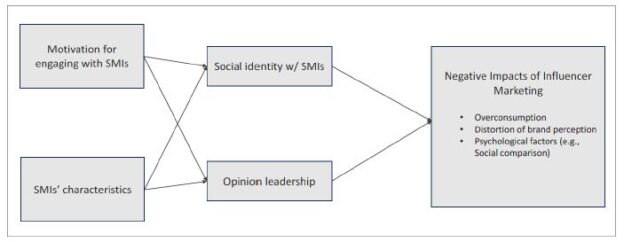
Based on the theoretical framework and relevant literature reviewed, the following conceptual model is proposed (see Figure 1).
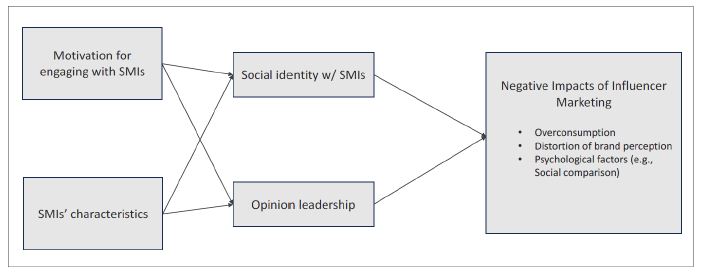
Figure 1: Conceptual model

Method

An online survey was created to gather robust data surrounding consumer habits regarding interaction with social media influencers. The survey employed a convenience sample drawn from a major research-intensive university located in the southeastern region of the United States. The survey was created using Qualtrics XM software and distributed to participants via an email invitation containing the survey link. On average, students required approximately 10 to 15 minutes to complete it. Prior to data collection, the survey received approval from the university’s Institutional Review Board (IRB). This study focused exclusively on college-age social media users who follow influencers promoting beauty and cosmetic products. This demographic was selected because “Gen Z has a dependence on technology for seeking out information about goods and services before making a purchase decision, and they have a strong reliance on e-word-of-mouth (WOM) advertising”. To ensure eligibility, participants were first asked if they use social media, which platforms they use, and whether they follow beauty and cosmetic influencers. Only those who indicated “yes” to all three questions qualified to continue. Clarifying questions were then used to confirm that the influencers they follow promote beauty and cosmetic products within their content. Participants who did not meet these criteria were excluded from the study.

Instruments

Nine key constructs were assessed using established scales from prior research. Unless otherwise noted, all items were measured on a 7-point Likert scale (1 = strongly disagree, 7 = strongly agree). Along with the primary constructs proposed in the conceptual model, this study also measured several external variables to provide additional insight into college-age students’ social media habits, such as purchase loyalty, purchase intention, and social comparison. Before examining motivations for following influencers, the study measured participants’ general social media usage using a scale developed by Hagerborn et al. [13]. To understand what qualities resonate most with users when deciding to follow and engage with influencers, scales from Croes and Bartels and Zhang et al. [14] were employed. These measures included characteristics such as trends, followers, attractiveness, relatability, and entertainment value. Participants selected the characteristics that best reflected their experiences.

Social identification with social media beauty and cosmetic influencers was measured using a three-item scale adapted from Leach et al.. Participants indicated the extent to which they felt psychologically connected and aligned with the influencers. Opinion leadership was also assessed to capture the role influencers play in shaping followers’ attitudes and decisions. Scales were adapted from Gentina et al. and Thakur et al. Participants indicated how effectively influencers interacted and engaged with their audiences while promoting beauty and cosmetic products. To maintain focus, they were asked to name a specific influencer to keep in mind when responding. Consumption habits were measured using the consumption desire scale by Patwardhan et al. [15]. Participants reflected on whether their perceived need or pressure to buy products increased with greater exposure to influencers, and whether they had overspent or purchased beyond their needs. This measure provided insight into how influencer-driven marketing contributes to excessive consumption. Distortion of brand perception was measured using items adapted from existing parasocial interaction/relationship (PSI/PSR) and influencer characteristic scales, modified to fit the cosmetic and influencer context.

Buying behavior and purchase intention were examined through several validated scales. Participants were first asked how many beauty and cosmetic products recommended by the named influencer they had purchased in the past 12 months. A purchase intention scale by Ki and Kim [16], along with items adapted from Fakhreddin and Foroudi and Kay et al. [17], measured likelihood of future purchases. Buying behavior was further assessed using scales from Ki and Kim, Croes and Bartels, and Kay et al. Purchase loyalty was measured using a scale adapted from Pereira et al. and Walsh et al., as cited in Fakhreddin and Foroudi. This construct examined participants’ allegiance to influencers and the products they endorse. Product knowledge was measured using a scale by Kay et al. which assessed participants’ interest, confidence, and expertise with beauty and cosmetic products, providing insight into how easily they might be persuaded by influencer recommendations. Finally, social comparison was measured using the online social comparison scale developed by Gibbons and Buunk, Steers et al., Reer et al., and Latif et al., as cited in Tandon et al. [18]. Participants indicated their experiences of comparing themselves to others in terms of appearance and possessions. This measure contextualized consumer buying behavior within the cosmetic sector.

Results

Participants

A total of 237 students participated in the survey; after removing incomplete responses, 157 usable samples remained (66.2%). All participants were between 18 and 22 years old, with 96.2% identifying as female. The majority identified as White American (82.8%), followed by African American (7.8%). By class standing, seniors represented the largest group (33.1%). Reported annual household income varied, with 30.6% indicating $150,000 or more and 25.5% reporting $100,000–$149,999 (see Table 1).

Table 1: Demographic profile

Demographic Variable

Category Frequency Valid Percent

Cummulative Percent

Gender Male

6

3.8%

3.8%

  Female

151

96.2%

100.0%

  Total

157

100.0%

 
Age 18-21

123

78.3%

78.3%

  22-25

31

19.7%

98.1%

  26-41

3

1.9%

100.0%

Academic class standing Freshman

18

11.5%

11.5%

  Sophomore

40

25.5%

36.9%

  Junior

38

24.2%

61.1%

  Senior

52

33.1%

94.3%

  Graduate

9

5.7%

100.0%

Ethnicity White American

130

82.8%

82.8%

  Black or African American

12

7.6%

90.4%

  Hispanic or Latino

5

3.2%

93.6%

  Asian

4

2.5%

96.2%

  Other

6

3.8%

100.0%

Annual Household income Under $25000

27

17.2%

17.2%

  $25,000-$50,000

11

7.0%

24.2%

  $50,001-$75,000

13

8.3%

32.5%

  $75,001-$99,999

18

11.5%

43.9%

  $1,00,000-$1,49,999

40

25.5%

69.4%

  $1,50,000 and Over

48

30.6%

100.0%

Social Media Usage and Influencers Followed

Survey participants shared their social media habits to reflect their exposure to various platforms and interactions with influencers. A majority (63.1%) reported spending between one and three hours per day on social media. TikTok emerged as the most commonly used platform for following influencers (84.4%), followed by Instagram (66.9 %). In terms of purchasing behavior, 65.6% indicated that they had purchased between one and five cosmetic or beauty products in the past year as a result of influencer recommendations. Participants also identified the influencers they followed most closely in the context of beauty and cosmetic promotion. Alix Earle was the most frequently mentioned, cited by 25% of participants, followed by Bridget Pheloung (Acquired Style) and Emilie Kieser. The responses included both traditional lifestyle influencers and professional makeup artists, highlighting the diversity of influencer types within the cosmetics space.

Reasons for following and Motivations for Engaging with SMIs

Participants identified the characteristics most important when choosing to follow influencers (see Table 2). Entertainment value ranked highest (71.3%), followed by relatability and authenticity, each selected by more than half of respondents. Mean score analysis revealed the strongest motivations for engaging with beauty influencers were information seeking (M = 6.02), content style and aesthetics (M = 5.75), and relaxing entertainment (M = 5.37). Among influencer attributes, trust (M = 5.83), expertise (M = 5.56), and interactivity (M = 5.06) were ranked most important, while attractiveness and popularity were considered less influential.

Table 2: Reasons for Following SMIs

Rank

Reason Frequency

Percentage

1

Entertainment

114

71.3%

2

Relatability

102

63.7%

3

Authenticity

89

55.6%

4

Creative Inspiration

87

54.4%

5

Humor

61

38.1%

6

Credibility

61

38.1%

7

Expertise

55

34.4%

8

Attractiveness

51

31.9%

9

Conumerism

23

14.4%

10

Number of Followers

13

8.1%

11

Other

3

1.9%

12

Congruency

0

0.0%

Relationships Among Variables

Correlation and regression analyses were conducted to examine the proposed model (Tables 3 and 4). A principal components extraction with Varimax rotation was first conducted to identify the underlying factor structure. Factors with eigenvalues greater than 1.0 were retained. After removing three cross-loading items, the retained factors explained 74.5% of the variance. Scale reliability was confirmed with Cronbach’s alpha values ranging from .71 to .96, exceeding the .70 threshold (Nunnally & Bernstein, 1994). Harman’s single-factor test (Mayr & Teller, 2024) showed that a single factor accounted for 25% of the variance, below the 50% threshold, indicating that common method bias was not a major concern. Most variables were significantly correlated at the .05 level or below. Regression analyses further indicated that both social identity and opinion leadership had positive effects on overconsumption (β = .22, t = 3.01, p < .01; β = .38, t = 5.09, p < .001, respectively), distortion of brand perception (β = .15, t = 2.33, p < .05; β = .58, t = 8.88, p < .001, respectively), and social comparison (β = .26, t = 3.41, p < .001; β = .24, t = 3.15, p < .01, respectively).

Table 3: Correlations


1

2 3 4 5 6 7 8 9 10

11

Social identity

.395**

.631** .490** .277** .022 .168* .325** .249** .270** .171*

.324**

Opinion leadership

.316**

.316** .349** .231** .347** .333** .409** .289** .540** .615**

.386**

Purchase intent

.278**

.276** .261** .147 .303** .199* .285** .319** .469** .462**

.373**

Brand loyalty

.271**

.236** .238** .189* .275** .111 .261** .255** .433** .390**

.414**

Distortion of brand perception

.243**

.332** .280** .114 .315** .423** .303** .107 .476** .524**

.279**

Overconsumption

.339**

.352** .327** .351** .174* .161* .296** .476** .225** .197*

.246**

Social comparison

.133

.345** .238** .115 .096 .168* .162* .171* .213** .160*

.182*

Note: 1=cool; new Trend; 2=Companionship; 3=Relaxing entertainment; 4=Boredom; 5=Information seeking; 6=Content 7=Attractiveness;8=Popularity; 9=Expertise; 10=Trust; 11=Interactivity *p < .05, **p < .01

Table 4: Regression Results


IVs

Social identity Opinion leader
β t p β t

p

Motivations            
Companionship

.53

7 .30 <.001 .20 2.80

.006

Relaxation

.32

4.42 <.001 .40 4.86

<.001

Information seeking      

.22

2.86

.005

Content      

.19

2.38

.018

F-value p

Adjust R2

24.6

<.001

.47


9.61

<.001

.25

   
SMI Characteristics

Attractiveness

.21

2.64 .009 .20 3.18

.002

Popularity      

.17

2.75

.007

Expertise      

.20

2.78

.006

Trust Interactivity  .27  3.23 .002 .43 5.73

<.001

F-value p

Adjust R2

8.44

<.001

.19


33.19

<.001

.51


Discussion of Findings

This study explored how social media influencer marketing impacts consumer behavior and psychology in the cosmetic sector. The analysis focused on the relationship between exposure to and interaction with influencers, overconsumption of products, and distorted brand perceptions.

The results identified key motivations for following influencers—entertainment, relatability, and authenticity—highlighting that genuine and transparent content is highly valued. For cosmetic and beauty products, influencers perceived as authentic, relatable, and entertaining resonate most strongly with followers. In terms of characteristics, trust, expertise, and interactivity emerged as most influential. Trust was ranked the highest, reflecting consumers’ need to feel confident in recommendations. This trust directly influenced willingness to purchase and contributed to unnecessary buying, linking influencer credibility to overconsumption. Expertise was the second most valued trait, as followers viewed influencer knowledge and skill as signals of product quality, further driving purchase decisions. Interactivity ranked third, enhancing followers’ sense of connection and belonging through comments, live videos, giveaways, and other engagement strategies. These findings demonstrate how trust, expertise, and interactivity together create a strong psychological bond between influencers and their followers.

Overconsumption—the purchase of products beyond need—was a central outcome of this study. Popularity, boredom, and companionship were all highly correlated with overconsumption. Popularity heightened perceptions of product necessity, as consumers sought belonging or alignment with trends. Notably, 89.3% of survey participants reported purchasing a product based on an influencer’s recommendation, with approximately 140 respondents acknowledging such purchases. These behaviors carry implications for product waste, packaging, shipping, and environmental impact when items are bought unnecessarily and discarded. Companionship, the feeling of belonging to an influencer’s community, also contributed to overconsumption by reinforcing a sense of shared identity. Trust and expertise further lowered skepticism toward recommendations, while interactivity amplified exposure to product promotions, strengthening feelings of need. Together, these patterns reveal how influencers can exploit psychological drivers to encourage excessive purchasing.

Distorted brand perception was another key outcome. Trust and expertise strongly correlated with how consumers perceived brands, as influencers’ credibility reduced skepticism and hesitation toward promoted products. Interactivity also shaped brand perception by fostering loyalty through ongoing engagement, which made brands appear more personable and accessible. However, this reliance on influencers meant that trust was often placed in the influencer rather than the brand, blurring the line between the two. Motivations such as content and companionship further influenced brand perception. Content—defined by style, format, and consistency—had the strongest correlation, showing how influencer presentation directly shaped consumer views of brands. Companionship reinforced this effect by creating a sense of friendship and belonging. These findings suggest that when influencers represent brands, they can overshadow brand identity and compromise the direct relationship between brands and consumers.

Finally, the study highlighted broader psychological implications. Attractiveness and popularity were strongly associated with opinion leadership, suggesting that physical appeal, visibility, and follower count significantly enhance an influencer’s ability to shape consumer opinions in the beauty and cosmetics domain. In addition, companionship and relaxation emerged as key motivations for social identification. These findings indicate that perceived interpersonal closeness, such as feeling that influencers are friends or conversational partners, along with psychological relief through enjoyment, stress reduction, or temporary escape, play meaningful roles in fostering users’ identification with influencers. Furthermore, both social identity and opinion leadership were found to positively influence overconsumption, distorted brand perception, and social comparison. Collectively, these results underscore the psychological mechanisms—trust, expertise, interactivity, attractiveness, popularity, and companionship—that make influencer marketing both highly persuasive and potentially problematic.

Implications

Theoretical Implications

The findings of this study align closely with existing literature and extend theoretical perspectives on consumer behavior in social media contexts. Specifically, they support the concept of trend-based consumerism, brand perception theories, and social comparison processes. Denton emphasized the role of influencer-driven social media trends in stimulating consumption, particularly among younger consumers. While Denton’s study focused on apparel, the current research demonstrates a similar pattern in the cosmetics sector, with popularity characteristics strongly correlated with overconsumption. Brand perception theories are also reinforced. Fitriati et al. argued that influencer recommendations shape consumer expectations of product value, a finding consistent with this study’s results showing that interactivity and dependency on influencers influence brand perceptions. Similarly, Bentley et al. emphasized consumers’ direct psychological relationships with brands, an avenue that complements but differs from the present study’s focus on influencer-driven brand associations. Croes and Bartels highlighted the role of social identification and motivations for social media use, shaping how this study measured motivations for following influencers. Adapting their scale produced results consistent with prior findings.

Together, these findings provide strong theoretical support for media dependency theory. The study shows that college-aged consumers rely heavily on influencers for product information and purchase decisions, with information seeking emerging as the strongest motivation. This dependency not only validates the central premise of media dependency theory but also reveals its potential negative outcomes, such as overconsumption and distorted brand perceptions. The psychological drivers of this dependency—such as the need to belong and feelings of companionship—further extend the theory by highlighting how relational ties with influencers contribute to excessive consumption. Importantly, these implications extend beyond cosmetics, offering insight into how reliance on influencers can shape consumer decision-making, brand communication, and purchasing behaviors across industries.

Practical Implications

This study provides several practical implications for brands, influencers, and consumers. For brands, the findings suggest that working with influencers perceived as trusted and knowledgeable is crucial, as these traits are strongly associated with purchase intention and brand perception. High interactivity is also valuable, as greater engagement increases exposure to both influencer content and brand products. However, the study also highlights risks: brand perception can become distorted when closely tied to influencers. The line between actual need and perceived need often blurs in influencer interactions, and consumers who later view their purchases as wasteful may associate this negatively with the brand. While profit remains central, brands will need to address the pressures of overconsumption created by influencer marketing and prioritize direct communication and authentic engagement with consumers. Loyalty and trust can coexist with influencer partnerships, but only if carefully managed.

For influencers, the study underscores the importance of managing relationships with followers ethically and transparently. Trust and expertise are powerful drivers of success but can also contribute to dependency, comparison, and waste. Like brands, influencers may prioritize personal gain in partnerships, which can compromise ethical decision-making. Transparency, as required by FTC regulations, builds trust among followers. Communicating when a recommendation is unaffiliated with a brand can further enhance authenticity. Additionally, being selective about brand partnerships strengthens credibility, whereas promoting products solely for financial gain undermines trust and perceived expertise.

Finally, consumers also benefit from these findings. As social media becomes increasingly embedded in daily life, particularly among Gen Z women, awareness of influencer practices is essential. This study highlights the manipulative nature of influencer marketing, where popularity and psychological drivers—such as the need to belong or relieve boredom— are often used to stimulate purchases. By recognizing these tactics, consumers can better distinguish between actual needs and perceived needs created by influencer messaging. Awareness of how repeated exposure intensifies feelings of need may also help reduce unnecessary purchases. Although challenging in the highly engaging environment of social media, developing this awareness can support more intentional and restrained consumption [19-21].

Conclusion and Future Research

This study examined the negative impacts of influencer marketing in the cosmetic sector, focusing on Generation Z college-aged women who are highly active on platforms such as TikTok and Instagram. The findings confirm that influencers hold significant power in shaping purchase decisions and brand perceptions. This research also contributes to existing knowledge by shifting the conversation on overconsumption from the fast-fashion industry to the cosmetic sector, where influencer marketing similarly drives trend-based cycles and waste. While influencer partnerships are effective in expanding reach, they risk weakening brands’ direct connection with consumers. These insights underscore the importance of balancing influencer strategies with efforts to preserve authentic brand-consumer relationships, laying the groundwork for future research on the long-term consequences of these dynamics. The study also identifies several avenues for future research. Given the breadth of variables examined, further investigation is needed into specific outcomes such as short-term versus long-term brand loyalty, sustained effects on brand perception, and the measurable environmental impact of overconsumption. Future research could explore issues such as shipping, packaging, and product waste to better assess the broader ecological footprint of influencer marketing. As this practice continues to expand, the availability of longitudinal data will offer additional opportunities to examine its implications for both brands and consumers.

References

  1. Vaghela K, Damle M, Hamza MS, Oudah AY (2023) Impact of social media influencers on brand promotion. AIP Conference Proceedings.
  2. Fakhreddin F, Foroudi P (2021) Instagram influencers: The role of opinion leadership in consumers’ purchase behavior. Journal of Promotion Management 28: 795-825.
  3. Croes E, Bartels J (2021) Young adults’ motivations for following social influencers and their relationship to identification and buying behavior. Computers in Human Behavior 124: 106910.
  4. Bentley K, Rajagopal P, Kulow K (2024) Unfaithful brands: How brand attachment can lead to negative responses to influencer marketing campaigns. Journal of Consumer Psychology 343: 456-472.
  5. Hassan SH, Teo SZ, Ramayah T, Al-Kumaim NH (2021) The credibility of social media beauty gurus in young millennials’ cosmetic product choice. PLOS ONE 16: e0249286
  6. Fitriati R, Siwi ISM, Munawaroh, Rudiyanto (2023) Mega-influencers as online opinion leaders: Establishing cosmetic brand engagement on social media. Journal of Promotion Management 29: 359-382.
  7. Williams DE, Pochipinski B, MacDonald M, Caulfield J (2023) The depiction of beauty-by-beauty influencers on Instagram and generations Z’s perception of them. Journal of Promotion Management 30: 473-512.
  8. Khurshid S, Ayoub DA, Kortam W (2024) The impact of influencer marketing on consumers’ intentions toward beauty brands after the COVID-19 pandemic. Arab Journal of Administration 44: 1-10.
  9. Lee JE, Watkins B (2016) YouTube vloggers’ influence on consumer luxury brand perceptions and intentions. Journal of Business Research 69: 12
  10. Geng R, Chen X, Wang S (2023) Wear in or wear out: How consumers respond to repetitive influencer marketing. Internet Research 34: 810-848.
  11. Silva MJdB, Farias SAd, Silva CJ (2023) Endorsement on Instagram and cultural dimensions: An analysis of digital influencers. The Bottom Line 36: 1-28.
  12. Denton A (2023) The cost of looking good: How fashion and trend-based consumerism impact the economy, law, and environment. Indiana Journal of Global Legal Studies 30: 2
  13. Hagerborn C, Ivarsson I, Linde S (2024) Trending towards overconsumption: The role of social media in shaping Swedish Gen Z’s buying patterns. Bachelor’s thesis, Jönköping University, Jönköping International Business School. DiVA
  14. Zhang S, Huang C, Li X, Ren A (2022) Characteristics and roles of streamers in ecommerce live streaming. The Service Industries Journal 42: 1001-1029
  15. Patwardhan V, Mallya J, Kaliappan S, Kumar D (2024) Influence of social media on young adults’ food consumption behavior: Scale development. Cogent Social Sciences 10: 2391016.
  16. Ki CW, Kim YK (2023) The mechanism by which social media influencers persuade consumers: The role of consumers’ desire to mimic. Psychology & Marketing 40: 24- 46.
  17. Kay S, Mulcahy R, Parkinson J (2020) What is less is more: The impact of macro and micro social media influencers’ disclosure. Journal of Marketing Management 36: 248-278.
  18. Tandon A, Dhir A, Talwar S, Kaur P, Mäntymäki M (2021) Dark consequences of social media-induced fear of missing out (FoMO): Social media stalking, comparisons, and fatigue. Technological Forecasting & Social Change 169: 120834.
  19. ElSayad G (2024) Beyond likes, comments, and shares: How can influencer marketing drive customer equity and purchase intention? Journal of Promotion Management 30: 1087-1112.
  20. Faust NT, Hong Y, Gains N, Christopoulos GI (2024) The effect of implicit theories of human beauty and perceived pressure on cosmetic consumption. Psychology of Aesthetics 18: 43-58.
  21. Isyanto P, Gita Sapitri R, Sinaga O (2019) Micro influencers marketing and brand image to purchase intention of cosmetic products Focallure. Systematic Reviews in Pharmacy 11: 601-605.

Effect of Moringa oleifera Aqueous Seed Extract on Some Productive Indicators of Broiler Chickens

DOI: 10.31038/IJVB.2025924

Abstract

Background: The research aims to study the effect of the Moringa oleifera aqueous seeds extract (MSE) on some productive indicators of broiler chickens. The experiment was conducted using 300 broiler chicks of the Ross 308 strain. Starting from one day of age until 42 days. The broiler chickens were allocated into four equal groups: T1 (control), T2, T3 and T4, each of which included 75 broiler chickens. They were fed balanced and uniform diets according to their age. Drinking water was ad libitum provided, with the addition of the MSE at a rate of 0, 80, 100 and 120 ml/liter of water for T1, T2, T3 and T4, respectively.

Results: The results showed a significant improvement (P<0.05) in the growth rate, and feed conversion ratio, with a decrease (P<0.05) in the percentage of dead broiler chickens, for the groups treated with MSE compared to the control group T1.

Conclusions: The study suggests that adding the aqueous of MSE to the drinking water of broiler chickens results in the improvement of the studied productivity indicators.

Keywords

Moringa oleifera, Seed extract, Productive indicators, Broiler chickens

Background

The poultry industry is one of the most important sectors of animal production, contributing to the provision of high-quality animal protein in large quantities to meet the growing nutritional needs of humans [1]. With increasing production, it has become necessary to rely on feed additives to improve growth, increase feed conversion efficiency, and enhance immunity against diseases. Antibiotics have been used for many years to achieve this goal [2], but their extensive use has led to the emergence of health problems, most notably the development of bacterial resistance to antibiotics and the accumulation of drug residues in poultry meat and eggs, which negatively impacts consumer health [3]. Therefore, recent studies have focused on safe and effective natural alternatives, with medicinal plants and their derivatives, such as oils and extracts, playing a prominent role in this field [4]. Moringa oleifera is a medicinal plant rich in active compounds such as phenols, flavonoids, antioxidants, amino acids, and minerals [5]. It is used as a plant-based supplement to improve health and immunity and increase production efficiency in poultry. Phenolic compounds and flavonoids are key factors in increasing the activity of antioxidant enzymes, reducing oxidative stress caused by free radical formation, and supporting the bird’s immune system by stimulating the production of antibodies and increasing the number of white blood cells [6]. Isothiocyanates and other plant compounds also act as antimicrobials, helping to reduce bacterial infections and disease, and improving the integrity of the intestinal mucosa, which positively impacts nutrient absorption and reduces mortality rates [7]. Several studies have indicated the important role of using Moringa in poultry nutrition to improve health and productivity [8]. Ali et al., [9] found that adding MSE to drinking water can lead to lower mortality rates and increased growth, which enhances production efficiency, as found by Rehman et al., [10]. Adding MSE to poultry drinking water has significant effects on improving growth rates, weight gain, meat quality, and its vitamin, mineral, protein, and fat content. Verma et al., [11] found that when studying the effect of adding an aqueous extract of Moringa oleifera leaves to the drinking water of four groups of broiler chickens, the first group received drinking water devoid of the extract, the second group received 60 ml of the extract per liter, the third group received 90 ml per liter, and the fourth group received 120 ml per liter. The results showed a significant increase (P<0.01) in the weights of broiler chickens and an improvement in the feed conversion ratio in the groups treated with the extract, with the highest increase recorded in the group receiving 90 ml per liter. Given the recent trend toward using medicinal plants and their extracts as a natural alternative to antibiotics to enhance chicken production efficiency, which enhances the safety of animal products and reduces reliance on chemicals that may negatively impact human health and the environment, the aim of this study was to study the effect of adding different levels of aqueous MSE to drinking water on some production indicators (weight gain, feed consumption, feed conversion ratio, and mortality rate) in broiler chickens.

Materials and Methods

Animals, Treatments and Experimental Design

The study was conducted using 300 one-day-old chickens of Ross 308 strain, in a private farm on the outskirts of Hama city, which relies on a semi-closed breeding system and a bedding of sawdust. The experiment lasted for 42 days during the period from 01/09/2024 to 11/10/2024. The broiler chicks were distributed into four groups, each containing 75 broiler chickens. Each group contained three replicates, each containing 25 broiler chickens, according to a completely random design. The broiler chickens were placed in mesh cages with dimensions of 2 x 1.5 m, with a density of 8 chickens /m2. The broiler chickens of each replicate were placed in a place equipped with a feeder and a drinker, and all groups underwent the same treatment in terms of heating, ventilation, and everything related to the management and care system. The broiler chickens were cared for from one day old until 42 days old, and the temperature was controlled when receiving the broiler chicks at around 33°C during the first three days, then it was gradually reduced at a rate of 1°C daily for all the studied treatments to be fixed at 21°C, while light was provided 24 hours a day during the first three days of caring for the broiler chicks, then the lighting was gradually reduced at a rate of one hour a day until the age of one week, to fix the lighting program according to (20L: 4D) until the end of the fattening period [12]. The broiler chickens were also vaccinated according to a unified preventive vaccination program followed in the breeding area (Table 1), in addition to giving them vitamins to resist the stress caused by the used vaccine.

Table 1: Immunization program followed during the period of care.

Today’s

Method of giving the vaccine

Type of vaccine given

1

Eye Drop Newcastle and bronchitis

10

Drinking Water  ND Clone 30

14

Drinking Water Gumboro

25

Drinking Water ND Clone 30

The broiler chickens were fed with balanced protein and energy pellet feed mixtures produced by Feedmix (Hama, Syria). The care period was divided into three phases: the starter phase (1-14 days), the grower phase (15-25 days), and the finisher phase (26-42 days). The feed mixtures were provided in accordance with their needs according to the age phase (Table 2) according to the recommended nutritional requirements tables for the breed Aviagen [13]. The feed mixtures and water were ad libitum provided.

Table 2: Composition of feed mixtures used in feeding experimental broiler chickens.

Ingredients(g/kg)

Starter Mixture
(1-14 days)
Grower Mixture
(15-25 days)

Finisher Mixture
(26-42 days)

Yellow corn

556.4

594.3

624.3

Soybean meal, 48%

320

280

231.3

Corn gluten, 60%

59.8

55.7

65.7

Soybean oil

20

30

40

Calcium carbonate

13

12

10.5

Calcium dibasic Phosphate

15

13

13

Common salt

1.5

1.5

1.5

Premix*

3

3

3

DL-Methionine, 98%

2.3

2

1.8

Lysine, Hcl, 78%

4.7

4.2

4.6

Choline

0.7

0.7

0.7

Threonine

1

1

1

Phytase

0.1

0.1

0.1

NaCo3

2.5

2.5

2.5

Chemical composition (g/kg)**      
ME kcal/kg diet

3012.65

3108.199

3213.92

Crude Protein%

23.48

21.57

20.14

Calcium

9.7

8.7

8.1

Available P

4.8

4.3

4.1

Lysine

14.4

12.9

11.9

Methionine

5.6

5.1

4.8

Threonine

9.7

8.8

8.1

*Premix per kg of diet: vitamin A, 1500 IU; vitamin D3, 200 IU; vitamin E, 10 mg; vitamin K3, 0.5 mg; thiamine, 1.8 mg; riboflavin, 3.6 mg; pantothenic acid, 10 mg; folic acid, 0.55 mg; pyridoxine, 3.5 mg; niacin, 35 mg; cobalamin, 0.01 mg; biotin, 0.15 mg; Fe, 80 mg; Cu, 8 mg; Mn, 60 mg; Zn, 40 mg; I, 0.35 mg; Se, 0.15 mg.
**According to Ross manual Guide, Aviagen [12].

Preparation of the Aqueous Extract of Moringa Seeds

Moringa seeds were obtained from private shops selling medicinal herbs in Hama Governorate. They were cleaned, leaves and foreign bodies were removed, dried, and then ground using a special mill for medicinal plants until a fine powder was obtained. Then 100 g of the powder were collected and mixed with 1000 ml of distilled water (at a ratio of 10: 1) using an electric mixer. The mixture was then left for 24 hours at room temperature. After that, the mixture was filtered using several layers of medical gauze to get rid of suspended particles. Then, the mixture was placed in a centrifuge (Bio-Rad- USA) at a speed of 3000 rpm for 10 minutes. After that, the extract was filtered using Whatman No. 101 filter papers to obtain a clear solution. Then, the extract was diluted with clean drinking water to obtain the doses that were provided to the broiler chickens daily [14] as follows:

Group T1: Drinking water only (control group).

Group T2: 80 ml of MSE/L of drinking water.

Group T3: 100 ml of MSE/L of drinking water.

Group T4: 120 ml of MSE/L of drinking water.

Chemical Analysis of Moringa Seed Extract Treatments

The MSE treatments (T2, T3, and T4) were analyzed for alkaloids, carbohydrates, flavonoids, glycosides, phenols, proteins, saponins, steroids, tannins, and terpenoids using the standard method by Ijarotimi et al. [15] and Nathaniel et al. [16], as shown in Table 3.

Table 3: Phytochemical content (mg/L) of moringa seed extract (MSE) treatments.

Phytochemicals

T2 T3

T4

Alkaloids

8.53

8.89

9.16

Carbohydrates

2.79

3.35

3.54

Flavonoids

3.98

4.23

4.52

Phenols

17.96

18.41

18.99

Protein

32.77

33.32

34.12

Saponins

5.87

6.18

6.63

Steroids

4.12

4.73

5.34

Tannins

47.63

53.2

55.32

Terpenoids

18.24

18.97

19.48

The calcium, magnesium, phosphorus, potassium, zinc, iron, and sodium content of MSE treatments was determined according to the methods described by Liang et al. [17]. The MSE treatments (T2, T3, and T4) were analyzed for vitamin A, B1, B2, B3, B6, B12, C, D3, E, K3, and β-carotene (Table 4) using the methods described by Sami et al. [18].

Table 4: Mineral and vitamin composition (mg/L) of moringa seed extract (MSE) treatments.

Micronutrients

T2 T3

T4

Calcium

601.3

621.7

637.8

Magnesium

38.47

41.20

43.50

Phosphorus

356.0

396.4

405.8

Potassium

69.00

74.00

77.10

Zinc

1.067

1.170

1.243

Iron

6.260

6.490

6.750

Sodium

243.8

262.7

275.7

Vitamin A

4.040

4.480

4.640

Vitamin B1

0.140

0.170

0.250

Vitamin B2

0.230

0.310

0.350

Vitamin B3

0.230

0.320

0.390

Vitamin B6

0.280

0.320

0.360

Vitamin B12

0.110

0.130

0.170

Vitamin C

4.650

4.800

4.940

Vitamin D3

ND

ND

ND

Vitamin E

546.0

597.0

630.0

Vitamin K3

ND

ND

ND

β-carotene

ND

ND

ND

ND = not detected.

Studied Indicators

The production indicators were studied during 42 days of the chickens ‘ life, as follows:

Weight of hatched broiler chickens (g): The broiler chickens were weighed at one day of age in each replicate separately using a scale with an accuracy of 0.1 g.

Weekly live weight (g): The individual weight of the broiler chickens was recorded weekly for all chickens in the studied groups.

Weight gain (g): Live weight at the end of the period – live weight at the beginning of the period [19].

Average feed intake of the broiler chickens (g): According to the average weekly feed intake, by weighing the amount of feed provided to each group at the beginning of the week, then weighing the amount of feed remaining in the feeders for each group at the end of the week, and according to the difference in weight. The average feed intake of each chicken was calculated according to the following equation:

Average feed intake (g) = Amount of feed given (g) – Amount of feed remaining (g).

Feed conversion ratio: According to the conversion ratio for each group weekly according to the following relationship:

Mortality rate: The number of dead broiler chickens was recorded daily from each replicate, and their percentage was recorded during the care period extending up to 42 days of age.

Statistical Analysis

The results of all studied indicators were subjected to statistical analysis using analysis of variance according to the completely random design using the statistical program SPSS26, and the significant differences between the averages of the coefficients were compared using the LSD test at a significance level of p < 0.05.

The mathematical model was as follows: Yij = μ + Ti + eij

Where:

Yij = Individual observation.

μ = The overall mean for the trial under consideration.

Ti = The effect of the ith treatment.

eij = Random residual error. [20]

Results

Live Weight

The results in Table 5 show the effect of adding the aqueous of MSE to drinking water on the average live weight of the experimental broiler chickens. As it is noted, there is a significant increase (P<0.05) in the average weights of the broiler chickens in the treatment groups T2, T3, T4, as they reached 2626.89, 2669.96, and 2725.66 g at the end of the experiment for the three groups, respectively, compared to the control group T1, which reached 2499.28 g.

Table 5: The Effect of adding aqueous of MSE to drinking water on the average live weight of experimental broiler chickens. (g)

The age

Experimental groups (Mean ± SD)
T1 T2 T3 T4

P- value

Day 1

4.12 ± 43.25ns 4.97 ± 43.32 ns 4.55 ± 43.46 ns 5.32 ± 43.37 ns 0.531
Week 1 8.74 ± 171.75 b 9.93 ± 181.64a 8.35 ± 185.46a  ± 187.479.27a

0.046

Week 2

12.54 ± 446.86c 13.01 ± 480.75b 12.89 ± 500.65a 13.42 ± 512.68a 0.039
Week 3 19.71 ± 915c 22.34 ± 967.92b 23.45 ± 993.26a 24.98 ± 1018.87a

0.042

Week 4

26.52 ± 1428.15c 26.05 ± 1513.42b 27.34 ± 1544.58b 28.54 ± 1582.28a 0.040
Week 5 31.10 ± 1990.85b 2099.62 ± 30.25a 31.21 ± 2137.08a 32.18 ± 2184.38 a

0.043

Week 6

34.13 ± 2499.28b 31.02 ± 2626.89a 35.73 ± 2669.96a 39.52 ± 2725.66 a

0.041

T1: Drinking water only (control group). T2: 80 ml of MSE/liter of drinking water.
T3: 100 ml of MSE/liter of drinking water. T4: 120 ml of MSE/liter of drinking water.
ns indicates no significant differences within the same line between the experimental groups (P>0.05).
Different letters a, b, c within the same line indicates significant differences between groups at a level of (P≤0.05).

Weight Gain

The results in Table 6 show the effect of adding the aqueous of MSE to drinking water on the average weight gain of broiler chickens during the experimental stages. A significant increase (P<0.05) was observed in the average weight gain of broiler chickens in the treatment groups T2, T3, T4, which reached 2582.57, 2626.5, and 2682.29 g at the end of the experiment, respectively, compared to the control group T1, which reached 2456.03 g.

Table 6: Effect of adding aqueous of MSE to drinking water on the average weight gain of experimental broiler chickens. (g)

The age

Experimental groups (Mean ± SD)
T1 T2 T3 T4

P- value

Week 1

4.12 ± 128.5 ns 4.55 ± 138.32ns 3.95 ± 142 ns 4.56 ± 144.1 ns 0.121
Week 2 5.10 ± 275.11b 6.40 ± 299.11ab 6.70 ± 315.19a 6.32 ± 325.21a

0.045

Week 3

12.70 ± 468.14b 13.30 ± 487.17a 14.11 ± 492.6a 14.10 ± 506.19a 0.043
Week 4 22.30 ± 513.15b 20.35 ± 545.5a 21.45 ± 551.32a 22.57 ± 563.41a

0.034

Week 5

19.16 ± 562.7b 18.67 ± 586.2ab 19.87 ± 592.5a 19.47 ± 602.1a 0.031
Week 6 7.62 ± 508.43b 8.42 ± 527.27ab 9.71 ± 532.88a 9.32 ± 541.28a

0.042

Full experience

31.02 ± 2456.03b  ± 2582.5727.78a 2626.5 ± 22.6a 32.1 ± 2682.29a

0.041

T1: Drinking water only (control group). T2: 80 ml of MSE/liter of drinking water.
T3: 100 ml of MSE/liter of drinking water. T4: 120 ml of MSE/liter of drinking water.
ns indicates no significant differences within the same line between the experimental groups (P>0.05).
Different letters a, b within the same line indicates significant differences between groups at a level of (P≤0.05).

Feed Intake

The results in Table 7 show the effect of adding the aqueous of MSE to drinking water on the average amount of feed consumed by the experimental broiler chickens. It is noted that there was no significant effect (P>0.05) of the MSE on the amount of feed consumed by the treatment groups T2, T3, T4, as the average reached 4530.4, 4556.86, and 4572.47 g, compared to the control group, as the average reached 4518.19 g.

Table 7: Effect of adding aqueous of MSE to drinking water on the average amount of feed intake of experimental broiler chickens. (g)

The age

Experimental groups (Mean ± SD)
T1 T2 T3 T4

P- value

Week 1

5.17 ± 188ns 5.20 ± 189.12ns 4.90 ± 190.34ns 5.88 ± 191.52ns 0.131
Week 2 5.80 ± 414.21ns 6.25 ± 416.34ns 6.98 ± 419.74ns 7.22 ± 420.61ns

0.081

Week 3

10.72 ± 732.14ns 12.14 ± 733.44 ns 14.19 ± 734.67ns 13.35 ± 735.41ns 0.075
Week 4 24.35 ± 813.15ns 22.30 ± 816.41 ns 25.37 ± 827.42ns 23.50 ± 835.81ns

0.053

Week 5

29.46 ± .1129.2ns 31.26 ± .1131.1 ns 34.21 ± .1139.24ns 35.56 ± .1141.21ns 0.068
Week 6 37.32 ± 1241.49ns 35.72 ± 1243.99ns  ± 1245.4937.51ns 36.75 ± 1247.91ns

0.094

Full experience

35.72 ± 4518.19ns 4530.4 ± 30.52ns 4556.86 ± 33.8 ns 4572.47 ± 40.12ns

0.055

T1: Drinking water only (control group). T2: 80 ml of MSE/liter of drinking water.
T3: 100 ml of MSE/liter of drinking water. T4: 120 ml of MSE/liter of drinking water.
ns indicates no significant differences within the same line between the experimental groups (P>0.05).

Feed Conversion Ratio

The results in Table 8 show the effect of adding the aqueous of MSE to drinking water on the average feed conversion ratio of the experimental broiler chickens. As indicated, there is a significant improvement (P<0.05) in the average feed conversion ratio of the broiler chickens of the treatment groups T2, T3, T4, as it reached 1.754, 1.735, and 1.705 g/g for the three groups, respectively, compared to the control group T1, as it reached 1.840 g/g.

Table 8: Effect of adding aqueous of MSE to drinking water on the average feed conversion ratio of experimental broiler chickens. g/g

The age

 Experimental groups (Mean ± SD)                   
T1 T2 T3 T4

P- value

Week 1

5.17 ± 1.463b 5.20 ± 1.397a 4.90 ± 1.340a 5.88 ± 1.329a 0.047
Week 2 5.80 ± 1.505b 6.25 ± 1.392a 6.98 ± 1.332a 7.22 ± 1.293a

0.045

Week 3

10.72 ± 1.564b 12.14 ± 1.505a 14.19 ± 1.491a 13.35 ± 1.453a 0.031
Week 4 24.35 ± 1.585b 22.30 ± 1.517a 25.37 ± 1.501a 23.50 ± 1.483a

0.042

Week 5

29.46 ± .2.007b 31.26 ± .1.929a 34.21 ± .1.923a 35.56 ± .1.895a 0.033
Week 6 37.32 ± 2.442b 35.72 ± 2.359a 37.51 ± 2.337a 36.75 ± 2.306a

0.035

Full experience

35.72 ± 1.840b 1.754 ± 30.45a 1.735 ± 33.8a 1.705 ± 36.12a

0.024

T1: Drinking water only (control group). T2: 80 ml of MSE/liter of drinking water.
T3: 100 ml of MSE/liter of drinking water. T4: 120 ml of MSE/liter of drinking water.
Different letters a, b within the same line indicates significant differences between groups at a level of (P≤0.05).

Mortality

The results in Table 9 show the effect of adding the aqueous of MSE to drinking water on the mortality rates of the experimental broiler chickens. A significant decrease (P<0.05) is observed in the percentage of dead broiler chickens in the treatment groups T2, T3, T4, as it reached 4, 2.66, and 1.33% at the end of the experiment for the three groups, respectively, compared to the control group T1, which reached 8%.

Table 9: Effect of adding aqueous of MSE to drinking water on the Average total mortality rate of broiler chickens in the experimental groups (%).

Groups

Total number of broiler chickens in the group Number of live broiler chickens at the end of the experiment

Mortality %

T1

75 69 8b
T2 75 72

4a

T3

75 73 2.66 a
T4 75 74

1.33a

P- value


0.043

T1: Drinking water only (control group). T2: 80 ml of MSE/liter of drinking water.
T3: 100 ml of MSE/liter of drinking water. T4: 120 ml of MSE/liter of drinking water.
Different letters a, b within the same line indicates significant differences between groups at a level of (P≤0.05).

Discussion

The results of the present study show the important role of MSE in improving the growth and weight gain of broiler chickens. These findings are consistent with that of Alabi et al. [21] when providing the aqueous extract of Moringa oleifera leaves to broiler chickens, as they noted that the average daily weight gain and final body weight were higher in the groups that received the extract at 120 ml/liter compared to the control group. Khan et al. [22] also recorded a significant increase in body weight when Moringa leaf powder was added at a rate of 1.2% to broiler chickens feed mixtures. In addition, adding Moringa oleifera leaves at a level of 5% to 20% to feed mixtures showed a significant improvement in the growth of broiler chickens [23]. The reason for the improved growth and weight gain may be explained by the richness of Moringa seeds in proteins rich in sulfur amino acids and their high content of oil and beneficial unsaturated fatty acids [24]. The results of the study show that there was no significant effect of MSE on the amount of feed consumed. This is consistent with previous researchers [25,26], who did not observe any effect of Moringa on the amount of feed consumed, while it contradicts the results reached by other authors [27,28,29], who found an increase in the amount of feed consumed. The results of the study also indicate an improvement in the feed conversion rate in broiler chickens in the treatment groups compared to the control group. These results are consistent with what was reached by previous researchers [28,29,30], who explained that Moringa leaves have an effect in improving the feed conversion rate, while the results differed from that of Naga et al. [31], who did not observe any effect of Moringa leaves on the feed conversion rate, while Cui et al. [25] found a significant increase in the feed conversion rate in Moringa leaf treatments. The improvement in the feed conversion rate may be attributed to the fact that MSE improves intestinal health, as it works to increase the length of the villi in the digestive tract [32], which in turn leads to better absorption of the nutrients available in Moringa leaves [33]. The results show a significant decrease in the percentage of dead broiler chicks during the experiment in the groups treated with MSE. This is consistent with the results of Alnidawi et al. [34] and contradicts that of other researchers [26,35,36]. The reason for the decrease in the mortality rate in the treatment groups may be attributed to the Moringa seeds containing a high percentage of antioxidants, vitamins and nutrients that contribute to enhancing the broiler chickens’ immunity and resistance to diseases.

Conclusions

The study concludes the positive effect of using the aqueous of MSE with drinking water in improving the productive performance of broiler chickens, as the live weight increased with stability in the amount of feed consumed, and the feed conversion ratio and the percentage of dead broiler chickens decreased.

Author Contributions

Researcher dr. Mohamed Alrez wrote the research, conducted the experiments, statistically analyzed the results, tabulated them, reviewed the research, and prepared it for publication.

Declarations

Ethics Approval and Consent to Participate

Approval was obtained from the Institutional Animal Care and Use Committee (IACUC) and informed consent was obtained from the animal owner for the experiments and publication of the results, with a commitment to applying the best veterinary practices for animal care

Consent for publication

Not applicable.

Availability of data and materials

The data obtained and analyzed during the current study are available from the corresponding author upon request and are also available on the website: https: //orcid.org/0009-0003-0735-1807.

Competing interests

The authors declare no competing interests.

Funding

The research was funded with support from Hama University.

References

  1. Gupta S, Jain R, Kachhwaha S, Kothari SL. (2018). Nutritional and medicinal applications of Moringa oleifera Lam – Review of current status and future possibilities. J Herbal Med [crossref]
  2. Makkar HP, Francis G, Becker K. (2007). Bioactivity of phytochemicals in some lesser-known plants and their effects and potential applications in livestock and aquaculture production systems. Animal [crossref]
  3. Pandey A, Pandey RD, Tripathi P, Gupta PP, Haider J, Bhatt S, Singh AV. (2012). Moringa oleifera Lam. (Sahijan) – a plant with a plethora of diverse therapeutic benefits: an updated retrospection. Med Aromat Plants [crossref]
  4. Stohs SJ, Hartman MJ. (2015). Review of the safety and efficacy of Moringa oleifera. Phytother Res [crossref]
  5. Rachmawati I, Rifai M. (2014). In vitro immunomodulatory activity of aqueous extract of Moringa oleifera Lam. leaf to the CD4+, CD8+ and B220+ cells in Mus musculus. J Exp Life Sci [crossref]
  6. Anwar F, Sajid L, Muhammad A, Anwarul HG. (2007). Moringa oleifera: A food plant with multiple medicinal uses. Phytother Res [crossref]
  7. Egbu CF, Motsei LE, Yusuf AO, Mnisi CM. (2022). Evaluating the efficacy of Moringa oleifera seed extract on nutrient digestibility and physiological parameters of broiler chickens. Agriculture, 12(8):1102. [crossref]
  8. Gul S, Hussain F, Taj R, Ullah A. (2024). https://www.mdpi.com/2077-0472/12/8/1102 J Adv Vet Anim Res, 11(2):339–348. [crossref]
  9. Ali S, Masood S, Zaneb H, Rehman HF, Masood S, Khan MR, et al. (2017). Supplementation of zinc oxide nanoparticles has beneficial effects on intestinal morphology in broilers chicken. Pak Vet J [crossref]
  10. Rehman HF, Zaneb H, Masood S, Yousaf MS, Hayat K, Majeed KA, et al. (2022). Effect of selenium nanoparticles and mannan oligosaccharide supplementation on growth performance, stress indicators, and intestinal microarchitecture of broilers reared under high stocking density. Animals [crossref]
  11. Verma MP, Lavania P, Baswal AK, Kumar A. (2024). Efficacy of Moringa oleifera leaf aqueous extract supplementation on growth performance of native ‘Ankleshwar’ poultry birds. Biological Forum – Int J, 16(3):257–261. [crossref]
  12. Aviagen. (2018). Ross Broiler: Management Handbook. Available at: https://en.aviagen.com
  13. Aviagen R. (2009). Ross Broiler Management Manual. Available at: http://goldenpoultry.com/wp-content/uploads/2014/09/Ross-Broiler-Handbook-2014i-EN.pdf
  14. Egbu CF, Motsei LE, Yusuf AO, Mnisi CM. (2022). Evaluating the efficacy of Moringa oleifera seed extract on nutrient digestibility and physiological parameters of broiler chickens. Agriculture, 12:1102. [crossref]
  15. Ijarotimi OS, Adeoti OA, Ariyo O. (2013). Comparative study on nutrient composition, phytochemical, and functional characteristics of raw, germinated, and fermented Moringa oleifera seed flour. J Food Sci Nutr [crossref]
  16. Nathaniel EU, Onyancha JM, Mugambi M, Ncene W, Moriasi GA. (2020). Chemical composition of Moringa oleifera Lam. and Moringa stenopetala Bac. leaves from Kenya. Int J Plant Res [crossref]
  17. Liang L, Wang C, Li S, Chu X, Sun K. (2019). Nutritional compositions of Indian Moringa oleifera seed and antioxidant activity of its polypeptides. Food Sci Nutr [crossref]
  18. Sami R, Li Y, Qi B, Wang S, Zhang Q, Han F, Ma Y, Jing J, Jiang L. (2014). HPLC analysis of water-soluble and fat-soluble vitamins of okra (Abelmoschus esculentus). J Chem [crossref]
  19. Abou Sekken MSM. (2015). Performance, immune response, and carcass quality of broilers fed low-protein diets containing Moringa oleifera leaves meal or its extract. J Am Sci [crossref]
  20. Sastry EVD. (2007). Essentials of Agricultural Statistics. Pointer Publishers, Jaipur (India), pp. 260–266.
  21. Alabi O, Malik A, Ng’ambi J, Obaje P, Ojo B. (2017). Effect of aqueous Moringa oleifera (Lam) leaf extracts on growth performance and carcass characteristics of Hubbard broiler chicken. Braz J Poult Sci, 19:273–280. [crossref]
  22. Khan I, Zaneb H, Masood S, Yousaf MS, Rehman HF, Rehman H. (2017). Effect of Moringa oleifera leaf powder supplementation on growth performance and intestinal morphology in broiler chickens. Anim Physiol Anim Nutr, 101:114–121. [crossref]
  23. Moreki JC, Gabanakgosi K. (2014). Potential use of Moringa oleifera in poultry diets. Glob J Anim Sci Res, 2:109–115. [crossref]
  24. Macambira GMCB, Rabello MIV, Navarro CDC, Lopes EC, Lopes GRD, Nascimento JDCRD, Silva JDCRD. (2022). Effects of Moringa oleifera leaf meal on performance and carcass yield of broilers. Rev Bras Zootec, 51. [crossref]
  25. Cui YM, Wang J, Lu W, Zhang HJ, Wu SG, Qi GH. (2018). Effect of dietary supplementation with Moringa oleifera leaf on performance, meat quality, and oxidative stability of meat in broilers. Poult Sci, 97(8):2836–2844. [crossref]
  26. Hassan HMA, El-Moniary MM, Hamouda Y, El-Daly EF, Youssef AW, Abd El-Azeem NA. (2016). Effect of different levels of Moringa oleifera leaves meal on productive performance, carcass characteristics, and some blood parameters of broiler chicks under heat stress. Asian J Anim Vet Adv, 11(1):60–66. [crossref]
  27. Akande TD, Ogunyemi J, Okunlola PF, Owolabi E, Olakanmi O. (2022). Growth-promoting and anti-lipogenic characteristics of three phytogenic feed additives in broilers’ diets. Adv Anim Vet Sci, 10(5):999–1006. [crossref]
  28. Gorleku DO, Badu GPA, Afele JT, Kaba JS, Abunyewa AA. (2022). Assessing the efficiency of Moringa oleifera leaf meal on the growth performance of broiler chicken. J Appl Life Sci Environ, 54(4):370–376. [crossref]
  29. El-Moniary MM, Hemid AAA, El-Wardany I, Gehad AE, Gouda A. (2010). The effect of early age heat conditioning and some feeding programs for heat-stressed broiler chicks on productive performance. World J Agric Sci, 6:689–695. [crossref]
  30. Khalid N, Sakhawat SF, Mehmood H, Ali MM, Ali R, Amin Y, Ayaz M. (2021). Effects of Moringa oleifera leaf powder as feed additive on growth performance and blood parameters of broilers. J Anim Health Prod, 9(3):271–276.
  31. Naga MK, Ashour AA, Rahman SAA, Abed M. (2020). Performance and histomorphological parameters of broiler chicks fed low crude protein diet supplemented with Moringa oleifera leaves powder. Menoufia J Anim Poult Fish Prod, 4(5):65–85.
  32. Abdulsalam SM, Yahaya S, Yakasai MA. (2015). Performance of broiler chickens fed on Moringa oleifera leaf meal supplemented poultry feed. Niger Agric J, 46(1):139–146. [crossref]
  33. Nkukwana TT, Muchenje V, Masika PJ, Mushonga B. (2015). Intestinal morphology, digestive organ size, and digesta pH of broiler chickens fed diets supplemented with or without Moringa oleifera leaf meal. S Afr J Anim Sci, 45(4):362–370. [crossref]
  34. Alnidawi A, Ali F, Abdelgayed S, Ahmed F, Farid MM. (2016). Moringa oleifera leaves in broiler diets: Effect on chicken performance and health. Food Sci Quality Manag, 58:40–48. [crossref]
  35. El-Tazi SM. (2014). Effect of feeding different levels of Moringa oleifera leaf meal on the performance and carcass quality of broiler chicks. Int J Sci Res, 3(5):147–151. [crossref]
  36. Ayo-Ajasa OY, Abiona JA, Fafiolu AO, Egbeyale LT, Njoku CP, Omotayo IG, Abel FAS. (2016). Performance characteristics of broilers fed graded levels of Moringa oleifera leaf meal. Malays J Anim Sci, 19(1):23–31. [crossref]

Domestic Violence: Combining AI Simulation and Mind Genomics Thinking to Explore Potential Mind-Sets and Relevant Responses

DOI: 10.31038/ALE.2025211

Abstract

The paper deals with the issues involved in domestic violence, specifically the problem of how to help police officers understand the mind of the abuser. Through AI, the police office can develop a simulation system that allows the office to explore the “mind” of the abuser to learn what different abusers may be thinking and what might be effective strategies to deal with the abuser. In turn, Mind Genomics provides the user with a sense of the different types of thinking going on among abusers and what may be reasonable points of discussion. The paper shows how to simulate these mind-sets and how to simulate the advice that a psychotherapist might give the police officer when considering the domestic violence situation. The paper finishes with a vision of AI coupled with Mind Genomics as a new educational tool for police officers that in effect becomes a never-exhausted, “always on” guide which can be used to deal with problems in “real time.”

Keywords

Abuser mind-set, Domestic violence intervention, Mind genomics, Police training

Introduction

Domestic violence is a persistent issue affecting victims, families, and communities. Police officers play a crucial role in addressing this issue, but understanding the broader psychological, social, and economic dynamics is essential. Officers face intense and volatile situations, where victims may not disclose their mistreatment due to fear, shame, or a desire to protect the abuser. They must balance immediate protective duties with awareness of long-term psychological dynamics [1-3]. Victims may react differently, wanting immediate intervention or refusing assistance due to financial or emotional challenges. Societal stigma attached to domestic incidents can further complicate the situation, leading to victims retracting claims or minimizing the severity of the abuse [4-6]. Understanding the root causes of domestic violence, including familial upbringing, past trauma, substance abuse, and socioeconomic stressors, is crucial for effective intervention. Officers must be sensitive to these nuances and develop strategies that tailor responses to the nuanced mind-set of the individuals involved. Non-judgmental communication is key, and officers should engage both the victim and the abuser with respect and tact [7-10]. Providing victims with realistic options and resources, such as social services, local shelters, or legal aid, is also vital. Officers must walk a fine line between restraint and proactivity, ensuring their intervention not only addresses immediate violence but also opens pathways for long-term solutions [11-13].

The Issues Emerging When We Recognize the Different Mind-Sets of Domestic Abusers

Domestic violence perpetrators display a wide range of mind-sets that determine the severity of abuse, interaction with victims, and response to law enforcement. Standard, one-size-fits-all approaches often fail to account for the differing motivations, rationalizations, and emotional ecosystems driving abusive behavior. Common mind-sets include “control-oriented” abusers who rely on coercion, intimidation, and isolation tactics, “rage-driven” abusers who act explosively in moments of anger or frustration, and “calculating manipulator” abusers who abuse their partners covertly without physical violence. Some abusers may have underlying mental health issues, such as narcissistic or antisocial personality disorders, which require training in recognizing these conditions. Understanding the diversity of abusive mind-sets challenges the stereotype that domestic violence is always a one-time, heightened emotional situation. Officers trained in identifying abusive mind-sets can better approach victims and discern the full scope of violence. Recognizing key mind-sets can help provide victims with a path toward long-term safety and justice [14-16].

How AI can Provide Us with Rapid Learning

Artificial Intelligence (AI) has the potential to revolutionize law enforcement training, particularly, in teaching police officers about domestic violence. By incorporating AI technology into training programs, officers can enhance their understanding of domestic violence, preparing them to respond more effectively. AI can create highly customized and interactive simulations, replicating real-life domestic violence situations, and providing immediate feedback and alternative responses. AI can handle large amounts of data, allowing for more comprehensive training modules. It also offers anonymity and privacy, fostering a deeper understanding of the subject matter. However, AI lacks the emotional intelligence of human instructors, which is crucial when dealing with sensitive societal issues. Over-reliance on AI may lead to a lack of human interaction, which is essential when dealing with sensitive societal issues. AI-driven training may also foster a “one-size-fits-all” mentality, limiting an officer’s ability to improvise during unpredictable situations. Ethical concerns arise due to AI models that are based only on certain types of case data, potentially filtering out other experiences and reinforcing stereotypes [17-19]. The 15 questions presented in Table 1 give a sense of the range of information available through AI, using the Mind Genomics platform, BimiLeap.com (Idea Coach option). The strategy to obtain this information was simply to instruct AI to provide questions and then answers to those questions, regarding issues in the interaction of police officers with situations involving domestic violence. The Mind Genomics platform was used (BimiLeap.com), with the request put into the Idea Coach feature.

Table 1: AI-generated questions and answers regarding the use of AI in cases of domestic violence.

Mind-Sets Revealed by Mind Genomics and Potential Advances in Understanding Domestic Violence

Mind Genomics is an emerging science that posits that individuals display unique, patterned ways of thinking through their responses to various stimuli in everyday life. This field, originally applied in consumer behavior to understand how different personalities react to specific messages, extends to broader areas, contributing to revelations about societal and interpersonal behavior. At its core, Mind Genomics proposes that the human mind is organized into various “mind-sets” or cognitive segments, which refer to stable, shared patterns of reasoning coordinated by specific stimuli. These mind-sets represent different cognitive predispositions toward processing experiences, emotions, and behavior. When applied to the studies of abusers in cases of domestic violence, Mind Genomics offers a structured way to categorize individuals based on how they think and interpret their actions, intent, and consequences [20-23]. In this context, mind-sets can be understood as specific patterns or clusters of thought processes that lead to specific behaviors or attitudes. Conceptually, mind-sets are a form of subgrouping within a larger population, crucially helping identify common responses shared by individuals within the same cognitive pattern. In terms of domestic violence, mind-sets could unveil how abusers cognitively justify, rationalize, or express their actions. One abuser might function within a mind-set of domination and control, motivated by power dynamics, while another’s behavior may be propelled by a defensive mind-set characterized by paranoia or insecurity. These divided categories can be used to reflect underlying mental frameworks that influence behavior and to understand abusers as individuals shaped by distinct cognitive lenses. Defining and categorizing abusers based on mind-sets could lead to more effective intervention strategies, helping law enforcement, social workers, and counselors understand the underlying motives behind such behavior. Recognizing whether an abuser perceives their actions through a lens of entitlement, frustration, or trauma can guide distinct approaches to rehabilitation or policing. For instance, abusers operating from a mind-set of control may require different therapeutic interventions from those who commit abuse sporadically in response to perceived emotional threats. By understanding mind-sets, patterns of abuse can be identified from early situational cues and interventions can be tailored based on cognitive predispositions. The value of positing hypothetical mind-sets lies in the ability to frame domestic violence in a non-homogeneous way. One criticism of prior generalized approaches to understanding abusers is that they often overlook the diversity of thought processes and personal histories underlying domestic violence. Instead of assuming that all abusers have the same motivations, positing different mind-sets helps domestic violence responders acknowledge the complexity of this behavior. Applying mind-sets allows for empathy-driven, psychologically informed intervention programs, making protective services more precisely suited to individual needs. This nuanced approach serves both the victim’s safety and the abuser’s potential rehabilitation. The law enforcement community can significantly benefit from applying Mind Genomics thinking to categorize abusers. When officers respond to domestic disputes, the traditional focus might be on immediate cessation of conflict or criminal arrest. However, with training in mind-sets as informed by Mind Genomics, law enforcement might also gain insight into the cognitive frameworks guiding the abuser’s actions. By identifying early markers of cognitive predispositions through statements, behavior, or situational history, officers could better predict the likelihood of reoffending, immediate safety risks, and guide victims toward the most appropriate services depending on the abuser’s mind-set. Additionally, police officers could more effectively diffuse situations by understanding the specific psychological motivations driving the behavior rather than using blanket approaches to all cases of abuse. The origins of Mind Genomics stem from decades of research into behavioral psychology and consumer science, aimed at decoding how people intellectually process stimuli. The concept was introduced in marketing programs to categorize consumers based on their emotional and intellectual responses to products, services, or advertisements. Behind this idea was the understanding that people process information in diverse, context-dependent ways, which could be traced and cataloged. This practice was later expanded to areas outside commercial issues. The rationale is that segmented, data-driven understandings of mind-sets bring value to domains like criminal justice, providing tools for better psychological prediction and tailored interventions. By incorporating Mind Genomics thinking into law enforcement approaches, the community stands to gain a new, deeper framework for profiling criminal behavior beyond rudimentary labels such as “violent” or “non-violent.” This could mean that police forces, probation offices, social workers, and courts can develop more intelligent, predictive forms of justice. Instead of intervention tools that rely on generic assessments of aggression or conflict, understanding mind-sets allows for interventions that recognize cognitive diversity among offenders. As this approach gains traction, we can expect collaboration between data scientists, psychologists, and public safety professionals to create systematic tools that identify structured pathways toward behavioral reform—ideal for criminals who might otherwise remain in cycles of abuse.

Combining Mind Geonomics Thinking with AI to Simulate Three Hypothetical Mind-Sets of Domestic Abusers

When analyzing domestic violence, it is important to understand that abusers might fall into different behavioral and psychological types. These mind-sets’ impact may affect how each abuser approaches their victims, how they view their actions, and how they might react to authority or intervention by law enforcement. For law enforcement officers, understanding these mind-sets can be crucial in handling the situation safely and effectively. This section explores how AI can be used to hypothesize the existence of three mind-sets of abusers in domestic violence cases, and then immediately simulate the “deeper nature” of each mind-set. The three mind-sets were generated by AI through the prompt to only identify three mind-sets. AI was not told the nature of these mind-sets.

The three mind-sets emerging from AI’s simulation are:

  1. Entitled & Control-Oriented Mindset: This person sees violence as a way to assert dominance and control, motivated by entitlement.

  2. Emotionally Volatile Mindset: This abuser is driven by strong emotions, often unable to manage intense anger or jealousy.

  3. Avoidant & Manipulative Mindset: This abuser is more calculated and strategic, using manipulation and more subtle forms of abuse to maintain control, but might be quick to downplay or deny their actions to outsiders, like law enforcement.

By framing responses from these different mind-sets, officers can start to identify patterns in abuser psychology—whether the abuser leans more towards outright control, emotional volatility, or calculated manipulation—thus better equipping themselves to see through manipulation and respond appropriately to each unique situation. Table 2 shows eight questions that a police officer might ask—or observe—when arriving at a domestic violence scene, along with three potential responses from abusers, each aligned with one of the above mindsets.

Table 2: Eight questions that a police officer might ask, and simulated answers from mind-sets.

Combining Mind Genomics Thinking with AI to Simulate a Therapy Session

Police officers can enhance their understanding of domestic violence incidents by simulating different mind-sets of potential abusers. By observing how different abusive mind-sets engage in therapeutic dialogue, officers gain insight into the psychological motives, behavioral triggers, and rationalizations that drive abusive behavior. This knowledge can help officers approach domestic violence situations with more nuanced strategies, potentially de-escalating situations or identifying early warning signs before violence occurs. By incorporating multiple mind-sets, officers can witness and analyze abuser reactions when challenged within a therapeutic framework, improving communication skills and informs appropriate intervention strategies. Additionally, simulating different mindsets can help officers distinguish abusive actions from mental health crises or substance-related violence, allowing officers to refer individuals to social or mental health services if necessary. Finally, simulating various personalities and therapeutic responses helps officers develop increased empathy for both abusers and victims, enhancing their ability to connect victims with resources and reduce the risk of retaliation or further violence in the home. AI can be instructed to provide varying levels of depth in its simulation. By slightly altering the instructions to AI, the user can incorporate the thinking of the psychotherapist as well, beyond simply the psychotherapist moderating the session. Table 3 shows the instructions given to AI, and the additional, optional instructions, to provide a deeper insight into the mind of the psychotherapist. Table 4 compares simulations from a session talking about a “code word” to signal when the emotions are overly strong. Table 5 compares simulations from a session talking about “taking a break” when the emotions are overly strong. Table 6 compares simulations from a session talking about moving the argument away from accusation.

Table 3: Instructions to AI to simulate a group therapy session with the psychotherapist making a suggestion and the three mind-sets responding, as well the private thoughts of the three mind-sets.

Table 4: Psychotherapist suggestion about a code word to signal and then reduce tensions—a comparison of two levels of analysis.

Table 5: Psychotherapist’s suggestion about removing oneself from the situation–A comparison of two levels of analysis.

Table 6: Psychotherapist suggestion about a reframing and moving away from anger towards communication—A comparison of two levels of analysis.

Discussion and Conclusions

< class=”rowfont”p>Police personnel often struggle with domestic violence calls in the complex, emotionally charged environment of law enforcement. AI and Mind Genomics are rapidly changing training methods, offering officers realistic simulations with unmatched depth and accuracy. AI offers broad to detailed situational training for real-time decision-making, enabling officers to join simulated crises, engage with everyone, forecast results, and refine the plan. AI simulations are intriguing for their agility and realism, as they allow officers to learn comprehensively in dynamic, reactive situations. AI can mimic emotions, relationships, and personality, while Mind Genomics combined with AI simulates the minds of victims and offenders, allowing the exploration of domestic violence occurring with people of different mind-sets and ways of thinking about the same issue. AI’s tolerance for human variations is strong, as everyone in a domestic violence situation discusses their emotions and experiences. AI allows police officers to explore the range of reactions to the same situation, including victims being terrified yet compliant, hesitant, doubtful, or protective of the abuser, and perpetrators being violent, manipulative, or repentant.

AI exercises can be tailored to train police regarding tactical de-escalation, such as calming the scene, separating victims and abusers, and calling social workers or mental health professionals. Gamification boosts situational preparation and learning, and AI can become a patient, persistent, data-driven mentor most police officers never had.

AI and Mind Genomics-trained cohorts may collaborate on domestic violence strategies that include social work, psychology, and legislation. By challenging the AI to generate novel social situations, new intervention and conflict resolution approaches may develop. Despite imperfections, the approach helps individuals acquire more knowledge than from textbooks or lectures. AI that correctly simulates reality, calculates emotional intelligence, biases, human behaviors, cognitive load during decision-making, and more, is decades ahead. This level of readiness changes police work in stressful, unpredictable circumstances, opening up a new era of opportunities in our ever-changing world.

Acknowledgments

The authors are delighted to acknowledge the ongoing help of Vanessa A. and Angela A. in the preparation of this and companion manuscripts.

References

  1. Campbell AM, Thompson SL, Harris TL, Wiehe SE (2021) Intimate Partner Violence and Pet Abuse: Responding Law Enforcement Officers’ Observations and Victim Reports From the Scene. Journal of Interpersonal Violence. [crossref]
  2. Piquero AR, Jennings WG, Jemison E, Kaukinen C, Knaul FM (2021) Domestic violence during the COVID-19 pandemic – Evidence from a systematic review and meta-analysis. Journal of Criminal Justice. [crossref]
  3. Saxton MD, Olszowy L, MacGregor JCD, MacQuarrie BJ, Wathen CN (2021) Experiences of Intimate Partner Violence Victims With Police and the Justice System in Canada. Journal of Interpersonal Violence. [crossref]
  4. Hine B, Noku L, Bates EA, Jayes K (2022) But, Who Is the Victim Here? Exploring Judgments Toward Hypothetical Bidirectional Domestic Violence Scenarios. Journal of Interpersonal Violence. [crossref]
  5. Muñoz-Rivas M, Bellot A, Montorio I, Ronzón-Tirado R, Redondo N (2021) Profiles of Emotion Regulation and Post-Traumatic Stress Severity among Female Victims of Intimate Partner Violence. International Journal of Environmental Research and Public Health. [crossref]
  6. Ullman SE (2021) Correlates of social reactions to victims’ disclosures of sexual assault and intimate partner violence: a Systematic review. Trauma, Violence, & Abuse. [crossref]
  7. Black A, Lumsden K (2023) Precautionary policing and dispositives of risk in a police force control room in domestic abuse incidents: an ethnography of call handlers, dispatchers and response officers. In: Ethnography and the Evocative World of Policing. Routledge.
  8. Franklin CA, Garza AD, Goodson A, Bouffard LA (2020) Police perceptions of crime victim behaviors: A trend analysis exploring mandatory training and knowledge of sexual and domestic violence survivors’ trauma responses. Crime & Delinquency.
  9. Nancarrow H, Thomas K, Ringland V, Modini T (2020) Accurately identifying the “person most in need of protection” in domestic and family violence law. Australia’s National Research Organisation for Women’s Safety.
  10. Notko M, Husso M, Piippo S, Fagerlund M, Houtsonen J (2021) Intervening in domestic violence: interprofessional collaboration among social and health care professionals and the police. Journal of Interprofessional Care. [crossref]
  11. Fagerlund M (2021) Gender and police response to domestic violence. Police Practice and Research.
  12. Notko M, Husso M, Piippo S, Fagerlund M, Houtsonen J (2021) Intervening in domestic violence: interprofessional collaboration among social and health care professionals and the police. Journal of Interprofessional Care. [crossref]
  13. Saxton MD, Jaffe PG, Dawson M, Straatman AL, Olszowy L (2022) Complexities of the Police Response to Intimate Partner Violence: Police Officers’ Perspectives on the Challenges of Keeping Families Safe. Journal of Interpersonal Violence. [crossref]
  14. Kadiani A, Chaudhury S, Saldanha D, Pande N, Menon P (2020) Psychosocial profile of male perpetrators of domestic violence: A population-based study. Industrial Psychiatry Journal. [crossref]
  15. Peraica T, Kovačić Petrović Z, Barić Ž, Galić R, Kozarić-Kovačić D (2021) Gender differences among domestic violence help-seekers: socio-demographic characteristics, types and duration of violence, perpetrators, and interventions. Journal of Family Violence.
  16. Wexler DB (2020) The Stop Domestic Violence Program: Group Leader’s Manual. WW Norton & Company.
  17. Amusa LB, Bengesai AV, Khan HTA (2022) Predicting the Vulnerability of Women to Intimate Partner Violence in South Africa: Evidence from Tree-based Machine Learning Techniques. Journal of Interpersonal Violence. [crossref]
  18. Khurana B, Seltzer SE, Kohane IS, Boland GW (2019) Making the ‘invisible’ visible: transforming the detection of intimate partner violence. BMJ Quality & Safety.
  19. McDaniel JL, Pease K, eds. (2021) Predictive Policing and Artificial Intelligence. Routledge.
  20. Jahja E, Papajorgji P, Moskowitz H, et al. (2024) Measuring the perceived wellbeing of hemodialysis patients: A Mind Genomics cartography. PLoS ONE. [crossref]
  21. Moskowitz HR, Kover A, Papajorgji P (2022) Applying Mind Genomics to Social Sciences. Information Science Reference.
  22. Moskowitz HR, Wren J, Papajorgji P (2020) Mind Genomics and the Law. Lambert Academic Publishing.
  23. Papajorgji P, Moskowitz H (2022) The ‘Average Person’ thinking about radicalization: a mind genomics cartography. Journal of Police and Criminal Psychology. [crossref]

Using AI to “Educate” by Synthesizing Issues of National and International Concern: The Case of Leaked Information About Israel’s Plans

DOI: 10.31038/PSYJ.2025752

Abstract

The paper demonstrates the use of generative AI (ChatGPT 3.5) to simulate an international issue, and then analyze reactions to the simulation. The study shows the simulation of what might happen if the United States were to share secret information obtained with Israel, specifically sharing that information with a country hostile to Israel. The paper shows how to simulate the situation, identify themes, understand possible ramifications of the action, and simulate the responses of groups that would react positively or negatively to this action. Using the Mind Genomics platform, BimiLeap.com (Idea Coach feature), the paper shows, in a step-by-step manner, the opportunities emerging when simulation and automated AI-analysis become widely available to the public in an efficient, low-cost manner. The paper finishes with a speculation on the effect such a platform might have in the world of education.

Keywords

AI simulation in international relations, Democratizing predictive modeling, Generative AI for critical thinking, Mind Genomics, Perspective-based AI analysis

Introduction

Artificial intelligence (AI) is revolutionizing the way decision-makers at the highest levels of government address complex, uncomfortable, and embarrassing situations. With AI advancements, there is a growing need for an accessible, inexpensive simulation system which democratizes access to predictive modeling, making both public officials and regular citizens smarter in the process. A rapid, inexpensive AI simulation system made available to government institutions and the general public would make for a smarter society overall. Empowering people with tools to model unpleasant or embarrassing events could steer us toward more democratic, informed decision-making [1,2]. An accessible AI simulation tool would allow sensitive government positions to better anticipate and address critical consequences before making decisions. These tools could simulate the outcomes of controversial policy choices, define strategic responses to unforeseen disasters, or highlight unintended social or economic impacts. Crowdsourcing AI simulations would allow ideas and resolutions to emerge from unexpected places, making the process more democratic [3-5].

This system would be beneficial not only for government officers but also for academia, civil organizations, industries, and entrepreneurs. By making AI simulations accessible, governments can make quick decisions for time-sensitive threats and foster greater trust and transparency between governments and the public [6,7].

Opening AI simulations to the masses would increase accountability, forcing advocates of policies to rigorously justify their decisions. However, democratizing simulations comes with risks, such as manipulation of results to serve biases or agendas. Ethical guidelines and safeguards could be built into AI models to identify and neutralize malicious designs [8].

A Worked Example: Simulating a Recent Issue of a Possible “Tiff” Between the US and Israel

Artificial intelligence (AI) systems accessible through Idea Coach, the AI-linked feature of Mind Genomics through BimiLeap.com, can be used for simulation. The simulation, shown in detail in this paper, generates insights into real-world scenarios, such as the hypothetical “betrayal” by the U.S. sharing with others secret information which it had developed with Israel. AI is adept at synthesizing raw data and generating insights which mirror complex human situations, removing cognitive biases typically present when humans analyze scenarios emotionally. AI also excels at organizing complex networks of variables and ensuring cohesiveness, which is crucial when confronting intricate issues like geopolitics, national security, or international diplomacy [9-11]. AI’s ability to summarize and generate outcomes has real-world implications for organizations in sectors like government, law, business, or research. It can sort through thousands of variations, reporting back on probable consequences, best- and worst-case actions, and even unintended secondary effects from multiple perspectives. AI synthesizes ideas and combines knowledge from dispersed domains, allowing for imaginative, unexpected “mashups” of factors which human analysts might overlook [12].

Summarization also yields practical benefits in a time-efficiency context, as AI can distill raw data into workable hypotheses and summarize them in seconds, increasing productivity and allowing teams to focus on interpretation and action. AI’s summaries also have a unique advantage of quantifying uncertainty, generating confidence levels for certain aspects of scenarios while pointing out areas requiring further scrutiny or research [13]. With the foregoing as background, consider the two scenarios shown in Table 1, and the insights which emerge, even from simulated results. AI is able to put a human face on the topic and give a sense of reality to what otherwise might be an important but hard to conceptualize topic.

Table 1: The two scenarios.

Key Ideas

Artificial Intelligence (AI) has the potential to revolutionize various industries by summarizing its own thinking (see Table 2). By allowing AI to synthesize its own ideas through literature, case studies, or hypothetical scenarios, it can provide an objective and multi-angle analysis of complex human situations. This can mitigate human biases and limitations, as AI can sift through emotional pitfalls to provide an unbiased summary. AI’s ability to process vast amounts of information quickly and efficiently allows it to cross-reference various data points faster than expert human analysts. AI-generated summaries can also serve as a baseline for human analysts, providing them with preliminary insights and enabling them to explore new angles. AI summarization can factor ideas from economics, sociology, history, and political science—turning each analysis into a multi-perspective solution. In situations where speed is essential, AI summarization could streamline operations and predict potential outcomes from betrayal scenarios and larger ripple effects.

Table 2: Key ideas emerging from the synthesis of the compositions.

Uncovering Themes in the Compositions: Steps Towards AI’s Ability to Coach “Critical Thinking”

AI can significantly improve critical thinking in the digital age by enhancing traditional methods of developing this skill. Platforms like BimiLeap allow users to engage with Mind Genomics, stimulating hypothetical situations like political betrayals. AI can also help break down scenarios into fundamental themes, promoting a deeper level of mental discipline and making individuals more insightful thinkers (see Table 3). When a user creates a composition, they engage in Mind Genomics, framing the scenario and deciding what may be relevant. AI then offers feedback by identifying the core themes within the composition, acting as a mentor who not only reads but dissects and interprets the writing. AI acts as a coach by pinpointing basic concepts or “themes” in ways the person may have overlooked. This back-and-forth between narrative building and thematic deconstruction can enhance a person’s capacity for critical thinking. Repetition of this exercise sharply improves the ability to think critically and in a structured, versatile manner. The iterative, feedback-based nature of AI-coached thinking prevents complacency or overreliance on surface-level thinking. The external viewpoint offered by AI’s thematic breakdown removes the “ego” which might intrinsically accompany self-evaluation, instead giving objective and critical feedback.Regular use of this AI-guided process for a few days can develop sharper cognitive functions, particularly regarding the ability to see ideas as interconnected systems. This theme-oriented perspective can be applied to various fields, enhancing not just analytical skill but also creativity.

Table 3: Themes emerging from the compositions.

Teaching What If’s: AI showing the Same “Situational Facts” from Different Perspectives

By exploring various perspectives, AI helps simulate cause-and-effect scenarios, fostering a deeper understanding of any given issue (see Table 4). This offers potential for strategic planning and critical thinking instruction. Considering multiple perspectives is essential for strategic planning, helping decision-makers foresee possible outcomes and adjust their strategies accordingly. Students exposed to AI-generated alternative perspectives are guided to think beyond their inherent biases, fostering analytical skills crucial for critical thinking in today’s ever-changing global environment. The value of making this analysis immediately available after a study encourages quicker learning cycles, allowing students to reconsider their positions and comprehend the complexities of international relations in real time. An AI-driven, perspective-oriented curriculum would encourage students to appreciate global interdependence and the cascade of effects which result from betrayal, diplomatic tensions, or alliances. Integrating AI into education and strategic planning multiple times over a semester or as part of everyday government operations could lead to better understanding of social issues and international affairs. By the fourth or fifth iteration on a topic or topics, cognitive flexibility should be demonstrably enhanced. Institutions like the government could benefit greatly from implementing this type of perspective-based thinking in their decision-making processes.

Table 4: What If’s—Themes in the composition.

Alternative Viewpoints: Putting Oneself in the Other Person’s “Shoes”

AI-driven alternative viewpoint analysis can enhance education in decision-making by allowing users to explore different perspectives on the same issue. Platforms like BimiLeap.com, which focus on Mind Genomics, offer users the ability to simulate real-world scenarios, incorporating AI-generated alternative viewpoints. This deepens critical thinking and enhances individuals’ ability to foster multidimensional thought processes. AI-driven simulations challenge cognitive biases and assumptions, allowing individuals to engage in rationality across the spectrum and uncover both positive and negative consequences [14-16]. This method of educational analysis accelerates the learning process by situating students within real-life scenarios where nuanced thought is encouraged and demanded. The effort ends up helping to overcome rote learning habits which handicap decision-making, drawing attention to hidden complexities and understanding long-term ramifications, latent variables, and conflicting interests, doing so simply while intriguing the student with analyses of a topic of their own choosing.

The primary value of these tools in decision-making is their ability to broaden context, forcing decision-makers to view issues from a broader, less egocentric perspective. As seen in Table 5, AI can generate responses from hypothetical perspectives, such as impacted civilian populations, international governing bodies, or economic markets, helping avoid rash decision-making. This approach exposes learners to novel possibilities they might not encounter within their conventional curriculum.For professionals, AI can simulate potential repercussions of various strategies, making adaptations more agile and thoughtful. This process fosters empathy through diverse opinions, humanizing abstract political or social groups. It also accelerates cognitive development by condensing learning cycles.Nothing is “free” however. Challenges emerging include the reliability and neutrality of AI outputs, as well as the unwanted outcome of over-reliance on algorithmic interpretations. Despite these challenges, AI-built scenarios pave the way for learners and professionals to adapt more easily to global issues as they evolve.

Table 5: Seeing the topic from the viewpoint of others.

The Road to Innovation: What is Missing?

Critical thinking about “what may be missing” is a powerful tool for understanding the present and envisioning future possibilities and innovation (see Table 6). It involves actively investigating gaps in information, logic, or assumptions, challenging superficial answers and pushing deeper inquiry. Encouraging critical thinking cultivates an environment of inquiry, encouraging individuals to question, probe, and evaluate unexamined factors which could change their understanding of the issue. The real value of this approach lies in its application to real-world situations, such as potential betrayal in international relations, engineering and design flaws, and storytelling plot points. By honing the practice of identifying what is missing, individuals prime themselves to think more flexibly, remaining open to new interpretations and information under pressure. The “what is missing” mindset not only critiques the present but also lays the foundation for future advancements, which is the heart of innovation. To drive this process effectively among others, it is essential that the environment is safe for inquiry and wrong answers. Mistakes need to be seen as part of the process of critical reflection and innovation, rather than failures. The “what is missing” exercise not only improves critical thinking but also builds a tolerance for ambiguity—a vital skill in the information age.

Table 6: What is missing?

The process can be gamified to make it more engaging and visual. For example, a curiosity game can be designed where students compete to identify the most critical gap in a scenario with missing information, thereby pooling their critical thinking skills for a collective, superior result. This method trains the mind to think dynamically, recognizing complex systems and interweaving factors, both seen and unseen.

Driving Innovation: Using the Simulated Events to Identify Issues that Need Structural Solutions

In the complex world of international relations, crises often arise from betrayals, misunderstandings, and unintended consequences. However, these moments of tension offer fertile ground for creative innovation. As leaders, thinkers, and innovators, we must shift our focus from crisis management to opportunity creation, focusing on the long-term possibilities and breaking the “fight or flight” mind-set. Every crisis contains the seeds of transformation within it, and entering a creative mindset allows us to repair and forge new paths simultaneously. By shifting focus towards innovation, we can capitalize on the opportunity created by temporary breaches and create a long-term vision built on creativity and strategic foresight. To create opportunities, we must re-examine the parameters driving the conflict and see the issues outside of their immediate context. This can lead to the emergence of fresh ideas and solutions which would not have been considered under more stable circumstances. Innovation often emerges most prolifically when the established order has been disrupted, allowing for new partnerships, novel strategies, and modernization (see Table 7).

Table 7: Innovative ideas emerging from the exercise.

In diplomacy, creativity is messier, as failure can lead to sanctions, loss of lives, or deeper mistrust. This high-stakes environment requires an iterative but safe process of ideation. We need to explore more lateral ways to imagine solutions, allowing for checks, re-alignments, and pivots. Integrating diverse perspectives and narratives is crucial for reshaping the dialogue. Fostering an environment where voices are heard, such as involving diverse fields like cybersecurity experts, social strategists, and data analysts, can enable holistic thinking and turn immediate threats or betrayals into premeditated actions which fuel future cooperation (see Table 7).

Interested Audiences vs. Disinterested or Even Hostile Audiences

When a group embraces a new idea, it often signifies a positive reaction to the innovation, as it aligns with their broader objectives and aligns with their national security and diplomacy goals. This acceptance can drive collaboration and validate the innovation, acknowledging that it meets their pressing needs or concerns. In contrast, when a group sees the innovation as critical, they may view it as a solution to a long-standing challenge or a method to solidify alliances. This commitment to the idea often leads to further commitment to its implementation, such as legislative support, financial backing, and integration into national or organizational strategies. Advocacy, a powerful tool for spreading the idea, can create wider acceptance and credibility. This can force opponents to react, as the embraced idea sets the standard for the future. The enthusiasm of the group’s acceptance can provide valuable insights for applied innovation across other fields (see Table 8).

Table 8: Audiences interested in the questions.

A group’s open rejection of an idea can signal a disconnect in values, strategies, or perspectives, potentially threatening their established practices or creating risks they deem unmanageable. Rejection can also be a sign of resistance to change, as some groups prefer to stick to tried-and-true solutions rather than adopting new ideas. Rejection may also be tied to the preservation of specific interests, such as political, economic, or cultural interests. Strategic misalignment may also be a reason for rejection. However, rejection can also be an opportunity to gather critical insights about concerns and fears, allowing for adjustments or changes in the presentation strategy. Engaging with opposing groups can lead to constructive engagement, identification of commonalities, and potentially lead to resolution or compromise (see Table 9).

Table 9: Opposing audiences.

Food for Thought: Questions and Answers Generated by AI

AI has become an indispensable tool in problem-solving, idea generation, and critical thinking, particularly in personalized tutoring. It can serve as a thought partner, particularly in probing deep subjects like geopolitical issues. As demonstrated in Table 10, platforms like BimiLeap.com, for example, use AI as an autonomous knowledge giver and questioner, generating relevant questions and offering insightful answers based on defined topics. This allows users to delve deeper into geopolitical and strategic dimensions, enhancing their understanding and enabling them to think expansively. AI’s ability to ask complex questions that encourage users to delve deeper shows how AI-generated questions empower the “wisdom of the masses” in relation to key political and social issues.

Table 10: Questions and answers generated by AI.

Coda: Transforming Education

AI-driven learning and problem-solving are revolutionizing education by providing a proactive approach to guiding people through complex problems. Platforms like Mind Genomics and BimiLeap.com offer platforms which are always on, providing context-sensitive answers in real time. This is particularly beneficial for young learners who can interact with complex problems that traditional education has not prepared them.AI-driven learning is not just about using technology for rote teaching; it is about engaging the imagination, fostering empathy, cultivating autonomy, and fueling an unrelenting inquiry into the world. It places immense problem-solving capacity into the hands of students, transforming them into skilled questioners and solvers of the world’s most immediate and pressing issues.

AI-driven systems also hold immense potential for society at large, as they can turn everyday dilemmas into solvable challenges, allowing individuals to work out strategic solutions informed by cognitive theory and real-world precedent. This approach makes problem-solving more accessible and engaging for younger students, turning the learning process into a game of discovery rather than a tedious repeat of established knowledge.

This model shows what problem-solving could look like not just in the classroom but across civil society. Grade school students taught to ask smart, informed questions are better equipped to tackle larger problems in life. With the help of AI, today’s students are tomorrow’s innovators or community leaders.

Discussion and Conclusions

AI-powered teaching platforms can encourage critical thinking by posing context-aware questions which challenge users to consider multiple viewpoints and implications. These AI tutors can simulate a multi-angle approach to learning, encouraging users to examine each facet of an issue from different perspectives. Continuous feedback and refinement enhance the learning process, as AI tools can probe further and ask follow-up questions which delve into the nuances of a user’s responses. AI-powered teaching platforms can introduce considerations which may not have occurred to human users, such as cybersecurity threats, media influence, and the role of non-state actors. AI can also provide personalized depth by adjusting the difficulty and focus of its questions to meet the user’s knowledge level and areas of interest.

AI systems can provide meaningful content generated from massive datasets, summaries, and topical analysis almost instantly. This scalability ensures that users always have access to the information they need when they need it. The future of AI-led thought leadership looks promising, as the partnership between humans and AI for complex learning and ideation could usher in new intellectual paradigms. AI tutors ensure that problems are approached from unique, data-driven angles, blending creativity, logic, and historical understanding into a comprehensive matrix of solutions.

Acknowledgment

The authors wish to acknowledge the extensive use of the Idea Coach, the AI-feature of the Mind Genomics platform—BimiLeap.com—as a co-developer of these ideas.

References

  1. Floridi L, Cowls J, Beltrametti M, Chatila R, Chazerand P, et al. (2018) AI4People—an ethical framework for a good AI society: opportunities, risks, principles, and recommendations. Minds and machines. 28: 689-707. [crossref]
  2. Moon MJ (2023) Searching for inclusive artificial intelligence for social good: Participatory governance and policy recommendations for making AI more inclusive and benign for society. Public Administration Review. 83: 1496-505.
  3. Rodriguez P, Costa I (2024) Artificial Intelligence and Machine Learning for Predictive Threat Intelligence in Government Networks. Advances in Computer Sciences 7: 1-0.
  4. Van Noordt C, Misuraca G (2022) Artificial intelligence for the public sector: results of landscaping the use of AI in government across the European Union. Government information quarterly. 39: 101714.
  5. Yigitcanlar T, Corchado JM, Mehmood R, Li RY, Mossberger K, et al. (2021) Responsible urban innovation with local government artificial intelligence (AI): A conceptual framework and research agenda. Journal of Open Innovation: Technology, Market, and Complexity. 7: 71.
  6. Chiariello AM (2022) AI and Public Services: a challenging relationship between benefits, risks and compliance with unavoidable principles. European Review of Digital Administration & Law. 2: 185-203.
  7. Fulton R, Fulton D, Hayes N, Kaplan S (2024) The Transformation Risk-Benefit Model of Artificial Intelligence: Balancing Risks and Benefits Through Practical Solutions and Use Cases.
  8. Stahl BC (2021) Artificial intelligence for a better future: an ecosystem perspective on the ethics of AI and emerging digital technologies. Springer Nature.
  9. Bareis J, Katzenbach C (2021) Talking AI into Being: The Narratives and Imaginaries of National AI Strategies and Their Performative Politics. Science Technology & Human Values 47: 855-81.
  10. Feijóo C, Kwon Y, Bauer JM, Bohlin E, Howell B, et al. (2020) Harnessing artificial intelligence (AI) to increase wellbeing for all: The case for a new technology diplomacy. Telecommunications Policy 44: 101988. [crossref]
  11. McQuillan D (2022) Resisting AI: An anti-fascist approach to artificial intelligence. Policy Press; 2022
  12. Daly A, Hagendorff T, Hui L, Mann M, Marda V, et al. (2019) Artificial intelligence governance and ethics: global perspectives. arXiv preprint arXiv: 1907 .03848.
  13. Palomares I, Martínez-Cámara E, Montes R, García-Moral P, Chiachio M, et al. (2021) A panoramic view and swot analysis of artificial intelligence for achieving the sustainable development goals by 2030: progress and prospects.
  14. Chamorro-Premuzic TI (2023) human: AI, automation, and the quest to reclaim what makes us unique. Harvard Business Press.
  15. Esmaeilzadeh H, Vaezi R (2022) Conscious empathic AI in service. Journal of Service Research. 25: 549-64.
  16. Lara F, Rueda J (2021) Virtual reality not for “Being someone” but for “Being in someone else’s shoes”: avoiding misconceptions in empathy enhancement. Frontiers in Psychology. 24: 12: 741516. [crossref]

Management Methods in Distributed Work Environments: Human vs Smart IT

DOI: 10.31038/PSYJ.2025751

Abstract

This study examines managerial preferences in the transition of work environments from a traditional hierarchical structure to decentralized autonomous forms as in decentralized autonomous organizations (DAO). In recent years, this transition has been shown to improve innovation, efficiency, and profitability, through empowering employees and encouraging market growth. These work environments function as complex adaptive systems (CAS), characterized by functional autonomy, resource and knowledge sharing, and organizational integration. A key social and managerial challenge in such environments is creating an organizational culture and management method that can synchronize the personal capabilities of autonomous workers with the overall systemic mission. This article reports about an empirical study that examines the preferences of workers in work environments with regards to management method that is appropriate for managing interactions, work processes, and decision-making in a decentralized work environment.

The research question of the study: What is the preferred method for managing in a decentralized work environment, and how does this affect employee behavior and organizational culture?

The dependent variable: synchronization of employee interactions in a distributed work environment characterized as CAS

Two main independent variables were studied:

  1. A human management method that fosters collaborative behavior and emphasizes an organizational culture of shared values and synchronization of
  2. A management method that leverages “smart” information The term “smart” implies powered by artificial intelligence [based on Blockchain), capable of performing automatic synchronization without human contact, while employing advance support of decision-making.

The data were collected through surveys and analyzed using statistical methods.

The key findings reveal a significant advantage of smart technologies (especially those based on smart contracts) over human management (even one that emphasizes a culture of shared values and synchronization of activities) for the effective management of interactions and work processes in distributed work environments. Workers in distributed environments with CAS characteristics tend to express a negative perception of human management methods, which emphasize personal needs even if they are for the common good. On the other hand, they demonstrate a clear preference for smart information systems and smart contracts capable of automatically synchronizing scheduled human activity. This indicates a desire for the work processes and organizational decision-making to occur automatically and decentralized without human influences that may emphasize personal needs. Regression models highlighted a significant negative relationship between human management that may emphasize personal benefit for the common good (as a management approach) and activity in a distributed work environment with CAS characteristics. In contrast, a management method based on the support of smart technology showed a strong positive relationship (B = 0.588) for workers in a distributed work environment. Another finding [although based on a relative minority of respondents] highlights this significant relationship among workers in operational roles (regression coefficient B = -0.733). Similarly, the predictive ability of the perception of smart technology among management employees for operating in a distributed work environment was also high (R² = 0.957). The study’s conclusions emphasize the preference for smart technology for synchronizing and managing work processes, decision-making, and information sharing, while seeing technology as essential for process management itself, and emphasizing a clear preference for stable and accurate automated management over human-centered approaches. In conclusion, this study strongly suggests that investing in distributed information technologies, such as blockchain and artificial intelligence, is essential for organizations that strive to improve innovation, efficiency, and profitability, and switch to a more autonomous and distributed work environment model, one that can promote innovation, efficiency, and future profit. These systems provide a transparent and impartial management framework that fosters collaboration and knowledge sharing while reducing human intervention—potentially accelerating work processes and reshaping certain managerial roles. This transition has a profound impact on organizational culture and necessitates attention to employees’ negative perceptions of certain human management approaches, even those intended for the common good, when planning the shift to smart technologies.

Keywords

Complex adaptive systems, Distributed work environments, Functional autonomy, Extensive resource, Knowledge sharing, Organizational integration. 

Background

Organizations today are undergoing a significant transformation, moving from traditional hierarchical structures to decentralized autonomous forms. This transition is not only expressed in structural configuration, but also in actual functional change while empowering employees. This change has the potential to improve innovation, efficiency and profitability. The effectiveness of these distributed work environments can be understood as complex adaptive systems (CAS), which enable a distributed environment and are naturally characterized by functional autonomy, extensive resource and knowledge sharing, and deep organizational integration. However, within these CAS environments, a key management challenge arises: the need to effectively synchronize the personal needs and benefits of autonomous workers with the requirements of the overall organizational systemic mission and goals. Indeed, the transition to a decentralized environment changes the motivation of employees to synchronize towards a single goal and the ability of managers to create a cultural environment suitable for managing autonomous workers. This study aims to address that challenge by investigating how interactions, workflows, and decision-making can be effectively managed in such distributed work environments.

To this end, the study specifically examines two key independent variables:

  1. A human management approach rooted in an organizational culture that emphasizes shared values and collaboration to foster collective
  2. A management approach that leverages “smart” information technologies, including automation capabilities, AI-driven decision support, and smart contracts using blockchain

The findings from this study are essential for understanding the effective management of these advanced organizational structures.

The Workplace as a Complex Adaptive System (CAS)

Research suggests that human organizations equipped with dynamic information coordination and monitoring systems can function as swarms, like those found in nature [1]. Studies indicate that collective intelligence using adaptive information systems develop effective interactions, collaborative knowledge-sharing, and decentralized decision-making, enhancing overall performance [2]. Further research reveals that when organizations operate according to CAS principles, traditional hierarchies dissolve, and employees exhibit increased autonomy. The availability of appropriate management and control tools fosters a flat organizational structure, where employees function more efficiently [3]. Employees working in CAS work environments report higher autonomy, environmental awareness, and access to necessary resources. They engage in continuous networking, share knowledge, and update information systems dynamically [4]. These employees demonstrate a stronger inclination toward technological innovation and are more likely to leverage digital platforms to optimize their work [5]. Further research suggests that project teams operating as CAS units achieve superior effectiveness in implementing work outcomes and adapting flexibly to client needs [6].

The Transition to Distributed Work Environments

Northfield Information Services and later Bloomberg conducted an in-depth analysis of 60 companies from the LAMP (Living Asset Management Performance) index, developed by Bragdon [7]. The index identifies companies structured to mimic natural adaptive behavior, emphasizing flexibility, shared values, and an organizational culture aligned with natural processes. Over 19 years, LAMP- indexed companies significantly outperformed leading financial benchmarks. These organizations were classified as DISTRIBUTED WORK ENVIRONMENTS (DWE) represent a novel organizational and business structure that optimizes time efficiency, task focus, resource utilization, and simultaneous engagement in multiple projects [8]. Within DWEs, “work circles” are defined, wherein employees collaborate on specific tasks as equal contributors. Each circle is delineated both by its members and by its interactions with other circles (Rikke, Janssen, & Kwee, 2019). DWE work circles have been found highly effective in achieving common goals, provided that the work environment includes synchronized information-sharing mechanisms, task-tracking systems, and data management tools [9]. These features facilitates the distribution of information among the DWE’s employees.

A DWE mirrors CAS characteristics, fostering a unified dynamic system. The ability of human collectives to function as CAS depends on a shared purpose and robust information management systems [10]. One of the important characteristics of the interaction between employees in a DWE such as CAS organization is that employees with functional autonomy establish the relationship between them on an ongoing basis, making personal use of the resources of the whole group, while integrating into the systemic/organizational process. As such, it can be assumed that the manager who drives this interaction towards effective execution of the work processes will also have the characteristic of an autonomous perception and personal benefit that integrates with the general benefit of the employees. This personal characteristic is called: human management method shared values and collaboration. [11]. Organizational activity in DWE such as CAS tends to be decentralized, autonomous, and task focused. The task leads employees to joint activity, but there is still a need for a factor that motivates, organizes, and integrates employees into activity based on “collective” behavior. A charismatic manager who motivates employees based on the personal benefit of each person [including himself] will likely be able to get employees to reduce their need for individualism [12]. In DWE such as CAS organizations, employees exercise significant discretion, act autonomously, and group for joint activity when a significant common goal is found. Therefore, a clear set of rules of conduct, organized control, regular updating, and synchronization between employees are required to bring about the free flow of information, a high level of connectivity, and data synchronization. There should be an ability to analyze data, information, and feedback within and outside the company. It seems that a combination of personal benefit and benefit for the common good is required for the manager whose mission is to synchronize employees in the CAS organization. Human management method shared values and collaboration has become a leading value.

The Value of Human Management Method Shared Values and Collaboration

The definition of human management method shared values and collaboration assumes that the activity of the individual employee has value not only for the employee himself or herself, but for the group as a whole and vice versa. That is, the employee’s action has a contribution to the group, but at the same time, the individual’s personal interest is realized. Management assumes that individuals will not perform an activity that is not beneficial also to themself, nor an activity that does not contribute to the whole. Therefore, an action of an individual will be measured by the result or contribution to the whole group, so that in order to create the contribution, the individual must first accurately define the personal needs, and at the same time must understand and accept the value of the contribution to the whole group, so that these needs are synchronized [13]. As a result, the motivation for an employee’s activity lies in those who are able to explain or demonstrate the convergence between the needs of the individual and the needs of the organization, and between the interest of the individual and the requirements of the organization. These are essentially the managers who advocate human management method shared values and collaboration. The variable we have chosen is based on human management method that shares values and collaboration. Studies have shown that in a work environment where there is a manager according to the concept of human management method shared values and collaboration, will inevitably lead to collective behavior based on the personal benefit of each employee and the organizational benefits.

In the context of DWE, where autonomous employees use collective resources and integrate into systemic processes, there is still a need for a factor that motivates, organizes, and integrates employees into “collective” behavior. The theoretical framework suggests that a manager capable of driving this interaction towards effective execution will likely possess the characteristic of an autonomous perception and personal benefit that integrates with the general benefit of the employees. It seems that a combination of personal benefit and benefit for the common good is required for the manager whose mission is to synchronize employees in the DWE organization. The theoretical approach suggests that managers who can explain or demonstrate the convergence between the needs and interests of the individual and the organization are essentially managers who advocate human management method shared values and collaboration. It is assumed that utilitarian managers capable of performing this combination will be able to constructively lead the distributed and autonomous activity in the DWE organization. According to this perspective, a manager’s decision or instruction is based on their personal benefit, but is perceived to inevitably lead to collective behavior based on each employee’s personal benefit and willingness to perform the activity. Therefore, it can be assumed that utilitarian managers who are able to perform this combination will be able to constructively lead the distributed and autonomous activity in the DWE organization.

Smart IT Technology in DWE

The importance of IT in today’s organizations continues to increase. Institutions’ ability to function is highly influenced by technology. Organizations that implement contemporary advanced information systems and technologies (e.g., AI tools) can achieve synchronization of information between employees according to needs, management of work processes and even the use of “smart contracts” to automatically manage complex interactions between employees, as found in blockchain systems [14]. Such technologies allow for the establishment of a permanent and procedural, synchronized and transparent interaction through the automatic execution of a series of smart contracts that bind each of the individual members of it [15]. The integration between employees is performed through ownership of a “block” and the creation of a chain of blocks, and the activity is conducted by activating those smart contracts according to a fixed or variable trigger. The trigger can be chosen according to organizational needs or requirements [16]. The blockchain system allows each employee’s personal interests to be preserved in parallel with the needs of the system [17] as required in an organization with CAS characteristics such as a DWE organization. All this without human managerial intervention that could disrupt the process due to personal needs of managers [18]. It has also been shown that updated information systems can help save time and reduce employee workload while controlling errors and fraud [19]. Other studies have found that information systems allow organizations to manage work processes in a more rational, more accurate and more synchronized way between employees, more than managers can do without information systems. For example: Synchronizing banking activities in order to provide excellent customer service requires constant updating and precise work with data, and therefore it has been found that the more a bank adopts sophisticated and comprehensive information systems, the more it will be able to increase employee performance, monitor the efficiency of organizational processes, and thus, increase the level of service to users and establish a competitive advantage [20].

Research Question

What is the preferred approach to effectively managing a distributed work environment?

Decentralization allows employees to operate mostly autonomously. The challenge is to synchronize personal needs with the demands of the overall task. So, is it necessary to continue with a human management method that will require supporting, synchronizing, and controlling the production activities of autonomous workers in a distributed organization based on collaborative and collective activity? Or is there a need for a completely different method that emphasizes intelligent, rational capabilities for synchronizing and sharing information and resources without much human control?

Variables

Dependent Variable: Work Environment Characterized as CAS

A distributed work environment where autonomously functioning employees tackle complex tasks.

Measurement method of the depended variable: A questionnaire containing four questions for each dimension [total of 3 dimensions as found in the factor analysis], each question contains five options according to a Likert scale. The questions are taken from the research findings of Hasgall (2015), Hasgall and Ahituv (2019).

Background Variables

Each background variable is examined by a nominal value scale that describes the status of the employee or the type of organization he or she works for a number of variables describing the work environment were examined, in order to understand whether it effects the correlation: Seniority, organizational field, position.

Independent Variable 1: A Human Management Method Emphasizes Shared Values and Collaboration

Measured by “Oxford” questionnaire [21]

Independent Variable 2: Smart IT Support

Examined by a questionnaire including 9 questions that explore the position of employees in a distributed work environment regarding the use of “smart” technologies as a basis for managing work processes [22].

Hypotheses

There are three main hypotheses derived from the analysis of the activities of employees in relation to organizational requirements in distributed work environments such as CAS organizations.

Hypothesis 1: Autonomous workers in a decentralized organization will express a negative perception towards a human management method that emphasizes shared values and collaboration to foster individual contribution for the collective good. Therefore, a positive correlation will not exist between this management method and the perception of a work environment as a Complex Adaptive System (CAS). In fact, a particularly strong negative correlation is expected between the emphasis on individual benefit for the collective good (as a management approach) and the perception of CAS in operational roles (Regression Coefficient B = -0.733).

Hypothesis 2: Autonomous workers in a decentralized organization will work towards achieving common goals and will demonstrate a critical dependence on integrated support systems based on smart information and communication technologies (such as AI and smart contracts utilizing blockchain technology). Therefore, there will be a strong positive correlation between support for smart information technologies and the dimensions of a CAS work environment (Regression Coefficient B = 0.588), with employees preferring to rely on these systems for managing interactions, work processes, decision- making, synchronization, and information sharing.

Hypothesis 3: Management methods – encompassing both the human method emphasizing shared values and collaboration, and the management method utilizing smart information technologies – significantly predict and explain the perception of the work environment as a CAS in decentralized organizations. These methods possess strong explanatory power in the variance of CAS perception, highlighting their critical role in shaping how employees perceive their work environment.

Methodology

This is a quantitative study, based on a survey in which 166 participants responded to all the parts of the questionnaire.

Sample and Sampling

Sample size: The responses of 16 out of 166 participants were methodologically inconsistent. So only 150 participants were taken into account.

Sampling method: Stratified sample; UN accordance with the following variables: type of organization [business, government, academic, education, trade], position of the employee [management, technology, operations].

150 responded to the questionnaire in parts. Table 1 demonstrates the distribution of participants according to personal and occupational characteristics; it appears that: 21% are employed in technological organizations, 54% in educational organizations, 8% in commercial organizations and 17% in government organizations. In addition, 46.6%% of the employees in Professional positions in the organization were tested, 25.3% managers at various levels and 28% operations personnel.

Table 1: Distribution of study participants (n=150) according to personal and occupational characteristics.

Employee’s Position

Organization Type

46.6%

Professional

21%

Technological

25.3%

Management

54%

Educational

28%

Operation

8%

Commercial
   

17%

Government

Research Tools

Questionnaire: “human management method shared values and collaboration values” (independent variable)

Measured by a questionnaire that inquires the extent to which an individual agrees with utilitarian ethical principles. The scale consists of 11 statements, each rated on a seven-point scale ranging from “strongly disagree” to “strongly agree” (Oxford Human management method shared values and collaboration Scale). The scale consists of 11 statements, each rated on a seven-point scale ranging from “strongly agree” to “strongly disagree.” A higher score on the Oxford Human management method shared values and collaboration Scale indicates a higher level of agreement with utilitarian ethical principles. The scale has been shown to have reliability and validity above 0.7 in various studies and has been used to investigate individual differences in decision-making and moral behavior.

Questionnaire: ‘Technological support’ (independent variable)

Tested by a questionnaire including nine questions on smart automated technological, which can support the activity of employees in a distributed organization

Questionnaire: ‘Work environment as CAS’ [dependent variable].

Tested by a questionnaire containing 16 questions. Each question has 5 answer options (from very high to very low). Based on research findings on complex systems: Hasgall (2015), Hasgall and Ahituv (2019):

Data Analysis

  1. Cronbach’s alpha significance of each of the questionnaires was performed
  2. Factor analysis for the dependent variable – work environment as
  3. Descriptive statistics for the findings were presented, including
  4. Inferential statistics: correlation between variables, correlation between dimensions – the relationship between work environment as CAS and human management method shared values and collaboration values. – the relationship between work environment as CAS and human management method shared values and collaboration values and technological support – the relationship between work environment as CAS and technological support
  5. Regression tests were performed to explain the variation in the dependent variable: work environment as CAS by the independent variables: human management method shared values and collaboration values and technological Later, a background variable “position of the employee” was found to be significant, and it also entered the explanatory variables.

Analysis of the Variables

This is a study of DWE such as CAS organizations, which are unique organizations even if they are based on the CAS structure. In order to test the suitability of the “work environment as CAS” sub- item for this study, a “confirmatory” factor analysis was conducted for the variable CFA (Confirmatory Factor Analysis) using the Varimax method, conducted on the working environment by a CAS questionnaire. The factor analysis demonstrates a theoretical structure of 12 items out of 16 questions included in the questionnaire; 4 items were omitted from the statistical processing as recommended by the statistical procedure (averaging the ratings for the relevant items in the questionnaire). The results show three clusters in the composition of the items as indicated in Table 2.

Table 2: Confirmatory factor analysis CFA for the research questionnaire on the topic of “work environment as CAS”

Component

Variable name

1

2

3


.837


Organizational integration (Sharing resources and knowledge)

.808


.774


.768


.854


Functional Autonomy


.820


.718


.771


Personal benefit


.737


.675

According to this factor analysis, the dependent variable was updated: Work environment characteristics as a CAS

From the factor analysis, the following dimensions were defined:

Component 1 = Organizational integration [Sharing resources and knowledge]

Component 2 = Functional autonomy [Organization-employee relationship]

Component 3 = Personal benefit

Analysis of the Research Hypotheses

The study examined three main hypotheses

  1. A positive correlation exists between all dimensions of a CAS working environment and individual human management method shared values and collaboration values.
  2. A positive correlation exists between all dimensions of a CAS working environment and the use of smart information technologies (algorithm, blockchain system, smart contract).
  3. The management method preferred by employees in the CAS working environment is explained by both human management method shared values and collaboration values, and the use of smart information technologies.

Correlations between the Research Variables and the Dimensions of Each Variable

The research variables, human management method shared values and collaboration and technological support were calculated.

First, the descriptive statistics of the variables were calculated (see Table 3). All the variables range from 1 to 5, indicating low (1) to high (5):

Table 3: Descriptive statistics of the variables.

M

SD M SD M SD M SD M

SD


3.5

0.5 3.6 0.0 3.2 0.2 3.5 0.6 3.6

0.3

Work environment as a CAS

3.4

0.7 3.7 0.4 3.0 0.4 3.3 0.8 3.7

0.3

Share resources and knowledge **

3.8

0.7 3.8 0.4 3.6 0.2 3.9 0.9 3.7

0.5

Functional Autonomy

2.9

0.7 2.6 0.4 3.5 0.3 2.8 0.8 3.1

0.4

Personal benefit **

2.7

0.5 2.8 0.6 2.8 0.3 2.6 0.6 3.0

0.4

Manager Human management method shared values and collaboration *

3.9

0.7 3.5 0.4 4.2 0.3 4.0 0.8 4.0

0.6

Technological support **

*p<0.05, **p<0.01

Pearson correlation between the independent variables:

The main hypothesis—that there is a relationship between shared values of the human management approach, cooperation, technological support, and the perception of the work environment as a Complex Adaptive System (CAS)—was tested using the Pearson correlation analysis, as shown in Table 4.

Table 4: Pearson correlation matrix between ‘human management method shared values and collaboration ‘ and ‘technological support’ and ‘Working environment as CAS’ and Cronbach’s alpha indices.


1 1.1 1.2 1.3 2 SD

Cronbach’s Alpha

1

‘Working environment as CAS’

        3.6

.5

1.1

organizational integration

.740**

      3.4

.7

1.2

Functional Autonomy

.776**

.279**     3.8

.7

1.3

Personal benefit

.285**

-0.063 .201**   2.9

.7

2

‘human management method shared values and collaboration ‘

-.162*

-.198* 0.061 0.065 2.7

.5

3

technological support

.263****

0.035 .198* .179* 0.004 3.9

.7

*p<0.05, **p<0.01

The findings presented in Table 4 indicate that there is no significant correlation between the shared values of the human management method and collaboration, and the dependent variable—’Work Environment as a Complex Adaptive System (CAS)’. This finding is not consistent with Hypothesis 1. These Findings indicate negative correlation between human management methods shared values and collaboration and the dependent variable – ‘Working environment as CAS’.

On the other hand, a significant positive correlation was found between technological support and ‘Working environment as CAS’ in general (r=0.263, p<0.01). Specifically, it was found in the dimensions: ‘Personal benefit ‘’ (r=0.179, p<0.05) and functional autonomy (r=.0.198, p<0.05). This finding could well imply that smart technology can enable autonomous workers in DWE such as CAS organizations to create a work process that synchronizes personal benefit, functional autonomy, and integration into the overall goal of the organization. In addition, positive correlations were found between technological support ‘ and dimensions: Functional Autonomy (r=0.198, p<0.05) and personal benefit (r=0.179, p<0.05).

Background Variables

Normal distribution tests of the quantitative variables were conducted using the Kolmogorov-Smirnov test. All variables demonstrated a non-normal (asymmetric) distribution. Therefore, the differences in the means between the categories of the variables were tested using parametric tests – the Kruskal-Wallis test.

Organization type – The findings demonstrate significant differences between the types of organizations in relation to the dimensions of the variable ‘sharing resources and knowledge’ and ‘personal benefit’. The averages of the organizational integration’s dimensions are highest among employees of government and technological organizations (M=3.7). In contrast, the averages of the ‘personal benefit’ dimension demonstrate an opposite trend, according to which the average is highest among employees of commerce (M=3.5, SD=0.3), and lowest among employees government organizations (M=2.6, SD=0.4). ‘Human management method shared values and collaboration ‘ values were found to be at the highest level on average and significantly among employees of technological organizations (M=3.0, SD=0.4) compared to employees of educational organizations (M=2.6, SD=0.6). Also, regarding ‘technological support’, significant differences in averages are demonstrated, with employees of technological, educational and commercial organizations demonstrating high averages (M~4.0) compared to employees of government organizations who demonstrated low technological support (M=3.5, SD=0.4). Employee position – as shown in Table 5.

Table 5: Differences in average scores for the variables according to employees’ position in the organization.

n=150

Professional n=70 Operation n=38 Management n=42

Position

M

SD M SD M SD M

SD


3.5

0.3 3.5 0.3 3.6 0.7 3.4

0.6

‘Working environment as CAS’

3.4

0.7 3.4 0.7 3.8 0.7 3.2

0.5

organizational integration

4.0

0.5 4.0 0.5 3.6 0.8 3.7

0.9

Functional Autonomy

2.7

0.7 2.7 0.7 2.8 0.8 3.0

0.5

Personal benefit

3.0

0.4 3.0 0.4 2.8 0.5 2.2

0.5

‘human management method shared values and collaboration ‘

4.1

0.6 4.1 0.6 3.9 0.9 3.8

0.7

technological support

*p<0.05, **p<0.01

The findings exhibited in Table 5 demonstrate significant differences in the scores of the ‘sharing of resources and knowledge’ dimension between positions, with the highest average being found among employees in operational positions (M=3.8, SD=0.7), compared to lower scores in management (M=3.2, SD=0.5) and professional (M=3.4, SD=0.7) positions. Significant differences were also found in the scores of the ‘functional autonomy’ dimension between the roles, with the highest average being found among employees in professional roles (M=4.0, SD=0.5) compared to lower scores in management (M=3.7, SD=0.9) and operations (M=3.6, SD=0.8) roles. Human management method shared values and collaboration values were found to be significantly higher among employees in the professional and operations field (M1=3.0, M2=2.8) compared to employees in management roles (M=2.2, SD=0.5). [23-28]

Regression Analysis

Regression analysis was performed to find factors that have an influence on the interaction between the variables.

Regression tests were performed between the variables of technological support and manager ‘human management method shared values and collaboration ‘ values and the ‘Working environment as CAS’ that characterizes DWE such as CAS organizations. After a variety of regression analyses, it was found that the employee’s position variable is significant. See Table 6.

Table 6: Regression to predict work environment as CAS as a function of the predictor’s ‘human management method shared values and collaboration ‘ and ‘technological support.

Role

  B R Square F

Sig.

Professional (Constant)

5.249

.177 7.2

<.050

Technology support

-.218

  ‘human management method shared values and collaboration ‘

-.281


Operation

(Constant)

3.378


.957


337.3

<.001

Technology support

.588

‘human management method shared values and collaboration’

-.733

Table 6 presents the results of two distinct regression models predicting the perception of the work environment as a CAS, based on ‘technological support’ and ‘human management method shared values and collaboration ‘. The table shows specifically for employees in Professional roles and those in Operation roles.

The analysis focusing on Operation roles yields particularly strong and noteworthy results.

The overall regression model for predicting CAS perception among Operation employees is highly statistically significant. The F-statistic for this model is 337.3, with a significance level of <.001.

Crucially, the model demonstrates exceptional explanatory power. The R Square value is 0.957, indicating that a remarkable 95.7% of the variance in CAS perception among Operation employees is explained by the combination of ‘technological support’ and ‘human management method shared values and collaboration ‘. This signifies a very strong predictive capability of these factors within this specific role group. This robustness likely stems from the fact that Operation employees’ activities are fundamentally dependent on technological support for synchronizing and managing work processes, decision- making, and information sharing, viewing technology as critical for process management itself. Furthermore, they exhibit a significant preference for automated technological management over human management, potentially due to the stability, accuracy, and synchronization automated systems provide, which are essential for their work. Therefore, for this group, a work environment characterized by effective technological support (facilitating CAS dimensions like sharing and integration) and a decreased reliance on human management method shared values and collaboration is exceptionally well predicted by these factors. Technological support has a strong and positive association with the perception of the work environment as a CAS. The regression coefficient (B) is 0.588. This suggests that Operation employees who perceive higher levels of technological support are significantly more likely to view their work environment as a Complex Adaptive System.

Human management method shared values and collaboration (as measured among the employees) has a strong and negative association with CAS perception. The coefficient (B) is -0.733. This indicates that Operation employees with a higher degree of utilitarian orientation tend to have a lower perception of their work environment as a CAS. These findings for Operation roles highlight a powerful relationship between both technological support and human management method shared values and collaboration and CAS perception, distinct from the results observed for Professional roles, particularly in the overall model’s predictive strength and the direction of the technological support effect. The influence observed in the Operation group are especially pronounced and robust. It is important to note that basic statistical tests were performed, such as testing the correlation between the predictor variables (“human management method shared values and collaboration” and “technological support”). This test found a very low correlation (0.004) between the two predictors, which rules out high multicollinearity as a possible explanation for the unusually high explanatory power (R² = 0.957) found in the regression model for operational roles.

Conclusions and Discussion

The findings of the study indicate that the key dimensions of a complex adaptive work environment [CAS] are functional autonomy, resource and knowledge sharing, and organizational integration. Those dimensions illustrate the difficulty of functioning in this environment where the personal benefit of an autonomous worker must synchronize with the overall mission of the organization. It also indicates that the appropriate way for employees in a distributed working environment with characteristics of complex adaptive systems, is to manage interactions, work processes, and decision-making processes. This is based on the use of smart technologies, smart contracts, and AI that enable employees to develop breakthrough innovation, manage systemic interactions, share information and resources, and carry out rational decision-making processes that are not violated by the utilitarian methods of human managers. The regression models revealed a particularly strong negative association between employee human management method shared values and collaboration, and CAS perception for employees in Operation roles (Regression Coefficient B = -0.733). This effect was more pronounced and robust compared to other roles like Professional roles. This negative relationship between human management method shared values and collaboration (as measured in employees) and CAS perception may be linked to the negative perception workers might have towards the human management method shared values and collaboration of managers. Employees in autonomous decentralized organizations (DWE such as CASs) express a preference to rely on intelligent information systems and smart contracts for organizational processes and synchronization rather than relying on a human manager, even a utilitarian one. This preference indicates a desire to eliminate the influence of a human manager and the manager’s need for “personal benefit that is for the common good”. Employees in DWE such as CAS organizations would prefer the optimization of work processes and organizational decision- making in an automated and decentralized manner. The negative relationship found between human management method shared values and collaboration and the ‘information/resource sharing’ dimension of CAS is also noted as potentially indicating a conflict between traditional leadership approaches (which might be perceived as utilitarian) and the collaborative nature of CAS environments.

Furthermore, a clear connection was found between the foundation of technological support and CAS behavior, especially in technological and government organizations. A clear connection was also found between technological support and organizational operational activity. Activity is responsible, among other things, for supporting, synchronizing, and operating work processes in the organization, decision-making processes, and sharing information and resources between employees. This finding can support the hypothesis that information technologies are not only important for sharing data and information between employees but are also critical for managing work processes. It can be said that, according to these findings, employees even prefer work process management based on technological support over independent organic management or hierarchical human management. Built-in technological support that will meet this requirement can include AI support, process management algorithm, and knowledge sharing between users, work process mirroring, scheduling, accuracy, and smart contracts that preserve rights. All of these are found in blockchain applications, which apparently can support the CAS required for the effectiveness of a decentralized organization. Therefore, the observed negative correlation and strong negative regression coefficient (especially for Operation roles) likely stem from the employees’ preference for automated technological systems that reduce the perceived need for human managers to perform the analysis of “personal benefit for the common good”, which is a characteristic associated with utilitarian management.

The significance of these findings is apparent when an organization wishes to be more innovative but maintain efficiency and profitability, it will need to move to work processes managed by smart information technologies, use blockchain systems that enable smart contracts between workers, and base them on AI. This approach will facilitate rapid, focused, and systematic sharing of required information and resources between autonomous workers. In addition, the negative perception of workers towards the human management method shared values and collaboration of managers must be considered. It might affect the nature of management and the transition to smart technologies. Employees in autonomous decentralized organizations (DWE such as CAS) prefer to rely on intelligent information systems through smart contracts that carry out organizational processes and synchronization between them, rather than relying on a human manager, even if the manager, like them, is characterized as utilitarian. According to this study, the employees’ preference is to eliminate the influence of a human manager, to eliminate the manager’s need for “personal benefit that is for the common good”, even if it characterizes their personal behavior. Employees in a DWE such as CAS organization would prefer the optimization of work processes and organizational decision-making in an automated and decentralized manner.

We have learned from previous studies that organizations with CAS characteristics, such as include employees who value operational autonomy while collaborating to achieve shared goals and employees who will prefer a flat, task-oriented management structure. These findings were part of the basic assumptions of this study, which led to the fact that in order to achieve a flat structure, synchronized autonomous activity, and optimal distribution of information and resources, these employees will prefer the automated decentralized control method using smart algorithms that are at the core of an advanced information system. This conclusion can be further strengthened by employing AI applications embedded in the work processes of the organization, which can establish a significant basis for automated management, control of the work processes, and decision-making of employees in DWE such as CAS organizations.

The high correlation between the use of a management method based on smart technology and the behavior of the operation employees is particularly noteworthy. It can indicate the motive for the employees’ preference for automated management by smart information and communication technologies found in blockchain systems and based on smart contracts. This preference indicates the vital need of those employees for updated and efficient operational processes that can contribute to the stabilization and synchronization of organizational activities. Efficient and supportive operational measures have become a very significant basis in promoting the effectiveness of the DWE such as CAS organization. Furthermore, the negative relationship between human management method shared values and collaboration and the “information/resource sharing” dimension indicates a potential conflict between traditional leadership and the collaborative nature of CAS environments.

These findings have significant implications for the future of many organizations. As organizations increasingly resemble DWE such as CASs, investing in decentralized information technologies and supporting AI adapted to autonomous work may be essential. Blockchain and AI-based systems can provide a transparent and impartial management framework, fostering collaboration and knowledge sharing while minimizing human intervention.

The study suggests that investment in distributed information technologies, such as blockchain and artificial intelligence, is essential for organizations that are in the process of moving toward a DWE such as CAS. The study suggests that smart technological systems can provide a transparent and unbiased management framework that encourages collaboration and knowledge.

Managers must prepare today for a coming soon world in which intelligent information systems based on blockchain that enable smart contracts between people, and AI that enables immediate and focused sharing of information and resources between autonomous workers in a distributed work environment and in complex conditions. This new capability may make management roles redundant, accelerate work processes, reflect institutional knowledge, streamline value chains, that lead to more professional interactions and enable the creation of disruptive innovation at a faster and more up-to-date pace.

Limitations and Potential Tracks for Further Research

The study is based on a specific sample of workers in one country, and therefore the findings should be tested elsewhere if it is desired to approach more generalization.

Further research is needed to examine the effects of different types of information technologies on working environments as CAS, and to explore the cultural and social influences on the adoption of these management practices. The study acknowledges that its findings are based on a specific sample of workers, limiting generalizability and suggesting future research in different geographical and cultural contexts.

It also explicitly notes the need for further research on different types of information technologies and cultural/social influences on the adoption of management practices.

The study can identify associations but cannot definitively establish cause-and-effect relationships between the variables. The reliance solely on employee self-reports for all variables introduces some potential for measurement biases, such as social desirability or subjective interpretation.

“Human management method shared values and collaboration” variable is measured by scale that does not necessarily refer to Management model while the overall sample size is 150, the most significant and robust findings relate specifically to the Operation subsample, comprising only 38 participants, This relatively small subsample size for the group with the strongest results, while statistically significant within the sample, can impact the confidence in generalizing these findings to a wider population of operation employees. However, the study can be expanded to other countries and to various sectors of organizations.

References

  1. Douchan Y, Wolf R, Kaminka GA (2019) Swarms can be In Proceedings of the 18th International Conference on Autonomous Agents and MultiAgent Systems 149-157.
  2. Rosenberg LB (2015) Human Swarms, a real-time method for collective intelligence. In ECAL 2015: the 13th European Conference on Artificial MIT Press 658-659.
  3. Akinnola P (2001) Improving Business Performance under a Complex Adaptive In Bonabeau, E., and Meyer, C. Swarm intelligence: A whole new way to think about business. Harvard Business Review 79: 106-115.
  4. Hasgall AE, Shoham S (2015) Effective use of digital applications promotes professional self-efficacy. Vine 45: 279-291.
  5. https://researchgate.net/publication/242276191_Modeling_Spatial_ Organization_with_Swarm_Intelligence_ProcessesHasgall A, Ahituv N (2017) “The Development of Knowledge Workers in an Organization characterized as Complex Adaptive Systems (CAS)” 14th International Conference on Intellectual Capital, Knowledge Management and Organizational Learning”, Hong Kong.
  6. Lahouti A, Abdelhamid TS (2022) Modelling Construction Production Environments as Complex Adaptive Systems. In Lean Construction 4.0. Routledge.
  7. Bragdon JH (2017) Companies that mimic life: Leaders of the emerging corporate Routledge.
  8. Hassan S, De Filippi P (2021) Decentralized autonomous Internet Policy Review 10(2): 1-10.
  9. Holland, Jh (2006) Studying complex adaptive Journal of Systems Science and Complexity 19: 1-8.
  10. Körner J, Thornton P, Klerkx L (2022) How to swarm? Organizing for sustainable and equitable food systems transformation in a time of crisis. Global Food Security 33:100629.
  11. Ghnemat R, Bertelle C, Duchamp GH (2010) Modeling Spatial Organization with Swarm Intelligence Processes. Journal of Bio-Inspired Computation 2: 374-382.
  12. Locher DA, Locher DA (2002) Collective behavior (p. 24) Upper Saddle River, NJ: Prentice Hall.
  13. Paulus PB, Kenworthy JB (2022) The crowd dynamics and collective stupidity of the January 6 riot: Theoretical analyses and prescriptions for a collectively wiser future. Group Dynamics: Theory, Research, and Practice.
  14. Jussila I, Goel S, Tuominen H (2012) Member commitment in co-operatives: The utilitarian Business and Management Research 1: 9-16.
  15. Anjariny AH (2016) Assessing Organizations Readiness toward Business Intelligence Systems: A Proposed Hypothesized Model. International Journal of Information Technology Convergence and Services (IJITCS)
  16. Pranata AR, Tehrani PM (2022) The legality of smart contracts in a decentralized autonomous organization. In Regulatory aspects of artificial intelligence on IGI Global.
  17. Liu L, Zhou S, Huang H, Zheng Z (2021) From technology to society: An overview of blockchain-based. IEEE Open Journal of the Computer Society 2: 204-215.
  18. Sedigheh M, Noor AMS, Craig S (2016) “Entrepreneurs adoption of information system innovation: The impact of individual perception and exogenous factors on entrepreneurs’ behavior”, Internet Research 26: 1181-120.
  19. Sharif MM, Ghodoosi F (2022) The ethics of blockchain in Journal of Business Ethics 1-17.
  20. Abbas J, Muzaffar A, Mahmood HK, Ramzan MA, Rizvi SSUH (2014) Impact of technology on performance of employees (a case study on Allied Bank Ltd, Pakistan) World Applied Sciences Journal 29: 271-276.
  21. Agboola AA (2003) Information technology, bank automation, and attitude of workers in Nigerian Journal of Social Sciences 7: 215-222.
  22. Kahane G, Everett JA, Earp BD, Caviola L, Faber NS, et al. (2018) Beyond sacrificial harm: A two-dimensional model of utilitarian psychology. Psychological Review 125:131.[crossref]
  23. Heslina H, Syahruni A (2021) The influence of information technology, human resources competency and employee engagement on the performance of Golden Ratio of Human Resource Management 1: 01-12.
  24. Appiah S (2017) Decentralized organizations as multi-agent systems-a complex systems Technical report.
  25. Bredeson, Dean (2011) Human management method shared values and collaboration Dentological Ethics. Applied Business Ethics: A Skills-Based Approach. Cengage Learning
  26. Chadfield SJ, Wei Y, Lieske SN (2022) Water sensitive communities: a systematic review with a complex adaptive systems perspective. Journal of Environmental Planning and Management 1-27.
  27. Dooley KJ (2022) Complex adaptive systems. In Handbook of Theories for Purchasing, Supply Chain and Management Research 335-344.
  28. Hasgall A, Ahituv N (2018) Implementing continuous adaptation to technology innovation in complex adaptive The Journal of High Technology Management Research 29: 35-45.
  29. Holland JH (2006) Studying complex adaptive systems, Journal of Systems Science and Complexity 19: 1-8.

Metabolic Rewiring and Cardiometabolic Burden in Primary Hypothyroidism: Translational Evidence from a South-Asian Cohort

DOI: 10.31038/EDMJ.20261011

Abstract

Background: Primary hypothyroidism, encompassing overt and subclinical forms, induces profound disturbances in systemic metabolism and increases the susceptibility to atherosclerotic cardiovascular disease (ASCVD). South-Asian populations are particularly vulnerable owing to a unique metabolic phenotype characterized by higher visceral adiposity and insulin resistance; however, data on this population remain scarce.

Objective: This study aimed to determine the prevalence and pattern of metabolic syndrome (MetS) and its components among adults with primary hypothyroidism in a tertiary care center in Bangladesh and to explore evidence of metabolic rewiring through cardiometabolic profiling.

Methods: In this cross-sectional study, 59 adults (≥18 years) with overt or subclinical hypothyroidism were enrolled from endocrine and allied medicine units at BIRDEM General Hospital, Dhaka. Anthropometric, biochemical, and thyroid parameters were assessed using standardized protocols. MetS was defined according to the International Diabetes Federation (IDF, 2005) criteria for South Asians. Data were analyzed descriptively and stratified according to hypothyroid subtype and treatment status.

Results: The cohort (mean age 52.2 ± 13.6 years; 76.3% female) exhibited a MetS prevalence of 76.3%. Central obesity (94.9%), low HDL-C level (86%), and elevated fasting glucose level (95%) were the most frequent abnormalities. Treated overt hypothyroid patients had significantly lower total cholesterol (161.9 ± 38.7 mg/dL vs. 200.8 ± 75.3 mg/dL), triglycerides (187.5 ± 89.2 mg/dL vs. 233.0 ± 126.9 mg/dL), and TSH (3.44 ± 2.19 µIU/mL vs. 47.05 ± 34.98 µIU/ mL) compared to untreated cases.

Conclusion: The remarkably high prevalence of MetS among adults with hypothyroidism in Bangladesh suggests a state of metabolic rewiring driven by thyroid hormone deficiency. Integrating metabolic screening with thyroid management may mitigate the long-term cardiometabolic risk in this high- burden population.

Keywords

Primary hypothyroidism, metabolic syndrome, South Asia, metabolic rewiring, dyslipidemia, insulin resistance, cardiometabolic risk

Introduction

Primary hypothyroidism, a common endocrine disorder, disrupts core metabolic processes, affecting lipid metabolism, glucose homeostasis, and cellular energy regulation [1,2]. Globally, overt hypothyroidism affects approximately 4-10% of adults, whereas subclinical hypothyroidism (SCH) affects up to 15%, with even higher rates reported in South Asia, regions marked by socioeconomic and nutritional transitions with resultant complex metabolic profiles [3,4]. Community-based studies highlight overt hypothyroidism prevalence between 5 and 7% and SCH prevalence up to 20% in South Asian adults [5,6].

Thyroid hormones T4 (thyroxine) and T3 (triiodothyronine) regulate the basal metabolic rate by modulating mitochondrial oxidative phosphorylation and thermogenesis, lipid catabolism, and carbohydrate metabolism [1,2]. Deficiency impairs mitochondrial function, diminishes hepatic LDL receptor gene expression, and attenuates peripheral lipoprotein lipase activity, resulting in increased circulating LDL cholesterol, triglycerides, and total cholesterol [7,8]. Additionally, hypothyroidism disrupts glucose metabolism by hindering GLUT4 translocation in insulin-sensitive tissues, reducing endothelial nitric oxide production, and promoting insulin resistance, hypertension, and arterial stiffness [9,10].

Metabolic syndrome (MetS), a constellation of central obesity, dyslipidemia, hyperglycemia, and hypertension, increases the risk of coronary heart disease and shares pathophysiological features with hypothyroidism [11]. Studies have reported that 35–65% of hypothyroid patients meet the MetS criteria, but estimates vary regionally due to genetic background, ethnicity, diet, and lifestyle [12-14]. South Asians demonstrate unique metabolic traits, including heightened visceral fat accumulation and lower HDL-C, even at normal BMI, intensifying insulin resistance and cardiovascular risks.

Despite increasing awareness of thyroid-metabolic syndrome interplay, data from South Asian populations, where dual burdens of hypothyroidism and metabolic syndrome premortem significantly compound cardiovascular disease risk, remain scarce. This study aimed to elucidate the prevalence and patterns of MetS components in Bangladeshi patients with hypothyroidism and assess the cardiometabolic impact of levothyroxine replacement.

Materials and Methods

Study Design and Setting

This cross-sectional analytical study was conducted at the Department of Endocrinology and Allied Medicine, BIRDEM General Hospital, Dhaka, Bangladesh, between January 2018 and August 2019. This study investigated adults with biochemically confirmed primary hypothyroidism, both overt and subclinical, who attended routine outpatient and inpatient endocrine services. The protocol was reviewed and approved by the Institutional Review Board of the Bangladesh Diabetic Association (BADAS) under ethical approval number BADAS-ERC/2018/05-02. The study adhered to the Declaration of Helsinki (World Medical Association, 2013), and all participants provided written informed consent before enrolment.

Participants and Eligibility

Patients were recruited consecutively according to predefined inclusion and exclusion criteria.

Inclusion Criteria:

  1. Adults (≥18 years).
  2. Diagnosed with primary hypothyroidism, either overt (elevated TSH with low FT4) or subclinical (elevated TSH with normal FT4) [1].

Exclusion Criteria

Secondary hypothyroidism, pregnancy, chronic renal or hepatic disease, corticosteroid or oral contraceptive use, or other systemic illnesses likely to affect metabolic parameters [7]

Data Collection and Measurements

Demographic data (age and sex), anthropometry (height, weight, and waist circumference [WC]), and blood pressure (BP) were recorded using standardized protocols. BMI was calculated as weight (kg)/height² (m²) and classified by Asian-specific cut-offs: normal < 23.0, overweight 23.0–26.9, obese ≥ 27.0 kg/m² [14].

After overnight fasting (8–12 h), venous blood samples were drawn for the following:

  • Fasting plasma glucose (FPG)
  • Lipid profile (TC, TG, HDL-C, LDL-C)
  • Thyroid profile (TSH, FT4)
  • Aspartate aminotransferase (AST)

All analyses were performed at the BIRDEM Central Biochemistry Laboratory using automated analyzers with internal quality control.

Definition of Variables

Metabolic syndrome (MetS) was defined according to the International Diabetes Federation (IDF, 2005) criteria: central obesity (WC ≥ 90 cm men; ≥ 80 cm women) plus any two of the following: (1) TG ≥ 150 mg/dL, (2) HDL-C < 40 mg/dL men/< 50 mg/dL women, (3) BP ≥ 130/85 mmHg or treated hypertension, and (4) FPG ≥ 100 mg/ dL or known diabetes.

Thyroid status was classified as:

  • Overt hypothyroidism: elevated TSH with low
  • Subclinical hypothyroidism: elevated TSH with normal FT4 [8].

Statistical Analysis

Data were analyzed using SPSS v26.0 (IBM Corp., Armonk, NY, USA). Continuous variables were expressed as mean ± SD and compared using independent sample t-tests or one-way ANOVA. Categorical variables are expressed as frequencies (%) and compared using χ² tests. p < 0.05. Subgroup analyses compared overt versus subclinical hypothyroidism and treated versus untreated overt cases.

Ethical Considerations

The study protocol was approved by the Institutional Review Board of the Bangladesh Diabetic Association (BADAS) (Ref: BADAS-ERC/2018/05-02). All procedures conformed to the ethical standards of the Declaration of Helsinki (World Medical Association, 2013). Written informed consent was obtained from each participant, and anonymity was ensured during data analysis and reporting.

Result

Demographic and Clinical Characteristics

A total of 59 adults diagnosed with primary hypothyroidism were included; the mean age was 52.2 ± 13.6 years, with females representing 76.3% of the cohort. Among these, 34 patients (57.6%) had overt hypothyroidism, whereas 25 (42.4%) had subclinical hypothyroidism. Within the overt group, 28 (82.4%) patients were on levothyroxine therapy, whereas six (17.6%) were newly diagnosed and untreated at study entry. The mean BMI was 26.8 ± 4.1 kg/m², and central obesity was highly prevalent (93.2%), indicative of the typical visceral adiposity in this population.

Prevalence of Metabolic Syndrome and Its Components

Metabolic syndrome (MetS), as defined by the International Diabetes Federation criteria adapted for South Asians, was diagnosed in 45 of 59 patients, corresponding to a prevalence of 76.3%, underscoring the metabolic burden associated with thyroid hormone deficiency.

The breakdown by hypothyroid subtype showed that MetS was present in 62.2% of patients with overt hypothyroidism and 57.1% of individuals with subclinical hypothyroidism, suggesting that metabolic derangements manifest before overt hormonal insufficiency.

Key individual MetS components were markedly prevalent:

  • Central obesity was observed in 9% of patients.
  • Elevated fasting plasma glucose levels were measured in 95%.
  • Low HDL cholesterol affected 86% of
  • Hypertriglyceridemia was present in approximately 68–76%.
  • Hypertension, defined as a systolic/diastolic BP ≥ 130/85 mmHg or treatment, had an impact of approximately 85%.

The clustering of these components illustrates profound metabolic dysfunction associated with thyroid hormone deficiency (Figure 1).

Figure 1: Prevalence and Components of Metabolic Syndrome among Primary Hypothyroid Patients. A clustered bar chart displaying percent prevalence of MetS components across overt treated, overt untreated, and subclinical subgroups.

Impact of Levothyroxine Therapy on Biochemical Parameters

Subgroup analysis comparing treated versus untreated overt hypothyroid patients revealed significant metabolic improvements attributable to hormone replacement therapy.

  • Lipid Parameters: Treated patients showed significantly lower total cholesterol levels (161.9 ± 7 mg/dL) compared to untreated (200.8 ± 75.3 mg/dL) (p < 0.05). Triglycerides were also reduced in treated patients (187.5 ± 89.2 mg/dL versus 233.0 ± 126.9 mg/dL), although the difference was statistically significant (p ≈ 0.06).
  • Thyroid Function Tests: TSH levels were dramatically lower among treated patients (3.44 ± 19 µIU/mL) than among untreated cases (47.05 ± 34.98 µIU/mL, p < 0.001). Correspondingly, FT4 levels were considerably higher (14.57 ± 3.28 pmol/L versus 7.71 ± 1.41 pmol/L, p < 0.001), indicating effective thyroid hormone restoration.

Subclinical hypothyroid patients exhibited intermediate lipid and thyroid profiles, suggesting an early onset of metabolic disturbances preceding overt hypothyroidism (Figure 2).

Figure 2: The interconnected metabolic pathways affected by primary hypothyroidism. The deficiency of T₃/T₄ triggers a cascade of metabolic disturbances, from mitochondrial energy inefficiency to lipid retention and insulin signaling impairment. This metabolic rewiring underpins the high prevalence of MetS observed in this study and mechanistically links endocrine dysfunction to cardiometabolic disease progression. T₃/ T₄ – Triiodothyronine and Thyroxine; LDL receptor – Low-Density Lipoprotein Receptor; GLUT4 – Glucose Transporter Type 4; ASCVD – Atherosclerotic Cardiovascular Disease.

Age-Stratified Metabolic Trends

The prevalence of MetS increased significantly with advancing age across hypothyroid subtypes, peaking in those older than 60 years for overt hypothyroidism and between 51 and 60 years for subclinical hypothyroidism. Age-correlated metabolic factors included increased triglyceride and decreased HDL-C levels (p < 0.05). Importantly, levothyroxine treatment was associated with favorable metabolic trends in all age groups, highlighting the restorative potential of early hormone replacement therapy.

Discussion

Elevated Metabolic Syndrome Burden

This study found an exceptionally high (76%) prevalence of MetS among Bangladeshi adults with hypothyroidism, exceeding many reports and implying a major cardiometabolic risk accumulation. The high MetS rates in subclinical hypothyroidism suggest that metabolic injury begins early.

Thyroid-Driven Metabolic Rewiring

Thyroid hormone deficiency disrupts mitochondrial oxidative function and β-oxidation, resulting in hepatocellular triglyceride accumulation and potentially metabolically associated fatty liver disease (MAFLD) [2,7,15] Suppression of hepatic LDL receptor expression and lipoprotein lipase activity elevates cholesterol and triglyceride levels. Levothyroxine therapy reverses this metabolic bottleneck.

Insulin Resistance and Vascular Effects

Impaired GLUT4 translocation and suppressed hepatic insulin signaling contribute to insulin resistance, as confirmed by widespread fasting hyperglycemia (95%). Vascular stiffness and hypertension (~85%) are associated with decreased endothelial nitric oxide production [10]. Metabolomic biomarkers such as branched-chain amino acids and acyl-carnitines indicate mitochondrial dysfunction within this milieu [16].

South Asian Predisposition and Aging

The South Asian adiposity phenotype—excess visceral adipose and low HDL-C at lower BMI—exacerbates the metabolic risk multiplicatively with hypothyroidism. Aging furthers insulin resistance through thyroid decline and adipocyte senescence (Kumar et al., 2020).

Levothyroxine as Therapeutic Modifier

Hormone replacement improves thyroid function and partially corrects lipid and vascular function abnormalities, suggesting that early intervention may prevent progression to atherosclerotic cardiovascular disease and MAFLD [17].

Outlook: Precision Endocrine-Metabolic Care

The integration of multi-omics approaches, such as lipidomics, metabolomics, and transcriptomics, may pinpoint thyroid hormone– sensitive metabolic networks, allowing tailored hormone replacement therapy targeting metabolic phenotypes rather than TSH alone [18,19].

Conclusion

Primary hypothyroidism in South-Asian adults is tightly linked to widespread metabolic reprogramming, manifested by a high prevalence of metabolic syndrome and atherogenic dyslipidemia. Both the overt and subclinical forms exhibit early insulin resistance and lipid abnormalities, highlighting that metabolic injury begins before overt hormonal failure. Levothyroxine therapy ameliorated these disturbances, indicating that thyroid hormone replacement exerts dual endocrine-metabolic benefits.

From a translational standpoint, incorporating cardiometabolic screening into routine thyroid evaluation and exploring molecular biomarkers of metabolic rewiring may reduce the ASCVD burden in hypothyroid populations.

Limitations and Future Directions

The present study had several limitations. First, its cross- sectional design restricts its ability to infer causality between thyroid dysfunction and metabolic outcomes. Second, the sample size was modest and recruited from a single tertiary-care center, which may limit the generalizability to broader South-Asian populations. Third, due to resource constraints, insulin resistance markers (e.g., HOMA- IR) and inflammatory biomarkers were not measured, which could have provided a deeper mechanistic insight.

Future research should include longitudinal and interventional studies to clarify the temporal relationship between thyroid dysfunction and metabolic syndrome development. Integrating omics-based analyses such as metabolomics and lipidomics could further elucidate the molecular underpinnings of metabolic rewiring in hypothyroidism.

Acknowledgments

The authors gratefully acknowledge the support of the Department of Endocrinology, BIRDEM General Hospital, Dhaka, Bangladesh for providing laboratory and logistic assistance. Appreciation was also extended to all the participants for their voluntary contributions.

Author Contributions

Shirazum Munira (1): Conceptualization, data collection, and primary manuscript drafting.

Nafisa Abedin (1,2): Data interpretation, figure and table preparation, critical revision of the manuscript, and corresponding author responsibilities.

Farhad Ahmed (3), Md. Shayedat Ullah (3), Indira Roy (4), Rhyma Karim (4), Umme Sumyia (4), Khaled Hassan (5), Afroza Begum (5), and Md. Arifuzzaman (5): Provided technical support, contributed to data analysis, and assisted in manuscript revision.

Conflict of Interest Statement

The authors declare no conflicts of interest and confirm that the study was conducted independently, without financial or institutional bias.

References

  1. Brent GA and Davies TF (2011) Hypothyroidism and thyroiditis. In: De Groot LJ, et (Eds.), Williams Textbook of Endocrinology. Elsevier.
  2. Mullur R, Liu YY and Brent GA (2014) Thyroid hormone regulation of Physiol. Rev. [crossref]
  3. Canaris GJ, Manowitz NR, Mayor G and Ridgway EC (2000) The Colorado thyroid disease prevalence study. Intern. Med. [crossref]
  4. Vanderpump MPJ (2011) The epidemiology of thyroid Br. Med. Bull [crossref]
  5. Paul R, et (2006) Prevalence of hypothyroidism in a Bangladeshi community. Bangladesh J. Med. Biochem.
  6. Shantha GPS, et al. (2009) Prevalence of hypothyroidism in metabolic syndrome patients and its association with insulin resistance. Indian J. Endocrinol. Metab
  7. Duntas LH and Brenta G (2012) The effect of thyroid disorders on lipid Med. Clin. North Am. [crossref]
  8. Peppa M, Betsi G and Dimitriadis G (2011) Lipid abnormalities and cardiometabolic risk in Eur. J. Endocrinol.
  9. Singla R, Gupta Y, Khemani M and Aggarwal S (2010) Thyroid disorders and insulin resistance: An emerging Indian J. Endocrinol. Metab.
  10. Taddei S, et al. (2003) Impaired endothelium-dependent vasodilation in subclinical J. Clin. Endocrinol. Metab. [crossref]
  11. Alberti KGMM, Zimmet P and Shaw J (2006) The metabolic syndrome—a new worldwide definition. Lancet 366(9491). [crossref]
  12. Kota SK, Kota SK, Jammula S, Meher LK and Modi KD (2012) Prevalence of metabolic syndrome in hypothyroidism and effect of replacement J. Clin. Endocrinol. Metab.
  13. Koirala S, Sharma R and Singh S (2016) Metabolic syndrome in hypothyroid patients: A cross-sectional study from J. Clin. Diagn. Res.
  14. Misra A and Khurana L (2011) Obesity-related non-communicable diseases: South Asians Caucasians. Nutr. [crossref]
  15. Eslam M, Sanyal AJ and George J (2020) MAFLD: A consensus-driven proposed nomenclature for metabolic associated fatty liver Gastroenterology. [crossref]
  16. Kim HJ, Lee SY and Park TJ (2023) Serum metabolomic signatures in hypothyroidism reveal mitochondrial Front. Endocrinol.
  17. Pérez-Méndez O, Hernández A and Mora-Martínez S (2022) Integrating metabolic screening in thyroid Endocr. Metab. Res.
  18. Sun J, Li X and Zhou H (2023) Multi-omics profiling of thyroid hormone-regulated Front. Mol. Biosci.
  19. Zhao L, et (2021) Integrative lipidomics reveals thyroid hormone-driven metabolic remodeling. Nat. Metab.

A Study on Estimation of Fetal Weight in Term Pregnancy by Clinical Methods and Ultrasonography and Comparison with Actual Birth Weight

DOI: 10.31038/IGOJ.2025813

Abstract

Reliable fetal weight assessment is a crucial part of predicting delivery risks and planning suitable obstetric interventions. The chosen estimation method can impact clinical decisions, especially when access to advanced diagnostic tools is limited. This study compared the predictive accuracy of two clinical formulas, Johnson’s method and Dare’s formula, with ultrasonography in estimating fetal weight at term, using actual birth weight as the benchmark. In a prospective cohort of 200 women with term singleton cephalic pregnancies, fetal weight was estimated via Johnson’s method, Dare’s formula, and ultrasonography (Hadlock’s formula). Actual birth weights were recorded after delivery. For each method, mean differences, mean errors, standard deviations, and Pearson correlation coefficients were calculated against actual birth weight. Johnson’s method estimated an average fetal weight of 2914.08g compared to the actual mean of 3115.4g, with a mean error of 250.25g and a strong correlation (r = 0.7640), indicating underestimation. Dare’s Formula estimated a mean weight of 3147.01g versus an actual mean of 2898.1g, with a mean error of 298.15g and r = 0.745, indicating overestimation. Ultrasonography showed the highest accuracy, with an average estimated weight of 3015.5g against an actual mean of 2974.1g, a mean error of 202.5g, and a very strong correlation (r = 0.877). Ultrasonography was the most precise method for fetal weight estimation, displaying minimal bias and the strongest correlation with actual birth weight. Of the clinical methods, Johnson’s method performed better than Dare’s formula, making it a viable option when ultrasonography is unavailable, although its tendency to underestimate should be considered in clinical decision-making.

Keywords

Fetal weight estimation, Johnson’s method, Dare’s formula, Ultrasonography, Hadlock’s formula, Birth weight, Obstetric assessment, Term pregnancy

Introduction

Precise estimation of fetal biometry in late pregnancy is a cornerstone of modern obstetric practice, guiding critical decisions regarding the timing, mode, and place of delivery. The ability to reliably predict fetal weight enables clinicians to anticipate and prevent complications such as shoulder dystocia in macrosomic fetuses, identify and manage intrauterine growth restriction (IUGR), and reduce adverse maternal and neonatal outcomes. Over time, a number of clinical and sonographic methods have been developed for this purpose. Nonetheless, no distinct or singular methodology has attained widespread recognition as a gold standard [1-3]. Clinical methodologies for predicting fetal weights, including Johnson’s and Dare’s formulas, are predicated on straightforward anthropometric measurements, chiefly “symphysio-fundal height (SFH)” and “abdominal girth (AG)’’. R.W. Johnson was the first to write about the Johnson’s formula. He utilized the SFH and changed it for fetal station to come up with an estimated fetal weight. Dare’s formula, on the other hand, employs the product of SFH and AG to find the weight in grams [4-6]. These treatments are cheap, don’t need much equipment, and can be done at any level of healthcare, which makes them especially valuable in places with few resources [7,8]. But their accuracy might be affected by things including the mother’s weight, the amount of amniotic fluid, problems with the uterus, the location of the fetus, and the examiner’s experience [6,9]. Studies have reported a tendency for some formulas to systematically overestimate or underestimate fetal weight, which can affect clinical decision-making methodologies [9-11].

Ultrasonography (USG) has gained widespread acceptance due to its ability to incorporate multiple biometric parameters, including bi-parietal diameter, abdominal circumference, femur length, and head circumference into regression equations such as Hadlock’s formula [12-15]. It is generally perceived as a more objective and reproducible technique as compared to clinical palpation, with reported advantages in cases of abnormal fetal growth, altered maternal nutrition, and high body mass index [16,17]. However, ultrasonographic accuracy can still be influenced by operator skill, fetal position, placental location, and extreme fetal size [18]. Additionally, the lack of functional ultrasound equipment and trained personnel in many primary healthcare facilities, especially in developing countries, remains a significant barrier to its universal use [19,20]. Comparative studies between clinical methods and ultrasonography have produced mixed results. Some studies find ultrasonography to be superior, particularly at the extremes of birth weight [21,22], while others show comparable performance between the two methods, especially for fetuses within the normal birth weight range of 2500-4000g. Clinical palpation tends to be less accurate for estimating weights below 2500g, though ultrasonography may provide better accuracy in such cases [23]. Given these differences, evaluating the most appropriate method based on specific context is crucial for different healthcare environments.

Recognizing the clinical importance of precise fetal weight estimation and the variability in reported accuracies, the present study was undertaken to systematically evaluate and compare the performance of Johnson’s method, Dare’s formula, and ultrasonography in predicting actual birth weight in term pregnancies. By assessing name differences, estimation errors, and correlation coefficients, the study aimed to identify the method that most closely approximates actual birth weight, thereby providing a reliable basis for obstetric decision-making. Importantly, the comparison extends beyond determining statistical accuracy; it also considers the clinical applicability of each method within different healthcare contexts. In resource-rich settings, ultrasonography may be readily available and preferred; however, in many rural or rural resource environments, access to functional ultrasound equipment and trained personnel is often limited [23,24]. In such scenarios, cost-effective and easily implementable clinical formulas retain significant value provided their limitations are understood and accounted for. By directly comparing these three approaches in a uniform cohort under the same clinical conditions, this study seeks to generate evidence that can guide practitioners in selecting the most appropriate method for fetal weight estimation according to their resource availability and clinical setting. The findings are expected to contribute to more informed clinical judgment, better delivery planning, and ultimately improved maternal and neonatal outcomes [25,26].

Materials and Methods

The randomized clinical study was conducted at the District Hospital, Krishnanagar, Nadia, as an institution-based investigation. It was designed as a prospective cohort study involving pregnant women who met the specific inclusion criteria. All eligible participants were recruited from the hospital’s Obstetrics and Gynaecology Department, and the study was carried out within the institutional setting to ensure uniformity of procedures and consistency in data collection. The study was performed after clearance from the Board of Studies and the Ethical Committee in the Department of Obstetrics and Gynaecology, Nadia District Hospital.

Inclusion Criteria

  1. The study included pregnant women with a singleton pregnancy.
  2. The pregnancy should be of cephalic presentation.
  3. The pregnant woman should carry a live fetus.
  4. The participants were required to have a known last menstrual period (LMP) or a prior ultrasound scan confirming the expected date of delivery.
  5. Only those with a gestational age between 37 and 42 weeks at the time of assessment were eligible.

Exclusion Criteria

  1. Women were excluded from the study if they were carrying an anomalous fetus.
  2. Pregnant women with the presence of coexisting uterine or adnexal pathologies such as fibroids or ovarian cysts.
  3. Pregnant women who have been previously diagnosed with liquor abnormalities.

Sample Size Estimation

The required sample size for the study was determined using the formula for estimating a population mean within a specified precision at a 95% confidence interval:

where,

Zα/2 = 1.96 (standard normal variate at 95% confidence)

σ = 8 (assumed standard deviation)

E = 1.5 (allowed error).

Substituting these values gave:

n=109.3

Thus, a minimum of 110 participants was required. To enhance the reliability of the results and account for potential dropouts, the sample size was increased to 200 term singleton pregnancies meeting the inclusion criteria.

Study Procedure

After getting the go-ahead from the Institutional Ethical Committee, all patients were chosen based on the rules for who could and couldn’t be included. All patients underwent a detailed medical history, full physical examination, and appropriate standard and specific investigations. The study involved pregnant women who satisfied the inclusion and exclusion criteria at the Obstetrics and Gynecology Department of the District Hospital in Krishnanagar, Nadia. The study involved 200 women. A thorough history will be acquired, including the patient’s education, occupation, socio-economic position, menstrual history, obstetric history, previous medical and surgical history, and personal history. A thorough general physical exam will be done. All systems and vital signs will be checked. A general physical examination was performed, succeeded by an abdominal assessment in the supine posture. Patients were told to empty their bladders before the inspection. After correcting the uterus’s dextro-rotation, the height of the uterus is measured by feeling from the xiphisternum down. To measure the symphysio-fundal height (in cm), a flexible standard measuring tape is used to touch the skin while pointing it toward the patient. The upper boundary of the pubic symphysis is felt. Next, the abdominal circumference (in cm) is measured at the level of the umbilicus in the same way. Johnson’s and Dare’s formula is used to figure out the expected weight of the fetus. The patient will have an ultrasound test to check the baby’s weight because there wasn’t one last week. Fetal biometry was evaluated using many parameters, including body weight, biparietal diameter, head circumference, abdominal circumference, and femoral length..

Formulas Used for Calculations

Johnson’s Formula

FW = (SFH – y) x 155

where,

FW: Fetal weight (in g)

SFH: Symphysio Fundal Height (in cm)

y = 13 when the head is not engaged

y = 12 when the head is at the “0” station

y = 11 when the head is at the +1 station

The fundal height is reduced by 1 cm if the mother’s weight is >91 kg.

Dare’s Formula

EFW = SFH x AG

where,

EFW: Estimated Fetal Weight (in g)

SFH: Symphysio Fundal Height (in cm)

AG: Abdominal Girth (in cm)

Hadlock’s Formula

log10 BW = 0.3596 + (0.00061 x BPD x AC) + (0.042 x AC) + (0.174 x FL) + (0.0064 x HC) – (0.00386 x AC x FL)

where,

BW: Body weight (in g)

BPD: Bi-parietal diameter (in mm)

AC: Abdominal circumference (in cm)

FL: Femoral length (in mm)

HC: Head circumference (in cm)

Statistical Evaluation

The statistical analysis was conducted using SPSS version 25.0 after importing data into a Microsoft Excel spreadsheet. The quantitative data was expressed as the mean and standard deviation, whilst the qualitative data was represented as the frequency and proportion of each group. The Student’s t-test was employed to compare the mean values of the two groups, while the Chi-square test was used to evaluate the frequency differences between them. A p-value less than 0.05 is considered statistically significant.

Results and Discussion

The study evaluated the precision of fetal weight estimation utilizing Johnson’s approach against actual birth weights. The average actual birth weight was 3115.4g, while the average estimated fetal weight calculated using Johnson’s approach was 2914.08g. (Table 1 and Figure 1). The mean difference of 87.14g indicated a tendency of Johnson’s method to underestimate fetal weight. The mean estimation error was 250.25g, corresponding to approximately 84g/kg of actual weight. The standard deviation of the estimations was 421.15g, and the standard error of the mean was 41.15g. The Pearson product-moment correlation coefficient between actual and estimated weight was 0.764, denoting a strong positive correlation and suggesting that, despite its tendency to underestimate, Johnson’s method demonstrates a reasonable degree of accuracy in predicting fetal weight.

Table 1: Comparison of the mean actual birth weight with the mean estimated birth weight by Johnson’s method.

Sr. No.

Parameters

Estimations

1.

Mean actual birth weight 3115.4 g

2.

Mean estimated fetal weight 2914.08 g
3. Difference between the mean actual birth weight and the mean estimated fetal weight

87.14 g

4.

Mean error of estimation

250.25 g (∼84 g/kg)

5.

Standard deviation (SD)

421.15 g

6.

Standard error of the mean (SE)

41.15 g

7.

Person product-moment correlation coefficient

0.764

8. p-value

0.001

Figure 1: Comparison of the mean actual birth weight with the mean estimated birth weight by Johnson’s method.

The study assessed the accuracy of fetal weight estimation using Dare’s Formula in comparison with actual birth weights. The mean actual birth weight was 2898.1g, whereas the mean EFW obtained using Dare’s Formula was 3147.01g (Table 2 and Figure 2). The mean difference of 146.8g indicated a tendency for Dare’s Formula to overestimate fetal weight. The mean estimation error was 298.15g, corresponding to approximately 93g/kg of actual weight. The standard deviation of the estimations was 415.18g, and the standard error of the mean was 41.74g. The Pearson product-moment correlation coefficient between actual and estimated weight was 0.745, indicating a strong positive correlation. Despite its tendency to overestimate, Dare’s Formula demonstrated a reasonable degree of accuracy in predicting fetal weight.

Table 2: Comparison of the mean actual birth weight with the mean estimated birth weight by Dare’s formula.

Sr. No.

Parameters

Estimations

1. Mean actual birth weight 2898.1 g
2. Mean estimated fetal weight 3147.01 g
3. Difference between the mean actual birth weight and the mean estimated fetal weight 146.8 g
4 Mean error of estimation 298.15 g (~93 g/kg)
5. Standard deviation (SD) 415.18 g
6. Standard error of the mean (SE) 41.74 g
7. Person product-moment correlation coefficient 0.745
8. p-value 0.001

Figure 2: Comparison of the mean actual birth weight with the mean estimated birth weight by Dare’s formula.

The study evaluated the accuracy of fetal weight estimation using ultrasonography (USG) compared to actual birth weights. The mean actual birth weight was 2874.5g, while the mean EFW by USG was 2817.4g. The difference between these means was 12.95g, indicating that USG provided a very close estimation of fetal weight. The mean error of estimation was 46.95g/kg of actual weight (Table 3 and Figure 3). The standard deviation (SD) of the estimations was 475.75g, and the standard error of the mean (SE) was 47.57g. The Pearson product-moment correlation coefficient between actual and estimated weights was 0.911, suggesting a very strong positive correlation. These findings demonstrated that ultrasonography was highly accurate in predicting fetal weight, with minimal error and high correlation with actual birth weights.

The study compared the accuracy of fetal weight estimations by ultrasonography (USG), Johnson’s method, and Dare’s formula with actual birth weights (Table 4 and Figure 4). Within the ±50g range, 14% of cases were accurately estimated by USG, 7.5% by Johnson’s method, and 6% by Dare’s formula. In the ±100g range, USG accurately estimated 28% of cases, Johnson’s method 12%, and Dare’s formula 12.5%. For the ±150g range, USG had 34.5% accuracy, Johnson’s method 18%, and Dare’s formula 15%. In the ±200g range, USG accurately estimated 45% of cases, Johnson’s method 34.5%, and Dare’s formula 27.5%. Within the ±250g range, USG had 57% accuracy, Johnson’s method 49%, and Dare’s formula 43.5%. For the ±300g range, USG accurately estimated 79.5% of cases, Johnson’s method 57%, and Dare’s formula 50%. Within the ±500g range, USG had 100% accuracy, Johnson’s method 72.5%, and Dare’s formula 65%. For the ±1000g range, Johnson’s method accurately estimated 100% of cases, and Dare’s formula 82%, while USG did not have data for this range. For estimations beyond ±1000 grams, only Dare’s formula had data, accurately estimating 100% of cases. These findings highlighted that USG consistently provided the highest accuracy across most ranges, followed by Johnson’s method and Dare’s formula, with Dare’s formula showing the highest accuracy in the widest ranges beyond ±500g.

Table 3: Comparison of the mean actual birth weight with the mean estimated birth weight using USG.

Sr. No.

Parameters

Estimations

1. Mean actual birth weight 2874.5 g
2. Mean estimated fetal weight 2817.4 g
3. Difference between the mean actual birth weight and the mean estimated fetal weight 12.95 g
4 Mean error of estimation 46.95 g/kg
5. Standard deviation (SD) 475.75 g
6. Standard error of the mean (SE) 47.57 g
7. Person product-moment correlation coefficient 0.911
8. p-value 0.001

Figure 3: Comparison of the mean actual birth weight with the mean estimated birth weight by USG.

Table 4: Comparison of the clinical method with USG, Johnson’s, and Dare’s methods with actual birth weight.

Range

USG (%) Johnson’s Method (%) Dare’s Formula (%)
±50 g 14 7.5

6

±100 g

28 12 12.5
±150 g 34.5 18

15

±200 g

45 34.5 27.5
±250 g 57 49

43.5

±300 g

79.5 57 50
±500 g 100 72.5

65

±1000 g

100 82
>±1000 g

100

Figure 4: Comparison of clinical method and USG with actual birth weight.

The study compared the actual birth weights of babies to the fetal weight estimates made using Johnson’s method, Dare’s formula, and ultrasonography (USG). Johnson’s approach often gave a lower estimate of fetal weight. Lazer et al. (1986) discovered that Johnson’s approach often underestimates, particularly in larger fetuses, which affects preparation for delivery. Ouzounian et al. (1998) assert that mistakes in clinical estimating methodologies may result in unsatisfactory delivery decisions. The underestimations underscore the necessity for modifications or additional methodologies to improve accuracy in clinical environments. Because there is so much variation, a combination approach incorporating both clinical and ultrasound data is needed to get a more accurate estimate of the baby’s weight. Dare’s formula often gave too high of an estimate, which meant that it needed to be recalibrated or adjusted for certain situations to prevent making mistakes in the clinic. The USG gave the most precise estimates with very little inaccuracy and a strong link to actual birth weights. Boyd et al. (1983) commend the precision of ultrasonography in prenatal care. Berard et al. (1998) further support the dependability of ultrasonography in different maternal and fetal situations. The established accuracy reinforces ultrasonography as a fundamental component in prenatal diagnosis and delivery decision-making. Moreover, variability in accuracy, with ultrasonography generally being more reliable.When comparing clinical methods, where the ultrasonography (USG) consistently outperformed both Johnson’s method and Dare’s formula in terms of mean estimation error, correlation with actual birth weight, and minimization of bias. Ouzounian et al. (1998) discuss ultrasonography’s higher reliability over clinical methods in accurate weight estimation. Irion and Boulvain (2000) highlight the challenge of estimating weight in larger fetuses, with clinical methods often showing greater discrepancies. The systematic biases highlight the importance of method selection based on the clinical context. In settings where ultrasonography is unavailable, Johnson’s method may be preferred due to its similar mean bias while acknowledging its limitations. These insights underscore the superiority of ultrasound in fetal weight estimation and the need for its combination with clinical assessments, especially in cases of expected larger fetuses.

The results of this study underscore the trade-offs between clinical palpation-based formulas and ultrasonography. Ultrasonography offers the highest accuracy and should be preferred where accessible clinical methods retain relevance in resource-limited environments. Future research should focus on refining clinical estimation formulas, incorporating maternal and fetal parameters, to bridge the accuracy gap with ultrasonography. Additionally, combining clinical methods with portable low-cost ultrasound devices could enhance accuracy in peripheral healthcare settings.

Conclusion

This study evaluated the precision of fetal weight estimation employing three clinical techniques: Johnson’s method, Dare’s formula, and ultrasonography. The initial two techniques were evaluated using ultrasonography (Hadlock’s formula) in comparison to actual birth weight. The data indicated that although all three approaches had a statistically significant positive connection with actual birth weights, their performance differed in terms of accuracy, bias, and reliability. Ultrasonography emerged as the most accurate technique, with the least mean variation from actual birth weight, the lowest mean estimation error, and the highest correlation coefficient.. Because it can make estimates with little bias, it is the best way to estimate fetal weight in well-equipped healthcare systems, especially where accuracy is important for making decisions about obstetrics. Johnson’s technique tended to underestimate fetal weight, while Dare’s formula tended to overestimate it. Johnson’s technique had a slightly better association with actual birth weight than Dare’s formula. This suggests that it might be more accurate when an ultrasound isn’t available. Nonetheless, both clinical procedures demonstrated elevated estimating errors and increased variability compared to ultrasonography. These results show that even while ultrasound is currently the best way to estimate baby weight, clinical approaches are still useful in low-resource or rural areas where ultrasound is not easily available. In some cases, Johnson’s method might be better than Dare’s formula since it has a reduced mean bias, even though it tends to underestimate. However, professionals need to keep these limits in mind when looking at outcomes so that they don’t make mistakes during obstetric procedures. The selection of a method for estimating heat and weight should be determined by the resources at hand, the clinical situation, and the necessity for precision. Improving healthcare workers’ expertise in clinical estimating procedures and making portable, affordable ultrasound technology more available could work together to improve outcomes for mothers and babies, especially in places where resources are limited.

References

  1. Yomibo-Sofolahan TA, Ariba AJ, Abiodun O, Egunjobi AO, Ojo OS (2021) Reliability of a clinical method in estimating foetal weight and predicting route of delivery in term parturient monitored at a voluntary agency hospital in Southwest Nigeria. Afr J Prim Health Care Fam Med 13(1): e1-e6. [crossref]
  2. Dare FO, Ademowore AS, Ifaturoti OO, Nganwuchu A (1990) The value of symphysio-fundal height/abdominal girth measurements in predicting fetal weight. Int J Gynaecol Obstet; 31 (3): 243-8. [crossref]
  3. Whitworth M, Bricker L, Mullan C (2015) Ultrasound for fetal assessment in early pregnancy. Cochrane Database Syst Rev 2015(7): CD007058. [crossref]
  4. Shittu AS, Kuti O, Orji EO, Makinde NO, Ogunniy SO, et al. (2007) Clinical versus sonographic estimation of foetal weight in southwest Nigeria. J Health Popul Nutr 25(1): 14-23. [crossref]
  5. Lanowski JS, Lanowski G, Schippert C, Drinkut K, Hillemanns P, et al. (2017) Ultrasound versus Clinical Examination to Estimate Fetal Weight at Term. Geburtshilfe Frauenheilkd; 77(3): 276-283. [crossref]
  6. Lanowski JS, Lanowski G, Schippert C, Drinkut K, Hillemanns P and Staboulidou I (2017) Ultrasound versus Clinical Examination to Estimate Fetal Weight at Term. Geburtshilfe Frauenheilkd 77(3): 276-283. [crossref]
  7. Ingale A, Khade SA and Shirodkar S (2019) Clinical versus ultrasonographic fetal weight estimation and its correlation with actual birth weight. Int J Contracept Obstet Gynecol; 8(2): 503-512.
  8. Roy AG, Kathaley MH (2018) Comparison of Estimation of fetal weight by clinical method, ultrasonography and its correlation with actual birth weight in term pregnancy. MVP Journal of Medical Sciences; Vol 5(1): 75-81.
  9. Shittu AS, Kuti O, Orji EO, Makinde NO, Ogunniy SO, et al. (2007) Clinical versus sonographic estimation of foetal weight in southwest Nigeria. J Health Popul Nutr 25(1): 14-23. [crossref]
  10. Torloni MR, Sass N, Sato JL, Renzi AC, Fukuyama M, et al. (2008) Clinical formulas, mother’s opinion and ultrasound in predicting birth weight. Sao Paulo Med J 126(3): 145-9. [crossref]
  11. Belete W, Gaym A (2008) Clinical estimation of fetal weight in low resource settings: comparison of Johnson’s formula and the palpation method. Ethiop Med J 46(1): 37-46. [crossref]
  12. Malik R, Thakur P, Agarwal G (2016) Comparison of three clinical and three ultrasonic equations in predicting fetal birth weight. International Journal of Reproduction, Contraception, Obstetrics and Gynecology; 5(1): 210-6.
  13. Bajaj P, Kadikar GK, Kannani M, Bhatt M, Shah S (2017) Estimation of foetal birth weight clinically and sonographically and its correlation with its actual birth weight: A prospective and comparative study. International Journal of Reproduction, Contraception, Obstetrics and Gynecology; 6(7): 3103-8.
  14. Weiner E, Mizrachi Y, Fainstein N, Elyashiv O, Mevorach-Zussman N, Bar J, et al. (2017) Comparison between three methods of fetal weight estimation during the active stage of labor performed by residents: A prospective cohort study. Fetal Diagnosis and Therapy; 42(2): 117-23. [crossref]
  15. Hiwale S, Misra H, Ulman S (2019) Fetal weight estimation by ultrasound: development of Indian population-based models. Ultrasonography; 38(1): 50-57.
  16. Johnson RW, Toshach CE. Estimation of fetal weight using longitudinal measurementation. American journal of obstet and gynaecol 1954: 68(3)891-6. [crossref]
  17. Sharma R, Singh S, Bhartyia V, Gupta J, Radhakrishnan G (2015) Product of Symphysio-Fundal Height and Abdominal Circumference: A Predictor of Estimated Fetal Weight at Birth. Int J Sci Stud; 3(9): 125-127.
  18. Hadlock FP, Deter RL, Harrist RB, Park SK(1982) Fetal biparietal diameter: rational choice of plane of section for sonographic measurement. AJR Am J Roentgenol; 138(5): 871-874. [crossref]
  19. Hadlock FP, Kent WR, Loyd JL (1982) An evaluation of two methods for measuring fetal head and body circumferences. J Ultrasound Med; 1(9): 359-60. [crossref]
  20. Goldstein RB, Filly RA, Simpson G (1987) Pitfalls in femur length measurements. J Ultrasound Med 1987; 6(4): 203-7. [crossref]
  21. Kathiriya D, Patil Y, Patange RP (2014) Comparative Study of Various Methods of Fetal Weight Estimation at Term Pregnancy. Inter J Recent Trends in Sci Tech; 9(3): 453-6.
  22. Sowjanya R, Lavanya S (2015) Comparative Study of Clinical Assessment of Fetal Weight Estimation Using Johnson’s Formula and Ultrasonographic Assessment Using Hadlock’s Formula At or Near Term. J Dent Med Sci; 14(4): 20-3.
  23. Dongol A, Bastakoti R, Pradhan N, Sharma N (2020) Clinical estimation of fetal weight with reference to Johnson’s formula: An alternative solution adjacent to sonographic estimation of fetal weight. Kathmandu University Medical Journal; 18(70): 111-116. [crossref]
  24. Lertrat W, Kitiyodom S (2021) Accuracy of intrapartum fetal weight estimation using dare’s formula and transabdominal ultrasonography in pregnant women with normal and high prepregnant BMI at Maharat Nakhon Ratchasima Hospital. Thai Journal of Obstetrics and Gynaecology 29: 313 21.
  25. Pavithra K, Priyadarshini K, Annapoorna Y (2022) Estimation of fetal weight by clinical method and its comparison with ultrasonography and its correlation with actual birth weight in term singleton pregnancy. Indian J Obstet Gynecol Res 9(3): 347-351.
  26. Gurung SD, Shrestha J, Gauchan E, Subedi A, Shrestha A, Thapa S (2022) Comparison of Actual Birth Weight with the Ultrasonographic and Clinical Estimation of Fetal Birth Weight: A Prospective Study. Nepalese Journal of Radiology 12(1): 8-12.