Monthly Archives: July 2025

β-Mannanase Enzyme Supplementation in Reformulated Grow-Finishing Diets Resulted in Retained Performance and an Economic Benefit

DOI: 10.31038/JCRM.2025825

Abstract

Many vegetable feed ingredients – such as wheat, corn, barley, palm kernel meal, sun flower meal and others – contain β-mannans, known as strongly antinutritive polysaccharide fibres. The content of soluble β-mannans in swine diets commonly ranges between 0.15% to 0.40%. As little as 0.05% soluble β-mannans in feed can elicit a strong innate immune response. Hemicell HT (Elanco) is a β-mannanase enzyme used to supplement animal feed, breaking down β-mannans and thus preventing economic losses due to the wasteful immune response elicited by these β-mannans. The current field study compared fattening pig performance on a control diet to a reformulated diet, including a β-mannanase enzyme combined with a 45 kcal/kg reduction in net energy (NE). A 130-day feeding trial was conducted on a commercial grow-finishing facility with DanBred x Piétrain pigs starting at 70 days of age. Standard four-phase (0-30 d, 31-60 d, 61-90 d, and 91-130 d) control diets were compared to reformulated diets with a 45 kcal/kg NE reduction along with the inclusion of a β-mannanase enzyme (Hemicell HT; Elanco) at 300 g/tonne. Standard production data were collected and analysed using JMP 17.0 statistical software. Overall, pig performance and carcass quality data did not differ significantly between treatment groups during the entire grow-finishing period. Hemicell HT had an overall benefit of € 5.24 per grow-finishing pig and € 2.38 per tonne of feed due to the 45 kcal/kg NE reduction. The current trial demonstrated that the inclusion of Hemicell HT in reformulated lower-energy diets (- 45 kcal/kg NE) was able to retain production performance in grow-finishing pigs with an additional economic benefit.

Keywords

β-mannanase, Grow-finishing pigs, Net energy reduction, Equal performance, Economic benefit

Introduction

All vegetable feed ingredients commonly used in swine diets contain polysaccharides, which are polymers of monosaccharides linked by glycosidic bonds. Starch, a polymer of glucose units linked by α-(1-4) with a few α-(1-6) bonds, is digested in the small intestine of pigs through endogenous enzyme activity. Non-starch polysaccharides (NSPs) are fibrous materials found in the plant cell wall, including celluloses, hemicelluloses, pectins, and oligosaccharides. Monogastric animals like pigs lack the endogenous enzymes required to digest β-linked NSPs like β-mannans [1]. β-mannans – an antinutritive factor present in many common feed ingredients [2]– have gained increasing attention in recent years. β-Mannans are linear polysaccharides composed of repeating units of β-1,4-mannose and α-1,6-galactose and/or glucose attached to the β-mannan backbone [3,4]. In monogastric diets, high concentrations of these β-mannans are considered unsuitable due to their antinutritive properties, mainly due to stimulation of an innate immune response at the level of the intestinal lining. The innate immune cells recognize pathogens through distinct molecules, called pathogen-associated molecular patterns (PAMPs), which are expressed on the pathogen surface [5]. The binding of PAMPs to pathogen recognition receptors (PRR) present on innate immune cells, results in the release of innate defense molecules such as reactive oxygen and nitrogen species, bacteriolytic enzymes, antimicrobial peptides and complement proteins [6]. These PAMPs include complex polysaccharides that resemble β-mannans [5]. Consequently, β-mannans present in the swine feed may be mistaken by the immune system in the gastrointestinal tract for invading pathogens causing an unwarranted immune activation [7,8], also known as a feed-induced immune response [9]. This misrecognition of β-mannans as invading pathogens results in a futile immune response that wastes energy and nutrients [3]. The hydrolysis of β-mannans through the inclusion of an exogenous β-mannanase enzyme can reduce and potentially eliminate their ability to induce FIIR.

Supplementation of β-mannanase to low- and high-mannan diets has the potential to improve the performance of growing pigs [10]. Other studies have concluded that β-mannanase improved growth performance in both weaning and grow-finishing pigs on corn-SBM diets [11-13] with minimal effects on nutrient digestibility [12]. Moreover, innate immune activation is accompanied by downregulation of anabolic functions [14], resulting in a reduced performance capacity. Therefore, supplementation of a β-mannanase enzyme to grow-finishing diets could reduce or eliminate the occurrence of FIIR and increase available energy and proteins for growth.

The objective of the current field study was to evaluate the effects of β-mannanase supplementation of grow-finishing diets with a reduced net energy content of 45 kcal/kg NE of feed containing a high level of β-mannans on grow-finishing pig performance, carcass quality, and economic parameters during the grow-finishing phase.

Materials and Methods

Description of Experimental Farm

The field trial was conducted on a conventional 400-pig grow-finishing unit in Belgium. The field study consisted of 7 Control batches and 2 Enzyme-treated batches that were enrolled between April 2023 and November 2024. A total of 3111 grow-finishing pigs were included in the study, of which 2335 grow-finishing pigs were assigned to the Control group and 776 grower pigs to the Enzyme-treated group. Each pen housed 11-12 grower pigs. Compartments were ventilated through mechanical ventilation with an air inlet through side walls. All pens were equipped with partially slatted concrete floors, dry feeders, and water was distributed through nipples in the feeders. Meal feed consumption was registered at group level. Both study groups were randomly allocated in time, eliminating potential seasonal effects throughout the study. No other changes were implemented during the period of the field study that might have impacted on the grow-finishing performance.

Experimental Design

Treatment Groups

At the start of the grow-finishing period, the entire batch of pigs was assigned to one of the treatment groups: Control or Enzyme-treated, respectively. A four-phase diet was distributed. The specific treatment was blinded to the farm personnel and only registered by the nutritionist at the feed mill. Grow-finishing pigs in the entire barn were considered one experimental unit and were weighed together at the start and end of the study period.

Experimental Diets

The pigs were fed a four-phase diet consisting of Phase 1 (0-30 days), Phase 2 (31-60 days), Phase 3 (61-90 days), and Phase 4 (91-130 days) in each of the treatment groups. The main difference between the diets in the Control and Enzyme-treated groups was the reduction in net energy content of 45 kcal/kg NE of feed in all phases (Table 1). The Enzyme-treated group was supplemented with a β-mannanase enzyme (Hemicell HT; Elanco, Indianapolis; IN) at an inclusion rate of 300 g per tonne of feed, according to the manufacturer’s instructions for use. All other enzymes (xylanase and phytase) in the diets remained at the same levels in both study groups.

Table 1: Feed formulation (expressed as % of total feed) of the different phases (Phase 1-2-3-4) for Control and Enzyme-treated diets with a 63 kcal/kg NE reduction in Enzyme-treated diets. All major feed ingredients in both treatment groups are mentioned. Premix composition is identical in both treatment groups. β-mannan content (expressed as %), proportion of diet that was taken into account for calculation of β-mannan content (expressed as %), and net energy content (calculation 2015; expressed as kcal/kg feed) is given for each of the feed formulations.


Phase 1 (day 1-30) Phase 2 (31-60) Phase 3 (day 61-90) Phase 4 (day 91-130)
Component Control Enzyme Control Enzyme Control Enzyme Control

Enzyme

Wheat

34.95

25.34 36.72 34.36 38.33 27.27 39.86 37.32

Barley

17.50 23.00 17.50 17.50 17.50 17.50 18.00

17.50

Corn

7.50

10.00 10.00 10.00 5.00 12.50 5.00

7.50

Wheat bran

6.00

6.00 6.00 6.00 6.00 8.00 6.00

8.00

Corn gluten

4.30

5.00 1.50 6.00 3.00 6.00 4.00

6.00

Biscuit by-product

4.00

4.00 4.00 4.00 3.00 4.00 4.00

4.00

Palm kernel meal

3.00

4.00 4.00 2.60 4.00 2.80 3.90

5.00

Corn by-product

3.00

3.00 . . 2.50 3.00 1.50

3.00

Swine fat

1.00

1.29 1.49 1.51 1.53 1.13 1.49

1.36

CaCO3

1.09

1.21 0.92 0.94 0.80 0.84 0.84

0.89

Piglet feed core

0.50

0.50 . . . . .

.

L-lysin HCl

0.45

0.45 . 0.47 0.46 0.50 0.46

0.45

NaCl

0.37

0.38 0.37 0.33 0.34 0.33 0.24

0.36

CaPO4

0.20

0.20 0.10 0.10 . . .

.

L-threonine

0.19

0.18 0.17 0.17 0.17 0.18 0.15

0.16

Liquid betaine

0.17

0.17 0.17 0.17 0.27 0.17 0.27

0.27

NaHCO3

0.10

0.15 0.10 0.15 0.15 0.15 0.28

0.17

Hydroxymethionine 88

0.14

0.15 0.10 0.10 0.09 0.09 0.07

0.07

L-tryptofaan 25%

0.09

0.09 0.07 0.06 0.02 0.06 0.01

0.01

Enzyme mix 10

0.05

0.05 0.05 0.05 0.05 0.05 0.05

0.05

Soy products

15.40

14.80 9.50 9.00 6.40 4.90 2.00

3.40

Rapeseed meal

.

. 3.00 3.00 6.00 5.00 6.00

3.20

Beet pulp

.

. . . . . 1.50

1.50

Sun flower pellets

.

. 3.00 3.00 2.69 5.00 3.87

3.26

Hemicell HT

.

0.03 . 0.03 . 0.03 .

0.03

β-mannan content (%)

0.511

0.581 0.552 0471 0.559 0.466 0.568

0.628

Proportion (%)

88.65

88.14 89.82 91.46 88.92 88.97 94.13

93.08

Net energy 2015 (kcal)

2,427

2,453* 2,412 2,405* 2,388 2,420* 2,389

2,412*

*Supplementation of Hemicell HT was incorporated into the feed net energy calculation for a total value of 63 kcal per kg feed.

Experimental Animals

DanBred * Belgian Piétrain grow-finishing pigs were obtained from a conventional commercial sow farm linked to the grow-finishing facility. The pigs were vaccinated to protect against Mycoplasma hyopneumoniae, Porcine Reproductive and Respiratory Syndrome Virus (PRRSV), and Porcine Circovirus type 2 (PCV-2). A study batch consisted of approximately 389 (± 1) grow-finishing pigs in each consecutive trial period.

Performance Data Collection

Pig body weight was measured at group level at 0 and 130 days. Feed provision (ad libitum) was recorded at treatment group level. Average daily weight gain (ADWG; expressed as g/d), average daily feed intake (ADFI; expressed as g/d) and feed conversion rate (FCR; expressed as kg feed per kg of weight gain) were calculated for the entire study period. Mortality was recorded along with the date of death and the number of dead animals.

Slaughter Parameters

The economically important slaughter parameters were collected from the slaughterhouse carcass database and consisted of the number of underweight (small) pigs, carcass rentability (%), basic price per kg, meat percentage (%), backfat depth (mm), loin depth (mm), AFI (quality index), proportion of pig with a rentability above 82%, quality supplement, and weight supplement.

Veterinary Treatments

Individual antibiotic treatments were administered as needed due to the critical state of the piglets and in case of a broader health issue in the barn, group treatment could be administered. The same veterinary products and dosages (ml/kg) were used throughout the entire study period. Individual antibiotic treatments or group treatments were recorded daily including the date, product, dose, ID number of treated piglets, presumed cause of treatment, and the number of times the treatment was repeated.

Economic Benefit per Piglet and per Tonne of Feed

The economic benefit of β-mannanase supplementation combined with a reduction in net energy of approximately 45 kcal/kg NE feed was calculated both at the grow-finishing pig level and at the feed cost level. For the calculation of economic benefit at the grow-finishing pig level, the following parameters were considered: feed cost reduction, pig price correction (standard price for 130 kg slaughter pig), and opportunity costs of mortality. For the calculation of economic benefit at the feed cost level, the following parameters were considered: total feed cost and the total amount of feed consumed.

Data Management and Statistical Analysis

Data was hand-recorded by the farm personnel and stored in MS Excel on OneDrive at the end of each day. Following the end of the feed trial, the data were extracted from Excel into JMP 17.0 and the blinded treatments were unblinded to reveal the respective treatment groups. Calculations, exploratory data analysis and quality review, and subsequent statistical analysis were all performed in JMP 17.0. All data were presented as a means with their respective pooled standard error of the mean (SEM). All means were tested for significant differences (P < 0.05) using a T-test.

Results

Piglet Weight

Data on weight and days in fattening are given in Table 2. The pigs arrived at the grow-finishing facility at an average weight of 22.41 kg. There were no significant differences (P > 0.05) observed in the start weight (d0) between both treatment groups. At slaughter (approx. day 130) pigs in the Enzyme-treated group were significantly (P < 0.05) heavier as compared to the Control group (130.5 kg ± 0.9 kg vs. 124.5 ± 2.3 kg, respectively). However, grow-finishing pigs in the Control group were slaughtered on average 6 days earlier as compared to the pigs in the Enzyme-treated group (126 d ± 2.3 vs. 132 d ± 2.1, respectively).

Table 2: Performance parameters and slaughter data for both Control and Enzyme-treated groups with a 63 kcal/kg NE reduction in Enzyme-treated diets. Continuous data are given as mean ± SEM. P-values < 0.05 represent statistically significant differences.

Parameter

Control Hemicell HT

P-value

Descriptive parameters


Number of groups

6

2

Average number of pigs per group – start

389

388

Average number of pigs per group

379

374

       
Production parameters      
Mortality (#)

10 ± 2.4

14 ± 8.0

0.347

Mortality (%)

2.5 ± 0.6

3.6 ± 2.1

0.346

Days in fattening

126 ± 2.3

132 ± 2.1

0.197

Average weight at start (kg)

22.33 ± 0.34

22.50 ± 0.00

0.316

Average weight at slaughter (kg)

124.5 ± 2.3

130.5 ± 0.9

0.018

Average daily weight gain (g/d)

813 ± 14

822 ± 3

0.420

ADFI (g/d)

2,135 ± 40

2,177 ± 169

0.423

FCR (kg feed/kg growth)

2.626 ± 0.028

2.643 ± 0.093

0.441

Cost per kg growth (€)

0.877 ± 0.053

0.828 ± 0.034

0.235

Slaugher parameters      
Number of small pigs

0.33 ± 0.33

0.50 ± 0.50

0.404

Rentability (%)

80.7 ± 0.5

80.8 ± 0.6

0.456

Basic price (€/kg)

1.79 ± 0.05

1.83 ± 0.04

0.320

Meat (%)

64.2 ± 0.3

64.6 ± 0.8

0.362

Backfat depth (mm)

12.7 ± 0.2

12.1 ± 0.1

0.121

Loin depth (mm)

73.6 ± 0.6

73.7 ± 1.3

0.461

AFI

3.2 ± 0.1

3.1 ± 0.1

0.293

Supplement >82%

6.4 ± 1.0

5.8 ± 1.1

0.336

Quality supplement

0.0270 ± 0.0034

0.0298 ± 0.0034

0.301

Weight supplement

-0.0066 ± 0.0031

-0.0162 ± 0.0029

0.045

Average Daily Weight Gain, Average Daily Feed Intake and Feed Conversion Rate

Data on ADWG, ADFI, and FCR are given in Table 2. Average daily weight gain was slightly, but not significantly (P > 0.05) higher in the Enzyme-treated group as compared to the Control group (822 ± 3 g/d vs. 813 ± 14 g/d, respectively). Average daily feed intake was slightly, but not significantly (P > 0.05) higher in the Enzyme-treated group as compared to the Control group (2,177 ± 196 g/d vs. 2,135 ± 40 g/d, respectively). Feed conversion rate was slightly, but not significantly (P > 0.05) higher in the Enzyme-treated group as compared to the Control group (2.643 ± 0.043 kg feed/kg gain vs. 2.626 ± 0.028 kg feed/kg gain, respectively).

Antimicrobial Treatment

No significant differences were observed at either the level of individual treatment or at the level of group treatment between both treatment groups during both feed trials.

Mortality

Data on mortality are given in Table 2. Overall, mortality was slightly, but not significantly (P > 0.05) higher in the Enzyme-treated group as compared to the Control group (3.6 % vs. 2.5 %, respectively).

Slaughter Parameters

Overall, slaughter parameters were not significantly (P > 0.05) different between both treatment groups. Only the weight supplement was significantly (P < 0.05) lower in the Enzyme-treated group as compared to the Control group (- 0.0162 ± 0.0029 vs. – 0.0066 ± 00.31, respectively). This might be the result of the average higher slaughter weight in the Enzyme-treated group.

Economic Benefit per Piglet and per Tonne of Feed

The detailed calculation of economic benefit per grow-finishing pig is given in Table 3. Overall, supplementation of a β-mannanase enzyme combined with a reduction of net energy by 45 kcal/kg feed over the four phases resulted in an economic benefit per piglet of € 5.24. The detailed calculation of economic benefit per tonne of feed is given in Table 4. Overall, supplementation of a β-mannanase enzyme resulted in a feed cost reduction of € 2.38 per tonne of feed.

Table 3: Detailed calculation of economic benefit per piglet considering a reduction in feed cost, piglet price corrections (130 kg; % slaughter rentability) and the opportunity cost of mortality for a reduction of 63 kcal/kg NE in Enzyme-treated diets.

Parameter

Control

Hemicell HT

Feed cost per fattening pig (0-130 d)

€ 92.18

€ 88.24

Benefit feed cost reduction

+€ 3.94

Pig price corrections (130 kg, % rentability)

 € 180.44

€ 182.38

Benefit technical results

+€ 1.94

Mortality (#)

5

6

Total opportunity cost due to mortality (€)

€ 1,170

€ 1,410

Opportunity cost per marketed piglet (€/piglet)

€ 3.05

€ 3.69

Benefits mortality

– € 0.64

Overall benefit per piglet  

+€ 5.24

Table 4: Detailed calculation of economic benefit of feed cost per tonne of feed considering total feed costs and total amount of feed consumed for a reduction of 63 kcal/kg NE in Enzyme-treated diets.

Parameter

Control

Hemicell HT

Total feed costs (0-130 d)

€ 30,843

€ 27,667

Total amount of feed consumed (tonne)

110.244

99.742

Feed cost per unit (€/tonne)

€ 279.77

€ 277.39

Overall benefit per tonne of feed

– € 2.38

Discussion

In current field trial, involving the 45 kcal/kg NE reduction, the β-mannan content ranged from 0.466% to 0.628% in all four phases. This β-mannan content was sufficiently high to maintain the standard feed composition without the need for additional protein substitutions as previously reported [15]. Since high levels of β-mannans are known to be an antinutritive factor [2], this may stimulate an innate immune response mainly due to their resemblance with PAMPs [5]. This innate immune response, known as FIIR [9] can lead to unnecessary immune activation, causing energy and nutrients to be wasted [3]. Therefore, 300 g/tonne of an exogenous β-mannanase enzyme (Hemicell HT; Elanco, Greenfield, IA) was added to the diet to hydrolyze these antinutritive β-mannans. The overall results demonstrated no significant differences between treatment groups in the measured (pig weight, feed provision) or calculated (ADWG, ADFI, FCR) performance parameters. Despite some minor numerical differences, the overall result confirmed that the addition of an exogenous β-mannanase to adapted formulations, with a reduction in net energy content of 45 kcal/kg of feed and the presence of a sufficient level of β-mannans, allowed grow-finishing pigs to perform equally to those fed the standard Control diets. These results are consistent with other recent studies in low- and high-mannan diets [10,15-18]. Slaughter data, including carcass quality parameters and economically important traits, did not differ significantly between treatment groups. These observations are in accordance with another study with inclusion of β-mannanase [16].

In addition to similar results in production performance, a substantial economic benefit of supplementation of a β-mannanase enzyme could be calculated. Based on the actual feed prices and measured feed intake, we obtained a 4.27% reduction in the feed cost (€ 88.24 vs. € 92.18 in the Enzyme-treated vs. the Control group, respectively) per grow-finishing pig produced and a 0.85% reduction in feed cost per tonne of feed (€ 277.39 vs. € 279.77, in Enzyme-treated vs. Control group, respectively). Considering all costs (feed cost, pig price correction at 130 kg, and opportunity costs for mortality) the income per produced piglet was € 5.24 higher for the Enzyme-treated group. Others concluded that β-mannanase improved growth performance in both weanling and grow-finishing pigs on corn-SBM diets [11-13]. A diet with a 150 kcal/kg reduction in digestible energy supplemented with β-mannanase outperformed in weight gain and feed efficiency [11].

Overall, the results from the current grow-finishing trial demonstrated that in the presence of a sufficient amount of β-mannans in the diet formulations, the addition of a β-mannanase enzyme (Hemicell HT; Elanco) could support grow-finishing pig performances under field conditions with formulations adapted towards net energy reduction. The adapted diet formulation resulted in improved economic benefits at the individual grow-finishing pig level and the cost per tonne of feed level.

Conclusions

The current trial demonstrated that the inclusion of Hemicell HT in reformulated diets with a lower energy content (45 kcal /kg NE) was able to retain production performance in grow-finishing pigs with an economic benefit. The inclusion of Hemicell HT provided an overall benefit of € 5.24 per piglet and € 2.38 per tonne of feed attributable to the 45 kcal/kg NE reduction. There was no significant difference in the overall quality of the slaughtered pigs.

Declarations

Ethics Approval and Consent to Participate

Field trial with an EFSA approved feed supplement for use in swine. No additional ethical approval was needed. Consent to participate was obtained following full information of the farmer on the protocol to be carried out.

Availability of Data and Material

The datasets analyzed during the current study are available from the corresponding author on reasonable request.

Competing Interests

The authors declare that they have no other competing interests.

Funding

The study was funded by Elanco Animal Health.

Author’s Contributions

FV and AdB were both involved in study design, data collection, data analysis and manuscript preparation. Both authors read and approved the final manuscript.

Acknowledgements

The authors greatly acknowledge the swine farmer for his participation in the study.

Author’s Information

FV is currently a Principal Technical Advisor Swine & Nutritional Health for Benelux / UK&ROI within Elanco Animal Health. He holds a DVM, a Master in Veterinary Public Health and Food Safety, a PhD in Veterinary Sciences, a PhD in Applied Biological Sciences, an EBVSTM European Specialist in Porcine Health Management and a Diplomate of the American Board of Veterinary Practitioners – Swine Health Management. He has an interest in swine intestinal health and specific approaches to improve intestinal health through non-antibiotic solutions.

Abbreviations

ADFI: Average Daily Feed Intake; ADWG: Average Daily Weight Gain; FCR: Feed Conversion Rate; NSP: Non-Starch Polysaccharide; PCV-2: Porcine Circo Virus – type 2; PRRSV: Porcine Reproductive and Respiratory Syndrome Virus; SBM: Soybean Meal

References

  1. Klein J, Williams M, Brown B, Rao S, Lee TJ (2015) Effects of dietary inclusion of a cocktail NSPase and β-mannanase separately and in combination in low energy diets on broiler performance and processing parameters. J Appl Poult Res 24: 489-501.
  2. Ferrel J, Anderson, DM, Hsiao HY (2014) Content of soluble non-starch polysaccharides β-Mannan and xylan in legume meals, non-legume meals, and cereal grains or cereal grain by-products. J Anim Sci 92: 328.
  3. Hsiao H-Y, Anderson DM, Dale NM (2006) Levels of β-mannan in soybean meal. Poult Sci 85: 1430-1432. [crossref]
  4. Jackson ME, Geronian K, Knox A, McNab J, McCartney E (2004) A dose-response study with the feed enzyme β-mannanase in broilers provided with corn-soybean meal based diets in the absence of antibiotic growth promoters. Poult Sci 83: 1992-1996. [crossref]
  5. Forsberg NE, Wang Y (2006) Nutrition and immunity in dairy cattle: implications to hemorrhagic bowel syndrome. Proc. Mid-South Rum. Nutr Conf 11-20.
  6. Sukhithasri V, Nisha N, Biswas L, Kumar VA, Biswas R (2013) Innate immune recognition of microbial cell wall components and microbial strategies to evade such recognitions. Microbiol Res 168: 396-406.
  7. Anderson DM, Hsiao HY, Dale NM (2008) Identification of an inflammatory compound for chicks in soybean meal. Poult Sci 88: 153-157.
  8. Li Y, Chen X, Chen Y, Li Z, Cao Y (2010) Effects of β-mannanase expressed by Pichia pastoris in corn soybean meal diets on broiler performance, nutrient digestibility, energy utilization and immunoglobulin levels. Anim Feed Sci Technol 159: 59-67.
  9. Arsenault RJ, Lee JT, Latham R, Carter B, Kogut MH (2017) Changes in immune and metabolic gut response in broilers fed β-mannanase in β-mannan-containing diets. Poult Sci 96: 4307-3216. [crossref]
  10. Kim JS, Ingale SL, Hosseindoust AR, Lee SH, Lee JH, Chae BJ, et al. (2017) Effects of mannan level and β-mannanase supplementation on growth performance, apparent total tract digestibility and blood metabolites of growing pigs. Animal 11: 202-208. [crossref]
  11. Lv JN, Chen YQ, Guo XJ, Piao XS, Cao YH, et al. (2013) Effects of supplementation of β-mannanase in corn-soybean meal diets on performance and nutrient digestibility in growing pigs. Asian-Aust. J Anim Sci 26: 579-587. [crossref]
  12. Pettey LA, Carter SD, Senne BW, Shriver JA (2002) Effects of beta-mannanase addition to corn-soybean meal diets on growth performance, carcass traits, and nutrient digestibility of weanling and growing-finishing pigs. J Anim Sci 80: 1012-1019. [crossref]
  13. Jo JK, Ingale SL, Kim JS, Kim YW, Kim KH, et al. (2012) Effects of exogenous enzyme supplementation to corn- and soybean meal-based or complex diets on growth performance, nutrient digestibility, and blood metabolites in growing pigs. J Anim Sci 90: 3041-3048. [crossref]
  14. Humphrey BD, Klasing KC (2005) The acute phase response alters cationic amino acid transporter expression in growing chickens (Gallus gallus domesticus). Comp Biochem Physiol A Mol Integr Physiol 142: 485-494. [crossref]
  15. Vangroenweghe F, Poulsen K, Thas O (2021) Supplementation of a β-mannanase enzyme reduces post-weaning diarrhea and antibiotic use in piglets on an alternative diet with additional soybean meal. Porc Health Man 7: 8-19. [crossref]
  16. Vangroenweghe F (2022) Application of a β-mannanase enzyme in diets with a reduced net energy content results in reduced production cost per kg of carcass weight. Aust J Vet Sci Anim Husb 9: 1109-1113.
  17. Vangroenweghe F, de Bruijn A, Vandenbussche G, Joye P (2023a) Supplementation of a β-mannanase enzyme to diets with a reduced net energy content supports post-weaning piglet performance during a PRRSV outbreak under field conditions. Am J Biomed Sci Res 20: 28-35.
  18. Vangroenweghe F, Goethals S, Van Zele D, de Bruijn A (2023b) Application of a β-mannanase enzyme in diets with a reduced net energy content in post-weaning piglets resulted in equal performance and an additional economic benefit. Med Res Arch 11: 1-12.
Real Time, Sequential and Semantic-Neuropsychological Analysis of Verb Fluency

DOI: 10.31038/PSYJ.2025724

Abstract

A real time semantic neuropsychological approach is proposed for the study and classification of verbs, during fluency testing. The Audio-recording of 100 young university students (equal male-female ratio) has been analyzed. A Second-by-second performance has been registered and analyzed for each participant. The database consisted of more than 2000 verbs. Results: the verb output of this sample was organized in four semantic dimensions motor actions verbs (MAV), psychological, emotional, and abstract. The real time sequential analysis indicated an initial/high production of MAV (particularly whole-body actions). Overall, MAV were the most produced, followed by psychological verbs. Specific analysis for time range (each 10 seconds) indicates several semantic-neuropsychological organization characteristics along the 60 seconds’ range. This approach provides not only more parameters, but most important, more precise parameters for neuropsychological analysis; in addition, it has the advantage of being easy to replicate in clinical conditions.

Introduction

Verb fluency tests (VFT) have been increasingly used during the past years, not only because verbs are harder to retrieve than names [1]; but mainly because verbs provide more complex psycholinguistic and neuropsychological properties [2,3]. Although positive and significant correlation may be found on the performance at different fluency tests (i.e., phonological, semantic, verbs), low to moderate association indicates that the performance depends on different cognitive abilities [4].

Linguistic and psycholinguistic analysis has produced different approaches to verbs analysis and classification criteria, however the highly complex features of verbs and the syntaxes template in which verbs are contextualized, have produced a significant debate [5,6]. Based on a neuropsychological point of view, a semantic approach has been proposed by several authors [7-10]. In particular, the embodied cognition framework makes emphasis on motor and tool-use verbs [11]. According to our review of the literature, four semantic dimensions may be properly identified: motor-action, psychological, abstract, and emotional.

Motor-Action Verbs

Initial studies with functional magnetic resonance imaging (fMRI) and healthy participants, found that different brain networks were activated in the motor and premotor areas when specific motor-verbs are processed: “leg/foot” areas for verbs like Kick, “arm/hand” areas for verbs like Pick and “mouth” areas for Lick [12]. More recent studies have found a higher specificity within motor/premotor regions activation, for example: grasping vs reaching [13-15]. Semantic similarity judgements also elicit specific activations: running verbs preferentially activates the dorsal precentral gyrus (bilaterally); speaking verbs preferentially activates Brodmann area 45; hitting verbs activates bilaterally the dorsal precentral gyrus Péran et al. [16] found that action-verbs and motor representation of the same actions activate a common fronto-parietal network, and in general an increment in activation for concrete (motor) verbs versus concrete nouns, at the central and precentral motor cortex is present [17]. A difference between low specific (whole-body) versus highly specific verbs (actions performed by a specific part of the body), has been proposed and used by Herrera et al. and Roberts et al. [18] in Parkinson disease studies.

A particular subtype of MAV is the instrumental subtype; these verbs describe the utilization of a tool/object as an instrument. In recent years, the study of tools utilization phenomena has been identified as action semantics [19,20]. Manipulable man-made-objects elicit significant activation in the parietal cortex, particularly the supramarginal gyrus [21]. Tool use verbs activate a distributed network along parietal, temporal and frontal regions. Yang et al., [22] found that, in contrast to hand actions per se, tool-hand actions elicit stronger activity in left superior parietal lobule, left middle frontal gyrus and left posterior middle temporal gyrus and greater connectivity among the same brain areas. At present time, the instrumental dimension of actions represents one of the most important fields in cognitive neuroscience [23].

Psych Verbs

Refers to mental states [24], providing an important link between theory of mind and language processing [25]. Psychological process and mental states are the core of human psychology: thinking, planning, learning, etc. are every day cognitive actions. Despite that psych verbs present a wide variety in argument structure patterns, many of them allow the alternation between the position of the inanimate and agent-like animate stimuli: upset, fascinate, surprise. These verbs may express the experiencer argument either as a subject or as an object [26]. Brennan and Pylkkänen studied in healthy participants the coercion effect (a cognitive mechanism that enriches or specifies the meaning), and the lexical semantic complexity for psych verbs: distrusted, annoyed. The authors reported a significant ventral-medial prefrontal cortex and anterior temporal lobe activation.

Emotional Verbs

Several limbic (anterior cingulate gyrus, insula and basal ganglia) anterior temporal lobe and orbito-frontal areas are involved in emotion word processing in healthy population [27,28]. Emotion vs motion verbs elicit more activity in the anterior middle temporal lobe [29]. Interestingly frontal-motor areas present greater activation when processing action-words with emotional content; consequently, a close relation between limbic and motor-expression of emotions has been proposed conceptualizing them as “emotional-actions” -kiss, cuddle- [30].

By EEG studies it’s been found that access to emotional content is faster than lexical (neutral content) access [31], one of the main lexical signatures is the early posterior negativity (EPN). This effect is earlier for nouns and adjectives than for verbs; also, verbs produce longer latencies of EPN [32]. Palazova et al. [33] found an EPN onset at 250 milliseconds post-stimulus for concrete emotional verbs; for abstract emotional verbs the onset was 50 milliseconds later. The emotional valance is processed previously to the semantic features.

Abstract versus Concrete Dimension

Initial studies in this arena have explored the abstract vs concrete property of verbs. Main findings indicate that highly concrete verbs preferentially activate sensorimotor networks (left lateral precentral gyrus, and inferior parietal cortex), while purely-abstracts verbs do not. In general, literature reports a tendency to more sensorimotor activation for more concrete verbs, and less sensorimotor activation for more abstract verbs [34,35]. More recent findings indicate that the anterior temporal lobe (mainly left hemisphere) is highly active when processing abstract verbs [36]

Real Time Analysis

For most fluency tests the main scoring criteria is the number of items (verbs) produced in one minute; in addition, in most procedures the registry is made by pencil (the examiner writes –in hurry- the subject’s production). Some testing procedures divide the registry every 15 seconds [37]. This procedure allows a higher sensibility to neuropsychological dysfunction in several pathologies such as Alzheimer [38]. However theoretical justification for the 15 seconds division has not been provided and usually the main score is the total number of verbs produced in the 15 second range (accumulative criteria), nor the type of verbs produced, nor the item-sequence (type of item) of the production. In addition, the great majority of VFT studies do not use audio-recording; the main limitation for writing to dictation is that, during the first 10-15 seconds subjects produces many items in a very fast manner. Consequently, the examiner has no time enough to write the production appropriately, thus, most examiners even prompt the subjects to “slow down” so he/she can write properly the production; some participant slow-down the pace of production to wait for the examiner to write.

Two general phases have been identified: 1) Selection (In the firsts 15-20 seconds) when items are highly available, automatically activated and abundantly produced; 2) Retrieval (seconds 20 to 60) when items are scarcely available, a more active/effortful search is required to produce each item [39,40]. At the present time, no real time registry (e.g. audio recording) validated to identify each phase, as the main testing procedure

Semantic Competition

When the phenomenon of co-activation is present: when subjects prepare to talk, and more specifically to perform VFT, semantic representations (names, verbs, etc.) are abundantly pre-activated and ready to be selected and produced, making the neurocognitive process efficient [41]; this phenomenon creates a competition between the multiple automatically activated representations [42]. In healthy participants retrieval always occurs after the initial abundant item production. What types of verbs are initially available? Is there any type of sequential (real time) semantic production during verbs fluency? These questions guided this research.

Here we propose that, additional to the semantic neuropsychological approach, by using audio-recording of VFT at least three four new neuropsychological criteria may be obtained:

  1. Semantic organization of the overall verb production
  2. Semantic analysis for the selectivity phase (abundant production of verbs)
  3. Semantic analysis for the retrieval phase (paced production of items)
  4. Sequential real time (second by second) semantic analysis of the output

Method

Participants. A hundred young healthy university students (equal male-female ratio), from three different universities/cities, with no neurological or psychiatric history, and with normal-average academic performance, participated in this study. Mean age was 21.97 (E.D. 1.74) years old, and the mean of school years: 16.10 (E.D. 2.34). Participation in the study was voluntary, and all the participants consciously agreed to be audio-recorded. Bilingual people (high proficiency) were excluded. Evaluation was done in individual form and in adequate private conditions. After audio-record setting was prepared, these instructions were given to each participant: “you must say as much verbs as you can, in one minute”. To compare the curvilineal performance (selection/retrieval), a semantic (animal) fluency task was also included; in this case, the instructions were: “you must say as much animals/verbs as you can, in one minute”. All the participants first carried out the verb fluency test and secondly the animal fluency one. A smart phone with the program audio recorder (version 5.00) was used to record the verbal production of each participant.

Verbs were analyzed considering the core meaning -the main nuclear action expressed- and classified according to the semantic dimensions described in the introduction:

a) Body actions: require the whole body -or most of it-: (run, jump, walk) b) Specific actions: require only parts of the body (eat, drink, chew) c) Instrumental actions: use-manipulation of an object-instrument (drive, clean, sweep) d) Psych verbs: cognitive/psychological actions (think, learn, listen) e) Emotional actions: emotional states or emotional components (love, hate)

Abstract Dimension

Additionally, we also explored the possibility that verbs-core meaning was abstract (evolve, grant). GAP (general all-purpose) verbs were considered in this category). Verbs that do not fitted within any of these previous categories (e.g. kill, steal), were considered as not classifiable.

Data Analysis

Inter-rate agreement was established at 95%, two different analyses were already performed from our group at two different sample-analysis [43]. Complimentary to descriptive and basic statistics, a non-linear regression analysis of the performance in both verb and semantic tests was conducted. A detailed description of this procedure is presented in appendix A.

Results

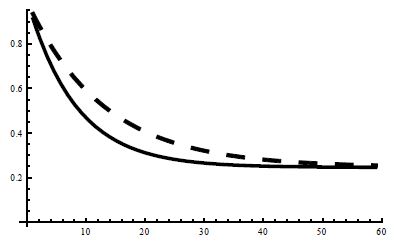
To explore the executive competence (item production), we modeled the real time performance at each second. Using a dichotomist approach (0= no item produced, 1= one item produced), the curves modeled in Figure 1 show the frequency of subjects that produced one item at each second. In general, a significant fall in production competence (curvilinear decay) is present in both verb and semantic tests. Selectivity-retrieval (abundant-scarce transition) is modeled in this sample. As expected, the verb-paradigm decline is more pronounced than the semantic-paradigm, producing a different curvilinear decay. The regression analysis revealed that both curves are fitted well with the model, because the values of R squared (coefficient of determination) are sufficiently high. The initial performance value (B3) and the asymptotic value of performance (B4) do not differ between the two groups. However, the performance rate (B2) is significantly higher (p = .01) in the verb performance group (see Table 1).

Figure 1: Curvilineal modeling for the verb (solid line), and the semantic (dashed line) performance.

Table 1: Results of the regression analysis.

Group

B2 B3 B4

R squared

The verb performance

0.122±0.015

0.912±0.044 0.246±,015

0.847

Significant level, p

0.01

>0.2

>0.2

 
The semantic performance

0.077±0.007

0.934±0.027 0.247±0.014

0.932

Note: Each coefficient value is given with its standard error.

General results are presented in Table 2. The average of production was 25.44 words for animals and 22.65 words for verbs; this result coincides with the literature (at different languages), indicating that verbs are harder to retrieve than names. Average performance is presented at each 10 second. The first-time range (1-10 seconds) represents the higher abundant item production phase, with seven verbs on average, on the second range productivity falls to 4 verbs, and progressively continues to fall at each time-range; in the 1-20 second range, half of the all the verbs are already produced. Regarding the speed of production, in the 1-10 second range one verb is produced each 1.35 seconds (on average), this speed continuously decrements, thus, in the last time range a verb is produced each 4.65 seconds (in average).

Table 2: Average production of verbs by time range.

Time range

Number of verbs Average ítem-second Relative percentage

Cumulative percentage

1-10

7.37 (1.45) 1.35 32.34

32.34

11-20

4.09 (1.34) 2.44 17.95 50.29
21-30 3.40 (1.20) 2.99 14.92

65.21

31-40

3.05 (1.45) 3.27 13.38 78.59
41-50 2.73 (1.34) 3.66 11.97

90.56

51-60

2.15 (1-02) 4.56 9.44

100.0

Semantic Neuropsychological Approach

A critical question for the semantic dimension criteria was if most verbs produced felt within these above-mentioned dimensions, and most importantly: what was the percentage of verbs that are not classified by these criteria? The main finding was that more than 80% of all verbs produced were classifiable in these semantic dimensions. By analyzing the not-classifiable verbs, abstract criteria (abstract non-psych verbs) represented 10.06 %; finally non-classifiable verbs represented only 8.14 % of all verbs produced. These results are presented in Table 3.

Table 3: Semantic production by times ranges.

1-10 11-20 21-30 31-40 41-50 51-60 Total

% **

Psych Freq

210

92 71 73 64 47 548

26.07

%*

28.49

24.33 23.58 25.00 26.77

23.85

   
Specific Freq

100

75 65 70 58 58 405

19.26

%*

13.56

19.84 21.59 23.97 24.26

29.44

   
Whole-Body Freq

214

47 35 24 33 15 367

17.45

%*

29.03

12.43 11.62 8.21 13.80

7.61

   
Instrum Freq

61

56 44 52 16 25 254

12.08

%*

8.27

14.81 14.61 17.80 6.69

12.69

   
Emotional Freq

58

26 14 19 15 14 146

6.94

%*

7.86

6.87 4.65 6.50 6.27

7.10

   
Abstract Freq

38

48 30 41 38 26 211

10.06

%*

5.15

12.69 9.96 14.04 15.89

13.91

   
Not-class Freq

56

34 42 13 15 12 171

8.14

%*

7.59

8.99 13.95 4.45 6.27

6.09


*Percentage to all verbs produced within the time range; ** Percentage to all verbs produced.

The verb production of this sample of young-university students can be properly classified in four semantic dimensions: MAV, psych verbs, abstract and emotional. Overall, the most frequently produced type of verbs was MAV (considering all three subtypes), followed by psych verbs (think, study, read); the less frequent verbs were abstract (to grant, transform, consume), and emotional (laugh, cry, love).

Results for the Selectivity (Abundant) Phase

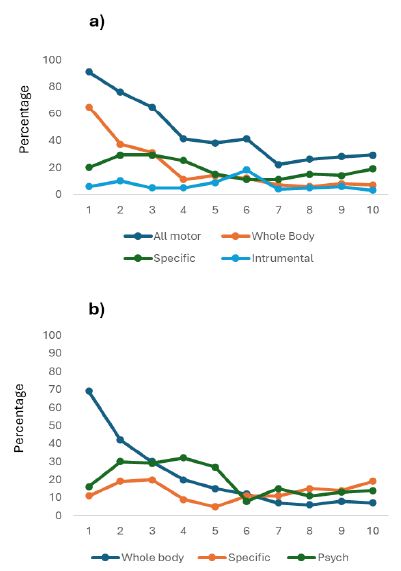
By dividing whole-body versus specific motor-action, allowing us to identify two different types of production (see Figure 2). In the 1-10 second range, whole-body actions verbs are the dominant dimension, mainly in the first 3 seconds, then a dramatic fall is presented. Specific actions verbs were produced in more discrete form, and like psych verbs follows a wave form of availability: slowly arising until reaching the highest value. The whole-body dimension presents a particularity: immediate and maximum availability, but also an immediate dramatic fall in production.

Figure 2: Real time production for the most frequent dimensions (range: 1-10 seconds).

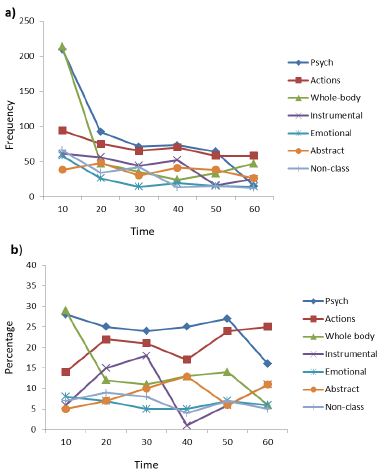
By analyzing the frequency of production within the first 20 seconds (see Figure 3), results indicate that during the abundant phase of the production, the semantic dimensions present different types of production. Whole-body and psych verbs are the only types of verbs that present a fast and high initial production (during the 10 seconds range), and both dimensions fall dramatically in their production. A more discreet pattern of production was presented by the instrumental verbs (clean, sweep, drive). Emotional and abstract verbs are situated at the bottom of the production.

Figure 3: All types of verbs produced by times range, a) frequency, b) relative percentage.

The dynamic semantic production for the whole 60 seconds is presented in Figure 3; results are divided in six intervals -10 seconds range-. Whole-body actions verbs continuously fall until the fourth interval (40´s seconds interval), where a plateau is reached. Psych verbs are the second (of only two) semantic abundant categories in the initial interval (mainly first five seconds); presenting a dramatic fall for the second interval, then showing a relative stable frequency of production from the third to the fifth interval. Specific actions verbs present a discrete decrement from the first to the third interval. These three principal semantic dimensions present a different productivity pattern along the six intervals.

Relative Percentage

The relative percentage within categories is presented in Table 3 and Figure 3b. This form of analysis illustrates that psych and specific actions verbs are the most frequently produced verbs along the different time ranges. The dynamic relative percentage of the production for each type of verb indicates that psych and specific-body verbs, remains on the top of the production. This value for the whole-body action verbs shows a less dramatic fall (see Figure 3a), indicating a more stable presence all through the 60 seconds. Instrumental verbs present an increment until the third interval, with a dramatic fall. Emotional verbs production presents discrete changes; the abstract dimension presents a similar behavior than the instrumental dimension, although with less dramatic changes observed.

Except for abstract verbs, all five semantic dimensions present the highest value at the first interval, two of them present a dramatic fall in the production (whole-body and psych), the other three only a discrete fall.

Item Fluency versus Semantic Fluency

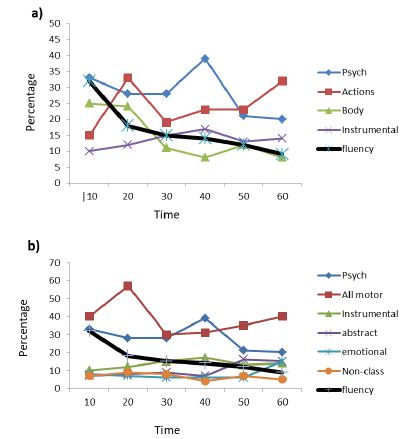
Considering the relative percentage of the fluency performance -all items produced- (Figure 4); interesting results can be noticed: although overall item fluency is diminishing during the abundant-scarce transition, the relative semantic fluency is maintained on top of the relative item fluency. This is evident for Psych and specific actions verbs, and more discretely for instrumental verbs (-a- figure). If both whole and specific motor actions are considered together (-b- figure), this effect is more evident.

As a final note it is important to state that participants also produced verbs of several different semantic dimensions; however, the relative percentage of these items was lower than 2%.

Figure 4: Comparison of overall fluency versus semantic dimensions (relative percentages).

Discussion

To our knowledge, this is the first real-time semantic-neuropsychological analysis of verbs fluency. This novel approach may represent promising cognitive and neuropsychological evaluation procedures.

Curvilinear modelling confirms significant differences in performance when comparing with the lexical-semantic paradigm. The semantics networks-correlates identified in the literature by functional neuroimaging and neuropsychological evidence, allows us to classify the great majority of verbs produced; and by identifying the abstract category, only 8% of the verbs were not-classified. However, considering that neuropsychological correlations for the abstract dimension are less clear, our proposal permits us to classify up to 82% of the verbs produced, in four semantic dimensions (or semantic templates).

In the very first seconds, whole-body-movements verbs are fast and abundantly produced, in contrast, the production of specific body-part-actions verbs arises slowly; this cognitive data differentiation parallels the functional neuroimaging evidence, indicating different brain networks [44]. However, in contrast to the functional-neuroimaging evidence, our results reflect that both types of verbs became lexically available in different forms. Our data reflects (for the first time in literature) different real-time production characteristics (frequency and sequence) between whole-body and specific body action verbs.

Why Whole-body verbs are so abundantly available at the first seconds? The great majority of these verbs are intransitive: they do not require a second agent-object to be performed; this grammatical simplicity may represent an additional factor . Another (complimentary) explanation is that every day whole-body actions are highly frequent for very-young active students, and the cognitive limitation of the testing condition: “only verbs in a limited time”, may provoke that the motor-action system activates highly available representations.

In several cognitive studies participants recall verb phrases better if they perform the physical actions described; the effect is also achieved if participants are asked to order phrases by the higher frequency of performance [45]. The imageability of the action described is also a priming factor in verb processing [46]; fictive motion comprehension (figurative motion processing: “my mind runs”) activates primary visual areas and motion sensitive visual areas [47]. Future studies may indicate if the verbs run, swim, walk, etc. present also higher imageability.

Why then are these verbs not the most overall produced? There are not many whole-body actions (or verbs), then as easy as they may be to produce, the semantic bank of this type of verb has little exemplars.

If all-motor verbs are considered together, this is the dominant semantic template; Bayram and Akbostanci [48] found that a normative group with a mean of 56 years old, produced more motor actions verbs than non-action verbs. This type of data suggests that in normative samples, motor verbs are the most type of verbs produced. We are currently finishing a report with a sample close to 200 participants from two different countries (same language) that show the relevance of the MAV production in normative samples as a preclinical neuropsychological marker, due that clinical research suggests that the presence of motor verbs may reflect healthy sensorimotor (frontal-striatal) networks (Chávez-Oliveros et al., 2023; Herrera et al. 2012; Roberts, 2015).

Specific Action Verbs

Production is more discreet at the beginning, but with constant relative production throughout the 60-second period. Differential and specific network-activation has been widely documented between specific body-part actions in healthy populations and, in brain damage patients [49]. Our data provides concrete cognitive evidence for the study of normative samples that support a methodology already used to differentiate specific versus non-specific motor/actions verbs in Parkinson disease patients.

Instrumental Verbs

This type of verb requires the most distributed neuropsychological networks along the frontal, temporal and parietal cortex [50]. Due to the complexity of the semantic-instrumental cognitive networks a higher semantic competence-processing may be required [51]. We recently reported that among the MAV the instrumental subcategory was the most affected in a sample of Parkinson disease patients.

Psych Verbs

Representing the second predominant semantic template production. Object-experiencer verbs are more cognitively demanding to produce than subject-experiencer verbs; actions that refers to concrete events requires specific semantic processing, due to their shared perceptual features for example jump versus hop, (therefore higher semantic-competence), subjective actions don’t [52]. Then, cognitive retrieval of this type of verbs may be easier than other verbs that describe concrete actions; brain correlates of psych verbs are scarce, but indicative of theory of mind networks. As with the motor division, separating abstract and emotional verbs, from subject-agency verbs, shows different initial availability and overall production. Further, a more precise analysis of subtypes of psych verbs may indicate intra-dimensional characteristics, for example the different cognitive properties (factive, negative representational, fictive representational, etc.). The factive dimension indicates the degree of certainty: “know” (I know= highly certain) versus “think”; non factive verbs denote only an intention: “promise”. Up to date a clear proposal for an intra-dimension analysis of psych verbs is not available.

Emotional Verbs

Representing the lowest frequency of verbs produced, networks for these verbs are highly constrained to limbic and paralimbic regions; therefore, the production of emotional verbs is more cognitive demanding than psych verbs. Traditionally considered as “psych” verbs, the data presented here indicates different frequency and sequence in the production characteristics than psych (non-emotional) verbs. Furthermore, as with motor-action verbs a differentiation within semantic categories (emotional vs non-emotional), suggest within brain-networks differentiation during fluency testing.

Some proposals have been developed to rate the type of emotion expressed -for example: basic versus secondary emotions-, and the frequency, valence, arousal, etc. When participants are directed to produce actions words that relate to basic emotions Cry and Laugh are among the top three most frequently generated action words for each emotion [53]. In our results, Cry and Laugh were also among the most frequent emotional verbs produced. These results suggest that if induced or not, these verbs will be produced, suggesting a specific form of action-emotion semantic organization.

Abstract Verbs

It has been described that abstract-semantic associations are scarce and vague and may be difficult to perform by a semantic template. Literature is scarce in abstract-semantic verbs, the main results indicate lesser sensorial and motor areas activation , with a significant anterior-temporal participation.

Semantic Dimensions/Templates

Our data suggests that in verb-fluency performance, four neuropsychological semantic-dimensions supported in literature (brain/neuropsychological correlates) are present. These results support the “Two level theory of verb meaning,” verbs meaning have two levels: a general framework or class, representing the thematic core -for example change of state verbs-, and a more specific level representing a specific semantic meaning -melt vs shake- [54]. When facing a verb fluency test, the output is organized in semantic templates (motor, psych, emotional, abstract), these templates are mainly neuropsychological, and not cognitive or linguistic: our results suggest that in the verb-fluency paradigm, cognitive performance is driven by specific brain networks (premotor, limbic, frontal-parietal, frontal-medial), rather than by language-lexical representations.

Some categories of verbs are harder to map and select than others [55]. Our results indicate that psych verbs and specific motor action verbs are the easiest to produce, whole body-actions present a medium degree of difficulty; finally, the hardest types of verbs to produce are emotional and abstract.

Why are verbs so hard to retrieve? verbs are not taxonomically structured as names -i.e. animals- [56]. According to Earles & Kernsten , verbs exhibit context effects more like superordinate nouns; also, verbs generally have more dictionary entries and interpretations than nouns: “catch the ball versus catching a cold”. A possible explanation for the lower semantic production (instrumental, emotional and abstract) is that verbs that implicate specific dimensions are more constrained to specific actions, been lesser in number in most languages; thus, harder to find-map and indeed to be semantically produced. If the later I correct, then motor/lighter verbs will be less produced because they present conflicting semantics (“catch”); less conflicting semantic verbs (running, swim) will be easier to produce.

The relative semantic percentage across the time range indicates that the semantic production occurs in templates that are resistant to the curvilinear decay of the item production (number of items produced).

“Surfing” the semantic system? The executive participation is -only- to navigate on top of these semantic templates? The same way a surfer cannot produce a wave, and only chooses which wave to ride (selection)? Once on top of these waves, there is not much to do, but to stay in balance (inhibitory control)? Figures 3 and 4 suggest this effect, but more research on real time cognitive/neuropsychological performance (neuroimaging) is needed to confirm-expand these initial findings.

Conclusions

The results presented here indicate that a real time/semantic-neuropsychological approach is highly plausible for the neuropsychological analysis of verb fluency testing. Several new parameters represent promising future cognitive and neuropsychological criteria (that of course requires proper validation): the semantic templates/dimensions, the initial faster and higher availability of whole-body motor verbs, and the time-range relative-percentage.

A real time analysis of the VF performance is necessary to discover different neuropsychological features of executive-semantic performance. We believe that the high content of motor-action verbs may represent neuropsychological markers of a healthy brain. Disruption of these semantic-neuropsychological templates may occur in brain-impairment pathologies e.g. Parkinson, Traumatic brain injury, affecting cognitive efficiency; but of course, clinical validation is required.

The motor-action dimension for neuropsychology is fundamental, literal and figurative language is full of actions (“grasp the idea”). Literature progressively indicates the close relation of motor-language verbs/actions and the optimal functioning of fronto-striatal functioning [57-59]. Also, the high presence of psych verbs is relevant for another fundamental field on human cognition: mentalization/theory of mind, and may represent an additional neuropsychological dimension for autism disorder spectrum.

Limitations and Future Directions

A wider evaluation and replication with several hundred participants of different age-school years (from different countries-language-cultures) are required; also, different interrater agreements from different research groups are required to achieve proper validation (e.g. kappa analysis).

References

  1. Allendorfer JB, Kissela BM, Holland SK, Szaflarski JP (2012) Different patterns of language activation in post-stroke aphasia are detected by overt and covert versions of the verb generation fMRI task. Medical Science Monitor 18(3): 135-137. [crossref]
  2. Chávez-Oliveros M, Flores-Lázaro, JC, Meza, HD, Ramírez-Burgos W (2023) Sequential production of motor-action verb subtypes in Parkinson’s disease patients. Dementia & Neuropsychologia 17:e20220027. [crossref]
  3. Herrera, E. Cuetos F, Ribacoba R (2012) Verbal Fluency in Parkinson’s Disease Patients on/off Dopamine Medication. Neuropsychologia 50(14): 3636-3640. [crossref]
  4. Stokholm, J. JØrgensen K, Vogel A (2013) Performances on five verbal fluency tests in a healthy, elderly Danish sample. Aging Neuropsychology and Cognition. 20(1): 22-33. [crossref].
  5. Vigliocco G, Vinson DP. Druks, J. Barber, H, Cappa SF (2011) Nouns and verbs in the brain: a review of behavioural, electrophysiological, neuropsychological and imaging studies. Neuroscience and Biobehavioral Review 35(3): 407-26. [crossref]
  6. White AS, Hacquard V, Lidz J (2018) Semantic Information and the Syntax of Propositional Attitude Verbs. Cognitive Science 42(2): 416-456. [crossref]
  7. Engelberg S (2014) The argument structure of psych-verbs: A quantitative corpus study on cognitive entrenchment. In: Boas H, Ziem A (eds.): Constructional approaches to argument structure in German. Boston, Berlin: De Gruyter Mouton. Part 1, 47-84.
  8. Herrera E, Rodríguez-Ferreiro J, Cuetos F (2012) The effect of motion content in action naming by Parkinson’s disease patients. Cortex 48(7): 900-904. [crossref]
  9. Kemmerer, D. González-Castillo J, Talavage, T. Paterson S, Wiley C (2008) Neuroanatomical Distribution of Five Semantic Components of Verbs: Evidence From fMRI. Brain and Language 107(1): 16-43. [crossref]
  10. Moseley RL, Pulvermüller F (2014) Nouns, verbs, objects, actions, and abstractions: local fMRI activity indexes semantics, not lexical categories.Brain and Language 132(100): 28-42. [crossref]
  11. Kemmerer D (2015) Are the motor features of verb meanings represented in the precentral motor cortices? Yes, but within the context of a flexible, multilevel architecture for conceptual knowledge. Psychonomic Bulletin & Review 22(4): 1068-75. [crossref]
  12. Pulvermüller F (2005) Brain mechanisms linking language and action. Nature Review Neuroscience 6(7): 576-82. [crossref]
  13. Cavina-Pratesi C, Connolly JD, Monaco S, Figley TD, Milner AD, et al. (2018) Human neuroimaging reveals the subcomponents of grasping, reaching and pointing actions. Cortex 98: 128-148. [crossref]
  14. Filimon F (2018) Human Cortical Control of Hand Movements: Parietofrontal Networks for Reaching, Grasping, and Pointing. The Neuroscientist 16(4): 388-407. [crossref]
  15. Vesia, M. Barnett-Cowan M, Elahi B, Jegatheeswaran G, Isayama R, et al. (2017) Human dorsomedial parieto-motor circuit specifies grasp during the planning of goal-directed hand actions. Cortex 92: 175-186. [crossref]
  16. Péran P, Démonet JF, Cherubini A, Carbebat D, Caltagirone C, Sabatini U (2010) Mental representations of action: the neural correlates of the verbal and motor components. Brain Res; 1328: 89-103. [crossref]
  17. Pavlova AA. Butorina AV, Nikolaeva AY, Prokofyev AO, Ulanov MA, et al. (2019) Effortful verb retrieval from semantic memory drives beta suppression in mesial frontal regions involved in action initiation. Human Brain Mapping 40(12): 3669-3681. [crossref]
  18. Roberts, A. Nguyen P, Orange JB, Jog, M. Nisbet KA. et al. (2017) Differential impairments of upper and lower limb movements influence action verb processing in Parkinson disease. Cortex 97: 49-59. [crossref]
  19. Andres M, Finocchiaro C, Buiatti M, Piazza M (2015) Contribution of motor representations to action verb processing. Cognition Neuropsy 134: 174-84. [crossref]
  20. Dalla Volta R, Avanzini P, De Marco D, Gentilucci M, Fabbri-Destro M (2018) From meaning to categorization: The hierarchical recruitment of brain circuits selective for action Cortex 100: 95-110. [crossref]
  21. Pelgrims, B. Olivier, E, Andrés M (2011) Dissociation between manipulation and conceptual knowledge of object use in the supramarginalis gyrus. Human Brain Mapping 32(11): 1802-10. [crossref]
  22. Yang J, Shu H, Bi Y, Liu Y, Wang X (2011) Dissociation and association of the embodied representation of tool-use verbs and hand verbs: An fMRI study. Brain and Language 119 3: 167-174. [crossref]
  23. Osiurak F, Federico G, Claidière N (2023) Technical reasoning: neither cognitive instinct nor cognitive gadget. Trends in cognitive sciences. 27(4): 339-340. [crossref]
  24. Brennan J, Pylkkänen L (2008) Processing events: behavioral and neuromagnetic correlates of Aspectual Coercion. Brain and Language 106(2): 132-43. [crossref]
  25. Nazlidou Moraitou D, Natsopoulos D, Papaliagkas V, Masoura, E. Papantoniou G (2018) Inefficient understanding of non-factive mental verbs with social aspect in adults: comparison to cognitive factive verb processing. Neuropsychiatry Disease and Treatment 10(14): 2617-2631. [crossref]
  26. Alexiadou A, Gianina Iordachioaia G (2014) The psych causative alternation. Lingua 148: 53—79.
  27. Girn M, Setton, R, Turner, GR, Spreng, R. N (2024) The “limbic network,” comprising orbitofrontal and anterior temporal cortex, is part of an extended default network: Evidence from multi-echo fMRI. Network neuroscience 8(3): 860-882. [crossref]
  28. Vigliocco G, Kousta ST, Della Rosa PA, Vinson DP, Tettamanti M, et al. (2014) The neural representation of abstract words: the role of emotion. Cerebral Cortex 24(7): 1767-1777. [crossref]
  29. Rodríguez-Ferreiro, J. Gennari SP. Davies, R, Cuetos F (2011) Neural Correlates of Abstract Verb Processing. Journal of Cognitive Neuroscience 23(1): 106-18. [crossref]
  30. Moseley, R, Carota, F, Hauk, O, Mohr, B, Pulvermüller F (2012) A role for the motor system in binding abstract emotional meaning. Cortex 22(7): 1634-1647. [crossref]
  31. Kissler J, Herbert C (2013) Emotion, Etmnooi, or Emitoon?–Faster lexical access to emotional than to neutral words during reading. Biological Psychology 92(3): 464-79. [crossref]
  32. Palazova, M, Mantwill, K, Sommer, W, Schacht A (2011) Are effects of emotion in single words non-lexical?Evidence from event-related brain potentials. Neuropsychologia 49(9): 2766-75. [crossref]
  33. Palazova, M, Sommer, W, Schacht A (2013) Interplay of emotional valence and concreteness in word processing: an event-related potential study with verbs. Brain and Language 125(3): 264-71. [crossref]
  34. Dalla Volta, R, Fabbri-Destro, M, Gentilucci, M. Avanzini P (2014) Spatiotemporal dynamics during processing of abstract verbs: an ERP study. Neuropsychologia 61: 163-174. [crossref]
  35. Sakreida, K, Scorolli, C, Menz MM, Heim, S, Borghi AM. et al. (2013) Are abstract action words embodied? An fMRI investigation at the interface between language and motor cognition. Frontiers in Human Neuroscience 9: 7: 125. [crossref]
  36. Muraki, EJ, Pexman, PM, Binney, R. J. (2025) Mapping Contributions of the Anterior Temporal Semantic Hub to the Processing of Abstract and Concrete Verbs. Human brain mapping 46(6): e70210. [crossref]
  37. Stuss DT, Alexander MP, Hamer, L, Palumbo, C, Dempster, R, et al. (1998) The effects of focal anterior and posterior brain lesions on verbal fluency. Journal of the International Neuropsychological Society 4(3): 265-78. [crossref]
  38. Amieva, H, Jacqmin-Gadda, H, Orgogozo, JM, Le Carret N, Helmer C, et al. (2005) The 9 year cognitive decline before dementia of the Alzheimer type: a prospective population-based study. Brain 128: 1093-101. [crossref]
  39. Hirshorn EAThompson-Schill SL (2006) Role of the left inferior frontal gyrus in covert word retrieval: neural correlates of switching during verbal fluency. Neuropsychologia. 44(12): 2547-57. [crossref]
  40. Snyder HR, Munakata Y (2013) So many options, so little control: abstract representations can reduce selection demands to increase children’s self-directed flexibility. Journal of Experimental Child Psychology 116(3): 659-73. [crossref]
  41. Vonberg, I, Ehlen, F, Fromm, O, Klostermann F (2014) The absoluteness of semantic processing: lessons from the analysis of temporal clusters in phonemic verbal fluency. Proceedings of the Library of Science One9(12): e115846. [crossref]
  42. Lev-Ari S, Keyzar B (2014) Executive control influences linguistic representations. Memory and Cognition 42(2): 247-63. [crossref]
  43. Diaz-García, L. Chávez-Oliveros MA, Flores-Lázaro JC (2025) Efecto del envejecimiento sobre el contenido motor en la fluidez de verbos. Revista Española de Geriatría y Gerontología.
  44. Mollo, G. Pulvermüller, F, Hauk O (2016) Movement priming of EEG/MEG brain responses for action-words characterizes the link between language and action. Cortex 74: 262-276. [crossref]
  45. Earles JL, Kernsten AW (2017) Why Are Verbs So Hard to Remember? Effects of Semantic Context on Memory for Verbs and Nouns. Cognitive Science 41(4): 780-807. [crossref]
  46. Xu, X, Kang, C, Guo T (2016) Imageability and semantic association in the representation and processing of event Cognitive Processing 17(2): 175-184. [crossref]
  47. Romero Lauro LJ, Mattavelli, G, Papagno, C, M (2013) She runs, the road runs, my mind runs, bad blood runs between us: literal and figurative motion verbs: an fMRI study. Neuroimag 83: 361-71. [crossref]
  48. Bayram, E, Akbostanci MC (2018) Verb naming fluency in hypokinetic and hyperkinetic movement disorders. Cortex 100: 21-31. [crossref]
  49. Taylor LJ, Evans, C, Greer, J, Senior, C, Coventry KR, et al. (2017) Dissociation between Semantic Representations for Motion and Action Verbs: Evidence from Patients with Left Hemisphere Lesions. Frontiers in Human Neuroscience 11: 35. [crossref]
  50. Ishibashi, R, Pobric, G, Saito, S, Lambon R (2016) The neural network for tool-related cognition: An activation likelihood estimation meta-analysis of 70 neuroimaging contrasts. Cognitive Neuropsychology. 33(3-4): 241-256. [crossref]
  51. Watson, CE, Buxbaum, L. J (2014) Uncovering the architecture of action semantics. Journal of experimental psychology. Human perception and performance 40(5): 1832-1848. [crossref]
  52. Brennan, J, Pylkkänen L (2010) Processing psych verbs: Behavioural and MEG measures of two different types of semantic complexity. Language and Cognitive Processes 25(6): 777-807.
  53. Portch, E. Havelka, J. Brown, C, Giner-Sorolla R (2015) Using affective knowledge to generate and validate a set of emotion-related, action words. PeerJ 3: e1100.[crossref]
  54. Kemmerer, D, Gonzalez Castillo J (2010) The Two-Level Theory of Verb Meaning: An Approach to Integrating the Semantics of Action With the Mirror Neuron System. Brain and Language 112(1): 54-76. [crossref]
  55. Hartshorne JK. O’Donnell TJ. Sudo, Y. Uruwashi, M. Lee, et al. (2016) Psych verbs, the linking problem, and the acquisition of language. Cognition 157: 268-288.
  56. Bauer, M, Saldert C (2019) Complex oral semantic verbal fluency in non-brain-damaged adults and individuals with multiple sclerosis and subjective anomia. Aphasiology 34(12): 1471-1486.
  57. Nisticó, R. Cerasa, A. Olivadese, G. Dalla Volta, R, Crasá, Vasta R. et al. (2019) The embodiment of language in tremor-dominant Parkinson’s disease patients. Brain and Cognition 135: 103586. [crossref]
  58. Carota F, Moseley R, Pulvermüller F (2012) Body-part-specific representations of semantic noun categories. Journal of Cognitive Neuroscience 24(6): 1492-509. [crossref]
  59. Pulvermüller. F. Moseley RL, Egorova N, Shebani Z, Boulenger. V (2014) Motor cognition-motor semantics: action perception theory of cognition and communication. Neuropsychologia 55: 71-84. [crossref]

Fundamental Mechanism of Qianghuo in the Treatment of Leukemia Based on Network Pharmacology and Molecular Docking Combined with Preclinical Evaluation

DOI: 10.31038/JPPR.2025812

Abstract

Background: The Qianghuo herb pair is renowned in traditional Chinese medicine (TCM) for its blood-activating and stasis-resolving properties, frequently incorporated into formulas for leukemia treatment. However, the specific relationship between the Qianghuo herb pair and leukemia, along with its underlying mechanisms, remains elusive. Based on network pharmacology and molecular docking technology, explore the relevant targets of Qianghuo and its mechanisms in treating leukemia.

Method: Diverse databases were utilized to investigate the chemical components and their respective targets of Qianghuo, alongside acquiring disease-related target information. A network relationship diagram of Qianghuo’s active ingredients, targets, and diseases was constructed using Cytoscape 3.8.2 software. Protein-protein interaction (PPI) networks were created and potential pathways were explored through Gene Ontology (GO) and Kyoto Encyclopedia of Genes and Genomes (KEGG) analysis. Molecular docking was utilized to assess the interactions between active ingredients and potential targets.

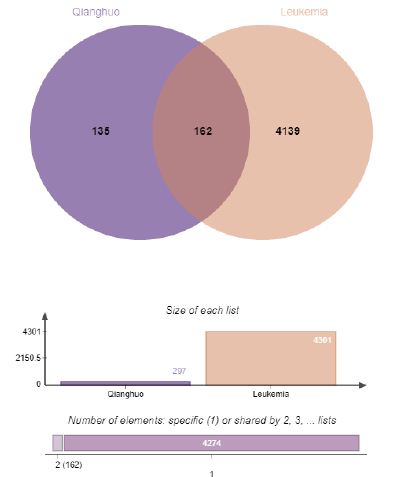
Result: In Qianghuo, a total of 15 active ingredients and 554 corresponding targets were obtained. The main active ingredients include Ammidin, 6’-Feruloylnodakenin, 8-geranoxy-5-methoxypsoralen, coumarin, glycoside, Demethylfuropinnarin, Bergaptin, etc. Among them, 162 targets intersect with drug-disease interactions, with AKT1, EGFR, SRC, CASP3, and HSP90AAA1 identified as core targets. Functional enrichment analysis of Gene Ontology (GO) yielded 870 entries, while Kyoto Encyclopedia of Genes and Genomes (KEGG) pathway analysis identified 154 pathways, notably including Pathways in cancer, PI3K-Akt signaling pathway, and Human papillomavirus infection. Molecular docking simulations revealed significant binding affinity between the main active ingredient of the drug and the core target proteins.

Conclusion: This study successfully elucidates the mechanism of action of Qianghuo in treating leukemia, predicts the potential targets of traditional Chinese medicine, elucidates complex signaling pathways, and demonstrates its therapeutic characteristics of multi-components, multi-targets, and multi-pathways. This provides a basis for exploring alternative approaches to researching novel leukemia drugs at the level of network pharmacology.

Keywords

Qianghuo, Leukemia, Network pharmacology, Bioinformatics, Molecular docking

Introduction

Leukemia is a malignant hematological disease with a high incidence in our country, which usually occurs in children and adolescents [1]. It is categorized into four types based on cell differentiation and disease progression: chronic lymphocytic leukemia (CLL), chronic myeloid leukemia (CML), acute lymphoblastic leukemia (ALL), and acute myeloid leukemia (AML). Among them, acute myeloid leukemia stands as the most prevalent, constituting approximately 70% of adult leukemias. This disease develops rapidly, with its natural course typically lasting only a few months. Studies indicate a close association between leukemia and various factors such as genetics, smoking, obesity, alcoholism, exposure to chemical agents (like benzene, formaldehyde, etc.), high-dose radiation, and contact with electromagnetic fields [2-4]. Currently, leukemia treatment methods encompass chemotherapy, immunotherapy, targeted therapy, etc. However, owing to the clonal biological traits inherent in leukemia, the cure rate remains low. Prolonged chemotherapy often induces a sharp decline in the patient’s physical resilience, potentially leading to complications such as bleeding and infection. Hence, the pursuit of novel leukemia drugs with potent efficacy at affordable costs has emerged as a focal point in drug research and development. Traditional Chinese medicine (TCM), with its notable advantages including affordability, minimal side effects, and evident therapeutic effects, has garnered attention as a promising avenue in current drug research and development [5,6].

Qianghuo documented in “Shen Nong’s Materia Medica”, consists of the dried rhizome and root of Qianghuo or Qianghuo Latifolia, belonging to the Umbelliferae family. It holds significance as one of the vital and precious medicinal resources in our country. Qianghuo is mainly composed of sugars, volatile oils, coumarin and other ingredients [7]. The synergy of these components addresses various health issues. It is reported that Qianghuo has anti-inflammatory, analgesic, antipyretic, antibacterial, anti-cancer cell proliferation, anti-arrhythmic, anti-thrombosis and promotion of brain blood circulation effects [8]. Its clinical versatility spans multiple disciplines, with applications in conditions like cancer, cardiovascular and cerebrovascular diseases, rheumatology, and immunology, among others. Despite its widespread clinical use, there remains a gap in understanding the mechanism of Qianghuo in treating leukemia.

Therefore, in order to clarify the effect and mechanism of Qianghuo in the treatment of leukemia, and to expand its clinical application, the potential targets and core active ingredients of Qianghuo anti-leukemia were screened by compound network pharmacology approach in this study. Then, the core active components and the core targets that exert anti-leukemia effects were reverse verified by molecular docking technology. Subsequently, the signaling pathway of Qianghuo in the treatment of leukemia was elucidated, and the therapeutic effect of Qianghuo in leukemia was predicted. These results provide ideas and directions for elucidating the mechanism of Qianghuo in the treatment of leukemia at the molecular level.

Materials and Methods

Software and Databases

Databases used: Drug ingredients and target acquisition database TCMSP (https://tcmspw.com/tcmsp.php), disease target acquisition database Gene Cards (https://www.genecards.org/), OMIM database (https://www.omim.org/), Therapeutic Target Database (http://db.idrblab.net/ttd); Protein information acquisition database (https://www.uniprot.org/); Gene interaction database String (https://www.string-db.org/); Intersection gene acquisition Venny 2.1 (http://bioinfogp.cnb.csic.es/tools/venny/index.html); Software used: Cytoscape V3.8.0 software [9], AutoDock 1.5.7 [10], Openbabel, Pymol [11].

Acquisition of Active Ingredients of Qianghuo and Screening of Targets

With the help of the TCMSP database, the corresponding active ingredients were searched using the keyword “Qianghuo”, and the two indicators of oral bioavailability (OB) ≥ 30% and drug likeness (DL) ≥ 0.18 were set as filtering conditions. Under the Related Targets column, search for target proteins related to the effective active ingredients respectively; then use the Uniprot database and Perl language to standardize the human gene names corresponding to the target proteins.

Obtaining Leukemia Target Proteins

Use OMIM, Genecards, TTD, DisGNET database and other databases, search with “leukemia” as the keyword, select the species as Homo sapiens, and obtain leukemia-related targets. The targets of the database were merged and duplicate targets were removed and corrected by Uniport as the final result of leukemia-related targets for subsequent analysis. Use the WeChat website to draw a Venn diagram of compounds and disease targets.

Construct a Nodule-active Ingredient-Target-Disease Interaction Network and Active Ingredients-Target-Pathway Network Diagram

First, we’ll match the target genes of the active ingredients of Qianghuo obtained from the TCMSP database with leukemia-related target genes. Then, using the WeChat website, we’ll draw a compound-disease target network. The intersection targets will be visualized through a Venn diagram to identify key targets specific to Qianghuo in treating leukemia. Next, we’ll submit the obtained intersection targets to the String11.0 database, setting the biological species as “Homo sapiens” to construct a protein interaction network. Finally, we’ll import the data into Cytoscape 3.7.1 for Network analysis and then screen the core targets based on degree values.

GO Function and KEGG Function Enrichment Analysis

DAVID 6.8 database was used for GO analysis, and the key targets were analyzed in the four modules of Biological process (BP), Cellular component (CC) and Molecular function (MF), and Kyot Encyclopedia of genes and genomes (KEGG). Analysis to identify key targets and enriched pathways.

Molecular Docking of Important Components and Core Targets of Qianghuo

Use the PubChem database to obtain the small molecule structure, save it in sdf format, convert the format in Openbable software, and save it in mol2 format. Download the protein structure of the relevant target through the PDB database, use Pymol software to remove water and ligands, and save it in pdb format. Finally, the database Auto Dock Vina is used to preprocess the small molecule ligands and protein receptors, and its plug-in is used to obtain docking active sites and perform molecular docking to obtain the lowest binding energy for docking between the target protein and the compound. Pymol software is used for visualize the docking results [12].

Results and Discussion

Traditional Chinese herbal medicine serves as a vital reservoir for the development of effective anticancer drugs, offering numerous active molecules with unique structures that can inspire the creation of novel therapeutics. Moreover, the rapid advancements in network pharmacology provide robust support for understanding the mechanisms underlying Chinese herbal medicine’s efficacy in cancer treatment [13]. Qianghuo, as a traditional Chinese medicinal material, has emerged as a research hotspot in recent years, and its compound preparations, action targets, pharmacological activities and other aspects have been continuously explored. Research has demonstrated that Qianghuo contains compounds with varying degrees of inhibitory effects on the proliferation of various cancer cells. This highlights its potential as a promising candidate for further exploration in anticancer drug development. Yang and co-works investigated the two major active ingredients in Qianghuo, nodol and isoimperatorin, and confirmed their inhibitory effects on the proliferation of rat fibroblast-like synovial cells [14]. Notably, the inhibitory effect of isoimperatorin was found to be superior to that of chanzolinol. Chang and co-works discovered the association of the SET domain-containing 2 (SETD2) gene with acute lymphoblastic leukemia [15]. Using this discovery as a starting point, they conducted sub-docking and molecular dynamics simulations. Their findings indicated that coniferin and coniferyl ferulate exhibit high affinity with the SETD 2 protein, demonstrating strong binding affinity and stable interaction. Importantly, coniferyl ferulate can be isolated from Rhizoctonia latifolia. Therefore, the traditional Chinese medicine compound coniferyl februate emerges as a promising lead compound with potential to develop into an anti-leukemia drug. While the aforementioned research findings offer valuable insights into the treatment of leukemia with Qianghuo, much remains to be explored regarding its active ingredients and pharmacological mechanisms. Therefore, further research in this area is necessary to elucidate these aspects and unlock the full therapeutic potential of Qianghuo in leukemia treatment.

Screening of Active Compounds and Targets of Qianghuo

Utilizing the TCMSP database, a total of 185 compounds contained in Qianghuo were collected. According to the ADME standard, which sets two parameter standards of OB≥30% and DL≥0.18, a total of 16 compounds were screened, primarily including Ammidin, 6′-Feruloylnodakenin, Bergaptin, sitosterol, etc., (Table 1 and Figure 1). Concurrently, we acquired a total of 554 targets associated with the drug ingredients. To standardize the protein target information, we utilized the UniProt database, specifically focusing on the “human” species. After merging the data, 297 duplicate values were removed.

Table 1: Information on the active ingredients of Qianghuo screened in TCMSP. OB, oral bioavailability; DL, drug-likeness.

MOL ID

Name Compound OB (%)

DL

MOL001941 QH1 Ammidin

34.55

0.22

MOL011962 QH2 6′-Feruloylnodakenin

32.02

0.67

MOL011963 QH10 8-Geranoxy-5-methoxypsoralen

40.97

0.5

MOL011968 QH11 coumarin

33.07

0.78

MOL011969 QH3 Demethylfuropinnarin

41.31

0.21

MOL011971 QH12 Diversoside

67.57

0.31

MOL011975 QH13 Notoptol

62.97

0.48

MOL001951 QH4 Bergaptin

41.73

0.42

MOL001956 QH5 Cnidilin

32.69

0.28

MOL000359 QH6 Sitosterol

36.91

0.75

MOL004792 QH14 Nodakenin

57.12

0.69

MOL000358 QH15 beta-Sitosterol

36.91

0.75

MOL001942 QH7 Isoimperatorin

45.46

0.23

MOL002644 QH8 Phellopterin

40.19

0.28

MOL002881 QH9 Diosmetin

31.14

0.27

Figure 1: Compound structural formula.

Leukemia-related Targets

Through the Genecards, TTD, and DisGNET databases, we conducted a keyword search for “leukemia”. We obtained 31 targets from the TTD database, 3507 targets from the Genecards database based on empirical screening with correlations greater than 1.5, and 2111 targets from the DisGeNET database. The targets obtained from the two databases were merged, deduplicated, corrected, and integrated using UniProt. These results constitute the final set of targets related to leukemia for subsequent analysis, totaling 4301 targets (Figure 2).

Figure 2: Venn diagram of the intersection targets between Qianghuo and leukemia.

Construction of PPI Network and Screening of Core Proteins

The intersection of the target genes related to the chemical components of Qianghuo and the leukemia target genes was obtained through Venny 2.1.0 and a venn diagram was generated. In the diagram, blue represents the target points of the active ingredients in Qianghuo, totaling 297, while red represents the targets of leukemia, totalling 4301. The overlapping area in the middle of blue and red represents the intersection target, totalling 162, as illustrated in Figure 2. The resulting 162 intersection genes were submitted to the STRING database to analyze the PPI network, as depicted in the Figure 3. The graph comprises 161 nodes and 1982 edges, with an average node degree of 24.6 and a local clustering coefficient of 0.565. Among them, according to the degree value, the top five targets are AKT1, EGFR, SRC, CASP3 and HSP90AA1, in Table 2. Similarly, the top five active ingredients in Qianghuo are Diosmetin, Cnidilin, Bergaptin, and Ammidin and Phellopterin in Table 3. The AKT1, EGFR, SRC, and CASP3 are the hub nodes of the network and can be regarded as potential key targets for the treatment of leukemia by Qianghuo. Akt, a serine/threonine kinase expressed in three isoforms (Akt1, Akt2, and Akt3), acts as the main effector of the PI3K signalling pathway. Its numerous substrates regulate various cellular processes such as protein synthesis, cell cycle progression, cell survival, apoptosis, angiogenesis [16].

Figure 3: Protein interaction map.

Table 2: The top five targets in Drug-ingredient-intersection target-disease network.

Gene

Degree

AKT1

100

EGFR

89

SRC

89

CASP3

84

HSP90AA1

81

Table 3: The top five compounds in Drug-ingredient-intersection target-disease network.

Compounds name

Degree

Diosmetin

58

Cnidilin

52

Bergaptin

43

Ammidin

41

Phellopterin

38

The PI3K-Akt-mTOR pathway, aberrantly upregulated in cancers including AML, plays a critical role in intracellular signalling [17]. Daniela Bres Sanin et al. [18] demonstrated that targeting the PI3K/Akt/mTOR pathway at different levels can effectively combat cancer cells, leading to the development of dual inhibitors that show efficacy against T-ALL cell lines and primary patient samples. The strong cytotoxic effect of targeting the PI3K/Akt/mTOR pathway demonstrates promising potential for the treatment of T-cell acute lymphoblastic leukemia (T-ALL). Epidermal growth factor receptor (EGFR), a member of the receptor tyrosine kinase (TK) family, is widely expressed in various cancers, including breast cancer, lung cancer, esophageal cancer, and head and neck cancer. EGFR and its family members play pivotal roles in complex signaling cascades that regulate tumor cell growth, differentiation, adhesion, migration, and survival. Consequently, they have emerged as promising candidates for cancer treatment [19]. SRC, a proto-oncogene tyrosine protein kinase, belongs to the non-receptor protein tyrosine kinase family [20]. This family is involved in a plethora of crucial cellular functions essential for maintaining cellular homeostasis, including cell cycle progression, motility, proliferation, differentiation, and survival. Small tyrosine kinase inhibitors have been indicated for the treatment of certain blood malignancies, including CML [21]. Zhang He et al. [22] discovered that SRC tyrosine kinase inhibitors exert an anti-tumor cell role by regulating EGFR and its downstream signaling pathways, which significantly inhibits tumor cell proliferation and infiltration. This finding provides valuable insights for the development of drugs for leukemia treatment. Based on previous research, it has demonstrated potential in leukemia treatment by influencing multiple proven effective targets. These findings suggest that these ingredients play a crucial role in the treatment of leukemia.

Construct Traditional Chinese Medicine-Active Ingredients-Target-Disease and Active Ingredients-Target-Pathway Network Diagram

Import the intersection genes into CytoScape 3.8.0 software to construct a drug-component-target-disease network diagram, as shown in Figure 4. Each goal in the diagram can correspond to one or more components, and the same component can be associated with multiple goals. This shows that Qianghuo has multi-component and multi-target properties in treating leukemia. At the same time, we also constructed a component-target-pathway network diagram, as shown in Figure 5. The top five genes by degree are shown in Table 4. The top five pathways are PI3K-Akt signaling pathway, Human papillomavirus infection, MicroRNAs in cancer and Chemical carcinog, Enesis – reactive oxygen species, Proteoglycans in cancer (Table 5). The above results indicate that the PI3K-Akt signaling pathway is one of the important ways to explore the mechanism of proteoglycans in the treatment of leukemia.

Figure 4: Construction of “herb-active ingredient-target-disease” network.

Figure 5: Construct a network diagram of Qianghuo’s active ingredients-genes-pathway.  In the figure, orange ovals represent genes, light green squares represent signaling pathways, and blue squares represent active components.

Table 4: The top five targets in Drug-ingredient-intersection target pathway network.

Gene

Degree

PIK3CA

15

PIK3CB

15

PIK3CD

15

MTOR

12

MAP2K1

11

Table 5: The top five compounds in Drug-ingredient-intersection target pathway network.

Pathway

Degree

PI3K-Akt signaling pathway

34

Human papillomavirus infection

29

MicroRNAs in cancer

26

Chemical carcinogenesis – reactive oxygen species

25

Proteoglycans in cancer

24

In the figure, the red inverted triangle represents the disease, the blue square represents the intersection target, the green ellipse represents the active ingredient of traditional Chinese medicine, and the pink triangle represents traditional Chinese medicine.

GO and KEGG Enrichment Analysis Results

To elucidate the potential mechanism of action of Qianghuo in the treatment of leukemia, the 162 common targets were imported into the DAVID database for KEGG and GO analysis. The KEGG pathway analysis revealed enrichment in 154 pathways, with prominent pathways including Pathways in cancer, PI3K-Akt signalling pathway (Figure 6), and Human papillomavirus infection (Figure 7A).

Figure 6: The PI3K-AKT signaling pathway that is the target of Qianghuo treatment of leukemia.

Concurrently, 870 GO biological processes were identified, with 152 related to molecular functions (MF). The top three significantly enriched MF terms were “protein binding,” “ATP binding,” and “protein serine/threonine/tyrosine kinase activity.” Additionally, 634 GO biological processes were linked to biological processes (BP), with the top three enriched terms being “signal transduction,” “protein autophosphorylation,” and “negative regulation of apoptotic process.” Furthermore, 84 GO terms were associated with cellular components (CC), with the top three enriched terms being “cytosol,” “cytoplasm,” and “plasma membrane” (Figure 7B). Among them, the PI3K-AKT pathway has been proven to play an important role in the occurrence and development of leukemia and is a key target for the treatment of leukemia [23]. The PI3K/AKT pathway is involved in cell growth, proliferation, and differentiation, and is often activated in cancer due to various mechanisms such as dysregulation of intrinsic components, mutations in upstream receptors, and/or abnormalities in other interacting signaling molecules [24,25]. Gan and others [26] found that overexpression of miR-217 can inhibit the abnormal activation of the PI3K/Akt pathway by targeting the expression of Akt3, thereby inhibiting cell proliferation, promoting tumor cell apoptosis, and enhancing the sensitivity of doxorubicin to AML. Veronika Ecker et al. [27] reported that the PI3K/AKT pathway can promote the oxidative metabolism pathway in CLL through mar AKTI overexpression, genetic phosphatase SH2-containing-inositol-5′- phosphatase-1 (SHIP1) deletion, or through SHIPI inhibition are activated, leading to the formation of toxic ROS levels. These events ultimately lead to the accumulation of toxic reactive oxygen species (ROS). These findings suggest that the anti-leukemia effect of Qianghuo may be related to multiple signaling pathways, including the PI3K/AKT pathway and oxidative metabolism pathway. Understanding these molecular mechanisms could provide valuable insights into Qianghuo’s efficacy in leukemia treatment.

Figure 7: GO and KEGG enrichment analysis in overlapping targets. (A) KEGG enrichment was consist of the top 10 pathways following the gene ratio. (B) The three sections from left to right were the top five main pathway bubble plots of BP, CC, MF. GO, Gene Ontology; KEGG, Kyoto Encyclopedia of Genes and Genomes; BP, biological process; CC, cellular component; MF, molecular function.

Molecular Docking Results

Molecular docking was performed for the hub active ingredients Diosmetin, Cnidilin, Bergaptin, and Ammidin with the core targets AKT1, EGFR, SRC, and CASP3 respectively. Part of the molecular docking results are shown in the Table 7, while the detailed docking results for ligands and receptors are provided in Table 6. In molecular docking, a lower the binding energy indicates a more stable conformation, and a binding energy less than negative five indicates that the ligand and receptor can spontaneously combine. The molecular docking results were consistent with the network pharmacology-related screening results, thereby further validating the reliability of the predicted targets from network pharmacology through molecular docking.

Table 6: Molecular docking visualization of the hub ingredients and hub targets of Qianghuo tablets for the treatment of leukemia.

Table 7: Molecular docking results of core targets.

Conclusion

In summary, this study used network pharmacology methods to analyze the mechanism of action of Qianghuo in the treatment of leukemia. It was found that the core active ingredients of Qianghuo in the treatment of leukemia are Cnidilin, Bergaptin, Ammidin, and Diosmetin. By stimulating the cancer signalling pathway, PI3K-Akt signalling pathway, Human cytomegalovirus infection and other pathways, it affects AKT1, EGFR, SRC, and CASP3, and other targets. It plays a role in complex signalling cascades that resist cancer cell proliferation and regulate tumor cell growth, differentiation, adhesion, and survival, thereby effectively inhibiting the infiltration of cancer cells and promoting the recovery of leukemia patients. At the same time, The targeted disease network shows that Qianghuo not only has a good therapeutic effect on cancer, but also has a good effect on other diseases such as rheumatoid, nutritional and metabolic diseases, indicating that different diseases can be treated with the same prescription. Compared with western medicine, which has severe side effects and high cost in treating leukemia, Qianghuo has absolute advantages in treating leukemia with low side effects and low price. In short, we provide an entry point into the mechanism of action of Qianghuo in the treatment of leukemia, and also provide a scientific basis for the treatment of leukemia by Qianghuo. In the next step, in vitro and in vivo experimental verification will be conducted to clarify the specific mechanism of Qianghuo in treating leukemia.

Funding

This work was supported by the Hubei Science and Technology Program (2022CFB781), the Hubei University of Science and Technology (Doctoral Startup Fund Project 170562), and Hubei Provincial Department of Education scientific research guidance project (B2022189).

Conflict of Interest

The authors have no conflicts of interest to declare.

References

  1. Liu X, Ye F, Wu J, How B, Li W, et al. (2015) Signaling proteins and pathways affected by flavonoids in leukemia cells. Nutr Cancer 67: 238-249. [crossref]
  2. Nikkila A, Erme S, Arvela H, Holmgren O, Raitanen J, et al. (1975) Background radiation and childhood leukemia: A nationwide register-based case-control study. Int J Cancer 139: 1975-1982. [crossref]
  3. Tong J, Qin L, Cao Y, Li J, Zhang J, et al. (2012) Environmental radon exposure and childhood leukemia. J Toxicol Environ Health B Crit Rev 2012; 15: 332-347. [crossref]
  4. Morton LM, Dores GM, Schonfeld SJ, Linet MS, Sigel BS, et al. (2019) Association of Chemotherapy for Solid Tumors With Development of Therapy-Related Myelodysplastic Syndrome or Acute Myeloid Leukemia in the Modern Era. JAMA Oncol 5: 318325. [crossref]
  5. Tang K, Du S, Wang Q, Zhang Y, Song H (2020) Traditional Chinese medicine targeting cancer stem cells as an alternative treatment for hepatocellular carcinoma. J Integr Med 18: 196-202. [crossref]
  6. Qi F, Zhao L, Zhou A, Zhang B, Li A, et al. (2015) The advantages of using traditional Chinese medicine as an adjunctive therapy in the whole course of cancer treatment instead of only terminal stage of cancer. Biosci Trends 2015; 9: 16-34. [crossref]
  7. Wu M, Tang L, Chen Y, Shu L, Xu Y, et al. (2024) Systematic characterization of the chemical constituents in vitro and in vivo of Qianghuo by UPLC-Q-TOF-MS/MS. Fitoterapia.172: 105758. [crossref]
  8. Zhang R, Zhu X, Bai H, Ning K (2019) Network Pharmacology Databases for Traditional Chinese Medicine: Review and Assessment. Front Pharmacol 10: 123. [crossref]
  9. Shannon P, Markiel A, Ozier O, Baliga NS, Wang JT, et al. (2003) Cytoscape: a software environment for integrated models of biomolecular interaction networks. Genome Res 13: 2498-2504. [crossref]
  10. Forli S, Huey R, Pique ME, Sanner MF, Goodsell DS, et al. (2016) Computational protein-ligand docking and virtual drug screening with the AutoDock suite. Nat Protoc 11: 905-919. [crossref]
  11. Yuan S, Chan HCS, Hu Z (2017) Using PyMOL as a platform for computational drug design. WIREs Computational Molecular Science 7: 2.
  12. Tao Y, Li W, Yang J, Xue T, Wang Y, et al. (2023) Exploring underlying mechanism of artesunate in treatment of acute myeloid leukemia using network pharmacology and molecular docking. Clin Transl Oncol 25: 2427-2437. [crossref]
  13. Zhou Z, Chen B, Chen S, Lin M, Chen Y, et al. (2020) Applications of Network Pharmacology in Traditional Chinese Medicine Research. Evid Based Complement Alternat Med.2020: 1646905. [crossref]
  14. Yang C, Gao H, Yang F, Wang Y (2019) Effects of quinol and isoimperatorin on the inhibition of lipopolysaccharide-induced proliferation of rat fibroblastlike synoviocytes. Pharm Res 38: 621-626+634.
  15. Chang Y, Chen H, Chen K, Chen K, Chang K, et al. (2016) Investigation of the inhibitors of histone-lysine N-methyltransferase SETD2 for acute lymphoblastic leukaemia from traditional Chinese medicine. SAR QSAR Environ Res 27: 589-608. [crossref]
  16. Kharas MG, Okabe R, Ganis JJ, Gozo M, Khandan T, et al. (2010) Constitutively active AKT depletes hematopoietic stem cells and induces leukemia in mice. Blood 115: 1406-1415. [crossref]
  17. Nepstad I, Hatfield KJ, Grønningsæter IS, Reikvam H (2020) The PI3K-Akt-mTOR Signaling Pathway in Human Acute Myeloid Leukemia (AML) Cells. Int J Mol Sci 21: 2907. [crossref]
  18. Daniela B, Camilla E, Francesca R, Giovanna T, Francesca C, et al. (2012) Harnessing the PI3K/Akt/mTOR pathway in T-cell acute lymphoblastic leukemia: eliminating activity by targeting at different levels. Oncotarget.3: 811-823. [crossref]
  19. Seshacharyulu P, Ponnusamy MP, Haridas D, Jain M, Ganti AK, et al. (2012) Targeting the EGFR signaling pathway in cancer therapy. Expert Opin Ther Targets.16: 15-31.
  20. Li S, Nguyen TT, Ung TT, Sah DK, Park SY, et al. (2022) Piperine Attenuates Lithocholic Acid-Stimulated Interleukin-8 by Suppressing Src/EGFR and Reactive Oxygen Species in Human Colorectal Cancer Cells. Antioxidants 11: 530. [crossref]
  21. Rivera-Torres J, San José E (2019) Src Tyrosine Kinase Inhibitors: New Perspectives on Their Immune, Antiviral, and Senotherapeutic Potential. Front Pharmacol 10: 1011.
  22. Dorenkamp M, Müller JP, Shanmuganathan KS, Schulten H, Müller N, et al. (2018) Hyperglycaemia-induced methylglyoxal accumulation potentiates VEGF resistance of diabetic monocytes through the aberrant activation of tyrosine phosphatase SHP-2/SRC kinase signalling axis. Sci Rep 8: 14684.
  23. Alzahrani AS (2019) PI3K/Akt/mTOR inhibitors in cancer: At the bench and bedside. Semin Cancer Biol 59: 125-132. [crossref]
  24. Liu X, Ye F, Wu Josephine, How Brian, Li W, et al. (2015) Signaling proteins and pathways affected by flavonoids in leukemia cells. Nutr cancer 67: 238-249. [crossref]
  25. Abrams SL, Ruvolo PP, Ruvolo VR, Ligresti G, Martelli AM, et al. (2017) Targeting signaling and apoptotic pathways involved in chemotherapeutic drug-resistance of hematopoietic cells. Oncotarget 8: 76525-76557. [crossref]
  26. Gan D, Wu J, Zhou M, Chen W, Jiang W (2024) miR-217 targets the PI3K/Akt pathway to enhance doxorubicin sensitivity in acute myeloid leukemia. Chinese Journal of Experimental Hematology 32: 39-44. [crossref]
  27. Ecker V, Stumpf M, Brandmeier L, Neumayer T, Pfeuffer L, et al. (2021) Targeted PI3K/AKT-hyperactivation induces cell death in chronic lymphocytic leukemia. Nat Commun 12: 35.

Effect of Moringa oleifera Aqueous Seed Extract on Growth and Nutrient Digestion in Awassi Lambs

DOI: 10.31038/IJVB.2025921

Abstract

Background: Recently, there has been increased interest in studying extracts of medicinal and aromatic plants and their use in improving animal production. Therefore, this research aimed to study the effect of aqueous extract of Moringa oleifera seeds (MSE) on growth and nutrient digestion in Awassi lambs. Sixty lambs of similar weight (23 ± 2 kg) and age (3 months ± 4 days) were divided into four groups (G1 control, G2, G3 and G4), each containing 15 lambs. They were fed a standardized concentrated diet for all groups. MSE was added at a rate of 0, 20, 40 and 60 ml/L of water.

Results: The results showed a significant improvement (P<0.05) in the final weight of the lambs, the daily and total weight gain rate, the feed conversion ratio, and the digestibility coefficients of nutrients in the two groups G3 and G4, which were given drinking water containing 40 and 60 ml/liter, compared to the control groups G1 and G2, which were treated with 20 ml/liter, and which also outperformed the control group G1.

Conclusions: Addition of moringa seed aqueous extract to drinking water improved growth rates, feed conversion, and nutrient digestibility in Awassi lambs.

Keywords

Moringa oleifera, Growth, Nutrient digestion, Awassi lambs

Introduction

Moringa oleifera (Moringa oleifera L.) is a fast-growing tree native to tropical and subtropical regions, but it can also be cultivated in arid regions, where it contributes to improving ecological balance and providing food for many organisms [1]. It is known as the “tree of life” and is sometimes called the “miracle tree” due to its high value in nutrition and alternative medicine [2]. Its leaves are rich in vitamins and minerals [3] and are an excellent source of iron, calcium, and vitamin C. They play a role in increasing energy levels and strengthening the immune system [4]. They are also an excellent source of biologically active compounds, such as polyphenols (tannins or flavonoids), in addition to containing small amounts of anti-nutritional factors, such as tannins and saponins. [5,6]. In recent years, the use of Moringa plant parts (leaves, seeds, flowers, and roots) or their extracts as feed additives in animal nutrition has been gaining popularity, improving health and productivity. An experiment replacing cottonseed meal in the diet of growing sheep with M. oleifera leaf powder (dry matter 20%) resulted in improved dry matter digestibility and increased growth rate (20%) [7]. Feeding lambs defatted M. oleifera seeds at rates of 2, 4, and 6 g of dry matter/lamb/day had no effect on feed intake, nutrient digestibility, or nitrogen levels; however, the highest daily weight gain of lambs was achieved [8]. In addition, adding moringa to the diets of Najd ewes led to a higher average daily weight gain and milk production compared to those fed alfalfa diets [9]. Some studies also found that using moringa leaves in diets led to an improvement in the feed conversion factor and growth [10], and the results of feeding lambs at 0 and 25 And 50 g/kg of moringa roots showed improvements in feed efficiency and nitrogen absorption in the body, which led to a higher average daily weight gain for these lambs [11]. Adding 4 g of moringa seeds daily to the diets of male Barki sheep resulted in increased final body weight and significantly improved daily weight gain [12]. Adding 25% Moringa oleifera leaves to sheep diets increased nutrient digestibility [13]. Studies have shown that M. oleifera extract improves the digestibility of organic matter (OM), dry matter, and neutral detergent fiber (NDF) in Nubian goats [14]. Therefore, this study aimed to investigate the effect of adding aqueous extract of Moringa oleifera seeds to the drinking water of Awassi lambs on growth and nutrient digestibility.

Materials and Methods

Animals, Treatments and Experimental Design

The study was conducted using 60 male Awassi lambs, similar in age (3 months ± 4 days) and weight (23 ± 2 kg, mean ± standard deviation), in a private sheep farm in the south of Hama city. The experimental lambs were fed a standardized concentrated ration twice daily at 7 a.m. and 4 p.m. It consisted of barley, bran, and cottonseed cake, in addition to salt, vitamins, minerals, calcium carbonate, and an antifungal as shown in Table 1.

Table 1: Ingredients and chemical composition of diet.

  Item

Feed ingredient ratios %

 
  Ingredients    
  Barley

64

 
  Bran

14

 
  Urea

0

 
  Decorticated cottonseed

18

 
  Salt

1

 
  Calcium carbonate

1

 
  Vitamins and minerals1

1.75

 
  Antifungal2

0.25

 
  Chemical composition  

Wheat straw

  Dry Matter

89.13

91

  Organic Matter

95.85

93.3

  Crude Protein

15.23

4.2

  Ether Extract

3.09

1.4

  Crude Fiber

7.39

41.5

  Ash

4.15

6.7

  Nitrogen Free Extract

66.23

46.2

  Metabolic Energy Kcal/Kg

2576

997

G1: Control group: water devoid of MSE. G2: drinking water containing 20 ml of MSE.
G3: drinking water containing 40 ml of MSE. G4: drinking water containing 60 ml of MSE
1 Each kg contained: vitamin A (2000000 IU), vitamin D3 (500000 IU), vitamin E (2500 mg), iron sulphate (5000 mg), manganese sulphate (1000 mg), copper sulphate (3000 mg), potassium iodide (100 mg), zinc sulphate (5000 mg), cobalt sulphate (50 mg), slinat sodium (100 mg), sodium chloride (25000 mg).
2Contains: Calcium propionate, Benzoic acid, Calcium formate, Citric acid, Calcium lactate, Plant essential oil extracts.

The ration was formulated to meet the nutritional requirements of lambs according to guidelines of the national research council NRC [15]. Wheat straw was offered ad libitum to the experimental groups. The experimental period lasted for 3 months, during which the lambs were divided using a completely randomized design into four treatment groups as follows = 15 lambs/treatment: The first group (G1): was given drinking water devoid of Moringa oleifera seed extract (MSE) (control group); the second group (G2): was given drinking water containing 20 ml of MSE /L of water; The third group (G3) was given drinking water containing 40 ml of MSE /L of water, and the fourth group (G4) was given drinking water containing 60 ml of MSE /L of water. The MSE -containing drinking water was provided ad libitum after the morning and evening feeds were provided.

During the experimental period, all lambs were housed in pens that met health care requirements and were numbered for easy monitoring and recording of results. They received preventive vaccinations and were treated for internal and external parasites before the start of the experiment.

Moringa Oleifera Seed Extract

Moringa seeds were obtained from private herbal shops in Hama Governorate. They were cleaned, removed from leaves and foreign matter, dried, and ground using a special mill for medicinal plants until a fine powder was obtained. 100 g of the powder was then mixed with 1000 ml of distilled water (ratio 1: 10) using an electric mixer. The mixture was then left to stand for 24 hours at room temperature. The mixture was then filtered using several layers of medical gauze to remove suspended particles. The mixture was then placed in a centrifuge (Bio-Rad, USA) at 3000 rpm for 10 minutes. The extract was then filtered using Whatman No. 101 filter paper to obtain a clear solution. The extract was then diluted with clean drinking water to obtain the daily doses given to the lambs [16].

Growth Performance

The growth performance was recorded during the period from the beginning of March until the end of June 2024, where the initial weight of the lambs was taken at the beginning of the experiment, and at the end of the experiment the final weights of the lambs were taken. During the experimental period, the amounts of feed offered and orts were recorded daily, to calculate the daily dry matter intake (DMI) by the difference between the offered and orts. The feed conversion ratio as was also calculated. as follows:

Feed conversion ratio = amount of feed consumed (g) / rate of weight gain (g)

Digestion Experiment

After the fattening experiment was completed, on the first day of July, the digestion experiment began. 16 male Awassi lambs were selected for use in the fattening experiment, with an average age of (6 months ± 4 days) and a weight of (44.5 ± 3 kg). were selected for easy collection of dung and urine. They were divided into four groups, each group containing 4 male lambs, and placed in metabolic cages measuring (1.2 × 0.75) meter. Bags dedicated to collecting dung and urine were attached with special ties, after each meal provided in order to calculate the digestibility coefficients of dry matter, crude protein, ether extract, crude fiber, organic matter, and total digestible nutrients (TDN). The offerd and refusals of the diets manure and urine samples were collected and recorded daily and for a 10-day period to calculate the digestibility coefficients for dry and organic matter, crude protein, crude fat, and crude fiber [17]. Chemical analyzes of the feed, urine and feces were conducted following the methods described in reference [17].

Statistical Analysis

All data were analyzed statistically using SPSS 26 software through One Way ANOVA at a significance level of 5%, and performed the Duncan multiple range test to assess the significance of differences between the means [18].

The mathematical model was as follows: Yij = μ + Ti + eij

Where:

Yij = Individual observation.

μ = The overall mean for the trial under consideration.

Ti = The effect of the ith treatment.

eij = Random residual error.

Results

Growth, Feed Intake and Feed Conversion Ratio

The results in Table 2 indicated a significant increase (P<0.05) in the final weight, average daily weight gain, and total weight gain of lambs in groups G3 and G4. The final live weight of lambs was 46.74 and 47.04 kg, the average total weight gain was 22.88 and 23.48 kg, and the average daily weight gain was 254.23 and 260.89 g, respectively, compared to group G2, where the final weight of lambs was 44.24 kg, the average total weight gain was 20.6 kg, and the average daily weight gain was 228.89 g/day. The control group G1, where the values ​​were 43.45 kg, 19.39 kg, and 219.22 g, respectively.

Table 2: The effect of Moringa oleifera aqueous seed extract on growth performance of lambs.

Growth performance

Experimental groups (Mean ± SD)

G1

G2 G3 G4

P-value

Initial weight (kg)

23.72 ± 0.45

23.64 ± 0.21 23.86 ± 0.24 23.56 ± 0.14

Final weight (kg)

43.45 ± 2.13c

44.24 ± 1.43b 46.74 ± 1.61a 47.04 ± 1.23a

0.03

Total weight gain (kg)

19.73 ± 6.47c

20.6 ± 8.58b 22.88 ± 7.59a 23.48 ± 7.13a

0.02

Average daily gain (g)

219.22 ± 6.32c

228.89 ± 9.89b 254.23 ± 13.40a 260.89 ± 12.44a

0.04

Feed intake (g/d)

1103 ± 51ns

1113 ± 75ns 1115 ± 63ns 1122 ± 60ns

0.03

Feed conversion ratio

5.03 ± 0.28c

4.86 ± 0.38b 4.38 ± 0.40a 4.30 ± 0.35a

0.01

G1: Control group: water devoid of MSE. G2: drinking water containing 20 ml of MSE.
G3: drinking water containing 40 ml of MSE. G4: drinking water containing 60 ml of MSE
Different letters a, b, c within the same line indicates significant differences between groups at a level of (P≤0.05).

The results also showed that there was no significant effect (P>0.05) of the aqueous extract of Moringa oleifera seeds on the amount of feed intake, which amounted to 1103, 1113, 1115, and 1122 g/day for groups G1, G2, G3, and G4, respectively. However, the results showed a significant improvement (P<0.05) in the feed conversion ratio in groups G3 and G4, which amounted to 4.38 and 4.30 g/g, respectively, compared to group G2, whose feed conversion ratio amounted to 4.86 g/g, and the control group G1, which averaged 5.03 g/g per day.

Nutrient Digestibility Coefficient and Nutritional Value of the Feed

The results in Table 3 show a significant improvement (P<0.05) in the digestibility coefficients of nutrients in the treatment groups G2, G3 and G4 compared with the control group G1, as the dry matter digestibility coefficient reached 75.42, 77.99, 80.98 and 81.38% for the groups, respectively, the organic matter digestibility coefficient reached 76.85, 78.85, 82.01 and 82.31%, respectively, the crude protein digestibility coefficient reached 77.50, 79.01, 81.51 and 81.79%, respectively, and the crude fiber digestibility coefficient reached 59.54, 62.30, 64.24 and 64.71%, respectively. The crude fat digestibility coefficient was 78.23, 82.81, 84.69 and 85.06% for the groups, respectively. The results also showed a significant improvement (P<0.05) in the percentage of total digestible nutrients (TDN) for the groups, 74.63, 76.7, 78.69 and 78.92%, respectively.

Table 3: The effect of Moringa oleifera aqueous seed extract on the nutrient’s digestibility and the diet’s nutritional

Digestibility coefficient (%)

Experimental groups (Mean ± SD)
G1 G2 G3 G4

P-value

Dry Matter

75.42 ± 2.3c

77.99 ± 1.5b 80.98 ± 2.72a 81.38 ± 3.32a

0.04

Organic Matter

76.85 ± 2.34c

78.85 ± 1.19b 82.01 ± 1.61a 82.31 ± 1.21a

0.02

Crude Protein

77.50 ± 1.9c

79.01 ± 1.73b 81.51 ± 2.62a 81.79 ± 1.65a

0.03

Crude Fiber

59.54 ± 1.06c

62.30 ± 1.82b 64.24 ± 1.45a 64.71 ± 1.55a

0.04

Ether Extract

78.23 ± 1.87c

82.81 ± 1.95b 84.69 ± 1.68a 85.06 ± 2.28a

0.01

Total Digestible Nutrients

74.63 ± 2.10c

76.7 ± 2.21b 78.69 ± 1.52a 78.92 ± 2.51a

0.03

G1: Control group: water devoid of MSE. G2: drinking water containing 20 ml of MSE.
G3: drinking water containing 40 ml of MSE. G4: drinking water containing 60 ml of MSE.
Different letters a, b, c within the same line indicates significant differences between groups at a level of (P≤0.05).
ns indicates no significant differences within the same line between the experimental groups (P>0.05).

Discussion

The results of the study show the important role of the aqueous extract of Moringa oleifera seeds in improving the growth rates and daily and total weight gain of Awassi lambs. This may be due to the richness of Moringa seeds in proteins rich in sulfur amino acids and their high content of oil and beneficial unsaturated fatty acids [19]. The results are consistent with the findings of [10] when using Moringa leaves in lamb rations, and with [11] when feeding lambs Moringa roots at rates of 25 and 50 g/kg.

The results also showed no significant effect of Moringa seed extract on the amount of feed consumed, which is consistent with the results of [20] when using Moringa oleifera seed meal as a protein source in the diets of Rahmani lambs.

The results also show a positive effect of the aqueous extract of moringa seeds in improving the feed conversion ratio of lambs in the treatment groups. This may be due to the effect of moringa in stimulating rumen fermentation and improving the digestibility of feed nutrients. [21]. This is consistent with the results of [20] when using Moringa seed meal in feeding Rahmani lambs, and also consistent with the results of [10] when using Moringa leaves in lamb rations.

The results indicate a significant improvement in nutrient digestibility (dry matter, organic matter, crude protein, crude fat, crude fiber, and TDN) in the groups treated with moringa seed extract. This may be attributed to moringa’s richness in digestive enzymes, which may help break down complex substances in the feed, facilitating their absorption in the digestive tract. Additionally, moringa may contribute to improving the rumen environment by promoting the growth of beneficial bacteria, which improves digestion and absorption. The study results are consistent with those obtained by [20] when using moringa seed meal in feeding Rahmani lambs. They are also consistent with the findings of [13] when using moringa leaves at a 25% rate in sheep rations. They are also consistent with the findings of [14] when using Moringa oleifera seed extract in Nubian goats.

Conclusions

The study concluded that the use of aqueous extract of Moringa seeds in the drinking water of Awassi lambs contributed to improving growth rates, weight gain, and feed conversion ratio, in addition to increasing the digestibility of feed nutrients.

Author Contributions

Researcher dr. Mohamed Alrez wrote the research, conducted the experiments, statistically analyzed the results, tabulated them, reviewed the research, and prepared it for publication.

Declarations

Ethics Approval and Consent to Participate

Approval was obtained from the Institutional Animal Care and Use Committee (IACUC) and informed consent was obtained from the animal owner for the experiments and publication of the results, with a commitment to applying the best veterinary practices for animal care

Consent for Publication

Not applicable.

Availability of Data and Materials

The datasets analyzed during the current study are available from the corresponding author upon reasonable request due to their sensitivity and are available upon request on the web site. https: //orcid.org/0009-0003-0735-1807.

Competing Interests

The authors declare no competing interests.

Funding

The research was funded with support from Hama University.

Corresponding Authors

Correspondence to Mohamed Alrez.

References

  1. Pandey A, Pandey RD, Tripathi P, Gupta PP, Haider J, Bhatt S, Singh AV (2012) Moringa oleifera Lam (Sahijan) – a plant with a plethora of diverse therapeutic benefits: an updated retrospection. Med Aromat Plants. [crossref]
  2. Gupta S, Jain R, Kachhwaha S, Kothari SL (2018) Nutritional and medicinal applications of Moringa oleifera Lam – Review of current status and future possibilities. J Herbal Med. [crossref]
  3. Stohs SJ, Hartman MJ (2015) Review of the safety and efficacy of Moringa oleifera. Phytother Res. [crossref]
  4. Rachmawati I, Rifai M (2014) In vitro immunomodulatory activity of aqueous extract of Moringa oleifera leaf to the CD4+, CD8+ and B220+ cells in Mus musculus. J Exp Life Sci. [crossref]
  5. Koul B, Chase N (2015) Moringa oleifera: panacea to several maladies. J Chem Pharm Res. [crossref]
  6. Rizwan N, Rizwan D, Banday MT (2022) Moringa oleifera: the miracle tree and its potential as non-conventional animal feed: a review. Agric Rev. [crossref]
  7. Murro J, Muhikambele V, Sarwatt S (2003) Moringa oleifera leaf meal can replace cottonseed cake in the concentrate mix fed with Rhodes grass (Chloris gayana) hay for growing sheep. Livest Res Rural Dev. [crossref]
  8. Ben SH, Makkar HPS (2009) Defatted Moringa oleifera seed meal as a feed additive for sheep. Anim Feed Sci Technol. [crossref]
  9. Babiker EE, Al Juhaimi F, Ghafoor K, Mohamed HE, Abdoun KA (2016) Effect of partial replacement of alfalfa hay with Moringa species leaves on milk yield and composition of Najdi ewes. Trop Anim Health Prod. [crossref]
  10. Allam SM, Aboul-Fotouh GE, El-Garhy GM, Gamal O (2015) Use of Moringa leaves (Moringa oleifera) in fattening lambs rations. Egypt J Nutr Feeds. [crossref]
  11. Soltan YA, Hashem NM, Morsy AS, El-Azrak KM, El-Din AN, Sallam SM (2018) Comparative effects of Moringa oleifera root bark and monensin supplementations on ruminal fermentation, nutrient digestibility and growth performance of growing lambs. Anim Feed Sci Technol. [crossref]
  12. El-Hedainy DK, El-Wakeel E, Rashad AMA (2020) Effect of Moringa seed meal as a feed additive on performance of fattening male Barki sheep. Int J Vet Sci Res. [crossref]
  13. Fadiyimu AA, Alokan JA, Fajemisin AN (2010) Digestibility, nitrogen balance and haematological profile of West African dwarf sheep fed dietary levels of Moringa oleifera as supplement to Panicum maximum. J Am Sci. [crossref]
  14. Kholif AE, Gouda GA, Anele UY, Galyean ML (2018) Extract of Moringa oleifera leaves improves feed utilization of lactating Nubian goats. Small Rumin Res. [crossref]
  15. NRC (National Research Council) (1985) Nutrient requirements of sheep. 6th ed. Washington, DC: National Academy Press.
  16. Egbu CF, Motsei LE, Yusuf AO, Mnisi CM (2022) Evaluating the efficacy of Moringa oleifera seed extract on nutrient digestibility and physiological parameters of broiler chickens. Agriculture. [crossref]
  17. AOAC (2002) Official methods of analysis. 13th ed. Washington, DC: Association of Official Analytical Chemists.
  18. Duncan DB (1955) Multiple range and multiple F tests. Biometrics. [crossref]
  19. Aregheore E (2002) Intake and digestibility of Moringa oleifera–Batiki grass mixture by growing goats. Small Rumin Res. [crossref]
  20. El-Naggar S, Abou-Ward GA, Tawila MA, Gad SM, Ali AM (2017) Impact of incorporating Moringa oleifera seed cake as protein source in growing lambs ration. Agric Eng Int: CIGR J. [crossref]
  21. Hoffmann EM, Muezel S, Becker K (2003) Effects of Moringa oleifera seed extract on rumen fermentation in vitro. Arch Tierernahr. [crossref]

Predicting Antimicrobial Resistance in Surgical ICU Patients: A Short Commentary

DOI: 10.31038/IGOJ.2025811


Infections are a significant cause of mortality and morbidity worldwide. Antimicrobial resistance (AMR) represents a mounting global health crisis, particularly within high-risk clinical settings such as intensive care units (ICUs), where patients are often immune compromised, frequently exposed to invasive procedures, and heavily reliant on broad-spectrum antibiotics. In the surgical ICUs, patients undergo a variety of surgical interventions and are prone to postoperative complications, which could possibly increase infection risk and antibiotic exposure [1-3].

In the resource constraint settings, antimicrobial stewardship continues to be challenging due to varied clinical practices and infrastructure gaps, the need for early prediction tools for AMR is essentially critical [4].

A very recent study published in the International Journal of Risk & Safety in Medicine [5] has reported the development and comparison of two machine learning-based predictive models— logistic regression (LR) and artificial neural networks (ANN)—to forecast AMR in surgical ICU patients using real-world clinical data from India. The study leverages a robust, real-world dataset drawn from ICU admissions in a private tertiary care hospital in India. Following screening of 8,010 patients, 4,542 surgical ICU patients were included, and over 104 clinical, demographical, microbiological, and pharmacological variables were initially assessed, reflecting that the dataset used is both comprehensive and contextually rich. The comprehensive nature of the data enabled systematic feature selection, resulting in a streamlined model with 38 significant predictors, which balanced performance with interpretability. The inclusion of diverse variables, such as surgical prophylaxis appropriateness, comorbidity burden, device usage, and specific antimicrobial exposures, demonstrates an insightful understanding of the multifactorial nature of AMR in critical care settings.

The results indicated that the ANN model demonstrated superior predictive performance over LR in multiple key metrics, including specificity (91.2% vs. 86%) and area under the receiver operating characteristic curve (94% vs. 93%), underscoring its potential for capturing complex nonlinear interactions often missed by traditional regression methods. The strength of the study lies not only in its large cohort (n=4542) but also in the breadth of clinical, demographic, and microbiological features, which allowed for robust model development. By integrating clinical parameters like device usage, comorbidity burden, surgical prophylaxis timing, and antibiotic history, the models reflect real-world clinical complexity.

Notably, this study represents one of the first applications of ANN to predict broad-spectrum antimicrobial resistance across multiple pathogens in a post-surgical ICU setting. By enabling the early identification of high-risk patients, these models have the potential to support personalized empiric therapy, strengthen antimicrobial stewardship, and mitigate the impact of resistant infections.

The absence of external validation and reliance on data from a single healthcare facility limits the generalizability across other healthcare settings. To optimize the clinical utility, future research should focus on multicentre validation across healthcare systems and incorporation into real-time electronic health record systems. Moreover, evaluating the influence of model outputs on clinical decision-making and patient outcomes following the implementation will be vital to understanding their long-term effectiveness.

In an era demanding precision and prudence in antimicrobial use, this study offers a compelling framework for integrating predictive analytics into ICU care and highlights the promise of machine learning tools in confronting AMR. Predictive tools like ANN can potentially be integrated into electronic health record systems to flag high-risk patients in real time, personalize empiric therapy, and avoid unnecessary antibiotic use. By enabling early risk identification, this approach may curb the emergence of resistant infections and provide timely support to clinicians navigating complex cases in ICU settings.

In conclusion, this study highlights the promising role of ANN in predicting antimicrobial resistance among surgical ICU patients, offering a valuable step toward personalized infection management. The findings support a data-driven shift in antimicrobial stewardship and ICU clinical decision-making. With increased precision and external validation, such models may become integral to the future infection control strategies.

References

  1. Schlapbach LJ, Kissoon N, Alhawsawi A, Aljuaid MH, Daniels R, Gorordo-Delsol LA, et (2020) World Sepsis Day: a global agenda to target a leading cause of morbidity and mortality. Am J Physiol-Lung Cell Mol Physiol 319(3): L518-L522. [crossref]
  2. Ferrara F, Castagna T, Pantolini B, Campanardi MC, Roperti M, Grotto A, et (2024) The challenge of antimicrobial resistance (AMR): Current status and future prospects. Naunyn Schmiedebergs Arch Pharmacol 397(12): 9603-9615. [crossref]
  3. Vierra M, Rouhani Ravari M, Soleymani Sardoo F, Shogan BD (2024) Tailored pre- operative antibiotic prophylaxis to prevent post-operative surgical site infections in general surgery. Antibiotics 13(1): 99. [crossref]
  4. Singh C, Pandey A, Singh L (2024) Health Policy Analysis on the Containment of Antimicrobial Resistance (AMR) in India: A Mixed Methods Study of Antimicrobial Stewardship as a Pivotal Intervention in Tackling Anti-Infect Agents 22(4): 8-22.
  5. Deshwal PR, Tiwari P (2025) A comparative analysis of logistic regression (LR) and artificial neural network (ANN) models for predicting antimicrobial resistance in surgical ICU patients: Insights from real-world evidence in India. Int J Risk Saf Med 09246479251337933.

Depositional Process and Palaeogeography of the Ogasa Group, Pleistocene Series on the Pacific Coast of Central Japan

DOI: 10.31038/GEMS.2025742

Abstract

Quaternary crustal movement of the Japanese islands caused the rapid uplift of mountain ranges and the relative subsidence of coastal and inland basins. In particular, from the Early Pleistocene, there was rapid uplift of the major mountain ranges, and in coastal areas, fan-deltas caused the burial of land shelf slopes and fan expansion. As one example, this paper presents the depositional processes of the Ogasa Group, which consists of gravelly fan-delta deposits on the Pacific coast in central Japan. The Ogasa Group divided into the Soga, Osuga, Kasui and Fukuroi Formations in ascending order. The depositional ages of these formations are estimated to be 1.78–1.19 Ma (Soga Formation), 1.19–0.91 Ma (Osuga Formation), 0.91–0.77 Ma (Kasui Formation), and after 0.77 Ma (Fukuroi Formation). The depositional processes and paleogeographical changes of the Ogasa Group can be divided into four stages as follows. Stage A: during the depositional stage of the Soga Formation, sand and mud were deposited from the shoreface to the continental slope, and at the late of this stage, the northwestward submarine channel was buried by coarse-grained sediments from the Tenryu River. Stage B: during the depositional stage of the Osuga Formation, the formation of a large fan-delta by the Oi River from the northeast, which successively advanced to the southwest, expanding the fan and extending offshore. Therefore, an inner bay was formed on its northwestern side, and sand and gravel from the Tenryu River were deposited. Stage C: during the depositional stage of the Kasui Formation, a lake was formed by sandbars formed offshore duo to the transgression. Stage D: during the subsequent deposition of the Fukuroi Formation, the fan formed by the Tenryu and Oi Rivers was thought to have expanded to the south.

Keywords

Middle Pleistocene, Ogasa Group, Fan-delta, Akaishi Mountains, Oi River, Tenryu River

Introduction

In central Honshu, Japan, there was rapid uplift of the Akaishi Mountains and other major mountain ranges from the late Pleistocene (Calabrian), and the land area expanded due to the supply of gravelly sediments in the surrounding areas [1]. Based on detailed stratigraphic and chronostratigraphic data of the Pliocene to Pleistocene in the central Honshu area, Shiba [2,3] divided the stratigraphic processes into four stages, placing the late early Pleistocene to early middle Pleistocene (Calabrian to early Chibanian), when the entire area became terrestrial with large-scale uplift of the Akaishi Mountains and other mountain ranges, in the Stage 2. During this stage, the island arc underwent a general uplift, and the subsidence area of the inland basin expanded, while in the coastal areas, the fan- delta caused the burial and landwardization of the shelf slopes and the expansion of fan areas. The Ogasa Group [4] is distributed in the coastal area of the Pacific Ocean between the Tenryu and Oi Rivers in western Shizuoka Prefecture (Figure 1) and consists mainly of gravelly fan-delta deposits from the late Early to early Middle Pleistocene. The large amount of sand and gravel comprising the Ogasa Group is supplied by the Tenryu and Oi Rivers, which originate from the Akaishi Mountains in the northern part of the distribution area, and the fan-deltas were formed when the Akaishi Mountains began to uplift on a large-scale [5]. Therefore, clarifying the details of the stratigraphy of the Ogasa Group and its depositional processes will help to better characterise the Stage 2 [2,3] of the Quaternary crastal tectonics. Shiba et al. [6] established the stratigraphy and depositional age of the Ogasa Group and inferred the depositional process based on the reconstruction of the depositional environment and its changes. This paper introduces the depositional processes of the Ogasa Group based on that paper [6].

Figure 1: Location map showing the study area indicated by the red box. R, River; Mts, Mountains; Mt. Mountain.

Stratigraphic Overview of the Ogasa Group

The Ogasa Group is Pleistocene series, mainly in Kakegawa and Fukuroi cities, and is exposed northwest to southeast on the Iwatahara Plateau, Enden Hills, Kasui Hills, Ogasa Hills and Minamiyama Hills (Figure 2). Many stratigraphic and palaeontological studies [4,7,8] have been carried out on the Ogasa Group. However, the lithology of the Ogasa Group is composed of thick gravels interbedded with sand and mud beds, which repeat from the lower to the upper part of the Group many times. The Ogasa Group is distributed far apart on the Ogasa Hills and other Hills, with different lithologies on each Hills, it was difficult to correlate the stratigraphy between hills.

Figure 2: Geological map of the Ogasa Group. M., Member.

The Ogasa Group consists of fan-delta deposits, mainly gravels, and unconformably overlies the uppermost part of the Kakegawa Group, the Hijikata Formation. The Ogasa Group is subdivided into the Soga, Osuga, Kasui and Fukuroi Formations (Figure 3), northwest-southeast running, inclined 5–10 degree to the southwest. The Kakegawa Group is a marine formation consisting of sand, mud, alternating sand and mud, and gravel beds, and is mostly composed of submarine fan deposits such as turbidite, except for shallow-water shelf deposits of the transgressive period in the upper part of this Group. The strata of the Kakegawa Group strike northwest-southeast and dip 15–30 degree to the southwest.

Figure 3: Stratigraphy and geological age of the Ogasa Group. F., Formation; M., Member; Strat., Stratigraphy. Cobb Mtn., Cobb Mountain. Wave line shows erosional surface.

The Soga Formation consists of the Aburayama sand Member in the Iwatahara Plateau, Enda Hills and Kasui Hills. In the Ogasa Hills, the Soga Formation consists of the Kogosho sand, Itasawa sand, Kamihijikata mud, Gansyoji gravel and Shinonba sand Members, while in the Minamiyama Hills, the Minamiyama gravel Member is distributed. The Osuga Formation is subdivided into the Takatenjin gravel, Ogasayama gravel, Oshiro sand, Hirano gravel, Obuchi gravel, Kamiishino sand, Higashioya sand and Mitsutoge gravel Membersin the Ogasa Hills. On the other hills, it consists of the Muramatsu gravel and mud Member. The Kasui Formation consists of the Kuno mud Member in the Kasui Hills and the Hattasan mud Member in the Ogasa Hills. The Fukuroi Formation consists of the Mukasa gravel Member in the Iwatahara Plateau, the Horikoshi gravel and mud Member in the Kasui Hills and the Yokosuka gravel Member on the Ogasa Hills.

Depositional Age of the Ogasa Group

The basement of the Ogasa Group is directly above the upper limit of the Olduvai Subchron [9], which corresponds to the Calabrian basement (approximately 1.8 Ma). Kameo [10] recognised the occurrence of the calcareous nannofossil Gephyrocapsa caribbeanica near the horizon of the Haruoka volcanic ash layer in the lower part of the Soga Formation at the eastern foot of the Ogasa Hills, and Gephyrocapsa oceanica slightly above the volcanic ash layer. According to Takayama et al. [11], the Haruoka volcanic ash layer was deposited at 1.72–1.65 Ma. Kameo [10] recognised the extinction of a large Gephyrocapsa genus in the uppermost horizon of the Soga Formation at the eastern foot of the Ogasa Hills, and assigned a base date of 1.2 Ma according to Takayama et al [11]. Ishida et al. [8] found normal magneticepoch in the uppermost part of the Soga Formation northwest of Takatenjin and in the basal part of the Gansyoji gravel Member. This is contrasted with the Cobb Mountain Subchron when combined with data from Kameo [10]. Therefore, the Soga Formation at the eastern foot of the Ogasa Hills is estimated to have been deposited between 1.78 and 1.19 Ma. In contrast, the Soga Formation of the Kasui Hills is not distributed strata in the Soga Formation above 1.65 Ma because its uppermost stratigraphic horizon is the Haruoka volcanic ash layer. The Soga Formation was deposited between 1.78 and 1.19 Ma, which means that the Osuga Formation was deposited after 1.19 Ma. Ishida et al. [8] recognised that the Kamiishino sand Member and the lower part of the Muramatsu gravel and mud Member of the Kasui Hills were deposited during the normal magnetic epoch, and compared their horizons to the Jaramillo Subchron. The Jaramillo Subchron is 1.07–0.99 Ma according to Gibbard and Head [12]. Therefore, in the Kasui Hills, the Muramatsu gravel and mud Member may have been deposited after 1.07 Ma, the base of the Jaramillo Subchron, while the upper part of this Member is reverse magnetic epoch, suggesting that it was deposited after 0.99 Ma. The upper part of the Osuga Formation in the Iwatahara Plateau is intercalated with the Kamikanzo volcanic ash layer. This ash layer is contrasted with the U8 volcanic ash layer of the Umegase Formation of the Kazusa Group, whose eruption age is estimated to be 0.92–0.91 Ma (MIS 23–24) according to Suzuki et al. [13].

The Kasui Formation of the Kasui Hills is intercalated with the Kunovolcanic ash layer, which is correlate to the Azuki volcanic ash layer, which is intercalated with the Ma 3 Member of the Osaka Group; Satoguchi and Nagahashi [14] estimated the age of this ash layer to be about 0.85 Ma. The Kasui Formation of the Ogasa and Kasui Hills was deposited in the reverse magnetic epoch [8], which corresponds to the horizon between the Jaramillo Subchron and the Brunhes Chron. The Kasui Formation is considered to have been deposited between 0.91–0.77 Ma based on the absence of Metasequoia and the inferred age of the lower Osuga Formation.

According to Ishida et al. [8], the four mud beds interbedded near the base of the Fukuroi Formation (the Yokosuka gravel Member) in the Ogasa Hills and the mud beds of the Horikoshi gravel and mud Member in the Kasui Hills are all normal magnetic epoch. This suggests that the base of the Fukuroi Formation was deposited after 0.77 Ma at the Brunhes-Matuyama Chron boundary, i.e. the base of Chibanian. The age of the uppermost part of the Ogasa Group cannot be specifically estimated because the uppermost horizon of the Ogasa Group could not be determined in this study. However, if the Ogasa Group is contrasted with the Osaka and Kazusa Groups, the uppermost part of the Ogasa Group is probably dated at around 0.4 Ma, which is considered to be the upper limit of both groups.

Depositional Environment of the Ogasa Group

The Soga Formation, the lowermost member of the Ogasa Group, is distributed in the Iwatahara-Kasui area by the Aburayama sand Member, which was deposited in the upper to lower shoreface. On the Ogasa Hills, on the other hand, the Kamihijikata mud Member was deposited on the continental slope from the outer continental shelf, while the Kogosho sand and the Itasawa sand Members were deposited on the inner shelf during the storm. The submarine channel deposits, the Gansyoji gravel and the Minamiyama gravel Members, were deposited above them, and the Shinonba sand Member, which have been deposited on the upper shoreface to inner shelf, accumulated. The sands of the Soga Formation include biotite and the gravels contain quartz porphyry and diorite, all of which are presumed to have been supplied by the Tenryu River system. In the Iwatahara-Kasui area, the Osuga Formation consists of the Muramatsu gravel and mud Formation, which is presumed to have been formed by several repetitions of the depositional environment of the inner bay or lagoon and upper shoreface or the diverging sandbar near the river mouth. From the sand and gravel of this member, it is assumed that these sediments were supplied by the Tenryu River system. On the other hand, the Osuga Formation at the eastern foot of the Ogasa Hills consists of the Takatenjin gravel Member, which was deposited near the mouth of the river from a sandbar on the river margin, followed by large-scale fan-delta front gravels (the Ogasayama gravel and Obuchi gravel Members) and fan braided river deposits (the Hirano gravel and Mitsutoge gravel Members). They consist of delta to fan deposits and are thought to have buried continental slopes. The absence of Tenryu River derived elements in the gravels of the Takatenjin gravel Member suggests that the sediments were supplied from the Oi River system and that the fan-delta of the Oi River system was first formed in the Ogasa Hills area during the Osuga Formation depositional period. The Ogasayama gravel Member is thought to have been supplied by the Oi River system, and this fan-delta expanded by advancing from north-east to south-west in the direction of the tilted stratification. The Oshiro sand Member overlying the Ogasayama gravel Member is thought to have been deposited on the upper shoreface, and the Hirano gravel Member of fan deposits and the Obuchi gravel Member deposited on the fan-delta front to the south of it were deposited above it. These gravel beds are also composed of sediments from the Oi River system, and this horizontal and vertical succession of lithologies corresponds to the progressive delta of Reading and Collinson [15], suggesting that the fan-delta developed in a more southerly offshore area at this time. The fan-delta is thought to have developed in a more southerly offshore extent at this period.

The Hiranogravel and the Obuchi gravel Members are overlain by the Kamiishino sand Member, the Higashioyasand and the Mitsutogegavel Members. These Members are deposits of lower shoreface, lower shoreface to backshore and fan, respectively. The presence of the Kamiishino sand and the Higashioya sand Members suggests that the transgression occurred prior to the deposition of these Members. The subsequent relative sea-level stagnation or falling of the sea-level formed the Kamiishino sand and Higashioyasand Members, and the fan sediments, the Mitsutoge gravel Member, was deposited above them, suggesting that an advancing fan-delta developed further to the south, extending the fan. The deposition of the Osuga Formation in the Ogasa Hills is thought to have completely buried and terrestrialised the continental slopes. In the sediments of the Osuga Formation, no sediments such as biotite sands or quartz porphyry gravels suggest that they were supplied from the Tenryu River system, except for the Kamiishino sand Member, and these sediments are thought to have been supplied from the Oi River system. The Kuno mud Member distributed in the Kasui Hills are presumed to have been deposited on the bottom of a freshwater lake with little influence from waves, based on the mud beds with well-developed laminae and shell fossils. The Hattasanmud Member in the Ogasa Hills is also presumed to have been deposited on a water bed based on its lithology. The Kasui Formation is considered to have been deposited during a transgressive period, because the depositional period of the Kasui Formation correlates with that of the Ma 3 Member, a transgressive deposit of the Osaka Group, and the mud beds of the Kasui Formation are widely distributed continuously from the Ogasa Hills to the Kasui Hills. Regarding the depositional environment of the Fukuroi Formation, the Mukasa gravel Member of the Iwatahara Plateau and the Yokosuka gravel Member of the Ogasa Hills are similar to the braided river depositional facies of Miall [16] and are considered braided river deposits on two different large fans. The Horikoshi gravel and mud Member of the Kasui Hills has a recurring environment of lake mud deposition based on the freshwater shell fossils produced, and a gravel layer near the river mouth. The Fukuroi Formation consists of similar fan deposits on the Iwatahara Plateau and Ogasa Hills, while the Kasui Hills are thought to be lake deposits derived from the Kasui Formation. The gravel beds on the Iwatahara Plateau and Kasui Hills contain quartz porphyry, which was supplied by the Tenryu River system, whereas the gravel beds on the Ogasa Hills lack such elements, suggesting that they were supplied by the Oi River system.

Depositional Processes and Palaeogeography

The Ogasa Group consists mainly of coarse-grained sediments formed ravelly fan-delta that started in Calabrian, which was formed when the Akaishi Mountains began to uplift on a large-scale and the Tenryu River and Oi River became the supply rivers of coarse-grained sediments [5]. According to Moriyama and Mitsuno [17], the Ina-Akaishi tectonic crastal movement, which uplifted a mountain range with a specific height of 2,500 m from Ina Valley to the Akaishi Mountains, started after about 1.8 Ma in the early Pleistocene. Suganuma et al. [18] suggest that full-scale uplift of the Akaishi Mountains began between 1.4 and 1.0 Ma, based on the contrast of widespread volcanic ash layers interbedded in fan deposits in the Ina Basin. In this study area, it is estimated that after about 1.8 Ma in the early Pleistocene after the deposition of the Kakegawa Group, the area was generally uplifted, the Iwatahara-Kasui area became a land area, the north-eastern to eastern foot of the Ogasa Hills area became shallow water and a fan-delta was formed between the mouth of the Tenryu River system to the coast. During the late depositional stage of the Soga Formation at 1.2 Ma, a submarine channel-filled gravel bed was formed at the northeastern foot of the Ogasa Hills from the Tenryu River system, and a full-scale fan-delta of coarse-grained sediment was formed in the eastern Ogasa Hills during the depositional stage of the Osuga Formation that started after 1.19 Ma, receiving gravel supply from the Oi River system on its northeastern side. This period roughly coincides with the start of the full-scale, rapid uplift of the Akaishi Mountainsrange. Based on the depositional ages and depositional environments of the various Formations of the Ogasa Group described so far, the depositional processes and palaeogeography of the Group are shown in the following four stages, A to D (Figure4).

Stage A (The Soga Formation: 1.78–1.19 Ma)

In the Iwatahara-Kasui area to the Ogasa Hills area facing the Pacific Ocean, there was a sea area where the continental slope spread offshore from the shoreface during the Soga Formation depositional period, and there was a fan-delta of the Tenryu River system and a coast continuous with it (Figure 4A). At the end of this period, at 1.2 Ma, there was an inflow of coarse-grained sediments from the Tenryu River system from the northwest direction, resulting in the formation of submarine channels and their burial (Figure 4A(a)).

Stage B (The Osuga Formation: 1.19–0.91 Ma)

Two depositional areas, the Ogasa Hills area and the nearby Iwatahara-Kasui area, resulted in contrastingly different depositional environments: fan-deltas and inner bays respectively. The formation of a large fan-delta of the Oi River, which juts offshore into the Ogasa Hills area, has resulted in the development of different depositional environments in the two neighbouring east-west areas. An inner bay or lagoon was formed in the Iwatahara-Kasui area from 1.07 Ma onwards (Figure 4B). In the Ogasa Hills area, a large fan-delta was formed at the beginning of the Osuga Formation depositional stage by the Oi River system flowing into the Takatenjin area (Figure 4B(a)), followed by the Oi River system flowing in from the northeast side of the Kakegawa. Subsequently, the fan-delta progressively advanced to the southwest, fan expanding to offshore (Figure 4B(b)). An inner bay or lagoon (Figure 4B(c)) was formed in the Iwatahara-Kasui area on its northwestern side, and mud, sand and gravel beds were deposited in the inner bay from the Tenryu River system. During this period, a large fan-delta is assumed to have formed in the lower reaches of the present-day Tenryu River (Figure 4B(d)), and the Iwatahara-Kasui area is estimated to have been a deep inner bay environment due to fan-deltas extending on both east and west sides.

Stage C (The Kasui Formation: 0.91–0.77 Ma)

The fan area extending offshore from the Iwatahara-Kasui and Ogasa areas was submerged by the transgression, but the inner part of the fan area was closed by offshore sandbars formed by wave erosion of the fan area, forming a freshwater lake. The lake then expanded to the north due to the transgression (Figure 4C).

Stage D (Fukuroi Formation: after 0.77 Ma)

Large fan-deltas were formed by the Tenryu River and the Oi River in both the Iwatahara Plateau and the Ogasa Hills, respectively, and fan areas spread out. Each of them moved southwards and buried the offshore continental slopes. However, a lake remained in the southern part of the Kasui Hills in this early stage (Figure 4D).

Figure 4: Depositional processes and paleogeographic evolution of the Ogasa Group. The dotted shapes in the background represent the current topography, and the solid lines indicate isobaths at 100 m intervals. The dotted areas represent depths shallower than 100 m. A, The depositional stage of the Soga Formation (1.78–1.19 Ma), (a) The Gansyoji submarine channel; B, The depositional stage of the Osuga Formation (1.19–0.91 Ma), (a) The Takatenjin delta plain, (b) Fan-delta of the Oi River during the depositional stage of the Ogasayama gravel to the Mitsutoge gravel Members, (c) The inner bay between the Oi and Tenryu River fans, (d) Fan-delta of the Tenryu River; C, During the depositional stage of the Kasui Formation (0.91–0.77 Ma), a lake appeared on the Ogasa and Kasui Hills; D, The depositional stage of the Fukuroi Formation (0.77 Ma~), The fans of the Tenryu and Oi Rivers developed to the south again.

Acknowledgment

The author would like to thank Ms. Kate Mariana, Geology, Managing Editor of Earth & Marine Sciences, for the publication of this paper.

References

  1. Matsuda T, Kinugasa Y (1988) Quaternary tectonic movements – the characteristics and the related problems on the Japanese Islands. The Quaternary Researh 26: 251-254.
  2. Shiba M (2021) Quaternary tectono-sedimentary history of the central Honshu area, Japanese Islands. New Concepts in Global Tectonics Journal 12: 105-131.
  3. Shiba M (2024) Characteristics of crustal uplift since the Pliocene in central Honshu, Japan, and sea level rise. Earth Science (Chikyu Kagaku) 75: 37-55.
  4. Makiyama J, Sakamoto T (1957) Explanatory text and the geological map of Japan, scale 1: 50000, Mitsuke and Kakezuka. Geological Suvery of Japan.
  5. Shiba M (2017) Formation of Suruga Bay, Large-scale uplift of arc and sea level rise. Tokai Univ. Press, Hiratsuka. Pg: 406.
  6. Shiba M, Nakamoto Y, Ohsako T, Nagahashi Y, Yokoyama K (2024) Stratigraphy, age and depositional process of the Ogasa Group, Pleistocene series in the western part of Shizuoka Prefecture, Japan. Earth Science (Chikyu Kagaku) 78: 159-178.
  7. Kuroda K (1975) Plant remains from the Pleistocene Ogasa Group, Shizuoka Prefecture, Japan. Jour Geol Soc Japan 81: 721-735.
  8. Ishida S, Makinouchi T, Nishimura A, Takemura K, Danhara T, et al. (1980) Middle Pleistocene of Kakegawa district, central Japan. The Quaternary Research 19: 133-147.
  9. Yoshida K, Niitsuma M (1976) Magneto-stratigraphy in the Kakegawa district. Pg: 54-59. In: Tsuchi R (ed), Neogene geology of the Kakegawa district 1-CPNS, Guidebook for Excursion 3, Kakegawa district.
  10. Kameo K (1998) Upper Neogene and Quaternary stratigraphy in the Kakegawa district besed on the calcareous nannofossil datum plain – With reference to the stratigraphic position of the Tamari Formation. Jour Geol Soc 104: 672-686.
  11. Takayama T, Sato T, Kameo K, Goto T (1995) Quaternary Coccolith Biostratigraphy and the Age of the Pliocene/Pleistocene Boundary. The Quaternary Research 34: 157-170.
  12. Gibbard PL, Head MJ (2020) The Quaternary Period. Pg: 1217-1255, In: Gradstein FM, Ogg JG, Schmitz MD, Ogg GM (eds), Geologic Time Scale 2020, Elsevier, Amsterdam, Oxford, Cambridge, Pg: 1357.
  13. Suzuki T, MurataM, Mizuno K, Ishihara T (2017) Sequence of Early Pleistocene Shirakawa ignimbrites and their identifications in distal areas in Northeast Japan. Quat Int 456: 195-209.
  14. Satoguchi Y, Nagahashi Y (2012) Tephrostratigraphy of the Pliocene to Middle Pleistocene series in Honshu and Kyushu islands, Japan. Island Arc 21: 149-169.
  15. Reading HG, Collinson JD (1996) Clastic coasts. Pg: 156-231, In: Reading HG (ed), Sedimentary Environments: Processes, Facies and Stratigraphy, Blackwell Publishing, Victoria, Australia, Pg: 688.
  16. Miall AD (1977) A review of the braided-river depositional environment. Earth-Science Reviews 13: 1-62.
  17. Moriyama A, Mitsuno K (1989) The uplifting of the Kiso and Akaishi mountain ranges deduced from the sedimentary, Deposits and the Ryuto surface in the southern Ina Valley, central Japan. Geographical Review Japan 62A-10: 691-707.
  18. Suganuma Y, Suzuki T, Yamazaki H, Kikuchi T (2003) Chrono-stratigraphy of the Ina Group, central Japan, based on correlation of volcanic ash layers with Pleistocene widespread tephras. The Quaternary Research 42: 321-334.

The Change from the Supercritical Fluid-Melt System into the Under-Critical Stage: The Zinnwald Example

DOI: 10.31038/GEMS.2025741

Abstract

In this contribution, we demonstrate that samples from the Zinnwald greisen deposits also contain diamonds that crystallized under crustal conditions. The occurrence of diamond whiskers in quard and lonsdaleite in fluorite opens a wide field of sophisticated research.

Keywords

Raman spectroscopy, Supercritical fluids, Formation of diamonds in crustal regions, Diamond whiskers

Introduction

The study of some samples (quartz, cassiterite, zinnwaldite, fluorite) from the famous tin deposit of Zinnwald (Sn-W-Li deposit at the German/Czech border in the eastern Erzgebirge) has shown by the occurrence of diamond, diamond whiskers, and lonsdaleite, that these normally mantle-type minerals occur in relatively surface-near mineralization and are not uncommon [1-6]. Further studies on the Zinnwald mineralization, including the host granite, showed that the whole palette of carbon minerals is typical and present. In the past, the study of graphite and related minerals was ignored. As a result, many fundamental minerogenetic aspects could, therefore, not be correctly interpreted. The Formation of diamond and SiC whiskers (in quartz and beryl) clearly demonstrates the formation on the spot [1]. That means the formation occurs directly on the Earth’s crust, which is traditionally not possible. Furthermore, the here-described graphite or carbon differs from classic graphite (e.g., from Madagascar) by the extreme Raman band at low frequencies, which, according to Shea and Wall (2012) [7], are radial breathing modes (RBM). Such graphite nanotubes can include and transport a variety of components, including NaSn2F5, boron, and many others. The Formation of diamonds and Co. in the crustal range needs an acceptable explanation. Is the input of supercritical fluids and melts coming from the mantle range into the crust responsible for the exceptional mineralization? Is the transition from the supercritical stage to the critical and under-critical stages connected with pressure shock wave-like cavitation processes? Is the formation of spherical lonsdaleite crystals in fluorite with a diameter of about 40 µm or diamond whiskers in quartz with lengths up to 200 µm so feasible?. The following new observations on the Zinnwald samples, presented here, should help address these questions.

Sample Material and References

Granite Sample

The sample is a halogen-enriched topaz-albite granite from the Zinnwald tin-tungsten mining district (sample ZW212) of the Variscan age [8-10]. A detailed description of this and related samples and the results of fluid and melt inclusion studies can be found in Webster et al. (2004) [11] and Thomas et al. (2005) [12]. At that time, it was already clear that there was a two-stage formation of the granite, at least. The second phase exhibits a high fluorine content in the melt (~6% F). Topaz shows three different morphologic types: fine needles of topaz crystals, intergrowth of topaz, fluorite, and cryolite, as well as isometric topaz crystals [12]. Unconsidered up to now is the frequent appearance of graphite (Figure 1) and also nano- to micro diamonds in these granites. Striking is also the occurrence of spherical REE-rich fluorite crystals in quartz phenocrysts [13], which, together with the obtained pseudo-binary solvus curve (granite melt-water system) and the Lorentzian distribution of certain elements (F, Rb, Cs), demonstrate an input of supercritical fluids or melts from the Earths mantle into the crust [5,6].

Figure 1: Graphite (Gr) in granite from Zinnwald (sample ZW212) [12].

Pegmatite Quartz

Incorporated with the Variscan tin-tungsten mineralization related to the granites are pegmatite α-quartz crystals (up to 20 cm long), which are partially replaced by later β-quartz [1]. Other essential minerals are topaz, cassiterite, zinnwaldite, and fluorite. The last three contain, in part, diamond, diamond whiskers, lonsdaleite, graphite, graphite whiskers, and α-rhombohedral spheres and whiskers of boron partly with boron carbide [14].

Zinnwaldite and Fluorite

For the Zinnwald tin-tungsten deposit, Zinnwald-Cinovec is, according to Baumann et al. (2000), the 3-meter thick pegmatite of the type “Stockscheider” between quartz porphyry and albite granite characteristical. The pegmatite consists of quartz, potassium feldspar, and zinnwaldite. Some smoky quartz crystals up to up to 20 cm long can be found. In the zinnwaldite bundle, there are mostly violet to colorless fluorite crystals enclosed. Fluorite crystals contain lonsdaleite and diamond inclusions [4].

Microscopy and Raman Spectroscopy

We performed all microscopic and Raman spectroscopic studies with a petrographic polarization microscope (BX 43) with a rotating stage coupled with the EnSpectr Raman spectrometer R532 (Enhanced Spectrometry, Inc., Mountain View, CA, USA) in reflection and transmission. The Raman spectra were recorded in the spectral range of 0–4000 cm-1 using an up-to-50 mW single-mode 532 nm laser, an entrance aperture of 20 µm, a holographic grating of 1800 g/mm, and spectral resolution ranging of 4 cm-1. Generally, we used an objective lens with a magnification of 100x: the Olympus long-distance LMPLFLN100x objective (Olympus, Tokyo, Japan). The laser power on the sample is adjustable down to 0.02 mW. The Raman band positions were calibrated before and after each series of measurements using the Si band of a semiconductor-grade silicon single-crystal. The run-to-run repeatability of the line position (based on 20 measurements each) is ± 0.3 cm−1 for Si (520.4 ± 0.3 cm-1) and 0.4 cm-1 for diamond (1332.7 cm-1 ± 0.4 cm-1 over the range of 80–2000 cm-1). The FWHM = 4.26 ± 0.42 cm-1. FWHM is the Full-Width at Half Maximum. We also used a water-clear natural diamond crystal (Mining Academy Freiberg: 2453/37 from Brazil) as a diamond reference (for more information, see Thomas et al., 2023) [15]. The zero-point position for the Raman spectroscopic measurements is shown in Figure 2.

Figure 2: Position of the diamond line during the Raman measurements in the range from -40 to 2015 cm-1 (sample 2453/37 from Brazil). The mean of 20 new measurements is 1332.2 ± 0.4 cm-1.

Reference Material

Diamond and Graphite

As reference material for diamond and graphite, we used well- studied material. The diamond from the Mining Academy Freiberg, which we have used since the start of the Raman spectroscopic studies, is used daily to calibrate the device (see Figure 2). Additionally, for the same purpose, graphite from Madagascar is also used.

Since diamond, lonsdaleite, and graphite are in the central focus of this contribution, we provide the Raman reference spectra of diamond and graphite here (Figures 2 and 3).

Figure 3: Typical Raman spectrum of small plate-shaped graphite crystals from Madagascar.

Single-Walled Carbon Nanotubes (SWCNTs)

This pure material is from ProGraphite GmbH, Untergriesbach, Germany. We used this reference material because the Raman spectra show strong bands in the low Raman range, unlike graphite crystals from Madagascar. The following features [7] characterize the Raman spectrum of the used single-walled carbon nanotubes as reference: a strong G-band at 1570 cm-1, a weaker D-band at 1332 cm-1, a resonant 2D band at 2650 cm-1, and between about 80 and 500 cm-1 the radial breathing modes (RBMs). Figure 4 shows a typical Raman spectrum of single-walled carbon nanotubes (SWCNT).

Figure 4: Typical Raman spectrum of single-walled carbon nanotubes (SWCNTs).

Results

Topaz-Albite Granite from the Zinnwald

The granite contains rare cassiterite-brown microcrystals surrounded by a halo of colorless, primary probably β-quartz (see Figure 5). The determination of β-quartz is not simple because the surrounding quartz is α-quartz, and β-quartz transforms fast into α-form. The quartz of the hallo shows extremely high Raman lines at 126.0 and 204.7 cm-1.

Figure 5: Diamond in granite quartz (sample ZW212) from Zinnwald. The diamond grain is 75 µm deep from the sample surface. The sample is 500 µm thick. D – diamond, α- Qtz – low-quartz, at the trapping probably β-Qtz – high-quartz. Under intense light, the diamond is in the center, cassiterite-brown, and at the rim, blue.

In Figure 5, a diamond crystal in granite quartz is depicted. Finding such crystals is not simple, as the granite sample contains many small, dark crystals, such as graphite. Figure 6 is a typical Raman spectrum of diamond shown – composed of the relatively broad diamond band at about 1326 cm-1 and the typical G-band at 1585 cm-1 of the carbon material. Depending on the isotope composition (13C vs. 12C), the band position of the diamond and the corresponding G-band can vary in a wide range [2]: pure 13C-diamond at 1283.1 cm-1 and pure 12C-diamond at 1332.7 cm-1. The same is the case for graphite: 1519 to 1581 cm-1 for both end members (13C vs 12C) respectively.

Figure 6: Raman spectrum of diamond in granite from Zinnwald (sample ZW212, Figure 5).

The diamond is partially transformed into carbon (see Figure 7) because the diamond is at high temperatures and low pressure over a long time, not stable [16].

Figure 7: Carbon, transformed from primary diamond (Figure 6) by its ascent with supercritical fluids or melts into the present granite from Zinnwald (sample ZW212).

The direct diamond-related carbon is very rare in the granite sample ZW212. Most carbon is related to spheric or quasi-spheric black globules, often present and then mostly in quartz. Typical Raman spectra are in Figures 6 and 8. Characteristically, for this type of carbon, there are extreme Raman bands in the low-frequency range from about 80 to 400 cm-1. The intensity is so strong that the range from 1200 to 2000 cm-1 is nearby suppressed. Taking only the Raman spectrum in the range between 1200 and 2000 cm-1 reveals the typical carbon band.The extremely high Raman bands are identified as radial breathing modes (RBM) by Shea and Wall (2012).

Figure 8: Raman spectra of graphite in granite from Zinnwald (ZW212), about 30 µm deep in quartz. Because the Raman band of graphite between 80 and 400 cm-1 is exceptionally high (lower Figure), therefore the range of the upper Figure is strongly enlarged by using only the Raman window from about 1200 to 2000 cm-1.

In contrast to crystalline graphite (see Figure 3) from Madagascar, the carbon in the Zinnwald granite shows extremely intense Raman bands in the low-frequency range. It looks like carbon nanotubes (SWCNTs) or MWCNTs (multi-walled carbon nanotubes – see Figure 4 and Shea and Wall (2012). The relatively strong band at 763.4 cm-1 can traced back to fluoroboric acid H[BF4] [12] (Figure 8).

Most carbon spheres in the granite quartz are composed obviously of multi-walled carbon nanotubes filled with different ions (rare alkalis, SnF2, SnO2, H2O, and many see Figure 9).

Figure 9: Raman spectrum of SnF2-loaded single-walled carbon nanotubes (SWCNTs). The RBM Raman band at 242.7 cm-1 corresponds to a SWCNT diameter of about 1 nm filled with NaSn2F5, and the Raman bands at 483.3 and 621.2 results from SnO2 [17].

Granite-related Tin-Tungsten Mineralization

Smoky Quartz

The results on smoky quartz are summarized in Thomas (2025a) [1]. Some carbon needles often have small diamond crystals at their tip (deep under the sample surface!). Figure 10a is a Raman spectrum of such carbon needles with a diamond on the tip.

Figure 10b show an about 80 µm long diamond whisker in quartz and the corresponding Raman spectrum. This whisker shows two points that held up. Chaotic processes during the crystal growth of the quartz host are so out of the question.

From the Raman band position, the diamond whisker is composed of 47.4% 13C, and the graphite is composed of 38.5% 13C, respectively.

Figure 10 a: Raman spectrum of a diamond-bearing carbon needle in quartz deep under the sample surface.

Figure 10 b: Diamond whisker in smoky quartz (upper photomicrograph) and the accompanying Raman spectrum of diamond whisker. The Raman band at 461.5 cm-1 is from the quartz host.

Zinnwaldite

A brief description of the deposits in Zinnwald (Germany) and Cinovec (Czech Republic) is provided by Baumann et al. (2000) [8], Breiter and Qiao et al. (2024). The Li-mica zinnwaldite (~2.2 % Li2O), named after this deposit, is the main constituent of this deposit and represents one of the largest Li-Sn-W greisen deposits in Europe. A careful study of zinnwaldite cleavage crystals reveals, besides small crystals of quartz, cristobalite, scheelite, cassiterite, and K2SnCl6, the presence of graphite grains. Figure 11 is an example of such a crystal with nanodiamonds (Table 1, Figures 11 and 12).

Table 1: Raman spectroscopic data of diamond and related carbon of the diamond in the Zinnwald granite ZW212; measurements on 19 crystals.

Sample

Diamond (cm-1) FWHM Carbon (cm-1)

FWHM

ZW212

1328.5 ± 4.3

63.1 ± 18.0 1578.7 ± 7.2

57.5 ± 13.5

Figure 11: Boron carbide-diamond crystal in zinnwaldite (Znw) from Zinnwald. The Raman spectrum of this crystal is in Figure 12.

Figure 12: Raman spectrum of boron carbide and maybe a diamond grain in zinnwaldite. The Raman band 1294 cm-1 can be a hint to a 13C-rich diamond [18]. Exceptional are the strong 1448 and 1657 cm-1 bands corresponding to boron carbide.

Besides such irregular grains, there are spherical crystals of a mixture of BxC, BN, and Si3N4 with strong Raman bands between 400 and 1460 cm-1 (see Figure 13). Similar spherical crystals are in smoky quartz [1] from Zinnwald and in cassiterite from Ehrenfriedersdorf (Sn-58) – Thomas, 1982. Boron carbides form at high temperatures and are stable at high pressure (GPa-range) and are also stable under intense Raman laser irradiation (50mW).

Figure 13: Raman spectrum of the spherical boron carbide BxC crystal (shown at the top right) in zinnwaldite (Znw).

In the low-frequency range, a band appears at 187 cm-1 (due to the B-C-B-C chain defect) as the pressure increases, as reported by Jay et al. (2023) [19]. After these authors, a significant kinetic barrier stabilizes the high-temperature configuration. Furthermore, in nature, it is probably a stoichiometric composition, not realistically – it is more a family of compounds of different compositions. However, the Raman spectra of such globules are more or less identical in zinnwaldite, quartz, and cassiterite. Very frequently, black films of graphite are observed. Figure 14 shows such aggregates.

Figure 14: Thick graphite (Gr) film in zinnwaldite (Zwn) from Zinnwald.

The Raman spectrum of such graphite is shown in Figure 15. Opposite to the graphite from Madagascar is FWHM (Full Width at Half Maximum), noticeably larger (see Table 2).

Figure 15: Raman spectrum of a graphite film in zinnwaldite (Figure 14), characterized by a strong Raman band at 1570.8 cm-1. This value corresponds to approximately 16.5% 13C.

Table 2: Results of the Raman measurements on the graphite main peak (G band).

Sample

G band FWHM

n (measured crystals)

Graphite in Zwn

1567.9 ± 4.6

21.8 ± 2.8 14

Gr from Madagascar

1580.2 ± 1.1 15.3 ± 1.9

14

Gr – graphite, Zwn – zinnwaldite.
Besides graphite, there are also inclusions filled with abiotic organic material (Figure 16).

Table 2 shows the Raman data for the graphite-G peak. In most cases, the D band, at approximately 1345 cm-1, is mostly absent (Figure 16).

Figure 16 shows the inclusion of abiotic organic material in zinnwaldite. It is a complex mixture of saturated hexane (Author Collective, 1987 – [20]; Hurai et al., 2015 – [21]; Thomas, 2024d – [22]), produced by a natural Fischer-Tropsch process with zinnwaldite as the catalyst.

Figure 16: Complex abiotic organic material in zinnwaldite (Zwn) from Zinnwald.

Fluorite

In zinnwaldite, purple fluorite crystals (~5 mm in diameter) are often present. Thomas and Trinkler (2024) [4] found spherical lonsdaleite in these crystals. Besides the frequent lonsdaleite crystals, another rare diamond type is also present (Figure 17), characterized by two diamond Raman bands corresponding to high 13C contents.

Figure 17: Diamond in a fluorite crystal in zinnwaldite from Zinnwald/Saxony. The main band lies at 1313.7 ± 3.3 cm-1 (10 measurements), which corresponds to 46.5% 13C.

Lonsdaleite is more frequently in the fluorite sample out of the zinnwaldite. Figure 18 shows the lonsdaleite crystal (a) and the Raman spectrum (b) from this crystal. In Table 3, the Raman-active vibrational modes are shown [23].

Figure 18: Lonsdaleite in fluorite from Zinnwald. a) Photomicrograph of lonsdaleite in fluorite. b) Raman spectrum of lonsdaleite. The Gaussian fit gives three components typical for lonsdalite.

Table 3: Raman-active vibrational modes.

Raman mode

Band position (cm-1)

FWHM (cm-1)

E2g

1245.6

36.1

A1g

1308.4

79.3

E1g

1356.5

24.4

According to Goryainov et al. (2018) [23], the three Raman-active vibration modes E2g (here 1245.6 cm-1), A1g (1308.6 cm-1), and E1g (1356.5 cm-1) are present.

The high 13C values of diamond in fluorite from Zinnwald spoke for a late supercritical input. The first input must be 12C richer.

Altenberg Tin Deposit

Not far from the Zinnwald deposit (~5 km) is the famous, however, closed Variscan tin deposit Altenberg [9,24]. Because there are also clear hints of supercritical fluids/melts present, the first data from that source should be given here in brief. Table 4 shows the results for diamonds found in quartz from pycnite rock. Pycnite is a variety of topaz, and the rock with the same name is composed of pycnite-topaz (44.2 ± 9.7), quartz (28.7 ± 8.8), and Li-mica (27.1 ± 8.0 %(vol/vol). The pycnite-topaz contains 19.8 % F [25].

Table 4: Raman spectroscopic data of diamond and related carbon of the diamond in the Altenberg pycnite rock; measurements on 18 crystals.

Sample

Diamond (cm-1) FWHM Carbon (cm-1) FWHM

n

Pycnite-Qtz

1324.2 ± 10.2

74.8 ± 18.0 1585.8 ± 7.6 57.0 ± 7.8 18

Pycnite

1572.2 ± 7.1 20.8 ± 5.2

12

n – number of studied crystals.

The Altenberg example demonstrates that the pycnite cupola in the mine is the result of the interaction of a primary pegmatitic (quartz- feldspar) stock with an F-rich supercritical fluid into the pycnite rock. Remnants of potassium feldspar are present. Such interaction is also valid for the entire Greisen body.

Interpretation

In this contribution, further data are presented, which underline the interpretation of the interaction of supercritical fluid and/ or melts coming from the Earth’s mantle with the more crustal granites forming the granite-related Variscan tin mineralizations. The more or less subparallel with the granite cupola from Zinnwald [9] proceeding mineralizations contain diamond, graphite, boron carbide, and orthorhombic cassiterite, which are clear high-pressure and high-temperature indicators. Additionally, the formation of diamond whiskers in smoky quartz [1] clearly demonstrates that not all high-pressure minerals were transported with supercritical fluids. They crystalized on the spot. The finding of such minerals also in typical greisen formations (zinnwaldite) demonstrates the significant influence of supercritical fluids, which bring a lot of water, solid indicator minerals, and dissolved ore elements for the formation of greisen and pegmatite bodies. These scientific proofs necessitate a new interpretation of the formation of this type of Variscan tin mineralization. From our studies, it is clear that supercritical fluids or melts have a significant impact on ore and pegmatite formation. At the transition of the supercritical fluid into the critical and undercritical fluids at the formation site of the Variscan mineralizations, processes occur that are not yet well understood. The example of Zinnwald shows that such processes occur over a large spatial area, demonstrating that also the input of supercritical fluids is not only spatial restricted. Figure 19 shows the pressure-temperature diagram for the equilibria of diamond and graphite, and coesite and β-quartz.

Figure 19: Schematic phase diagram of diamond and graphite as well as between coesite and β-quartz. SCF – supercritical fluid, D – diamond, Gr – graphite, β-Qtz – high-quartz, Coe – coesite.

The transport of diamonds, as an example, with the supercritical fluid is not the problem. However, the formation of diamonds, for instance, as whiskers at a crustal level with about 0.1 to 0.3 GPa is, at the moment, a significant problem. One explanation is that during the sudden change from the supercritical state to the critical state, an enormous pressure rise occurs. Conceivable is, however, a more slow transition. Another possibility is that processes like cavitation have a significantly detrimental effect. However, cavitation processes are more chaotic. Here is already a vast playground of sophisticated research.

Discussion

In the last years, starting from 2023, the author and coauthors have found in minerals of Variscan tin deposits of the Erzgebirge (Germany), Krušné Hory (Czech Republic), and Slakoský les (Kaiserwald) in the Czech Republic high-pressure and high-temperature minerals in more crustal regions (pressure about 0.1 to 0.3 GPa. These minerals belong to diamond, lonsdaleite, moissanite, complex boron carbides, orthorhombic cassiterite, coesite, cristobalite-X-I, as well as beryl-II. Studied were the deposits Zinnwald, Altenberg, Cinovec, Krupka, Sadisdorf, Ehrenfriedersdorf, the granite from Greifenstein, granites from Annaberg, Schlaggenwald (Slavkovský les). Because samples can be contaminated during preparation [26-31] with diamond and SiC (moissanite), the samples were carefully cleaned, and only diamonds were used, which are far enough below the surface. The discovery of diamond- and moissanite whiskers in these samples enhanced the reliability of our findings. Furthermore, the proof of extremely 13C-rich diamonds and graphite in the studied samples clearly demonstrates the reality of our findings.

Acknowledgment

This contribution is dedicated to Adolf Rericha for his encouragement and his intense discussions of the problems related to the meaning of supercritical fluids.

References

  1. Thomas R (2025a) Diamond, diamond whisker, graphite, carbon, and coesite in a quartz crystal from Zinnwald, E-Erzgebirge. Geol Earth Mar Sci 7: 1-6.
  2. Thomas R (2025b) Extremely 13C-rich diamond in orthorhombic cassiterites in the Variscan Erzgebirge, Saxony/Germany. Geol Earth Mar Sci 7: 1-5.
  3. Thomas R (2025c) SnF2-rich supercritical fluid in the Variscan tin deposit Zinnwald/ Saxony, Germany (2025b). Geol Earth Mar Sci 7: 1-5.
  4. Thomas R, Trinkler M (2024) Monocrystalline lonsdaleite in REE-rich fluorite from Sadisdorf and Zinnwald/E-Erzgebirge, Geol Earth Mar Sci 6(4): 1-5.
  5. Thomas R, Rericha A (2024) Extreme element enrichment, according to the Lorentzian distribution at the transition of supercritical to critical and under-critical melt or fluids. Geol Earth Mar Sci 6: 1-6.
  6. Thomas R, Rericha A (2025) Extreme element enrichment by the interaction of supercritical fluids from the mantle with crustal rocks. Minerals 15: 1-10.
  7. Shea Mj, Wall MH (2012) Representative Raman measurements of carbon nanotubes. Spectroscopy Europe 14: 14-16.
  8. Baumann L, Kuschka E, Seifert T (2000) Lagerstätten des Enke Stuttgart. Pg: 300.
  9. Breiter K (2014) 800 years of mining activity and 450 years of geological research in the Krušné Hory/Erzgebirge Mountains, Central Boletim do Museu Parense Emílio Goeldi. Ciȇncias Naturalis 9: 105-134.
  10. Qiao S, John T, Loges A (2024) Formation of topaz-greisen by boiling fluid: A case study from the Sn-W-Li deposit, Zinnwald/Cinovec. Economic Geology 119: 805-828.
  11. Webster J, Thomas R, Förster H-J, Seltmann R, Tappen C (2004) Geochemical evolution of halogen-enriched granite magmas and mineralizing fluids of the Zinnwald tin-tungsten mining district, Erzgebirge, Germany. Mineralium Deposita 39: 452-472.
  12. Thomas R, Förster H-J, Rickers K, Webster JD (2005) Formation of extremely F-rich hydrous melt fractions and hydrothermal fluids during differentiation of highly evolved tin-granite magmas: a melt/fluid-inclusion study. Contrib Mineral Petrol 148: 582-601.
  13. Thomas R (2024a) REE-rich fluorite in granite from Zinnwald/East Erzgebirge/Germany. Geol Earth Mar Sci 6: 1-5.
  14. Werheit H, Filipov V, Kuhlmann U, Schwarz U, Armbrüster M, et al. (2010) Raman effect in icosahedral boron-rich solids. Science and Technology of Advanced Materials 11: 1-27.
  15. Thomas R, Davison P, Rericha A, Recknagel U (2023) Ultrahigh-pressure mineral inclusions in a crustal granite: Evidence for a novel transcrustal transport mechanism. Geosciences 13: 1-13.
  16. Cebik J, McDonough JK, Peerally F, Medrano R, Neitzel I, et (2013) Raman spectroscopy study of the nanodiamond-to-carbon onion transformation. Nanotechnology 24: 1-10.
  17. Zakalyukin RM, Levkevich EA, Kumskov AS (2023) One-dimensional NaSn2F5 crystals inside single-walled carbon nanotubes. Crystals 13: 1-15.
  18. Zaitsev AM (2001) Optical Properties of Diamond. A Data Handbook. Springer, I-XI, and 1-502 pages.
  19. Jay A, Duparc OH, Sjakste J, Vast N (2023) Theoretical Raman spectrum of boron carbide B4.3C under pressure. Acta Materialia 255: 1-11.
  20. Author Collective (1987) Spectral Database for Organic Compounds, SDBS, National Institute of Advanced Industrial Science and Technology (AIST), Japan.
  21. Hurai V, Huraiová M, Slobodník M, Thomas R (2015) Geofluids – Developments in Microthermometry, Spectroscopy, Thermodynamics, and Stable Isotopes. Elsevier.
  22. Thomas R (2024d) Another fluid inclusion type in pegmatite quartz: Complex organic compounds. Geol Earth Mar Sci 6: 1-5.
  23. Goryainov SV, Likhacheva AY, Ovsyuk NN (2018) Raman scattering in lonsdaleite. Journal of Experimental and Theoretical Physics 127: 20-24.
  24. Weinhold G (2002) Die Zinnerz-Lagerstätte Altenberg/Osterzgebirge. Bergbaumonographie 9, Freiberg 274 + X pages.
  25. Thomas R, Davidson P (2013) The missing link between granites and granitic pegmatites. Journal of Geosciences 58: 183-200.
  26. Keller DS, Ague JJ (2022) Possibilities for misidentification of natural diamond and coesite in metamorphic rocks. Neues Jb. Mineral. Abh 197: 253-261.
  27. Blank VD, Kulnitsky BA, Rerezhogin IA, Tyukalova EV, Denisov VN, et (2016) Graphite-to-diamond (13C) direct transition in a diamond anvil high-pressure cell. Int. J. Nanotechnol 13: 604-611.
  28. Enkovich PV, Brazhkin VV, Lyapin SG, Novikov AP, Kanada H, et (2016) Raman spectroscopy of isotopically pure (12C, 13C) and isotopically mixed (12.5C) diamond single crystals at ultrahigh pressures. Journal of Experimental and Theoretical Physics 123: 443-451.
  29. Thomas R (1982) Ergebnisse der thermobarometrischen Untersuchungen an Flüssigkeitseinschlüsse in Mineralen der postmagmatischen Zinn-Wolfram- Mineralisation des Freiberger Forschungshefte C370. Pg: 85.
  30. Thomas R (2024b) The SnO2 -to-rutile phase transition in SnO2 from high to low pressure in nature. Geol Earth Mar Sci 6: 1-4.
  31. Thomas R (2024c) Rhomboedric cassiterite as inclusions in tetragonal cassiterite from Slavkovský les – North Bohemia (Czech Republic). Geol Earth Mar Sci 6: 1-6.

Commentary: The Unperceived Pregnancy as a Dissociative Disorder

DOI: 10.31038/AWHC.2025832

Introduction

Because the physical symptoms that suggest pregnancy are universally understood and accepted, it seems implausible that a woman could fail to recognize the fact of her own gestational state. However, in 1/300 pregnancies through 20 weeks of gestation and 1/2455 through labor and birth, that is exactly what occurs. The unperceived pregnancy is a misunderstood reproductive anomaly that can have deleterious developmental consequences for the fetus and in extreme cases can result in the death of the neonate leading to criminal charges. Current research recognizes this is a clinical syndrome with a distinctive pattern of symptoms and behaviors that can be identified diagnostically and is closely related to clinical disorders involving dissociation.

Key Findings from Research

There are clear repetitive markers that occur across studies which pertain to the frequent absence of certain expected pregnancy markers:

  • No morning sickness
  • Minimal to no weight gain
  • Spotting throughout gestation which gives the appearance that menstruation is continuing
  • No apparent sensations of fetal movement
  • No significant changes in abdominal girth

Some research calls attention to lower levels of HCG in this population of women which may provide an explanation for the absence of nausea and vomiting, markers associated with pregnancy. Other studies explore the silhouette effect, characterized by an absence of abdominal swelling. Across cases, there is a consistent failure to accurately perceive pregnancy-related symptoms; consequently, women do not receive pre-natal care. If they do seek medical care for a non-pregnancy related concern, the pregnancy is frequently not discovered by their healthcare practitioner which only serves to confirm for her that she is not pregnant, a phenomenon which has been referred to as “iatrogenic participation”.

Women routinely describe the experience of a dissociative episode while giving birth and describe similar experiences across cases confusing labor contractions with severe menstrual cramps and the pushing associated with transition as the need to have a bowel movement. As a result, babies are most often born in bathrooms. In their dissociative state, sensation and perception are highly distorted so that vision is blurry, and hearing is muffled. As a result, women often fail to see their babies move or hear their babies cry or feel their babies’ breath. When babies do succumb at birth, it is generally due to passive neglect and a firm belief, in this dissociative state, that the neonate was stillborn. In the aftermath of birth, they often use a common language to describe dissociation.

  • I felt like I was watching myself.
  • I was panicked like a split between my body and my mind.
  • Everything was out of focus like in a tunnel.
  • It was like being in two different places at once.

The onset of dissociative symptoms under extreme stress is closely linked to a history of trauma and play a key role during gestation, as well as after labor and birth. The trauma may result from early attachment disruptions, abandonment and loss, physical or sexual abuse or trauma associated with the conception of the unperceived pregnancy. Traumatic responses involve emotional and physical numbing as well as avoidance. In vulnerable women, additional risk factors include younger age, single status, unstable family relationships, family history of unperceived pregnancies and psychiatric history.

Conclusion

A woman’s medical care should be informed by a thorough record of her psychosocial history, updated with each visit. Current stressors, current supports and her knowledge of and access to resources during times of crisis should be addressed. A detailing of history should include an in-depth inquiry into reproductive events:

  • Onset of menstruation and regularity of menstrual cycles.
  • Mood changes around menstruation.
  • Number of pregnancies and live births and how far into gestation were pregnancies diagnosed.
  • Any pregnancy losses and dates of loss; miscarriage, voluntary termination, stillbirth along with emotional reactions to those losses.
  • Any mood changes during pregnancy or in the postpartum period.

Family psychiatric history is also relevant in identifying a woman’s vulnerability to psychological changes around childbearing along with a personal accounting of any early losses, attachment disruptions, physical and sexual abuse and its impact on physical and psychological health. Trauma-informed care should include psychoeducation about defensive strategies that can emerge under stress like dissociation along with a referral to a therapist experienced in dealing with trauma [1-9].

References

  1. Barnes, D.L (2022) Towards a new understanding of pregnancy denial: The misunderstood dissociative disorder. Archives of Women’s Mental Health 25(1): 51-59. [crossref]
  2. Chechko N, Losse E, Nehls, S (2023) Pregnancy denial: Toward a new understanding of the underlying mechanisms. Current Psychiatry Reports, 25(10): 493-500. [crossref]
  3. Delong H, Eutrope J, Thierry A, et al (2022) Pregnancy denial: a complex symptom with life context as a trigger? A prospective case-control study. British Journal of Obstetrics & Gynecology, 129: 485-92. [crossref]
  4. Klier, C. M, Ina B, Kuipers Y, Amon, S (2024) Denial of reproductive potential: a predictor of unperceived pregnancy in an Austrian neonaticide sample. Archives of Women’s Mental Health 28(3): 463-469. [crossref]
  5. Kumar P, Magon N (2012) Hormones in pregnancy. Nigerian Medical Journal 53(4): 179-83. [crossref]
  6. Olza I, Alfaro, V. C, Klier, C. M (2023) Restorative justice in a case of traumatic birth following an unperceived pregnancy. Archives of Women’s Mental Health 28(3): 471-474. [crossref]
  7. Sandoz P (2011) Reactive-homeostasis as a cybernetic model of the silhouette effect of denial of pregnancy. Medical Hypotheses 77(5): 782-5. [crossref]
  8. van Brouwershaven, A. C, Dijkstra, Ci. I, Bolt, S. H, Werdmuller, A. M (2023) Discovering a pregnancy after 30 weeks: A qualitative study on explanations for unperceived pregnancy. Journal of Psychosomatic Obstetrics & Gynecology, 44(1): 2197139. [crossref]
  9. Wessel J, Endrikat J, Kästner R (2003) Projective identification and denial of pregnancy—considerations of the reasons and background of unrecognized pregnancy also undiagnosed by a physician. Z Geburtshilfe Neonatology 207(2): 48-53. [crossref]

Dentine Hypersensitivity: An Update

DOI: 10.31038/JDMR.2025812

Abstract

Dentine hypersensitivity (DH) appears to be increasing in prevalence over time, both in the UK and across the world. As many of our patients are living longer and retaining their natural dentition later into life, dentine hypersensitivity may become a more pressing challenge for dentists to manage. The management of dentine hypersensitivity can be difficult, and the evidence and advice are developing quickly. This article explores the aetiology of DH on all tooth surfaces and subsequently provides greater detail on abrasion as well as discussing the importance of erosion. There is also a detailed section on Non-Carious Cervical Lesions. Finally, the management of DH is discussed with recommendations for clinical practice.

Introduction

Dentine hypersensitivity (DH) is defined as a “short, sharp, pain arising from exposed dentine in response to stimuli, typically thermal, evaporative, tactile, osmotic or chemical, which cannot be ascribed to any other form of dental defect or pathology” [1] and may influence the Quality of life (QoL) of those who suffer with the problem [2]. The most accepted theory of dentine hypersensitivity is the hydrodynamic theory, whereby on stimulus of exposed dentine, dentine fluid displaces and stimulates the nerves in the odontoblast layer [3] although other mechanisms cannot be ruled out [4]. The reported prevalence of DH in the population is high, with the largest and most recent cross- sectional study of seven European countries demonstrating 75.9% of participants were suffering from dentine hypersensitivity, using the Schiff cold air sensitivity scale [5]. In the UK, the prevalence again remains high, with a study showing DH prevalence at 89 % in 2024 [5]. The Schiff test involves application of a cold stimulus to the tooth and records a score based on the individual patient’s response [5]. ‘The Cumulative Hypersensitivity Index (CHI) has been validated as a method for recording the severity of DH for a patient. It uses the recognised Schiff sensitivity score as a sextant cumulative score and is likened to the method of recording a BEWE or BPE for tooth wear and periodontal screening respectively [6]. Dentine hypersensitivity can profoundly affect quality of life (QoL), with one study demonstrating interference with speaking, eating, social interaction and DH made toothbrushing difficult for a small number of patients [2,7]. There was also a significant emotional impact, with many reporting they felt they could not participate in everyday life as they would wish [2]. This article further expands on the latest aetiologies and management for DH, further to the previous BDJ article in 2017 [8]. Since then, there have been several advances in our understanding of the condition, related terminologies and management strategies. We focus primarily on advances in aetiology, management and the term Non-Carious Cervical Lesions in this article.

Aetiology

Exposure of Dentine

Dentine hypersensitivity occurs sometimes when dentine is exposed. Dentine exposure can be caused by tooth wear, such as erosion, abrasion, and attrition [3], although often it is a combination of these [9]. Abrasion and erosion often work synergistically, with abrasion more likely to occur following erosive attacks [10] There is increasing concern that some toothpastes may be causing abrasion, [10] particularly charcoal toothpastes in recent years [11].

There is also concern regarding erosion following carbonated drink consumption, [12] with a recent study showing that one tenth of University students in the UK were consuming carbonated drinks at least once per day and 30% were consuming them twice per week [13]. Further to this, since the recent Soft Drink Industry levy, consumption of sugar free alternatives, which may still be erosive, has increased by 40% [14].

Gingival recession can also lead to root dentine exposure [15]. The prevalence of recession in the population is high, with a 2023 systematic review and meta-analysis showing an 85% prevalence [16]. Gingival recession can be caused by numerous factors, for example periodontitis [5] and it has been demonstrated that patients with periodontitis are found to be increasingly affected by DH [9]. Furthermore, gingival recession can follow periodontal treatment [17], other clinical studies have also shown that DH is more prevalent in situations with gingival recessional and without gingival inflammation [6].

Trauma from toothbrushing has been suggested to be a cause of gingival recession. Brushing frequency and a horizontal scrubbing method of toothbrushing (inappropriate or overzealous techniques) may create recession, although there is little high-quality evidence to support this [18]. Some para-functional habits can cause exposure of dentine, such as pipe-smoking (9), as can the wearing of both lip and tongue piercings [19] Tooth position, orthodontic movement, high muscle attachments and gingival biotype can also lead to recession [20].

Dentine Tubule Exposure and Signs of Progressive Wear

Evidence suggests that areas of exposed dentine causing dentine hypersensitivity to have more and wider patent dentine tubules and it is now well understood that removal of the smear layer at the surface of dentine leads to the opening of the dentine tubules [21].

The smear layer therefore acts as a protective agent to mask dentine hypersensitivity symptoms by occluding dentinal tubules, with studies suggesting that the smear layer prevents approximately 86% of fluid flow through the dentine tubules [22].

It is postulated that both chemical or mechanical agents may lead to loss of the smear layer, this can include toothbrushing, toothpastes and erosive agents in the diet or intrinsic erosive sources [23]. The presence of DH is an indicator of a possible active or progressive tooth wear issue and more recent acidic episodes have been shown in another novel study to increase the chance of DH the more recently acidic intake is consumed [24]. This study was conducted on incisal/ occlusal surfaces demonstrating DH is not always on buccal or labial cervical tooth surfaces.

Dentine Whitening

Dental bleaching can also cause DH, with studies demonstrating that both hydrogen peroxide and carbamide peroxide can lead to sensitivity [15,25]. The mechanism of this sensitivity however is different, as the peroxide travels quickly through the enamel and dentine, reaching the pulp. Therefore, this can be described as more like symptoms of pulpitis [26]. This may make treatment in these cases more challenging.

Causes

Abrasive Toothpastes

There has been considerable development in toothpastes on the market. Charcoal toothpastes are becoming increasingly common and are now readily available on the Highstreet [27]. A 2022 systematic review of in-vitro studies found that charcoal toothpastes had some of the highest abrasive potential of all whitening treatments and the study concluded that these products are potentially able to damage the hard tissues of the teeth [28]. Interestingly, a study by Franco et al. in 2020 showed that charcoal toothpastes do not have any bleaching properties and are therefore unable to change the intrinsic colour of the dentine [29] consequently the whitening effects of charcoal toothpastes are due to its abrasive properties removing extrinsic staining [28]. Further to this, an in-vitro study demonstrated that there were again limited whitening effects of charcoal toothpastes. However, the study showed that these products do increase surface roughness, which could potentially lead to dentine hypersensitivity if dentine is exposed [30].

In contrast to this, the relative dentine and enamel abrasivity of charcoal toothpastes were like other toothpastes [31]. However, as discussed in the study, RDA/REA is only one of many factors to consider when looking at abrasivity. In addition, a brushing machine was used, which may not replicate exactly how abrasive the toothpaste would be in-vivo [31]. Nonetheless, a similar study, using hand brushing instead of machine brushing on acrylic, found that toothpastes containing charcoal caused a similar amount of abrasion to those without a charcoal abrasive [32]. A study concerning human enamel samples reported that toothpaste with a higher RDA has been shown to have little effect on wear of enamel, although dentine wear increased by a statistically significant amount [33]. However, a 2023 study using bovine enamel reported that wear increased relative to regular toothpaste (containing sodium bicarbonate) for products containing charcoal [34]. The data regarding charcoal toothpastes and its effect on enamel or dentine clearly differs across studies, although it does appear that there is definite potential for these toothpastes to cause damage, particularly to dentine. Some studies are also laboratory based and although helpful, may not always relate to a clinical situation. Considering this and the fact that the aesthetic outcomes of these toothpastes appear poor at best, with the possibility that they may even cause marginal staining of resin composites [35], it would be sensible to advise patients to avoid these products.

Brushing Force

A 2015 laboratory study on human dentine samples, investigated for the first time the effect of brushing force on the patency of dentinal tubules and in-turn the effect brushing force may have on dentine hypersensitivity [36]. It demonstrated that an increased brushing force (400g) leads to a large increase in the number of patent dentine tubules. Importantly, and in contrast, lower brushing forces closer to 100 g had therapeutic effects on the dentine and resulted in the development of a smear layer irrespective of whether a toothpaste was used. Patent dentinal tubules are a prerequisite for dentine hypersensitivity and therefore demonstrated that an over-zealous brushing force could lead to increased sensitivity [36]. Lower brushing forces are not always obtained and the author reported that lower forces of 100g occur when the toothbrush bristles do not bend [36]. It would therefore appear sensible to advise patients not to brush firmly. Anecdotally, many patients believe that a firm brushing style will lead to improved oral hygiene and therefore we should be counselling our patients on this. Perhaps suggesting an electric toothbrush with a pressure sensor is a sensible compromise or suggesting that the toothbrush bristles do not bend on brushing.

Bristle Stiffness

With reference to bristle stiffness, a recent laboratory study using bovine dentine found that with increased brushing force, there is a statistically significant increase in dentine wear. This was concluded for both soft and medium toothbrush bristle stiffness. It was observed that medium-stiffness bristle toothbrushes, do cause an increase in dentine wear, however, this was only at an increased brushing force (4N equivalent to 400g). At lower brushing forces (1N-3N), the wear between the brushes was not statistically significant [37].

Regarding human enamel samples, Turssi et.al reported that medium and hard stiffness bristles caused more wear than softer bristles [38]. However, the toothbrushes used did have different bristle diameters/ number of bristles per tuft, which may have affected the results. Anecdotally, it may also be inferred that due to the diameter of filaments within softer brushes being less, they may by default carry more toothpaste and may in fact bend and contact more the dentine surface.

Bristle Arrangement and Shape

When using human dentine samples, a study observed that the arrangement of the toothbrush bristles and brushing mode can affect the amount of dentine wear [39]. The study investigated the following toothbrushes a) sonic toothbrush, b) oscillating-rotating, c) flat manual brush and d) rippled manual toothbrush. A standard brushing force of 2N and same toothpaste was used. It was observed that the sonic brush produced the most wear, followed by oscillating, then flat manual and rippled manual toothbrushes. It has been surmised that the bristles of the power brush may travel a longer distance over the tooth, thereby increasing the wear. The rippled bristles of the manual brush produced less wear, possibly since less bristles were in contact with the tooth. The increased movement frequency of the sonic brush, together with its wiping movement may apply increased shear forces to the dentine [39]. A 2022 study from the University of Zurich reported that the shape of the bristles can affect the amount of dentine wear. The study used bovine dentine samples and examined both tapered bristles and round ended bristles. It was determined that the round ended bristles caused a statistically significant increase in wear, compared to the tapered bristles. This was the outcome for all brushing forces applied. There is also evidence to suggest that the cleaning efficacy of tapered brushes is an improvement on round ended bristles [40].

Similarly, a study compared the relative dentine abrasivity of toothbrushes with different tuft arrangements – looking specifically at crossed and parallel tufts. It was observed, using bovine dentine samples, that parallel tufts caused significantly more wear. This was the outcome regardless for the slurry abrasivity and bristle stiffness. Soft crossed toothbrushes also caused more wear than the medium crossed toothbrushes [41]. It appears that the data regarding bristle stiffness is conflicting, and that bristle shape, arrangement and mode of brushing all play a part in the aetiology of wear and DH. It is likely impractical to advise patients to buy toothbrushes with specifically shaped bristles as this information is not readily available to the lay consumer. It appears sensible, based on the information we have, to advise patients to avoid using a charcoal dentifrice and make use of a gentle brushing habit (or make use of a pressure sensor). Further, research is needed regarding bristle stiffness.

Brushing Frequency

A study on self-reported DH, indicated that there was no association between both brushing frequency and time spent brushing on the prevalence of DH [42]. However, again based on clinical experience many patients feel compelled to brush their teeth more than twice a day to achieve optimal oral hygiene and they should be advised that this is not necessary.

Erosion – Intrinsic and Extrinsic Sources of Acid

A 2020 systematic review of 53 cohort and cross-sectional studies demonstrated that carbonated drinks, energy drinks and fruit juices are heavily implicated in dental erosion. Furthermore, it was observed that those who had a high intake of carbonated drinks between meals or those who hold drinks in their mouth prior to swallowing, had an increase in the prevalence of erosion. Drinking carbonated/ acidic drinks at bedtime was also reported to be an additional risk factor for erosion [43]. Frequent consumption of dietary acids throughout the day is associated with erosive tooth wear [44].

A 2017 study demonstrated greater self-reported DH in those drinking more than three dietary acids per day, particularly between meals. What was of particular interest was the strong association between habits such as sipping/ swishing dietary acids in the mouth, which was independent of frequency of consumption. This indicated that contact time with dietary acids may be even more vital in the aetiology of DH [42].

The largest European study investigating DH demonstrated a strong link between an erosive diet and dentine hypersensitivity. Patients were clinically assessed for dentine hypersensitivity, and this was cross referenced with a questionnaire detailing erosive acid intake. There was a strong correlation between erosive drinks (isotonic/ energy drinks) and dentine hypersensitivity [45].

Consumption of erosive drinks has been demonstrated to be associated with wear on both the incisal and occlusal surfaces of the teeth. There is a positive relationship between the severity of this wear and the severity of reported DH. In addition, DH was associated with acidic beverage consumption and was more prevalent the less time there had been since the last consumption of such beverages [24]. This is likely due to the effect of recent interruption of the smear layer by erosion.

Gastric reflux is significantly associated with both erosive tooth wear and DH [6]. Often this presents as wear on the palatal surface of the anterior maxillary teeth. Patients with reflux should be advised to seek medical care with their general medical practitioner (GMP). It is important to note that reflux may be silent, and patients may be unaware of their reflux, therefore practitioners should keep this in mind and refer patients to the GMP as necessary [46].

Erosive acids within the diet, particularly acidic drink consumption, leads to erosive tooth wear and subsequent dentine hypersensitivity. Patients must be instructed that these foods/ drinks should be limited in the diet and drunk at mealtimes only.

Non-Carious Cervical Lesions (NCCLs) and Toothwear

NCCLs are tooth wear lesions located at the cervical region of teeth, known as the Cemento Enamel Junction (CEJ), without the presence of caries. They are usually wedge shaped [47]. It has long been suggested that these lesions may be a result of tensile stress in the cervical area, because of occlusal forces [48]. This historically has been termed abfraction, defined as hard tissue loss because of ‘cyclic and non-axial loading of teeth that leads to biomechanical stress’, that is theorized to cause wedge defects at the CEJ [49]. There is a great deal of debate regarding if abfraction is a major cause of tooth wear and if it could therefore be an indirect cause of dentine hypersensitivity. Often studies fail to control for other possible causative factors including toothpaste abrasivity, toothbrushing habits and erosive factors in the diet. Currently there appears to be little clinical evidence that occlusal factors are contributing to NCCL development [50].

A 2012 systematic review demonstrated that there is currently limited high-quality evidence linking occlusal forces with the formation of NCCLs [51]. Many of the studies looking into abfraction have used computer algorithms to analyse these forces, however they do appear to have limitations. Often in these studies the forces are shown to be equally applied lingually [52], however this contradicts the clinical evidence that most of these lesions are observed buccally [53], which is where abrasion from toothbrushing is normally identified by a clinician.

Furthermore, studies have demonstrated that NCCLs can be replicated in a laboratory setting using both abrasive and erosive challenges, without occlusal forces [54]. ‘However, abfraction type lesions have not been replicated in laboratory settings. Interestingly, from an anthropological point of view NCCLs were not prevalent before the introduction of toothbrushing and dentifrice use [55].

It appears that evidence regarding abfraction is limited and the available studies are not able to demonstrate a conclusive link between occlusal forces and NCCLs. Therefore, it remains prudent that both erosion and abrasion contribute to development of NCCL’s, at least early on, and to concentrate preventative advice with our patients around these aetiologies. Figure 1 provides an example of abfraction lesions on multiple teeth, caused by erosion and brushing abrasion. Please note not all teeth are in occlusion.

Figure 1: Non-carious cervical lesions caused by erosion and abrasion.

Management

The most important aspect of management is prevention of aetiologies, as discussed above. There have been numerous suggested treatments to alleviate dentine hypersensitivity. Often these treatments will focus on blocking the neural transmission or act as an occluding agent i.e. blocking the dentine tubules [56]. The latter has allowed better management by focusing on the aetiology i.e. dentine tubule exposure as follows. Figure 2 demonstrates the surface of dentine with dentine tubules occluded and covered following tubule occluding toothpaste application (Table 1).

Figure 2: 1000x scanning electron microscopy image of the surface of dentine following dentine tubule occluding toothpaste application.

Table 1: Summary on the management of dentine hypersensitivity.


Preventive

Reinforce good oral hygiene
Identify any causes of tooth wear or recession and keep thorough records of their site and severity using recognised indices such as a CHI or Schiff scores for DH’.
Patients should avoid the use of abrasive dentifrices such as charcoal toothpastes and similarly avoid overloading toothbrush heads with toothpaste.
Use gentle force when brushing or make use of a toothbrush with a pressure sensor.
Softer bristled brushes may provide additional protection, although evidence is limited.
Toothbrushes with tapered bristles may reduce the risk of abrasion, although this advice may be impractical to implement.
Reduce consumption of acidic drinks and food
Avoid habits such as swishing or holding drinks in the mouth
Patients with suspected gastric reflux should be advised to see their GMP, it should be remembered that reflux may be silent.
Toothpaste and restorative interventions as required Conventional brushing and dab-on techniques with stannous fluoride may be beneficial
Calcium sodium phosphosilicate dentifrices such as NovaMin provide protection through dentinal tubule occlusion.
Strontium and arginine-based dentifrices are also beneficial, although strontium is more acid resistant.
Restorative treatment such as composite build ups/covering may be required in areas of tooth wear
Restorative treatment of gingival recession may be considered as appropriate, such as gingival veneers, restorative restoration of recession defects and soft tissue grafting for local defects.

Stannous Fluoride and Dab On

Dentine tubule patency has been shown recently to decrease after brushing with a stannous fluoride dentifrice and the effect was statistically significant [57]. Moreover, dab-on techniques using both stannous fluoride and sodium fluoride were found to have an even greater reduction on dentine tubule patency (over an equivalent brushing time of 4-6 weeks), with stannous fluoride being superior. There was a statistically significant decrease in patent dentine tubules when applying stannous fluoride brushing/ dab-on and sodium fluoride dab-on compared to when using sodium fluoride when brushing [57]. Sodium fluoride is mentioned further, below. This study was novel in that it demonstrated the importance of dab on and its mechanism of action [57].

Other Toothpastes When Brushing

Calcium sodium phosphosilicate (CSPS) has been suggested as a treatment for DH and is included in some toothpastes. It acts to occlude dentinal tubules and is marketed as NovaMin [58]. A 2016 study has shown that twice daily use of 5% CSPS dentifrice significantly reduces DH [56]. Novamin toothpastes have been shown to significantly decrease dentine tubule patency [59]. A systematic review and meta- analysis found similar results, indicating that CSPS use reduces DH symptoms compared to a control group [60].

Strontium based toothpastes have also been shown to be efficacious in the treatment of DH. A study has demonstrated that 8% strontium acetate toothpastes achieved a significantly greater level of tubule occlusion compared to 8% arginine. It was also reported to provide an acid-resistant layer after use, which was not found in the use of arginine [61].

A systematic review has demonstrated that arginine containing toothpastes also have positive efficacy in the reduction of dentine hypersensitivity. This was after 8 weeks of constant use [62]. Furthermore, a study investigating a twice daily use of a pro-argin mouthwash for eight weeks, found that it led to a significant reduction in DH symptoms [63].

It was demonstrated in a 2012 study that arginine-based toothpastes lead to a significant increase in tubule occlusion compared to a control group, although as discussed previously strontium performed better over a long time [61]. A 2015 study has demonstrated that arginine dentifrices may occlude tubules beneath the surface, though, once again the strontium dentifrice performed better over less time [64].

The toothpastes only work within the outer microns of teeth (up to 9 micrometres below the dentine surface) therefore very aggressive wear, e.g. lots of vomiting/very acidic drinks etc., or scaling in a dental surgery, are likely to rinse away the occluded section of dentine and require repeated toothpaste applications to help continually occlude the dentine and reduce DH symptoms [64].

Sodium Fluoride and Dab On

Sodium fluoride toothpastes have and continue to often be advised for acute management of DH, although the efficacy of fluoride as sodium fluoride is modest as it does not have substantial occluding properties [65]. It should be noted that Duraphat 2800 ppm or 5000 ppm Sodium Fluoride toothpaste is not marketed for DH but is still mistakenly prescribed for this condition.

A novel study showed that sodium fluoride used repeatedly over a longer time has been shown to create precipitation of a smear layer at the surface of the tubules when ‘dabbed’ on [57]. This is perhaps due to some Calcium Fluoride precipitates at the surface of the dentine. Nonetheless, this was not fluorapatite, which is important for greater acid resistance and as shown by other papers, above, active ingredients for DH such as Stannous Fluoride, Novamin, Strontium Acetate and Arginine, may also work in a quicker time scale.

Practitioners should bear in mind that desensitising toothpastes may be masking an underlying problem i.e. dietary acid and the importance of reducing dietary acid. Therefore, although not useful as a mode of treatment for DH symptoms, NaF used over time may be appropriate as a routine toothpaste, provided the aetiology of DH is managed.

It should be acknowledged that it is not acceptable to simply provide a toothpaste or apply an in- office procedure or application without removing the underlying predisposing features that were implicated in the initiation of DH. The importance of prevention, education and management of the condition cannot be understated. It may be sensible therefore to consider management strategies based on three specific conditions associated with DH namely 1) a patient with gingival recession, 2) a patient with periodontal disease or the impact of periodontal treatment and 3) a patient with tooth wear [66,67].

Conclusion

The prevalence of DH is high and likely to be an increasing challenge to manage for the dental profession. DH may occur on tooth surfaces occlusally or cervically. The latter is associated with NCCLs. Abfraction is a misnomer and NCCL is a better term, caused at least initially by erosion and or erosion and abrasion. Sodium fluoride is not recommended for the management of DH, patients should be counselled on the use of NovaMin, arginine, stannous fluoride and strontium dentifrices. Patients should avoid charcoal toothpastes and not overload their toothbrush head with toothpaste. Limiting the frequency and amount of extrinsic acid consumed and intrinsic erosion, the latter in liaison with the medical team, is therefore, important. Further research is needed regarding bristle stiffness, diameter, arrangement and shape as currently advising patients regarding this matter is challenging, however, reducing brushing force (whilst brushing effectively) is possibly the most important factor to consider.

The authors declare they have no conflicts of interest.

Author Contributions

Charlie Rose – Conceptualisation, drafting, editing, revisions and final approval.

Ryan Olley – Conceptualisation, editing, revisions, supervision and final approval.

David Gillam – Editing, revisions and supervision.

References

  1. Dowell P, Addy M (1983) Dentine hypersensitivity‐A review: Aetiology, symptoms and theories of pain J Clin Periodontol 10: 341-50. [crossref]
  2. Gibson BJ, Boiko O V, Baker SR, Robinson PG, Barlow APS, et (2015) The everyday impact of dentine sensitivity: personal and functional aspects. In: Dentine hypersensitivity. Elsevier; 2015. P: 89-107.
  3. Borges A, Barcellos D, Gomes C (2012) Dentin hypersensitivity-etiology, treatment possibilities and other related factors: a literature World Journal of Dentistry 3: 60-7.
  4. Chabanski MB, Gillam DG (1997) Aetiology, prevalence and clinical features of cervical dentine J Oral Rehabil 24: 15-9. [crossref]
  5. West NX, Davies M, Sculean A, Jepsen S, Faria-Almeida R, et al. (2024) Prevalence of dentine hypersensitivity, erosive tooth wear, gingival recession and periodontal health in seven European countries. J Dent. [crossref]
  6. Olley RC, Wildon, R., Moazzez R., Bartlett D. (2013) Validation of a Cumulative Hypersensitivity Index (CHI) for dentine hypersensitivity Journal of Clinical Periodontology. [crossref]
  7. Gillam D (2021) The impact of dentine hypersensitivity on the quality of life: an Clinical Oral Science and Dentistry. [crossref]
  8. Olley RC, Sehmi H (2017) The rise of dentine hypersensitivity and tooth wear in an ageing population. Br Dent J 223: 293-7. [crossref]
  9. Dababneh RH, Khouri AT, Addy M (1999) Dentine hypersensitivity—An enigma? A review of terminology, mechanisms, aetiology and Br Dent J 187: 606-11. [crossref]
  10. Addy M (2005) Tooth brushing, tooth wear and dentine hypersensitivity—are they associated? Int Dent J 55: 261-7. [crossref]
  11. Greuling A, Emke JM, Eisenburger M (2021) Abrasion behaviour of different charcoal toothpastes when using electric Dent J (Basel) 9: 97. [crossref]
  12. Inchingolo AM, Malcangi G, Ferrante L, Del Vecchio G, Viapiano F, et al. (2023) Damage from carbonated soft drinks on enamel: a systematic review. Nutrients 15:1785. [crossref]
  13. Qutieshat A, Aouididi (2020) Carbonated beverage consumption among UK university students. Expert journal of marketing 8: 73-81.
  14. Bandy LK, Scarborough P, Harrington RA, Rayner M, Jebb SA (2020) Reductions in sugar sales from soft drinks in the UK from 2015 to BMC Med 18: 1-10. [crossref]
  15. Dionysopoulos D, Gerasimidou O, Beltes C (2023) Dentin hypersensitivity: etiology, diagnosis and contemporary therapeutic approaches—a review in Applied Sciences 13: 11632. [crossref]
  16. Yadav VS, Gumber B, Makker K, Gupta V, Tewari N,et (2023) Global prevalence of gingival recession: A systematic review and meta‐analysis. Oral Dis 29: 2993-3002. [crossref]
  17. Fischer C, Fischer RG, Wennberg A (1992) Prevalence and distribution of cervical dentine hypersensitivity in a population in Rio de Janeiro, J Dent 20: 272-6. [crossref]
  18. Heasman PA, Holliday R, Bryant A, Preshaw PM (2015) Evidence for the occurrence of gingival recession and non‐carious cervical lesions as a consequence of traumatic J Clin Periodontol 42: S237-55. [crossref]
  19. Plessas A, Pepelassi E (2012) Dental and periodontal complications of lip and tongue piercing: prevalence and influencing factors. Aust Dent J 57: 71-8. [crossref]
  20. Tugnait A, Clerehugh (2001) Gingival recession—its significance and management. J Dent 29: 381-94. [crossref]
  21. Bubteina N, Garoushi S (2015) Dentine hypersensitivity: a Dentistry 5: 330-6.
  22. Pashley DH (2013) How can sensitive dentine become hypersensitive and can it be reversed? J Dent 41: S49-55. [crossref]
  23. Addy M (2002) Dentine hypersensitivity: new perspectives on an old Int Dent J 52: 367-75.
  24. Olley RC, Moazzez R, Bartlett (2015) The relationship between incisal/occlusal wear, dentine hypersensitivity and time after the last acid exposure in vivo. J Dent 43: 248-52. [crossref]
  25. Martin J, Fernandez E, Bahamondes V, Werner A, Elphick K, et al. (2013) Dentin hypersensitivity after teeth bleaching with in-office Randomized clinical trial. Am J Dent 26: 10-4. [crossref]
  26. Haywood VB, Sword RJ (2017) Tooth bleaching questions answered. Br Dent J 223: 369-80. [crossref]
  27. Greenwall LH, Greenwall-Cohen J, Wilson NHF (2019) Charcoal-containing Br Dent J 226: 697-700. [crossref]
  28. Tomas DBM, Pecci-Lloret MP, Guerrero-Girones J (2023) Effectiveness and abrasiveness of activated charcoal as a whitening agent: A systematic review of in vitro Annals of Anatomy-Anatomischer Anzeiger 245: 151998. [crossref]
  29. Franco MC, Uehara JLS, Meroni BM, Zuttion GS, Cenci MS (2020) The effect of a charcoal-based powder for enamel dental bleaching. Oper Dent 45: 618-23. [crossref]
  30. Koc Vural U, Bagdatli Z, Yilmaz AE, Yalçın Çakır F, Altundaşar E et (2021) Effects of charcoal-based whitening toothpastes on human enamel in terms of color, surface roughness, and microhardness: an in vitro study. Clin Oral Investig 25: 5977-85. [crossref]
  31. Zoller MJ, Hamza B, Cucuzza C, Gubler A, Attin T, et al. (2023) Relative dentin and enamel abrasivity of charcoal toothpastes. Int J Dent Hyg 21: 149-56. [crossref]
  32. Ghajari MF, Shamsaei M, Basandeh K, Galouyak MS (2021) Abrasiveness and whitening effect of charcoal-containing whitening toothpastes in permanent teeth. Dent Res J (Isfahan) 18: 51. [crossref]
  33. Franzo D, Philpotts CJ, Cox TF, Joiner A (2010) The effect of toothpaste concentration on enamel and dentine wear in J Dent 38: 974-9. [crossref]
  34. Carneiro BT, Kury M, Lopes JC, Goncalves RS, Suzuki TYU, et (2023) Effect of whitening toothpastes and activated charcoal powder on enamel wear and surface roughness. Braz Oral Res 37: e092. [crossref]
  35. Bragança GF, Soares PBF, Simeão Borges J, Fernandes Vilela AB, Santos Filho PC, et (2022) Effects of charcoal toothpaste on the surface roughness, color stability, and marginal staining of resin composites. Oper Dent 47: 214-24. [crossref]
  36. Sehmi H, Olley RC (2015) The effect of toothbrush abrasion force on dentine hypersensitivity in-vitro. J Dent 43: 1442-7. [crossref]
  37. Hamza B, Tanner M, Körner P, Attin T, Wegehaupt FJ (2021) Effect of toothbrush bristle stiffness and toothbrushing force on the abrasive dentine Int J Dent Hyg 19: 355-9. [crossref]
  38. Turssi CP, Binsaleh F, Lippert F, Bottino MC, Eckert GJ, et (2019) Interplay between toothbrush stiffness and dentifrice abrasivity on the development of non- carious cervical lesions. Clin Oral Investig 23: 3551-6. [crossref]
  39. Bizhang M, Schmidt I, Chun YHP, Arnold WH, Zimmer S (2017) Toothbrush abrasivity in a long-term simulation on human dentin depends on brushing mode and bristle PLoS One 12: e0172060. [crossref]
  40. Hamza B, Svellenti L, Körner P, Attin T, Wegehaupt FJ (2022) Effect of tapered-end and round-end bristles on the abrasive dentine wear applying increasing brushing Acta Odontol Scand 80: 465-9. [crossref]
  41. Hamza B, Niedzwiecki M, Körner P, Attin T, Wegehaupt FJ (2022) Effect of the toothbrush tuft arrangement and bristle stiffness on the abrasive dentin Sci Rep 12: 840.
  42. O’Toole S, Bartlett D (2017) The relationship between dentine hypersensitivity, dietary acid intake and erosive tooth wear. J Dent 67: 84-7. [crossref]
  43. Chan AS, Tran TTK, Hsu YH, Liu SYS, Kroon J (2020) A systematic review of dietary acids and habits on dental erosion in Int J Paediatr Dent 30: 713-33. [crossref]
  44. Lussi A, Schaffner M (2000) Progression of and risk factors for dental erosion and wedge-shaped defects over a 6-year period. Caries Res 34: 182-7. [crossref]
  45. West NX, Sanz M, Lussi A, Bartlett D, Bouchard P, et (2013) Prevalence of dentine hypersensitivity and study of associated factors: a European population-based cross- sectional study. J Dent 41(10): 841-51. [crossref]
  46. Olley RC, Frost BEM PM (2019) Clinical and academic recommendations for primary dental care Br Dent J 227: 451-5. [crossref]
  47. Villamayor KGG, Codas-Duarte D, Ramirez I, Souza-Gabriel AE, Sousa-Neto MD, et (2024) Morphological characteristics of non-carious cervical lesions. A systematic review. Arch Oral Biol 106050. [crossref]
  48. Lee WC, Eakle WS (1984) Possible role of tensile stress in the etiology of cervical erosive lesions of J Prosthet Dent 52: 374-80. [crossref]
  49. Grippo Abfractions (1991) a new classification of hard tissue lesions of teeth. Journal of Esthetic and Restorative Dentistry 3: 14-9. [crossref]
  50. Bhundia S, Bartlett D, O’Toole S (2019) Non-carious cervical lesions-can terminology influence our clinical assessment? Br Dent J 227: 985-8. [crossref]
  51. Senna P, Del Bel Cury A, Rösing C (2012) Non‐carious cervical lesions and occlusion: a systematic review of clinical J Oral Rehabil 39: 450-62. [crossref]
  52. Rees JS (2022) The effect of variation in occlusal loading on the development of abfraction lesions: a finite element J Oral Rehabil 29: 188-93. [crossref]
  53. Sarode GS, Sarode SC (2013) Abfraction: A Journal of Oral and Maxillofacial Pathology 17: 222-7. [crossref]
  54. Dzakovich JJ, Oslak RR (2008) In vitro reproduction of noncarious cervical lesions. J Prosthet Dent 100: 1-10. [crossref]
  55. Bhundia S, Bartlett D, O’Toole S (2019) Non-carious cervical lesions-can terminology influence our clinical assessment? Br Dent J 227: 985-8. [crossref]
  56. Mason S, Kingston R, Shneyer L, Harding M (2017) Clinical study to monitor dentinal hypersensitivity with episodic use of a desensitising dentifrice. BDJ Open 3: 1-6. [crossref]
  57. Olley RC, Mohsen BM, Alhaij S, Appleton PL(2020) Measurement of eroded dentine tubule patency and roughness following novel dab-on or brushing abrasion. J Dent 98: 103358. [crossref]
  58. Mohammed A, Ofuonye I (2017) Dentine hypersensitivity: review of a common oral health J Dent Craniofac Res 2: 16.
  59. Mullan F, Paraskar S, Bartlett DW, Olley RC (2017) Effects of tooth-brushing force with a desensitising dentifrice on dentine tubule patency and surface J Dent 60: 50-5. [crossref]
  60. Zhu M, Li J, Chen B, Mei L, Yao L, et (2015) The effect of calcium sodium phosphosilicate on dentin hypersensitivity: a systematic review and meta-analysis. PLoS One 10: e0140176. [crossref]
  61. Olley RC, Pilecki P, Hughes N, Jeffery P, Austin RS, Moazzez R, et al. (2012) An in situ study investigating dentine tubule occlusion of dentifrices following acid challenge. J Dent 40: 585-93. [crossref]
  62. Sharif MO, Iram S, Brunton PA (2013) Effectiveness of arginine-containing toothpastes in treating dentine hypersensitivity: a systematic J Dent 41: 483-92. [crossref]
  63. Hu D, Stewart B, Mello S, Arvanitidou L, Panagakos F, et (2013) Efficacy of a mouthwash containing 0.8% arginine, PVM/MA copolymer, pyrophosphates, and 0.05% sodium fluoride compared to a negative control mouthwash on dentin hypersensitivity reduction. A randomized clinical trial. J Dent 41: S26-33. [crossref]
  64. Olley RC, Moazzez R, Bartlett D (2015) Effects of dentifrices on subsurface dentin tubule occlusion: an in situ International Journal of Prosthodontics 28: 2. [crossref]
  65. Petersson (2013) The role of fluoride in the preventive management of dentin hypersensitivity and root caries. Clin Oral Investig 17: 63-71. [crossref]
  66. Gillam DG, Chesters RK, Attrill DC, Brunton P, Slater M, et (2013) Dentine hypersensitivity-guidelines for the management of a common oral health problem. Dent Update 40: 514-24. [crossref]
  67. Gillam DG (2017) A new perspective on dentine hypersensitivity-guidelines for general dental Dent Update 44: 33-42. [crossref]