Abstract
Objective: To evaluate the strength of expired medications commonly used in free clinics, with the goal of determining whether their shelf lives can be safely extended. Given the limited literature in this area, the study intends to generate evidence that could inform cost-saving strategies and reduce pharmaceutical waste without compromising patient safety.
Methods: Samples from expired metformin, pioglitazone, and alogliptin products were analyzed using a validated high performance liquid chromatography [HPLC] method to determine the levels of their active ingredients. Quantitative analysis was performed using a HyPurity® column [C18, 150 4.6 mm, 3 μ, Thermo Scientific] column with gradient elution at a flow rate of 1mL/min. Detection wavelength for metformin, pioglitazone, and alogliptin was 250, 270, and 276 nm, respectively.
Results: Expiry dates of analyzed batches ranged from April 2007 to April 2017 for metformin, December 2005 to November 2015 for pioglitazone, and October 2015 to April 2017 for alogliptin. Despite the wide range in expiry dates for the selected oral hypoglycemic agents, all analyzed samples maintained an average strength within 10% of their listed concentrations [metformin: 96.5%, alogliptin: 98.1%, and pioglitazone 100.3%].
Conclusion: Our results provide support for utilizing near-expiry metformin, pioglitazone, and alogliptin in the free clinic setting with patient and physician consent. With an extended post-expiry shelf life, the use of these oral hypoglycemic agents can contribute to reducing the financial burden of expired medication disposal and increased storage life, as well as being available for the management of type 2 diabetes mellitus in free clinic patients.
Keywords
Oral hypoglycemics, Metformin, Pioglitazone, Alogliptin, HPLC analysis, Drug expiration
Introduction
Type 2 diabetes mellitus [T2DM] is an endocrine disorder affecting approximately 38.4 million individuals in the United States, [11.6% of the population] and in which the body loses sensitivity to insulin [1]. Different classes of oral and injectable hypoglycemic agents are effective in managing T2DM. Selection of hypoglycemic agents may differ depending on the patient’s A1c goal, comorbidities, concomitant medications, and cost. Metformin is a biguanide hypoglycemic agent approved by the Food and Drug Administration [FDA] in 1994 and is one of the most common oral hypoglycemic agents used in T2DM treatment due to its effectiveness, cost, and relative tolerability [2]. According to the American Diabetic Association [ADA], metformin is the preferred first-line medication used to treat T2DM [3] and is currently used world-wide by more than 200 million patients daily [4], making it one of the most commonly used daily medications. Metformin acts through multiple mechanisms affecting liver metabolism, e.g. suppression of gluconeogenesis, and host-gut microbiota [enhanced anerobic glucose utilization] [4,5], resulting in lower blood glucose levels and increased insulin sensitivity in appropriately treated patients [4]. When used alone, metformin is capable of reducing A1c by approximately 1.12%, making it one of the most effective oral hypoglycemic agents, while also avoiding undesirable adverse effects such as weight gain and hypoglycemia [6]. Metformin has also found its way onto the WHO’s list of essential medicines [7]. Pioglitazone is a thiazolidinedione [TZD] agent that functions as an agonist to PPAR-alpha and PPAR-gamma nuclear receptors, increasing sensitivity to insulin naturally produced by the body [8]. Pioglitazone was FDA approved in July of 1999 for the treatment of T2DM in adults as an adjunct to healthy diet and exercise [8]. According to the 2025 ADA Standards of Care in Diabetes, pioglitazone is typically not a first line agent for treatment of T2DM but can be used in combination with or as an alternative to metformin therapy if it is not tolerated [3]. Pioglitazone is considered to be a highly effective agent in lowering blood glucose to achieve a goal A1c. Alogliptin is a dipeptidyl peptidase-4 [DPP-4] inhibitor that works by preventing the deactivation of the incretin hormones glucose-dependent insulinotropic polypeptide [GIP] and glucagon-like peptide-1 [GLP-1] [9]. By prolonging the action of these peptides, insulin secretion and sensitivity are increased while glucagon secretion is decreased. The FDA approved alogliptin in January 2013 to improve glycemic control in adults with T2DM. This included alogliptin alone, as well as two combination formulations: one with metformin and the other with pioglitazone. Alogliptin and other DPP-4 inhibitors are not typically first line agents for glycemic control in T2DM but are often used as adjunctive agents to help reach a goal A1c [10].
Of the three medications, the cost of metformin is relatively low with a median 30-day average wholesale price [AWP] as low as $3 compared to alogliptin and pioglitazone at $234 and $345, respectively. Also, there is still a statistically significant gap between insured and uninsured patients when it comes to medication adherence and affordability. Per the 2017-2018 National Health Interview Survey, 35.7% of uninsured patients with diabetes did not take their medication as prescribed and 42.6% asked their doctor for a lower-cost medication [10]. While there are approaches to lower prescription drug costs, such as discount programs and manufacturer coupons, this is a time where free clinics play a vital role in lowering the financial burden and providing healthcare to underserved populations. Free clinics are a nationwide healthcare model that exists in every State, including Wisconsin. They were introduced to assist populations that struggle to access healthcare, including individuals who are without health insurance, by bridging this gap to help uninsured Americans. The 1000+ free clinics and pharmacies in the United States are members of the National Association of Free & Charitable Clinics [NAFC, https: // nafcclinics.org/]. These clinics operations are based on voluntary work by various healthcare providers and diverse public and private gifts/ donations. However, one major challenge to free clinics is increasing demand with decreased funding [11]. One way to address decreased funding is to use donated medications that may be close to expiry in the treatment of patients at free clinics.
Providing close-to-expiry or even expired medications to those who cannot afford them may appear as disregarding this group’s health, and the debate continues between opposers and supporters [12,13]. Despite the controversy, meaningful care would still be provided if the medications are still effective, especially when low-income individuals experience T2DM at a higher rate than others. It is reported that patients with very low income have 55% higher incidence rate of T2DM than those who have never experienced low or very low income [14]. This presents an opportunity to provide effective hypoglycemic drugs to this population. If such drugs are proven to retain their potency beyond expiry date, these donated medications even if they are close to expiration date can greatly improve management of a disease state that disproportionally affects patients with a high social deprivation index. The expiration date assigned to a medication is the date until which the manufacturer can guarantee its established strength and purity at its designated storage conditions, i.e. this is the date that manufacturers disclose for a product based on the limited time within which stability studies are conducted [15]. However, does this mean that drugs would lose potency once they are beyond the listed expiration date? Not necessarily so. Relatively few literature reports address this question but there are plausible indications that many medications retain active ingredient stability beyond manufacturer-provided expiration dates. For example, through the Shelf-Life Extension Program [SLEP], the FDA collaborated with the US Department of Defense to analyze, verify drug levels, and extend expiration dates of more than 100 strategic medications in army stockpiles to reduce waste and cost of replacing these technically expired medications. In 2009, the program was able to provide expiration date extensions of up to 5 years through analytical verification methods [16]. In alignment with the SLEP study, the British Antarctic Survey Medical Unit examined the stability of five expired drugs [atropine, nifedipine, flucloxacillin, naproxen, and bendroflumethiazide analyzed 15-51 months past expiry dates] that experience extreme temperature variations while in transport and storage [17]. After analysis, it was found that all drugs had retained stability, and only one of the five drugs had vials of freeze-dried solid medication that exhibited some potential degradation products in one-third of vials. Additionally, two studies investigated EpiPen injectors up to 50 months after expiry. One study reported a retained potency in 61% of injectors [18], while the other study found that 35 EpiPens retained 84-96% potency up to 36 months after expiration [19]. These studies and others, including a comprehensive review by Zilker et al., [20], show that many pharmaceutical products may display extended stability, especially if they are in solid dosage forms, e.g. tablets and capsules.
As a result of widespread availability of expired medication batches at free clinics affiliated with the Wisconsin Association of Free and Charitable Clinics, including various anti-diabetic agents, we extended our earlier investigation of expired respiratory tract medications [21] to include the oral hypoglycemic products reported in this study. The study evaluated the levels of three active constituents in expired oral hypoglycemics [metformin, alogliptin, and pioglitazone] utilizing a validated HPLC analytical method. Our results provide further evidence to support the post-expiry stability of pharmaceutical products and offer reassurance that select oral hypoglycemic medications within a few months or even days of expiry can still be utilized when other alternatives are not available.
Methods and Materials
Chemicals and Reagents
Analytical standard metformin, alogliptin, and pioglitazone were purchased from Sigma Aldrich [St. Louis, MO], AChemBlock [Hayward, CA], and Alfa Aesar [Ward Hill, MA], respectively. Analytical solvents were purchased from Fisher Scientific. All analyzed batches were provided by the Greater Milwaukee Free Clinic [GMFC] in Milwaukee, WI, which ceased operations in May 2019. While at the clinic, samples were stored at standard room conditions, except for occasional power outages that may have impacted heating and cooling systems. All samples remained sealed and unopened unless stated otherwise in this report.
Instruments
Analytical procedures were conducted using an HPLC system [Prominence LC-2030, Shimadzu, Japan] equipped with a quaternary pump, autosampler, and photodiode array [PDA] detector.
Standard Solutions
For each analytical standard, two aliquots each weighing 100.0 mg, were separately placed into 100-mL volumetric flasks designated as MS-A/MS-B, PS-A/PS-B, and AS-A/AS-B for metformin, pioglitazone, and alogliptin, respectively. Methanol was added to the mark in each flask, which was sealed and stored at 2°C. The XS-A solutions were utilized for constructing calibration curves, whereas XS-B solutions were used for validating accuracy and precision.
Analytical Method Development
Gradient elution was performed with a flow rate of 1 mL/min which started at 5% acetonitrile [solvent A] in 0.1% aqueous formic acid [solvent B] for 1 minute, followed by a linear increase from 5% to 100% [A] over 6 minutes, maintaining 100% [A] for 1 minute, returning to 5% [A] and running for 2 minutes. Column temperature was maintained at 25 °C and injection volume set to 10 μL. All hypoglycemics were separated using a HyPurity® column [C18, 150 4.6 mm, 3μ, Thermo Scientific] with detection at 250, 270, and 276 nm for metformin, pioglitazone, and alogliptin, respectively.
Method Validation
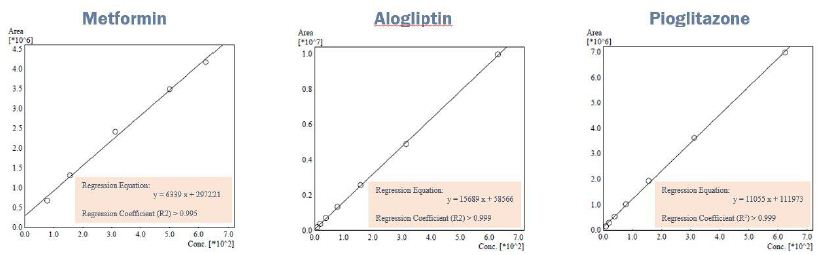
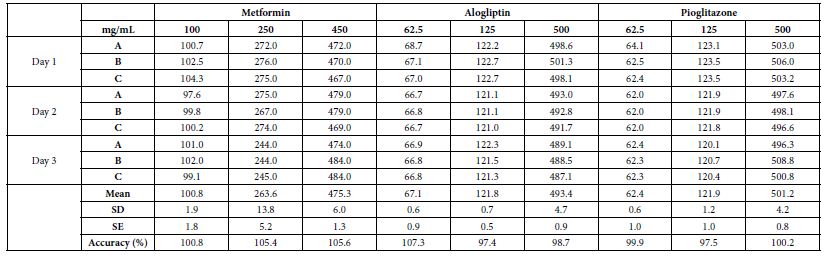
The developed method was validated for selectivity, calibration curve linearity, accuracy, and precision, following FDA/ICH guidelines for pharmaceuticals and biologics [22]. Multipoint calibration curves were constructed for the three drugs using standard solutions at different concentrations. Accuracy and precision were validated at 3 different standard solution concentrations for each drug. All samples were injected in triplicate for analysis. A detailed description of method validation is included in Supplement A.
Sample Preparation and Analysis
All samples were in the form of film-coated tablets. For each batch, a subset of tablets totaling 30% of the entire lot (3-10 tablets depending on batch size) was selected for analysis. The selected tablets were ground into a fine powder, and the equivalent of one tablet was transferred to a 10-mL volumetric flask. Any remaining powder was stored at 4°C. The transferred aliquots were suspended in 10 mL of methanol and ultrasonicated for 20 minutes. Approximately 2 mL of the resulting solution was filtered through a 0.45μ filter into an HPLC vial, with the initial 1 mL discarded, before being injected onto the column in triplicate. Samples were diluted as necessary for concentrations to fall within the calibration curve range.
Results
Based on validation results included in Appendix A, the developed method was selective [specific for detecting the exact ingredients], accurate and reproducible. Thus, it could be reliably utilized to determine concentrations of all three drugs in their respective dosage forms. The examined samples included single and combination products of the three hypoglycemics in tablet form. The out-of-date samples (23 total) comprised four batches of metformin, two batches of metformin/alogliptin, six batches of metformin/pioglitazone, nine of pioglitazone, and two of alogliptin/pioglitazone. Additionally, one in-date sample was analyzed for metformin and for pioglitazone. No significant degradation product peaks were identified in any of the analyzed samples. Representative chromatograms for three analyzed products are depicted in Figure 1.
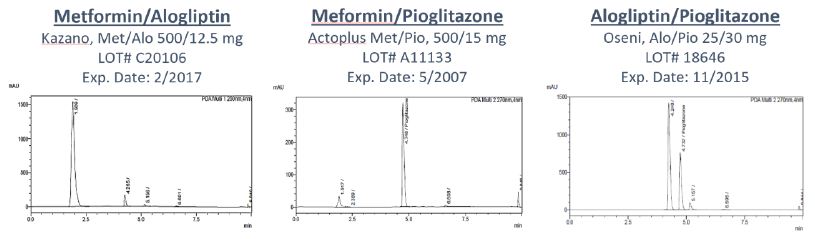
Figure 1: Representative chromatograms of out-of-date samples of combinations of each oral hypoglycemic.
The manufacturer expiration dates ranged from April 2007 to April 2017 for metformin, December 2005 to November 2015 for pioglitazone, and October 2015 to April 2017 for alogliptin. As illustrated in Table 1 and Figure 2, all samples exhibited drug levels between 90-110% of target concentration [metformin: 95.7+3.1%], [pioglitazone: 100.4+4.5%], and [alogliptin: 98.1+8.3%].
Table 1: Concentrations of hypoglycemic drugs in expired samples and in-date samples relative to label concentrations.
|
|
Determined concentration relative to label (%) | ||||
| Brand | Expiry Date | LOT# | Metformin | Pioglitazone |
Alogliptin |
| Actoplus | June 2007 |
A11314 |
98.4 | 105.4 |
– |
| Actoplus | April 2007 |
A11443 |
92.5 | 104 |
– |
| Actoplus | May 2007 |
A11133 |
100.2 | 102.5 |
– |
| Actoplus | May 2007 |
A11191 |
92.3 | 90.6 |
– |
| Actoplus | July 2007 |
A11332 |
97.8 | 105.4 |
– |
| Actoplus | July 2007 |
A11330 |
96.8 | 97.4 |
– |
| Actavis | August 2019 |
1259918M |
94.5 | – |
– |
| Ascend | May 2018 |
3116062 |
92.6 | – |
– |
| Teva | February 2019 |
100001905 |
92.8 | – |
– |
| Fortamet | April 2008 |
575G0464A |
92.6 | – |
– |
| Actos | December 2005 |
C10376 |
– | 106.4 |
– |
| Actos | April 2007 |
C11109 |
– | 103.4 |
– |
| Actos | November 2007 |
C11616 |
– | 102.2 |
– |
| Actos | April 2007 |
A11157 |
– | 97.7 |
– |
| Actos | February 2006 |
C10363 |
– | 101.9 |
– |
| Actos | July 2007 |
C11708 |
– | 101.2 |
– |
| Actos | August 2007 |
A11608 |
– | 100.2 |
– |
| Actos | March 2006 |
C10385 |
– | 100.9 |
– |
| Actos | April 2007 |
C11152 |
– | 98.9 |
– |
| Kazano | April 2017 |
C20121 |
98.8 | – |
90.4 |
| Kazano | February 2017 |
C20106 |
99.2 | – |
98.6 |
| Oseni | October 2015 |
A18640 |
– | 96.9 |
93.9 |
| Oseni | November 2015 |
A18646 |
– | 91.2 |
109.5 |
| Metformin (Generic) | April 2024 |
1010262 |
103.3 | – |
– |
| Pioglitazone (Generic) | November 2023 |
M2017437 |
– | 103.3 |
– |
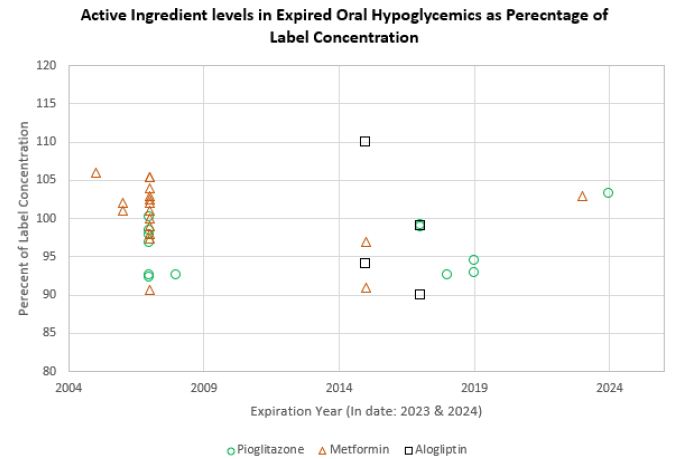
Figure 2: Concentration Distribution of hypoglycemic ingredients in expired samples and one in-date sample (2024) as percentage of label concentrations.
Discussion
The pharmaceutical industry adheres to FDA rules and regulations to determine drug stability and indicate expiration dates on product labels. These expiration dates assure and guarantee consumers that the drug will maintain its potency if stored properly and used before a specific date. However, exceeding an expiration date doesn’t necessarily mean the product loses effectiveness. In fact, it is not uncommon that expired medications are disposed of in a manner that could harm the environment, kept for personal use, or donated to free clinics rather than being properly disposed of. Healthcare practitioners at free clinics frequently encounter the ethical challenge of deciding whether to dispense expired medications, especially when they represent the sole treatment option for their patients. Under these circumstances, it would be beneficial to provide physicians with accurate data to inform their choices regarding the utilization or avoidance of expired medications for specific medical conditions. Based on the interactive health compass Milwaukee database, there are many uninsured people in the Milwaukee area. In the 53206 zip code, for example, the uninsured rate has most recently been documented at 19.24% [23]. This population is generally unable to afford medical care and utilize free clinics in the area. Data suggests that chronic diseases, including diabetes, have high rates [24]. Diabetes alone increases the risk of cardiovascular problems significantly, without comorbid conditions [25]. Free clinics, often underfunded and resource-limited, frequently struggle to provide patients with first-line medication therapies due to constraints in cost and availability. For many patients, even metformin which is considered ‘inexpensive’, a small copay may not be affordable. Providing free clinics with information about long-term stability of specific agents allows for providers within these settings to better ethically manage uninsured patients and provide more first-line therapy, which ultimately increases the health of the communities involved. Due to Medicaid policy changes within the next few years, almost 10 million people may lose access to insurance [26]. As we have found with the new agents coming to market for diabetes, drugs are becoming more expensive [27]. This work is imperative to continue for the improvement of health outcomes for uninsured patients now, and may even become more important as Medicaid policy changes occur.
The findings from this study demonstrate that all tested metformin samples maintained a potency exceeding 90% of their specified strength for up to 16 years post their designated expiration dates. It can be noted that, excluding lots 100001905, 1259918M, and 3116062, all other metformin samples were sealed and unopened. The pre-opening of these specific lots may have introduced potential sources of degradation within the samples, such as air and moisture. Additionally, sample lot 575G0464A exhibited a thicker film-coating, a characteristic that may have affected the observed metformin concentration in that sample due to potential inclusion of the film coating in the prepared samples. For reference, an in-date sample of metformin was analyzed and had a concentration within 90-110% of its expected potency. Similarly, all alogliptin and pioglitazone products exhibited a retention of more than 90% of their specified strength for periods exceeding 8 and 18 years, respectively. Sample lots A18640 and A18646 which were combination tablets of alogliptin and pioglitazone, had a hard-to-remove film-coating, which may have contributed to an increased variability in the observed drug concentrations. The lack of significant degradation product peaks further supports active ingredient stability in analyzed samples. One in-date sample of pioglitazone was analyzed and produced a similar result to that of the in-date metformin sample. However, we were unable to acquire any in-date alogliptin samples despite reaching out to different manufacturers. Expiry dates varying from 2007 to 2017 between the three hypoglycemics and results that all samples tested were above the 90% concentration threshold, suggest that such drugs could maintain potency in excess of 10 years post-expiry. Based on the above results and as noted in our earlier study [21], the potential impact of the data is far-reaching, and can influence various facets and modalities, ranging from clinical and home use to the global availability of medications. With 38.4 million individuals in the U.S alone struggling with T2DM, our study supports the notion of increased availability to many who may not be able to afford monthly prescriptions. Valid global implications may be considered especially for regions where economical deprivation may contribute to higher incidence of T2DM.
The use of expired drugs that have retained active ingredient concentrations can be a viable option for free clinic patients. With that said, the potential risks and benefits of an expired medication may still be evaluated on a drug-to-drug basis. In the future, other drugs will need to be studied to determine if they show extended potency past the manufacturing expiry date. This study helps in addressing the broader question of risk and benefit. With all the samples proving to be within ±10% of the intended concentration, there is not a clear and obvious risk due to loss of potency or development of potentially toxic degradation products. While there could be further risks that are unknown, it appears that the use of expired oral hypoglycemics similar to those tested in this study can provide minimal risk and great benefit to patients who cannot afford otherwise. This is in line with a 2019 commentary which recommended that long-term stability testing should be conducted to support use of medications beyond their initially disclosed expiration dates [28].
Conclusion
Our findings demonstrate the sustained strength of metformin, pioglitazone, and alogliptin, and provides evidence for their utilization at home and in free clinics. Our results were generated by a selective, accurate, and reproducible HPLC method developed in-house for measuring the concentrations of these drugs in expired batches of film-coated tablets. Our findings show that all three hypoglycemics maintained their expected concentration levels for extended periods up to 18 years beyond their labeled expiration dates. These results offer valuable insights for pharmacists, physicians, and patients considering the use of expired medications in various contexts, including at home use and within free clinics. Any ethical issues related to this concept should be further investigated.
Acknowledgements
The authors thank Dr. Rachel Kavanaugh and Jacob Dyer in providing in-date samples of metformin and pioglitazone, respectively, for comparative analysis.
Author Contributions
M. Hawi, A. Little, C. White: analytical lab work, data management, manuscript creation and review. J. Dyer: data review, manuscript creation and review
E. Abourashed: principal investigator, project planning and lab oversight, data review, final manuscript editing, formatting and submission.
Declaration of Generative AI and AI-Assisted Technologies In The Writing Process
References
- CDC. Diabetes [Internet]. 2024 [cited 2025 Nov 13]. National Diabetes Statistics Report.
- Nasri H, Rafieian-Kopaei M (2014) Metformin: Current J Res Med Sci Off J Isfahan Univ Med Sci. 19: 658-664. [crossref]
- ElSayed NA, Aleppo G, Aroda VR, Bannuru RR, Brown FM, et (2022) 9. Pharmacologic Approaches to Glycemic Treatment: Standards of Care in Diabetes—2023. Diabetes Care. 12: S140-s157.
- Foretz M, Guigas B, Viollet B (2023) Metformin: update on mechanisms of action and repurposing Nat Rev Endocrinol. 19: 460-476. [crossref]
- Rena G, Hardie DG, Pearson ER (2017) The mechanisms of action of Diabetologia. 60: 1577-1585. [crossref]
- Vieira IH, Barros LM, Baptista CF, Rodrigues DM, Paiva IM (2022) Recommendations for Practical Use of Metformin, a Central Pharmacological Therapy in Type 2 Clin Diabetes. 40: 97-107. [Crossref]
- The selection and use of essential medicines, 2025: WHO Model List of Essential Medicines, 24th list [Internet]. [cited 2025 Nov 13].
- Singh G, Can AS, Correa R (2024) Pioglitazone. In: StatPearls [Internet]. Treasure Island (FL): StatPearls [cited 2024 Jul 16.
- Terrell JM, Jacobs TF (2024) In: StatPearls [Internet]. Treasure Island (FL): StatPearls Publishing. [cited 2024 Jul 16].
- Cohen RA, Cha AE (2017-2018) Strategies used by adults with diagnosed diabetes to reduce their prescription drug [Internet]. [cited 2024 Jul 16].
- Birs A, Liu X, Nash B, Sullivan S, Garris S, et (2016) Medical Care in a Free Clinic: A Comprehensive Evaluation of Patient Experience, Incentives, and Barriers to Optimal Medical Care with Consideration of a Facility Fee. Cureus.
- Research C for DE Don’t Be Tempted to Use Expired Medicines. FDA [Internet]. 2024 May 7 [cited 2024 Oct 17].
- Diven DG, Bartenstein DW, Carroll DR (2015) Extending Shelf Life Just Makes Mayo Clin Proc. 90: 1471-1474. [crossref]
- Park JC, Nam GE, Yu J, McWhorter KL, Liu J, et (2023) Association of Sustained Low or High Income and Income Changes With Risk of Incident Type 2 Diabetes Among Individuals Aged 30 to 64 Years. JAMA Netw Open. 6. [crossref]
- Commissioner O of Expiration Dating Extension. FDA [Internet]. 2024 Jun [cited 2024 Jul 16].
- Courtney B, Easton J, Inglesby TV, SooHoo C (2009) Maximizing State and Local Medical Countermeasure Stockpile Investments through the Shelf-Life Extension Biosecurity Bioterrorism Biodefense Strategy Pract Sci. 7: 101-107. [crossref]
- Browne E, Peeters F, Priston M, Marquis PT (2019) Expired Drugs in the Remote Wilderness Environ Med. 30: 28-34. [crossref]
- Cantrell FL, Cantrell P, Wen A, Gerona R (2017) Epinephrine Concentrations in EpiPens After the Expiration Ann Intern Med. 166: 918-919. [crossref]
- Rachid O, Simons FER, Wein MB, Rawas-Qalaji M, Simons KJ (2015) Epinephrine doses contained in outdated epinephrine auto-injectors collected in a Florida allergy Ann Allergy Asthma Immunol. 114: 354-356.[crossref]
- Zilker M, Sörgel F, Holzgrabe U (2019) A systematic review of the stability of finished pharmaceutical products and drug substances beyond their labeled expiry dates. J Pharm Biomed Anal. Mar 20;166: 222-35. [crossref]
- Kutty RG, Bevry M, Hoffmann P, Abourashed EA (2022) Determination of albuterol and montelukast post-expiry drug strength by HPLC. Heliyon. 8. [crossref]
- Center for Drug Evaluation and Research, Center for Biologics Evaluation and Analytical Procedures and Methods Validation for Drugs and Biologics [Internet]. FDA; 2020.
- Health Compass Milwaukee [Internet]. [cited 2025 Nov 13]. Chronic condition – diabetes.
- CDC. Chronic Disease [Internet]. 2025 [cited 2025 Nov 13]. Fast Facts: Health and Economic Costs of Chronic Conditions.
- Cardiovascular Disease | American Diabetes Association [Internet]. [cited 2025 Nov 13].
- Gore Democrats Exaggerate Estimated Impact of GOP Bill on Uninsured. FactCheck.org [Internet]. 2025 May 16 [cited 2025 Nov 13].
- Taylor SI (2020) The High Cost of Diabetes Drugs: Disparate Impact on the Most Vulnerable Patients. Diabetes Care. 43: 2330-2332. [crossref]
- Gikonyo D, Gikonyo A, Luvayo D, Ponoth P (2019) Drug expiry debate: the myth and the Afr Health Sci. 19: 2737-2739. [crossref]