Abstract
This study documents the presence of diamond, diamond-like carbon (DLC), graphite, and carbon whiskers in the outer growth zone of a smoky quard crystal from Zinnwald, eastern Erzgebirge, Germany. Optical microscopy and Raman spectroscopy show that these carbon phases occur as needle- and whisker-like crystals concentrated in the late stage of quard growth. Coesite associated with the assemblage indicates pressures of about 2 GPa, which are too low for the equilibrium graphite-to-diamond transformation. In addition, fluid inclusions containing CO2, CH4, and H2 point to a carbon-bearing C–O–H fluid system. The coexistence of multiple carbon phases, their unusual morphologies, and their restriction to the final growth zone are best explained by rapid disequilibrium precipitation from a supercritical fluid or melt, rather than by stable low-pressure diamond growth. The Zinnwald occurrence, therefore, supports fluid-controlled carbon deposition and may reflect mantle–crust interaction during Variscan mineralization.
Keywords
Diamonds, Carbon whiskers, Hydrothermal quartz, Raman spectroscopy, C-O-H fluids, Disequilibrium crystallization, Zinnwald
Introduction
This contribution examines diamond, diamond-like carbon (DLC), graphite, and carbon whiskers in the outer growth zone of a smoky quartz crystal from Zinnwald, eastern Erzgebirge, Germany. The central question is whether these carbon phases record equilibrium diamond growth or, instead, rapid disequilibrium precipitation from a carbon-bearing fluid or melt during late quartz crystallization. A concise description of the pre-Mesozoic geology of the Saxo-Thuringia zone can be taken from Linneman and Romer (2010) [1]. Previous work from Variscan mineralizations in the Erzgebirge and related regions has reported high-pressure mineral associations, including diamond, lonsdaleite, and orthorhombic cassiterite, and has been interpreted as evidence for mantle–crust interaction mediated by supercritical fluids or melts. So the found CaCl2-type and cotunnite-type cassiterite give pressures of 12 and 54 GPa, respectively [2-4]. Against that background, the Zinnwald quartz sample is important because it contains mixed carbon phases in a late-growth zone, together with coesite and C–O–H-bearing fluid inclusions (Table 1).
Table 1: Diamonds in orthorhombic cassiterite from the Sauberg mine near Ehrenfriedersdorf.
|
Sample |
First-order Raman band | FWHM | n |
| Sn-58 | 1334.3 ± 4.1 cm⁻¹ | 33.8 ± 4.8 cm⁻¹ |
6 |
|
Sn-70 |
1326.4 ± 4.8 cm⁻¹ | 64.4 ± 15.2 cm⁻¹ |
11 |
FWHM – Full-Width at Half Maximum.
The Zinnwald occurrence is therefore significant because diamond, graphite, DLC, and carbon whiskers appear in the final growth zone of a hydrothermal quartz crystal, whereas the coesite-constrained pressure of about 2 GPa is too low for equilibrium graphite-to-diamond transformation. This mismatch motivates the interpretation developed here: the carbon phases most likely formed by disequilibrium, fluid-controlled precipitation rather than by stable low-pressure diamond growth.
Sample Material
The sample material is detailed described in Thomas (2025b) [5]. It is a 6 cm-long smoky quartz crystal from a pegmatitic vein. From this crystal, we prepared a 500 µm-thick, both-side-polished section for the microscopic and Raman spectroscopic studies (Figure 1).
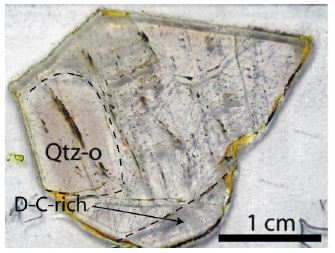
Figure 1: Thick section of the used quartz sample (ZQ-2) from Zinnwald, E-Erzgebirge. Qtz-o is the older core of the a-quartz crystal. D-C-rich: region with many whisker-like crystals of diamond, carbon, graphite, and DLC. The quartz, apart from the older core, shows a pronounced mosaic structure.
Methods: Microscopy and Raman Spectroscopy
We performed all microscopic and Raman spectroscopic studies with a petrographic polarization microscope (BX 43) with a rotating stage coupled with the EnSpectr Raman spectrometer R532 (Enhanced Spectrometry, Inc., Mountain View, CA, USA) in reflection and transmission. We used Raman spectroscopy as the main tool for characterizing the carbon materials (diamond, DLC, graphite, and carbon). According to Zaitsev (2001) [6], the more correct term for DLC is “diamond-like materials.” The data presented here were acquired using an EnSpectr Raman microscope (RamMics R532). Measurements covered the spectral range from 0 to 4000 cm⁻¹ and were conducted with a single-mode 532 nm laser operating at a maximum output of 50 mW. Analytical settings included a 20 µm entrance aperture, a holographic grating of 1800 g mm⁻¹, and a spectral resolution of approximately 4 cm⁻¹ (generally for the whole range). For most analyses, a long-working-distance Olympus LMPlanFL 100× objective is used. Laser power at the sample surface was continuously adjustable down to 0.02 mW. Higher powers (up to 50 mW) were applied only for overview measurements. Generally, for measurements, we used 0.9 mW on the sample over the range 750-1450 cm⁻¹ to prevent local heating. Raman band positions were calibrated before and after each measurement series using the Si band of a semiconductor-grade single-crystal silicon chip. Based on 20 repeated measurements, run-to-run reproducibility was ± 0.2 cm⁻¹ for silicon (520.2 ± 0.2 cm⁻¹) in the measuring range 100 to 1450 cm⁻¹. As a second reference, we used a water-clear diamond crystal from Brazil. For the first order diamond line, we obtained (1330.1 ± 0.6) cm⁻¹ with a FWHM = 5.1 ± 0.1 cm⁻¹.
Results
The outer growth zone of the quartz crystal contains abundant needle- and whisker-like crystals of carbon, graphite, DLC, and diamond (Figures 2-6). These phases are concentrated in the final growth zone and are absent or rare toward the crystal interior, except for a single colorless diamond whisker reported near the center [5]. Coesite identified at the end of quartz growth indicates pressures of about 2 GPa, which are insufficient for equilibrium diamond formation from graphite. Most fluid inclusions are secondary and contain a vapor phase dominated by CO2. A smaller number of high-temperature inclusions also contain H2, identified from the 354 cm⁻¹ band, and CH4, identified from the 2917 cm⁻¹ band. Together, these inclusions indicate a carbon-bearing C–O–H fluid system associated with late quartz growth. Next, we show some examples of whisker-like diamond, DLC, graphite, and carbon. Such an appearance is exceptional. Also, the often observed bending is unusual.
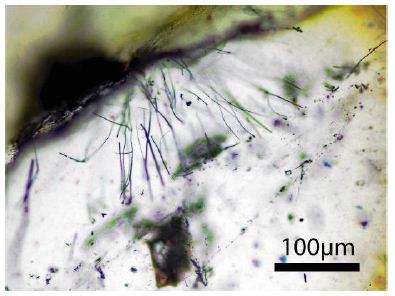
Figure 2: Carbon needles in rand zone of the quartz crystal. Some needles are bent.
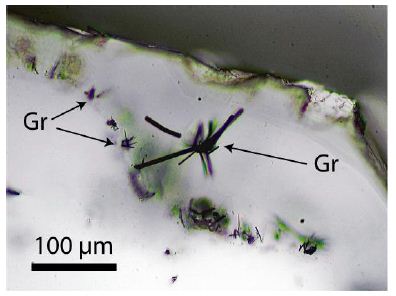
Figure 3: Graphite (Gr) needles in the same growth zone as Figure 2.
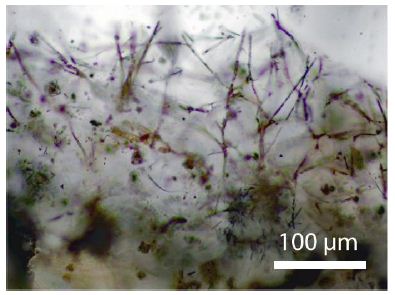
Figure 4: DLC-needles, often bent, in the outer growth zone of the quartz crystal. The most needles have a brownish shade.
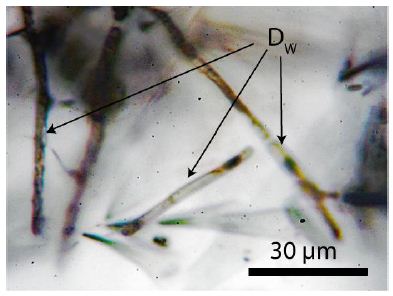
Figure 5: Diamond whiskers (DW), often colorless to brownish, in the outer growth zone of the quartz.
Using the needle in Figure 6, we have performed Raman measurements in the first-order diamond range. The results are in Table 2. To compare the data, the measured values from Thomas (2025b) [5] are included. Conspicuously, the FWHM values for all carbon types shown here are relatively large. That can be traced back to higher portions of sp2 (one carbon atom forms three bonds in one plane, additionally one p-orbital for one π-bond remaining). Pure diamond material consists mainly of sp3 (four equivalent bonds in a tetrahedral arrangement). A high proportion of sp2 leads to an increase in the FWHM.
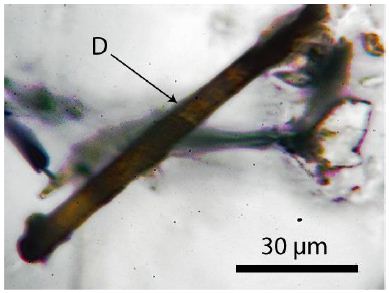
Figure 6: A brownish translucent diamond-carbon needle in the outer quartz growth zone.
Table 2: Raman measurements in the first-order diamond range.
|
Sample |
First order D band (cm⁻¹) | FWHM (cm⁻¹) | G-band (cm⁻¹) | FWHM (cm⁻¹) | n |
| Needle Fig. 6 | 1330.1 ± 4.3 | 73.6 ± 12.0 | 1582.8 ± 4.8 | 67.7 ± 7.7 |
20 |
|
Thomas 2025b |
1321.6 ± 3.8 | 51.6 ± 6.7 | 1552.9 ± 7.1 | 47.9 ± 4.3 | 12 |
| Thomas 2025b | 1321.6 ± 7.0 | 14.3 ± 0.8 | 1575.6 ± 6.5 | 51.7 ± 13.2 |
14 |
As already mentioned, the estimated pressure (2 GPa) from the presence of coesite is insufficient for the diamond formation at the equilibrium graphite-diamond. Figure 7 shows a typical high-temperature fluid inclusion.
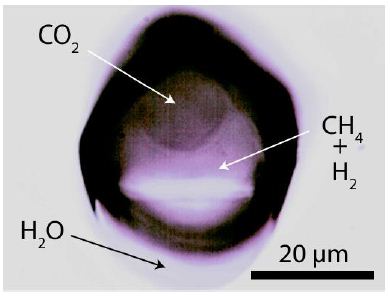
Figure 7: Complex high-temperature fluid inclusion in the Zinnwald quartz consists of carbon dioxide (CO2), methane (CH4), and hydrogen (H2). The water-rich phase (H2O) consists of CO2 and higher hydrocarbons. Note the low contrast between the quartz host and the water-rich phase.
Interpretation
Disequilibrium Growth from C–O–H Fluids Rather than Direct Graphite-to-Diamond Conversion
The occurrence of diamond in the Zinnwald quartz is unlikely to reflect equilibrium crystallization along the graphite–diamond boundary. The coesite-bearing assemblage indicates pressures of about 2 GPa, which are too low for direct graphite-to-diamond conversion under equilibrium conditions. A more consistent explanation is precipitation from a carbon-rich supercritical C–O–H fluid or melt, in which redox state, carbon speciation, and rapid disequilibrium changes controlled carbon deposition. This interpretation is supported by four observations: mixed carbon phases, whisker-like morphologies, evidence for rapid growth, and fluid inclusions rich in C–O–H species.
- fluid inclusions containing CH4, H2, and CO2,
- needle- and whisker-like crystal morphologies,
- the coexistence of diamond, DLC, graphite, and carbon,
- and their concentration in the final growth zone of the quartz
Taken together, these features argue against stable low-pressure diamond growth. They are more consistent with a strongly disequilibrium fluid system in which carbon precipitated rapidly from a supercritical fluid or melt during late quartz growth. Transient local overpressure at microsites, or the transport of pre-existing, deeper-formed diamond by an ascending fluid, may also have contributed. Thus, the Zinnwald occurrence is best explained by fluid-controlled, disequilibrium carbon deposition rather than by simple equilibrium graphite-to-diamond transformation.
Discussion
The key result of this study is that the Zinnwald carbon assemblage is best explained by disequilibrium precipitation during late quartz growth, not by equilibrium graphite-to-diamond transformation. This conclusion follows from three linked observations: coesite constrains pressure to about 2 GPa, which is too low for equilibrium diamond formation; the carbon phases occur as mixed needle- and whisker-like morphologies concentrated in the final growth zone; and associated inclusions record a carbon-bearing C–O–H fluid containing CO2, CH4, and H2. Together, these features support rapid, heterogeneous carbon deposition from a supercritical fluid or melt in which redox fluctuations, carbon speciation, and kinetic effects control phase formation. Transient local overpressure or transport of deeper-formed diamond by an ascending fluid remain possible contributing mechanism, but they do not alter the main inference that fluid-controlled disequilibrium processes dominated carbon deposition in the Zinnwald quartz. This interpretation also fits the broader regional context. Nearby major tin deposits, including Ehrenfriedersdorf, Altenberg, Krupka, and Slavkovský les, as well as the Schneckenstein deposit, have yielded spherical diamonds [7-13], and related Variscan tin mineralizations also contain orthorhombic cassiterite [2,3] and diamond enclosed in topaz [14,15]. Taken together, these occurrences strengthen the view that some Variscan mineral assemblages record transcrustal carbon transport and mantle–crust interaction rather than simple closed-system crystallization.
Limitations
This interpretation should nevertheless be regarded as provisional because the present study is based on a limited sample set and primarily on optical observations and Raman spectroscopy. Although the coexistence of diamond, DLC, graphite, carbon whiskers, coesite, and C–O–H-bearing fluid inclusions is consistent with disequilibrium, fluid-controlled growth, the data do not yet fully exclude alternative explanations, such as the transport of deeper-formed diamond or a transient local overpressure during quartz growth. Additional work, including broader sampling, quantitative Raman mapping, microstructural analysis, and isotopic measurements, would be needed to test the generality of the Zinnwald occurrence and further constrain the origin of the carbon phases.
Acknowledgment
I thank Michael Leh in D-02699 Neschwitz, Germany for his longstanding interest and support of my home office work.
References
- Linnemann U, Romer RL (2010) Pre-Mesozoic Geology of Saxo-Thuringia. Schweizerbart Science Pg: 488.
- Thomas R (2024a) The CaCl2-to-rutile phase transition in SnO2 from high to low pressure in Geol Earth Mar Sci 6: 1-4.
- Thomas R (2024b) Rhomboedric cassiterite as inclusions in tetragonal cassiterite from Slavkovský les – North Bohemia (Czech Republic). Geol Earth Mar Sci 6: 1-6.
- Yehdego DT (2009) Pressure induced phase transformation of SnO2 an ab initio constant pressure Master of Science Thesis, University of Texas at el Paso. Pg: 54.
- Thomas R (2025b) Diamond, diamond whisker, graphite, carbon, and coesite in a quartz crystal from Zinnwald, E-Erzgebirge. Geol Earth Mar Sci 7: 1-6.
- Zaitsev AM (2001) Optical Properties of Diamond -A Data Berlin, Heidelberg, New York, Springer. Pg: 502.
- Thomas R, Davidson P, Rericha A, Recknagel U (2022a) Water-rich coesite in prismatine-granulite from Waldheim/Saxony. Veröffentlichungen Museum für Naturkunde Chemnitz 45: 67-80.
- Thomas R, Davidson P, Rericha A, Recknagel U (2022b) Discovery of stishovite in the prismatine-bearing granulite from Waldheim, Germany: A possible role of supercritical fluids of ultrahigh-pressure origin. Geoscience 12: 1-13.
- Thomas R (2023a) Growth of SiC whiskers in beryl by a natural supercritical VLS Aspects in Mining & Mineral Science 11: 1292-1297.
- Thomas R, Davidson P, Rericha A, Recknagel U (2023a) Ultrahigh-pressure mineral inclusions in a crustal granite: Evidence for a novel transcrustal transport mechanism. Geoscience 94: 1-13.
- Thomas R (2023b) Unusual cassiterite mineralization, related to the Variscan tin-mineralization of the Ehrenfriedersdorf deposit, Aspects in Mining & Mineral Sciences 11: 1233-1236.
- Thomas R, Recknagel U, Rericha A (2023b) A moissanite-diamond-graphite paragenesis in a small beryl-quartz vein related to the Varsican tin-mineralization of the Ehrenfriedersdorf deposit, Aspects in Mining & Mineral Science 11: 1310-1319.
- Thomas R, Rericha A (2025) Strong isotope fractionation between 13C and 12C in the supercritical fluids related to the Variscan mineralizations in Erzgebirge, Slavkovsky Les (Kaiserwald), and Lusatian Mountains, Germany, and the Czech Republic and some remarks on the low-pressure formation of diamond. Geol Earth Mar Sci 5: 1-5.
- Thomas R (2026) Diamond in pycnite-rock from Altenberg and in the topaz from the famous Schneckenstein Geol Earth Mar Sci 8: 1-7.
- Thomas R (2025a) Extremely 13C-rich diamond in orthorhombic cassiterites in the Variscan Erzgebirge, Saxony/Germany. Earth Mar Sci 7: 1-5.