Abstract
The results of an assessment of Internet user activity under seismic hazard conditions in the North Caucasus before a series of earthquakes in late February–early March 2026 are presented. The analysis used Google search engines and estimates of query volumes for terms associated primarily with biological earthquake precursors, together with software for automated screening of Google search data.
The frequency of Internet searches for the terms “insects, birds, air, ambulance, dolphins” increases in advance under seismic hazard conditions and is consistent with descriptive models of precursory seismogenic disturbances of geophysical fields.
Keywords: Earthquake, Precursors, Trend, Search engines, Internet, Population
Introduction
The anthropogenic component of the environment responds to changes in the natural environment. This response is manifested in changes in behavioral activity at conscious and unconscious levels and in the intensity of communication, leading to variations in collective consciousness. Behavioral activity in the form of psychomotor acts is recorded in communication media [1]. The Internet makes it possible to track changes in Internet users’ activity through the flow of electronic messages containing signals associated with natural processes and phenomena and the disturbances of geophysical fields that they induce. Internet users record their observations in messages, including observations of other populations of organisms, and seek confirmation of their perceptions. The self-organization of Internet users through collective behavior amplifies weak observational signals from individual users by increasing their number and the repetition of the terms being discussed. Accordingly, monitoring Internet users’ activity using a set of topic-specific queries can be used to assess collective consciousness during disturbances of geophysical fields and to identify the causes of these disturbances [2-4]. A set of topic-specific terms constitutes a working ontological model of the process or phenomenon being assessed. This also applies to seismic processes, for which, particularly when instrumental observations are scarce, special attention should probably be paid to terms associated with biological earthquake precursors. The set of terms adapted to a seismically hazardous region should be refined after each strong seismic event. Internet search engines [5] are tools for both information retrieval and the analysis of population activity and variations in collective consciousness. Internet search engines allow the boundaries of the study region to be specified.
Experimental Data
In February–March 2026, a deformation wave propagated across the Greater Caucasus and was associated with a series of minor earthquakes. These began in the Eastern Caucasus. However, the most distinctly felt earthquakes occurred near Sochi on March 3, 2026:
- 12: 09: 47, latitude 43.52°, longitude 39.54°, hypocentral depth 10 km, mb = 4.4, I0 = 4; and
- 13: 05: 38, latitude 43.52°, longitude 39.49°, depth 10 km, mb = 4.7, I0 = 4.5–5.0.
Another earthquake was recorded near Sochi on March 6 at 04: 29: 09, latitude 43.52, longitude 39.60, depth 10 km, mb = 4.5, I0 = 4–4.5. At 13: 44: 24, another deep-focus earthquake was recorded in the Eastern Caucasus (hypocentral depth 100 km, latitude 43.38, longitude 46.53, mb = 4.5).
These earthquakes are classified as felt events on the SIS-17 scale [6].
Table 1 lists the preceding earthquakes in the region, according to data from the Geophysical Survey of the Russian Academy of Sciences [7].
Table 1: Characteristics of earthquakes in the Caucasus.
| No. | Date, time GMT | Latitude, ° | Longitude, ° | Depth, km | mb* | I0* | Region |
| 1 | 2026-02-23 08: 28 | 43.60 | 45.80 | 110 | 3.9 | — | Eastern Caucasus |
| 2 | 2026-02-27 23: 38 | 40.58 | 48.75 | 10 | 4.3 | 3.5–4 | Eastern Caucasus |
| 3 | 2026-02-27 22: 08 | 44.59 | 37.45 | 10 | 3.5 | — | Western Caucasus |
| 4 | 2026-02-27 22: 01 | 40.64 | 48.40 | 10 | 4.0 | 3 | Eastern Caucasus |
| 5 | 2026-02-28 02: 34 | 40.77 | 48.60 | 10 | 4.3 | 3.5–4 | Eastern Caucasus |
| 6 | 2026-03-01 21: 42 | 42.75 | 46.78 | 70 | 4.0 | — | Eastern Caucasus |
| 7 | 2026-03-01 01: 01 | 42.83 | 47.72 | 10 | 3.7 | 2–2.5 | Eastern Caucasus |
| 8 | 2026-03-02 14: 52 | 38.27 | 38.44 | 5 | 4.5 | 5–5.5 | Turkey |
| 9 | 2026-03-02 12: 52 | 42.39 | 45.80 | 2 | 3.4 | 4 | Eastern Caucasus |
* mb — earthquake magnitude; I0 — shaking intensity.
The experiment used software for automated screening of data from the Google search engine using topic-specific queries.
Discussion of Experimental Results
Figure 1 shows changes (in %) in the normalized volumes of Google search queries submitted by Internet users in Krasnodar Krai for the terms “insects, birds, air, ambulance, dolphins” before the Sochi earthquakes of March 3 and 6, 2026.
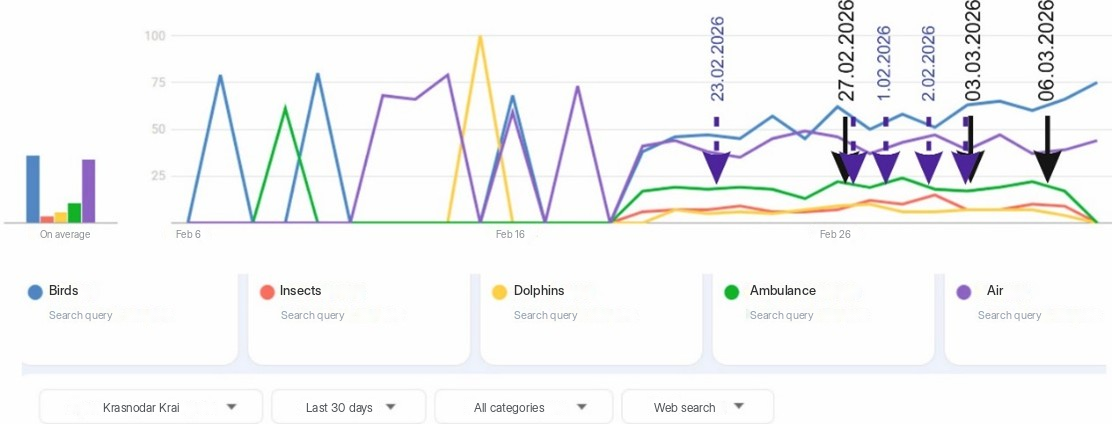
Figure 1: Popularity of Internet search queries in Krasnodar Krai. Arrows indicate earthquakes (blue arrows mark those in the Eastern Caucasus).
The arrows in Figure 1 mark the earthquakes listed in Table 1. Earthquakes in the Eastern Caucasus are highlighted in color. The daily numbers of these queries were normalized to the highest query count (100%), which in this case corresponded to the term “dolphins.” No significant changes were found for domestic and wild animals or for the term “water.” The terms were selected empirically. Variations in the search query volumes of Internet users in Krasnodar Krai were consistent with descriptive models of precursory phenomena, with increased activity before earthquakes. The deformation wave in the Earth’s crust propagated across the Caucasus from east to west. The Eastern Caucasus became active first. The full moon occurred on March 3. The bombing of Iran should also be kept in mind. In the collected statistics, changes in air composition became an exceptionally popular search topic around the earthquakes of March 3 and 6, 2026. The query “private ambulance Sochi” was exceptionally popular; the number of queries for “blood pressure pills ambulance” increased by 200%, “ambulance phone number” by 120%, “ambulance Sochi” by 110%, “private ambulance Krasnodar” by 90%, and “ambulance Krasnodar” by 40%. People dreamed of dolphins and insects. Considerable interest in ornithology can be explained by observations of the sky and seasonal bird migration. The largest query volumes came from the major Internet populations of Krasnodar, Greater Sochi, Tuapse, and Anapa. The degree of order in the sum of normalized queries in Figure 1 can be characterized by the coefficient of variation of the query counts shown in Figure 2, without resorting to spectral or fractal analysis. Each value was assigned to the right boundary of a sliding one-week window.
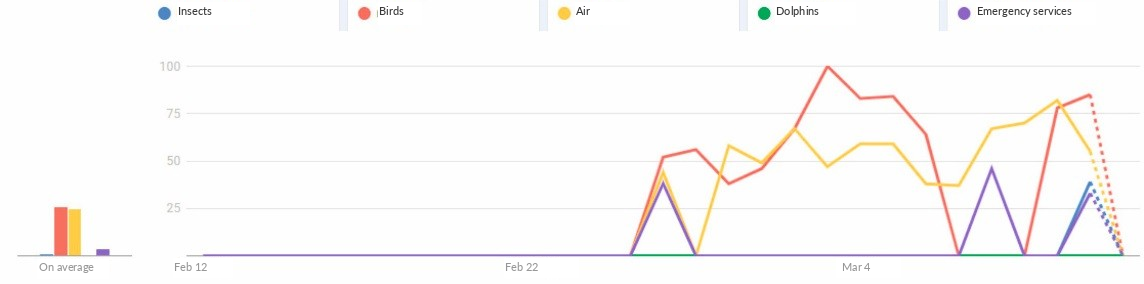
The coefficient of variation in Figure 2 revealed a wave of increasing order in the sum of queries before the Sochi earthquakes of March 3 and 6, 2026. A strong geomagnetic storm (K = 7) was recorded on January 20–21, 2026. However, it is not reflected in Figure 2. Therefore, the coefficient of variation peaks on February 22, 2026, in Figure 2 are not associated with the weak geomagnetic storm with K = 4++. The earthquake of March 3, 2026, occurred at a minimum of geomagnetic activity (K = 1). Under the assumption that a deformation wave propagated toward Sochi from the Eastern Caucasus, the results for Internet users’ activity in Chechnya (Figure 3a) and Dagestan (Figure 3b) are useful.
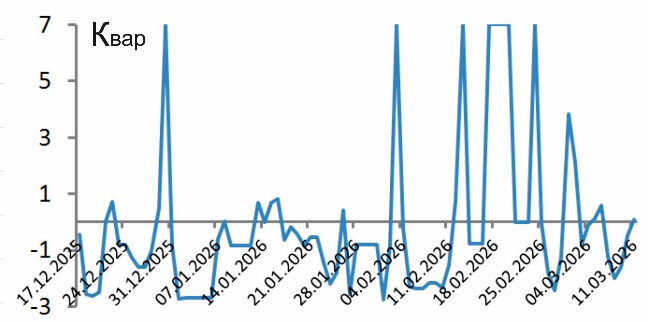
Figure 2: Changes in the weekly coefficient of variation of the sum of queries.
(a) Chechnya
(b) Dagestan
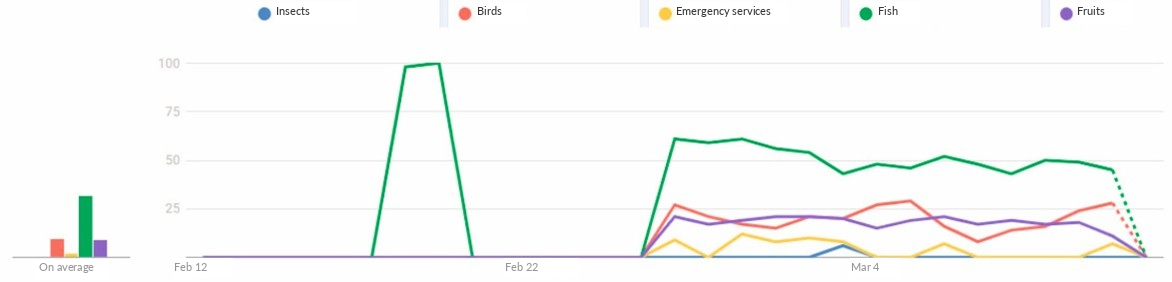
Figure 3: Popularity of Internet search queries in Chechnya (a) and Dagestan (b).
The results in Figure 3 do not contradict the hypothesis that the consciousness of Internet users in the Eastern Caucasus responds to a deformation wave in the Earth’s crust. To verify the results and select the search queries, findings from a similar experiment were used for the earthquake near Anapa on February 9, 2026, at 23: 21 GMT (February 10 at 02: 21 Moscow time), with magnitude M = 5.3 and a hypocentral depth of 10 km. The epicenter (φ = 45.01° N, λ = 37.51° W) was located 19 km east-northeast of Anapa and 36 km northwest of Novorossiysk. A distinctive feature of this earthquake was that Krasnodar, the largest city in the region (116 km from the epicenter), and its Internet users fell within the potential zone of precursory disturbances of geophysical fields (R = 100.43M km, where M is magnitude). Figure 4 shows the sum of queries for the terms “insects, ambulance, wild animals,” whose query counts were comparable.
The results in Figure 3 confirm increased activity of insect and wild animal populations and increased discussion of ambulance services 3–4 days before the earthquake, consistent with the lead time of precursors for earthquakes of this intensity. The new moon occurred on February 17. The overlap between the terms used in the experiments makes it possible to use the resulting set to assess variations in collective consciousness through the activity of the Internet population of Krasnodar Krai under seismic hazard conditions.
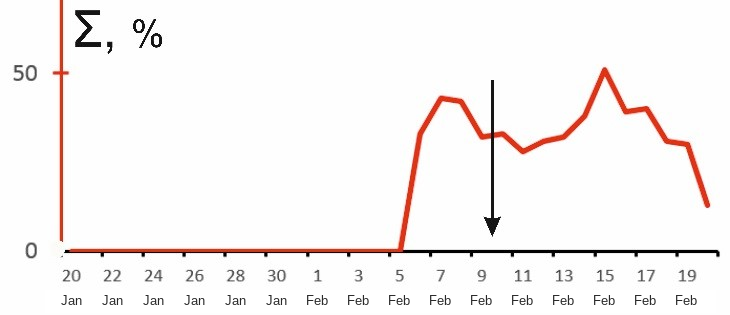
Figure 4: Sum of search queries for the terms “insects, ambulance, wild animals” before and after the earthquake of February 10, 2026 (black vertical arrow).
Conclusion
The Google search engine enables a spatial and temporal assessment of collective consciousness based on user activity within specified geographic boundaries and is a promising tool for geophysical monitoring. Using the felt earthquakes near Sochi on March 3 and 6, 2026, as a case study, a set of terms was developed to assess the activity of the Internet population of Krasnodar Krai under seismic hazard conditions, with software for automated screening of Google search data using topic-specific queries. The frequency of the terms “insects, birds, air, ambulance, dolphins” in Internet users’ behavior increases in advance under seismic hazard conditions and is consistent with descriptive models of precursory seismogenic disturbances of geophysical fields.
References
- Tertyshnikov AV (2020) The Internet-community response to the Mexican Earthquake of February 1, 2019. E3S Web of Conferences, 196, 03007. STRPEP 2020.
- Tertyshnikov AV (2023) The reaction of Internet Users to the Seismic Hazard. World Journal of Environmental Biosciences. 12: 14-17.
- Tertyshnikov AV (2022) The November 14, 2018 Sakurajima Volcano Eruption through the Lens of Internet-Based Seismic Hazard Semantic Criteria. Heliogeophysical Research [Solar-Terrestrial Physics Research]. 35: 12-20. [Original Russian publication].
- Tertyshnikov AV, Obelchenko DS (2025) Trend of the informational Precursor of macroseismicity near Santorini Island in early 2025 using ai resources / Proceedings of the International Scientific and Practical Conference “Actual problems of physics and technology” S.U. Umarov Physical-Technical Institute of the National Academy of Sciences of Tajikistan. Dushanbe: Donish Publishing House, 2025, 271 pages (60-66).
- Tertyshnikov AV, Obelchenko DS (2026) Activity of Turkey’s internet community before the Istanbul earthquake” with reference number // Global Journal of Ecology. 11: 001-004.
- State Standard 57546–2017. SIS-17 — Earthquakes. Seismic Intensity Scale. Moscow: Standartinform, 2017.
- Earthquake Data. Geophysical Survey of the Russian Academy of Sciences [Electronic resource].