Abstract
We received new collections in our department which are stored at the museum and deal with the Devonian System. First investigation of the Devonian palaeontology of Ukraine was published by Pusch (1829-1831), than Eichwald (1840), F. Schmidt (1873-1876) and others. The known Polish researcher Roman Kozlowski (1929) published monograph deal with Lower Devonian brachiopods of Podillia. After the Second World War, study of the Devonian sections during the 1960s was connected with geological prospecting. Most outcrops along the Dniester River in the middle part of the valley were available for study. Lower Devonian fossils are represented by diverse remains of brachiopods, molluscs, corals, bryozoans, graptolites, echinoderms, conodonts, and others.
The outcrops open Lower Devonian sequence available in Volley Dniester River and left tributaries. An especially good outcrop opens Mytkiv Suite on slops of Nichlava River near Verkhniakivtsy Village (Tsegelnjuk, 1974).
Keywords
Lower devonian, Ukraine, Brachiopods, Corals, Gastropods, Pelecipods, Crinoids, Museum collections
Introduction
In total the National Museum of Natural History in Kyiv has only twelve collections with Devonian samples, collected from 1874 to 2011. Two of the older collections were transferred from the Kyiv University as a result of reorganisation of that institution. Authors for conservation as monographically described collections gave the others. Some samples displayed in the Museum whereas others are stored in the hall of “monographical collections” which are only allowed to be visited by specialists. These monographical collections were assembled by P.N. Venjukov, P.D. Tsegelnjuk, V.P. Grytsenko and others. In Ukraine, the Lower Devonian (Lokhcovian) sections are very good exposit, with total thickness near 577 m. The outcrop sections are located on the banks of Dniester River and it tributaries (Figure 1). The Lokhcovian sequins’represented by three members (Borschiv – 256 m, Chortkiv – 195 m and Ivane – 126 m Formations) divided by lithologicaly fitures. More than 400 samples from these sections are represented by brachiopods, corals, crinoideas, graptolites, molluscs and trilobites, ostracodes and bryozoans. Other samples obtained from the boreholes in Podillia, which are located along the western slope of the Ukrainian Shield, extending in Chernivtsy and Ternopil district (Figure 1). Some samples of boreholes core with fossils not studied yet.
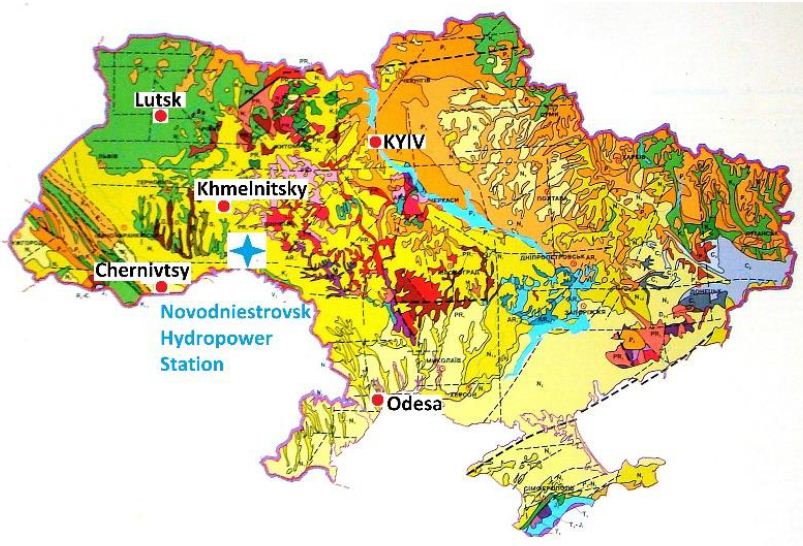
Figure 1: Geological map of Ukraine (Bragin et al. 2001, p.67), showing locations mentioned in the text).
Material and Methods
The new collection was send us from Illia Zakharov in 2026. We are grateful to him for the gift. The collection number IBS-AF. GMC_8686. The collection consist from more than hundred samples (brachiopods, molluscs, coralls, stromatoporata, briozoan, trilobites, fragments of crinoidea and others). A graptolite Monograptus uniformis found recently again [1]. The section represented by an alternation thick beds (2-3 m) of gray mudstones and thin beds (1-2 cm) of limestone, both includes different fossils. Total thick – 24 m. The samples washed in ultrasonic machine with washing powder. As result we got almost clean fossils. Different monographs used to identify fossils [2]; Nikiforova, 1954, Third International Symposium on Silurian and Devonian Boundary and Lower and Middle Devonian Stratigraphy. Atlas of Silurian and Early Devonian Fauna of Podolia (appendix to the guide), Leningrad, 1968, and others.
Results and Discussion
The Lower Devonian deposits in the territory of Ukraine first described and published by Pusch (1829-1831), than Eichwald (1840), F. Schmidt (1873-1876) and others. The known Polish researcher Roman Kozlowski (1929) published monograph deal with Lower Devonian brachiopods of Podillia. After the Second World War, study of the Devonian sections during the 1960s connected with geological prospecting. Most outcrops along the Dniester River in the middle part of the valley were available for study. Diverse remains of brachiopods [2,3], molluscs, corals [4,5], bryozoans, graptolites, conodonts [6,7] and others represent lower Devonian fossils. In the collection three younger samples geologically age, the Cretaceous, found (Figure 2, m-o). The beginning of Lokhcovian Stage in Podillian region now connect with rest of graptolites Monograptus uniformis which was found at the base of the Khudykivtsy Subformation in most of outcrops [8,9]. Stratigraphically overlying units are the Mytkiv, Bogdanivka Subformation of Borschiv Formation [10]. Next two Formations Chortkiv and Ivane same belongs to Lokhkiv Stage – the first Stage of Lower Devonian (Stratigraphical schema of Devonian deposits of Volynopodylian Konstantinenko, Kotl The section of the sequence iar, 2013, p/ 202-203). The sequence represented mostly by argillite with interbeds of limestone and marls which are full of remains of different fossils. The thickness of the sequence of Mytkiv Subformation is near 125 m. The limestones and mudstones (argillites) from our collection includes different species of brachiopods (Schellwienella preumbracula Kozl., Rugoleptaena emarginata Kozl., Ripidomelloides frequens Kozl., Howellella angustiplicata Kozl., Atrypa nieczlaviensis Kozl., Lanceomyonia borealliformis (Siem.) and others; crinoides Podolicrinus nikiforovae Yelt., Scyphocrinites elegans Zenk., and others, graptolites Monograptus uniformis Prib.; trilobites Warburgella rugulosa Alth, Acastella tiro Richt. R.F., Homolanotis sp. and other. Interest, some fossils were affected by wave action, indicated significant turbulence at certain stages of sea basin development [5].
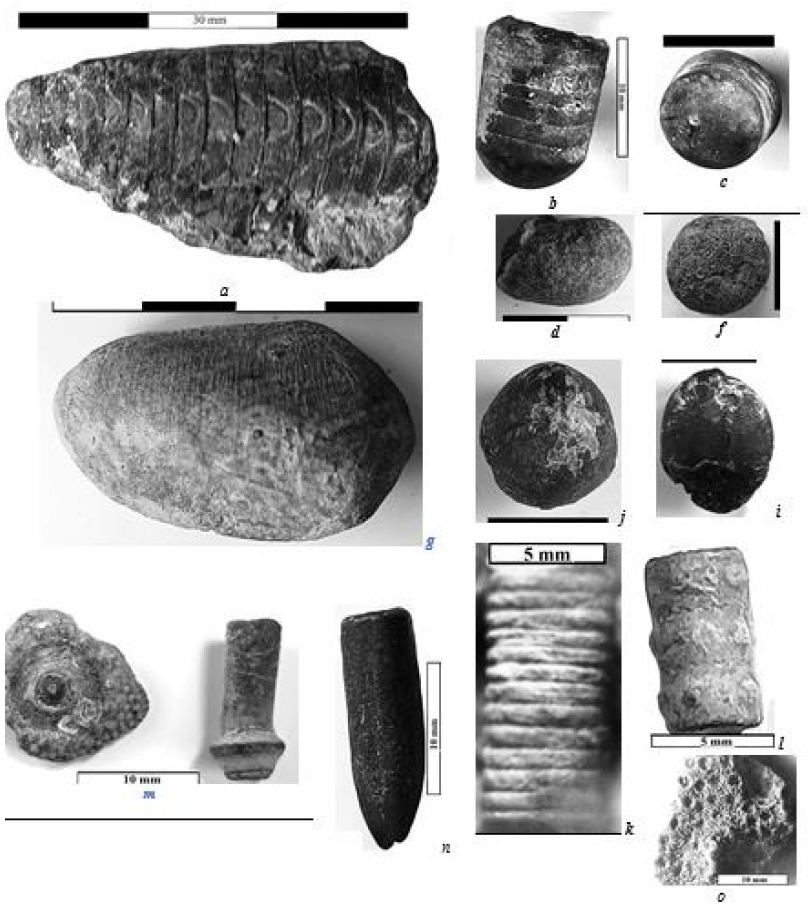
Figure 2: a – Homalonotus roemeri (?) Richt.R.F.; b, c – Cephalopoda gen. et sp. ind.; d, f – Stromatopora sp. ind.; g – Grammmysia (?) sp.; j, i – Dualina nigra Barr.; k – Scyphocrinites elegans Zenk.; l – Podoliocrinus nikiforovae Yelt. (a-l – Upper part of Lokhkiv Stage, Mytkiv Formation); m – Cydaris sp.; n – Actiocamax sp.; o – Stylina sp. (m-o – Cretaceous). Outcrop on banks of Nichlava River, Verkhniakivtsy Village near Borschiv Town), Scale bar calibrated in 10 mm intervals and 5 mm.
Devonian deposits distributed in Ukraine on the western slope of the Ukrainian Shield. In the Middle Transdniester Region, these rocks include limestone, marls, and mostly argillites. The deposits join in Tiverian Regiostage that includes three Formations (Borschiv, Chortkiv and Ivane). The sections include a rich fossil assemblage although preservation are not very good in some cases due to influence of waves and crystallization. Nevertheless, described different fossils: crinoids [11], brachiopods [2]; Nikiforova, 1954) graptolites [12], trilobites (Balashova, 1968), ostracods [13,14], conodonts [6,7], corals Acmophyllum armatum Syt. [15], gastropods [16-19] and other fossils were found and studied. The Lower Devonian deposits and fossils that actively investigated in Ukraine in the second half of the 20th century support correlation mostly with the Barrandien of Czech Republic and Belgium (Gedinian Stage). The sedimentation during the Lower Devonian and the fossils testify shallow water conditions and warm water with normal salinity. In the Upper part of Lokhcovian sediment sequence indicate slowly shallowing and possibly desalination. Appearance of red colour siltstones and sandstones with remains armoured (shelled) fish suggest a shallowing sea and warmer climate. The injuries in the Early Devonian rhynchonelliform brachiopods Lanceomyonia borealiformis [3] described by Dernov and Grytsenko from outcrop Verkhniakivtsy Lokhcovian Stage of Lower Devonian [3]. A total biostratigraphic analysis of the Lower Devonian deposits in Ukraine [10].
Conclusion
The relatively large thickness of the Lower Devonian deposits provides evidence of an active regressive tectonic regime due compensation of dipping by a sedimentation. In lower part of Lower Devonian, the rocks represented mostly by the mudstones (argillites) with thin and interbeds of limestone/ without unconformities and conglomerates – evidence of slow and continuous accumulation of sediments and shoreline migration. The relative depth open sea beginning of Devonian proves by graptolite finds. Nevertheless, upper part relatively shallow water and wave activity indicated by that locality in the rolling of remains in upper parts of the Borschiv Formation of Podillia (Figure 2g, k, l). The sea sediments and fossils studded along the western edge of the East European platform. Shell injuries prove the presence of predators in this sea basin. The younger fossils indicate transgression of Cretaceous sea.
Acknowledgement
We would like to thank the reviewers; whose comments and suggestions improved the quality of the final version of the manuscript. This study was funded by the National Museum of Natural History, National Academy of Sciences of Ukraine (No. 0122U000429).
References
- Grytsenko VP, Furmanchuk G Yo (2024) New finds of fossil during expedition in August of 2024 (Podillia, Ukraine).
- Kozlowski R (1929) Les Brachiopodes gothlandiens de la Podolie Paleontologia Polonica 1: 1-254.
- Dernov Vitaly, Grytsenko Volodymyr (2025) Shell injuries in the Early Devonian rhynchonelliform brachiopods Lanceomyonia borealiformis (Siemiradzki, 1906) from Podillia, western Ukraine. Acta Palaeontologica Romaniae 21: 59-67.
- Grytsenko VP (2016) Geological diversity of Vendian-Lower Devonian of Podillia. The problems of Geology Phanerozoic of Ukraine. – Lviv 2016.
- Grytsenko V, Istchenko A, Konstantinenko L, Tsegelnjuk P (1999) Animal and plant communities of Podolia: Paleocommunities: A case study from the Silurian and Lower (Ed. A. Boucot et J.A.B. Lawson). New York, Cambridge University Press. Pg: 462-487.
- Drygant DM (1971) Conodontovye zony asnalogov Ludlowskogo i Gedinskogo yarusov v In: Granitsa Silura i Devona i biostratigrafia Silura. Trudy III Mezhdunarodnogo symposiuma. I: 85-89 (in Russian).
- Drygant DM (2010) The conodonts of Devonian Southern-Western outskirt of East-European plateform (Volyno-Podillia, Kyiv: Akademperiodyka NAS of Ukraine: 156 (in Ukrainian).
- Tsegelnjuk PD (1976) Brachiopods and stratigraphy of Lower Paleozoic of Volyn- Kyiv, Naukova dumka: 1–148. (In Russian).
- Tsegelnjuk PD (1981) Stratigraphy Lower Devonian south-west outskirt of Easteuropean Thectonik and Stratigraphy 21: 3-16 (in Russian).
- Konstantinenko LI., Kotliar O Yu (2013) Part 6. Devonian System. In Stratigraphy of Upper Proterozoic, Paleozoic and Mesozoic of Ukraine (Gozhyk, P.F., ed.): 200-207. (In Ukrainian).
- Yeltyschewa RS (1968) Krinoidei Skalskogo i Borschovskogo gorizontov Podolii). V Siluriysko-devonskaya fauna Podolii [Crinoids from the Skalski and Borschovski horizons of Podolia. In: Silurian-Devonian fauna of Podolia]. Izdatel’stvo Leningradskogo Universiteta. Pg: 30-50. pl. 1-5. (In Russian).
- Graptolites and stratigraphy (1976) Kalio D, Koren T (eds), Academy of Sciences of Estonian Institute of Geology 1-256 (in Russian).
- Krandievski VS (1963) Fauna ostracod Silurijskikh vadkladiv Podillia. Kyiv, Naukova 1-149. (In Ukrainian).
- Abushik AF (1971) Ostracodes from the basic section of the Silurian – Lower Debvonian of In: Paleozojskie ostracody iz opornykh razrezov evropejskoj chaste SSSR. (Ivanova V.A., ed). Pg: 7-133. /Nauka, Moscow (In Russian).
- Sytova VA (1968) Tetracorally Skalskogo i Borschovskogo gorizontov Izd LGU. Pg: 57-71. (In Russian).
- Sytova VA, Balashov ZG, Yeltyschewa RS.,Mironova M.G., Sinitsyna I.N., 1978. Istoria razvitia nekotorykh grupp organizmov v silurijskom bassejne Podolii. Bulletin MOIP, otdel 4: 142-143. (In Russian).
- Baliński A (2012) The brachiopod succession through the Silurian–Devonian boundary beds at Dnistrove, Podolia,Ukraine. Acta Palaeontologica Polonica 57: 897-924.
- Bragin, M, Velikanov BYa, Gavrylenko MM, Goshovsky SV, Gozhyk PF, et al. (2001) Atlas. Geology and minerals of Ukraine. (Galetskyi L.S., ed.), Kyiv, Taki spravy, 1-168 (In Ukrainian).
- Grytsenko VP, Naumenko IeV (2022) Diversity of fossils in the sections of Chortkiv suite (Lochkovian) in Podillia,: Collection of Scientific Works of the Institute of Geological Sciences of the NAS of Ukraine 15: 86-92.