Abstract
The paper combines generative AI (ChatGPT-3.5) with Mind Genomics principles to synthesize different types of situations in which people may barricade themselves. The study focuses on the nature of the barricade, the thoughts of the barricader, the people who may be in danger, the messages to which the barricader may respond positively, and the signals suggesting that the situation is going in the wrong direction. The objective is to incorporate Mind Genomics principles into an easy-to-use program, allowing individuals involved in such social issues to “get up to speed” in managing these situations, with the assistance of a flexible AI-based coach.
Keywords
Mind genomics, Generative AI, Barricade incidents, Hostage negotiation, Crisis response
Introduction
Barricades and hostage situations are serious and dangerous situations that can arise due to various reasons, such as political or social grievances, personal conflicts, mental health issues, or criminal intent. Potential risks associated with barricades include physical harm to hostages, escalation of violence, and emotional trauma for all involved. Law enforcement agencies typically respond to barricades by establishing communication, assessing the situation, and negotiating a peaceful resolution. Communication plays a crucial role in resolving barricades peacefully, allowing law enforcement to establish a rapport with hostile individuals or groups, and understand their demands or motivations [1-8].
AI technology can assist law enforcement by analyzing data and providing real-time information. AI can also simulate different scenarios to help them make informed decisions by predicting potential outcomes and suggesting strategic approaches to negotiation and resolution. At the same time, human judgment plays a crucial role in balancing AI technology in resolving barricade situations by providing officers with critical thinking skills needed to interpret AI-generated data, assess the situation, and make informed decisions [9-13].
The Role of Mind Genomics as a Complement to AI
Barricades have long been a symbol of resistance or protest in society, but what exactly goes on in the minds of those who participate in barricading? This is where Mind Genomics comes into play, as it allows us to understand the different mindsets people may have when it comes to barricading. Instead of focusing on the individuals carrying out the act, Mind Genomics helps us delve deeper into the underlying thoughts and motivations behind their actions. Through Mind Genomics, we can identify the various cognitive patterns and belief systems that influence people to barricade. By recognizing such cognitive patterns and belief systems, we can gain a better understanding of the social issues at play. This knowledge can then be used to inform law enforcement agencies on how to approach and handle similar situations in the future [14-18].
By using AI technology to synthesize and simulate the properties of these mindsets, a tool may be created for training and education purposes. The integration of AI with the Mind Genomics platform, BimiLeap.com, synthesizes the possible thoughts of those individuals who engage in barricading. The effort is, of course, simulation since it may not be possible to get into the mind of actual barricaders. As we go through this study, these simulations may provide a guide for communication and further recommendations. This information can be used to develop strategies for conflict resolution and de-escalation, ultimately promoting peace and understanding in society.
The remainder of this paper focuses on a set of simulations for different types of barricades. The simulations were done with the “Idea Coach” feature of BimiLeap.com.
Following the actual simulation efforts, the Mind Genomics program later provides a detailed analysis using critical thinking, which will help in understanding the topics, the different points of view, and even suggest innovations in process.
Asking AI to Deconstruct Situations Where a Person Barricades Themselves in a Building
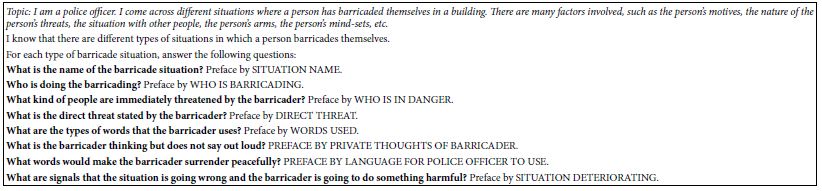
The process begins with instructions to the AI, in the “Idea Coach” feature of BimiLeap.com. Table 1 presents the instructions given to the AI. The instructions themselves are simple and unambiguous. The instructions do not specify the number or nature of the barricade situations, but only the detailed specifics desired from AI for each barricade situation.
Table 1: Instructions to the AI to specify an unknown number of barricade situations.
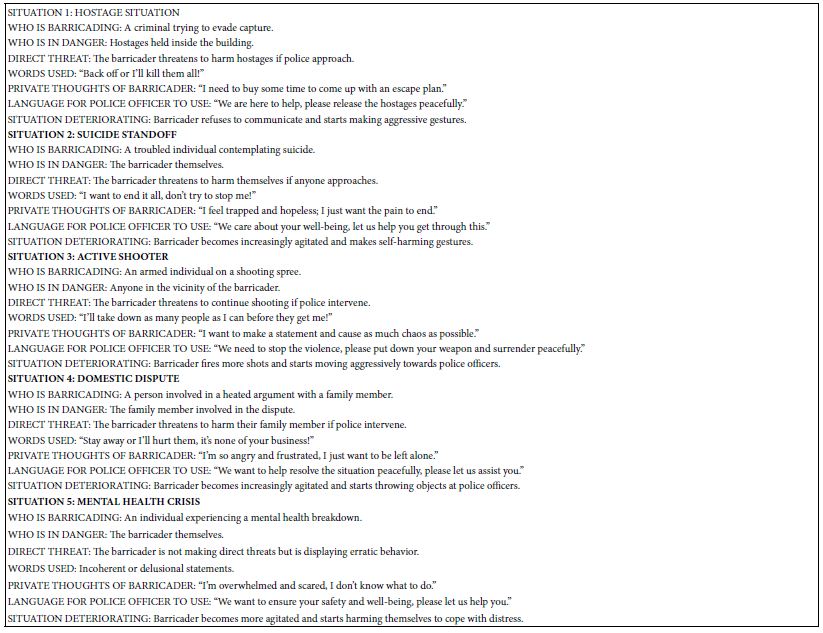
In turn, Table 2 presents the five different barricades suggested by AI. The instructions may be repeated for several iterations, which may result to more than five types of barricades, but at least five will suffice for the purposes of this paper. One important thing to note in Table 2 is the sense of being educated in barricade situations. The reader may acquire a sense of understanding of the situations and possible appropriate responses. Each of the questions in Table 2 could be expanded by asking more than one option for each request, to provide the police officer with a deeper insight on the topic. For example, the reader could request four or five responses to the specific barricader, rather than asking for only one.
Table 2: The five hostage situations suggested by AI.
Moving From Providing Information to Providing Critical Thinking About the Topic
Artificial intelligence can assist in identifying patterns and trends in barricade incidents, enabling law enforcement agencies to make data-driven decisions and predictions.
AI can also analyze various perspectives and data sources to provide insights that may not have been apparent through traditional methods, enhancing overall situational awareness and response strategies.
The program’s critical thinking adds value to the discussion on barricades by providing a deeper understanding of the basic information, themes, and perspectives surrounding the topic (see Table 3). By analyzing patterns and exploring different viewpoints, AI may offer a more comprehensive view of the issue at hand, allowing users to absorb the information in a simplified manner.
Table 3: Critical thinking, part 1 – basics (key ideas, themes, perspectives).
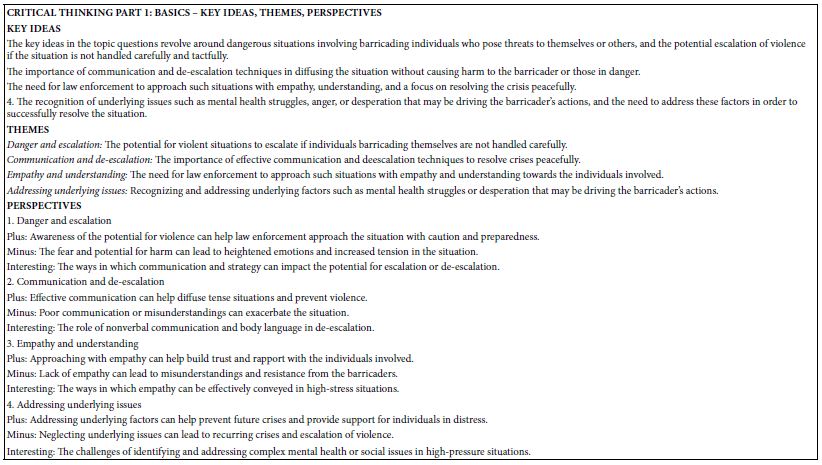
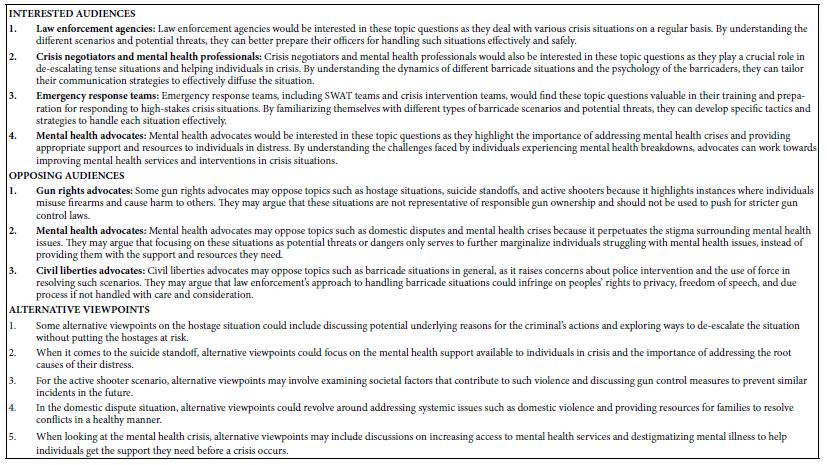
Table 4 continues the process of AI-based critical thinking, which now focuses on the different viewpoints. The analysis is set up with three prompts: interested audiences, opposing audiences, and alternative viewpoints, respectively. Incorporating alternative viewpoints from community members, experts, and stakeholders allows law enforcement agencies to create more inclusive and comprehensive recommendations. Considering different perspectives can help identify blind spots and ensure recommendations are culturally sensitive and responsive to the needs of everyone involved in barricade situations. Recognizing individual reactions to proposed barricade solutions is essential for effective communication and implementation. Law enforcement agencies can anticipate challenges and understand community expectations by considering potential reactions and feedback, allowing them to tailor their approach for better acceptance and compliance.
Table 4: Critical thinking from the point of view of interested audiences, opposing audiences, and alternative viewpoints.
Innovations
AI-generated ideas may provide new perspectives and approaches in law enforcement. Police departments may enhance their tactics by integrating AI suggestions to meet modern policing demands. This ongoing innovation helps law enforcement stay ahead of evolving threats in society, such as barricade situation. This may lead to safer outcomes for law enforcement and those involved in such situations.
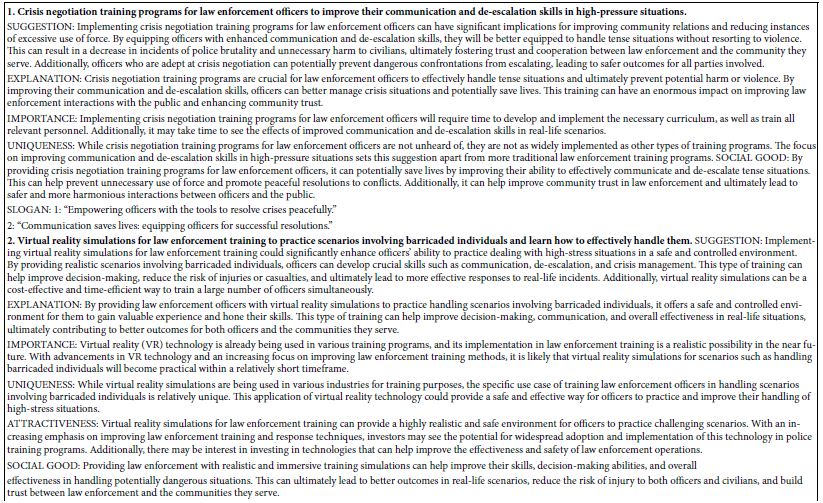
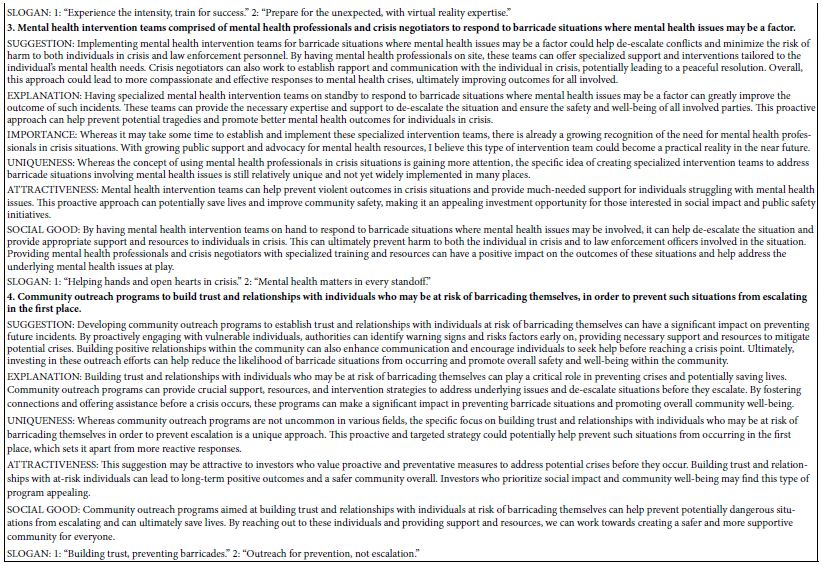
Table 5 shows how AI can generate innovative solutions in process and then apply additional analyses to these solutions. The solutions generated in Table 5 may not be effective but are quickly and efficiently produced in just five minutes. Each iteration may produce 2-5 solutions. Thus, the BimiLeap.com platform can be a source of raw ideas for innovations, which may be polished later [19-21].
Table 5: Deep analysis of four proposed AI-generated process innovations.
Afterward: Looking At Police Confronting Barricades in the Year 2027, After AI and Mind Genomics Thinking Have Been Accepted and Implemented
In 2027, two years after the widespread adoption of BimiLeap.com and Mind Genomics thinking in law enforcement, the landscape of policing has undergone a profound transformation. New police officers entering the force are being trained to use AI tools that provide real-time insights into the mind-sets of individuals involved in barricades. This information allows them to better understand the motivations and behaviors of those they encounter during such situations, leading to more effective and empathic responses. Experienced officers, on the other hand, are adapting their approach to incorporate these new technologies, enhancing their ability to handle barricade situations with greater precision and insight.
As a result of this shift, the relationship between police officers and the community has improved significantly. The use of BimiLeap.com has enhanced transparency and communication between law enforcement and the public, fostering trust and understanding on both sides. This has led to a more collaborative and proactive approach to policing, with a focus on prevention and community engagement, rather than just reacting to incidents.
However, with the increased reliance on AI in law enforcement, ethical considerations must be carefully addressed. Questions of data privacy, bias in algorithms, and the potential for misuse of technology need to be carefully monitored and regulated to ensure responsible and ethical use of these tools. Despite the challenges, the incorporation of Mind Genomics thinking and AI in policing has greatly enhanced the safety and effectiveness of police operations during barricades. By providing officers with valuable insights and guidance, they are better equipped to de-escalate situations, protect the public, and ensure a peaceful resolution to potentially volatile encounters.
The perception of law enforcement has also shifted positively, with the public recognizing the benefits of using AI to support police decision-making. Empathy plays a crucial role in this new approach, as officers are trained to see beyond the surface of a situation and understand the underlying motivations and emotions at play.
Overall, the integration of AI and Mind Genomics thinking has led to a cultural shift in policing, fostering a more data-driven, empathic, and community-oriented approach to law enforcement. As policies and regulations continue to evolve to ensure responsible use of these technologies, the future of policing looks towards a more cohesive and effective response to barricade situations and beyond.
Acknowledgment
The authors gratefully acknowledge the help of Angela A. and Therese D. in the preparation of this and other manuscripts.
References
- Beauregard E, Michaud P (2014) “HIGH-RISK”: a useful tool for improving police decision-making in hostage and barricade incidents. Journal of Police and Criminal Psychology. [crossref]
- Call JA (2008) Psychological consultation in hostage/barricade crisis negotiation. Forensic Psychology and Neuropsychology for Criminal and Civil Cases. [crossref]
- Fuselier GD, Van Zandt CR, Lanceley FJ (1991) Hostage/barricade incidents. FBI Law Enforcement Bulletin. [crossref]
- Michaud P, St-Yves M, Guay JP (2008) Predictive modeling in hostage and barricade incidents. Criminal Justice and Behavior. [crossref]
- Murphy RA (2001) Hostage and barricade incidents: A Profiling perspective. CSU ePress. [crossref]
- Neller DJ, Healy TC, Dao TK, Meyer S, Barefoot DB (2021) Situational predictors of negotiation and violence in hostage and barricade incidents. Criminal Justice and Behavior. [crossref]
- Vecchi GM (2002) Hostage/barricade management: A hidden conflict within law enforcement. FBI Law Enforcement Bulletin. [crossref]
- Vecchi GM (2006) Assessing organizational group conflict in law enforcement hostage/barricade management. Nova Southeastern University. [crossref]
- Blount K (2022) Using artificial intelligence to prevent crime: implications for due process and criminal justice. AI & Society. [crossref]
- Borowsky JP (2011) Responding to threats: A case study of power and influence in a hostage negotiation event. Journal of Police Crisis Negotiations
- Grubb AR, Brown SJ, Hall P, Bowen E (2020) From deployment to debriefing: introducing the D.I.A.M.O.N.D. model of hostage and crisis negotiation. Police Practice and Research. [crossref]
- Hayward KJ, Maas MM (2020) Artificial intelligence and crime: A primer for criminologists. Crime Media Culture: An International Journal. [crossref]
- Nichols J (2014) Negotiating in the 21st century: bridging the gap between technology and hostage negotiation. Journal of Applied Security Research. [crossref]
- Moskowitz H, Kover A, Papajorgji P (2022) Applying mind genomics to social sciences. IGI Global. [crossref]
- Moskowitz H, Wren J, Papajorgji P (2020) Mind genomics and the law. Mauritius: LAP Lambert Academic Publishing. [crossref]
- Ng R, Rayner S (2010) Integrating psychometric and cultural theory approaches to formulate an alternative measure of risk perception. Innovation: The European Journal of Social Science Research. [crossref]
- Papajorgji P, Moskowitz H (2022) The “average person” thinking about radicalization: a mind genomics cartography. Journal of Police and Criminal Psychology. [crossref]
- Ruxho FA (2024) Book review: applying mind genomics to social sciences by P. Papajorgji, A. Kover, and H. Moskowitz. Sustainable Regional Development Scientific Journal. [crossref]
- Lodder AR, Zelznikow J (2005) Developing an online dispute resolution environment: Dialogue tools and negotiation support systems in a three-step model. Harvard Negotiation Law Review. [crossref]
- Magris S (2021) Prevention and Management of Hostages: Psych evolving negotiation strategy (PENS) International Journal of Intelligence and CounterIntelligence. [crossref]
- Kumamoto T, Yoshida Y, Fujima H (2023) Evaluating large language models in ransomware negotiation: A comparative analysis of ChatGPT and Claude. Research Square. [crossref]