Abstract
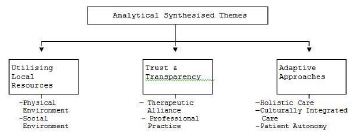
Refugees permanently resettled in high-income countries experience increased rates of psychological distress, yet consistently underutilise statutory mental health services. While existing literature focuses predominantly on structural and cultural barriers, this systematic review synthesises evidence on factors that facilitate service access and ongoing engagement from the direct perspectives of refugees. A search across four electronic databases yielded 12 qualitative studies encompassing 195 refugees and asylum seekers across diverse host nations. Thematic synthesis identified three primary themes: (1) Utilising Local Resources, (2) Trust and Transparency, and (3) Adaptive Approaches. Findings demonstrate that service engagement is maximised when care is embedded within trusted community structures, supported by transparent therapeutic alliances, and tailored through flexible, culturally integrated practices.
Introduction
Over 82 million individuals globally are forcibly displaced, with approximately one million resettled in high-income nations. The compounding impact of pre-migration trauma and post-migration stressors elevates psychological distress among refugees beyond the level of other migrant populations [1,2]. Despite high clinical need, refugees encounter significant system-level and cultural obstacles that impede service utilisation [3,4]. Prior systematic reviews have largely integrated provider perspectives or focused narrowly on structural barriers, inadvertently omitting initial access points and contributing to a deficit-oriented understanding. To address this gap, this review systematically synthesises empirical qualitative literature to identify service-level and social facilitators of mental health access and engagement, centring exclusively on the lived experiences of refugee service users.
Methods
Literature Review and Selection
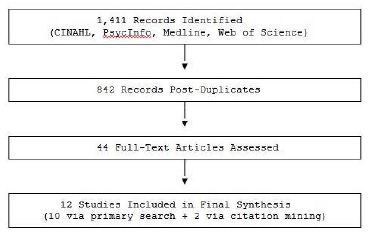
Conducted in accordance with PRISMA guidelines [5], four electronic databases (CINAHL, PsycInfo, Medline, and Web of Science) were searched for peer-reviewed studies published between 2011 and 2022. Search strings combined terms for refugee populations, access/engagement phenomena, and mental health service contexts.
Eligibility Criteria
Quality Appraisal and Data Synthesis
Methodological quality was evaluated using the Critical Appraisal Skills Programme (CASP) qualitative tool [6]. Studies were retained regardless of score due to the limited scope of available literature. Data were extracted and synthesized inductively using Thomas and Harden’s [7] three-stage thematic synthesis approach (line-by-line coding, descriptive theme generation, and analytical synthesis).
Results
Study Characteristics
The 12 included studies represented 195 refugees (103 males, 107 females across single/overlapping cohorts) aged 16–65 from diverse origin regions (Africa, Middle East, South Asia, South America, Eastern Europe). Eight studies were rated high quality and four medium quality via CASP criteria.
Utilising Local Resources
- Physical Environment: Proximity and structural accessibility significantly promoted initial Integrating mental health services within familiar non-clinical hubs (e.g., schools, walk-in community centres) reduced geographical barriers and mitigated fears of institutional stigma associated with major hospital facilities.
- Social Environment: Trusted social networks served as primary mediators. Encouragement, shared positive experiences, and direct navigation assistance from family, community leaders, teachers, and sponsors helped demystify complex Western referral pathways.
Trust and Transparency
- Therapeutic Alliance: Sustained engagement depended on relational authenticity, empathy, active listening, and explicit cultural curiosity from Continuity of care with a single practitioner fostered security comparable to supportive personal networks.
- Professional Practice: Perceived clinical competence and strict adherence to confidentiality were Concerns regarding interpreter discretion within small ethnic communities often hindered disclosure, highlighting the need for transparent boundary enforcement across all care personnel.
Adaptive Approaches
- Holistic Care: Services that concurrently addressed post-migration material stressors (e.g., asylum claim navigation, housing assistance, social welfare support) demonstrated higher retension.
- Culturally Integrated Care: Frameworks accommodating diverse explanatory models of illness—including collaboration with traditional or religious healers—validated client worldviews and enhanced intervention acceptability.
- Patient Autonomy: Flexible session scheduling, adaptable session lengths, and non-prescriptive, collaborative choices regarding trauma disclosure empowered service users and reinforced self-agency.
Discussion
This systematic review confirms that refugee mental health service engagement in high-income resettlement nations is optimized when care models move beyond traditional, clinic-bound paradigms. Facilitators operate ecologically across structural, interpersonal, and methodological domains. Embedding care in local, accessible sites overcomes transportation and bureaucratic barriers, while social networks function as critical bridge-builders [8,9]. Within clinical encounters, relational trust and holistic responsiveness take precedence over specific Western therapeutic modalities. Furthermore, the importance of addressing housing, legal processes, employment, and social integration alongside psychological care supports ecological models of refugee mental health which emphasise the interaction between trauma and post migration stressors Flexibility regarding trauma disclosure aligns with emerging evidence that non-directive, collaborative treatment models best prevent re-traumatisation and support long-term recovery.
Recommendations for Clinical Practice
- Service Architecture: Transition toward community-based, co-located delivery models (e.g., school or community centre based clinics) with walk-in capabilities and direct transport assistance.
- Multi-Agency Integration: Establish cross-sector partnerships with social housing, legal assistance, and third-sector organizations to provide comprehensive, non-siloed support.
- Workforce Training: Implement mandatory cultural humility and cross-cultural mental health training for clinicians and professional medical interpreters.
- Community Engagement: Develop “cultural broker” systems and psychoeducational outreach programs to foster health literacy and destigmatize formal care within refugee networks.
References
- Miller KE, Rasmussen A (2010) War exposure, daily stressors, and mental health in conflict and post-conflict settings: Bridging the divide between trauma-focused and psychosocial Social Science & Medicine 70: 7-16. [crossref]
- Silove D, Ventevogel P, Rees S (2017) The contemporary refugee crisis: An overview of mental health World Psychiatry 16: 130-139. [crossref]
- Kirmayer LJ, Narasiah L, Munoz M, Rashid M, Ryder AG, et al. (2011) Common mental health problems in immigrants and refugees: General approach in primary Canadian Medical Association Journal 183: E959-E967. [crossref]
- Satinsky E, Fuhr DC, Woodward A, Sondorp E, Roberts B (2019) Mental health care utilisation and access among refugees and asylum seekers in Europe: A systematic Health Policy 123: 851-863. [crossref]
- Page MJ, McKenzie JE, Bossuyt PM, Boutron I, Hoffmann TC, et al. (2021) The PRISMA 2020 statement: An updated guideline for reporting systematic BMJ 372: n71. [crossref]
- Critical Appraisal Skills Programme (2024) CASP checklist: 10 questions to help you make sense of qualitative research.
- Thomas J, Harden A (2008) Methods for the thematic synthesis of qualitative research in systematic BMC Medical Research Methodology 8: 45. [crossref]
- Colucci E, Minas H, Szwarc J, Guerra C, Paxton G (2015) In or out? Barriers and facilitators to refugee-background young people accessing mental health services. Transcultural Psychiatry 52: 766-790. [crossref]
- Posselt M, McDonald K, Procter N, de Crespigny C, Galletly C (2017) Improving the provision of services to young people from refugee backgrounds with comorbid mental health and substance use problems: Addressing the barriers. BMC Public Health 17: 280.