Abstract
Nutrition is usually presented to clinicians as a technical domain—macronutrients, biomarkers, guidelines—but patients live it as an emotional, cultural, and psychological experience. The same plate of food can represent comfort, guilt, rebellion, reward, or self care, depending on the mind that encounters it. Emotional eating, mindless eating, and conflicted eating are not marginal behaviors; they are central to how people drift from health toward nutritional disease. Yet medical education still treats food as a counseling topic rather than a lived emotional world. At the same time, AI supported training platforms now demonstrate that empathy, communication, and soft skill reasoning can be taught with the same rigor as technical skills. Mind Genomics adds a complementary layer by treating the patient’s inner logic as a measurable system, revealing distinct mind sets that respond differently to the same nutritional message. This paper integrates AI generated patient narratives with Mind Genomics segmentation to illuminate how people think and feel about everyday eating long before diabetes or obesity are diagnosed. The goal is to give clinicians a sharper lens on the emotional landscape of food, so prevention and counseling can begin where patients actually live—inside their daily decisions, habits, and feelings.
Keywords
Mind genomics, Emotional eating, Nutritional psychology, Artificial intelligence, Patient communication
Abbreviations
AI: Artificial Intelligence; OLS: Ordinary Least Squares
Introduction
Medical education increasingly recognizes nutrition as a major determinant of health, yet structured nutrition training remains limited in many medical curricula. Professional organizations have emphasized the need for longitudinal nutrition education in order to strengthen physicians’ ability to address diet-related disease and provide effective counseling [1,2]. Despite these efforts, nutrition is still often taught primarily as a technical domain of macronutrients, biomarkers, and dietary guidelines rather than as a lived behavioral and psychological experience.
Parallel to these developments, research in nutritional psychiatry and nutritional psychology has demonstrated that dietary patterns interact closely with mood, cognition, and emotional wellbeing. Food therefore functions not only as metabolic fuel but also as a continuous psychological signal embedded in identity, stress regulation, culture, and emotional meaning [3,4]. Individuals rarely approach food neutrally. Emotional eating research shows that people frequently use food to regulate feelings, distract themselves from stress, or create temporary comfort, often followed by cycles of guilt or frustration that reinforce unhealthy eating patterns [5,6].
At the same time, artificial intelligence has begun to play an expanding role in healthcare education. AI-supported virtual patient simulations are increasingly used to train communication skills, empathy, and patient-centered reasoning. These systems allow learners to practice clinical conversations, experiment with phrasing and tone, and receive structured feedback on interpersonal skills that are traditionally difficult to teach at scale [7,8].
Mind Genomics provides a complementary framework for understanding how individuals interpret everyday experiences and make behavioral decisions. Rather than studying attitudes through traditional surveys, Mind Genomics experimentally combines small elements of meaning into short narrative vignettes that respondents evaluate. Statistical decomposition of these responses reveals the psychological “drivers” that shape interest, resistance, or indifference toward specific messages [9,10]. In this way, Mind Genomics treats everyday decision-making as an experimentally measurable system.
Understanding these psychological drivers is particularly important in the context of eating behavior. Dietary choices are rarely determined by knowledge alone; they emerge from emotional triggers, habits, identity, convenience, and social context [11]. As a result, two individuals may receive identical nutritional advice yet respond to it in entirely different ways.
The present study focuses on the early stage of the nutritional trajectory—the world of everyday eating before chronic disease such as obesity or diabetes is formally diagnosed. The central premise is that prevention requires understanding the emotional landscape of food as patients actually experience it in daily life. AI provides narrative realism, while Mind Genomics offers experimental structure for exploring how different psychological mindsets interpret the same eating situations. Together, these approaches create a framework for examining how patients think and feel about food long before disease becomes clinically visible.
Materials and Methods
This study applies the Mind Genomics experimental framework to explore the emotional meanings associated with everyday eating. Mind Genomics treats everyday decision-making as an experimentally measurable system by decomposing complex experiences into smaller elements of meaning that can be systematically tested [9].
The study begins by identifying a set of micro-elements—short statements representing different ways individuals think and feel about food. These elements reflect multiple dimensions of everyday eating, including emotional drivers, situational triggers, identity themes, and practical considerations. In the Mind Genomics design, these elements are typically organized into a structured matrix consisting of four questions with four alternative answers each, yielding sixteen total elements intended to capture a broad range of interpretations related to eating behavior.
The elements are combined into short narrative vignettes. Each vignette contains two to four elements drawn from the full set, arranged according to a systematic experimental design so that each element appears in different combinations across the vignettes. Respondents evaluate a series of these vignettes and rate them according to personal resonance—for example, the degree to which the scenario reflects their own eating behavior or emotional relationship with food.
The ratings are analyzed using ordinary least squares (OLS) regression to estimate the part-worth utility associated with each element. The resulting coefficients reveal which ideas generate strong positive reactions, which provoke rejection, and which have minimal influence on responses. Cluster analysis is then applied to the pattern of coefficients in order to identify distinct psychological segments referred to as mindsets. These mindsets represent different interpretive frameworks through which individuals understand everyday eating situations rather than demographic groupings.
AI systems are used to generate narrative expansions of the experimental elements and to simulate clinician–patient dialogues representing different mindsets. AI-based educational simulations and large language model tools have increasingly been used to support communication training and patient-centered interaction in healthcare education [8,12].
Together, the integration of Mind Genomics segmentation and AI-generated narrative simulation creates a dual-lens system for understanding eating behavior. The quantitative layer identifies psychological drivers of everyday food choices, while the narrative layer illustrates how these drivers may appear in realistic clinical conversations about nutrition and health.
This study represents a conceptual and simulation-based application of the Mind Genomics framework. No real patient data or identifiable human participant information were used in this work. The AI-generated narratives and simulated dialogues are illustrative examples developed for educational and methodological demonstration.
Results
Mindsets Emerging from Everyday Eating
Everyday eating is not a single behavior but a set of psychological operating systems through which individuals interpret food, respond to stress, and understand nutritional advice. When the Mind Genomics framework is conceptually applied to the domain of everyday eating, it suggests that individuals may interpret food-related situations through several distinct psychological orientations.
Based on the structure of the experimental elements and their narrative interpretation, three illustrative mindsets emerge that represent different ways individuals relate to food in daily life. These mindsets are not demographic categories but patterns of meaning that shape how people experience hunger, react to emotional stress, and respond to recommendations about healthy eating.
The three mindsets identified in this framework are:
Mindset 1: The Emotional Eater
Mindset 2: The Convenience Navigator
Mindset 3: The Health-Identity Striver
Each mindset reflects a different internal logic guiding everyday eating behavior. The Emotional Eater experiences food primarily as emotional regulation and comfort. The Convenience Navigator approaches eating as a practical activity shaped by schedule constraints and convenience. In contrast, the Health-Identity Striver views food choices as expressions of discipline, self-control, and personal identity.
To illustrate the differences among these psychological orientations, Table 1 summarizes the defining characteristics of the three mindsets across several behavioral dimensions, including motivations for eating, responses to stress, interpretations of hunger, reactions to nutritional advice, barriers to change, and interpretations of failure.
Table 1: Psychological mindsets in everyday eating identified through the mind genomics framework.
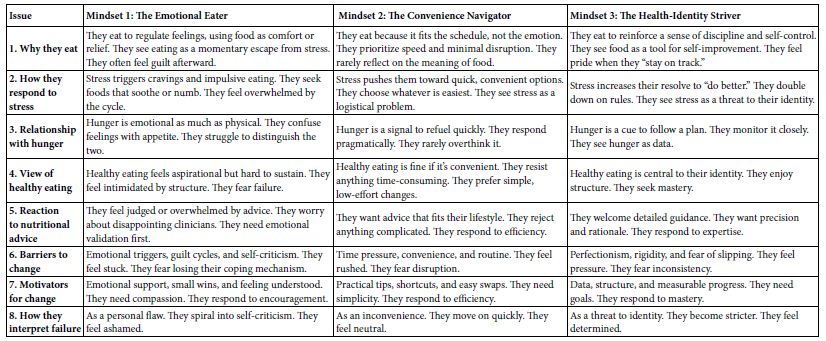
Table 1 demonstrates that individuals who appear similar in demographic terms may interpret food and eating behavior in fundamentally different ways. Recognizing these psychological orientations can help clinicians anticipate how patients might respond to nutritional counseling and tailor communication strategies accordingly.
Fly-on-the-Wall Simulation
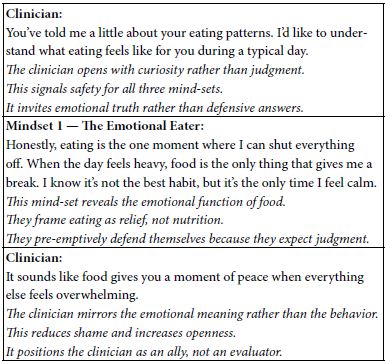
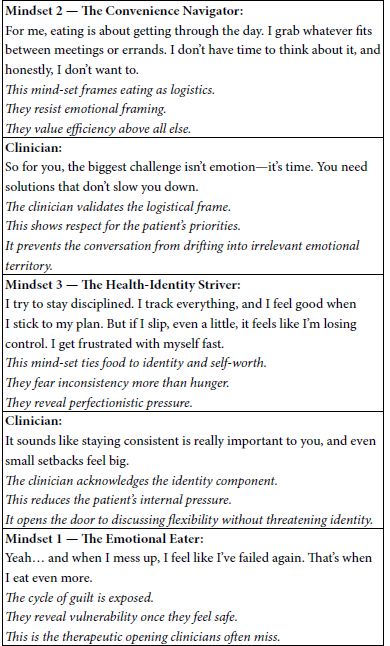
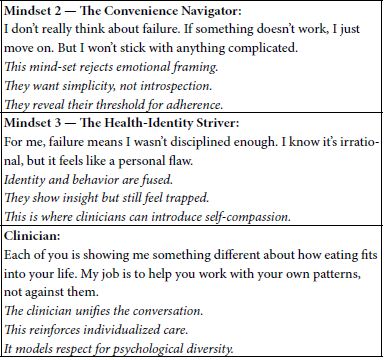
To further illustrate how these mindsets may appear in real-world clinical conversations, a “fly-on-the-wall” simulation was developed using AI-generated dialogue.
In this approach, the reader is positioned as an observer watching an interaction between a clinician and representative patients belonging to different mindsets. The purpose of the simulation is to translate the conceptual psychological segmentation into narrative form, allowing clinicians to observe how different orientations toward food may manifest during patient discussions.
The simulation highlights how the Emotional Eater frames food as emotional comfort, how the Convenience Navigator treats eating as a practical activity shaped by time pressure, and how the Health-Identity Striver interprets food choices as part of a disciplined lifestyle identity. By presenting these contrasting perspectives side by side, the dialogue illustrates how identical nutritional advice may be interpreted differently depending on the patient’s underlying mindset.
Illustrative Clinician–Patient Dialogue
Discussion
The findings from this study show that everyday eating is not a single behavior but a set of emotional, cognitive, and logistical patterns that shape how people move along the nutritional arc. The three mindsets—Emotional Eater, Convenience Navigator, and Health Identity Striver—demonstrate that patients do not hear nutritional advice the same way. Each mindset filters information through its own logic, priorities, and vulnerabilities. When clinicians assume a single “typical patient,” they inadvertently miss the psychological diversity that drives adherence, resistance, or ambivalence. AI and Mind Genomics together provide a structured way to surface these hidden patterns and make them visible, teachable, and clinically actionable.
AI contributes by generating natural-language voices that reflect the emotional logic of each mindset. Recent reviews of generative AI tools have highlighted their growing role in healthcare education, research assistance, and clinical training environments [12]. In this context, simulated patient narratives allow clinicians to rehearse conversations with individuals who think and feel differently about food. The Emotional Eater reveals the role of food as comfort and emotional relief; the Convenience Navigator exposes the logistical pressures that shape everyday eating; and the Health-Identity Striver shows how food choices become expressions of discipline and self-control. These voices are not caricatures. Rather, they are grounded in the conceptual structure of the Mind Genomics framework, ensuring that the AI-generated simulations reflect meaningful psychological patterns rather than generic stereotypes.
Mind Genomics contributes by decomposing the complexity of everyday eating into conceptual elements that represent the different ways individuals interpret food-related situations. It highlights which ideas resonate strongly, which are ignored, and which provoke resistance. This structure allows educators to teach soft-skill reasoning with the same rigor as technical content. Instead of vague advice like “meet patients where they are,” Mind Genomics helps clarify where patients are—what they value, what they fear, and what motivates them. This precision transforms empathy from an intuition into a teachable skill.
The combination of AI and Mind Genomics also addresses a major gap in medical education: the lack of systematic training in the emotional and psychological dimensions of nutrition. Students learn about dietary guidelines, but they rarely learn how patients experience food in daily life. They are taught what patients should do, but not how patients think. By integrating narrative realism with psychological segmentation, this approach gives learners a dual lens: they can see the structure of patient thinking and hear how it sounds in conversation. This dual perspective is essential for building clinical intuition.
Clinicians who understand mindsets can tailor their communication more effectively. Emotional Eaters need validation and emotional support before they can engage with behavioral change. Convenience Navigators need simple, efficient solutions that fit their routines. Health Identity Strivers need structured goals and reassurance that flexibility does not undermine identity. When clinicians match their approach to the patient’s mindset, adherence improves, trust deepens, and nutritional counseling becomes more effective.
This approach also has implications for prevention. Nutritional disease does not begin with biomarkers; it begins with daily decisions shaped by emotion, habit, and identity. By understanding the emotional landscape of everyday eating, clinicians can intervene earlier and more effectively. They can recognize when a patient is drifting toward patterns that increase risk for diabetes or obesity. They can offer support that aligns with the patient’s psychological operating system. Prevention becomes not just a matter of information but of emotional alignment.
Finally, this work demonstrates that AI can play a constructive role in teaching empathy. AI does not replace human connection; it enhances it by giving clinicians repeated exposure to diverse patient voices. Mind Genomics ensures that these voices are grounded in meaningful psychological patterns. Together, they create a new educational instrument—one that is scalable, rigorous, and deeply human. This integration represents a new frontier in medical humanities, where technology supports the development of emotional intelligence, communication skills, and patient-centered care.
Conclusion
Everyday eating is a psychological world that clinicians must understand if they hope to prevent nutritional disease. AI and Mind Genomics together provide a powerful framework for illuminating this world. AI generates realistic patient voices, while Mind Genomics structures the underlying patterns of interpretation. The result is a dual-lens system that makes the emotional landscape of eating visible, teachable, and clinically actionable. This approach transforms empathy from an abstract ideal into a practical skill that can be practiced, refined, and mastered. As medical education evolves, integrating AI-supported narrative simulation with Mind Genomics segmentation offers a promising and scalable new path forward—one that honors the complexity of human behavior and strengthens the clinician’s ability to meet patients where they truly live.
Competing Interests
The authors declare that they have no competing interests.
References
- Aspry KE, Van Horn L, Carson JAS et (2018) Medical Nutrition Education, Training, and Competencies to Advance Guideline-Based Diet Counseling by Physicians A Science Advisory from the American Heart Association. Circulation. [crossref]
- Crowley J, Ball L, Hiddink GJ (2019) Nutrition in medical education a systematic The Lancet Planetary Health. [crossref]
- Adan RAH, van der Beek EM, Buitelaar JK et (2019) Nutritional psychiatry Towards improving mental health by what you eat. Eur Neuropsychopharmacol. [crossref]
- Nutritional Psychology Institute (2024) What is Nutritional Psychology. Nutritional Psychology Institute.
- American Psychological Association (2013) Stress and eating. American Psychological Association.
- Frayn M, Livshits S, Knäuper B (2018) Emotional eating and weight regulation a qualitative study of compensatory behaviors and J Eat Disord. [crossref]
- Gehrman E (2024) How Generative AI Is Transforming Medical Education. Harvard Medicine Magazine.
- Masters K (2019) Artificial intelligence in medical Med Teach
- Moskowitz HR (2012) Mind genomics the experimental inductive science of the ordinary and its application to aspects of food and feeding. Physiol Behav. [crossref]
- Moskowitz HR, Ashman H (2006) Founding a New Science Mind Genomics. J Sens Stud
- Lazarevich I, Irigoyen-Camacho ME, Radilla-Vázquez CC et (2025) Mindful Eating and Its Relationship with Obesity Eating Habits and Emotional Distress in Mexican College Students. Behav Sci Basel. [crossref]
- Sallam M (2023) ChatGPT Utility in Healthcare Education Research and Practice Systematic Review on the Promising Perspectives and Valid Concerns. Healthcare Basel. [crossref]