Abstract
Using AI (ChatGPT 3.5) and Mind Genomics thinking, the paper shows how the medical professional can learn how to understand and converse with patients on topics such as COVID-19. The approach comprises an initial query to AI about the topic, using the Idea Coach feature on BimiLeap.com. The query can be modified and resubmitted, providing the medical professional with a real-time learning tool based on AI. Once the queries and iterations are completed and the program goes offline, the information generated by AI is subject to additional critical thinking by AI. The output comprises key themes, perspectives, analyses of responses of audiences (positive, negative, alternative viewpoints), as well as suggested innovation. The paper proposes the approach as a just-in-time teaching system for the medical professional who needs an understanding of how patients may think about a condition, and how one might communicate with the patient.
Keywords
Artificial Intelligence; medical communication; Mind Genomics; patient interaction
Introduction
Many medical professionals struggle with the job of communicating with patients. This shortcoming in effective interactions with patients can lead to misunderstandings, misinformation, frustration, and ultimately, the loss of trust in the medical professional. Furthermore, poor communication skills can hinder the diagnostic process, as patients may not feel comfortable sharing important information about their health. As a result, it is crucial for medical professionals, especially students, but also new doctors and nurse practitioners to learn how to talk to patients in a clear, empathic, respectful and ultimately productive manner.
One solution to this problem is the integration of artificial intelligence (AI) technology as a colleague and tutor for medical professionals. AI can provide simulated patient interactions for students to practice and improve their communication skills in a safe environment. AI can also provide real-time feedback and suggestions on how to improve communication with patients, helping the medical professional become more confident and effective in their interactions. In addition, AI can serve as a resource for medical professionals to access information on different communication strategies, cultural nuances, and techniques for building rapport with patients. AI can provide personalized guidance based on the individual needs and preferences of each healthcare provider, helping them to tailor their communication style to better meet the needs of their patients. This personalized approach can lead to more positive patient experiences and ultimately, better health outcomes. Furthermore, AI can assist medical professionals in gathering important information about their patients, such as their medical history, treatment preferences, and communication preferences. This information can help medical professionals build stronger relationships with their patients, as they can better understand and address their individual needs and concerns. By using AI technology, medical professionals can enhance their ability to provide patient-centered care and improve overall patient satisfaction.
Using the Mind Genomics Platform as Access Point to AI
The Mind Genomics platform, with its access to ChatGPT 3.5, is designed to help the medical professional communicate effectively with patients, as will be shown in this paper and the companion paper. With the Idea Coach feature of the Mind Genomics platform, BimiLeap. com, the user can request AI to provide different ways to ask patients about how they are feeling, what concerns them, and so forth. The AI returns with language designed to elicit the necessary information from the patient. The exercise helps the medical professional practice their communication skills in a safe and controlled environment. The happy outcome is that the medical professional ends up learning the nature of insightful and empathic questions, the language which shows compassion, and builds rapport with patients.
The topic of this paper is the interaction with the patient regarding COVID-19 (henceforth abbreviated as COVID). The Idea Coach feature provides a variety of alternative questions, explaining the subtleties of the question where relevant. With the Idea Coach feature, the medial professional can input the specific questions they need help with, and the Idea Coach can provide feedback on the wording, tone, and overall effectiveness of their questions. This personalized coaching can help to refine the medical professional’s communication style and help them learn how to ask relevant and sensitive questions about a complex topic like COVID. For example, the Idea Coach could suggest ways to frame questions about COVID symptoms, exposure history, and vaccination status in a clear and non-judgmental manner. It could also provide guidance on how to address patient concerns and convey important information about the virus and preventive measures. Through repeated practice and feedback from AI. With direct, easy to understand feedback, the medical professional would soon become more confident and skilled in communicating effectively with patients about COVID and other health-related topics.
A Worked Example: How AI can Show Ways for the Doctor to Talk to the Patient.
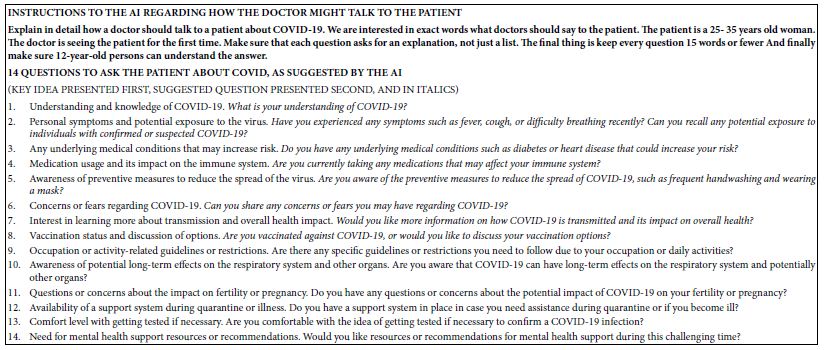
Table 1 presents the instructions to AI (Idea Coach in BimiLeap. com). The instructions or prompts are written in simple English (the program can work in other languages as well). The instructions are straightforward, simple and direct. At the same time, they convey very little information. All that is known is the topic (COVID), the identity of the respondent (woman, age 25-35), and some simple requests about format (questions 15 words or fewer, simple language). The simplicity of writing the prompt to the AI removes the factor of expertise as a necessity. Anyone can write these simple instructions.
Table 1 first shows the “key idea” and then the question corresponding to that key idea. The question itself is shown in italics. The question itself (in italics) was generated immediately upon request in a so-called iteration. The user typed in the request at the top of Table 1, submitted the requests by selecting the proper “box” on the screen, and the 14 questions emerged immediately. This iteration could be repeated if desired. After the iterations were completed, and the BimiLeap.com program shut down by the user, the underlying program reviewed the results of each iteration through “critical thinking”.The first part of the critical thinking was to state the “key idea” of each question. That “key idea” is presented BEFORE the actual question.
Table 1: Instructions to the AI requesting how the doctor should talk to the patient (top), and the critical thinking and related specific questions emerging from AI (bottom).
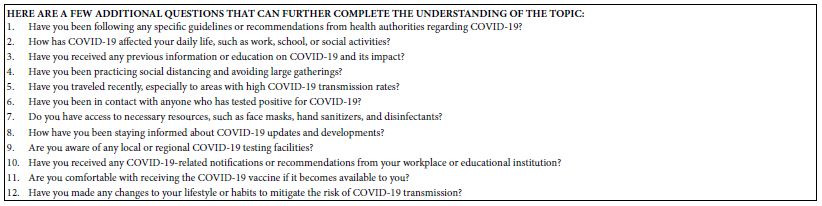
During the “critical thinking” period, where AI analyzes its own work “off-line,” AI often comes up with additional questions that were not presented to the user at the time the iteration was occurring, viz., when the user was interacting with BimiLeap. Table 2 shows 12 additional questions suggested by AI that became available when the results of AI’s off-line analyses were completed. The user receives this additional information in the form of an Excel workbook, called the Idea Book.
Table 2: Twelve additional, relevant questions to ask the patient. These questions were generated as part of the AI’s critical thinking analysis of its own work.
Critical Thinking by AI Regarding the 15 Questions
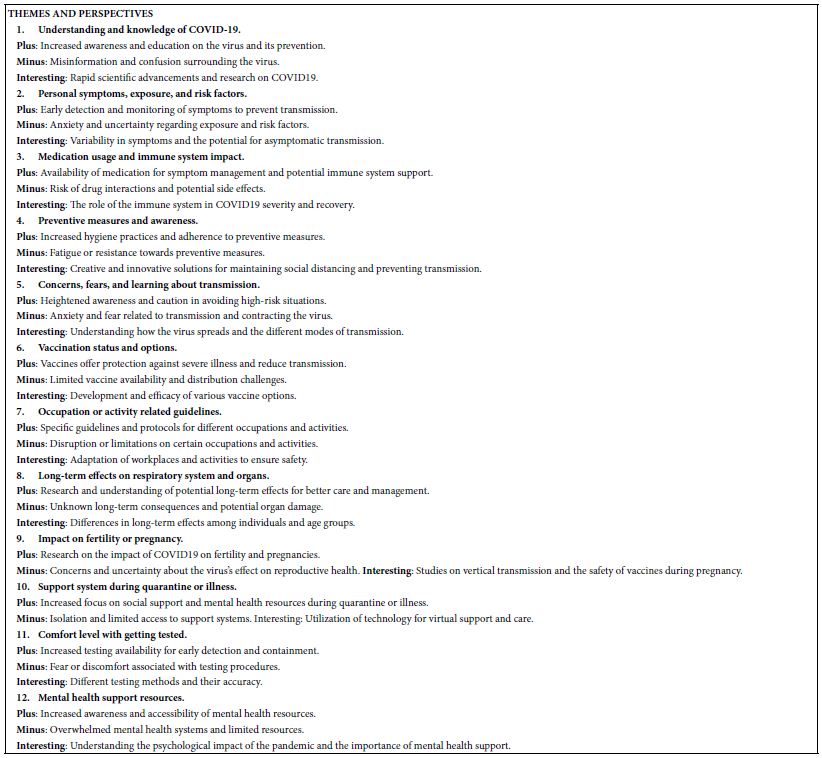
Critical thinking by the Idea Coach feature in BimiLeap is designed to provide deeper insights of a practical nature for the user, insights which teach. Critical thinking begins with the identification of themes and perspectives within the set of questions that the AI had generated. The critical thinking is “built-in.” That is, for every iteration, the critical thinking questions and analyses are done automatically. Thus, for this study, the user actually did eight iterations. We are looking at one iteration. The critical thinking analysis done off- line was done separately for each of the eight iterations, providing a useful compendium of material from which to understand the nature of questions that one could ask. The objective of repeating the critical thinking for each iteration was to create a resource for the medical professional. Table 3 shows the 12 themes and perspectives emerging from the questions. Table 3 goes a bit deeper into the theme, considering different questions that one might ask.
Table 3: Twelve themes and perspectives identified by AI.
AI Suggests Three Audiences: Those Who Accept, Those Who Oppose, and Those Who Think Differently
By hearing different points of view on COVID, medical professionals can learn how each patient reacts and adjust their communication methods accordingly. This helps them handle tough talks and give each patient individualized care. By staying informed about evolving beliefs and attitudes, healthcare providers can identify trends, misconceptions, and misinformation, build trust with patients, and ensure accurate information sharing. Also, seeing things from different points of view prepares the medical professional for possible relationship problems, like language or cultural hurdles. By consistently engaging with diverse viewpoints, medical professionals enhance their ability to dispel myths, address misconceptions, and provide accurate information which resonates with diverse patient experiences.
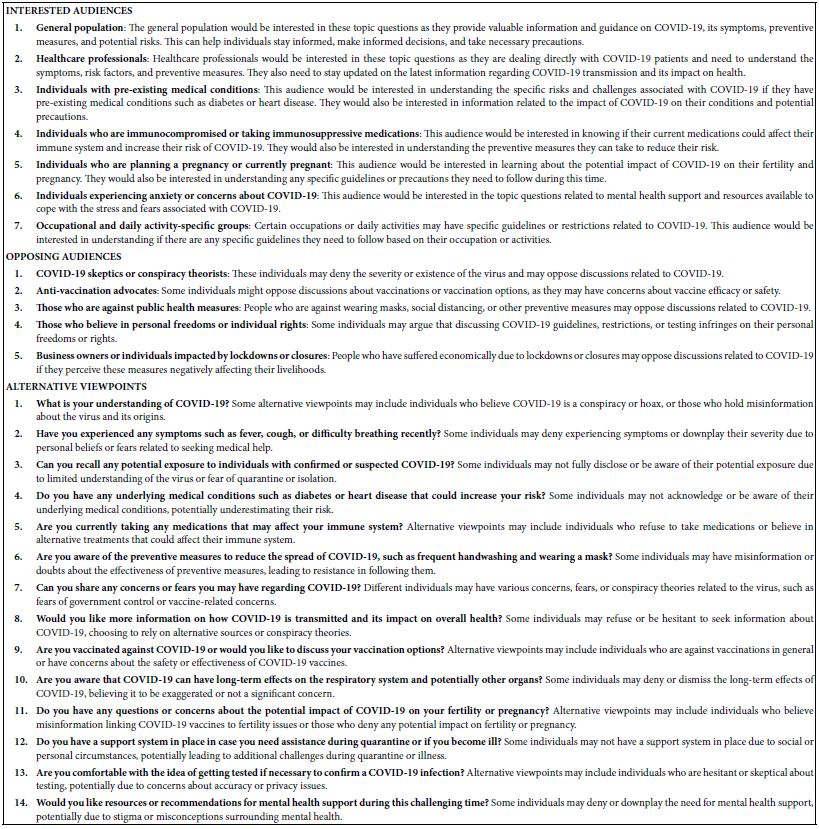
Table 4 presents possible responses by three populations to the issues surrounding COVID. These populations are those who are interested, those who oppose, and those who “think differently,” because the “facts” that they believe to be true are not true according to orthodox medical belief.
Table 4: Responses of three likely audiences; Interested, Opposing, and Alternative Viewpoints.
Innovations
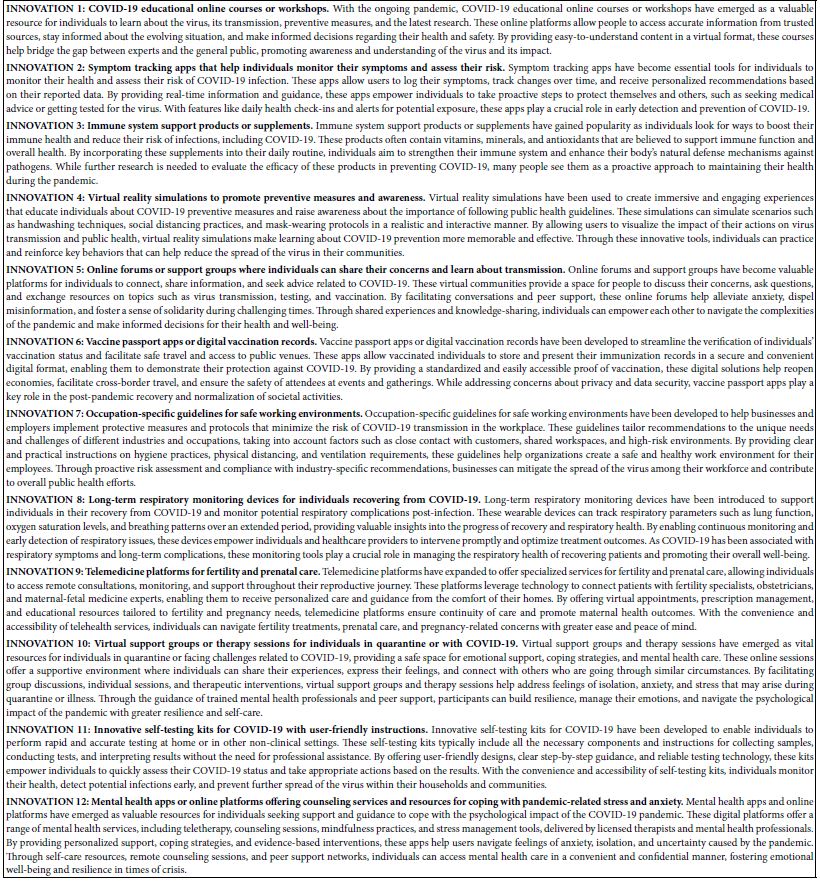
The feature of critical thinking generated by AI in the Mind Genomics platform are suggested innovations. The AI can only go so far, and the innovations may already be in place. Yet, simply having AI suggest these ideas, and then using AI to expand the interest creates a framework where AI becomes a true collaborator. In this spirit, Table 5 presents 12 innovations as AI conceptualizes them at the early stages [1-15].
Table 5: Twelve innovations suggested by AI for the patients and medical professionals dealing with COVID.
Discussion and Conclusions
Using AI as a coworker and teacher for medical workers is important for improving soft skills like knowing how people with COVID think. AI can model conversations with patients to help workers learn how to understand and talk to patients in tough situations. One of the best things about using AI in medical education is that it can figure out the different ways that people may talk to medical professionals when they need help. AI can help the professional understand and adapt to the different needs and communication styles of patients by giving them specific advice and feedback in real time.
Medical workers can learn how to have tough talks and get along with patients by simulating real-life contacts with patients using AI technology. This can help build trust and make patients happier, which can lead to better results in the long run. Moreover, AI can give doctors information about how patients behave and what they like, which lets them adjust how they talk to each patient to best meet their needs. This personalized method can help people talk to each other better and help patients do better. Finally, AI can help doctors learnmore about the mental and emotional parts of patient care, in addition to making it easier for them to talk to each other.
As a whole, incorporating AI into medical education gives students a one-of-a-kind chance to improve their soft skills and talk to patients more clearly. At the same time, with AI technology, medical workers of all types can learn to understand, connect with, and give patient-centered care which meets each patient’s unique needs.
Acknowledgment
The authors gratefully acknowledge the ongoing support and encouragement of Dr. Rizwan Hamid of the Global Healthcare Management Forum in Brooklyn. Dr. Hamid is a continuing source of encouragement for young medical professionals to create a more patient-focused, knowledge-driven healthcare system.
The authors are grateful to Vanessa A. and Angela A. for their ongoing help in preparing these and other manuscripts for publication.
References
- Allen MR, Webb S, Mandvi A, Frieden M, Tai-Seale M, Kallenberg G (2024) Navigating the doctor-patient-AI relationship-a mixed-methods study of physician attitudes toward artificial intelligence in primary care. BMC Primary Care 25(1): 42. [crossref]
- Al-Zyoud W, Oweis T, Al-Thawabih H, Al-Saqqar F, Al-Kazwini A, et al. (2021) The psychological effects of physicians’ communication skills on covid-19 patients. Patient Preference and Adherence: 677-90. [crossref]
- Casini L, Delnevo G, Mirri S, Monti L, Prandi C, Roccetti M, et (2019) What Do Patients Tell Doctors on the Internet? Ask AI How to Valorize Online Medical Conversations. In2019 28th International Conference on Computer Communication and Networks (ICCCN) IEEE.
- Debad SJ, Metcalfe J (2024) DOCTORS AND ARTIFICIAL INTELLIGENCE: WORKING TOGETHER FOR A HEALTHIER FUTURE. SPARK-ing Big Questions: What is the Future of Health Technology? 31: 70.
- Delnevo G, Roccetti M, Mirri S (2018) Modeling patients’ online medical conversations: a granger causality approach. InProceedings of the 2018 IEEE/ACM international conference on connected health: applications, systems and engineering technologies.
- Gopichandran V, Sakthivel K (2021) Doctor-patient communication and trust in doctors during COVID 19 times—A cross sectional study in Chennai, India. Plos One. 16(6): e0253497. [crossref]
- Mehta-Shah, N., S. Mehta, and R. Zemel, in Consumer-based New Product Development for the Food Industry, ed. S. Porretta, H. Moskowitz, and A. Gere,(2021) The Royal Society of Chemistry, 8, pp. 119-131.
- Mendel T, Nov O, Wiesenfeld B (2024) Advice from a doctor or AI? Understanding willingness to disclose information through remote patient monitoring to receive health advice. Proceedings of the ACM on Human-Computer Interaction 8(CSCW2): 1-34.
- Mheidly N, Fares J (2020) Leveraging media and health communication strategies to overcome the COVID-19 infodemic. Journal of Public Health Policy 41(4): 410-20. [crossref]
- Patra M, Hamiduzzaman M, McLaren H, Siddiquee NA (2024) A scoping review of changes to patient-doctor communication during COVID-19. Health Communication. 39(1): 25-48. [crossref]
- Reddy BV, Gupta A (2020) Importance of effective communication during COVID-19 Journal of Family Medicine and Primary Care 9(8): 3793-6. [crossref]
- Theriot A, Urrutia-Alvarez N, McKinley EM (2021) An analysis of pandemic panic buying motivators among undergraduate college students using mind genomics cognitive Psychology 12(9): 1457-71.
- Tripathy AK, Carvalho R, Puthenputhussery A, Chhabhaiya N, Anthony B (2015) MediAssistEdge—Simplifying diagnosis procedure & improving patient doctor In2015 International Conference on Technologies for Sustainable Development (ICTSD) IEEE.
- Wittenberg E, Goldsmith JV, Chen C, Prince-Paul M, Johnson RR (2021) Opportunities to improve COVID-19 provider communication resources: A systematic Patient Education and Counseling 104(3): 438-51. [crossref]
- Yashar-Gershman SG, Rosenberg AT, Sawhney M, Machicao MF, Moskowitz HR, Bernstein HH (2024) Developing a novel screening tool to address pediatric COVID-19 vaccine hesitancy at point of care. Vaccine 42(9): 2260-70. [crossref]